mirror of
https://github.com/coder/coder.git
synced 2026-11-22 03:18:31 +08:00
dependabot/github_actions/github-actions-fe5f304cd8
145
Commits
| Author | SHA1 | Message | Date | |
|---|---|---|---|---|
 Jaayden Halko |
1f1aa6ae3c |
feat: add chat project template schema and queries (#32309)
Adds the database layer for attaching workspace templates to chat projects: the schema, the queries, their authorization, and the audit type. Nothing calls the new queries yet, and the existing create and update handlers pass the new parameters unset. The API, the limit's enforcement, and the agent tools follow in the PRs above. - Attachments live in a `chat_project_templates` table (`project_id`, `template_id`, `created_by`, `created_at`), deleted with the project or the template. `chat_projects` gains `limit_templates` (default `false`), `default_template_id`, `default_template_version_preset_id`, and `default_parameters jsonb`. A project stores a default preset or default parameter values, not both. - `InsertChatProjectTemplates` needs project `update` and `use` on every template. It skips templates that are already attached, and templates outside the project's organization, so an attachment never crosses organizations. `DeleteChatProjectTemplate` needs project `update` and template `read`, and clears the project's default when it detaches the default template. Both checks are in dbauthz. - `GetChatProjectTemplatesByProjectIDs` is authorized through the project, and leaves out deleted, deprecated, and agent-disabled templates. It does not check the caller's access to each template, so callers do that before they expose one. - `UpdateChatProjectByID` changes the template settings only when the request sets them, so an update that omits them cannot write back a stale snapshot. - `AuditableChatProjectTemplates` is the audit form of a project's attached templates, logged as a write to the project. The new `chat_projects` columns are tracked in the project's own audit diff, with the default parameter values masked because they may hold credentials. **NOTE**: the migration adds one table and four columns and changes no existing rows. Existing projects keep unlimited template access. Stack (merge top to bottom): - #32309 👈 - #30754 - #32310 - #30755 - #30756 - #30898 |
||
|
Michael Suchacz
|
d1f308d9f3 |
feat: let organization members turn off organization skills in chats (#31134)
## Stack Organization skills load into every member's Coder Agents chats in their organization, with no way for a member to opt out. This stack adds a per-organization setting that lets members turn them off for their own chats, bottom to top: 1. **#31134** data model, API, and chatd (this PR) 2. #31135 admin and member controls in the dashboard, the `/` menu, and docs ## What changes Organizations get `members_can_disable_skills`, off by default. Users who can update organization skills change it with `PUT /api/experimental/organizations/{organization}/skill-settings`, which writes an organization audit entry. Anyone who can read the organization can `GET` it. While the setting is on, each member saves their own choices with `PATCH /api/experimental/organizations/{organization}/members/{user}/skill-preferences`: `all_skills_disabled` (a master switch that also covers skills created later) and `skills`, a sparse map from skill ID to on or off. `GET` returns the setting, the master switch, and `disabled_skill_ids`. The routes follow the personal-settings rules: without `read_personal` or `update_personal` on that user the caller gets 404, a PATCH while the setting is off gets 403, and a key that is not an organization skill that member can read gets a 400 that names the key. The check runs as the member, not the caller, so an owner or user admin editing someone else's choices is held to that member's skills. Turning the setting off keeps the choices but ignores them. Migration 000636 adds the column and two tables keyed by organization membership. Both cascade when the membership goes away, and the per-skill table also cascades when the skill is deleted, so a recreated skill loads by default. chatd reads the preferences as the chat owner when it builds the skill index and when it loads a body for `read_skill` or for a structured skill invocation (#30861). A skill the member turned off is left out of the index, and both loads report it as not found, including later in a running chat. If the preferences cannot be read, turn preparation fails, as it already does when the skill metadata cannot be read. Older migration tests created organizations with `dbgen.Organization` and `GetDefaultOrganization`, which now select the new column before it exists, so they insert organizations with raw SQL instead. ## Review focus - Authorization in `coderd/organizationskillpreferences.go` and the five new dbauthz methods (`read_personal` and `update_personal` on the user, `organization_skill` update for the setting). - `GetOrganizationSkillMemberPreferencesRow.Excludes` is the one rule chatd applies; #31135 mirrors it in `activeOrganizationSkills`. ## Testing - Go tests cover the queries and cascades, dbauthz, both routes (including the audit diff and each 400 case), and chatd (index, `read_skill`, skill invocations, master switch, a change during a chat). Each new test fails with its code path removed. - Remote dogfood UAT (10 scenarios, real model) passed on the pre-split branch head `186c28d81ab`, which has the same code except the fix below. It found one issue: two spellings of one skill ID with opposite values stored a random result. The PATCH now rejects every aliased key with a 400. A second run on the stack's top head at the time, `718dd6d1bd1`, passed: every aliased form returns 400 and stores nothing, and chats leave out a skill the member turned off, including in `read_skill`. - Polish and the test audit stayed inside the implementation diff. No new dependencies. - Rebased on main as one commit. The migration is now 000636, after main's 000634 and 000635. Every organization skill load passes the chat owner, including main's skill invocation path, so `/skill` invocations honor the opt-out too. The model's skill index leaves out a skill that is not model-invocable or that the member turned off. Apart from that, the diff is unchanged. > Xum, an AI agent, opened this PR for @ibetitsmike and wrote this description. |
||
|
Garrett Delfosse
|
6ebefb8325 |
feat: add chat project sharing API (#30439)
API for chat project sharing (experiment `chat-projects`). Builds on #30479 (merged). Owners share a project with users, groups, or the whole organization (the Everyone group, ID = organization ID). Chats in a shared project stay private. | Role | Project and instructions | Memories | ACL | Delete | |---------|--------------------------|------------|------|--------| | `use` | read | read/write | read | no | | `admin` | read/write | read/write | edit | no | Only the owner, and administrators whose role grants delete, can delete a project. - **API:** `GET`/`PATCH .../chats/projects/{project}/acl`, same shapes as `/chats/{chat}/acl`, plus SDK methods. Project responses include the caller's `permissions` (`update`, `delete`, `share`); the UI hides edit and delete accordingly. - **Listing:** `GET /chats/projects` returns owned and shared projects. Removes `GetChatProjectsByOwnerID`. - **Chat access:** creating a chat in a project, and loading its memory and instructions on each turn, requires the chat owner to own the project or have an ACL grant (`chatd.ChatProjectUsableBy`). Role grants don't count. If the grant is removed, existing chats lose memory and instructions on their next turn. - **Validation:** users and groups must be in the project's organization; keys must be canonical UUIDs; callers can't change their own role; the owner can't be added. Migration `000624` drops a user's grants when they leave the organization, so rejoining doesn't restore access. - **Instructions:** readers who can't edit get 403 instead of 404, and the UI hides editing. - **Agent prompt:** memories are visible to and editable by sharees, so the agent is told not to save secrets or personal details. Known gap: project deletion still detaches chats, and a sharee's open sidebar keeps showing them until reload. #30683 replaces this. Not included: share notifications, `/acl/available`, sharing UI. <details> <summary>Decision log</summary> - `use` grants memory read/write over HTTP, because agents in a sharee's chats can already write memories. Making the agent read-only for sharees was the alternative (@f0ssel chose sharees changing memories through use). - An administrator with `share` can grant themselves access and then use the project. Accepted to keep access control simple (@f0ssel). </details> > Generated by Coder Agents. |
||
|
Jaayden Halko
|
a379c849da |
feat: add project skill queries and authorization (#30826)
Adds the storage and authorization layer for chat project skills. The `skills` table already allows a `project_id` owner (migration 000621); this adds the queries for it and authorizes them through the parent chat project, the same way project instructions work. - New queries in `skills.sql`: insert, get by name, list metadata, update (COALESCE on description, content and enabled), delete, and `GetProjectSkillByIDForUpdate` for the shared update lock. - dbauthz checks `chat_project:read` on the project for reads and `chat_project:update` for writes. `authorizeChatProjectInstructions` became `authorizeChatProjectConfig`, shared by instructions and skills. `Skill.RBACObject()` still denies project rows so nothing reaches them without going through the project. - Audit: new `chat_project_skill` resource type (enum-only migration 000624), `AuditableChatProjectSkill`, and the usual diff/request/table/FriendlyString/AuditFilter wiring. The API that emits these entries comes in the next PR. Stack (merge top to bottom): - #30826 👈 - #30827 - #30838 - #30840 - #30854 - #30855 - #30856 - #30861 - #30880 - #30881 - #30882 - #30884 |
||
|
Asher
|
899d25a5b1 | feat: add byte tracking to ssh and pty connections (#30389) | ||
|
Steven Masley
|
f25b6294b6 |
feat: set workspace secrets on workspace builds (#30250)
Lets clients set secrets when creating a workspace or a build. Secrets are saved with the build and are never sent to the provisioner. Part of [RELAY-7](https://linear.app/codercom/issue/RELAY-7/agent-relay-deliver-provider-credentials-via-coder-secrets-instead-of). **Stack** (design decisions in #30248) 1. #30248 Database schema, queries, and RBAC 2. #30249 Encryption at rest 3. **#30250 Set secrets on workspace builds (this PR)** 4. #30251 Deliver secrets to the agent 5. #30252 Docs 6. #30388 List a build's secrets 7. #30459 Audit a build's secrets - `secrets` is a new field on the create workspace and create build requests. - Each secret is delivered as an env var, a file, or both. `ephemeral` secrets last for one build only. - Secrets carry forward to every later build until a request replaces or removes them. - A secret set on another secret's env var or file path replaces that secret entirely. - A null `value` removes a secret, which needs `update` permission on the owner's workspace secrets. - Deleting a workspace clears its secret values. Secrets are stored but not delivered to the agent until #30251. <details> <summary>Example request</summary> ```json POST /api/v2/workspaces/{workspace}/builds { "transition": "start", "secrets": [ { "name": "openai-key", "value": "sk-...", "env_name": "OPENAI_API_KEY" }, { "name": "kubeconfig", "value": "apiVersion: v1 ...", "file_path": "~/.kube/config" }, { "name": "session-jwt", "value": "eyJ...", "env_name": "SESSION_JWT", "ephemeral": true }, { "name": "old-token", "value": null } ] } ``` </details> <details> <summary>Implementation details</summary> - Validation reuses the user secret field rules and the file path delivery policy. It rejects: - duplicate names, env names, or file paths within one request - a removal that also sets a target or `ephemeral` - In the build transaction, the builder: 1. copies the previous build's live, non-ephemeral secrets that the request does not name or take over 2. inserts the requested secrets 3. "Earlier builds' rows are cleared when the new build's job completes - Copying and clearing run as `AsWorkspaceSecretManager`, so autostart and other system-initiated builds work without secret permissions. Requested secrets are authorized as the build's actor. - Each row records `source` (`request` or `carry_forward`). - Per-build limit violations return a 400. - A completed delete in `provisionerdserver`, or an orphan delete in the builder, clears the workspace's values and keeps the rows. </details> --- *Created by Coder Agents on behalf of @Emyrk.* |
||
|
Steven Masley
|
7aef110ca2 |
feat: add workspace secrets table, queries, and RBAC (#30248)
Adds the database table, queries, and permissions for workspace secrets: secrets set on a workspace build and delivered to the agent, never to Terraform. Each secret belongs to one workspace build. A new build copies the previous build's secrets, then the old copies lose their values but stay as history. |
||
|
Garrett Delfosse
|
2b9fad8bba |
feat: add chat project sharing database layer (#30479)
Database and authorization layer for chat project sharing (experiment `chat-projects`), part 1 of 2. #30439 adds the API on top of it. Nothing here changes behavior: projects start with empty ACLs, no endpoint writes them yet, and deleting a project still detaches its chats. Project deletion is in #30683. - **Schema:** migration `000621` adds `user_acl` and `group_acl` jsonb columns to `chat_projects`, typed as `ChatACL` like chats, with GIN indexes. It also adds the `chat_project:share` API key scope. - **Queries:** - `GetChatProjectsOwnedOrSharedWithUserID`: owned projects plus projects with an ACL entry for the user directly, through a group, or through the Everyone group (whose ID is the organization ID). Entries count only for members of the project's organization. Keys match regardless of actions, so dbauthz filters the rows. - `IsChatProjectAccessibleByUserID`: whether a user owns a project or holds a `read` or `*` grant on it, for code running under a system subject. With sharing disabled, dbauthz answers owner-only. - `GetChatProjectByIDForUpdate`: lets the ACL update read, modify, and write in one transaction. - `UpdateChatProjectACLByID`. - **RBAC:** - New `share` action on `chat_project`. dbauthz requires it to update the ACL. - `ChatProject.RBACObject` attaches the project ACL. Memory objects get a derived ACL: project `read` grants memory read, and `read` with `update` grants memory create and delete. Wildcard grants count. Read sharees change memories through their chats' agents, which #30439 gates. Project instructions authorize through the same object, so a `read` grant reads them and an `update` grant edits them. - `--disable-chat-sharing` also covers projects: ACLs are ignored, the ACL update is rejected, and roles deny `chat_project:share`. The help text and chat sharing docs say so. - **Audit:** `user_acl` and `group_acl` changes are tracked. - **Tests:** - Querier tests run the access queries both raw and through dbauthz (owner, direct user, group, Everyone, wildcard grants, a member of another org, grants without read). - RBAC object and memory ACL tests, with an authorizer check, in both sharing modes. - dbauthz cases including the disabled guards, and the `chat_project:share` negation in the roles test. The generated TypeScript changes only add the new scope value. > Generated by Coder Agents. |
||
|
Michael Suchacz
|
db7f5a7703 |
feat: add organization skill API routes (#30610)
## Stack Part of [CODAGT-1341](https://linear.app/codercom/issue/CODAGT-1341/support-organization-level-skills-in-coder-agents). This stack adds organization skills to Coder Agents: admins publish a skill once per organization, share it with groups or members, and chats in that organization load it next to personal and workspace skills. It replaces the 21-PR draft stack #30584 to #30604 with five PRs, bottom to top: 1. #30609 data model: one migration, queries, RBAC and dbauthz 2. **#30610** organization skill API routes and the scope-neutral SDK (this PR) 3. #30611 sharing ACL routes 4. #30612 settings UI: shared skills table, admin page, member section 5. #30613 chats: chatd loading, `/` menu, docs ## What changes This PR adds the organization skill CRUD routes and makes the skill SDK types owner-neutral so personal and organization skills share them. **API contract change (experimental API, personal and organization skills):** skill list and get responses gain `enabled`, and `PATCH .../skills/{skillName}` now takes `{content?, enabled?}`, so `content` is optional and a toggle doesn't resend it. A PATCH with neither field returns 400; `content`, when present, is validated as before. In the SDK, `UserSkill`, `UserSkillMetadata`, `CreateUserSkillRequest` and `UpdateUserSkillRequest` become `Skill`, `SkillMetadata`, `CreateSkillRequest` and `UpdateSkillRequest` (`codersdk/userskills.go` moves to `codersdk/skills.go`), and `UpdateSkillRequest.Content` is now `*string`. The personal client method names are unchanged. The site changes are the handwritten edits that rename forces (`api.ts`, `queries/userSkills.ts`, `testHelpers/skills.ts` and three call sites), with no UI change. Organization routes under `/api/experimental/organizations/{organization}/skills`, not gated by an experiment or license, like the personal ones: - `GET` lists with the caller's own permissions, so admins, the site owner and org auditors see every skill and members see only skills shared with them. `GET /{skillName}` goes through the new `httpmw.ExtractOrganizationSkillParam` and admits only read, so a missing skill and a denied one both return 404. - `POST` checks `create` on the organization before reading the body, then seeds `group_acl` with the Everyone group (whose ID is the organization ID) so a new skill reaches every member until an admin narrows it. The 100-skill cap and a duplicate name return 409. - `PATCH` admits only callers who can read the skill, because its response includes the content; `DELETE` admits callers who can read or delete it. A reader who can't change the skill gets a write-specific 403 from the database wrapper, and everyone else gets 404. PATCH locks the row as system, updates as the caller in the same transaction, and audits the locked row only after the transaction commits. - Audit: `database.AuditableOrganizationSkill` records resource type `organization_skill` with the organization ID; personal skills keep `user_skill`. Personal and organization handlers share one create and update path in `coderd/userskills.go` (`createSkill`, `updateSkill`, and a `skillWriteErrors` table per owner and action). ## Commits The first commit reproduces the reviewed code from the old stack; each later commit is a labeled trim or fix. - `49cb2c84276` feat: add organization skill API routes. Reproduction: every file this commit changes, including the SDK layer's site edits, equals the reviewed old `write-routes` head `aa597100f28`; the rest of the tree differs only by #30609's migration merge and main. - `dc893bc60d6` refactor(coderd): share the skill create and update path across owners (production +164/-188). It keeps the organization create check before the body read, the lock as system then update as caller order, and audit assignment after the transaction. No swagger, `codersdk` or `typesGenerated.ts` change; `make gen` is clean. - `f94925425ef` test(coderd): merge duplicate personal and organization skill tests. `TestSkillsCRUD`, `TestSkillValidationAndConflicts` and `TestSkillAudit` are table-driven over Personal, OrgAdmin and SiteOwner, alongside `TestOrganizationSkillAuditsDeniedWrites` and one `ScopedAPIKeys` subtest; `TestPatchUserSkill` is deleted because none of its blocks were unique. Coverage of `userskills.go`, `organizationskills.go` and `httpmw/organizationskillparam.go` is 101 of 117 blocks before and after, the same block set. - `ad0a7a37504` fix(coderd): require read access to patch an organization skill. The organization PATCH route now admits only `read`, because its response carries the skill's content: a key scoped to `organization_skill:update` without read gets 404, like GET, instead of 200 with the content. Readers without update still get 403, and DELETE is unchanged. `TestOrganizationSkillAccess/ScopedAPIKeys` asserts the 404, that the response has no content, and that the skill is unchanged; against the old route it fails with 200. - `69d00ded0b6` and `f67b79343ec` merge the updated #30609 layer, including main; `69d00ded0b6` resolves a conflict in the personal skills page with main. No other changes of their own. - `18373ffd59e` merges the updated #30609 layer (main at `e7b76872098`) and reapplies the `AuditableOrganizationSkill` entry in `enterprise/audit/table.go` alongside main's new `AuditableChatProjectInstructions` entries. ## Size Production +838/-308, tests +733/-322, generated +801/-274; total +2372/-904. This is above the 500-line reviewer-friendly limit on purpose: Mike asked for 4 to 5 PRs instead of the 21 small ones this stack replaces. ## Replaces #30587 (scope-neutral SDK and personal enabled state), #30588 (read routes), #30589 (write routes and audit). ## Validation - The coverage comparison above, before and after the test merge. - `make gen` leaves no diff after the shared create and update refactor. - On `18373ffd59e`: `make gen` is clean; build, vet, the `coderd` and `enterprise/coderd` skill tests, `rbac`, `httpmw`, `dbauthz` and `enterprise/audit` pass; `pnpm check`, `pnpm lint` and `make pre-commit` pass. - Remote UAT round 7 through Coder Agents passed on the whole stack; see #30613's Validation for scope and findings. > Xum opened this PR on behalf of @ibetitsmike. |
||
|
Michael Suchacz
|
b67587c875 |
feat: add the organization skills data model (#30609)
## Stack Part of [CODAGT-1341](https://linear.app/codercom/issue/CODAGT-1341/support-organization-level-skills-in-coder-agents). This stack adds organization skills to Coder Agents: admins publish a skill once per organization, share it with groups or members, and chats in that organization load it next to personal and workspace skills. It replaces the 21-PR draft stack #30584 to #30604 with five PRs, bottom to top: 1. **#30609** data model: one migration, queries, RBAC and dbauthz (this PR) 2. #30610 organization skill API routes and the scope-neutral SDK 3. #30611 sharing ACL routes 4. #30612 settings UI: shared skills table, admin page, member section 5. #30613 chats: chatd loading, `/` menu, docs ## What changes This PR adds the data model and authorization for organization skills. Personal skills keep working unchanged: `git diff origin/main -- codersdk site` shows only generated RBAC and API key scope additions (`apikey_scopes_gen.go`, `rbacresources_gen.go`, `rbacresourcesGenerated.ts`, the RBAC and scope unions in `typesGenerated.ts`) and `codersdk.ResourceTypeOrganizationSkill` with its friendly string. No personal route, SDK type or site component changes, and `coderd/userskills_test.go` changes only by mechanical constant renames. **One migration, `000621_skills`** (please review it closely): - renames `user_skills` to `skills` with its constraints, index and triggers, and recreates the cap function and `delete_deleted_user_resources`, whose PL/pgSQL bodies name the table; - adds `organization_id` and `project_id` (`ON DELETE CASCADE`), `enabled` (default true), and `group_acl` / `user_acl` (`jsonb`, default `{}`), with CHECKs for exactly one owner, ACLs that are JSON objects, and ACLs that stay empty unless an organization owns the row, plus partial unique name indexes per owner kind; - replaces the cap trigger with `enforce_skills_per_owner_limit()`: 100 rows per owner, disabled rows included, locking the owner row `FOR NO KEY UPDATE` so unrelated foreign key checks are not blocked; - adds a `BEFORE DELETE` trigger on `organization_members` that removes a departing member from `user_acl` on that organization's skills, so rejoining doesn't restore a direct grant; - adds the `organization_skill` `resource_type` and `api_key_scope` enum values last; nothing in the migration uses them. The down migration undoes the three old migrations in reverse order: it drops organization and project rows and restores `user_skills`, its names, the cap function and `user_id NOT NULL`. Authorization: a new RBAC resource `organization_skill` (create, read, update, delete, share). Owner and org admin get it; site and org auditors get read; members read only through the skill's ACL, which applies only to members of its organization. `Skill.RBACObject()` returns the organization object with both ACLs; project rows stay denied to everyone. New sqlc queries cover organization insert, get, list (SQL-filtered through `GetAuthorizedOrganizationSkillMetadata` and a `regosql` converter), update and delete, with dbauthz wrappers and the audit table entries. No routes yet. ## Commits The first commit reproduces the reviewed code from the old stack; each later commit is a labeled trim or fix. - `baa3150e3b7` feat: add the organization skills data model. Reproduction: every non-site file this commit changes equals the reviewed old `authz` head `1e16b3004c4`, except that the old stack's migrations 000615, 000616 and 000617 are merged into one migration (then `000615_skills`, now `000621_skills`) with one fixture (`testdata/fixtures/000621_skills.up.sql`) and one migration test (now `testMigration000621Skills`). At that commit, `dump.sql` was byte-identical to the old head's. - `1b84e83463a` test(coderd/database): keep only the SQL paths of the org skill matrix. `TestOrganizationSkillAuthorization` becomes `TestOrganizationSkillQueries` instead of being deleted, because coverage showed it is this PR's only run of the `GetAuthorizedOrganizationSkillMetadata` row scan (80% to 65% without it) and of the organization update and delete queries (100% to 0%). Swapping `group_acl` and `user_acl` in the converter makes `GrantedMember` fail. The removed cases are decided by `TestRolePermissions`, `TestSkillRBACObjectOrganizationACL` and the dbauthz method suite. - `e2931b412e9` test(coderd/database): fold the skill cap cases into existing coverage. The user case is covered by `TestUserSkillLimit` and `TestUserSkillLimitConcurrentCreates`; the organization case folds into `ConcurrentOrganizationInsertsHonorCap`, which now also checks that disabled rows count and another organization is unaffected (mutation checked); the project case stays. - `be62aea9021` test(coderd/rbac): drop `TestOrganizationSkillReadScope`, covered by `TestExternalScopeNames` and the generated scope file. - `0c275ba37de` merges main at `454a2fcc697`, which took 000615 to 000618: it renumbers the migration to 000619 and resolves `dump.sql`, `check_constraint.go` and the generated API docs. `8f2b4b87ee2` merges main at `ad85646164e`, which took 000619: it renumbers the migration to 000620. - `5248d56b64f` merges main at `e7b76872098`, which took 000620 (`000620_audit_chat_project_instructions_resource_type`): it renumbers the migration, fixture and migration test to `000621_skills` (step `Migration000621Skills`, version 621), and resolves `enterprise/audit/table.go` (keeping main's `AuditableChatProjectInstructions` entries and the `Skill` entry), `dump.sql` and `models.go` (the `resource_type` enum gets `chat_project_instructions`, then `organization_skill`) and the regenerated `schemas.md`. The up and down SQL are unchanged by every renumbering. ## Size Production +549/-67, tests +728/-33, generated +881/-314; total +2158/-414. This is above the 500-line reviewer-friendly limit on purpose: Mike asked for 4 to 5 PRs instead of the 21 small ones this stack replaces. ## Replaces #30584 (rename `user_skills` to `skills`), #30585 (skill owners), #30586 (organization skill authorization). ## Validation - Migration test: up keeps the existing personal row and its ID; down restores the `user_skills` names, cap function and `NOT NULL`, and drops organization rows; soft-deleting a user removes their skills after up, after down, and after re-up. - `go test` passed on `be62aea9021`, before the main merges, for `coderd` (skill tests), `coderd/database`, `dbauthz`, `migrations`, `gentest`, `coderd/rbac/...`, `coderd/x/chatd`, `coderd/x/skills`, `enterprise/audit` and `enterprise/coderd`; `make lint/check-scopes` passed; the four personal skills Vitest files pass unchanged. - On `5248d56b64f`: build, vet, `TestMigrate`, `TestMigrationChain`, the `migrations`, `database`, `dbauthz`, `gentest`, `rbac` and `enterprise/audit` packages pass; `make gen` run twice is clean, and `make pre-commit` passes. - Remote UAT round 7 through Coder Agents passed on the whole stack; see #30613's Validation for scope and findings. > Xum opened this PR on behalf of @ibetitsmike. |
||
|
|
97c5260adb |
feat: add chat project instructions API (#30368)
Adds the experimental API for chat project instructions: `GET`, `PUT`,
and `DELETE
/api/experimental/organizations/{organization}/chats/projects/{project}/instructions`,
behind the `chat-projects` experiment.

- `GET` returns 200 with empty instructions and null
`updated_by`/`updated_at` when nothing is set, so clients don't need a
404 path.
- `PUT` requires update access only (the read-back runs under a system
context, so a custom role with update but not read can save). It
sanitizes the text with `SanitizePromptText`. It rejects blank text with
400, pointing the caller to `DELETE`, and rejects text over the chat
prompt byte limit. It records the caller as `updated_by`. The upsert and
the read-back that returns the editor's profile run in one transaction.
- `DELETE` returns 204, including when nothing is set.
- Users without access to the project get 404, like the other project
routes.
- `PUT` and `DELETE` are audited as a new `chat_project_instructions`
resource (`write` and `delete`), with the project as the resource ID and
its name as the target. The diff tracks only the instruction text.
Saving unchanged text and deleting unset instructions are not audited. A
per-project advisory lock serializes reading the previous value with the
write, so concurrent edits produce accurate diffs. Migration `000615`
adds the enum value.

The codersdk client gains `ChatProjectInstructions`,
`UpdateChatProjectInstructions`, and `DeleteChatProjectInstructions`.

**What to scrutinize:** writes are last-writer-wins with no version
precondition, matching the deployment, user, and organization prompt
settings.

**Generated:** `coderd/apidoc/docs.go`, `coderd/apidoc/swagger.json`,
and `docs/reference/api/schemas.md` come from the Swagger annotations;
`site/src/api/typesGenerated.ts` comes from `codersdk`;
`docs/admin/security/audit-logs.md`, `coderd/database/dump.sql`, and
`coderd/database/models.go` come from the audit table and migration.
Together they are about 400 of this PR's lines.

**Validation:** `make gen` leaves no diff. `go test ./coderd -run
TestChatProject` and `go test ./enterprise/coderd -run
TestChatProjectInstructions` pass. `TestChatProjectInstructionsAudit`
checks the audit entries for create, update, and delete, and that no-op
saves and deletes are not audited. It covers unset GET, create, update,
blank and oversized PUT, delete, access denial, and cascade on project
delete.

---

Stack (merge top to bottom). #30377 through #29583 are f0ssel's split of
the original #29583, and this stack sits on #29583:
- #30377 data layer and project dialog (f0ssel)
- #30378 new-chat form locked to a project (f0ssel)
- #30379 project page route (f0ssel)
- #29583 sidebar folders (f0ssel), the base of this stack
- #30291 composer frame
- #30292 project chat list caches
- #30293 project page header
- #30294 project chats list
- #30367 instructions storage and prompt injection
- #30368 instructions API 👈
- #30369 instructions editor dialog
- #30370 instructions Details panel

---------

Co-authored-by: Garrett Delfosse <delfossegarrett@gmail.com>
Co-authored-by: Claude Opus 5.5 (1M context) <noreply@anthropic.com>
|
||
|
Ehab Younes
|
5b060beeb1 |
feat: separate connection log methods from app names (#30466)
Connection logs now record how a connection was made (`connection_method`) separately from which app made it (`app_name`). Storage, the HTTP API, search filters, and the UI move to the new fields. Legacy agent reports and the deprecated `type` field keep working. - Add `connection_method` (`ssh`, `reconnecting_pty`, `workspace_app`, `port_forwarding`, `tunnel`) and optional `app_name` and `app_display_name` to `GET /api/v2/connectionlog`. Deprecate `type` and make it a plain string in the API and the Go SDK. - Add `method:` and repeatable `app:` search filters. `type:` keeps its old results but can't be combined with the new filters. - Replace the Type menu with a Method menu, show the app next to the method in each row, and warn when a filter uses `type:`. - Change the Active SSH connections preset to `method:ssh`, so it also includes SSH sessions from VS Code and JetBrains apps. - Generate `codersdk.ConnectionLogMethod` from the database enum with `typegen dbenums`. - Migration 000617 rewrites `connection_logs` under an ACCESS EXCLUSIVE lock, which takes about 50 seconds for 10 million rows. `vscode` and `jetbrains` rows become `ssh` rows with that app. Rolling back folds apps into the old types and loses per-app names. - Document the new filters and how to replace each `type:` value. Closes #27412 |
||
|
Thomas Kosiewski
|
f923f4a525 |
chore!: remove the chat automations experiment (#30412)
Removes the experimental Chat Automations feature (`chat-automations` experiment) from main. This reverts the 16-PR stack that added it and adds two forward migrations that undo its schema and credential changes.
> [!WARNING]
> **Upgrade consequences**
>
> - **Automation data is deleted.** Migration 000615 drops the `chat_automations` table and deletes every queued message an automation delivered. Chats, their messages and ordinary queued messages stay. Messages lose their automation provenance (`automation_id`, `input_id`).
> - **Automation-only credentials are revoked.** Migration 000616 deletes API keys, OAuth2 codes and OAuth2 tokens whose only scopes (or allow-list entries) were `chat_automation:*`. Mixed credentials keep their other scopes. Custom roles lose their `chat_automation` permissions. OAuth2 apps that allowed only `chat_automation` scopes get the whitespace allowlist that grants nothing, as in 000595.
> - **A coordinated restart is required.** Stop all old replicas before the new version runs the migrations. Old replicas read the dropped table and columns, so a rolling deploy is not supported.
> - **Remove `--chat-max-automations-per-owner` before upgrading.** The flag, the YAML key `chat.maxAutomationsPerOwner` and the env var `CODER_CHAT_MAX_AUTOMATIONS_PER_OWNER` are removed. A deployment that still sets the flag or the YAML key will not start (`unknown flag` / `unknown option`). The env var is ignored. This includes dogfood. No release or tag contains the flag.
> - **Down migrations restore the schema only.** 000616 down and 000615 down recreate the 000611 schema with empty tables. They do not restore deleted automations, webhook secrets, provenance, queued deliveries, revoked credentials, stripped permissions or the deleted experiment rule.
## What is removed
- The `chat-automations` experiment and its stored runtime rule (`experiment_rule:chat-automations`).
- The `--chat-max-automations-per-owner` deployment option.
- The `chat_automation` RBAC resource, its member and chatd grants, and the `chat_automation:*` API key scopes.
- The automation sqlc queries, dbauthz wrappers and audit table entries.
- The management routes under `/api/experimental/organizations/{organization}/chat-automations`, and the webhook route `POST /api/experimental/chat-automations/{automation}/events` with its rate limiter.
- The chatd management service, webhook publish, schedule loop, the `manage_automations` tool, and the chatstate admission seam and queue promotion guard that only automations used.
- The Agents Automations page, editor, nav entry, chat labels, the Manage automations toggle and the API client.
- The `archived:any` chat search value that the automations "View chats" dialog added.
- `docs/ai-coder/agents/automations.md`, its manifest entry, the glossary entry and the related rows.
Reverted PRs: #30085, #30096, #30112, #30117, #30127, #30134, #30160, #30166, #30167, #30171, #30187, #30207, #30214, #30217, #30219, #30220.
## What stays, and why
- Migrations 000609, 000610 and 000611, their fixture, and the #30297 lock fix with `migration000609_test.go` stay unchanged. Deployments such as dogfood already ran them.
- New migration **000615** reverses the schema changes of 000609 and 000611 against the current schema. It uses the same short-wait lock-and-retry block as 000609, and it rebuilds `chats_expanded` from main's current definition minus the two automation columns. New migration **000616** follows the 000595 Tasks removal for credentials and recreates `api_key_scope` without the five `chat_automation:*` values. It keeps the `chat_project_memory:*` values from 000612.
- The `chat_automation` value stays in the `resource_type` enum, and `codersdk.ResourceTypeChatAutomation` stays. Old audit log rows stay readable, as with `task` after the Tasks removal.
- The 000615 delete fires the existing queue-version trigger, so `queue_version` moves to `snapshot_version` for each affected chat. `snapshot_version` is not bumped: the coordinated restart restarts every stream loop from an empty state, and the site does not read the version fields.
- `coderd/x/chatd/ARCHITECTURE.md` drops the sections the stack added and gets back its pre-stack wording, merged with the later main edits to the same file.
## Notes for reviewers
- #30379 (chat project page) merged while this PR was in progress. It passed `manageAutomationsEnabled` in `AgentCreatePage.test.tsx` and listed an `automations` route in `AgentsPageLayout.test.tsx`. Later main commits also added automation props in `ConversationTimeline.test.tsx` and `ConversationTimelineWorkingBlocks.stories.tsx`. This PR removes all of them.
- Remaining `automation` matches under `coderd`, `codersdk`, `enterprise`, `site/src` and `docs` are intended:
- migrations 000609 to 000611, their fixture and `migration000609_test.go`;
- the new 000615 and 000616 migrations and `migration000615_test.go`;
- the `chat_automation` resource type in `dump.sql`, `models.go`, `codersdk/audit.go`, the generated API docs, `swagger.json` and `typesGenerated.ts`;
- unrelated uses of the word "automation" (docs, `chatlabels_test.go`, `ratelimit.go`, `autostop.go`, `subagent_catalog.go`, `WorkspaceSharingSection.tsx`, `AgentChatPage.stories.tsx`).
Remote UAT on an isolated dev deployment passed. It upgraded a populated pre-removal database, then checked chats, queued messages, tokens, the 404 routes, the removed page and nav entry, and the experiments list.
---
_Generated with [`xum`](https://github.com/coder/xum) • Model: `anthropic:claude-opus-5-5` • Thinking: `high`_

|
||
|
Garrett DelfosseandClaude Opus 5.5
|
a08ba6a70c |
feat: add shared project memory API for chats in a project (#29301)
- Experiment, stacked on #29242. UI is in #29583. - Adds **project memory**: `chat_project_memories` rows with a name (lowercase slug, unique per project), a one-line description (150 characters) and a body (8KB). Up to 200 per project, shared by every root chat in the project. Chats outside a project and subagents have no memory. - Memories are immutable: they are created and deleted, never edited. Agent tools are `read_memory`, `save_memory`, `delete_memory` and `consolidate_memory`. Saving an existing name fails and points the agent at `consolidate_memory` to replace it. - **Consolidation is agent-driven, in the turn**, modeled on how Claude Code compacts its memory index when warned it is near its limit. From 160 memories (80%), save results ask the agent to get under 140 (70%) with `consolidate_memory`, choosing what to merge and drop. That tool deletes and saves memories in one transaction under the per-project advisory lock, and rolls back entirely if a delete is missing, a name is taken, or the result exceeds 200. There is no background extraction or consolidation. - **The memory index reaches the model as model-only conversation messages**, not in a tool description or the system prompt. At turn start the chat gets a full `<project-memory-index>` snapshot when its prompt has none (first turn, or after compaction), otherwise a `<project-memory-index-update>` listing only what changed. Tool definitions and the system prompt carry no memory state, so memory writes never invalidate the provider's cached prompt prefix. Writes by other chats, or by this chat mid-turn, reach the model at its next turn. - REST API (create, list, get, delete) under `/api/experimental/organizations/{organization}/chats/projects/{project}/memories`. Memory permissions follow projects onto the `agents-access` role. - **Every memory change is audited** as `ChatProjectMemory` create or delete. REST changes are attributed to the caller. Tool changes (`save_memory`, `delete_memory`, `consolidate_memory`) are attributed to the chat owner, carry the `chat_id`, and record one entry per memory after the change commits, so a rolled-back consolidation records nothing. ### Examples **What the model sees.** The system prompt gets a fixed guidance block with no memory state: ```text <memory> Memory is durable context shared by every chat in the project "platform". Save facts that will matter in future chats: … The memory index is in the conversation: a <project-memory-index> message lists every saved memory, and <project-memory-index-update> messages at the start of later turns list what changed. Changes made during a turn, including your own, appear in the next turn's update. … Memories cannot be edited: replace one that no longer holds with consolidate_memory, or delete it. </memory> ``` On the first turn, after the user's message, the chat gets a model-only row with the full index (hidden in the UI): ```text <project-memory-index> - deploy-day: Deploys happen on Tuesdays - release-owner: Alice owns releases; ping her before tagging </project-memory-index> ``` On a later turn where memories changed, it gets only the difference: ```text <project-memory-index-update> Added or changed: - deploy-day: Deploys happen on Wednesdays (changed 2026-09-30) - staging-url: Staging lives at staging.example.com Removed: - old-ci-notes </project-memory-index-update> ``` Resulting request layout, with the provider's cached prefix unchanged by memory writes: ```text [tools: fixed] [system: fixed <memory> guidance] [turn 1 user] [index snapshot] [assistant/tools …] [turn 2 user] [index update] [assistant …] ``` **Tool calls and results** (produced by the tools in this PR): ```text save_memory {"name":"staging-url","description":"Staging lives at staging.example.com","body":"Staging is https://staging.example.com; deploys from main."} → {"count":3,"saved":"staging-url"} save_memory {"name":"deploy-day", …} // name already exists → error: a memory named "deploy-day" already exists; read it, then replace it with consolidate_memory by deleting "deploy-day" and saving the new version in one call consolidate_memory {"delete":["deploy-day"],"save":[{"name":"deploy-day","description":"Deploys happen on Wednesdays (changed 2026-09-30)","body":"The team deploys every Wednesday since 2026-09-30."}]} → {"count":3,"deleted":["deploy-day"],"saved":["deploy-day"]} read_memory {"name":"deploy-day"} → {"name":"deploy-day","description":"…","body":"…","created_at":"2026-09-30T15:04:05Z","created_by":"alice"} ``` Near and at the cap: ```text save_memory … → {"count":160,"saved":"one-more","warning":"memory is 160/200, approaching the limit. Consolidate it to under 140 memories now with consolidate_memory: merge overlapping memories into one, and drop stale, wrong, or superseded ones."} save_memory … → error: memory is full (200/200); use consolidate_memory to merge overlapping memories and drop stale ones, and include this memory in its save list ``` **REST memory object** (`GET .../chats/projects/{project}/memories`): ```json { "id": "59500000-0000-4000-8000-000000000001", "project_id": "7c0e4a3e-5b1f-4f7d-9a51-2f3c8f6d2b10", "organization_id": "bb640d07-ca8a-4869-b6bc-ae61ebb2fda1", "name": "deploy-day", "description": "Deploys happen on Wednesdays (changed 2026-09-30)", "body": "The team deploys every Wednesday since 2026-09-30.", "created_by": "0ed9befc-4911-4ccf-a8e2-559bf72daa94", "created_by_username": "alice", "created_at": "2026-09-30T15:04:05Z" } ``` Create takes `{"name", "description", "body"}` and answers 409 on a duplicate name or at the cap. <details> <summary>Screenshots (predate the immutable-memory rework; tool output shape has since changed)</summary>    </details> --- Generated with Coder Agents on behalf of @f0ssel. --------- Co-authored-by: Claude Opus 5.5 (1M context) <noreply@anthropic.com> |
||
|
Thomas Kosiewski
|
f55aa6c50d |
feat: add chat automations schema, RBAC resource, and audit entries (#30085)
Adds the storage and authorization pieces for Automations for Coder Agents. No route, SDK request type, or chatd code uses them yet, so nothing is exposed. This is the bottom PR of the Automations stack (RFC step 1). Later PRs add the chatd acceptance seam, management routes, webhooks, and schedules on top of these names and constraints. **Schema** (migrations 000609, 000610) - `chat_automations` table with enums `chat_automation_kind`, `chat_automation_target_mode`, `chat_automation_webhook_use`, and `chat_automation_when_busy`. It includes `created_by_chat_id`, the webhook secret hash and version, the single-use `webhook_consumed_at` marker, the schedule cursor and revision, and `queue_generation`. Named CHECKs enforce the target and kind shapes from the RFC. A composite foreign key keeps `new_chat_model_config_id` in the automation's organization, the same pattern the model override tables use. A trigger (`chat_automations_chat_organization`) keeps `target_chat_id` and `created_by_chat_id` in that organization too. A composite foreign key cannot do that while keeping `ON DELETE SET NULL` on PostgreSQL 13. The trigger validates a reference only on insert or when it changes, so chat deletion can still clear both references. Indexes cover the owner and both chat references for cascades and `SET NULL`. - Provenance columns with partial indexes and no foreign key to `chat_automations`: `automation_id`, `input_id`, `queue_generation` on `chat_queued_messages` (all set or all null), `automation_id` and `input_id` on `chat_messages`, and `chats.automation_id`. `chats_expanded` is recreated to include `automation_id`. - `chat_automation` values for `api_key_scope` and `resource_type`. The down migration is a no-op because enum values cannot be dropped. **Authorization** - New organization-scoped RBAC resource `chat_automation` (create, read, update, delete). The `agents-access` role grants it for the member's own automations. It is excluded from the member role's user-level permissions, so a member without `agents-access` gets nothing. Site owners and organization admins get it through their existing all-permissions lists. The owner-only update, enable, and run rule from the RFC belongs to the management service in a later PR. - The generated scopes stay out of `externalLowLevel`, so API keys gain no user-requestable scopes. - `dbauthz` wrappers for the three queries this PR adds: `InsertChatAutomation`, `GetChatAutomationByID`, and `DeleteChatAutomationByID`. `InsertChatAutomation` also requires update on the target chat, read on the creating chat, and read on the new-chat model config (its user and group ACL). There is also a `dbgen.ChatAutomation` helper. **Audit** - `enterprise/audit/table.go` entries for `ChatAutomation`, with `webhook_secret_hash` and `prompt` marked `ActionSecret`. The prompt is treated as chat content, like chat titles. The schedule cursor, revision, and queue generation are ignored as internal bookkeeping. `Chat.automation_id` is tracked. **Required checks from the ticket** - Migrations apply and roll back: `TestMigrate` and `TestMigrateUpWithFixtures` (new fixture for 000609). Dogfood UAT also applied the migrations on a dev instance, rolled them back, re-applied them, and compared schema dumps. After rollback, the only differences from main were the enum values that cannot be dropped and develop.sh's own `_develop` schema. After re-applying, the only difference from this branch's `dump.sql` was the `_develop` schema. - Secret hash marked secret: `Test_chatAutomationSecretFieldsRedacted` checks the table entries and that an audit diff contains neither the raw hash, its base64 form, nor the prompt text. Also covered: `TestRolePermissions` cases for own, other owner, other organization, and a member without `agents-access`. `TestChatAutomationShapeConstraints` covers the named CHECKs, the cross-organization foreign key and trigger, a cross-organization retarget, and deleting referenced chats. Under `site/`, only generated files changed (`typesGenerated.ts`, `rbacresourcesGenerated.ts`). Closes CODAGT-1207 Part of CODAGT-1135 --- _Generated with [`xum`](https://github.com/coder/xum) • Model: `anthropic:claude-opus-5-5` • Thinking: `high`_ --------- Signed-off-by: Thomas Kosiewski <tk@coder.com> |
||
|
Garrett DelfosseandClaude Opus 5.5
|
7cd1b2040b |
feat: add chat projects API (#29242)
- Experiment, behind `chat-projects` (off by default). First of three stacked PRs: #29301 (memory), #29583 (UI). This PR is API only; the screenshots below are from the UI in #29583. - CRUD under `/api/experimental/organizations/{organization}/chats/projects/{project}`. `GET /api/experimental/chats/projects` lists the caller's projects across all organizations. - `project_id` on chat create and as a chat list filter. A chat joins a project only at creation; there is no move. - Projects are identified by ID. Names are display labels (64 characters, description 1024) with no uniqueness constraint. An optional `icon` URL (usually an emoji image under `/emojis`) is capped at 256 characters and audited. - A user can own at most 100 projects across all organizations; creating another answers 409. Creates count and insert under a per-owner advisory lock so concurrent requests cannot overshoot. - Projects are private to their `owner_id`. Members may only create their own, and a chat can only be bound to a project its owner owns. An unreadable or foreign project on chat create answers 404 so IDs cannot be probed; a project from another organization answers 400. - Permissions ride on the `agents-access` role next to chats (after #30004), so whoever can use Coder Agents can use projects. Owners and org admins reach every project. ### Examples Create a project in an organization: ```http POST /api/experimental/organizations/{organization}/chats/projects {"name": "Platform", "description": "Infra and deploy work", "icon": "/emojis/1f680.png"} ``` ```json { "id": "7c0e4a3e-5b1f-4f7d-9a51-2f3c8f6d2b10", "organization_id": "bb640d07-ca8a-4869-b6bc-ae61ebb2fda1", "owner_id": "0ed9befc-4911-4ccf-a8e2-559bf72daa94", "name": "Platform", "description": "Infra and deploy work", "icon": "/emojis/1f680.png", "created_at": "2026-09-30T15:04:05Z", "updated_at": "2026-09-30T15:04:05Z" } ``` List the caller's projects across organizations with `GET /api/experimental/chats/projects` (an array of the object above). Update with `PATCH .../chats/projects/{project}` and any of `name`, `description`, `icon`; delete with `DELETE`, which detaches its chats. Create a chat in the project, and list only its chats: ```http POST /api/v2/chats {"organization_id": "bb640d07-…", "project_id": "7c0e4a3e-…", "content": [{"type": "text", "text": "Plan the deploy"}]} GET /api/v2/chats?project_id=7c0e4a3e-… ``` At the limit: ```json 409 {"message": "You can have at most 100 chat projects. Delete a project to create another."} ``` <details> <summary>Screenshots (UI from #29583)</summary>   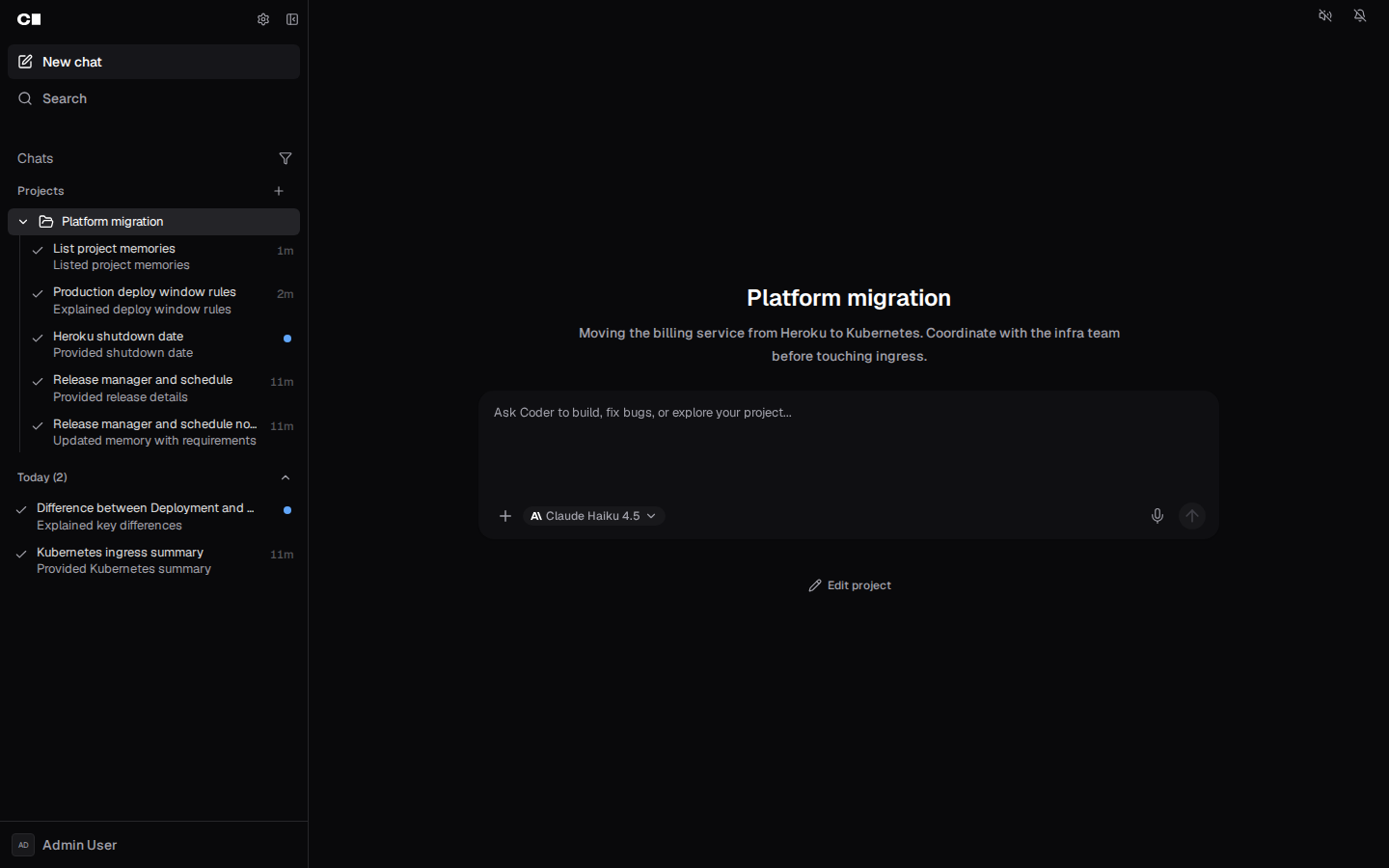   </details> --- Generated with Coder Agents on behalf of @f0ssel. --------- Co-authored-by: Claude Opus 5.5 (1M context) <noreply@anthropic.com> |
||
|
Asher
|
957aefa475 |
feat: add client_session_id to connection_logs table (#29686)
The client session ID is not populated yet; this just adds the ability for agents to send a client session ID with the rest of the connection data, once it gets piped through. |
||
|
Bobby Ho
|
b9e3de8403 |
fix: make redirect_uris the source of truth for OAuth2 redirect URIs (#29440)
Fix OAuth2 callback edits retaining stale redirect URIs - Make `redirect_uris` the sole source of truth, with the first entry as primary and `callback_url` retained as a synchronized, deprecated copy. - Backfill existing apps and unify all writers. Callback-only admin updates now replace the previous primary while preserving alternate URIs. - Share redirect URI validation, reject fragments, and add limits of 32 URIs and 2048 bytes per URI. - Add regression coverage for migration, callback edits, validation, and rejection of removed URIs during authorization and token exchange. One data migration; no schema or request/response shape changes. Admin API and UI list editing follow separately. Rollout: Drain old replicas before upgrading; callback edits handled by old code are not reflected on new replicas. Refs PLAT-619. |
||
|
Michael Suchacz
|
b957e66ccc |
feat!: drop the Coder Tasks tables and queries (#29086)
Drops the `tasks`, `task_workspace_apps` and `task_snapshots` tables, the `tasks_with_status` view and the `task_status` enum, and recreates `workspaces_expanded` without the `tasks` join and `task_id` column. Deletes `queries/tasks.sql` and every wrapper, fixture and test that existed only for those queries (dbauthz, dbmock, dbmetrics, dbfake, dbgen, querier_test), plus the `task_id` projection in `GetWorkspaceAgentAndWorkspaceByAuthToken`. **Breaking change:** migration 000594 deletes all task rows. The down migration restores the schema (tables, constraints, indexes, views), not the data. **Review changes:** the schema-only migration test was removed per review (`TestMigrate/UpDownUp` still exercises the down path), the test file no longer reorders existing tests, and the migration moved from 000593 to 000594. The `dump.sql` reorder is pg_dump dependency ordering: `tasks_with_status` pulled its four workspace tables ahead of it, and without the view they return to alphabetical positions. **Stack context:** Coder Tasks removal stack (CODAGT-642): #28743 frontend → #28788 CLI → #28789 API → #28790 provisioner → #29084 notifications → #29085 build reasons → **#29086 tables** → #28750 permissions. The last four PRs replace the single data-drop migration that used to live in #28750; each carries one concern and its own migration number. > Created by Xum (AI agent) on behalf of @ibetitsmike. ## Delivery record **Decision (2026-09-11 ~14:40Z): merge** through the stack merge endpoint, squash, pinned to head `f1d236a0c82f123b8a0d6878799c227ef9bd5776` (merge SHA appended below once landed). **Independent substantive reviews on this PR (3):** | # | Kind | Reviewed commit | Findings and disposition | Source | |---|---|---|---|---| | 1 | Codex code review (bot), PR opened | `24535f8410` | No findings, no threads | [summary](https://github.com/coder/coder/pull/29086#issuecomment-5583877627) | | 2 | Human review, spikecurtis (COMMENTED) | `24535f8410` | 4 findings: dump.sql reorder question (answered: pg_dump dependency hoisting by `tasks_with_status`); two moved tests (undone, the test file is no longer touched); schema-only migration test (deleted). All resolved. | [review](https://github.com/coder/coder/pull/29086#pullrequestreview-5142045164) | | 3 | Human review, spikecurtis (APPROVED) | `f1d236a0c8` (this head) | Approval on the exact final head | [review](https://github.com/coder/coder/pull/29086#pullrequestreview-5179353695) | The four COMMENTED reviews by @ibetitsmike on `f35688f40b` are thread-reply wrappers and are not counted. **Pre-split history relevant to this diff:** this layer's content lived in the monolithic #28750 until 2026-09-08, which received 10 completed Codex code reviews (2026-08-28 to 2026-09-01) and spikecurtis's CHANGES_REQUESTED review of 2026-09-04 that asked for the split. Counting those, the completed-review total relevant to this diff exceeds the six-review budget, so no further discretionary review or fresh final advisory was commissioned. The usable final recommendation for the final diff is review 3 above: the reviewer who authored every finding on this layer approved the exact head. **Exact-head checks:** `required` SUCCESS in [run 34580949353](https://github.com/coder/coder/actions/runs/34580949353/job/103205933212); rollup 15 success, 8 skipped, 1 failure. The failure is the non-required `Analyze PR for Documentation Updates Needed` job ([103204101137](https://github.com/coder/coder/actions/runs/34580949071/job/103204101137)), caused by the dormant `doc-check-pr-29086` review workspace (CODAGT-1025), not a code finding; GitHub flags only `required` as required for this PR. Merge-ref freshness: `refs/pull/29086/merge` has the exact head as second parent and `25af21b5d5d` (the #29085 squash) as first parent; main has since gained #29231, #28639 and #29218 (12 files, none overlapping this PR). The composed tree (`git merge-tree` of current main and this head) builds (`go build ./...`) and vets (`go vet` on `coderd`, `coderd/database/...`, `coderd/wsrelated/...`) cleanly. Layer diff parity with the previously pushed layer verified by numstat after both GitHub restacks. `gh stack push` did not run the local pre-push suite; CI is the validation evidence. **Deferred:** the dormant doc-check workspace (CODAGT-1025) is outside this PR. Next in the stack, #28750, stays blocked: CHANGES_REQUESTED, its approval and CI predate the restack, and its review budget is exhausted. |
||
|
|
e035967ef1 |
feat: mint access tokens with the negotiated scope (#28237)
**TL;DR** First of PLAT-480, continuing the merged PLAT-479 stack. #28178 decided what the scope is and #28179 reported it; this PR is the one that makes it bind. Until now the scope negotiated at `/oauth2/authorize` was recorded on the grant but never reached the token: every OAuth2 access key was minted with `coder:all`, so a client that asked for `coder:workspaces.access` still got full API access. | PR | What it does | |---|---| | #28167 | `ScopesCover` compares an allowlist against a request by permission coverage rather than by name. Merged. | | #28178 | The authorize endpoint checks the request against the scope catalog, grants it only if the app's filtered allowlist covers it, and persists the result on the code. Merged. | | #28179 | The consent page lists the negotiated permissions, and `invalid_scope` reaches the client's own callback per RFC 6749 §4.1.2.1. Merged. | | **#28237 (this)** | The exchange mints the API key with the stored scope, and the token response states what was granted. | | #28740 | Re-checks the app allowlist at redemption, for a code whose app was narrowed after the code was issued. | | #28751 | Lets a refresh narrow the granted scope, which is the `scope` request parameter this PR still ignores. | - #28179 has merged, so this diff is against main and reviews on its own. - **This is the first PR in the stack where a token's authority actually changes.** Everything before it recorded and reported. That is the blast radius worth reviewing: a grant that negotiated a narrow scope now gets a key that is genuinely narrower, and anything that was quietly relying on `coder:all` will start seeing 403. - Grants that predate the scope columns carry what migration 000569 backfilled, `coder:all`, so they refresh unrestricted and reach what they reached before. Pinned by `BackfilledScopeRefreshesUnrestricted`, seeded the way the migration leaves a row rather than exchanged. - The actor that writes the key stays `rbac.ScopeAll`. Narrowing it to the granted scope would deny `api_key:create` and fail the exchange. The bound lives on `api_keys.scopes`, which dbauthz reads on every request, not on the actor doing the insert. **Where in the flow** <details> <summary>Diagram: where the stored scope turns into a bound on the token</summary> ```mermaid flowchart TD AZ["GET or POST /oauth2/authorize<br/>negotiates the scope and persists it on the code<br/>PR 28178, merged"] AZ --> TK["POST /oauth2/tokens"] TK --> GT{"grant_type"} GT -->|authorization_code| S1["scope read from codes.scope"] GT -->|refresh_token| S2["scope read from tokens.scope<br/>req.Scope is parsed and ignored, PR 28751"] S1 --> CV["scopeStringToAPIKeyScopes, this PR<br/>every name must be in the api_key_scope enum<br/>an empty list is an error, not coder:all"] S2 --> CV CV -->|"unknown name, or empty"| ERR["400 invalid_grant, this PR<br/>error_description names the offending value"] CV -->|mintable| GEN["apikey.Generate with Scopes, this PR<br/>was: no Scopes, so every key defaulted to coder:all"] GEN --> KEY["api_keys.scopes<br/>read by dbauthz on every later request:<br/>this is where the grant becomes a bound"] GEN --> ROW["the new tokens row carries the same scope,<br/>so the next refresh reads back the same grant"] KEY --> RESP["200 with scope in the token response, this PR<br/>RFC 6749 5.1, OAuth 2.1 1.4.1"] ROW --> RESP ``` </details> - Token endpoint only, both grants. Authorize is untouched apart from two comments that said the scope was not yet enforced. - `scopeStringToAPIKeyScopes` turns the stored scope string into `database.APIKeyScopes` for `apikey.Generate`. Names are checked there rather than inside `apikey.Generate`, whose error would surface as a 500 rather than an OAuth2 error. - An empty list is an error, not an unrestricted key. `apikey.Generate` defaults an empty scope list to `coder:all`, so an empty stored scope would silently widen the grant instead of failing it. The same reasoning is why the `expandRBACScope` comment in `modelmethods.go` was stale: that function already errored on an empty list while its comment still promised `rbac.ScopeAll`. - A stored scope outside the `api_key_scope` enum answers 400 `invalid_grant` rather than 500, with the offending name in `error_description`. Not `invalid_scope`: RFC 6749 §5.2 and OAuth 2.1 §3.2.4 both scope that code to what the client requested, and this value is server state the client cannot change by asking differently. The grant is what is unusable, and re-authorizing is the only way out. - Refresh copies the presented token's scope onto both the new API key and the rotated refresh row. `req.Scope` is parsed but ignored; #28751 is where it starts being honoured. - The swagger annotation moves from `oauth2.Token` to `codersdk.OAuth2TokenResponse`, because `oauth2.Token` has no `scope` field to document. - `EveryCatalogNameMintable` pins the catalog against the `api_key_scope` enum. The two are maintained separately, and a name negotiable at authorization but unmintable at exchange would leave a client holding a code it can never redeem. **What it satisfies** Checked against both RFC 6749 and the OAuth 2.1 draft (draft-ietf-oauth-v2-1-15). The 2.1 draft moves the scope-reporting rule from RFC 6749 §5.1 into §1.4.1 and grades it in §3.2.3, but the requirement is the same one. - RFC 6749 §5.1, OAuth 2.1 §1.4.1 — "If the issued access token scope is different from the one requested by the client, the authorization server MUST include the `scope` response parameter in the token response". OAuth 2.1 §3.2.3 grades `scope` as "RECOMMENDED, if identical to the scope requested by the client; otherwise, REQUIRED". Both grants set it unconditionally, which covers both grades. Without it, a client whose request was narrowed against the app's allowlist, or defaulted because it requested nothing, first learns its bounds from an unexplained 403. Pinned by `IssuedTokenBoundsTheAPI`, which requests no scope and asserts the response names what it got. - OAuth 2.1 §1.4.1 — "The authorization server MAY fully or partially ignore the scope requested by the client, based on the authorization server policy or the resource owner's instructions." This is what licenses ignoring `scope` on a refresh, and the licence is conditional on reporting the actual grant. Before this PR the exchange both ignored the request and said nothing, which is the half that was not defensible. - OAuth 2.1 §4.3.1, RFC 6749 §6 — the refresh `scope` parameter is OPTIONAL and "if omitted is treated as equal to the scope originally granted by the resource owner". Exactly what `refreshTokenGrant` does with `dbToken.Scope`. - OAuth 2.1 §4.3.3 — "If a new refresh token is issued, the refresh token scope MUST be identical to that of the refresh token included by the client in the request." Rotation copies `dbToken.Scope` onto the new refresh row. - OAuth 2.1 §3.2.3 — "If refresh tokens are issued, those refresh tokens MUST be bound to the scope and resource servers as consented by the resource owner. This is to prevent privilege escalation by the legitimate client". The refresh row has carried the negotiated scope since #28178; this PR is what makes the access token minted from it carry the same bound. Pinned by `RefreshDoesNotWidenTheScope`. - OAuth 2.1 §1.4.1 — a client that omits `scope` must be met with "a pre-defined default value or fail the request indicating an invalid scope", and the server "SHOULD document its scope requirements and default value". #28178 chose the default; `scopes_supported` and the integration guide document it. Unchanged here, but it is why `IssuedTokenBoundsTheAPI` can request nothing and still receive a bounded token. - Not yet: OAuth 2.1 §4.3.1 also says "The requested scope MUST NOT include any scope not originally granted by the resource owner." A refresh naming a narrower scope is ignored rather than honoured, and one naming a wider scope is ignored rather than rejected with `invalid_scope` (§3.2.4, "exceeds the scope granted by the resource owner"). Neither case widens a token, so there is no escalation, and §1.4.1's MAY plus the `scope` response parameter keep the client correctly informed in the meantime. #28751 is where narrowing lands. Documented under Limitations until then. --- First of three, [PLAT-480](https://linear.app/codercom/issue/PLAT-480). Depends on #28179, which has merged, so this reviews against main. #28178 decided the scope and #28179 reported it. This PR is the one that makes a token feel it. --------- Co-authored-by: Claude Opus 5 <noreply@anthropic.com> Co-authored-by: Steven Masley <Emyrk@users.noreply.github.com> |
||
|
Michael Suchacz
|
a3eb1ee930 |
fix: gate MCP user tokens on owner-scoped personal RBAC (#27945)
Re-gates every `mcp_server_user_tokens` dbauthz method from `rbac.ResourceDeploymentConfig` onto owner-scoped personal actions, mirroring the `external_auth_links` prior art. These are per-user credential rows, not deployment config, and the old gate forced every call site to elevate with `dbauthz.AsSystemRestricted`. ## Summary - Reads gate on `ActionReadPersonal` and writes on `ActionUpdatePersonal` against the token owner (`MCPServerUserToken.RBACObject()` derives from `user_id`). The id-keyed refresh and refresh-failure mutations resolve the owner via a `GetMCPServerUserTokenByID` prefetch inside dbauthz; the mutation queries cannot retarget a row's owner, so there is no fetch-authorize race. - All seven token-path `AsSystemRestricted` elevations in `coderd/mcp.go` and all four in chatd are removed along with their `//nolint:gocritic` markers; handlers use the request actor. - The daemon-wide chatd subject keeps only `ActionReadPersonal` on `ResourceUser`. Background token refresh and failure persistence use a new per-user `AsChatdTokenOwner` subject holding only user-level `ActionUpdatePersonal` scoped to the token owner (both mutations resolve the row via the underlying store, so the subject needs no read grant), and chatd never holds site-wide personal-write access. `TestAsChatd` pins the complete `ResourceUser` action set and `TestMCPServerUserTokensAuth` exercises both subjects against the real authorizer. - New strict-authorizer test (`rbac.NewAuthorizer` against real rows): owner passes get/upsert/delete, a stranger fails, and an org admin of another org fails. No user-visible behavior change. Stacked on #27944. Completes the MCP org-separation stack. Closes https://linear.app/codercom/issue/CODAGT-806 UAT: regression pass on a dogfood instance: OAuth2 connect redirect, member list/status with redaction, self-scoped disconnect (cannot touch another user's token), end-to-end chat MCP tool invocation, and lower-stack audit/ACL smoke checks. > Mux (AI agent) authored this PR on Mike's behalf. <!-- mux-attribution: model=claude-fable-5 thinking=high --> |
||
|
Michael Suchacz
|
7ca7c30f40 |
feat: add group and user ACLs to MCP server configs (#27944)
Adds group and user ACLs to org-scoped MCP server configs so
organizations can restrict specific MCP servers to subsets of members,
mirroring the template ACL pattern.

## Summary

- Migration adds `group_acl`/`user_acl` JSONB columns (nested `{"<id>":
{"permissions": [...]}}` shape) and seeds every existing config with its
organization's Everyone group read entry (the Everyone group ID equals
the org ID), so member access is unchanged by default. Creation seeds
the same entry.
- The blanket org-member read grant from the base PR is replaced by ACL
evaluation: Rego requires org membership for every ACL grant, and
`GetAuthorizedMCPServerConfigs` compiles ACL-aware SQL filters.
- New `ActionShare` (org admins) gates `GET|PATCH
/api/experimental/organizations/{organization}/mcp-servers/{mcpserverconfig}/acl`
(nested under the organization like the rest of the config surface).
PATCH validates principals against the config's organization, merges
sparse updates under a row lock, stamps `updated_by`/`updated_at`, and
is audited as a Write with `Old` captured before authorization. A config
deleted concurrently between the middleware fetch and the locked
re-fetch is concealed as 404, matching the update and delete handlers.
ACL columns are tracked in the audit table.
- ACL management is available in all editions (no enterprise
entitlement), documented in the MCP servers page. Revoking an ACL does
not retro-strip already-selected configs from existing chats; new
selection is blocked at chat create.
- Force On respects the ACL: the forced set is loaded as the chat owner,
so a `force_on` server whose ACL denies the owner never attaches at
create, send, or generation time.
- No rolling-upgrade machinery: upgrades run in scheduled maintenance
downtime, so the migration only backfills existing rows; the API sets
the Everyone read grant explicitly on every insert.

Stacked on #27943. Part of the MCP org-separation stack.

Closes https://linear.app/codercom/issue/CODAGT-712

UAT: verified on a dogfood instance with two members and a custom group:
Everyone-seed default visibility, group grant with Everyone removal
(non-member loses list/fetch/selection), foreign-principal rejection,
non-admin share denial (audited 403 / concealed 404), user_acl restore,
and audited ACL diffs.

> Mux (AI agent) authored this PR on Mike's behalf.

<!-- mux-attribution: model=claude-fable-5 thinking=high -->
|
||
|
Michael SuchaczandMathias Fredriksson
|
443e3b9b80 |
feat!: org-scope MCP server configs with RBAC (#27942)
Moves `mcp_server_configs` from deployment scope to organization scope
so each organization fully controls the MCP servers its members can use
with Coder Agents.

## Summary

- Migration: adds `organization_id` (NOT NULL, FK) and keeps existing
rows as the default organization's originals with credentials intact.
Other organizations start with no MCP servers and configure their own;
nothing is copied across organizations. Chats outside the default
organization keep any now-cross-organization `mcp_server_ids` entries;
the runtime already ignores IDs that do not resolve in the chat's
organization, so no data rewrite is needed. Slug uniqueness becomes
`(organization_id, slug)`.
- RBAC: new org-scoped `ResourceMCPServerConfig` with regosql converter
and `GetAuthorizedMCPServerConfigs`; org admins get in-org CRUD, org
members get read (replaced by ACL evaluation in the follow-up ACL PR in
this stack).
- API: all config routes nest under the organization, matching
templates: `POST|GET
/api/experimental/organizations/{organization}/mcp-servers` and
`GET|PATCH|DELETE .../mcp-servers/{mcpserverconfig}` (plus
`oauth2/connect`), resolved by a read-only param middleware that
conceals read-denied and cross-organization access as 404. Two routes
stay on the frozen `/api/experimental/mcp/servers/{mcpServer}` block:
the OAuth2 callback (the redirect URI baked into existing AS-side client
registrations) and `oauth2/disconnect`, which must remain reachable by
users removed from the organization so they can still revoke their token
grant.
- Chat runtime: selection validation and generation resolve configs
strictly by IDs, enabled state, and the chat's organization in SQL;
requested duplicates are normalized; invalid or cross-org IDs are
rejected with the precise ID list. IDs already persisted on a chat are
exempt from message-time rejection so disabling a selected server never
blocks sends; generation skips servers that are no longer usable.
- Frontend: API layer and admin settings pages target the new endpoints.
The admin page manages the default organization's servers; the org
picker is tracked separately (CODAGT-714).

- Security hardening from review: OAuth user grants are additionally
bound to `oauth2_revocation_url` (changing it invalidates grants, and a
racing OAuth callback gets 409 instead of recreating a grant).
Stack-wide SSRF protection for MCP config-directed traffic was split
into its own PR at the top of this stack (#28242) to keep this diff
reviewable; this PR keeps main's existing discovery IP-range guard.
OAuth2 auto-discovery now completes before the config row is inserted: a
failed discovery persists nothing, and there is no provisional row that
concurrent updates could race against.

Two follow-up PRs in this stack were split out to keep this diff
reviewable: #28064 completes the swagger annotations for the moved
routes (main already ships these experimental MCP handlers unannotated),
and #28065 carries hardening fixes and regression pins on top of the
cutover.

- Force On enforcement (landed on main mid-review) is org-scoped: the
forced set is read per chat organization
(`GetForcedMCPServerConfigsByOrganization`), so another organization's
`force_on` server never attaches to a chat.

## Breaking changes (experimental API)

The MCP server config endpoints move from the deployment-scoped
`/api/experimental/mcp/servers` block to organization-nested paths:
`POST|GET /api/experimental/organizations/{organization}/mcp-servers`
and `GET|PATCH|DELETE
/api/experimental/organizations/{organization}/mcp-servers/{mcpserverconfig}`
(plus `oauth2/connect`). The old paths are removed, so API consumers
must supply an organization. Two routes intentionally stay on the frozen
`/api/experimental/mcp/servers/{mcpServer}` block: the OAuth2 callback
(its redirect URI is baked into existing AS-side client registrations)
and `oauth2/disconnect` (must remain reachable by users removed from the
organization). These endpoints are under `/api/experimental`, so no
deprecation window is provided.

## Rolling upgrades

During a rolling deploy, an old replica creating an MCP config can fail
the new `NOT NULL organization_id` constraint until it is upgraded
(reads are unaffected: old binaries' generated queries select their own
column lists). This matches the repo's existing precedent for additive
NOT NULL migrations (000562) and affects only the admin config-create
path in the upgrade window.

Upgrades are expected to run in scheduled maintenance downtime with the
database locked during migration, so the migration ships no
rolling-upgrade compatibility machinery. The down migration deletes
organization-created configs (their chat references are cleaned by the
000510 delete trigger) and restores deployment-wide slug uniqueness.

Part of the MCP org-separation stack (CODAGT-711 -> CODAGT-717 audit ->
CODAGT-712 ACLs -> CODAGT-806 token RBAC).

Closes https://linear.app/codercom/issue/CODAGT-711

UAT: validated end to end on a two-org dogfood deployment, including a
real pre-migration to post-migration upgrade, cross-org isolation
(404s), same-slug-two-orgs, chat selection gating, and a live MCP tool
call through the org-scoped generation path. The migration was later
revised to keep existing rows in the default organization only (no
per-organization copies); that revision is covered by the migration test
suite.

> Mux (AI agent) authored this PR on Mike's behalf.

<!-- mux-attribution: model=claude-fable-5 thinking=high -->

---------

Co-authored-by: Mathias Fredriksson <mafredri@gmail.com>
|
||
|
Bobby Ho
|
663f41ffa9 |
feat: derive OAuth2 client type from token_endpoint_auth_method (#28043)
Adds an OAuth2 client type (public vs confidential, RFC 7591 §2) derived from the requested auth method instead of hardcoded confidential. The type is stored and guarded here, but no endpoint enforces on it yet; public behavior at the token endpoint follows in the next PR in the stack. - Client type is derived once and reused by both registration and redirect URI validation, so they can't disagree - IsPublic() fails closed: an unrecognized or missing value reads as confidential - RFC 7592 update (PUT) now rejects moving a client between public and confidential (400) instead of silently flipping it when the auth method is omitted - Discovery still doesn't advertise "none"; follows once the token endpoint honors it ### Behavior by client shape `client_type` is derived from `token_endpoint_auth_method` at POST and pinned at PUT. RFC 7592 GET/PUT authenticate with the registration access token, not the client secret, so neither endpoint reads a secret. | Registered with | Stored `client_type` / method | GET reports | PUT that flips the method | |------------------------------------|---------------------------------------|-----------------------|-----------------------------------------| | omitted, or `client_secret_basic` | `confidential` / `client_secret_basic` | `client_secret_basic` | `none` → 400 `invalid_client_metadata` | | `none` (new) | `public` / `none` | `none` | `client_secret_*` → 400 `invalid_client_metadata` | | `none` (before this PR) | `confidential` / `none` | `none` | either → 200, type stays `confidential` | - PUT still replaces every other RFC 7591 field. `client_type` is the only pinned one; the method may move within a type (`client_secret_basic` ↔ `client_secret_post`). - Row 3 is the only shape where the two columns disagree. The guard fires only on a method change that crosses the type line, so those clients keep managing themselves instead of being locked out of their own configuration endpoint. - The token endpoint does not consult `client_type` yet, so every client still authenticates with a secret and registration still issues one. Split out of #27873, second in the stack (on top of #28041). Refs https://linear.app/codercom/issue/ENG-3029/oauth2-support-public-client |
||
|
Susana Ferreira
|
c3895ff9c0 |
feat: add CSV export for AI spend data (#27491)
## Description

Adds `GET /api/v2/organizations/{organization}/ai/spend/export`,
returning `text/csv` with per-user, per-group, per-model, per-provider
aggregated AI spend. The data is built from the raw AI Gateway token
usage tables rather than the `ai_user_daily_spend` rollup, but stays
consistent with it: spend is attributed through the token usage's
effective group and bucketed by the token usage `created_at`, the same
values the daily rollup derives from.

The period defaults to the current UTC month, narrowed to the configured
AI Gateway retention window when the month begins before retained data
does. Explicit `period_start`/`period_end` params must be provided
together, are interpreted as UTC, and may span at most 31 days. Unlike
the default period, an explicit period that begins before the retention
window is rejected rather than narrowed. Every row echoes the applied
bounds, so a narrowed window is visible in the export.

The endpoint requires organization-level admin permissions.

## Changes

- Add the `ExportOrganizationAISpend` query aggregating
`aibridge_token_usages` joined to `aibridge_interceptions`, scoped to
the organization via the effective group, resolving the username, group
name, and organization name alongside their IDs.
- Add the `exportOrganizationAISpend` handler and route, gated by the
`aigateway-cost-control` experiment and the `AIBridge` feature,
returning the CSV in a single response.
- Add the `ExportOrganizationAISpend` codersdk client method.
- Require organization-wide `ResourceGroupMember` read, since the export
aggregates every user in the organization. The per-row filter stays in
`dbauthz` as defence in depth.
- Escape leading formula characters in the free-text columns, so a model
or provider name recorded from an intercepted request cannot be
evaluated when the CSV is opened in a spreadsheet.
- Add an index on `aibridge_token_usages (effective_group_id,
created_at)`, which the period and group predicates otherwise cannot
use.

Closes
https://linear.app/codercom/issue/AIGOV-293/add-csv-export-for-ai-spend-data

> [!NOTE]
> Generated by Coder Agents on behalf of @ssncferreira
|
||
|
J. Scott Miller
|
6c102cc3f3 |
feat: count only workspace-capable users toward license seats (#27279)
Adds permission-based license seat counting behind the
`workspace-capable-licensing` experiment. When the experiment is enabled
and a valid license carries the AI Governance add-on, the `user_limit`
feature counts only active users the RBAC engine authorizes to create a
workspace, instead of every active user. Users without workspace-create
capability ("gateway accounts", e.g. AI-Gateway-only users) no longer
consume seats.

## How it works

- A new `GetActiveUsersAuthorizationRoles` bulk query returns effective
roles (implied member roles, org default member roles) and group
memberships for every seat-eligible user (active, not deleted, not
system, not a service account), matching `GetActiveUserCount` semantics.
- `license.CountWorkspaceCapableUsers` evaluates `workspace.create`
against the any-organization object form, which covers site-wide grants,
membership grants, and org-scoped bans in one check. Evaluation is
deduplicated on a sha256 of each user's canonical subject JSON (a fixed
sentinel user ID, sorted deduplicated roles and groups), so cost scales
with unique subjects rather than user count, and every subject field
participates in both the evaluation and the key.
- The AI Governance add-on is only known after license claims are
parsed, so `Entitlements()` passes a lazy `WorkspaceCapableUserCountFn`
(following the `ManagedAgentCountFn` precedent) and
`LicensesEntitlements` resolves it when a validated add-on is present.
Each license's `user_limit` claim becomes a candidate pair of limit and
counting mode, the most favorable pair is selected (see Behavior notes),
and the selected pair's limit, entitlement, and count become the
`user_limit` feature's terms; the warnings read the same values.
`license.Entitlements` gains `logger`, `authorizer`, and `experiments`
parameters.
- All custom roles are prefetched in a single query before evaluation
(new exported `rolestore.PrefetchCustomRoles`), and each count emits one
Info log line (capable count, eligible active users, unique subjects,
elapsed) whose presence identifies the counting mode. The count is
bounded by a 60s timeout.

## Behavior notes

- Without the experiment or without the add-on, the legacy
`GetActiveUserCount` path is unchanged.
- When the mode is active, the over-limit and expired-limit warnings say
"workspace-capable users" instead of "active users", since that is what
was counted.
- With multiple licenses, each license's `user_limit` claim forms a
candidate pair of limit and counting mode (workspace-capable for add-on
licenses, all active users otherwise), and the most favorable pair is
enforced: a pair satisfied by its own count wins over any unsatisfied
one, then higher entitlement, then higher limit. One license's limit is
never combined with another license's counting mode, so a small add-on
license can neither borrow a bigger non-add-on limit nor suppress it.
- Licenses in their grace period still gate the count; it reverts to the
legacy count only on hard expiry. While the add-on exists only on
grace-period licenses, a warning tells admins the counting mode will
revert and states the legacy active-user count they will then be
measured by.
- Count errors (database failures, timeout) abort the entitlements
computation, matching the legacy count's error semantics: the refresh
fails and the caller keeps the previous entitlements rather than a
silently different count. One exception: a stored role string that fails
to parse is logged and treated as not workspace-capable instead of
failing the refresh, since authorization fails closed on such roles
anyway.
- The experiment is deliberately not in `ExperimentsSafe`.

Part of the gateway-accounts feature; no behavior changes for
deployments without the experiment.

## Stack

Part 1 of the gateway-accounts stack. Each PR builds on the previous:

1. **#27279 (this PR)**: permission-based license seat counting. Behind
the `workspace-capable-licensing` experiment and gated on the AI
Governance add-on, `user_limit` counts only users the RBAC engine
authorizes to create workspaces.
2. **#27280**: adds the `organization-ai-gateway-access` org role
carrying the AI Bridge interception permissions (extracted from the
member floors, backfilled into org default roles by migration) and
enforces it at AI Gateway authentication; bridge usage stops claiming AI
Governance seats under the experiment.
3. ~~**#27281**: gates workspace ACL grants on matching member-level
capability (each granted action only takes effect while the recipient
holds that action in the org), so workspace sharing is ineffective for
(and rejected toward) users without workspace capabilities, evaluated
live on every authorization.~~ Tabled — excluded from the
gateway-accounts MVP.

Related but independent: **#27278** hides the Workspaces page create
CTAs for users without workspace-create permission.

## Benchmarks

`BenchmarkCountWorkspaceCapableUsers` (in `usercount_bench_test.go`, run
manually with `go test ./enterprise/coderd/license/ -bench
BenchmarkCountWorkspaceCapableUsers -benchtime 5x -run '^$'` — never
executed by CI) measures the count across user-scale and role-diversity
shapes:

| Scenario | Users | ~Unique subjects | per count |
|---|---|---|---|
| Uniform | 1k | 4 | 8.5ms |
| Uniform | 10k | 4 | 71ms |
| Uniform | 50k | 4 | 344ms |
| ManyOrgs (100 orgs) | 10k | ~200 | 112ms |
| CustomRoles (1000 org-scoped roles) | 10k | ~1000 | 168ms |
| UniquePairs (every user a distinct subject) | 10k | ~10,000 | 2.66s |

Summary:

- **Row-side cost is ~7µs per user, linear** (role parsing, subject
canonicalization, and sha256 per row). The bulk query + subject dedupe
handles 50k users in ~350ms; extrapolated 100k ≈ 0.7s. A non-issue at
the 10-minute refresh cadence.
- **Unique subjects are the dominant axis at ~0.26ms each** (role
expansion + one any-organization rego evaluation per subject). The
worst-case scenario — every user a distinct subject — costs ~2.7s at 10k
users, extrapolating to ~13s at 50k.
- **Realistic deployments sit near the cheap rows.** Subject diversity
tracks orgs × role/group combinations, not user count; only per-user
custom roles or per-user org-membership patterns approach the worst
case.
- Caveat encountered while building the harness: the roles query's plan
depends on accurate table statistics. With stale stats (e.g. right after
a bulk user import, before autovacuum ANALYZEs), the planner picks a
nested-loop plan that re-runs the aggregation per user row — a ~300×
regression (1.08s for 1k users). Fresh statistics restore the hash-join
plan; the harness ANALYZEs after seeding, so the numbers above reflect
the healthy plan.
|
||
|
Susana Ferreira
|
a9fdf87a2f |
feat: add GET /groups/{group}/members/ai/spend (#27130)
## Description

Adds `GET /api/v2/groups/{group}/members/ai/spend?user_ids=...` (also available org-scoped at `/api/v2/organizations/{org}/groups/{groupName}/members/ai/spend`) to return per-member AI spend attributed to a group, along with each member's effective budget group and the applied spend limit when the queried group is their effective budget source.

In the UI, this endpoint is used alongside the existing `/api/v2/groups/{group}/members` endpoint. AI spend data is kept separate from that endpoint so that:

- Different concepts stay on different endpoints: identity (group members) vs. cost control (spend). Cost control is an additional feature layered on top of groups/orgs.
- Callers that don't need spend information don't pay for its computation.

UI flow:

1. Request `/api/v2/groups/{group}/members` → returns the group's members.
2. Request `/api/v2/groups/{group}/members/ai/spend?user_ids=...` with the IDs from step 1.

**Note:** Only current members of the queried group are returned. `spend_limit_micros` and `limit_source` are populated only when the queried group is the member's effective budget source (its own limit or a user override). `effective_group_id` is null when the member's budget resolves to a group in another organization, since an organization is treated as a tenant boundary.

<img width="2880" height="1904" alt="image" src="https://github.com/user-attachments/assets/33ed395d-d1a3-4b46-bb04-c8d3f41c8886" />

## Changes

- Add `codersdk.GroupMembersAISpend` and `GroupMemberAISpend` types, reusing the shared `AISpendPeriodWindow`.
- Add `GetGroupMembersAISpend` SQL query with a dbauthz per-row filter that mirrors `GET /api/v2/groups/{group}/members`.
- Add handler and routes under `/groups/{group}/members/ai/spend` (and the org-scoped alias) with a required `user_ids` query param (cap 100). Callers with more than 100 members are expected to batch across multiple requests.
- Add codersdk client method.
- Tests: dbauthz, raw SQL, endpoint, and role-access.

Closes https://linear.app/codercom/issue/AIGOV-471/backend-group-members-endpoint-with-members-spend

> [!NOTE]
> Initially generated by Claude Opus 4.7, modified and reviewed by @ssncferreira
|
||
|
Susana Ferreira
|
2adc8f5272 |
feat: add GET /organizations/{org}/groups/ai/spend (#27123)
## Description

Adds `GET /api/v2/organizations/{org}/groups/ai/spend?group_ids=...` to return per-group AI spend and configured limits for a set of groups in an organization.

In the UI, this endpoint is used alongside the existing `/api/v2/organizations/{org}/groups` endpoint. AI spend data is kept separate from that endpoint so that:

- Different concepts stay on different endpoints: identity (groups) vs. cost control (spend). Cost control is an additional feature layered on top of groups/orgs.
- Callers that don't need spend information don't pay for its computation.

UI flow:

1. Request `/api/v2/organizations/{org}/groups` → returns the organization's groups.
2. Request `/api/v2/organizations/{org}/groups/ai/spend?group_ids=...` with the IDs from step 1.

The groups endpoint from 1) is currently not paginated, but if pagination is added later, this design keeps the two responses in sync. This spend endpoint intentionally takes `group_ids` rather than paginating on its own, since it depends on the group set from step 1. Pagination could be added in the future, especially for Cost Control-focused pages.

<img width="2880" height="1460" alt="image" src="https://github.com/user-attachments/assets/ea83b74d-6a4f-45a6-af2f-1024e019da07" />

## Changes

- Add `codersdk.OrganizationGroupsAISpend` and `OrganizationGroupAISpend` types, plus a shared `AISpendPeriodWindow` embedded in the spend response.
- Add `GetOrganizationGroupsAISpend` SQL query with a dbauthz per-row filter that mirrors `GET /organizations/{org}/groups`.
- Add handler and route under `/organizations/{organization}/groups/ai/spend` with a required `group_ids` query param (cap 100). Callers with more than 100 groups are expected to batch across multiple requests.
- Add codersdk client method.
- Tests: dbauthz, raw SQL, endpoint, and role-access.

Closes https://linear.app/codercom/issue/AIGOV-466/backend-organization-groups-endpoint-with-groups-spend

> [!NOTE]
> Initially generated by Claude Opus 4.7, modified and reviewed by @ssncferreira
|
||
|
Callum Styan
|
ad29777cb2 | feat: NATS mTLS pubsub implementation (#26902) | ||
|
Michael Suchacz
|
2ad5af5b54 |
fix(coderd): use pasted-text attachments as chat title input (#27067)
Closes https://linear.app/codercom/issue/CODAGT-268 ## Problem The chat UI collapses large pastes (>=10 lines or >=1000 chars) into a synthetic `pasted-text-*.txt` attachment. A chat created with only such an attachment had no title input anywhere: the create path derived `titleSource` only from text and file-reference parts (so the chat was named "New Chat"), async auto-titling extracted text the same way and silently skipped generation, and the manual propose/regenerate paths returned an empty title for the same reason. The regular prompt path already inlines these files for the model; only the title paths were blind. ## Fix Add a single title-input derivation in `chatprompt` and use it everywhere: - `chatprompt.TitleText` joins text and file-reference parts (unchanged formatting), and falls back to synthetic pasted-text attachment content (truncated to a 16 KiB title budget) when they yield nothing. - `chatprompt.SyntheticPasteFileIDs` identifies paste attachments; `chatprompt.FallbackTitle` consolidates the previously duplicated `chatTitleFromMessage` / `fallbackChatTitle`. - Chat creation captures paste blob references while validating file parts (the file row was already loaded there) and derives `titleSource` via `TitleText`. Only the create path derives titles; message send and edit reuse the same validation without copying any blob data. - `GenerateChatTitleAsync` and the manual propose/regenerate paths resolve paste content via `titlePasteText`, which only queries when a visible user message has no other title text, so chats with typed text never incur a file fetch. - Title-path paste fetches are bounded: a new `GetChatFileDataPrefixesByIDs` query returns only a `substr` prefix (`chatprompt.TitlePasteBytePrefix`, 64 KiB = 4 bytes x the 16 Ki-rune title budget) so full blobs (up to 10 MiB each) never leave the database for titling, and `chatprompt.TitlePasteText` applies the same bound to the create path which already holds the loaded row. Deliberate side effect: because generation-time extraction now matches create-time `titleSource` exactly, file-reference-only chats also become eligible for AI titles. They were previously skipped by the same derivation mismatch. Non-goals: no frontend changes (attachment chip UX stays as is), and non-synthetic user-uploaded `.txt` files still yield "New Chat". ## Testing - Unit tests for `TitleText`, `TitlePasteText`, `SyntheticPasteFileIDs`, `FallbackTitle`, `titleInput`, `titlePasteText`, and paste-aware `extractManualTitleTurns`. - Real-database test for `GetChatFileDataPrefixesByIDs` (prefix shorter and longer than stored data) plus dbauthz coverage for the new query. - Integration tests: paste-only create gets a fallback title from the paste content, async title generation fires with the paste content as input, and `RegenerateChatTitle` works on a paste-only chat. > This PR was written by [Mux](https://mux.coder.com) on Mike's behalf. |
||
|
Danny Kopping
|
a1330e3a8c |
refactor: rename Ai* database identifiers to AI* (AIGOV-369) (#26327)
Adds `ai` to sqlc's `gen.go.initialisms` in `coderd/database/sqlc.yaml` so the generated DB code follows Go's initialism convention. Adds the matching `ai` -> `AI` case to the dbgen PascalCase helper (`scripts/dbgen/main.go`) so the corresponding `dbmem` / mock identifiers stay in sync. `make gen` regenerates the rest; hand-written call sites that consume DB-generated identifiers (`enterprise/audit/table.go`, `coderd/database/modelmethods.go`, `enterprise/coderd/aigatewaykeys.go`, `coderd/database/dbauthz/*`, etc.) are updated to match. Scope is deliberately limited to the database layer: - `coderd/rbac/*` (resource and scope generators) is untouched — `ResourceAi*` / `ScopeAi*` constants stay on main's casing. - `codersdk/*` (Go SDK) is untouched — `codersdk.ResourceAi*` / `codersdk.APIKeyScopeAi*` constants stay on main's casing, so external Go SDK consumers see no source-level break. - `Aibridge*` identifiers (one SQL token `aibridge`, not `ai_bridge`) are out of scope. On-the-wire values are unchanged: enum strings, RBAC resource type strings, API key scope strings, and JSON tags all stay the same. The HTTP/JSON surface is unaffected. Refs: [AIGOV-369](https://linear.app/codercom/issue/AIGOV-369/change-ai-references-in-coderddatabasemodelsgo-to-ai) 🤖 Generated with [Coder Agents](https://coder.com) |
||
|
Sas Swart
|
f0ac52e83c |
feat: persist boundary logs (#24812)
Add database persistence to `ReportBoundaryLogs`. On first log for a session, the handler lazy-creates a `boundary_sessions` row, then batch-inserts all `BoundaryLog` entries into `boundary_logs`. Structured logging and usage tracking are preserved. Old boundary clients (no `session_id`) fall back to log-only mode. > [!NOTE] > This PR was authored by Coder Agents. |
||
|
Yevhenii Shcherbina
|
360611ea15 |
feat: audit user AI budget override mutations (#25745)
Relates to https://linear.app/codercom/issue/AIGOV-285/add-user-budget-overrides-table-and-crud-api Adds audit-log support for `user_ai_budget_override` mutations. Without it, an admin could quietly change a user's per-user spend cap (e.g. from `$500` to `$50`), reassign it to a different group, or delete it entirely with no record of who did it. Both write (`create-or-update`) and delete actions now generate audit log entries. Unlike group AI budgets, which only track `spend_limit`, overrides also track `group_name`: an override can be reassigned to a different attributed group, so that change needs to show up in the diff. The raw `spend_limit_micros`, IDs, and timestamps are ignored in favor of the human-readable `spend_limit` and `group_name`. Depends on #25439. ## Screenshot <img width="1343" height="514" alt="image" src="https://github.com/user-attachments/assets/aee30f58-6e81-435e-9bca-5bc98f49d8d3" /> |
||
|
|
a586b7e5e0 |
feat: add boundary_log rbac resource (#24810)
RFC: [Bridge ↔ Boundaries Correlation RFC](https://www.notion.so/coderhq/Gateway-and-Firewall-Correlation-RFC-31ad579be592803aa8b3d48348ccdde9) Register a dedicated `boundary_log` RBAC resource type with `create`, `read`, and `delete` actions, replacing the placeholder `rbac.ResourceAuditLog` and `rbac.ResourceSystem` references previously used in the dbauthz layer. Create is granted at user-level so workspace agents can only write logs owned by their workspace owner, preventing cross-workspace log fabrication. Delete is restricted to `DBPurge` only; no human role (including owner) can delete boundary logs. | Subject | Create (own) | Create (other) | Read (all) | Delete | |---|---|---|---|---| | Workspace agent | yes | no | no | no | | Owner (site admin) | yes (via member) | no | yes | no | | Auditor | no | no | yes | no | | DBPurge | no | no | no | yes | ### Changes - **RBAC policy & resource definition**: add `boundary_log` to `policy.go` and generate `ResourceBoundaryLog` object, scope constants, and codersdk/TypeScript types. - **dbauthz authorization**: replace all `ResourceAuditLog`/`ResourceSystem` placeholders with `ResourceBoundaryLog`. `InsertBoundaryLog` and `InsertBoundarySession` derive the workspace owner from the agent and authorize with `.WithOwner()` for user-scoped create. - **Role assignments:** - **Owner (site):** read only. Excluded from `allPermsExcept` wildcard; create is inherited from member at user-level. - **Member (user-level):** create. User-scoped so agents can only write logs they own. - **Auditor (site):** read. - `boundary_log` is excluded from org-admin, org-member, and org-service-account `allPermsExcept` calls for consistency with `ResourceBoundaryUsage`. - **System subjects:** - **DB Purge** (`SubjectTypeDBPurge`): delete. The only subject that can remove boundary logs. - **Workspace agent scope**: `ResourceBoundaryLog` with wildcard ID in the agent scope allow-list (necessary for creation since no pre-existing ID exists). User-level role scoping prevents deployment-wide access. - **DB migration** (`000510_boundary_log_scopes`): add `boundary_log:*`, `boundary_log:create`, `boundary_log:delete`, `boundary_log:read` enum values to `api_key_scope`. - **Test coverage**: `BoundaryLogCreate` (user-scoped, only matching owner succeeds), `BoundaryLogDelete` (all human roles denied), `BoundaryLogRead` (owner + auditor). dbauthz mock tests set up workspace agent lookups for owner derivation. - **Generated docs**: update OpenAPI specs, API reference docs, and frontend type definitions. --------- Co-authored-by: Muhammad Danish <mdanishkhdev@gmail.com> Co-authored-by: Coder Agents <coder-agents-review[bot]@users.noreply.github.com> |
||
|
Michael Suchacz
|
5a8d0016a5 |
feat: add personal skill storage, API, and SDK (#25363)
> Mux updated this PR on behalf of Mike. ## Stack Context This PR is the storage, permissions, API, and SDK layer for experimental personal skills. #25362 has landed on `main`, so this branch is restacked directly on `main`. Stack order: 1. #25363 storage, permissions, API, and SDK 2. #25365 API test coverage 3. #25366 chattool and chatd integration 4. #25066 settings UI and docs 5. #25386 personal skills slash menu ## What? Adds the `user_skills` database table, generated queries, RBAC resources and scopes, audit resource handling, experimental user-scoped CRUD endpoints, SDK types, and generated API/site types. Follow-up review and restack fixes: - Enforce a bounded personal skill description in parser and database constraints. - Return `403 Forbidden` for unauthorized create and update attempts. - Return explicit conflict responses when soft-deleted users are targeted. - Keep user admins out of personal skills, while site owners can read and delete but not create or update. - Document trigger-raised constraint names and keep schema constants covered by tests. - Reuse `UserSkillMetadata` in the full `UserSkill` SDK response type. - Generate user skill IDs in Go instead of relying on a database default. - Rebase on latest `main` and renumber the user skills migration to `000502_user_skills`. ## Why? Personal skills need durable user-owned storage with owner authorization, limited site-owner moderation, and a hidden API surface before chatd can consume them. ## Validation - `make gen` - `go test ./coderd/database -run '^TestUserSkillSchemaConstants$' -count=1` - `go test ./coderd/database/dbauthz -run '^TestMethodTestSuite/TestUserSkills$' -count=1` - `go test ./coderd -run '^TestPatchUserSkill$' -count=1` - `go test ./codersdk ./coderd/database/db2sdk` - `make lint` - pre-commit hook on `97fd58108d` |
||
|
Danielle Maywood
|
170a6e1fe9 | feat: add chat sharing foundation (#25041) | ||
|
Yevhenii Shcherbina
|
2732378da2 |
feat: audit group AI budget mutations (#25374)
Relates to https://linear.app/codercom/issue/AIGOV-284/add-group-budgets-table-and-crud-api Adds audit-log support for `group_ai_budget` mutations. Without it, an admin could silently lower a spend limit from `$500` to `$50` or delete a budget entirely, with no record of who performed the action. Both write (`create-or-update`) and delete actions now produce audit log entries, including before/after diffs for `spend_limit_micros`. Depends on #25203. ## Old Version <img width="1340" height="456" alt="image" src="https://github.com/user-attachments/assets/e9ff52fb-a905-4aef-a4ee-7cdc58e68b75" /> ## New Version (see https://github.com/coder/coder/pull/25374/changes/9d22833de87cc106c24142c1d471a3f71872bf67) <img width="1347" height="496" alt="image" src="https://github.com/user-attachments/assets/1b9bbfa1-f86d-48e3-a0b1-266eb76f851f" /> |
||
|
Michael Suchacz
|
96333acda3 |
fix(coderd): filter build instance agents in SQL (#25031)
Replaces the per-agent Go-side template-version filter in
`handleAuthInstanceID` with a purpose-built SQL query.

`GetWorkspaceBuildAgentsByInstanceID` joins `workspace_agents ->
workspace_resources -> workspace_builds -> provisioner_jobs ->
workspaces` and excludes:

- non-`workspace_build` provisioner jobs (template-version-import,
dry-run)
- deleted agents and sub-agents
- deleted workspaces

The handler:

- drops the per-candidate `GetWorkspaceResourceByID` /
`GetProvisionerJobByID` lookups
- drops the `provisioner_jobs.input` JSON parsing and the follow-up
`GetWorkspaceBuildByID` call
- compares `latestHistory.ID` against `selected.WorkspaceBuildID`
returned directly from the query
- preserves the existing recycled-instance safety check and matching
response codes

One intentional behavior tightening: agents whose workspace is deleted
now return 404 (previously they could reach the recycled-instance check
and return 400, or 200 if the stale build was still latest). This
matches the existing token-auth path, which already refuses to
authenticate against deleted workspaces.

The original `GetWorkspaceAgentsByInstanceID` query is intentionally
untouched. It remains the generic raw lookup used elsewhere in tests and
helpers.

The dbauthz wrapper for the new query uses the system-read fast path
with `fetchWithPostFilter` for non-system reads, with `RBACObject()`
delegating to the embedded `WorkspaceTable`.

Tests:

- new `TestGetWorkspaceBuildAgentsByInstanceID` covering newest-first
ordering, exclusion of deleted/sub agents, exclusion of template-import
and dry-run jobs, and exclusion of deleted workspaces
- new dbauthz mock test for `GetWorkspaceBuildAgentsByInstanceID`
- new `TestPostWorkspaceAuthAWSInstanceIdentity/RecycledInstanceID`
exercising the recycled-instance rejection branch (HTTP 400 when the
agent's build is no longer latest)
- existing `TestPostWorkspaceAuth{AWS,Azure,Google}InstanceIdentity`
continue to cover the handler end to end (including the template-version
+ workspace-build same-instance-ID scenario via
`setupInstanceIDWorkspace`)

> Mux is acting on Mike's behalf.
|
||
|
Mathias Fredriksson
|
fc2493780f |
fix: exclude subagent chats from sidebar pagination (#24404)
GetChats now returns only root chats (parent_chat_id IS NULL). A new GetChildChatsByParentIDs query fetches children for visible roots and embeds them in each parent's Children field. The singular getChat endpoint does the same. Archive invariant is one-way: parent archived implies child archived. Parent archive/unarchive cascades via root_chat_id. Individual child archive is permitted; child unarchive while the parent is archived is rejected atomically (row lock on child, re-read parent inside the transaction). Embedded children are filtered by the caller's archive state so individually-archived children stay hidden from active-parent views. Gitsync MarkStale uses GetChatsByWorkspaceIDs directly; MarkStaleParams.OwnerID removed (dead after the switch). Frontend: buildChatTree reads from the embedded children field, WebSocket handlers route child events into the parent's children array, and archiving a child strips it from the parent cache. |
||
|
Spike Curtis
|
e19b21b7d5 |
chore: add GetLatestWorkspaceBuildWithStatusByWorkspaceID query (#24441)
<!-- If you have used AI to produce some or all of this PR, please ensure you have read our [AI Contribution guidelines](https://coder.com/docs/about/contributing/AI_CONTRIBUTING) before submitting. --> relates to GRU-18 Adds new database query supporting the Agent Connection Watch we will add. |
||
|
Callum StyanandClaude Sonnet 4.6
|
730edba87a |
fix: fix false positive disconnected agent metric reporting (#24225)
We noticed during higher active workspace counts that the agent connection metric, generated via a query to the database, would report a relatively high amount of agents as disconnected. Somewhere between 5 and 20%. However, other metrics such as # of websocket connections would suggest that all agent connections are healthy. Looking at the `Agents` function in prometheus metrics, plus the query execution time (not accounting for actual database RT time) revealed that this reporting of agents as disconnected was almost certainly false positives due to clock drift in the way we're generating the metric values. At 10k metrics, with a p50 of 2ms and p99 of 5ms, the entire `agents` function could take upwards of 50s to execute. Because we were doing a query/database RT to query th apps for each agent individually, and grabbing a `time.Now` value on each iteration of that loop, it's likely the portion of agents that were reported as disconnected were those that had last heartbeat the furthest in the past. The fix here is to set a consistent `now` before fetching agent data to avoid clock drift inflating the inactive timeout comparison, and replace the per-agent app query N+1 with a single batched lookup to prevent loop execution time from pushing agents over the disconnected threshold. Signed-off-by: Callum Styan <callumstyan@gmail.com> Co-authored-by: Claude Sonnet 4.6 <noreply@anthropic.com> |
||
|
Cian JohnstonandMathias Fredriksson
|
22062ec52e |
feat: add organization scoping to chats (#23827)
Fixes https://github.com/coder/internal/issues/1436 * Adds organization_id to chats with backfill (workspace org → user org membership → default org) * No support yet for ACLs (follow-up issue) - Cross-org workspace binding rejected (both in `CreateChatRequest` and in `create_workspace` tool - Adds `OrganizationAutocomplete` to `AgentCreateForm` - Docs updated with `organization_id` in chats-api.md > 🤖 Written by a Coder Agent. Reviewed by many humans and many agents. --------- Co-authored-by: Mathias Fredriksson <mafredri@gmail.com> |
||
|
Cian Johnston
|
d5a1792f07 |
feat: track chat file associations with chat_file_links on chats (#23537)
Needed by #23833 Adds a `chat_file_links` association table to track which files are associated with each chat. - `AppendChatFileIDs` query links a file to a chat with deduplication - `GetChatFileMetadataByIDs` query returns lightweight file metadata by IDs - Tool-created files (e.g. `propose_plan`) are linked to the chat after insert - User-uploaded files are linked to the chat when the referencing message is sent - Single-chat GET endpoint hydrates `files: ChatFileMetadata[]` on the response > 🤖 Created by Coder Agents and massaged into shape by a human. |
||
|
Jon Ayers
|
a1d51f0dab |
feat: batch connection logs to avoid DB lock contention (#23727)
- Running 30k connections was generating a ton of lock contention in the DB |
||
|
Kyle Carberry
|
bcdc35ee3e |
feat: add chat read/unread indicator to sidebar (#23129)
## Summary Adds read/unread tracking for chats so users can see which agent conversations have new assistant messages they haven't viewed. ## Backend Changes - Adds `last_read_message_id` column to the `chats` table (migration 000439). - Computes `has_unread` as a virtual column in `GetChatsByOwnerID` using an `EXISTS` subquery checking for assistant messages beyond the read cursor. - Exposes `has_unread` on the `codersdk.Chat` struct and auto-generated TypeScript types. - Updates `last_read_message_id` on stream connect/disconnect in `streamChat`, avoiding per-message API calls during active streaming. - Uses `context.WithoutCancel` for the deferred disconnect write so the DB update succeeds even after the client disconnects. ## Frontend Changes - Bold title (`font-semibold`) for unread chats in the sidebar. - Small blue dot indicator next to the relative timestamp. - Suppresses unread indicator for the currently active chat via `isActive` from NavLink. ## Design Decisions - Only `assistant` messages count as unread — the user's own messages don't trigger the indicator. - No foreign key on `last_read_message_id` since messages can be deleted (via rollback/truncation) and the column is just a high-water mark. - Zero API calls during streaming: exactly 2 DB writes per stream session (connect + disconnect). - Unread state refreshes on chat list load and window focus. The `watchChats` WebSocket optimistically marks non-active chats as unread on `status_change` events, but does not carry a server-computed `has_unread` field. Navigating to a chat optimistically clears its unread indicator in the cache. |
||
|
Asher
|
24ab216dd1 |
feat: add new group members endpoint with filtering and pagination (#23067)
Partially addresses #21813 (still need to make changes to the "add user" button to be complete) Since there are a lot of user tests already, I moved them into `coderdtest` to be shared. |
||
|
George K
|
e5c19d0af4 |
feat: backend support for creating and storing service accounts (#22698)
Add is_service_account column to users table with CHECK constraints enforcing login_type='none' and empty email for service accounts. Update user creation API to validate service account constraints. Related to: https://linear.app/codercom/issue/PLAT-27/feat-backend-support-for-creating-and-storing-service-accounts |
||
|
Mathias Fredriksson
|
a104d608a3 |
feat: add file/image attachment support to chat input (#22604)
This change adds support for image attachments to chat via add button and clipboard paste. Files are stored in a new `chat_files` table and referenced by ID in message content. File data is resolved from storage at LLM dispatch time, keeping the message content column small. Upload validates MIME types via content type or content sniffing against an allowlist (png, jpeg, gif, webp). The retrieval endpoint serves files with immutable caching headers. On the frontend, uploads start eagerly on attach with a background fetch to pre-warm the browser HTTP cache so the timeline renders instantly after send. |
||
|
Kayla はな
|
56bdea73b8 |
feat: add workspace acls to task rbac objects (#22311)
To allow tasks to be shareable, we need to share both the `task` resource and the `workspace` resource, and their sharing state needs to be kept in sync. We've already implemented all of the necessary ACL functionality for workspaces, so we can just sort of proxy those ACLs back to the task as well. |
||
|
|
edee917d88 |
feat: add experimental agents support (#22290)
feat: add AI chat system with agent tools and chat UI Introduce the chatd subsystem and Agents UI for AI-powered chat within Coder workspaces. - Add chatd package with chat loop, message compaction, prompt management, and LLM provider integration (OpenAI, Anthropic) - Add agent tools: create workspace, list/read templates, read/write/ edit files, execute commands - Add chat API endpoints with streaming, message editing, and durable reconnection - Add database schema and migrations for chats, chat messages, chat providers, and chat model configs - Add RBAC policies and dbauthz enforcement for chat resources - Add Agents UI pages with conversation timeline, queued messages list, diff viewer, and model configuration panel - Add comprehensive test coverage including coderd integration tests, chatd unit tests, and Storybook stories - Gate feature behind experiments flag --------- Co-authored-by: Cian Johnston <cian@coder.com> Co-authored-by: Danielle Maywood <danielle@themaywoods.com> Co-authored-by: Jeremy Ruppel <jeremy@coder.com> Co-authored-by: Claude Sonnet 4.6 <noreply@anthropic.com> |







