mirror of
https://github.com/coder/coder.git
synced 2026-11-22 19:39:23 +08:00
dependabot/github_actions/github-actions-fe5f304cd8
294
Commits
| Author | SHA1 | Message | Date | |
|---|---|---|---|---|
 Srinija Kakumanu |
05d8c8d4f8 |
fix(coderd): list endpoints return 500 for API keys with ID-scoped allow lists (#32145)
> [!NOTE] > This PR was generated by Coder Agents on behalf of @ksrinija. ## Ticket Link Fixes [CORE-780](https://linear.app/codercom/issue/CORE-780/bug-list-endpoints-return-500-column-reference-id-is-ambiguous-for-api) ## Description List endpoints returned 500 with `pq: column reference "id" is ambiguous` for API keys whose scope has an ID-scoped allow list (for example `--allow template:<uuid>`). The SQL authorization filters for workspaces, templates, audit logs and connection logs used the shared `resourceIDMatcher()`, which emits an unqualified `id`. Their list and count queries join other tables that also have an `id` column. The ID check is only generated for specific IDs, so wildcard allow lists (`template:*`) and tokens without allow lists were not affected. This PR qualifies the column in each affected converter in `coderd/rbac/regosql/configs.go`: `workspaces.id`, `t.id`, `audit_logs.id` and `connection_logs.id`. This follows the existing pattern used by `chatResourceIDMatcher()` (`chats_expanded.id`) and `ChatModelConfigConverter` (`cmc.id`). <details> <summary>Decision log</summary> - **Inline qualified matchers instead of changing `resourceIDMatcher()`.** Other converters share the helper and query different tables and aliases, so no single prefix inside it is correct for all of them. - **Remaining converters checked; none affected.** `UserConverter`, `MCPServerConfigConverter` and `OrganizationSkillConverter` filter single-table queries. `AIBridgeInterceptionConverter`'s queries either read one table or join subqueries that do not expose an `id` column. `NoACLConverter` and `DefaultVariableConverter` are only used in tests. This was checked against the query SQL, not run against Postgres. - **`AIBridgeInterceptionConverter` must keep a bare `id`.** Its queries refer to the table both as `aibridge_interceptions` and by the alias `ai`, so qualifying it with either name would break the others. - **Possible follow-up, not in scope:** change `resourceIDMatcher()` to take a column argument so each converter names its column explicitly. Pending team discussion. - **Tests:** string-match cases in `compile_test.go` document the exact SQL each converter generates, and need no database fixtures. A Postgres-backed test (`TestAllowListIDScopedListEndpoints`) also runs all 4 affected queries, so a later alias or join change that breaks the qualified column is caught. Both were kept after review discussion. </details> ## Testing Done - **SQL generation tests:** added `WorkspaceAllowList`, `TemplateAllowList`, `AuditLogAllowList` and `ConnectionLogAllowList` to `TestRegoQueries` in `coderd/rbac/regosql/compile_test.go`. Each compiles an ID-scoped allow list with the affected converter and checks the exact generated SQL. - **Postgres regression test:** added `TestAllowListIDScopedListEndpoints` in `coderd/database/dbauthz/allowlist_test.go`. It runs `GetWorkspaces`, `GetTemplatesWithFilter`, `GetAuditLogsOffset` and `GetConnectionLogsOffset` against Postgres with the real RBAC authorizer and an allow list naming one row of each type. Each subtest checks that the query succeeds and returns only the allow-listed row, out of two. This catches future alias or join changes that the string tests cannot. - **Confirmed both tests catch the bug:** with `configs.go` reverted to `main`, all 4 `TestRegoQueries` cases fail because the generated SQL contains the bare `id`, and all 4 Postgres subtests fail with `pq: column reference "id" is ambiguous`. With the fix, all pass. - **Existing tests:** `go test ./coderd/rbac/... ./coderd/database/dbauthz/...` passes. - **Lint:** the repo's pre-commit checks (`make pre-commit`, including `golangci-lint`) pass. - **CI:** <fill in once checks finish on `e64c7f69c9`> |
||
|
Sas Swart
|
da78c88100 |
feat(coderd): add queries for organization AI model prices (#30718)
Adds the store queries for organization AI model prices in `ai_model_configs`, with authorization. They cover basic CRUD on one price, keyed by `(organization_id, provider_id, model)`. - `GetOrganizationAIProviderModelPrice` reads one price. - `UpsertOrganizationAIProviderModelPrice` sets one price, with typed params. It rewrites an existing row only when a price differs, so `updated_at` records the last change. - `DeleteOrganizationAIProviderModelPrice` soft deletes one price. Reads and upserts only match live rows, so setting a price after a delete inserts a new live row. All three authorize against `ResourceAiModelPrice.InOrg(org)`. The new `AiModelPriceInOrg` case in `TestRolePermissions` pins that only owners and org admins pass. A TODO in dbauthz notes that this should become a resource for AI Governance model config. Each query has its own test. The upsert tests cover that identical prices leave `updated_at` unchanged, that changed prices advance it, and that an empty model is rejected. **Used later:** #30719 seeds its lookup tests with the upsert. #30720 serves all three through the org price API. --- *This PR was generated by Coder Agents on behalf of @SasSwart.* |
||
|
Ethan
|
f69b98abfc |
fix(coderd): ignore retired OAuth2 scopes such as task:* (#31117)
Closes CODAGT-1422 After upgrading to v2.38, Coder Agents can't connect to Coder's own MCP server if its MCP server config was created before the upgrade. When an admin creates an OAuth2 MCP server config without any scopes, we save the authorization server's entire `scopes_supported` list and send it on every connect. Before v2.38 that list included the `task:*` scopes, which #28750 removed. Since #28178, `/oauth2/authorize` rejects the whole request if it names a scope outside the catalog, so connecting fails with: ``` 'task:*': unknown or unsupported scope ``` The issue suggests a migration that strips `task:*` from `mcp_server_configs`, but I don't think that's the right fix. We can't backport it to 2.38, as `main` already has migrations past the last one on `release/2.38`. A config with only `task:*` scopes would be left with none, and requesting no scope gets you `coder:all`. The column also holds scopes for third-party MCP servers. Any other OAuth2 client that cached the old `scopes_supported` would also stay broken, as would every client the next time we remove a scope. To fix, we'll retire removed scopes rather than delete them. There's now a small list of retired scope names next to the scope catalog, and the authorization server drops those names from a request and grants the rest. RFC 6749 §3.3 lets the server ignore part of the requested scope, and the token response already returns the scope that was issued. Names that were never in the catalog are still rejected, and so is a request of only retired names, so it can't widen into a broader default grant (e.g. `coder:all`). Existing configs then connect without anyone editing them. If we'd assumed from the start that scopes get removed, we'd have retired them rather than deleted them, and that's all this does. It fixes the cause rather than the one MCP config symptom, it's code only so it cherry-picks cleanly onto `release/2.38`, and the next removed scope just moves into the retired list. Third-party MCP servers that remove a scope will still break Agents the same way, since our MCP client saves the authorization server's `scopes_supported` instead of following the MCP spec's scope selection. I've left that for a follow-up. |
||
|
Garrett Delfosse
|
6ebefb8325 |
feat: add chat project sharing API (#30439)
API for chat project sharing (experiment `chat-projects`). Builds on #30479 (merged). Owners share a project with users, groups, or the whole organization (the Everyone group, ID = organization ID). Chats in a shared project stay private. | Role | Project and instructions | Memories | ACL | Delete | |---------|--------------------------|------------|------|--------| | `use` | read | read/write | read | no | | `admin` | read/write | read/write | edit | no | Only the owner, and administrators whose role grants delete, can delete a project. - **API:** `GET`/`PATCH .../chats/projects/{project}/acl`, same shapes as `/chats/{chat}/acl`, plus SDK methods. Project responses include the caller's `permissions` (`update`, `delete`, `share`); the UI hides edit and delete accordingly. - **Listing:** `GET /chats/projects` returns owned and shared projects. Removes `GetChatProjectsByOwnerID`. - **Chat access:** creating a chat in a project, and loading its memory and instructions on each turn, requires the chat owner to own the project or have an ACL grant (`chatd.ChatProjectUsableBy`). Role grants don't count. If the grant is removed, existing chats lose memory and instructions on their next turn. - **Validation:** users and groups must be in the project's organization; keys must be canonical UUIDs; callers can't change their own role; the owner can't be added. Migration `000624` drops a user's grants when they leave the organization, so rejoining doesn't restore access. - **Instructions:** readers who can't edit get 403 instead of 404, and the UI hides editing. - **Agent prompt:** memories are visible to and editable by sharees, so the agent is told not to save secrets or personal details. Known gap: project deletion still detaches chats, and a sharee's open sidebar keeps showing them until reload. #30683 replaces this. Not included: share notifications, `/acl/available`, sharing UI. <details> <summary>Decision log</summary> - `use` grants memory read/write over HTTP, because agents in a sharee's chats can already write memories. Making the agent read-only for sharees was the alternative (@f0ssel chose sharees changing memories through use). - An administrator with `share` can grant themselves access and then use the project. Accepted to keep access control simple (@f0ssel). </details> > Generated by Coder Agents. |
||
|
Steven Masley
|
7aef110ca2 |
feat: add workspace secrets table, queries, and RBAC (#30248)
Adds the database table, queries, and permissions for workspace secrets: secrets set on a workspace build and delivered to the agent, never to Terraform. Each secret belongs to one workspace build. A new build copies the previous build's secrets, then the old copies lose their values but stay as history. |
||
|
Garrett Delfosse
|
2b9fad8bba |
feat: add chat project sharing database layer (#30479)
Database and authorization layer for chat project sharing (experiment `chat-projects`), part 1 of 2. #30439 adds the API on top of it. Nothing here changes behavior: projects start with empty ACLs, no endpoint writes them yet, and deleting a project still detaches its chats. Project deletion is in #30683. - **Schema:** migration `000621` adds `user_acl` and `group_acl` jsonb columns to `chat_projects`, typed as `ChatACL` like chats, with GIN indexes. It also adds the `chat_project:share` API key scope. - **Queries:** - `GetChatProjectsOwnedOrSharedWithUserID`: owned projects plus projects with an ACL entry for the user directly, through a group, or through the Everyone group (whose ID is the organization ID). Entries count only for members of the project's organization. Keys match regardless of actions, so dbauthz filters the rows. - `IsChatProjectAccessibleByUserID`: whether a user owns a project or holds a `read` or `*` grant on it, for code running under a system subject. With sharing disabled, dbauthz answers owner-only. - `GetChatProjectByIDForUpdate`: lets the ACL update read, modify, and write in one transaction. - `UpdateChatProjectACLByID`. - **RBAC:** - New `share` action on `chat_project`. dbauthz requires it to update the ACL. - `ChatProject.RBACObject` attaches the project ACL. Memory objects get a derived ACL: project `read` grants memory read, and `read` with `update` grants memory create and delete. Wildcard grants count. Read sharees change memories through their chats' agents, which #30439 gates. Project instructions authorize through the same object, so a `read` grant reads them and an `update` grant edits them. - `--disable-chat-sharing` also covers projects: ACLs are ignored, the ACL update is rejected, and roles deny `chat_project:share`. The help text and chat sharing docs say so. - **Audit:** `user_acl` and `group_acl` changes are tracked. - **Tests:** - Querier tests run the access queries both raw and through dbauthz (owner, direct user, group, Everyone, wildcard grants, a member of another org, grants without read). - RBAC object and memory ACL tests, with an authorizer check, in both sharing modes. - dbauthz cases including the disabled guards, and the `chat_project:share` negation in the roles test. The generated TypeScript changes only add the new scope value. > Generated by Coder Agents. |
||
|
Michael Suchacz
|
2c432a12a3 |
feat: add organization skill sharing ACL routes (#30611)
## Stack Part of [CODAGT-1341](https://linear.app/codercom/issue/CODAGT-1341/support-organization-level-skills-in-coder-agents). This stack adds organization skills to Coder Agents: admins publish a skill once per organization, share it with groups or members, and chats in that organization load it next to personal and workspace skills. It replaces the 21-PR draft stack #30584 to #30604 with five PRs, bottom to top: 1. #30609 data model: one migration, queries, RBAC and dbauthz 2. #30610 organization skill API routes and the scope-neutral SDK 3. **#30611** sharing ACL routes (this PR) 4. #30612 settings UI: shared skills table, admin page, member section 5. #30613 chats: chatd loading, `/` menu, docs ## What changes This PR adds the routes that let admins choose who can read an organization skill. It reuses the MCP server ACL machinery rather than adding a second implementation. Routes under `/api/experimental/organizations/{organization}/skills/{skillName}`, all behind `httpmw.ExtractOrganizationSkillParam` with `share`, so a caller without share gets 404: - `GET /acl` returns the resolved user and group grants. - `GET /acl/available` returns the organization's users and groups that can be granted, with the same `q`, `after_id`, `limit` and `offset` paging as the MCP endpoint. - `PATCH /acl` takes a sparse `UpdateOrganizationSkillACLRequest`: only the listed principals change, `read` grants and `""` removes. It returns 204 and writes a `write` audit entry with the old and new ACL. **Concurrency (please review closely):** the PATCH transaction first locks the granted users' `organization_members` rows `FOR KEY SHARE` (new query `LockOrganizationMembersByUserIDsForShare`, run as system), then locks the skill row `FOR UPDATE`, then validates the update on the transaction handle. Member removal takes the same locks in the same order (its membership row, then the skill rows through the #30609 trigger), so the two can't deadlock, and a removal can't miss a grant written by a concurrent PATCH. A skill deleted between the middleware read and the row lock stays a 404. Grants are users and groups, the same as MCP server configs (Mike's decision, for parity). Only the `read` role exists; any other role is a validation error, as are users or groups outside the organization. Supporting changes: - `coderd/mcp_acl.go`: the MCP ACL handlers' resolution, candidate listing and validation move into generic helpers (`writeOrganizationACLAvailable`, `validateOrganizationACLUpdate`, `resolveACLUsers`, `resolveACLGroups`) shared by both resources; `acl.Validate` accepts a named `acl.Role` constraint that now includes `codersdk.OrganizationSkillRole`. - `codersdk/skills.go`: `OrganizationSkillRole`, `OrganizationSkillACL` with its user and group entries, `UpdateOrganizationSkillACLRequest`, and client methods. - New sqlc query `UpdateOrganizationSkillACLByID` with its dbauthz wrapper (requires `share`). ## Commits The first commit reproduces the reviewed code from the old stack; each later commit is a labeled trim or fix. - `b1c85560b69` feat: add organization skill sharing ACL routes. Reproduction: every file this commit changes equals the reviewed old `acl-routes` head `80c1c3594e6`; the rest of the tree differs only by #30609's migration merge and main. - `b5d2ee265c8` test(coderd): merge duplicate organization skill ACL route tests (+49/-111). The removed cases repeated `TestMCPServerConfigACL`, `TestMCPServerConfigACLAvailable` or `TestRolePermissions`; with the MCP tests included, the covered block set of `organizationskills_acl.go`, `mcp_acl.go` and `rbac/acl/updatevalidator.go` is identical before and after. Kept: `TestOrganizationSkillACL` (`OrgAdminManagesACL`, `ReadersGetNotFound`, `SparseUpdateChangesReaders` with the audit diff, `RejectsUnsupportedRole`, `ScopedAPIKeys`), `TestOrganizationSkillACLConcurrentDelete`, and the lock order tests `TestOrganizationSkillACLMemberRemoval` (`RemovalBeforeGrant`, `RemovalAfterGrant`). `OrgAdminManagesACL` now also checks that users from another organization are not candidates (mutation checked). Sharing the param extractor with MCP was skipped: it would save about 10 lines of security-sensitive code. - `e09c4dba66b` Merge the updated org-api layer into sharing. Brings in #30610's `ad0a7a37504`; the merge has no changes of its own. - `1d3817dc639` and `c8c88f84d18` merge the updated #30610 layer, including main; no changes of their own. - `c4d22c47990` merges the updated #30610 layer (main at `e7b76872098`); no changes of its own. ## Size Production +431/-102, tests +377/-0, generated +918/-0; total +1726/-102. This is above the 500-line reviewer-friendly limit on purpose: Mike asked for 4 to 5 PRs instead of the 21 small ones this stack replaces. ## Replaces #30591 (ACL queries), #30592 (ACL routes). ## Validation - `go build` and `go vet` passed; `make gen` exited 0 with no diff. - `go test` passed for `coderd` (skill, MCP and ACL tests), `coderd/database`, `dbauthz`, `migrations`, `gentest`, `coderd/rbac/...`, `coderd/httpmw`, `coderd/x/skills/...`, `coderd/x/chatd/...`, and the audit and skill tests in `enterprise/audit` and `enterprise/coderd`. - The covered block comparison above, before and after the test merge. - On `c4d22c47990`: the same checks as #30610's head, plus `go test ./coderd/ -run 'Skill|MCP|ACL'`, pass. - Remote UAT round 7 through Coder Agents passed on the whole stack; see #30613's Validation for scope and findings. > Xum opened this PR on behalf of @ibetitsmike. |
||
|
Michael Suchacz
|
b67587c875 |
feat: add the organization skills data model (#30609)
## Stack Part of [CODAGT-1341](https://linear.app/codercom/issue/CODAGT-1341/support-organization-level-skills-in-coder-agents). This stack adds organization skills to Coder Agents: admins publish a skill once per organization, share it with groups or members, and chats in that organization load it next to personal and workspace skills. It replaces the 21-PR draft stack #30584 to #30604 with five PRs, bottom to top: 1. **#30609** data model: one migration, queries, RBAC and dbauthz (this PR) 2. #30610 organization skill API routes and the scope-neutral SDK 3. #30611 sharing ACL routes 4. #30612 settings UI: shared skills table, admin page, member section 5. #30613 chats: chatd loading, `/` menu, docs ## What changes This PR adds the data model and authorization for organization skills. Personal skills keep working unchanged: `git diff origin/main -- codersdk site` shows only generated RBAC and API key scope additions (`apikey_scopes_gen.go`, `rbacresources_gen.go`, `rbacresourcesGenerated.ts`, the RBAC and scope unions in `typesGenerated.ts`) and `codersdk.ResourceTypeOrganizationSkill` with its friendly string. No personal route, SDK type or site component changes, and `coderd/userskills_test.go` changes only by mechanical constant renames. **One migration, `000621_skills`** (please review it closely): - renames `user_skills` to `skills` with its constraints, index and triggers, and recreates the cap function and `delete_deleted_user_resources`, whose PL/pgSQL bodies name the table; - adds `organization_id` and `project_id` (`ON DELETE CASCADE`), `enabled` (default true), and `group_acl` / `user_acl` (`jsonb`, default `{}`), with CHECKs for exactly one owner, ACLs that are JSON objects, and ACLs that stay empty unless an organization owns the row, plus partial unique name indexes per owner kind; - replaces the cap trigger with `enforce_skills_per_owner_limit()`: 100 rows per owner, disabled rows included, locking the owner row `FOR NO KEY UPDATE` so unrelated foreign key checks are not blocked; - adds a `BEFORE DELETE` trigger on `organization_members` that removes a departing member from `user_acl` on that organization's skills, so rejoining doesn't restore a direct grant; - adds the `organization_skill` `resource_type` and `api_key_scope` enum values last; nothing in the migration uses them. The down migration undoes the three old migrations in reverse order: it drops organization and project rows and restores `user_skills`, its names, the cap function and `user_id NOT NULL`. Authorization: a new RBAC resource `organization_skill` (create, read, update, delete, share). Owner and org admin get it; site and org auditors get read; members read only through the skill's ACL, which applies only to members of its organization. `Skill.RBACObject()` returns the organization object with both ACLs; project rows stay denied to everyone. New sqlc queries cover organization insert, get, list (SQL-filtered through `GetAuthorizedOrganizationSkillMetadata` and a `regosql` converter), update and delete, with dbauthz wrappers and the audit table entries. No routes yet. ## Commits The first commit reproduces the reviewed code from the old stack; each later commit is a labeled trim or fix. - `baa3150e3b7` feat: add the organization skills data model. Reproduction: every non-site file this commit changes equals the reviewed old `authz` head `1e16b3004c4`, except that the old stack's migrations 000615, 000616 and 000617 are merged into one migration (then `000615_skills`, now `000621_skills`) with one fixture (`testdata/fixtures/000621_skills.up.sql`) and one migration test (now `testMigration000621Skills`). At that commit, `dump.sql` was byte-identical to the old head's. - `1b84e83463a` test(coderd/database): keep only the SQL paths of the org skill matrix. `TestOrganizationSkillAuthorization` becomes `TestOrganizationSkillQueries` instead of being deleted, because coverage showed it is this PR's only run of the `GetAuthorizedOrganizationSkillMetadata` row scan (80% to 65% without it) and of the organization update and delete queries (100% to 0%). Swapping `group_acl` and `user_acl` in the converter makes `GrantedMember` fail. The removed cases are decided by `TestRolePermissions`, `TestSkillRBACObjectOrganizationACL` and the dbauthz method suite. - `e2931b412e9` test(coderd/database): fold the skill cap cases into existing coverage. The user case is covered by `TestUserSkillLimit` and `TestUserSkillLimitConcurrentCreates`; the organization case folds into `ConcurrentOrganizationInsertsHonorCap`, which now also checks that disabled rows count and another organization is unaffected (mutation checked); the project case stays. - `be62aea9021` test(coderd/rbac): drop `TestOrganizationSkillReadScope`, covered by `TestExternalScopeNames` and the generated scope file. - `0c275ba37de` merges main at `454a2fcc697`, which took 000615 to 000618: it renumbers the migration to 000619 and resolves `dump.sql`, `check_constraint.go` and the generated API docs. `8f2b4b87ee2` merges main at `ad85646164e`, which took 000619: it renumbers the migration to 000620. - `5248d56b64f` merges main at `e7b76872098`, which took 000620 (`000620_audit_chat_project_instructions_resource_type`): it renumbers the migration, fixture and migration test to `000621_skills` (step `Migration000621Skills`, version 621), and resolves `enterprise/audit/table.go` (keeping main's `AuditableChatProjectInstructions` entries and the `Skill` entry), `dump.sql` and `models.go` (the `resource_type` enum gets `chat_project_instructions`, then `organization_skill`) and the regenerated `schemas.md`. The up and down SQL are unchanged by every renumbering. ## Size Production +549/-67, tests +728/-33, generated +881/-314; total +2158/-414. This is above the 500-line reviewer-friendly limit on purpose: Mike asked for 4 to 5 PRs instead of the 21 small ones this stack replaces. ## Replaces #30584 (rename `user_skills` to `skills`), #30585 (skill owners), #30586 (organization skill authorization). ## Validation - Migration test: up keeps the existing personal row and its ID; down restores the `user_skills` names, cap function and `NOT NULL`, and drops organization rows; soft-deleting a user removes their skills after up, after down, and after re-up. - `go test` passed on `be62aea9021`, before the main merges, for `coderd` (skill tests), `coderd/database`, `dbauthz`, `migrations`, `gentest`, `coderd/rbac/...`, `coderd/x/chatd`, `coderd/x/skills`, `enterprise/audit` and `enterprise/coderd`; `make lint/check-scopes` passed; the four personal skills Vitest files pass unchanged. - On `5248d56b64f`: build, vet, `TestMigrate`, `TestMigrationChain`, the `migrations`, `database`, `dbauthz`, `gentest`, `rbac` and `enterprise/audit` packages pass; `make gen` run twice is clean, and `make pre-commit` passes. - Remote UAT round 7 through Coder Agents passed on the whole stack; see #30613's Validation for scope and findings. > Xum opened this PR on behalf of @ibetitsmike. |
||
|
Thomas Kosiewski
|
f923f4a525 |
chore!: remove the chat automations experiment (#30412)
Removes the experimental Chat Automations feature (`chat-automations` experiment) from main. This reverts the 16-PR stack that added it and adds two forward migrations that undo its schema and credential changes.
> [!WARNING]
> **Upgrade consequences**
>
> - **Automation data is deleted.** Migration 000615 drops the `chat_automations` table and deletes every queued message an automation delivered. Chats, their messages and ordinary queued messages stay. Messages lose their automation provenance (`automation_id`, `input_id`).
> - **Automation-only credentials are revoked.** Migration 000616 deletes API keys, OAuth2 codes and OAuth2 tokens whose only scopes (or allow-list entries) were `chat_automation:*`. Mixed credentials keep their other scopes. Custom roles lose their `chat_automation` permissions. OAuth2 apps that allowed only `chat_automation` scopes get the whitespace allowlist that grants nothing, as in 000595.
> - **A coordinated restart is required.** Stop all old replicas before the new version runs the migrations. Old replicas read the dropped table and columns, so a rolling deploy is not supported.
> - **Remove `--chat-max-automations-per-owner` before upgrading.** The flag, the YAML key `chat.maxAutomationsPerOwner` and the env var `CODER_CHAT_MAX_AUTOMATIONS_PER_OWNER` are removed. A deployment that still sets the flag or the YAML key will not start (`unknown flag` / `unknown option`). The env var is ignored. This includes dogfood. No release or tag contains the flag.
> - **Down migrations restore the schema only.** 000616 down and 000615 down recreate the 000611 schema with empty tables. They do not restore deleted automations, webhook secrets, provenance, queued deliveries, revoked credentials, stripped permissions or the deleted experiment rule.
## What is removed
- The `chat-automations` experiment and its stored runtime rule (`experiment_rule:chat-automations`).
- The `--chat-max-automations-per-owner` deployment option.
- The `chat_automation` RBAC resource, its member and chatd grants, and the `chat_automation:*` API key scopes.
- The automation sqlc queries, dbauthz wrappers and audit table entries.
- The management routes under `/api/experimental/organizations/{organization}/chat-automations`, and the webhook route `POST /api/experimental/chat-automations/{automation}/events` with its rate limiter.
- The chatd management service, webhook publish, schedule loop, the `manage_automations` tool, and the chatstate admission seam and queue promotion guard that only automations used.
- The Agents Automations page, editor, nav entry, chat labels, the Manage automations toggle and the API client.
- The `archived:any` chat search value that the automations "View chats" dialog added.
- `docs/ai-coder/agents/automations.md`, its manifest entry, the glossary entry and the related rows.
Reverted PRs: #30085, #30096, #30112, #30117, #30127, #30134, #30160, #30166, #30167, #30171, #30187, #30207, #30214, #30217, #30219, #30220.
## What stays, and why
- Migrations 000609, 000610 and 000611, their fixture, and the #30297 lock fix with `migration000609_test.go` stay unchanged. Deployments such as dogfood already ran them.
- New migration **000615** reverses the schema changes of 000609 and 000611 against the current schema. It uses the same short-wait lock-and-retry block as 000609, and it rebuilds `chats_expanded` from main's current definition minus the two automation columns. New migration **000616** follows the 000595 Tasks removal for credentials and recreates `api_key_scope` without the five `chat_automation:*` values. It keeps the `chat_project_memory:*` values from 000612.
- The `chat_automation` value stays in the `resource_type` enum, and `codersdk.ResourceTypeChatAutomation` stays. Old audit log rows stay readable, as with `task` after the Tasks removal.
- The 000615 delete fires the existing queue-version trigger, so `queue_version` moves to `snapshot_version` for each affected chat. `snapshot_version` is not bumped: the coordinated restart restarts every stream loop from an empty state, and the site does not read the version fields.
- `coderd/x/chatd/ARCHITECTURE.md` drops the sections the stack added and gets back its pre-stack wording, merged with the later main edits to the same file.
## Notes for reviewers
- #30379 (chat project page) merged while this PR was in progress. It passed `manageAutomationsEnabled` in `AgentCreatePage.test.tsx` and listed an `automations` route in `AgentsPageLayout.test.tsx`. Later main commits also added automation props in `ConversationTimeline.test.tsx` and `ConversationTimelineWorkingBlocks.stories.tsx`. This PR removes all of them.
- Remaining `automation` matches under `coderd`, `codersdk`, `enterprise`, `site/src` and `docs` are intended:
- migrations 000609 to 000611, their fixture and `migration000609_test.go`;
- the new 000615 and 000616 migrations and `migration000615_test.go`;
- the `chat_automation` resource type in `dump.sql`, `models.go`, `codersdk/audit.go`, the generated API docs, `swagger.json` and `typesGenerated.ts`;
- unrelated uses of the word "automation" (docs, `chatlabels_test.go`, `ratelimit.go`, `autostop.go`, `subagent_catalog.go`, `WorkspaceSharingSection.tsx`, `AgentChatPage.stories.tsx`).
Remote UAT on an isolated dev deployment passed. It upgraded a populated pre-removal database, then checked chats, queued messages, tokens, the 404 routes, the removed page and nav entry, and the experiments list.
---
_Generated with [`xum`](https://github.com/coder/xum) • Model: `anthropic:claude-opus-5-5` • Thinking: `high`_

|
||
|
Ehab Younes
|
fc01bee831 |
fix: keep new API keys within the caller's scopes and allow list (#30256)
A scoped key holding api_key:create could mint a broader key, e.g. a token scoped to [api_key:create user:read] could mint coder:all.

- New keys must be covered by the caller's scopes and allow list, and inherit them when none are requested
- Requests beyond the caller return 403
- New key expiry is capped at the caller's
- Covers POST /users/{user}/keys/tokens, POST /users/{user}/keys, app auth-redirect, and /oauth2/authorize (invalid_scope on excess grants or a restricted session allow list)
- coder:all sessions, including browser logins, behave as before
- Not addressed: workspace start still mints a coder:all key for the owner
|
||
|
Ehab Younes
|
f0e2fce326 |
fix: let scoped tokens list and mark inbox notifications read (#30176)
`inbox_notification:read` and `inbox_notification:update` existed but weren't in the public scope catalog, so only `coder:all` tokens could use the inbox. The inbox endpoints also returned 500s or a clean socket close when a scope was missing, instead of a 403. - Add `inbox_notification:read` and `inbox_notification:update` to the public scope catalog. `create` stays internal, so there is no `inbox_notification:*`. No migration is needed. - Every inbox endpoint checks scopes up front and returns 403 naming the missing scope. The watch endpoint checks before the websocket upgrade. - `read-status` requires both `read` and `update`. It returns 404 unless the notification belongs to the caller, so an owner can no longer mark another user's notification read. |
||
|
Garrett DelfosseandClaude Opus 5.5
|
a08ba6a70c |
feat: add shared project memory API for chats in a project (#29301)
- Experiment, stacked on #29242. UI is in #29583. - Adds **project memory**: `chat_project_memories` rows with a name (lowercase slug, unique per project), a one-line description (150 characters) and a body (8KB). Up to 200 per project, shared by every root chat in the project. Chats outside a project and subagents have no memory. - Memories are immutable: they are created and deleted, never edited. Agent tools are `read_memory`, `save_memory`, `delete_memory` and `consolidate_memory`. Saving an existing name fails and points the agent at `consolidate_memory` to replace it. - **Consolidation is agent-driven, in the turn**, modeled on how Claude Code compacts its memory index when warned it is near its limit. From 160 memories (80%), save results ask the agent to get under 140 (70%) with `consolidate_memory`, choosing what to merge and drop. That tool deletes and saves memories in one transaction under the per-project advisory lock, and rolls back entirely if a delete is missing, a name is taken, or the result exceeds 200. There is no background extraction or consolidation. - **The memory index reaches the model as model-only conversation messages**, not in a tool description or the system prompt. At turn start the chat gets a full `<project-memory-index>` snapshot when its prompt has none (first turn, or after compaction), otherwise a `<project-memory-index-update>` listing only what changed. Tool definitions and the system prompt carry no memory state, so memory writes never invalidate the provider's cached prompt prefix. Writes by other chats, or by this chat mid-turn, reach the model at its next turn. - REST API (create, list, get, delete) under `/api/experimental/organizations/{organization}/chats/projects/{project}/memories`. Memory permissions follow projects onto the `agents-access` role. - **Every memory change is audited** as `ChatProjectMemory` create or delete. REST changes are attributed to the caller. Tool changes (`save_memory`, `delete_memory`, `consolidate_memory`) are attributed to the chat owner, carry the `chat_id`, and record one entry per memory after the change commits, so a rolled-back consolidation records nothing. ### Examples **What the model sees.** The system prompt gets a fixed guidance block with no memory state: ```text <memory> Memory is durable context shared by every chat in the project "platform". Save facts that will matter in future chats: … The memory index is in the conversation: a <project-memory-index> message lists every saved memory, and <project-memory-index-update> messages at the start of later turns list what changed. Changes made during a turn, including your own, appear in the next turn's update. … Memories cannot be edited: replace one that no longer holds with consolidate_memory, or delete it. </memory> ``` On the first turn, after the user's message, the chat gets a model-only row with the full index (hidden in the UI): ```text <project-memory-index> - deploy-day: Deploys happen on Tuesdays - release-owner: Alice owns releases; ping her before tagging </project-memory-index> ``` On a later turn where memories changed, it gets only the difference: ```text <project-memory-index-update> Added or changed: - deploy-day: Deploys happen on Wednesdays (changed 2026-09-30) - staging-url: Staging lives at staging.example.com Removed: - old-ci-notes </project-memory-index-update> ``` Resulting request layout, with the provider's cached prefix unchanged by memory writes: ```text [tools: fixed] [system: fixed <memory> guidance] [turn 1 user] [index snapshot] [assistant/tools …] [turn 2 user] [index update] [assistant …] ``` **Tool calls and results** (produced by the tools in this PR): ```text save_memory {"name":"staging-url","description":"Staging lives at staging.example.com","body":"Staging is https://staging.example.com; deploys from main."} → {"count":3,"saved":"staging-url"} save_memory {"name":"deploy-day", …} // name already exists → error: a memory named "deploy-day" already exists; read it, then replace it with consolidate_memory by deleting "deploy-day" and saving the new version in one call consolidate_memory {"delete":["deploy-day"],"save":[{"name":"deploy-day","description":"Deploys happen on Wednesdays (changed 2026-09-30)","body":"The team deploys every Wednesday since 2026-09-30."}]} → {"count":3,"deleted":["deploy-day"],"saved":["deploy-day"]} read_memory {"name":"deploy-day"} → {"name":"deploy-day","description":"…","body":"…","created_at":"2026-09-30T15:04:05Z","created_by":"alice"} ``` Near and at the cap: ```text save_memory … → {"count":160,"saved":"one-more","warning":"memory is 160/200, approaching the limit. Consolidate it to under 140 memories now with consolidate_memory: merge overlapping memories into one, and drop stale, wrong, or superseded ones."} save_memory … → error: memory is full (200/200); use consolidate_memory to merge overlapping memories and drop stale ones, and include this memory in its save list ``` **REST memory object** (`GET .../chats/projects/{project}/memories`): ```json { "id": "59500000-0000-4000-8000-000000000001", "project_id": "7c0e4a3e-5b1f-4f7d-9a51-2f3c8f6d2b10", "organization_id": "bb640d07-ca8a-4869-b6bc-ae61ebb2fda1", "name": "deploy-day", "description": "Deploys happen on Wednesdays (changed 2026-09-30)", "body": "The team deploys every Wednesday since 2026-09-30.", "created_by": "0ed9befc-4911-4ccf-a8e2-559bf72daa94", "created_by_username": "alice", "created_at": "2026-09-30T15:04:05Z" } ``` Create takes `{"name", "description", "body"}` and answers 409 on a duplicate name or at the cap. <details> <summary>Screenshots (predate the immutable-memory rework; tool output shape has since changed)</summary>    </details> --- Generated with Coder Agents on behalf of @f0ssel. --------- Co-authored-by: Claude Opus 5.5 (1M context) <noreply@anthropic.com> |
||
|
Thomas Kosiewski
|
f55aa6c50d |
feat: add chat automations schema, RBAC resource, and audit entries (#30085)
Adds the storage and authorization pieces for Automations for Coder Agents. No route, SDK request type, or chatd code uses them yet, so nothing is exposed. This is the bottom PR of the Automations stack (RFC step 1). Later PRs add the chatd acceptance seam, management routes, webhooks, and schedules on top of these names and constraints. **Schema** (migrations 000609, 000610) - `chat_automations` table with enums `chat_automation_kind`, `chat_automation_target_mode`, `chat_automation_webhook_use`, and `chat_automation_when_busy`. It includes `created_by_chat_id`, the webhook secret hash and version, the single-use `webhook_consumed_at` marker, the schedule cursor and revision, and `queue_generation`. Named CHECKs enforce the target and kind shapes from the RFC. A composite foreign key keeps `new_chat_model_config_id` in the automation's organization, the same pattern the model override tables use. A trigger (`chat_automations_chat_organization`) keeps `target_chat_id` and `created_by_chat_id` in that organization too. A composite foreign key cannot do that while keeping `ON DELETE SET NULL` on PostgreSQL 13. The trigger validates a reference only on insert or when it changes, so chat deletion can still clear both references. Indexes cover the owner and both chat references for cascades and `SET NULL`. - Provenance columns with partial indexes and no foreign key to `chat_automations`: `automation_id`, `input_id`, `queue_generation` on `chat_queued_messages` (all set or all null), `automation_id` and `input_id` on `chat_messages`, and `chats.automation_id`. `chats_expanded` is recreated to include `automation_id`. - `chat_automation` values for `api_key_scope` and `resource_type`. The down migration is a no-op because enum values cannot be dropped. **Authorization** - New organization-scoped RBAC resource `chat_automation` (create, read, update, delete). The `agents-access` role grants it for the member's own automations. It is excluded from the member role's user-level permissions, so a member without `agents-access` gets nothing. Site owners and organization admins get it through their existing all-permissions lists. The owner-only update, enable, and run rule from the RFC belongs to the management service in a later PR. - The generated scopes stay out of `externalLowLevel`, so API keys gain no user-requestable scopes. - `dbauthz` wrappers for the three queries this PR adds: `InsertChatAutomation`, `GetChatAutomationByID`, and `DeleteChatAutomationByID`. `InsertChatAutomation` also requires update on the target chat, read on the creating chat, and read on the new-chat model config (its user and group ACL). There is also a `dbgen.ChatAutomation` helper. **Audit** - `enterprise/audit/table.go` entries for `ChatAutomation`, with `webhook_secret_hash` and `prompt` marked `ActionSecret`. The prompt is treated as chat content, like chat titles. The schedule cursor, revision, and queue generation are ignored as internal bookkeeping. `Chat.automation_id` is tracked. **Required checks from the ticket** - Migrations apply and roll back: `TestMigrate` and `TestMigrateUpWithFixtures` (new fixture for 000609). Dogfood UAT also applied the migrations on a dev instance, rolled them back, re-applied them, and compared schema dumps. After rollback, the only differences from main were the enum values that cannot be dropped and develop.sh's own `_develop` schema. After re-applying, the only difference from this branch's `dump.sql` was the `_develop` schema. - Secret hash marked secret: `Test_chatAutomationSecretFieldsRedacted` checks the table entries and that an audit diff contains neither the raw hash, its base64 form, nor the prompt text. Also covered: `TestRolePermissions` cases for own, other owner, other organization, and a member without `agents-access`. `TestChatAutomationShapeConstraints` covers the named CHECKs, the cross-organization foreign key and trigger, a cross-organization retarget, and deleting referenced chats. Under `site/`, only generated files changed (`typesGenerated.ts`, `rbacresourcesGenerated.ts`). Closes CODAGT-1207 Part of CODAGT-1135 --- _Generated with [`xum`](https://github.com/coder/xum) • Model: `anthropic:claude-opus-5-5` • Thinking: `high`_ --------- Signed-off-by: Thomas Kosiewski <tk@coder.com> |
||
|
Nick Vigilante
|
4a184ca54a |
feat: add generated API key scopes reference (DOCS-135) (#29307)
## Summary Coder validates every requested API key scope against a curated public catalog in `coderd/rbac`, but the docs never listed it. Readers had to infer the requestable set from the `codersdk.APIKeyScope` enum, which is a superset that includes internal scopes a token cannot carry. This adds `scripts/scopesdocgen`, which renders `docs/reference/api-key-scopes.md` from `rbac.ExternalScopeNames` and the policy definitions behind it: - built-in scopes (`coder:all`, `coder:application_connect`) - composite `coder:*` scopes, each with the permissions it expands to - low-level `resource:action` scopes, with the action descriptions the policy declares - the deprecated `all` / `application_connect` aliases and their canonical spellings The generator is wired into `make gen`, so CI fails when the scope catalog and the page drift apart. ## Also in this change - `coderd/apikey.go`: the unrequestable-scope `400` detail pointed at `admin/users/sessions-tokens#api-key-scopes`, which only ever held a partial list. It now points at the generated reference. - `docs/admin/users/sessions-tokens.md`: the partial enumeration and the "read the schema, but not all of it applies" caveat are replaced with a link to the reference. The how-to content stays. ## Verification - `go test ./scripts/scopesdocgen` covers the sentence formatting, the scope partitioning, and a guard that every name in `rbac.ExternalScopeNames()` appears on the rendered page. - `go test ./coderd -run 'TestTokenScoped|TestCreateTokenScopes|TestExternalScopesAreStorable|TestTokenLegacySingularScopeCompat'` passes, confirming the page's claims about the default scope and the rejection of internal scopes. - `make lint/emdash`, `make lint/docs-html`, `make lint/check-scopes`, `pnpm run check-docs`, and Vale on the changed pages are clean. Full `make pre-commit` passed. <details> <summary>Context and scope decisions</summary> Part of the DOCS Automated reference documentation project, which tracks generating reference pages from product source of truth instead of maintaining them by hand. DOCS-135 is the first item: it was filed as "wire up the existing generator," but `scripts/apikeyscopesgen` emits Go (`codersdk/apikey_scopes_gen.go`), not documentation, so there was no generator output to surface and this adds one. Decisions made while implementing: - **Placement.** `docs/reference/api-key-scopes.md`, as a direct child of Reference rather than inside `docs/reference/api/`, because that directory is owned by the swagger generator. - **Page shape.** Follows the `scripts/docgenenv` convention for generated reference pages: the generated marker and page metadata in front matter, the generated-content banner in the body, and sections starting at level two because the front-matter title renders as the page heading. - **Public scopes only.** The page lists what `rbac.IsExternalScope` accepts. Internal `resource:action` pairs are deliberately excluded, which is the distinction the old schema link failed to make. - **Acronym handling.** Policy action descriptions are lowercase source strings (`"ssh into a given workspace"`). The generator restores the casing of a small set of leading acronyms rather than editing the RBAC package, so the change stays inside the docs pipeline. Sibling backlog items turned out to be already delivered and are being rescoped separately: `metricsdocgen` and `auditdocgen` already write into their docs pages, and `scripts/configdocgen` already generates the configuration reference. </details> --- Generated with Coder Agents on behalf of @nickvigilante. Linear: [DOCS-135](https://linear.app/codercom/issue/DOCS-135/wave-1-wire-up-api-key-scopes-reference-to-docs) ## Product UI impact, please read This PR corrects three RBAC action description strings in `coderd/rbac/policy/policy.go`: | Action | Before | After | |---|---|---| | `workspace:start` | allows starting a workspace | start a workspace | | `workspace:stop` | allows stopping a workspace | stop a workspace | | `api_key:update` | update an api key, eg expires | update an api key, for example its expiry | These were internal-facing until this PR, which is what made them worth fixing: the new reference page renders them verbatim to operators, and "eg expires" is not decodable by a reader without codebase context. **They are not docs-only.** `make gen` propagates them to `coderd/rbac/object_gen.go` and `site/src/api/rbacresourcesGenerated.ts`, and `CreateEditRolePageView.tsx` renders the description next to each action in the custom roles editor. So this changes admin UI copy, and `CreateEditRolePageView.stories.tsx` means Pixel may now report a genuine snapshot diff on that component rather than the pre-existing failure noted below. The new wording matches the convention the rest of the table already follows (`ssh into a given workspace`, `create an AI Gateway key`), so this makes the UI more internally consistent, not less. Flagging it explicitly because a docs PR changing product copy deserves an owner's eyes rather than a silent merge. Happy to split it out if RBAC or frontend would rather own it, with the caveat that the reference page would then publish `eg expires` in the meantime. <details> <summary>CI note: Storybook / Pixel failure</summary> The `Storybook` check fails at its `Snapshot` step, and `Pixel / Review` reports `build failed` with no snapshots processed. **Updated:** this note originally said the branch touched no files under `site/`. That is no longer true. Correcting the RBAC policy description strings (CRF-24) required `make gen`, which regenerated `site/src/api/rbacresourcesGenerated.ts` alongside `coderd/rbac/object_gen.go`. That file is a generated string table with no rendered component behind it, so it still cannot account for a Storybook snapshot or Pixel build failure, but the original justification no longer holds and is replaced by this one. The failure predates that change: it was present when the branch genuinely had no `site/` diff. Every other check passes. </details> |
||
|
Garrett DelfosseandClaude Opus 5.5
|
7cd1b2040b |
feat: add chat projects API (#29242)
- Experiment, behind `chat-projects` (off by default). First of three stacked PRs: #29301 (memory), #29583 (UI). This PR is API only; the screenshots below are from the UI in #29583. - CRUD under `/api/experimental/organizations/{organization}/chats/projects/{project}`. `GET /api/experimental/chats/projects` lists the caller's projects across all organizations. - `project_id` on chat create and as a chat list filter. A chat joins a project only at creation; there is no move. - Projects are identified by ID. Names are display labels (64 characters, description 1024) with no uniqueness constraint. An optional `icon` URL (usually an emoji image under `/emojis`) is capped at 256 characters and audited. - A user can own at most 100 projects across all organizations; creating another answers 409. Creates count and insert under a per-owner advisory lock so concurrent requests cannot overshoot. - Projects are private to their `owner_id`. Members may only create their own, and a chat can only be bound to a project its owner owns. An unreadable or foreign project on chat create answers 404 so IDs cannot be probed; a project from another organization answers 400. - Permissions ride on the `agents-access` role next to chats (after #30004), so whoever can use Coder Agents can use projects. Owners and org admins reach every project. ### Examples Create a project in an organization: ```http POST /api/experimental/organizations/{organization}/chats/projects {"name": "Platform", "description": "Infra and deploy work", "icon": "/emojis/1f680.png"} ``` ```json { "id": "7c0e4a3e-5b1f-4f7d-9a51-2f3c8f6d2b10", "organization_id": "bb640d07-ca8a-4869-b6bc-ae61ebb2fda1", "owner_id": "0ed9befc-4911-4ccf-a8e2-559bf72daa94", "name": "Platform", "description": "Infra and deploy work", "icon": "/emojis/1f680.png", "created_at": "2026-09-30T15:04:05Z", "updated_at": "2026-09-30T15:04:05Z" } ``` List the caller's projects across organizations with `GET /api/experimental/chats/projects` (an array of the object above). Update with `PATCH .../chats/projects/{project}` and any of `name`, `description`, `icon`; delete with `DELETE`, which detaches its chats. Create a chat in the project, and list only its chats: ```http POST /api/v2/chats {"organization_id": "bb640d07-…", "project_id": "7c0e4a3e-…", "content": [{"type": "text", "text": "Plan the deploy"}]} GET /api/v2/chats?project_id=7c0e4a3e-… ``` At the limit: ```json 409 {"message": "You can have at most 100 chat projects. Delete a project to create another."} ``` <details> <summary>Screenshots (UI from #29583)</summary>  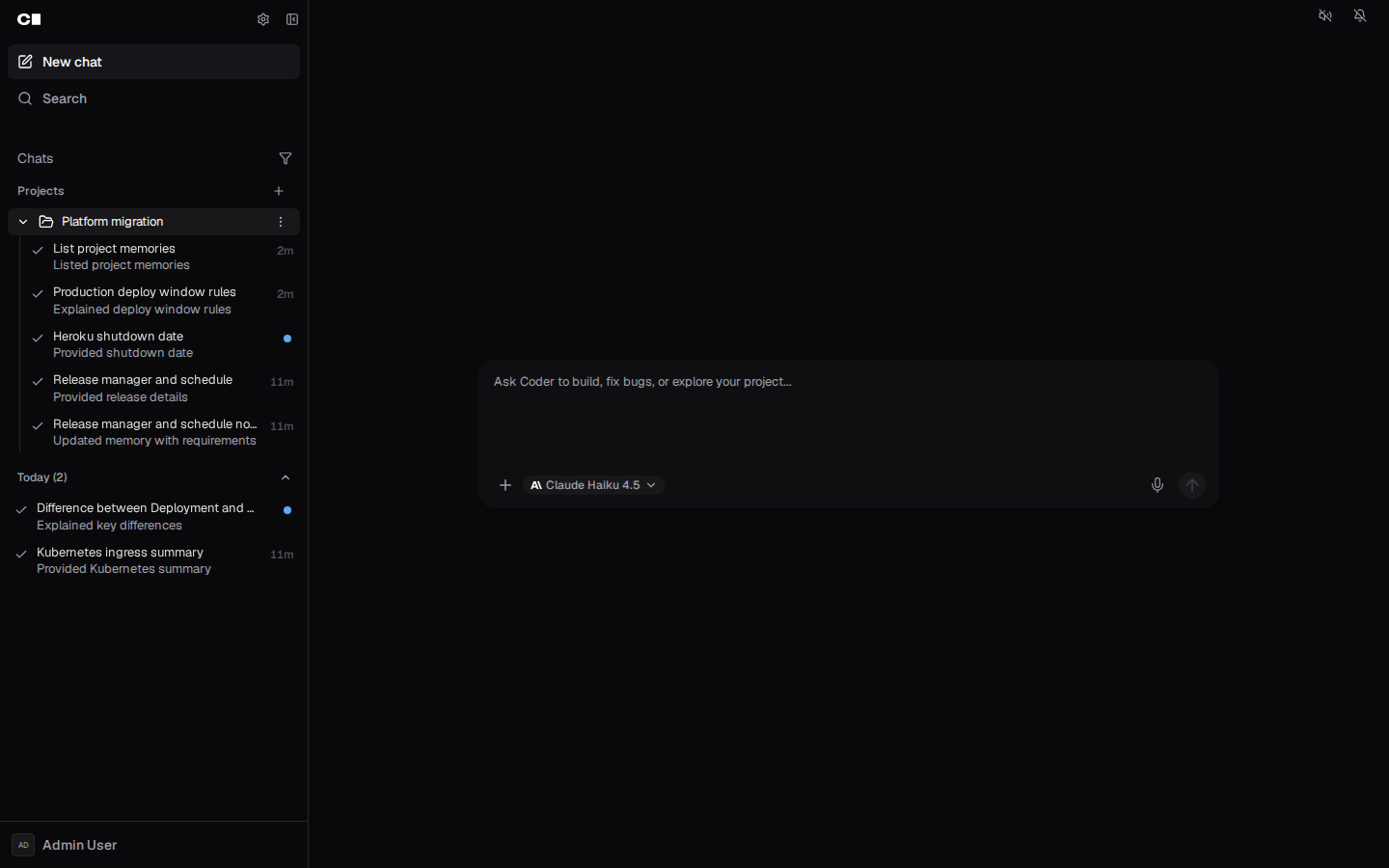 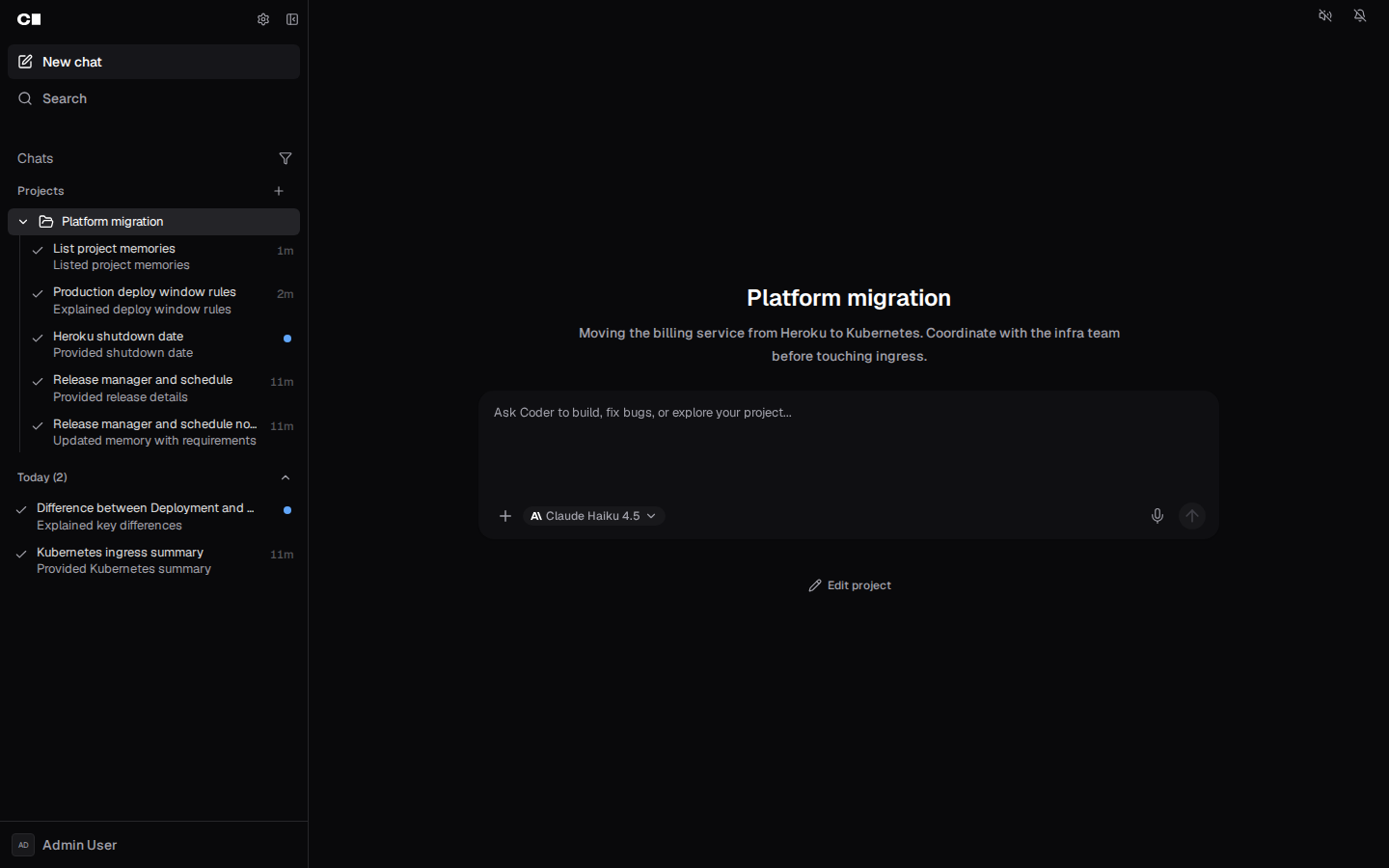 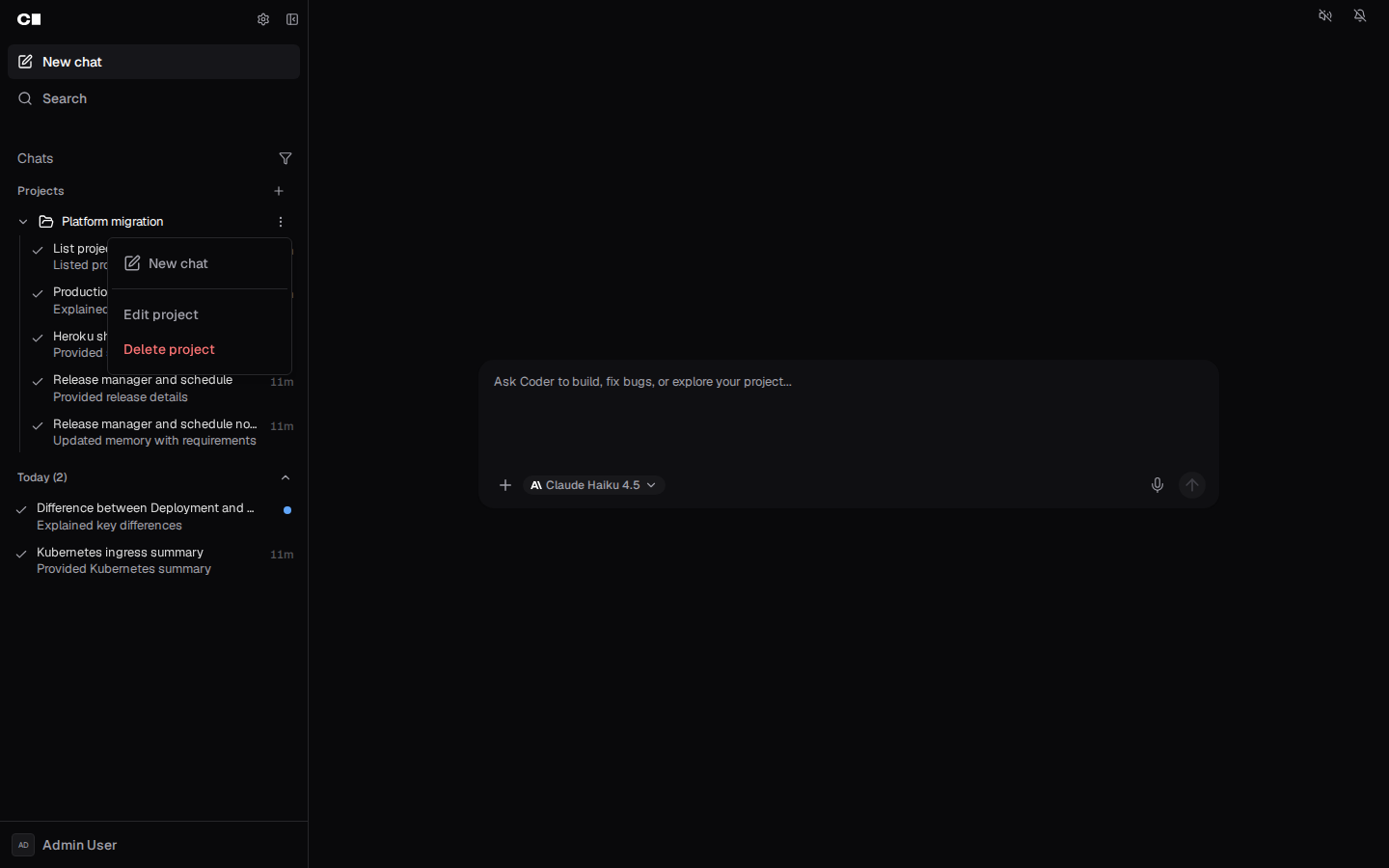 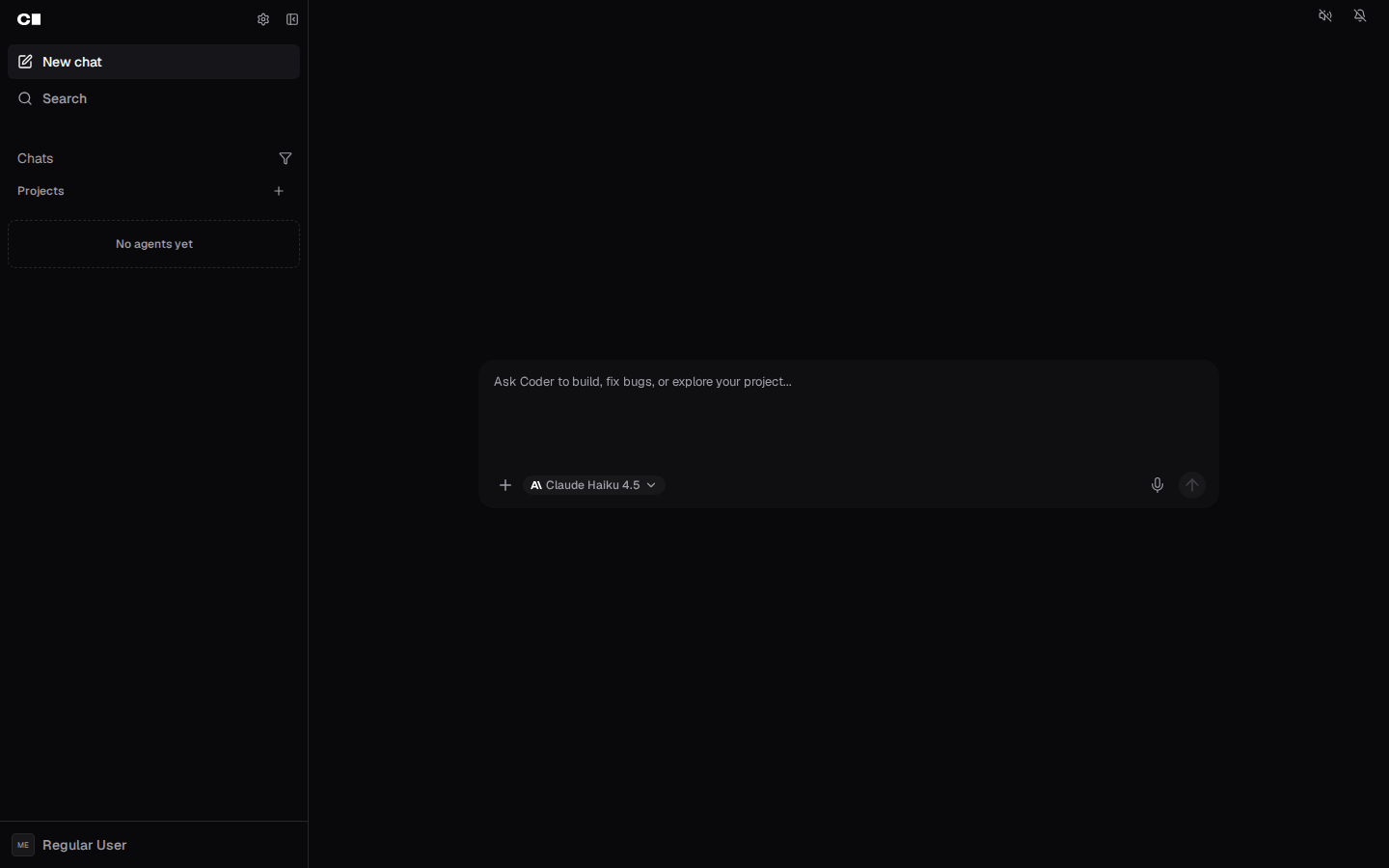 </details> --- Generated with Coder Agents on behalf of @f0ssel. --------- Co-authored-by: Claude Opus 5.5 (1M context) <noreply@anthropic.com> |
||
|
Bobby Ho
|
631fe09e11 |
fix: narrow OAuth2 client registration scope to the catalog (#29952)
fix: filter unsupported scopes in OAuth2 dynamic client registration - Filter scopes against the external catalog during registration and RFC 7592 updates, storing and returning only supported names. - Reject non-empty lists with no supported scopes using `400 invalid_client_metadata` to avoid creating unrestricted allowlists. - Preserve legacy scope lists when resent unchanged; leave existing records and the admin app API unchanged. - Add filtering tests and verify stored scopes in registration tests. Not a security fix: authorization already rejects unsupported scopes. Closes PLAT-674. |
||
|
Michael Suchacz
|
6826da9397 |
feat: restore agents-access as a default organization role (#30004)
Restores `agents-access` (**Coder Agents User**) as a built-in organization role and adds it to every organization's `default_org_member_roles`. Members keep Coder Agents by default, and admins can now restrict it per organization by removing the role from the defaults and granting it through IdP role sync or direct assignment. Since #28186, chat permissions lived in the organization-member floor, so the only way to limit Coder Agents was narrowing per-model access lists, which did not hide the feature. - Migration 000602 appends `agents-access` to every organization's defaults, so upgrading keeps every member's access. New organizations get it from `rbac.DefaultOrgMemberRoles()`. - Service accounts do not inherit the role from the defaults (`GetAuthorizationUserRoles`), so they still need an explicit grant for chat. - Owners and Organization Admins keep chat access regardless of defaults. Chats shared with a user stay readable without the role. - Role sync is unchanged. It does not store default roles, so after the default is removed a mapped user gets `agents-access` at their next sign-in. - The retired-role mechanism (`IsRetiredRoleName`) is removed. - `PATCH /api/v2/organizations/{organization}` rejects duplicate `default_org_member_roles` entries (the CLI already de-duplicated them). - Custom organization role requests treat built-in role names case-insensitively, since custom role names are stored lowercase and `Agents-Access` would otherwise become an undeletable shadow of the built-in role. - The Agents permission alert tells restricted members their chats are kept, and the model selector for users without chat permission no longer claims that no models are configured. Docs add "Control who can use Coder Agents" to the Agents getting-started guide. **NOTE**: Migration 000602 deletes custom roles named `agents-access`, which the built-in role would shadow. The down migration does not restore them. Stored member grants of `agents-access` from the earlier built-in role or a deleted custom role stay and now grant chat access. ## Validation - Remote dogfood [UAT](https://dogfood.cdr.dev/agents/e1c18dc6-f6f0-49a1-b6cd-6ce014b51a86) passed on |
||
|
Bobby Ho
|
55da502938 |
feat: allow admins to configure an OAuth2 app's scope allowlist (#29313)
Add backend support for scope allowlists on admin-created OAuth2 apps, previously available only through DCR. - Add optional, space-separated `scope` to create/update requests and return canonicalized, deduplicated scopes in app responses. - On create, omitted or empty `scope` means unrestricted. On update, `scope` replaces the allowlist; omission preserves it, and an empty string clears it to unrestricted. - Keep scope enforcement unchanged. Add tests for scope round-trips, DCR canonicalization parity, and authorization narrowing. - Include generated SDK and docs updates. The UI scope picker follows in a separate PR. Part of [PLAT-475](https://linear.app/codercom/issue/PLAT-475). |
||
|
Michael Suchacz
|
d2e94e299a | chore: delete dead functions and skip-only or duplicated tests (#29461) | ||
|
Michael Suchacz
|
f46ff158c5 |
feat!: remove the Coder Tasks RBAC resource, scopes and permissions (#28750)
Removes the `task` RBAC resource, its five `task:*` API key scopes, and every persisted reference to them. Custom role permission arrays drop their `task` entries; API keys and OAuth2 codes and tokens lose task scopes, and task-only ones are revoked; OAuth2 apps whose scope list named only task scopes get a whitespace-only scope so they stay restricted instead of reading as unconfigured; then `api_key_scope` is recreated without the task values. Generated RBAC, SDK, site and API doc artifacts are regenerated. The `resource_type` enum keeps `task` so historical audit log rows remain queryable. **Breaking change:** migration 000595 revokes task-only keys and grants. The down migration restores the enum values only. **Review changes:** the api_keys scope cleanup deletes any key left without a non-task scope (redundant EXISTS dropped), the allow-list comment states the real reason (`allow_list` cannot be empty), and the migration test keeps each fixture next to its expected post-migration value. Renumbered from 000594 to 000595. **Stack context:** Coder Tasks removal stack (CODAGT-642): #28743 frontend → #28788 CLI → #28789 API → #28790 provisioner → #29084 notifications → #29085 build reasons → #29086 tables → **#28750 permissions**. The last four PRs replace the single data-drop migration that used to live in #28750; each carries one concern and its own migration number. > Created by Xum (AI agent) on behalf of @ibetitsmike. ## Delivery record **Status (2026-09-11 16:30Z): not merged; awaiting re-review.** Head `80ee30141ee81287a03de3f46407f6a421387778` on `main`. **Review history relevant to this diff:** 10 completed Codex code reviews on the monolithic diff (2026-08-28 to 2026-09-01) plus spikecurtis CHANGES_REQUESTED (2026-09-04, asked for the split), spikecurtis COMMENTED 2026-09-08 (three findings on the migration and test, all applied and resolved) and spikecurtis COMMENTED 2026-09-11 ([r3990045458](https://github.com/coder/coder/pull/28750#discussion_r3990045458), [r3990067224](https://github.com/coder/coder/pull/28750#discussion_r3990067224), both applied in `80ee30141ee` and resolved). The review budget is exhausted, so no further discretionary review or final advisory was commissioned; a fresh independent final advisory for the final diff does not exist and remains a documented gap. The reviewer's own re-review is the remaining gate. **Findings and dispositions on the current head:** - OAuth-linked API key fixtures were confusing (deletion came from the token trigger, not the migration): removed from `keys`; the grants loop creates its backing api_keys row inline and asserts only code/token rows. - Missing cases: added `multi-task-scopes-key`, `multi-task-allows-key`, and `task-only-key` (only task scopes and only task allows, deleted). - Earlier round: redundant EXISTS on the api_keys scope DELETE dropped; allow-list comment corrected (`allow_list` cannot be empty); test restructured as before/after tables; renumbered to 000595. **Test evidence for `80ee30141ee`:** `TestMigration000595RemoveTaskPermissions` passes (up, down, re-up); red-green: removing the token DELETE and UPDATE from the migration fails the test at the grants/tokens assertion, file restored byte-identically. Full repository pre-push hook passed before the push (`test` 97s, `test-js` 45s, site build; `pre-push passed (143s)`). Note: this workspace runs a service on loopback:3000, jsdom's default origin, which made `test-js` fail on unmocked inbox requests for any commit; the hook run used an `LD_PRELOAD` shim that only makes `connect()` to loopback:3000 return `ECONNREFUSED`, matching CI, with no change to sources, tests, config, or the host. Exact-head CI: run [34622204759](https://github.com/coder/coder/actions/runs/34622204759) in progress at the time of writing. **Deferred:** `AI Documentation Check` failures on this stack come from the dormant `doc-check-pr-*` workspace (CODAGT-1025), not code. |
||
|
|
07f9018c61 |
feat: re-check the app allowlist at OAuth2 code redemption (#28740)
**TL;DR** Second of the PLAT-480 stack. #28237 made the negotiated scope bound the issued token; this PR makes a narrowing of an app's registered scopes apply to codes that were already issued. | PR | What it does | |---|---| | #28237 (merged) | Mints access tokens with the negotiated scope, so a grant for one scope stops behaving as full access, and reports the granted scope per RFC 6749 §5.1. | | **#28740 (this)** | Re-checks the code's scope against the app's registered scopes at redemption, closing the ten minute window in which a narrowing was ignored. | | #28744 | Makes code redemption single-use under concurrency. Carries no scope logic and is independent of this PR. | - #28237 has merged, so this targets main. - No new endpoints and no schema change. --- An authorization code is valid for ten minutes, and its scope is checked against the app's registered scopes exactly once, when the code is issued. A registration narrowed inside that window had the narrowing ignored: the code still redeemed for a token carrying the wider scope. - The token exchange re-checks the code's scope against the registration as it stands at redemption and refuses with `invalid_grant`. RFC 6749 §5.2 reserves `invalid_scope` for the scope the client asked for, and this one comes from the stored grant. - The check is coverage rather than membership, and reuses the comparison the authorize endpoint already runs. That comparison now goes through a new `rbac.FirstScopeNotCovered`, which expands the allowlist once rather than once per granted scope. - Only the client can change its registered `scope`, through RFC 7592; no administrator surface writes the column. The re-check reflects the registration at redemption rather than constraining the client. - Refresh keeps the scope originally granted. That is a product choice, not an RFC requirement: a narrowing applies at the next authorization rather than mid-session, so tightening an app's scopes does not break integrations already running. - Codes issued before migration 000569 carry `coder:all`. For an app registered with a narrower `scope` those are refused at redemption until they expire, at most ten minutes. Stack: #28237 (merged), this PR, #28744. --------- Co-authored-by: Claude Opus 5 <noreply@anthropic.com> Co-authored-by: Steven Masley <Emyrk@users.noreply.github.com> |
||
|
|
9368917813 |
feat: report the negotiated scope to the user and the client (#28179)
**TL;DR** Last of the stack, split out of #28045. #28178 decided what the scope is; this PR is everything that reports it, to the user on the consent page and to the client on rejection. | PR | What it does | |---|---| | #28007 | Schema: `codes.scope` and `tokens.scope`, so a negotiated scope has somewhere to live. Every code is still stamped unrestricted. | | #28167 | `ScopesCover` compares an allowlist against a request by permission coverage rather than by name, and fails closed on any shape it does not model. Added with no production callers. | | #28178 | The authorize endpoint checks the request against the scope catalog, grants it only if the app's filtered allowlist covers it, and persists the result on the code. | | **#28179 (this)** | The consent page lists the negotiated permissions, and `invalid_scope` reaches the client's own callback per RFC 6749 §4.1.2.1 instead of a Coder error page. Retires the interim plumbing #28178 left behind. | - #28178 has merged, so this diff is against main and reviews on its own. It is still worth reading first: nothing here decides a scope, it only reports the one `negotiateScope` already returns. - **The consent page HTML is not final.** Layout and wording in `site/static/oauth2allow.html` are still being refined. It is in this branch so the scope-enforcement flow can be exercised end to end in a browser, not because the markup is settled. The reviewable part of Half A is the Go side that decides what the page states; the presentation will change. - An unrestricted grant still reads as full access, not as a scope name. Nothing about what a token can do changes in this PR either. **Where in the flow** - Authorize endpoint only, both verbs. GET decides what the consent page states; both verbs send `invalid_scope` to the callback. The token exchange, refresh, and revocation are untouched. - `negotiateScope` is unchanged from #28178, so which requests succeed is unchanged. This PR reads its result twice: once to decide what the page lists, once to decide where the rejection goes. - The endpoint sits behind `apiKeyMiddlewareRedirect`, so the user is authenticated before any of this runs. That matters for the redirect, not just for the page. - Consent page rendering moves a decision into Go rather than the template: `RenderOAuthAllowData` carries `Scopes` and `Unrestricted` separately, and the template branches on `Unrestricted` alone. **What it satisfies** - RFC 6749 §4.1.2.1 — on a failure that is not a bad redirection URI, the server "informs the client by adding the following parameters to the query component of the redirection URI". `invalid_scope` now goes there. #28178's interim delivery, a static error page on GET and an error body on POST, is what this replaces. - RFC 6749 §4.1.2.1 — `state` is "REQUIRED if a `state` parameter was present in the client authorization request", so it is echoed only when the client sent one, never synthesized. Pinned by `OmittedStateNotEchoed`. - RFC 6749 §3.1.2.4 and §4.1.2.1 — on a "missing, invalid, or mismatching redirection URI" the server "MUST NOT automatically redirect the user-agent to the invalid redirection URI". This is the whole ordering argument, and the file's other error paths keep their existing delivery precisely because several of them are where that validation fails. - RFC 9700 §2.1 — pre-registered redirection URIs "MUST utilize exact string matching". `extractAuthorizeParams` already did this before the stack; Half B depends on it rather than adding it. - RFC 9700 §4.11.2 — names this exact hazard: an attacker who registers a client can "intentionally send an erroneous authorization request, e.g., by using an invalid scope value, thus instructing the authorization server to redirect the user agent to its phishing site". The destination is still only ever a URI that client registered, so this is a phishing surface that costs an attacker a registration, not an open redirect. The precaution the section requires, authenticating the user first, is what `apiKeyMiddlewareRedirect` provides. - RFC 9700 §4.12 — a server redirecting a request that may carry credentials "MUST NOT use the HTTP 307 status code". 302, matching the success redirect beside it. - RFC 6749 §4.1.2.1 — `server_error` exists "because a 500 Internal Server Error HTTP status code cannot be returned to the client via an HTTP redirect". An unusable registered callback is the one case with nowhere to redirect, so it answers 500 on both verbs and logs the app and URL for an operator to correlate by. - Not yet: §1.4.1 still wants `scope` in the token response when the grant differs from the request. Tokens are untouched here, as in #28178, so that lands with enforcement. --- Split out of #28045 ([PLAT-479](https://linear.app/codercom/issue/PLAT-479)). Last of three. #28178 has merged, so this reviews against main. #28178 decided what the scope is. This PR is everything that tells someone about it. --------- Co-authored-by: Claude Opus 5 <noreply@anthropic.com> Co-authored-by: Steven Masley <Emyrk@users.noreply.github.com> |
||
|
|
57cbca585f |
feat: negotiate and persist authorization scope (#28178)
**TL;DR** Middle of the stack, split out of #28045, that makes an OAuth2 app's scope allowlist actually restrict what a client can be granted. The authorize endpoint has always parsed `scope` and then thrown it away. | PR | What it does | |---|---| | #28007 | Schema: `codes.scope` and `tokens.scope`, so a negotiated scope has somewhere to live. Every code is still stamped unrestricted. | | #28167 | `ScopesCover` compares an allowlist against a request by permission coverage rather than by name, and fails closed on any shape it does not model. Added with no production callers. | | **#28178 (this)** | The authorize endpoint checks the request against the scope catalog, grants it only if the app's filtered allowlist covers it, and persists the result on the code. Both GET and POST negotiate, so a doomed request fails before the consent page renders. | | #28179 | The consent page states what was negotiated, and `invalid_scope` is delivered to the client's own callback per RFC 6749 §4.1.2.1 instead of a Coder error page. | - Each earlier PR is inert alone: the columns carry a placeholder, the coverage rules have no caller. - Visible on upgrade, unlike the rest of the stack. A scope name outside the catalog, OIDC vocabulary included, now gets `invalid_scope`, on admin-created apps as well as DCR ones. - Tokens are unaffected. This changes which authorization requests succeed, not what a token can do. **Where in the flow** - Authorize endpoint only, both legs: GET before the consent page renders, POST before the code is minted. The token exchange, refresh, and revocation are untouched. - The result is persisted on the authorization code. The exchange copies it onto the token row, but the API key it mints still carries no scope, so nothing is enforced at request time yet. - Registration and discovery are unchanged. The catalog checked against is the `scopes_supported` both discovery documents already advertise. **What it satisfies** - OAuth 2.1 §1.4.1 — the server "MAY fully or partially ignore the scope requested by the client, based on the authorization server policy". The app's allowlist is that policy; until now the server ignored scope in every direction. - OAuth 2.1 §1.4.1 — on an omitted scope it "MUST either process the request using a pre-defined default value or fail the request". The filtered allowlist is that default; an allowlist filtering to nothing takes the second branch. Same rule as RFC 6749 §3.3. - OAuth 2.1 §1.4.1 — scope values "are defined by the authorization server", and OIDC is named there as an extension that defines its own. Hence `invalid_scope` for openid/profile/email rather than silent acceptance. - OAuth 2.1 §4.1.2.1 — `invalid_scope` is "invalid, unknown, or malformed", which now covers an uncatalogued name and an over-broad one alike. Delivery is interim here (static page on GET, error body on POST); §4.1.2.1 wants it redirected to the client's callback, which is #28179. - OAuth 2.1 §4.1.1 — `scope` stays OPTIONAL. Omitting it selects a default, never an error. - RFC 7591 §2 — a registered `scope` is the list "the client can use when requesting access tokens", a ceiling rather than a menu. Enforced here for the first time; a client that registered an unsupportable one repairs it via RFC 7592. - RFC 8414 §2 — `scopes_supported` is that catalog, advertised since before this stack, so a conformant client had no grounds to send a name outside it. - Not yet: §1.4.1 also requires `scope` in the token response when the grant differs from the request. Tokens are untouched here, so that lands with enforcement. --- Split out of #28045 ([PLAT-479](https://linear.app/codercom/issue/PLAT-479)). #28167 has merged, so this diff is against main and reviews on its own. The authorize endpoint parsed scope and threw it away, so an app's allowlist never restricted anything and a client asking for too much was never told no. Phase 1 added the columns that carry a negotiated scope from a code to the token, but nothing wrote one. **What changes** - Requested names must be in the external scope catalog. The app's stored allowlist is filtered through that same catalog, which only ever narrows. - The allowlist bounds authority, not spelling. A request is granted when every permission it grants is also granted by the allowlist, named or not, so an app allowed coder:workspaces.access can approve a client asking only for workspace:ssh. - Omitting scope grants the filtered allowlist (RFC 6749 §3.3). - Both handlers negotiate, so a request that cannot succeed fails before the consent page renders rather than after the user clicks Allow. - Two paths produce an empty result and stay distinct. No allowlist and no request keeps the previous unrestricted grant, written as an explicit sentinel because the column is NOT NULL with a non-empty CHECK. An allowlist filtering to nothing is rejected, since falling back would grant more than it ever permitted. **Accepted compatibility break, and it is wider than DCR.** The catalog check runs before the allowlist is consulted, so it covers admin-created apps too. - Admin-created apps store no allowlist and had scope discarded outright. A client sending OIDC vocabulary (openid, profile, email) now gets invalid_scope on upgrade. - DCR apps registered with openid, read or admin also hold allowlists this server cannot grant from, and fail in both directions. - scopes_supported has always been advertised on both discovery documents, predating this stack, so a conformant client had no grounds to send an uncatalogued name. RFC 6749 §4.1.2.1 makes invalid_scope the answer for one that does. - Grandfathering would seed the enforcement path with values it cannot evaluate: a visible error now, a silent hole later. - The rejection names the registered scopes and the remedy. Pinned in TestOAuth2AuthorizeDCRScopeCompatibility. **Interim error delivery, replaced in PR 3.** Rejections go out however each handler already reports errors: a static error page on GET, an OAuth2 error body on POST. #28179 delivers them to the client's own callback (RFC 6749 §4.1.2.1) and rewrites the requireInvalidScope helper. About 25 lines here are interim on purpose and flagged as such in that helper. **Not changed.** Issued tokens are still unrestricted. The exchange copies the negotiated scope onto the token record, but the API key it mints carries no scope. This changes which authorization requests succeed, not what a token can do. Stack: #28167 (merged), this PR, then #28179 for the consent page and the invalid_scope redirect. --------- Co-authored-by: Claude Opus 5 <noreply@anthropic.com> Co-authored-by: Steven Masley <Emyrk@users.noreply.github.com> |
||
|
Michael Suchacz
|
45f2eb48cc |
refactor(coderd): restore agents-access cleanup migration (#28587)
## Summary - restore the `agents-access` data cleanup migration as `000587` (renumbered from `000585`; main advanced past that number) - revert the temporary RBAC tolerance for retired role names now that the migration strips stale grants - make the migration test discover its predecessor dynamically, since this branch does not carry main's `000585`/`000586` ## Stack context Stacked on #28186, which retires the `agents-access` role but intentionally ships without a migration so it can be backported across diverged migration numbers. This layer completes the retirement on main: it cleans up stale role grants in `users.rbac_roles`, `organization_members.roles`, and `organizations.default_org_member_roles`, then reverts the interim leniency (role expansion dropping legacy names, assignment validation ignoring them) that existed only to keep the migration-less base safe. `rbac.ReservedRoleName` still reserves the retired name so custom roles cannot shadow it on rollback. Do not backport this PR alongside the base PR. ## Rollback note The down migration restores effective access broadly because it cannot reconstruct which users previously held the removed role. ## Validation - `go build ./coderd/... ./enterprise/...` - full `coderd/database/migrations`, `coderd/rbac/...`, and `coderd/database/dbauthz` suites - targeted members tests in `coderd` - repository pre-commit checks (`lint/go`, `lint/ts`, etc.) > Mux created this pull request on Mike's behalf. |
||
|
Michael Suchacz
|
845790e652 |
feat: enable Coder Agents for organization members (#28186)
## Summary - make Coder Agents available to organization members without a separate built-in role - remove the obsolete role from backend and frontend role surfaces - update authorization, UI, documentation, and regression coverage ## Database note This PR intentionally ships no migration so it backports cleanly across diverged migration numbers. Stale `agents-access` grants may remain in user role arrays and org default member roles; the retired name is treated as a grant of nothing (role expansion drops it, assignment validation ignores it, and the name stays reserved). A follow-up PR will add the data cleanup migration. ## Validation - `make gen` - `make lint` - repository pre-commit checks - targeted RBAC, migration, chat API, enterprise, site, Storybook, and race tests - `git diff --check` ## Rollback note Rolling back the deployment restores the previous behavior directly: no data changed, and older binaries still resolve any lingering `agents-access` grants. > Mux created this pull request on Mike's behalf. |
||
|
Bobby HoandMcKayla はな
|
c9fc5b7ea1 |
fix: canonicalize API key scope aliases at ingress (#28322)
`rbac.IsExternalScope` accepts `all` and `application_connect`, neither
of which is an `api_key_scope` enum member. The plural `Scopes` field
stored the name as given, so `{"scopes":["all"]}` passed validation and
then 500'd inside `apikey.Generate` with `invalid API key scope: "all"`.
Reachable from `coder tokens create --scope all`, from the spellings
`docs/admin/users/sessions-tokens.md` taught, and from the `codersdk`
constants exported for exactly this purpose.

- Canonicalize inside `apikey.Generate`, in the loop that already
validates each name. One statement covers every caller and all three
input paths: plural `Scopes`, deprecated singular `Scope`, and the
default. Replaces two open-coded switches and the handler's own
per-element copy, so one place decides the stored spelling and the
handler only decides what may be requested.
- Deduplicate in the same pass. An alias and its canonical spelling are
two names going in and one name in the column.
- `ExternalScopeNames()` lists every name `IsExternalScope` accepts,
instead of dropping catalog entries that fail to parse. A curated entry
that cannot be stored used to pass every test and 500 at runtime; it now
fails two.
- Split the 400. A misspelled name and an internal `api_key_scope`
member need different words, since no re-spelling makes the second
requestable. Both rejection sites share one helper that names the case
and links the docs.
- Add reject-path tests for `not_a_real_scope` and `debug_info:read`.
The second is a valid enum member the rbac catalog treats as internal,
so before this both handler guards could be deleted with the suite still
green. A further case pins that plural `Scopes` wins when a caller sets
both fields.
- `TestExternalScopesAreStorable` pins the class rather than the two
known instances: every public rbac scope name must be storable.
`coderd/rbac` cannot assert this itself, since `database` imports `rbac`
and not the reverse.
- Docs use the canonical spellings, link the `codersdk.APIKeyScope`
schema, and say which scopes a token cannot request.

Egress is unchanged: `convertAPIKey` still derives a legacy singular
name on the way out. `ExternalScopeNames()` returns the same 57 names as
before, and `codersdk/apikey_scopes_gen.go` regenerates identically.

`rbac.CanonicalScopeName` merged with #28167, so this applies to `main`
and reviews on its own. The OAuth2 provider ignores scopes entirely
today (`authorize.go:237`, `tokens.go:377`, `tokens.go:520`), so it is
unaffected until those TODOs resolve.

Deferred from review: PLAT-528, PLAT-529, PLAT-530, and PLAT-532.
PLAT-532 covers `{"scopes":[]}` and `{"allow_list":[]}` defaulting open,
which predates this PR.

---------

Co-authored-by: McKayla はな <mckayla@hey.com>
|
||
|
Ethan
|
cbe24a3da5 |
feat: add chat model config RBAC resource (#27957)
Add the `chat_model_config` RBAC resource, actions, and API key scopes. This layer includes the scope migration and generated API types. Model list queries apply token scopes, SQL authorization filters, and row ACLs. Write and default-management handlers keep deployment configuration authorization until the next API layer replaces it. Depends on #27956 _This pull request description was generated by Coder Agents._ |
||
|
McKayla はな
|
5ca0143992 | refactor: upgrade golangci-lint to v2.0.2 (#28416) | ||
|
Bobby HoandClaude Opus 5
|
dea3a2944a |
feat(coderd/rbac): compare scopes by permission coverage (#28167)
Split out of #28045 ([PLAT-479](https://linear.app/codercom/issue/PLAT-479)) so the coverage rules can be reviewed on their own. First of three. No behavior change: both functions are added without production callers, and the OAuth2 authorize endpoint consumes them in the next PR. **ScopesCover(allowed, requested)** reports whether every permission the request grants is also granted by the allowlist. It expands both sides and compares permissions rather than names, so coder:workspaces.access covers workspace:read without ever naming it. The fail-closed rules are the part worth reviewing: - Coverage models site-level grants only. A scope carrying org or user permissions, a negative permission, or a narrowed allow list is refused on either side rather than compared on the part that is modeled. Answering "covered" from the fraction that was read would report authority that was never examined. - An unknown name on either side is an error, not a false, since a caller cannot tell "not covered" apart from "could not decide". - A wildcard request is covered only by a wildcard grant. Enumerating every workspace action that exists today does not cover workspace:*, because the wildcard also authorizes the actions added tomorrow. **CanonicalScopeName** maps the aliases IsExternalScope accepts, all and application_connect, onto the api_key_scope enum spellings. IsExternalScope answers whether a name may be requested, not how it is spelled once persisted, so anything storing a validated name has to canonicalize in between. Both sides of ScopesCover must already be canonical, which its parameter names restate at every call site. Covered by 17 coverage cases, guard cases that drive each unmodeled shape through both sides of the comparison, and an exhaustive sweep over the external catalog: coder:all covers all of it, and every catalog name covers itself. Stack: this PR, then negotiate and persist the scope, then the consent page and invalid_scope redirect. --------- Co-authored-by: Claude Opus 5 <noreply@anthropic.com> |
||
|
Michael Suchacz
|
a3eb1ee930 |
fix: gate MCP user tokens on owner-scoped personal RBAC (#27945)
Re-gates every `mcp_server_user_tokens` dbauthz method from `rbac.ResourceDeploymentConfig` onto owner-scoped personal actions, mirroring the `external_auth_links` prior art. These are per-user credential rows, not deployment config, and the old gate forced every call site to elevate with `dbauthz.AsSystemRestricted`. ## Summary - Reads gate on `ActionReadPersonal` and writes on `ActionUpdatePersonal` against the token owner (`MCPServerUserToken.RBACObject()` derives from `user_id`). The id-keyed refresh and refresh-failure mutations resolve the owner via a `GetMCPServerUserTokenByID` prefetch inside dbauthz; the mutation queries cannot retarget a row's owner, so there is no fetch-authorize race. - All seven token-path `AsSystemRestricted` elevations in `coderd/mcp.go` and all four in chatd are removed along with their `//nolint:gocritic` markers; handlers use the request actor. - The daemon-wide chatd subject keeps only `ActionReadPersonal` on `ResourceUser`. Background token refresh and failure persistence use a new per-user `AsChatdTokenOwner` subject holding only user-level `ActionUpdatePersonal` scoped to the token owner (both mutations resolve the row via the underlying store, so the subject needs no read grant), and chatd never holds site-wide personal-write access. `TestAsChatd` pins the complete `ResourceUser` action set and `TestMCPServerUserTokensAuth` exercises both subjects against the real authorizer. - New strict-authorizer test (`rbac.NewAuthorizer` against real rows): owner passes get/upsert/delete, a stranger fails, and an org admin of another org fails. No user-visible behavior change. Stacked on #27944. Completes the MCP org-separation stack. Closes https://linear.app/codercom/issue/CODAGT-806 UAT: regression pass on a dogfood instance: OAuth2 connect redirect, member list/status with redaction, self-scoped disconnect (cannot touch another user's token), end-to-end chat MCP tool invocation, and lower-stack audit/ACL smoke checks. > Mux (AI agent) authored this PR on Mike's behalf. <!-- mux-attribution: model=claude-fable-5 thinking=high --> |
||
|
Michael Suchacz
|
7ca7c30f40 |
feat: add group and user ACLs to MCP server configs (#27944)
Adds group and user ACLs to org-scoped MCP server configs so
organizations can restrict specific MCP servers to subsets of members,
mirroring the template ACL pattern.

## Summary

- Migration adds `group_acl`/`user_acl` JSONB columns (nested `{"<id>":
{"permissions": [...]}}` shape) and seeds every existing config with its
organization's Everyone group read entry (the Everyone group ID equals
the org ID), so member access is unchanged by default. Creation seeds
the same entry.
- The blanket org-member read grant from the base PR is replaced by ACL
evaluation: Rego requires org membership for every ACL grant, and
`GetAuthorizedMCPServerConfigs` compiles ACL-aware SQL filters.
- New `ActionShare` (org admins) gates `GET|PATCH
/api/experimental/organizations/{organization}/mcp-servers/{mcpserverconfig}/acl`
(nested under the organization like the rest of the config surface).
PATCH validates principals against the config's organization, merges
sparse updates under a row lock, stamps `updated_by`/`updated_at`, and
is audited as a Write with `Old` captured before authorization. A config
deleted concurrently between the middleware fetch and the locked
re-fetch is concealed as 404, matching the update and delete handlers.
ACL columns are tracked in the audit table.
- ACL management is available in all editions (no enterprise
entitlement), documented in the MCP servers page. Revoking an ACL does
not retro-strip already-selected configs from existing chats; new
selection is blocked at chat create.
- Force On respects the ACL: the forced set is loaded as the chat owner,
so a `force_on` server whose ACL denies the owner never attaches at
create, send, or generation time.
- No rolling-upgrade machinery: upgrades run in scheduled maintenance
downtime, so the migration only backfills existing rows; the API sets
the Everyone read grant explicitly on every insert.

Stacked on #27943. Part of the MCP org-separation stack.

Closes https://linear.app/codercom/issue/CODAGT-712

UAT: verified on a dogfood instance with two members and a custom group:
Everyone-seed default visibility, group grant with Everyone removal
(non-member loses list/fetch/selection), foreign-principal rejection,
non-admin share denial (audited 403 / concealed 404), user_acl restore,
and audited ACL diffs.

> Mux (AI agent) authored this PR on Mike's behalf.

<!-- mux-attribution: model=claude-fable-5 thinking=high -->
|
||
|
Michael Suchacz
|
f7a0de7a11 |
fix: harden org-scoped MCP config chat gating, updates, and visibility (#28065)
Hardens the org-scoped MCP server config surface from #27942 with fixes and regression pins that are independent of the core cutover: - Keep chats sendable after a selected MCP server is disabled (persisted selections are exempt from message-time rejection). - Keep cached MCP selections usable after a background refetch error (gate the composer on missing data, not `isSuccess`). - Merge PATCH updates onto the current row so unset fields are not clobbered. - Give auditors the full management view of MCP configs their audit logs reference (site and org auditor roles). - Regression pins: frozen OAuth2 callback path, cross-org concealment for item routes, OAuth callback token binding, and disconnect responses indistinguishable from nonexistent config IDs. - Storybook: semantic textbox queries in MCP loading stories; docs note that the MCP settings page needs deployment access. ## Stack context Part of the MCP org-separation stack (CODAGT-711 org scope -> apidocs -> hardening -> CODAGT-717 audit -> CODAGT-712 ACLs -> CODAGT-806 token RBAC). Split out of #27942 to keep the core cutover reviewable; each change here builds on the org-scoped routes and chat gating introduced below it. > Mux (AI agent) authored this PR on Mike's behalf. <!-- mux-attribution: model=claude-fable-5 thinking=high --> |
||
|
Michael SuchaczandMathias Fredriksson
|
443e3b9b80 |
feat!: org-scope MCP server configs with RBAC (#27942)
Moves `mcp_server_configs` from deployment scope to organization scope
so each organization fully controls the MCP servers its members can use
with Coder Agents.

## Summary

- Migration: adds `organization_id` (NOT NULL, FK) and keeps existing
rows as the default organization's originals with credentials intact.
Other organizations start with no MCP servers and configure their own;
nothing is copied across organizations. Chats outside the default
organization keep any now-cross-organization `mcp_server_ids` entries;
the runtime already ignores IDs that do not resolve in the chat's
organization, so no data rewrite is needed. Slug uniqueness becomes
`(organization_id, slug)`.
- RBAC: new org-scoped `ResourceMCPServerConfig` with regosql converter
and `GetAuthorizedMCPServerConfigs`; org admins get in-org CRUD, org
members get read (replaced by ACL evaluation in the follow-up ACL PR in
this stack).
- API: all config routes nest under the organization, matching
templates: `POST|GET
/api/experimental/organizations/{organization}/mcp-servers` and
`GET|PATCH|DELETE .../mcp-servers/{mcpserverconfig}` (plus
`oauth2/connect`), resolved by a read-only param middleware that
conceals read-denied and cross-organization access as 404. Two routes
stay on the frozen `/api/experimental/mcp/servers/{mcpServer}` block:
the OAuth2 callback (the redirect URI baked into existing AS-side client
registrations) and `oauth2/disconnect`, which must remain reachable by
users removed from the organization so they can still revoke their token
grant.
- Chat runtime: selection validation and generation resolve configs
strictly by IDs, enabled state, and the chat's organization in SQL;
requested duplicates are normalized; invalid or cross-org IDs are
rejected with the precise ID list. IDs already persisted on a chat are
exempt from message-time rejection so disabling a selected server never
blocks sends; generation skips servers that are no longer usable.
- Frontend: API layer and admin settings pages target the new endpoints.
The admin page manages the default organization's servers; the org
picker is tracked separately (CODAGT-714).

- Security hardening from review: OAuth user grants are additionally
bound to `oauth2_revocation_url` (changing it invalidates grants, and a
racing OAuth callback gets 409 instead of recreating a grant).
Stack-wide SSRF protection for MCP config-directed traffic was split
into its own PR at the top of this stack (#28242) to keep this diff
reviewable; this PR keeps main's existing discovery IP-range guard.
OAuth2 auto-discovery now completes before the config row is inserted: a
failed discovery persists nothing, and there is no provisional row that
concurrent updates could race against.

Two follow-up PRs in this stack were split out to keep this diff
reviewable: #28064 completes the swagger annotations for the moved
routes (main already ships these experimental MCP handlers unannotated),
and #28065 carries hardening fixes and regression pins on top of the
cutover.

- Force On enforcement (landed on main mid-review) is org-scoped: the
forced set is read per chat organization
(`GetForcedMCPServerConfigsByOrganization`), so another organization's
`force_on` server never attaches to a chat.

## Breaking changes (experimental API)

The MCP server config endpoints move from the deployment-scoped
`/api/experimental/mcp/servers` block to organization-nested paths:
`POST|GET /api/experimental/organizations/{organization}/mcp-servers`
and `GET|PATCH|DELETE
/api/experimental/organizations/{organization}/mcp-servers/{mcpserverconfig}`
(plus `oauth2/connect`). The old paths are removed, so API consumers
must supply an organization. Two routes intentionally stay on the frozen
`/api/experimental/mcp/servers/{mcpServer}` block: the OAuth2 callback
(its redirect URI is baked into existing AS-side client registrations)
and `oauth2/disconnect` (must remain reachable by users removed from the
organization). These endpoints are under `/api/experimental`, so no
deprecation window is provided.

## Rolling upgrades

During a rolling deploy, an old replica creating an MCP config can fail
the new `NOT NULL organization_id` constraint until it is upgraded
(reads are unaffected: old binaries' generated queries select their own
column lists). This matches the repo's existing precedent for additive
NOT NULL migrations (000562) and affects only the admin config-create
path in the upgrade window.

Upgrades are expected to run in scheduled maintenance downtime with the
database locked during migration, so the migration ships no
rolling-upgrade compatibility machinery. The down migration deletes
organization-created configs (their chat references are cleaned by the
000510 delete trigger) and restores deployment-wide slug uniqueness.

Part of the MCP org-separation stack (CODAGT-711 -> CODAGT-717 audit ->
CODAGT-712 ACLs -> CODAGT-806 token RBAC).

Closes https://linear.app/codercom/issue/CODAGT-711

UAT: validated end to end on a two-org dogfood deployment, including a
real pre-migration to post-migration upgrade, cross-org isolation
(404s), same-slug-two-orgs, chat selection gating, and a live MCP tool
call through the org-scoped generation path. The migration was later
revised to keep existing rows in the default organization only (no
per-organization copies); that revision is covered by the migration test
suite.

> Mux (AI agent) authored this PR on Mike's behalf.

<!-- mux-attribution: model=claude-fable-5 thinking=high -->

---------

Co-authored-by: Mathias Fredriksson <mafredri@gmail.com>
|
||
|
Jeremy Ruppel
|
d9d6ce9ddf |
perf(coderd/rbac): build span role attributes only when recording (#27310)
`rbacTraceAttributes` materialized the subject's role names (one string allocation per role) and was passed into every `Filter`, `Authorize`, and `Prepare` span at creation time, so the O(roles) work ran even when no tracer was recording. It also called `SafeRoleNames()` twice. Replace it with `setRBACAttributes`, which attaches the same attributes *after* the span is created and only when `span.IsRecording()` is true, reading `SafeRoleNames()` once. Recorded spans are unchanged; untraced and unsampled calls skip the per-role work. This originated from #27309: once `/authcheck` checks are batched through `rbac.Filter`, each below-threshold group paid the role-attribute build for the `Filter` span *and* for every per-object `Authorize` span, so the redundant per-call work showed up as extra allocations per request. ## Benchmarks `AMD EPYC 9575F`, `benchstat`, no tracer configured (exercises the `IsRecording()==false` path). **`BenchmarkRBACManyOrgs`** (general RBAC eval), before vs after: wall time flat (geomean −0.04%), allocations strictly lower everywhere (geomean B/op −0.52%; `Authorize` −1.0 to −1.3% B/op), no regressions. **Authcheck path** (`BenchmarkAuthcheckGrouping`, #27309 vs #27310, back-to-back): this change is an **allocation reduction and is time-neutral**. On the endpoint (`Grouped`) path, per-request allocations drop ~4-5% B/op at common org counts (1-10); on the pure per-object path the reduction grows with org count (B/op −2.6% → −7.3% at 100 orgs). Wall time is flat within noise: low-org deltas sit inside this host's ±10-23% run-to-run variance, so no wall-time claim is made. Net: same speed, less garbage per request, which also lowers GC pressure under real concurrent load. <details> <summary>Decision log</summary> - The `Filter` span wraps the whole filtering routine (total latency + `num_objects`); it is the valuable span and is kept. The costly part was `rbacTraceAttributes`, not the span itself. - `rbacTraceAttributes` was O(roles): it allocated a string per role for the `subject_roles` attribute and called `SafeRoleNames()` twice. On `Filter`'s below-threshold fallback it ran once for the `Filter` span and again for each per-object `Authorize` span, so a group of N objects paid N+1 builds vs the old loop's N. Benchmarks confirm this as real per-call allocation; its wall-time cost is below the authcheck benchmark's noise floor. - Deferring attribute construction behind `IsRecording()` requires the span object, so the three callsites moved from `StartSpan(ctx, rbacTraceAttributes(...))` to `StartSpan(ctx)` then `setRBACAttributes(span, ...)`. No spans were removed or renamed; recorded output is identical. - Tradeoff: when a span is not recording, `subject_roles`/`num_subject_roles`/etc. are not computed. Unsampled spans emit nothing anyway, so there is no observable output change. </details> --- Authored with Coder Agents. |
||
|
Jeremy RuppelandSteven Masley
|
51a9aa1bfc |
perf(coderd): batch authcheck permissions via rbac.Filter (#27309)
`POST /api/v2/authcheck` evaluated every check with a full policy evaluation in a serial loop. A subject in many organizations (100+) produced hundreds of full evaluations, taking seconds on a cold cache (DEVEX-608). Group the checks by `(action, resource type)` and authorize each group with the existing `rbac.Filter`, which amortizes a single partial evaluation across the group once it is large enough. Each check is wrapped in a small value struct that carries its response key, so `Filter`'s returned subset maps back to keys by reading a field rather than relying on element identity. `Filter` now takes an explicit `prepareThreshold`; existing callers pass the new `rbac.DefaultFilterThreshold` (10), and `checkAuthorization` passes 50, above the ~35-group crossover measured for this workload, so subjects with few objects of a given type keep the per-object path and cannot regress. ## Stacking This is stacked on top of #27244. `Filter` runs `Prepare` (partial evaluation), and those residuals are only compact once #27244's set-membership residuals land. On plain `main` the existing O(N) residual fanout means batching can regress at high org counts, so this change should land with or after #27244. <details> <summary>Decision log</summary> ### Bottleneck - `site/src/modules/permissions/organizations.ts` defines ~14 permission checks per org; `organizationsPermissions()` flattens them across all orgs into one `POST /api/v2/authcheck`. A 100-org request is ~1400 checks. - `checkAuthorization` looped serially, calling `Authorizer.Authorize` (full eval) once per check. - The endpoint's `maxFetch = 10` only caps checks that carry a `resource_id`, not total checks, so it does not bound this workload. ### Approach - Group checks by `(action, resource type)` and run each group through `rbac.Filter`, which does one partial evaluation (`Prepare`) and reuses it across the group. - Carry the response key as data in a small value struct implementing `RBACObject()`, so allowed results map back to keys without pointer identity: ```go type authorizeCheck struct { key string object rbac.Object } func (c authorizeCheck) RBACObject() rbac.Object { return c.object } ``` - `Filter` takes a required `prepareThreshold int` (no functional options). Generic callers pass `rbac.DefaultFilterThreshold = 10`; `/authcheck` passes 50 because the measured crossover for this workload is ~35 groups. ### Alternatives rejected - **Bounded `errgroup` parallelism**: reduced wall time at high org counts but not aggregate work (allocations flat). Discarded in favor of reducing work via partial evaluation. - **Symmetric-deny Rego simplification** (on the #27244 branch): replacing the known-org deny-fold with symmetric `org := -1` / `scope_org := -1` rules failed existing SQL-compile tests. A `-1` known-org vote gated by `not org = -1` produces a negated membership test over the unknown org id, which OPA emits as an unconvertible support rule. #27244's fold (`member_allow - org_deny`, a positive set-difference membership test) is therefore load-bearing, not incidental. </details> --- Authored with Coder Agents. --------- Co-authored-by: Steven Masley <Emyrk@users.noreply.github.com> |
||
|
Jeremy Ruppel
|
7e708b24ce |
perf(coderd/rbac): collapse org authorization to a set-membership test (#27244)
## Problem Authorization for users who belong to many organizations is slow. On the list <br>endpoints (`/api/v2/organizations`, `/users`, `/groups`) a user in hundreds of <br>orgs saw multi-second page loads <br>([DEVEX-608](https://linear.app/codercom/issue/DEVEX-608/performance-degrades-for-users-in-many-organizations-across-multiple) <br>/ coder/coder#21890 / Pylon [#2758](<https://github.com/coder/coder/issues/2758>)). This is partial-evaluation bound: `rbac.Prepare` <br>scales with the number of org-scoped roles the subject carries. ## Root cause The known-org path in `check_org_permissions` indexed an N-entry vote map by the <br>object's org id: ```rego vote := allow_map[input.object.org_owner] ``` `input.object.org_owner` is unknown during partial evaluation. Indexing a map by <br>an unknown key cannot reduce to a single expression, so OPA emits one residual <br>query per org membership, and `newPartialAuthorizer` then calls `PrepareForEval` <br>once per residual, making `Prepare` O(N) in org count. The list endpoints <br>intentionally use partial eval; the fan-out is in partial eval itself. ## Change Test the object's org id for membership in a set that is fully known at <br>partial-evaluation time, so the query collapses to a single <br>`organization_id = ANY(ARRAY[...])` residual instead of N residuals: * The known-org clause only ever votes to allow, tested via <br>`org_owner in org_ids_with_vote(role_org_votes, 1)`. * Org-level denies are folded into the org-member level as a ground set <br>difference (`member_allow - org_deny`), so the unknown org id appears in only <br>one positive membership test and the decision never branches on it. * The per-org vote maps are computed once as memoized zero-arg rules <br>(`role_org_votes`, `role_member_votes`, `scope_org_votes`, <br>`scope_member_votes`) instead of through parametrized functions that OPA <br>re-evaluates at every call site. * `role_allow`/`scope_allow`, the `any_org` path, and full evaluation are <br>unchanged in behavior. Semantics are unchanged (see the equivalence argument below). The only <br>representational change is that a denied known org's intermediate `org` vote is <br>now `0` instead of `-1`, compensated by the set difference and not observable in <br>the final `allow` decision. ## Results Measured with `BenchmarkRBACManyOrgs` (added on `main` in coder/coder#27270). Full tables: <br>[B/op and allocs/op](<https://github.com/coder/coder/pull/27244#issuecomment-4984523720>). * Residual queries: O(N) -> O(1). * `Prepare` / `PrepareAndCompile` memory changes from < />quadratic growth on `main` <br>(176 MiB, 7.08M allocs per op at 100 orgs) to near-linear (6.5 MiB, 258k <br>allocs), a < />96% reduction at 100 orgs, with similar wins in time. * Memoizing the vote maps removed an early single-org regression: at 1 org <br>`Prepare` now allocates < />7% fewer bytes and < />9% fewer objects than `main`. * `Authorize` (full evaluation) memory is marginally higher (+1-8%, largest at <br>1 org) and time-neutral. This is the inherent cost of the set-membership form <br>that keeps partial evaluation from fanning out; full evaluation builds an <br>allow set it would not otherwise need. * `go test ./coderd/rbac/...` passes, including `TestAuthorizeDomain` (full- vs <br>partial-eval equivalence) and the regosql suite. A second, independent bottleneck remains (out of scope here): the vote map is <br>still built in O(N^2) in `check_all_org_permissions` <br>(`roles[_].by_org_id[org_id]` scans all roles per org). Fixing it means <br>pre-merging roles' `by_org_id` into one org->perms map in the OPA input, and is <br>tracked as a follow-up. ## Testing * `OrgDenyBlocksMember` (`TestAuthorizeLevels`): an org-level deny blocks a <br>member-allowed action on an owned in-org object, while a clean org is allowed, <br>including an action-scoped deny. * `ScopeOrgDenyBlocksMember` (`TestAuthorizeScope`): the same fold at the scope <br>level. * The shared harness covers full and partial evaluation and asserts the partial <br>result compiles to SQL with zero support rules. <details><summary>Decision log and equivalence argument</summary> ### Why not deny-via-set-membership The first attempt expressed deny as a second set-membership clause (`:= -1 if org_owner in deny_set`). That makes `org`/`scope_org` multi-valued, and the `not org = -1` checks in `role_allow`/`scope_allow` then cause OPA to emit a `data.partial.__not__` support rule that regosql cannot compile (`TestAuthorizeDomain/UserACLList` failed). It failed even when the deny set was empty, purely because the `-1` clause exists. ### Why not deny-via-enumeration A follow-up enumerated only the (usually empty) deny set. It compiled and passed, but it branches on the unknown org id (one ground residual per denied org), which violates the "do not branch on the unknown" rule in `coderd/rbac/POLICY.md`. ### Final approach: allow-only + ground set difference The known-org clause votes only to allow, and the org-level deny gate is moved into the org-member level as `member_allow - org_deny`, a set difference over fully-known sets. The unknown org id is used only in positive `in` tests, so there is no enumeration, no negated membership, and no branching on the unknown. ### Empty-set residual pruning A naive set-membership left unsatisfiable residuals (`org_owner in set()`) for levels with no matching permissions (e.g. the org level for an org-member role, or scope-org for `ScopeAll`), each still costing a `PrepareForEval`. Guarding each membership with a ground `count(...) > 0` lets OPA drop those branches, flattening the residual count across org sizes. ### Memoized vote maps Profiling the single-org path showed the cost was repeated function evaluation: the parametrized helpers rebuilt the same vote map for the org, member, and scope paths on every check. Hoisting the maps into memoized zero-arg complete rules (which OPA evaluates once per query) removed that overhead and eliminated the single-org `Prepare` regression, while composition keeps the policy readable. ### Equivalence (known-org path, `site != -1`) * A: original `org == 1` <=> `org_owner in org_allow` (unchanged). * B: original `org != -1 and member == 1` <=> `org_owner not in org_deny and org_owner in member_allow` <=> `org_owner in (member_allow - org_deny)` = new `org_member == 1`. The critical case (`org` denies, member allows): old blocks it via `not org = -1`; new blocks it because `org_owner` is removed from `member_allow - org_deny`. Same outcome. Deny-wins aggregation is intact because `check_all_org_permissions` still nets an org to `-1` via `to_vote`, landing it in `org_deny`. </details> --- This PR was generated by Coder Agents on behalf of @jeremyruppel. |
||
|
Steven Masley
|
52423eb87b |
feat: promote MinimumImplicitMember experiment to GA (#27472)
Promotes the `minimum-implicit-member` experiment to GA and removes it.

## What changes

- The `minimum-implicit-member` experiment constant, its
`RoleOptions.MinimumImplicitMember` toggle, and the global
`rbac.MinimumImplicitMember()` accessor are deleted. The minimal-member
behavior is now the only behavior: `organization-member` and
`organization-service-account` carry only the floor (read-self records,
notifications, and similar) and grant **no workspace permissions**.
Workspace access lives exclusively on the
`organization-workspace-access` role.
- The experiment gate on customizing `default_org_member_roles` (`PATCH
/organizations/{org}`) is removed; the built-in-roles-only validation
remains.
- The dashboard's Default Roles section and the implied-roles display on
the members page are no longer experiment-gated.
- Admin docs: new "Default member roles" section in
`docs/admin/users/organizations.md`, cross-linked from
`groups-roles.md`.

## Why this is safe for existing deployments

Migration `000516` (shipped earlier) backfilled
`default_org_member_roles` with `['organization-workspace-access']` on
every organization. Members therefore keep exactly the effective
permissions they had with the experiment off; the workspace elevation
flows through the default role instead of being baked into
`organization-member`.

**Rollback caveat:** rolling back past this release restores the bundled
elevation, silently re-granting workspace access to members of
organizations that cleared their default roles.

## Review

Deep-review R1 findings are addressed in `chore: address deep-review
findings` (copy fixes, read-only Default Roles for viewers, removable
overlapping explicit grants, RBAC prose restoration, test
de-tautologizing, docs). Point-by-point disposition is in the PR
comments.

---

Generated by Coder Agents on behalf of @Emyrk.
|
||
|
J. Scott Miller
|
6c102cc3f3 |
feat: count only workspace-capable users toward license seats (#27279)
Adds permission-based license seat counting behind the
`workspace-capable-licensing` experiment. When the experiment is enabled
and a valid license carries the AI Governance add-on, the `user_limit`
feature counts only active users the RBAC engine authorizes to create a
workspace, instead of every active user. Users without workspace-create
capability ("gateway accounts", e.g. AI-Gateway-only users) no longer
consume seats.

## How it works

- A new `GetActiveUsersAuthorizationRoles` bulk query returns effective
roles (implied member roles, org default member roles) and group
memberships for every seat-eligible user (active, not deleted, not
system, not a service account), matching `GetActiveUserCount` semantics.
- `license.CountWorkspaceCapableUsers` evaluates `workspace.create`
against the any-organization object form, which covers site-wide grants,
membership grants, and org-scoped bans in one check. Evaluation is
deduplicated on a sha256 of each user's canonical subject JSON (a fixed
sentinel user ID, sorted deduplicated roles and groups), so cost scales
with unique subjects rather than user count, and every subject field
participates in both the evaluation and the key.
- The AI Governance add-on is only known after license claims are
parsed, so `Entitlements()` passes a lazy `WorkspaceCapableUserCountFn`
(following the `ManagedAgentCountFn` precedent) and
`LicensesEntitlements` resolves it when a validated add-on is present.
Each license's `user_limit` claim becomes a candidate pair of limit and
counting mode, the most favorable pair is selected (see Behavior notes),
and the selected pair's limit, entitlement, and count become the
`user_limit` feature's terms; the warnings read the same values.
`license.Entitlements` gains `logger`, `authorizer`, and `experiments`
parameters.
- All custom roles are prefetched in a single query before evaluation
(new exported `rolestore.PrefetchCustomRoles`), and each count emits one
Info log line (capable count, eligible active users, unique subjects,
elapsed) whose presence identifies the counting mode. The count is
bounded by a 60s timeout.

## Behavior notes

- Without the experiment or without the add-on, the legacy
`GetActiveUserCount` path is unchanged.
- When the mode is active, the over-limit and expired-limit warnings say
"workspace-capable users" instead of "active users", since that is what
was counted.
- With multiple licenses, each license's `user_limit` claim forms a
candidate pair of limit and counting mode (workspace-capable for add-on
licenses, all active users otherwise), and the most favorable pair is
enforced: a pair satisfied by its own count wins over any unsatisfied
one, then higher entitlement, then higher limit. One license's limit is
never combined with another license's counting mode, so a small add-on
license can neither borrow a bigger non-add-on limit nor suppress it.
- Licenses in their grace period still gate the count; it reverts to the
legacy count only on hard expiry. While the add-on exists only on
grace-period licenses, a warning tells admins the counting mode will
revert and states the legacy active-user count they will then be
measured by.
- Count errors (database failures, timeout) abort the entitlements
computation, matching the legacy count's error semantics: the refresh
fails and the caller keeps the previous entitlements rather than a
silently different count. One exception: a stored role string that fails
to parse is logged and treated as not workspace-capable instead of
failing the refresh, since authorization fails closed on such roles
anyway.
- The experiment is deliberately not in `ExperimentsSafe`.

Part of the gateway-accounts feature; no behavior changes for
deployments without the experiment.

## Stack

Part 1 of the gateway-accounts stack. Each PR builds on the previous:

1. **#27279 (this PR)**: permission-based license seat counting. Behind
the `workspace-capable-licensing` experiment and gated on the AI
Governance add-on, `user_limit` counts only users the RBAC engine
authorizes to create workspaces.
2. **#27280**: adds the `organization-ai-gateway-access` org role
carrying the AI Bridge interception permissions (extracted from the
member floors, backfilled into org default roles by migration) and
enforces it at AI Gateway authentication; bridge usage stops claiming AI
Governance seats under the experiment.
3. ~~**#27281**: gates workspace ACL grants on matching member-level
capability (each granted action only takes effect while the recipient
holds that action in the org), so workspace sharing is ineffective for
(and rejected toward) users without workspace capabilities, evaluated
live on every authorization.~~ Tabled — excluded from the
gateway-accounts MVP.

Related but independent: **#27278** hides the Workspaces page create
CTAs for users without workspace-create permission.

## Benchmarks

`BenchmarkCountWorkspaceCapableUsers` (in `usercount_bench_test.go`, run
manually with `go test ./enterprise/coderd/license/ -bench
BenchmarkCountWorkspaceCapableUsers -benchtime 5x -run '^$'` — never
executed by CI) measures the count across user-scale and role-diversity
shapes:

| Scenario | Users | ~Unique subjects | per count |
|---|---|---|---|
| Uniform | 1k | 4 | 8.5ms |
| Uniform | 10k | 4 | 71ms |
| Uniform | 50k | 4 | 344ms |
| ManyOrgs (100 orgs) | 10k | ~200 | 112ms |
| CustomRoles (1000 org-scoped roles) | 10k | ~1000 | 168ms |
| UniquePairs (every user a distinct subject) | 10k | ~10,000 | 2.66s |

Summary:

- **Row-side cost is ~7µs per user, linear** (role parsing, subject
canonicalization, and sha256 per row). The bulk query + subject dedupe
handles 50k users in ~350ms; extrapolated 100k ≈ 0.7s. A non-issue at
the 10-minute refresh cadence.
- **Unique subjects are the dominant axis at ~0.26ms each** (role
expansion + one any-organization rego evaluation per subject). The
worst-case scenario — every user a distinct subject — costs ~2.7s at 10k
users, extrapolating to ~13s at 50k.
- **Realistic deployments sit near the cheap rows.** Subject diversity
tracks orgs × role/group combinations, not user count; only per-user
custom roles or per-user org-membership patterns approach the worst
case.
- Caveat encountered while building the harness: the roles query's plan
depends on accurate table statistics. With stale stats (e.g. right after
a bulk user import, before autovacuum ANALYZEs), the planner picks a
nested-loop plan that re-runs the aggregation per user row — a ~300×
regression (1.08s for 1k users). Fresh statistics restore the hash-join
plan; the harness ANALYZEs after seeding, so the numbers above reflect
the healthy plan.
|
||
|
Steven Masley
|
5af3d95b06 |
test(coderd/rbac): verify workspace creation ban denies any_org create (#27533)
<!-- Created by Coder Agents on behalf of @Emyrk. --> Adds RBAC tests for a user holding both `organization-workspace-access` and `organization-workspace-creation-ban`. - Single org with both roles: the `any_org` workspace create check returns **false**, since the ban's negative permission is the only organization vote. - Member of two orgs, banned in one, workspace-access in the other: `any_org` create returns **true**, since the max vote across organizations wins. - Per-org checks confirm the ban denies create/delete only in the banned org, and non-banned actions (read, update) remain allowed. --- <sub>Coder Agents on behalf of @Emyrk.</sub> |
||
|
McKayla はな
|
3cf97ff8e7 | fix: show selected owner's external auth when creating a workspace (#26653) | ||
|
Michael Suchacz
|
997b5d0843 |
feat: add synthetic gateway keys (#27170)
> Mux is working on behalf of Mike. ## Summary Add a per-user synthetic API key for chatd AI Gateway attribution. Chatd resolves the key from the chat owner, extends it before expiry, and discards the generated bearer token so the key is never a usable credential. There is no mapping table. The key is resolved from `api_keys` by a deterministic token name (`chatd_<owner_id>_session_token`), mirroring the provisionerd session token model, with three deltas that chatd needs: - **Login type guard**: token names are unvalidated user input, so a user can create a bearer token with the colliding name. The lookup excludes `login_type = 'token'` rows, so chatd never picks up (or extends) a real user token. Synthetic keys are minted with the owner's login type, which is never `token`. - **In-place expiry extension instead of delete-and-reinsert**: chat generations have no stop boundary, and an in-flight generation may have already delegated the current key ID to aibridged. Extending `expires_at` keeps the key ID stable forever. - **Advisory-lock mint**: the unique index on token names is partial (`WHERE login_type = 'token'`), so nothing DB-enforces uniqueness for synthetic keys. A per-user advisory lock serializes concurrent mints. Keys carry a minimal scope (`api_key:read`) as defense in depth; the delegated gateway path never evaluates scopes and the secret is discarded at mint. Migration 000544 removes the foreign keys from the legacy message and queue `api_key_id` columns while chatd continues stamping them for rolling compatibility. Stale IDs are tolerated because routing uses `chats.owner_id`. Individual key deletion, delete-all, and password reset remove the key without changing chat history or queue versions, and the next lookup remints it. Suspension does not delete the key; delegated gateway authorization rejects inactive users at request time. This is the first PR in a three-PR rollout and must be fully deployed before #27171. Refs https://linear.app/codercom/issue/CODAGT-561/maintain-synthetic-api-key-per-user-per-chat |
||
|
Steven Masley
|
3b72a3e5dd |
test(coderd/rbac): add many-orgs authorization benchmark (#27270)
<!-- Authored with Coder Agents on behalf of @Emyrk --> Adds `BenchmarkRBACManyOrgs` to measure `Authorize`, `Prepare` (partial evaluation), and `Prepare`+`CompileToSQL` as a subject's org-membership count grows (1, 5, 10, 50, 100 orgs). - Written to evaluate the org set-membership rewrite in #27244, where partial-eval cost scales with org count. - Subject uses pre-expanded cached roles (`WithCachedASTValue`), member + per-org `organization-member` roles, `ScopeAll`; authorizer has no cache so each iteration measures a real evaluation. Results comparing `main` vs #27244 are posted on that PR. <sub>Coder Agents on behalf of @Emyrk.</sub> |
||
|
George K
|
6af0f4d698 |
feat: add workspace restart functionality to API (#25757)
This models restart as durable orchestration of existing stop and start workspace builds instead of adding a new restart transition. Keeping restart as two existing transitions preserves the current build/provisioner model. The child start build is created only after the parent stop build succeeds, rather than being inserted immediately in a pending state. That keeps `workspace_builds` aligned with actual provisioner-ready work and avoids introducing a second pending-build lifecycle that the provisioner and build acquisition paths would need to understand. Refs: https://linear.app/codercom/issue/PLAT-143 |
||
|
George K
|
ba094c5706 |
fix(coderd): allow user-admin password resets to succeed (#26537)
User Admin password resets could update the target user's hashed password but fail while revoking that user's API keys. The transaction then rolled back and returned HTTP 500, so the password was never changed. Add a user-scoped API key revoker actor and use it in both password reset flows so key revocation succeeds without broader system auth. Refs: https://linear.app/codercom/issue/PLAT-316 |
||
|
Jon Ayers
|
6b3341aad3 | fix!: require org membership for user ACLs (#26852) | ||
|
Paweł Banaszewski
|
0f1e792f3f |
feat(coderd/database): add AI Gateway key auth lookup and last-used queries (#26505)
Adds DB methods`GetAIGatewayKeyIDByHashedSecret` and `UpdateAIGatewayKeyLastUsedAt`. `GetAIGatewayKeyIDByHashedSecret` - returns AI Gateway key ID by hashed secret value. `UpdateAIGatewayKeyLastUsedAt` - updates last used timestamp for given AI Gateway key. Used by standalone AI Gateway for authentication and keeping track of currently used keys. |
||
|
Steven Masley
|
195c545bc1 |
fix(coderd/rbac): guard builtInRoles with atomic.Pointer (#26384)
<sub>Coder Agents on behalf of @Emyrk.</sub> |
||
|
Steven Masley
|
f17f8392bd |
feat(coderd): gate org-member workspace elevation behind experiment (#26027)
Gates the workspace-ops elevation on `organization-member` and `organization-service-account` behind the `minimum-implicit-member` experiment. |
||
|
Steven Masley
|
938c2080f3 |
feat: configurable default org member roles (#25994)
Refs #25936. Adds a configurable per-org default member role set. Unioned into each member's effective roles at read time. <sub>with Coder Agents on behalf of @Emyrk.</sub> |
||
|
Steven Masley
|
bec2115e75 |
refactor: extract organization-workspace-access role (#25929)
<!-- Authored by Coder Agents on behalf of @Emyrk. --> Refs [PLAT-217](https://linear.app/codercom/issue/PLAT-217/rfc-for-gateway-accounts). Extracts an `organization-workspace-access` role so workspace elevation can be split off the organization-member floor without changing behavior. - New role holds the workspace-side resources currently granted by `organization-member`. - The `MinimumImplicitMember` floor preserves the existing behavior until #26027 shrinks it. - Prebuilds orchestrator inserts memberships via `dbauthz.AsSystemRestricted` and no longer needs `OrganizationMember` or `AssignOrgRole` grants. <details><summary>Agent context</summary> - `coderd/rbac/roles.go`: `OrgWorkspaceAccessMemberPerms()` grants `Workspace`, `WorkspaceDormant`, `File` (Create+Read), `ProvisionerDaemon` (Create+Read), and `Task`. Deliberate omissions (`Template`, `Group`, `WorkspaceProxy`, etc.) are documented inline. - `coderd/rbac/roles_test.go`: `orgWorkspaceAccessUser` is added to `requiredSubjects`. `UserProvisionerDaemons` is split into `UserProvisionerDaemonsCreate` and `UserProvisionerDaemonsUpdateDelete` because the new role grants Create+Read only and the test framework requires uniform pass/fail per case. - `codersdk/rbacroles.go`: exposes `RoleOrganizationWorkspaceAccess`. - `enterprise/coderd/prebuilds/membership.go`: `InsertOrganizationMember` runs under `dbauthz.AsSystemRestricted`. The orchestrator never acts with the elevation role; the membership row only exists so prebuilt workspaces have a valid owner. - `coderd/database/dbauthz/dbauthz.go`: drops the now-dead `OrganizationMember` and `AssignOrgRole` permissions from the prebuilds-orchestrator role and the orchestrator's entry in `assignRoles`. </details> --- <sub>Coder Agents on behalf of @Emyrk.</sub> |







