mirror of
https://github.com/coder/coder.git
synced 2026-11-22 03:18:31 +08:00
main
309
Commits
| Author | SHA1 | Message | Date | |
|---|---|---|---|---|
 John T Skarbek |
54fe847c6f |
chore: remove references to torn-down dev.coder.com instance (#31702)
The `dev.coder.com` instance has been torn down and now only redirects to another instance. Nothing in the repo calls it. Every reference was a test fixture, mock, story, Helm test input, docs example, or comment. Replace all occurrences with `coder.example.com` and update the comments that claimed the mocks were fetched from that instance. The Helm golden files were updated to match their inputs. Closes DOG-43 https://linear.app/codercom/issue/DOG-43/scan-codercoder-repo-for-remaining-references-to-devcodercom-and |
||
|
Garrett DelfosseandClaude Opus 5.5
|
b0fe0ba261 |
fix(coderd): tighten up database connection errors (#31850)
Tightens up database connection errors so they stay concise, and logs internal error details server-side instead of returning them in API responses. Adds tests covering the error output. 🤖 Generated with [Claude Code](https://claude.com/claude-code) Co-authored-by: Claude Opus 5.5 <noreply@anthropic.com> |
||
|
Bobby Ho
|
0fd07754f5 |
fix(coderd/httpmw): anchor CSRF exemption patterns (#31125)
fix(httpmw): restrict CSRF exemptions to intended routes CSRF exemptions used shell-style patterns evaluated as unanchored regexes, allowing unintended cookie-authenticated routes to bypass protection. This enabled CSRF against role-management routes containing `derp` and dev container recreate/delete endpoints. - Anchor exemptions to their intended routes or subtrees. - Remove the broad workspace-agent exemption, duplicate first-user entry, and obsolete `/api/v2/scim` pattern. - Preserve intended exemptions and requests without session cookies, keeping agents, proxies, provisioners, and SCIM providers unaffected. - Add regression tests for unintended matches, legitimate exemptions, requests without session cookies, and rejection of a cross-origin request to a formerly exempt route. Validation: `go test ./coderd/httpmw/ -count=1`, `go vet`, and `golangci-lint run ./coderd/httpmw/...` pass. Backports: Omit the doubled-leading-slash test on branches without #29798. Refs [PLAT-733](https://linear.app/codercom/issue/PLAT-733) |
||
|
Michael Suchacz
|
34ef30ee90 | fix: harden chat workspace file upload input validation (#30184) | ||
|
Ethan
|
d8a78b28fd |
refactor(coderd): share chat sends and interrupts with in-process callers (#30730)
This follows on from #30027, which added `api.CreateChatAsUser`, and does the same for sending a message to a chat and interrupting it. These aren't new endpoints, they're Go methods for code running inside coderd (say, a Slack bot) that needs to keep a conversation going in a chat it created, without an API key. Nothing calls them yet. We'll move the bodies of `POST /api/v2/chats/{chat}/messages` and `POST /api/v2/chats/{chat}/interrupt` into functions that both the handlers and `api.SendChatMessageAsUser` / `api.InterruptChatAsUser` call. The caller passes a user ID, and the call runs with that user's own roles, so it can't do anything that user couldn't already do over the API. The endpoints' behaviour doesn't change. |
||
|
Michael Suchacz
|
db7f5a7703 |
feat: add organization skill API routes (#30610)
## Stack Part of [CODAGT-1341](https://linear.app/codercom/issue/CODAGT-1341/support-organization-level-skills-in-coder-agents). This stack adds organization skills to Coder Agents: admins publish a skill once per organization, share it with groups or members, and chats in that organization load it next to personal and workspace skills. It replaces the 21-PR draft stack #30584 to #30604 with five PRs, bottom to top: 1. #30609 data model: one migration, queries, RBAC and dbauthz 2. **#30610** organization skill API routes and the scope-neutral SDK (this PR) 3. #30611 sharing ACL routes 4. #30612 settings UI: shared skills table, admin page, member section 5. #30613 chats: chatd loading, `/` menu, docs ## What changes This PR adds the organization skill CRUD routes and makes the skill SDK types owner-neutral so personal and organization skills share them. **API contract change (experimental API, personal and organization skills):** skill list and get responses gain `enabled`, and `PATCH .../skills/{skillName}` now takes `{content?, enabled?}`, so `content` is optional and a toggle doesn't resend it. A PATCH with neither field returns 400; `content`, when present, is validated as before. In the SDK, `UserSkill`, `UserSkillMetadata`, `CreateUserSkillRequest` and `UpdateUserSkillRequest` become `Skill`, `SkillMetadata`, `CreateSkillRequest` and `UpdateSkillRequest` (`codersdk/userskills.go` moves to `codersdk/skills.go`), and `UpdateSkillRequest.Content` is now `*string`. The personal client method names are unchanged. The site changes are the handwritten edits that rename forces (`api.ts`, `queries/userSkills.ts`, `testHelpers/skills.ts` and three call sites), with no UI change. Organization routes under `/api/experimental/organizations/{organization}/skills`, not gated by an experiment or license, like the personal ones: - `GET` lists with the caller's own permissions, so admins, the site owner and org auditors see every skill and members see only skills shared with them. `GET /{skillName}` goes through the new `httpmw.ExtractOrganizationSkillParam` and admits only read, so a missing skill and a denied one both return 404. - `POST` checks `create` on the organization before reading the body, then seeds `group_acl` with the Everyone group (whose ID is the organization ID) so a new skill reaches every member until an admin narrows it. The 100-skill cap and a duplicate name return 409. - `PATCH` admits only callers who can read the skill, because its response includes the content; `DELETE` admits callers who can read or delete it. A reader who can't change the skill gets a write-specific 403 from the database wrapper, and everyone else gets 404. PATCH locks the row as system, updates as the caller in the same transaction, and audits the locked row only after the transaction commits. - Audit: `database.AuditableOrganizationSkill` records resource type `organization_skill` with the organization ID; personal skills keep `user_skill`. Personal and organization handlers share one create and update path in `coderd/userskills.go` (`createSkill`, `updateSkill`, and a `skillWriteErrors` table per owner and action). ## Commits The first commit reproduces the reviewed code from the old stack; each later commit is a labeled trim or fix. - `49cb2c84276` feat: add organization skill API routes. Reproduction: every file this commit changes, including the SDK layer's site edits, equals the reviewed old `write-routes` head `aa597100f28`; the rest of the tree differs only by #30609's migration merge and main. - `dc893bc60d6` refactor(coderd): share the skill create and update path across owners (production +164/-188). It keeps the organization create check before the body read, the lock as system then update as caller order, and audit assignment after the transaction. No swagger, `codersdk` or `typesGenerated.ts` change; `make gen` is clean. - `f94925425ef` test(coderd): merge duplicate personal and organization skill tests. `TestSkillsCRUD`, `TestSkillValidationAndConflicts` and `TestSkillAudit` are table-driven over Personal, OrgAdmin and SiteOwner, alongside `TestOrganizationSkillAuditsDeniedWrites` and one `ScopedAPIKeys` subtest; `TestPatchUserSkill` is deleted because none of its blocks were unique. Coverage of `userskills.go`, `organizationskills.go` and `httpmw/organizationskillparam.go` is 101 of 117 blocks before and after, the same block set. - `ad0a7a37504` fix(coderd): require read access to patch an organization skill. The organization PATCH route now admits only `read`, because its response carries the skill's content: a key scoped to `organization_skill:update` without read gets 404, like GET, instead of 200 with the content. Readers without update still get 403, and DELETE is unchanged. `TestOrganizationSkillAccess/ScopedAPIKeys` asserts the 404, that the response has no content, and that the skill is unchanged; against the old route it fails with 200. - `69d00ded0b6` and `f67b79343ec` merge the updated #30609 layer, including main; `69d00ded0b6` resolves a conflict in the personal skills page with main. No other changes of their own. - `18373ffd59e` merges the updated #30609 layer (main at `e7b76872098`) and reapplies the `AuditableOrganizationSkill` entry in `enterprise/audit/table.go` alongside main's new `AuditableChatProjectInstructions` entries. ## Size Production +838/-308, tests +733/-322, generated +801/-274; total +2372/-904. This is above the 500-line reviewer-friendly limit on purpose: Mike asked for 4 to 5 PRs instead of the 21 small ones this stack replaces. ## Replaces #30587 (scope-neutral SDK and personal enabled state), #30588 (read routes), #30589 (write routes and audit). ## Validation - The coverage comparison above, before and after the test merge. - `make gen` leaves no diff after the shared create and update refactor. - On `18373ffd59e`: `make gen` is clean; build, vet, the `coderd` and `enterprise/coderd` skill tests, `rbac`, `httpmw`, `dbauthz` and `enterprise/audit` pass; `pnpm check`, `pnpm lint` and `make pre-commit` pass. - Remote UAT round 7 through Coder Agents passed on the whole stack; see #30613's Validation for scope and findings. > Xum opened this PR on behalf of @ibetitsmike. |
||
|
Michael Suchacz
|
7517301ffa |
chore: add golangci new-code quality gates (#30622)
Stack context: second layer of the Go lint gate stack, built on the exclusion fix below. Why: adds commented-out code detection and a `log/slog` ban to the main config, plus a new-code-only pass requiring reasons on lint suppressions, flagging ignored errors (including `_, _ = w.Write(...)`), and banning `time.Sleep` in tests. Fixing the hits surfaced a real bug: GitLab warnings went to the wrong logger. The new-code pass resolves symlinked checkout paths so it does not silently report nothing. Validation: both configs report 0 issues; each seeded violation is caught; `make pre-commit` passed. > Xum acted for Mike to open this PR. |
||
|
Thomas Kosiewski
|
f923f4a525 |
chore!: remove the chat automations experiment (#30412)
Removes the experimental Chat Automations feature (`chat-automations` experiment) from main. This reverts the 16-PR stack that added it and adds two forward migrations that undo its schema and credential changes.
> [!WARNING]
> **Upgrade consequences**
>
> - **Automation data is deleted.** Migration 000615 drops the `chat_automations` table and deletes every queued message an automation delivered. Chats, their messages and ordinary queued messages stay. Messages lose their automation provenance (`automation_id`, `input_id`).
> - **Automation-only credentials are revoked.** Migration 000616 deletes API keys, OAuth2 codes and OAuth2 tokens whose only scopes (or allow-list entries) were `chat_automation:*`. Mixed credentials keep their other scopes. Custom roles lose their `chat_automation` permissions. OAuth2 apps that allowed only `chat_automation` scopes get the whitespace allowlist that grants nothing, as in 000595.
> - **A coordinated restart is required.** Stop all old replicas before the new version runs the migrations. Old replicas read the dropped table and columns, so a rolling deploy is not supported.
> - **Remove `--chat-max-automations-per-owner` before upgrading.** The flag, the YAML key `chat.maxAutomationsPerOwner` and the env var `CODER_CHAT_MAX_AUTOMATIONS_PER_OWNER` are removed. A deployment that still sets the flag or the YAML key will not start (`unknown flag` / `unknown option`). The env var is ignored. This includes dogfood. No release or tag contains the flag.
> - **Down migrations restore the schema only.** 000616 down and 000615 down recreate the 000611 schema with empty tables. They do not restore deleted automations, webhook secrets, provenance, queued deliveries, revoked credentials, stripped permissions or the deleted experiment rule.
## What is removed
- The `chat-automations` experiment and its stored runtime rule (`experiment_rule:chat-automations`).
- The `--chat-max-automations-per-owner` deployment option.
- The `chat_automation` RBAC resource, its member and chatd grants, and the `chat_automation:*` API key scopes.
- The automation sqlc queries, dbauthz wrappers and audit table entries.
- The management routes under `/api/experimental/organizations/{organization}/chat-automations`, and the webhook route `POST /api/experimental/chat-automations/{automation}/events` with its rate limiter.
- The chatd management service, webhook publish, schedule loop, the `manage_automations` tool, and the chatstate admission seam and queue promotion guard that only automations used.
- The Agents Automations page, editor, nav entry, chat labels, the Manage automations toggle and the API client.
- The `archived:any` chat search value that the automations "View chats" dialog added.
- `docs/ai-coder/agents/automations.md`, its manifest entry, the glossary entry and the related rows.
Reverted PRs: #30085, #30096, #30112, #30117, #30127, #30134, #30160, #30166, #30167, #30171, #30187, #30207, #30214, #30217, #30219, #30220.
## What stays, and why
- Migrations 000609, 000610 and 000611, their fixture, and the #30297 lock fix with `migration000609_test.go` stay unchanged. Deployments such as dogfood already ran them.
- New migration **000615** reverses the schema changes of 000609 and 000611 against the current schema. It uses the same short-wait lock-and-retry block as 000609, and it rebuilds `chats_expanded` from main's current definition minus the two automation columns. New migration **000616** follows the 000595 Tasks removal for credentials and recreates `api_key_scope` without the five `chat_automation:*` values. It keeps the `chat_project_memory:*` values from 000612.
- The `chat_automation` value stays in the `resource_type` enum, and `codersdk.ResourceTypeChatAutomation` stays. Old audit log rows stay readable, as with `task` after the Tasks removal.
- The 000615 delete fires the existing queue-version trigger, so `queue_version` moves to `snapshot_version` for each affected chat. `snapshot_version` is not bumped: the coordinated restart restarts every stream loop from an empty state, and the site does not read the version fields.
- `coderd/x/chatd/ARCHITECTURE.md` drops the sections the stack added and gets back its pre-stack wording, merged with the later main edits to the same file.
## Notes for reviewers
- #30379 (chat project page) merged while this PR was in progress. It passed `manageAutomationsEnabled` in `AgentCreatePage.test.tsx` and listed an `automations` route in `AgentsPageLayout.test.tsx`. Later main commits also added automation props in `ConversationTimeline.test.tsx` and `ConversationTimelineWorkingBlocks.stories.tsx`. This PR removes all of them.
- Remaining `automation` matches under `coderd`, `codersdk`, `enterprise`, `site/src` and `docs` are intended:
- migrations 000609 to 000611, their fixture and `migration000609_test.go`;
- the new 000615 and 000616 migrations and `migration000615_test.go`;
- the `chat_automation` resource type in `dump.sql`, `models.go`, `codersdk/audit.go`, the generated API docs, `swagger.json` and `typesGenerated.ts`;
- unrelated uses of the word "automation" (docs, `chatlabels_test.go`, `ratelimit.go`, `autostop.go`, `subagent_catalog.go`, `WorkspaceSharingSection.tsx`, `AgentChatPage.stories.tsx`).
Remote UAT on an isolated dev deployment passed. It upgraded a populated pre-removal database, then checked chats, queued messages, tokens, the 404 routes, the removed page and nav entry, and the experiments list.
---
_Generated with [`xum`](https://github.com/coder/xum) • Model: `anthropic:claude-opus-5-5` • Thinking: `high`_

|
||
|
Atif Ali
|
261269aff0 |
fix: support path-aware OAuth discovery for remote MCP (#30168)
## Problem VS Code discovers Coder's MCP endpoint as a path-qualified OAuth resource, but Coder advertises the deployment root. Accepting MCP-bound tokens also requires keeping REST-backed tool calls within the originating MCP resource rather than granting those tokens direct REST access. ## Fix - Publish path-aware protected resource metadata and authentication challenges; keep authorization-server metadata at the root. - Validate the MCP audience and delegate tool requests through a private in-process transport that retains identity, scopes, expiry, revocation, and streaming cancellation. - Reject unsupported MCP path aliases and validate SDK path components before URL resolution. - Add discovery, audience, authorization, endpoint-isolation, and transport lifecycle regression tests and update integration docs. ## Validation VS Code completed OAuth and returned the authenticated user through a real MCP tool. Official MCP SDK 1.30.1 completed discovery, registration, PKCE, tool execution, and refresh. These live checks preceded the final path hardening; the hardened paths are covered by automated regressions. Affected Go package tests, targeted race tests, backend/SDK lint, and targeted documentation checks passed during self-review. The exact PR commit was also checked separately from the uncommitted consent-scope fix. > [!NOTE] > Tokens are MCP-audience-bound, but grants still include `coder:all`; least-privilege scopes remain a separate requirement ([PLAT-639](https://linear.app/codercom/issue/PLAT-639)). Preview: https://coder.com/docs/@fix/mcp-internal-delegation/ai-coder/mcp-server <details> <summary>Implementation decisions and review context</summary> 1. Treat `/api/experimental/mcp/http` and its single-trailing-slash form as supported MCP resource paths; reject other aliases and descendants before route authentication. 2. Preserve deployment-root discovery and authorization-server metadata for existing REST integrations. 3. Bind private delegation to the authenticated API-key ID. Revalidate the original credential and enforce normal RBAC/scopes on every internal REST request; do not derive delegation from HTTP headers. 4. Keep internal HTTP, streaming, and WebSocket traffic in-process with no network fallback. Close the transport on outer-request cancellation and normal completion. 5. Validate workspace owner/name path segments before SDK URL construction, including tool-level tests that malformed arguments cannot select a different REST endpoint. 6. Keep compatibility and delegated tool execution together: discovery-only changes would allow authentication while leaving real MCP tool calls broken. </details> > 🤖 This PR was created with the help of Coder Agents, and needs a human review. 🧑💻 |
||
|
Garrett DelfosseandClaude Opus 5.5
|
a08ba6a70c |
feat: add shared project memory API for chats in a project (#29301)
- Experiment, stacked on #29242. UI is in #29583. - Adds **project memory**: `chat_project_memories` rows with a name (lowercase slug, unique per project), a one-line description (150 characters) and a body (8KB). Up to 200 per project, shared by every root chat in the project. Chats outside a project and subagents have no memory. - Memories are immutable: they are created and deleted, never edited. Agent tools are `read_memory`, `save_memory`, `delete_memory` and `consolidate_memory`. Saving an existing name fails and points the agent at `consolidate_memory` to replace it. - **Consolidation is agent-driven, in the turn**, modeled on how Claude Code compacts its memory index when warned it is near its limit. From 160 memories (80%), save results ask the agent to get under 140 (70%) with `consolidate_memory`, choosing what to merge and drop. That tool deletes and saves memories in one transaction under the per-project advisory lock, and rolls back entirely if a delete is missing, a name is taken, or the result exceeds 200. There is no background extraction or consolidation. - **The memory index reaches the model as model-only conversation messages**, not in a tool description or the system prompt. At turn start the chat gets a full `<project-memory-index>` snapshot when its prompt has none (first turn, or after compaction), otherwise a `<project-memory-index-update>` listing only what changed. Tool definitions and the system prompt carry no memory state, so memory writes never invalidate the provider's cached prompt prefix. Writes by other chats, or by this chat mid-turn, reach the model at its next turn. - REST API (create, list, get, delete) under `/api/experimental/organizations/{organization}/chats/projects/{project}/memories`. Memory permissions follow projects onto the `agents-access` role. - **Every memory change is audited** as `ChatProjectMemory` create or delete. REST changes are attributed to the caller. Tool changes (`save_memory`, `delete_memory`, `consolidate_memory`) are attributed to the chat owner, carry the `chat_id`, and record one entry per memory after the change commits, so a rolled-back consolidation records nothing. ### Examples **What the model sees.** The system prompt gets a fixed guidance block with no memory state: ```text <memory> Memory is durable context shared by every chat in the project "platform". Save facts that will matter in future chats: … The memory index is in the conversation: a <project-memory-index> message lists every saved memory, and <project-memory-index-update> messages at the start of later turns list what changed. Changes made during a turn, including your own, appear in the next turn's update. … Memories cannot be edited: replace one that no longer holds with consolidate_memory, or delete it. </memory> ``` On the first turn, after the user's message, the chat gets a model-only row with the full index (hidden in the UI): ```text <project-memory-index> - deploy-day: Deploys happen on Tuesdays - release-owner: Alice owns releases; ping her before tagging </project-memory-index> ``` On a later turn where memories changed, it gets only the difference: ```text <project-memory-index-update> Added or changed: - deploy-day: Deploys happen on Wednesdays (changed 2026-09-30) - staging-url: Staging lives at staging.example.com Removed: - old-ci-notes </project-memory-index-update> ``` Resulting request layout, with the provider's cached prefix unchanged by memory writes: ```text [tools: fixed] [system: fixed <memory> guidance] [turn 1 user] [index snapshot] [assistant/tools …] [turn 2 user] [index update] [assistant …] ``` **Tool calls and results** (produced by the tools in this PR): ```text save_memory {"name":"staging-url","description":"Staging lives at staging.example.com","body":"Staging is https://staging.example.com; deploys from main."} → {"count":3,"saved":"staging-url"} save_memory {"name":"deploy-day", …} // name already exists → error: a memory named "deploy-day" already exists; read it, then replace it with consolidate_memory by deleting "deploy-day" and saving the new version in one call consolidate_memory {"delete":["deploy-day"],"save":[{"name":"deploy-day","description":"Deploys happen on Wednesdays (changed 2026-09-30)","body":"The team deploys every Wednesday since 2026-09-30."}]} → {"count":3,"deleted":["deploy-day"],"saved":["deploy-day"]} read_memory {"name":"deploy-day"} → {"name":"deploy-day","description":"…","body":"…","created_at":"2026-09-30T15:04:05Z","created_by":"alice"} ``` Near and at the cap: ```text save_memory … → {"count":160,"saved":"one-more","warning":"memory is 160/200, approaching the limit. Consolidate it to under 140 memories now with consolidate_memory: merge overlapping memories into one, and drop stale, wrong, or superseded ones."} save_memory … → error: memory is full (200/200); use consolidate_memory to merge overlapping memories and drop stale ones, and include this memory in its save list ``` **REST memory object** (`GET .../chats/projects/{project}/memories`): ```json { "id": "59500000-0000-4000-8000-000000000001", "project_id": "7c0e4a3e-5b1f-4f7d-9a51-2f3c8f6d2b10", "organization_id": "bb640d07-ca8a-4869-b6bc-ae61ebb2fda1", "name": "deploy-day", "description": "Deploys happen on Wednesdays (changed 2026-09-30)", "body": "The team deploys every Wednesday since 2026-09-30.", "created_by": "0ed9befc-4911-4ccf-a8e2-559bf72daa94", "created_by_username": "alice", "created_at": "2026-09-30T15:04:05Z" } ``` Create takes `{"name", "description", "body"}` and answers 409 on a duplicate name or at the cap. <details> <summary>Screenshots (predate the immutable-memory rework; tool output shape has since changed)</summary> 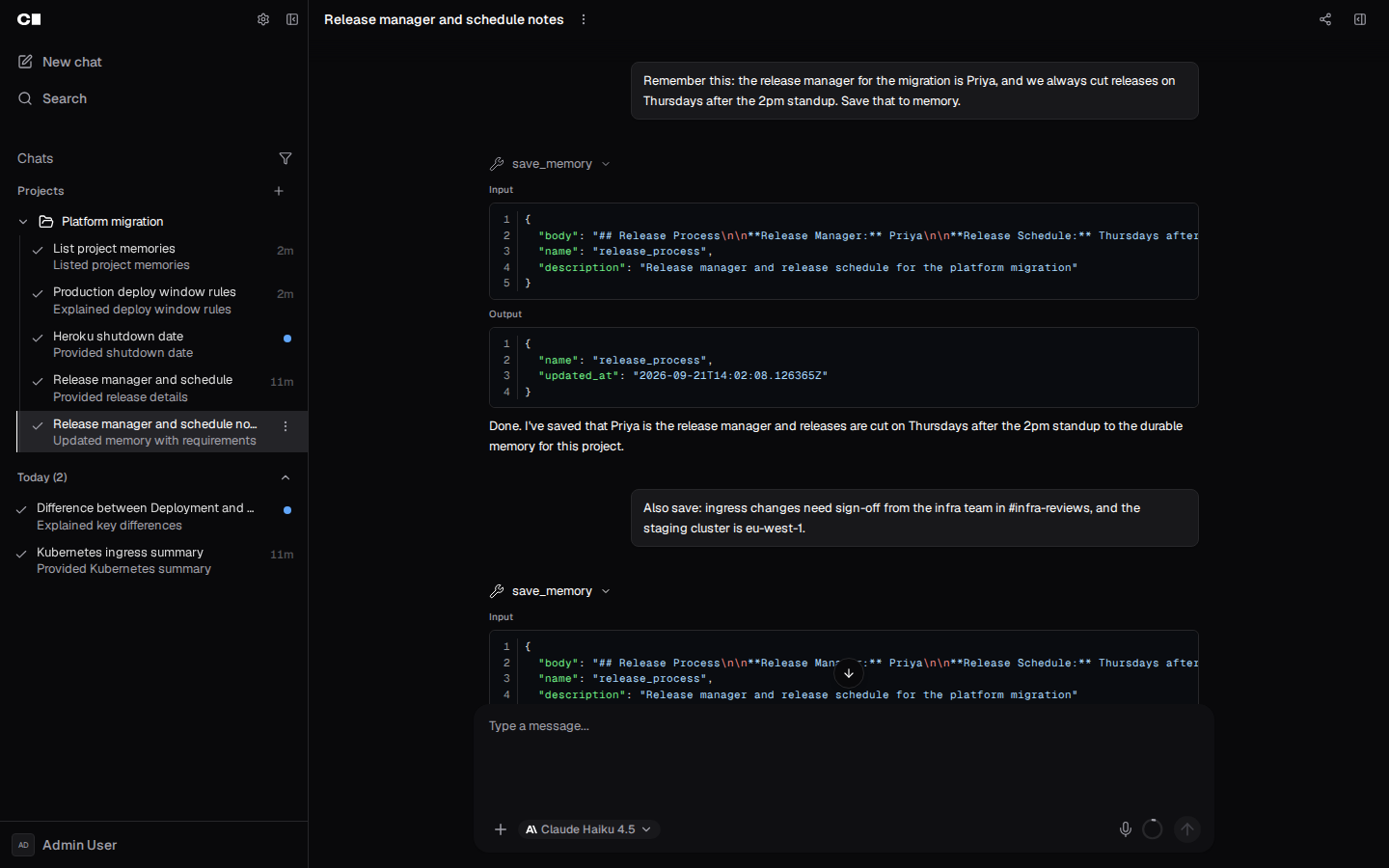 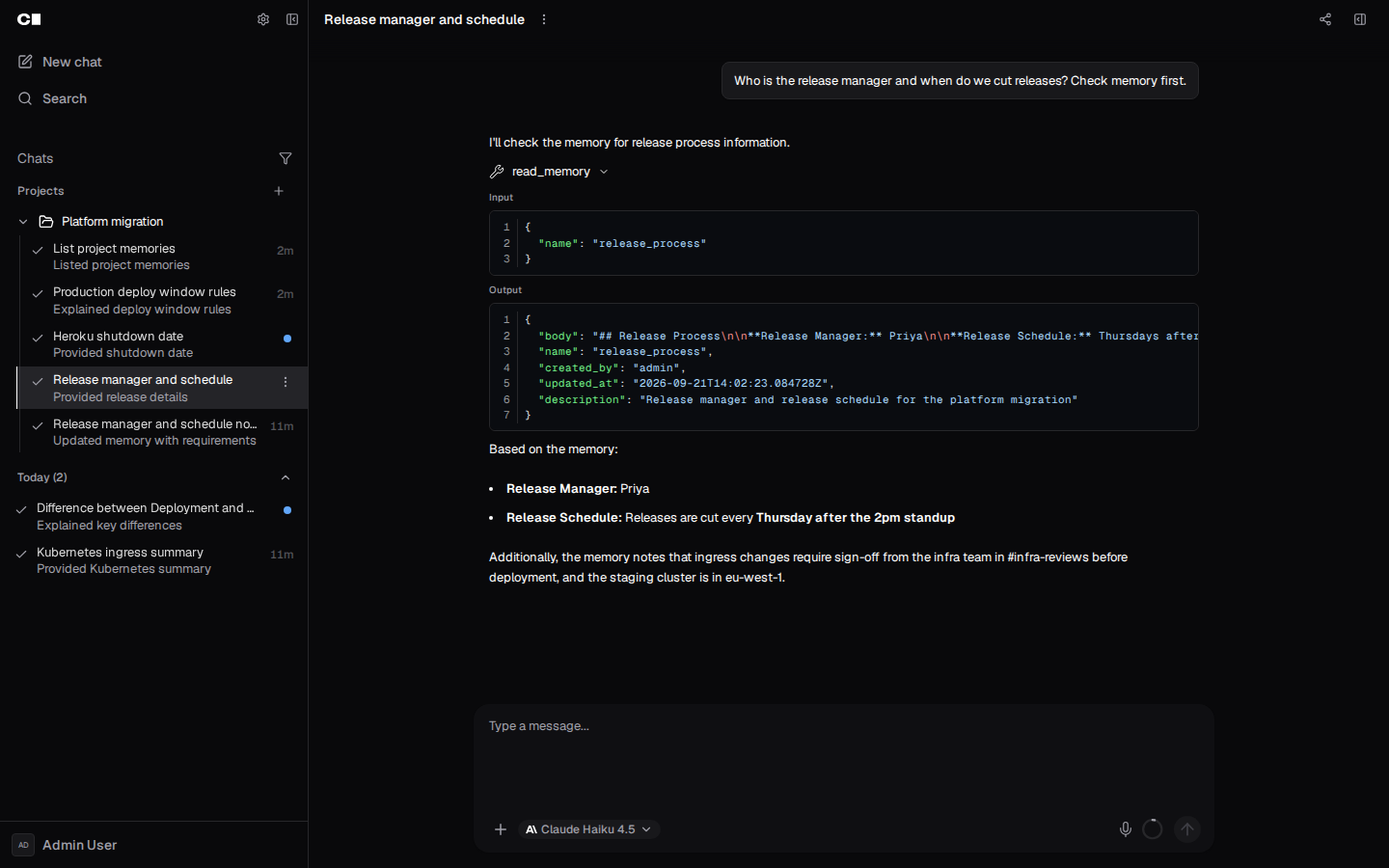 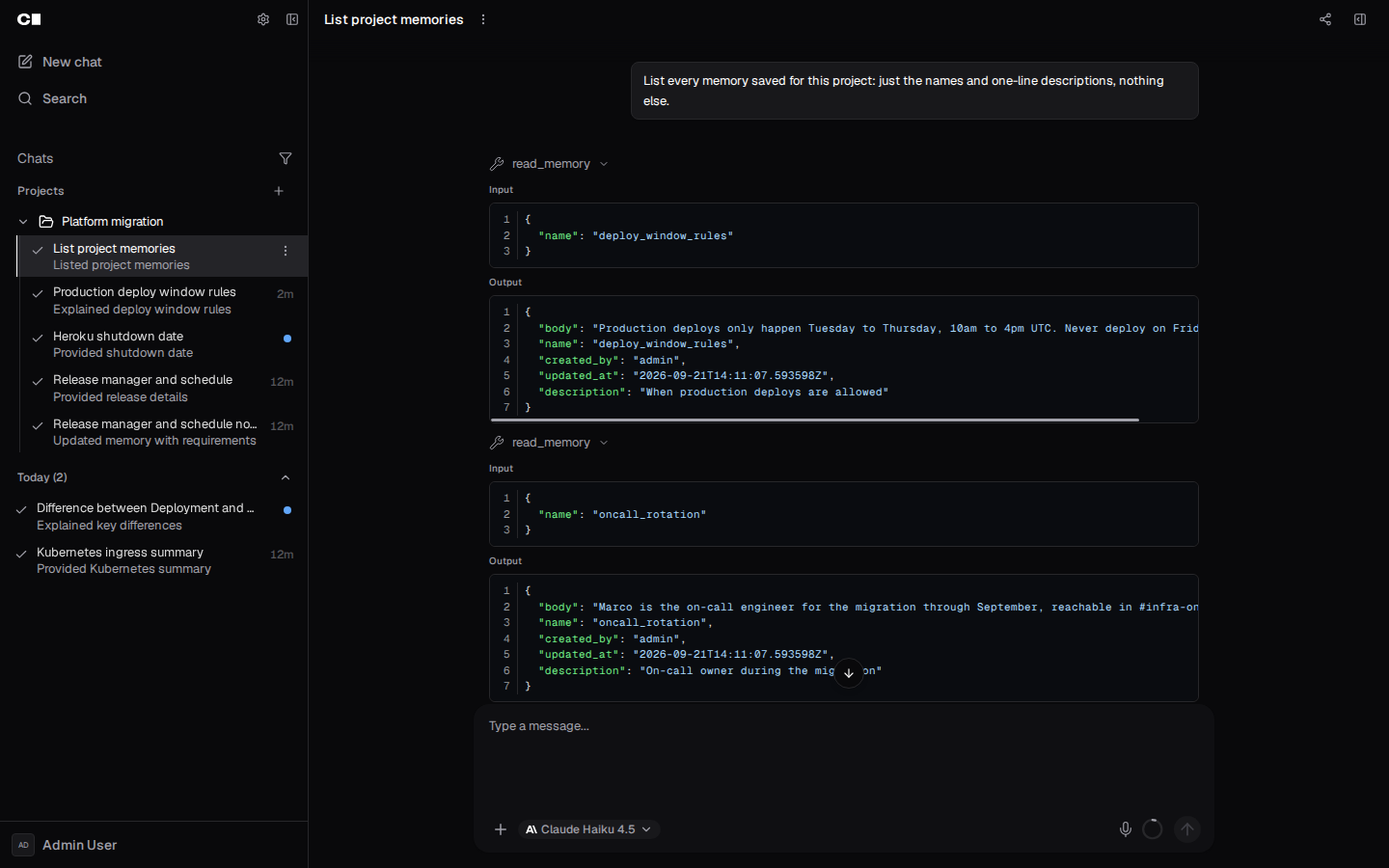 </details> --- Generated with Coder Agents on behalf of @f0ssel. --------- Co-authored-by: Claude Opus 5.5 (1M context) <noreply@anthropic.com> |
||
|
Thomas Kosiewski
|
b517db4beb |
feat: deliver webhook events to existing chats through chat automations (#30127)
Part of CODAGT-1210 (1 of 2). Part of CODAGT-1135. > Stack: PR 5 of "Automations for Coder Agents", on top of #30117. The ticket is split in two by operation: this PR delivers webhook events to `existing_chat` targets; the stacked follow-up delivers them to `new_chat` targets and closes CODAGT-1210. Until then a `new_chat` automation's events endpoint answers `501`. ## What this adds - `POST /api/experimental/chat-automations/{automation}/events`. External systems send the automation's webhook secret as `Authorization: Bearer <secret>` and a JSON body of at most 256 KiB. The route has no API key middleware and sits outside the `/api/experimental` group, behind its own rate limiter keyed by caller and a fixed endpoint key (IP address for unauthenticated callers), so varying the automation id does not reset the budget. - Secret check: SHA-256 of the bearer value, compared in constant time. Unknown ids, other kinds, and wrong secrets all get the same `401`. The `chat-automations` experiment is checked for the automation owner only after the secret matches (`404` when off). The body is then read: over the limit `413`, not JSON `400`. - `chatd.PublishAutomationWebhook` sends as the owner (`dbauthz.As` with the owner's subject) through `SendMessage` with the `queue` busy behavior set explicitly, so automations never interrupt or steer. `user_prompt_submit` hooks run first: a denial is `403`, an unreachable hook service `502`. - One admission check runs before the send (so refused events never reach hooks) and again in the `AdmitInTx` callback, which locks the automation together with the chat's queued automations in one ascending-order call. Under the lock it rechecks: enabled, secret version (a request verified before a rotation but committed after it gets `401`), single-use state, target chat (root chat of the owner, same org, not archived), owner status, and the owner's `chat:update` permission. It then applies **When busy**: `skip` refuses a busy chat (`409`), `queue` refuses input beyond the automations' share, half the chat queue cap rounded down and at least 1 (`429`); busy and the share count only queued rows that promotion would still deliver. It marks a single-use webhook consumed and returns the provenance. - The message has two parts: the saved prompt, and a labeled part with the body as untrusted event data inside `<automation_event_data>` tags. `json.HTMLEscape` escapes `<`, `>`, and `&` in the body, which keeps the JSON value and makes the closing tag impossible to forge. - `chatd.Config.Authorizer` (wired from `options.Authorizer`) for the explicit owner checks; publishing fails closed without one. - New query `ConsumeChatAutomationWebhookByID` with a dbauthz wrapper. Status codes follow the RFC's failure outcomes table; the chat-without-a-model case returns the same `400` as a person's message. ## Notes for reviewers - Single-use consumption runs from the chatd publish code as the owner, because the chatd role only reads `chat_automation`. No lower-layer RBAC change. - ARCHITECTURE.md prose was drafted by an agent at the user's request; the user will review it. - Size: about 1,460 hand-written lines after review fixes (about 770 of them tests), over the ~1,000 budget because of the review hardening. Generated: about 360 lines (`coderd/apidoc`, `dbmock`, `dbmetrics`, `querier.go`, `queries.sql.go`, `docs/reference/api/schemas.md`, `typesGenerated.ts`). - Dogfood UAT ran through Coder Agents on a real dev deployment with curl deliveries. Round 1 found error-mapping defects, fixed here; rounds 2 and 3 passed, the last on the final code (the head after it changes only ARCHITECTURE.md). - Deferred: CODAGT-1233 (stale automation rows filling the physical queue cap; lower-layer `SendMessage` path). --- _Generated with [`xum`](https://github.com/coder/xum) • Model: `anthropic:claude-opus-5-5` • Thinking: `high`_ |
||
|
Garrett DelfosseandClaude Opus 5.5
|
7cd1b2040b |
feat: add chat projects API (#29242)
- Experiment, behind `chat-projects` (off by default). First of three stacked PRs: #29301 (memory), #29583 (UI). This PR is API only; the screenshots below are from the UI in #29583. - CRUD under `/api/experimental/organizations/{organization}/chats/projects/{project}`. `GET /api/experimental/chats/projects` lists the caller's projects across all organizations. - `project_id` on chat create and as a chat list filter. A chat joins a project only at creation; there is no move. - Projects are identified by ID. Names are display labels (64 characters, description 1024) with no uniqueness constraint. An optional `icon` URL (usually an emoji image under `/emojis`) is capped at 256 characters and audited. - A user can own at most 100 projects across all organizations; creating another answers 409. Creates count and insert under a per-owner advisory lock so concurrent requests cannot overshoot. - Projects are private to their `owner_id`. Members may only create their own, and a chat can only be bound to a project its owner owns. An unreadable or foreign project on chat create answers 404 so IDs cannot be probed; a project from another organization answers 400. - Permissions ride on the `agents-access` role next to chats (after #30004), so whoever can use Coder Agents can use projects. Owners and org admins reach every project. ### Examples Create a project in an organization: ```http POST /api/experimental/organizations/{organization}/chats/projects {"name": "Platform", "description": "Infra and deploy work", "icon": "/emojis/1f680.png"} ``` ```json { "id": "7c0e4a3e-5b1f-4f7d-9a51-2f3c8f6d2b10", "organization_id": "bb640d07-ca8a-4869-b6bc-ae61ebb2fda1", "owner_id": "0ed9befc-4911-4ccf-a8e2-559bf72daa94", "name": "Platform", "description": "Infra and deploy work", "icon": "/emojis/1f680.png", "created_at": "2026-09-30T15:04:05Z", "updated_at": "2026-09-30T15:04:05Z" } ``` List the caller's projects across organizations with `GET /api/experimental/chats/projects` (an array of the object above). Update with `PATCH .../chats/projects/{project}` and any of `name`, `description`, `icon`; delete with `DELETE`, which detaches its chats. Create a chat in the project, and list only its chats: ```http POST /api/v2/chats {"organization_id": "bb640d07-…", "project_id": "7c0e4a3e-…", "content": [{"type": "text", "text": "Plan the deploy"}]} GET /api/v2/chats?project_id=7c0e4a3e-… ``` At the limit: ```json 409 {"message": "You can have at most 100 chat projects. Delete a project to create another."} ``` <details> <summary>Screenshots (UI from #29583)</summary> 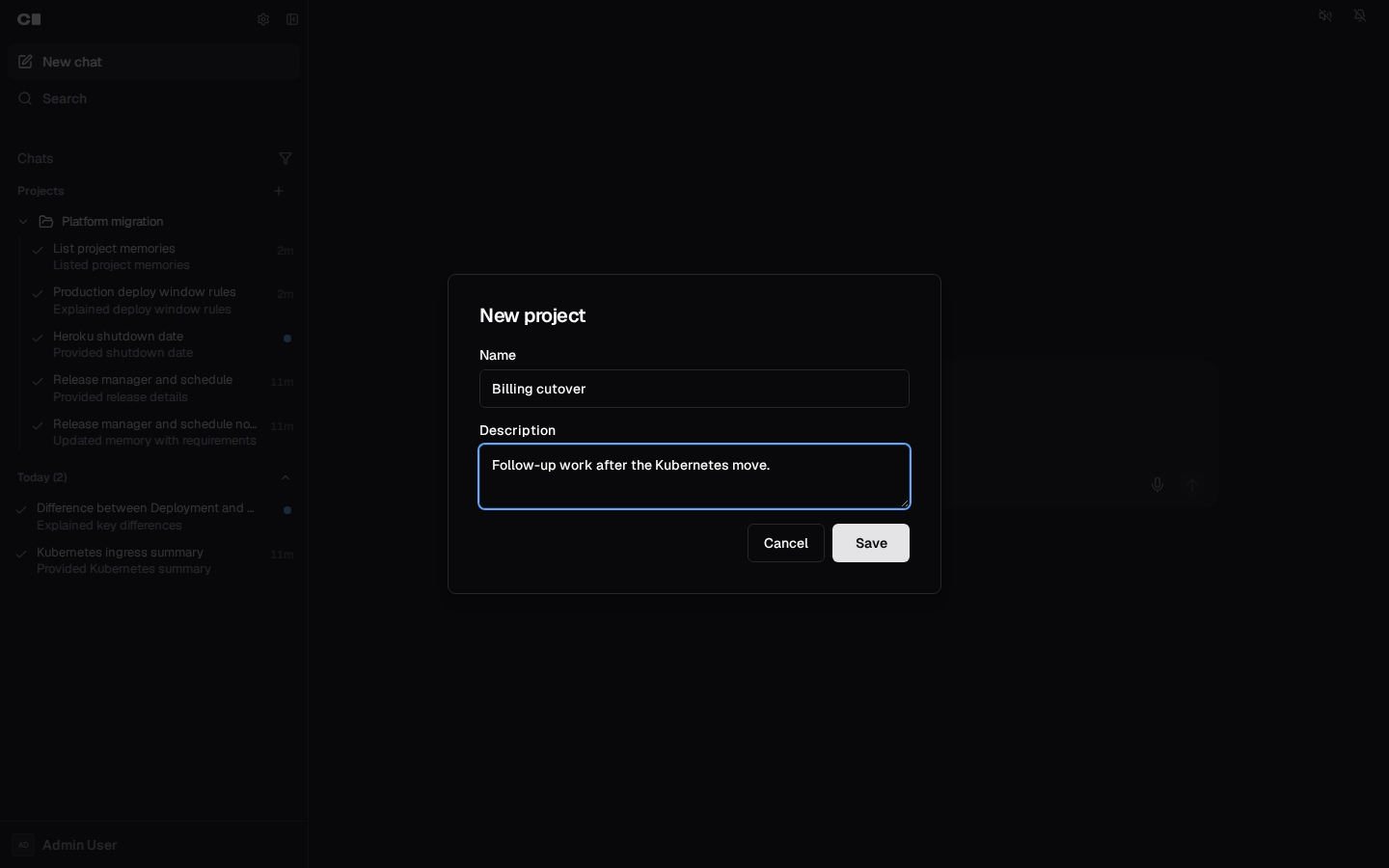 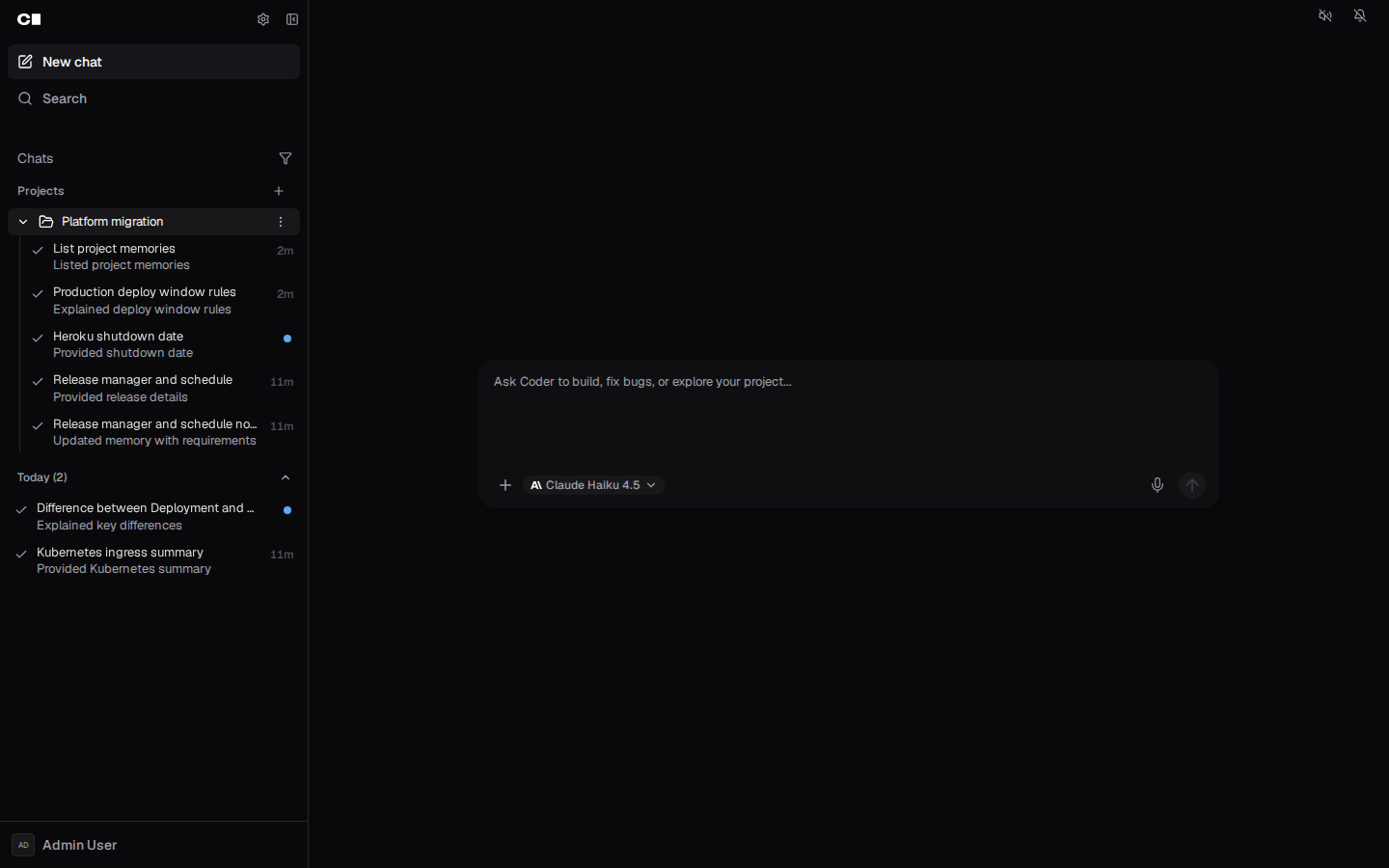 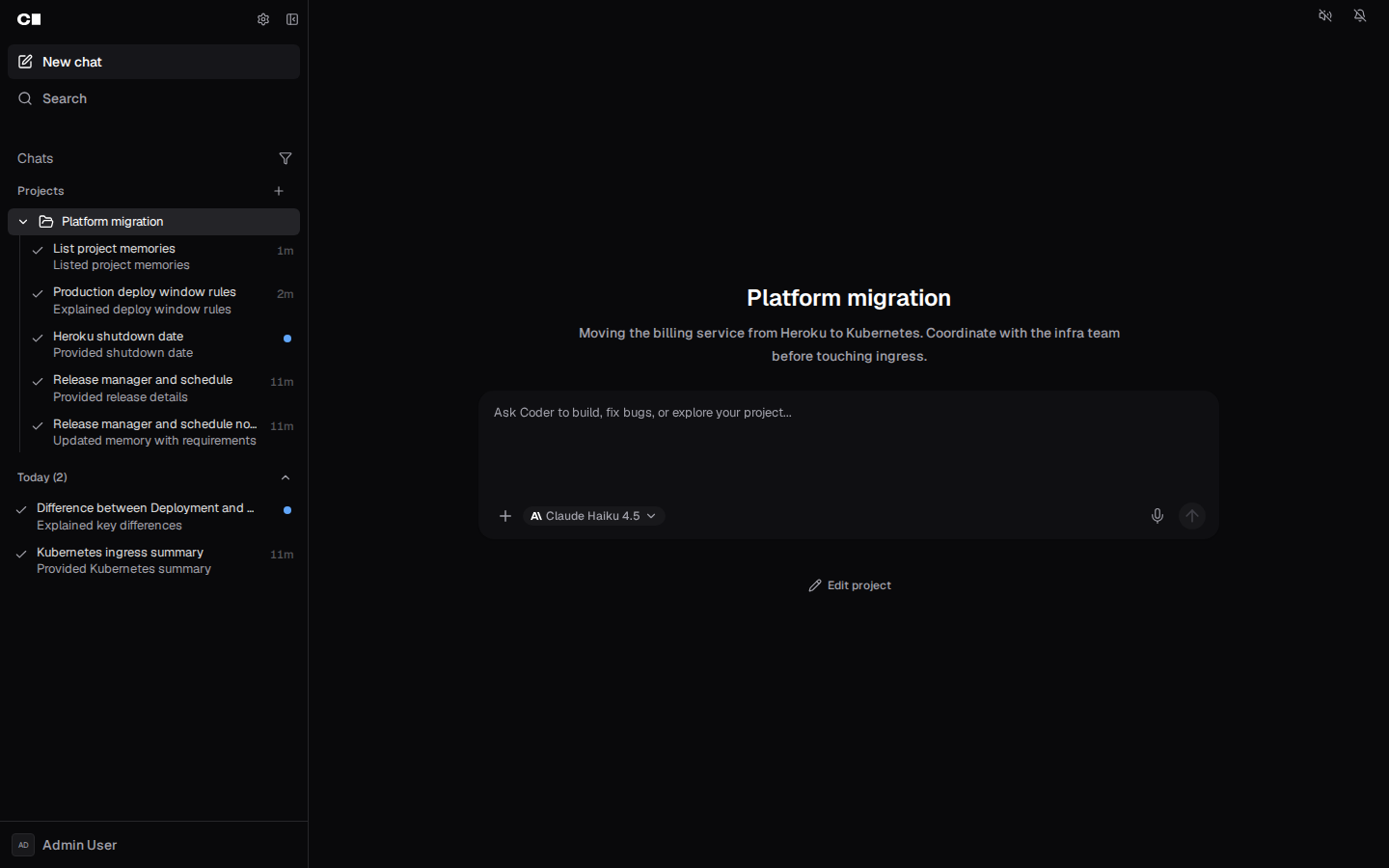 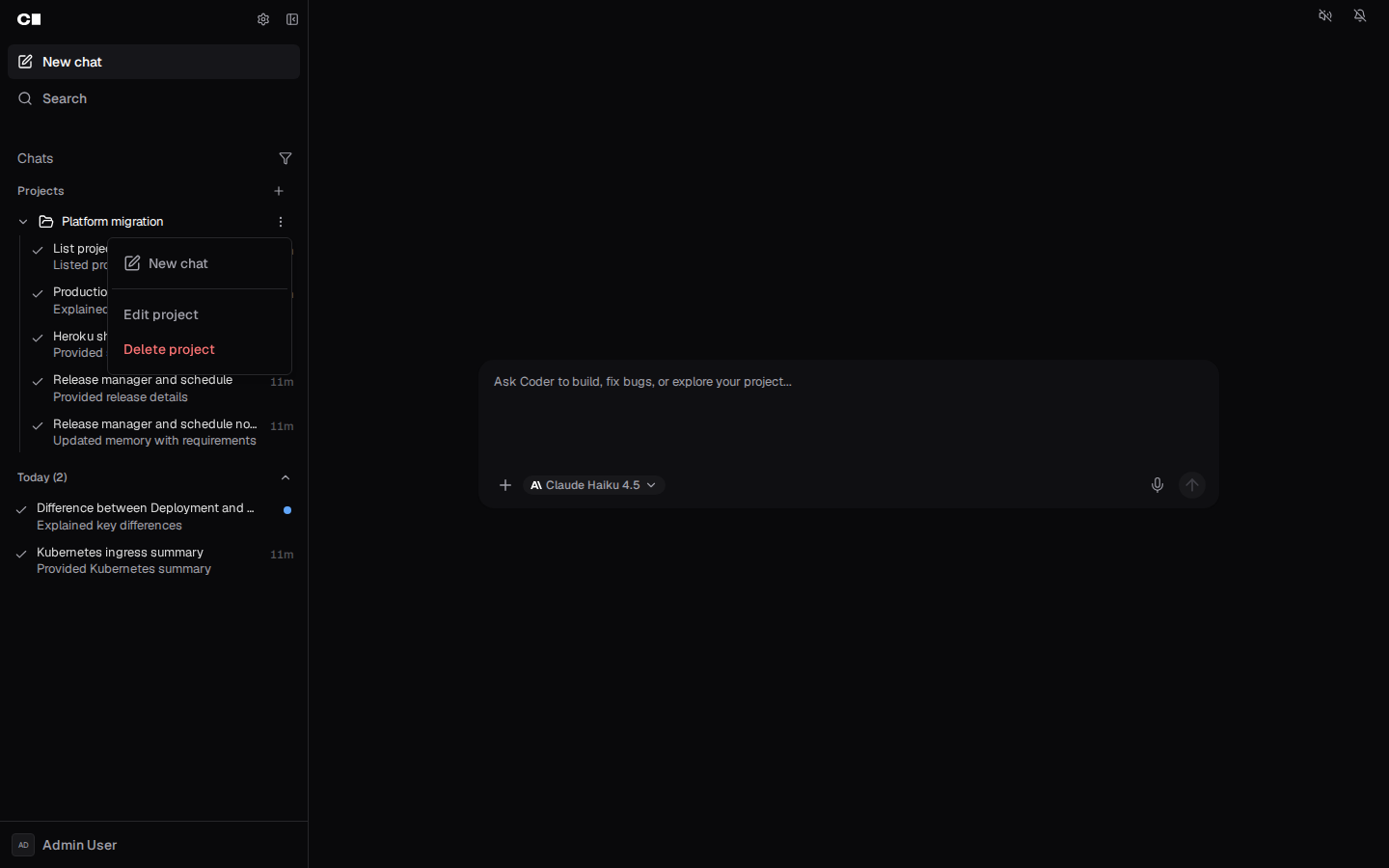 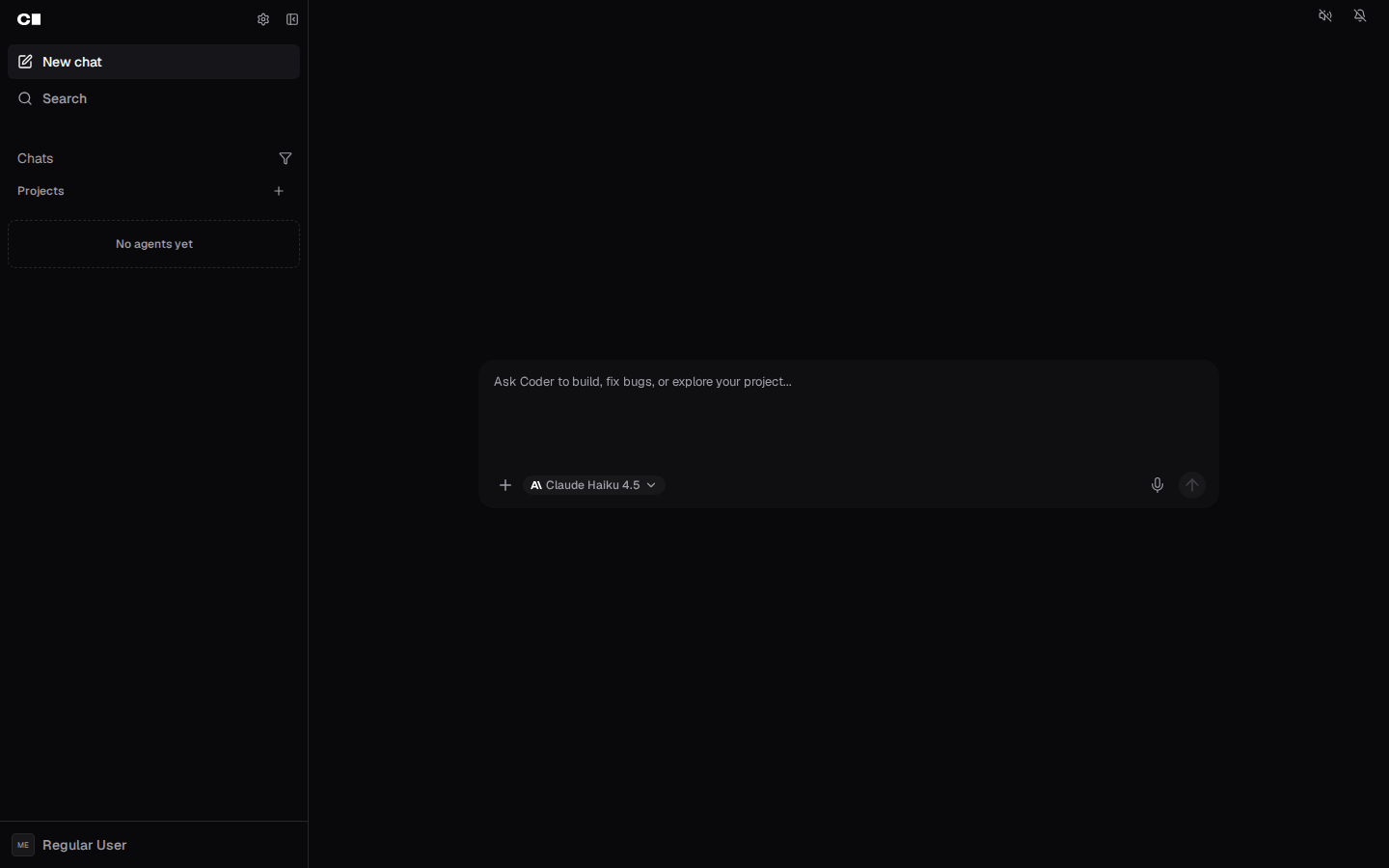 </details> --- Generated with Coder Agents on behalf of @f0ssel. --------- Co-authored-by: Claude Opus 5.5 (1M context) <noreply@anthropic.com> |
||
|
Bobby Ho
|
0058843a63 |
fix: ignore OAuth2 access tokens sent in the URL query string (#29878)
Ignore OAuth2 provider access tokens supplied only via `?access_token=` or `?coder_session_token=`, enforcing OAuth 2.1 §5.1 (D6-05). - Apply across all routes, including custom token readers. Protected routes return 401 with a Bearer challenge and no error code; optional-auth routes proceed unauthenticated. - Continue accepting tokens via `Authorization`, `Coder-Session-Token`, or session cookies, ignoring any query copy. - Log ignored tokens without updating `last_used` or `expires_at`. - Leave Coder session and API tokens unchanged, preserving dashboard WebSocket authentication. **Breaking:** OAuth2-authenticated embedded dashboards lose WebSocket access; the only known use was the VS Code chat sidebar, removed in vscode-coder v1.14.6. - Update docs and regression tests. No migration or new configuration. Fixes PLAT-603. |
||
|
Michael Suchacz
|
6826da9397 |
feat: restore agents-access as a default organization role (#30004)
Restores `agents-access` (**Coder Agents User**) as a built-in organization role and adds it to every organization's `default_org_member_roles`. Members keep Coder Agents by default, and admins can now restrict it per organization by removing the role from the defaults and granting it through IdP role sync or direct assignment. Since #28186, chat permissions lived in the organization-member floor, so the only way to limit Coder Agents was narrowing per-model access lists, which did not hide the feature. - Migration 000602 appends `agents-access` to every organization's defaults, so upgrading keeps every member's access. New organizations get it from `rbac.DefaultOrgMemberRoles()`. - Service accounts do not inherit the role from the defaults (`GetAuthorizationUserRoles`), so they still need an explicit grant for chat. - Owners and Organization Admins keep chat access regardless of defaults. Chats shared with a user stay readable without the role. - Role sync is unchanged. It does not store default roles, so after the default is removed a mapped user gets `agents-access` at their next sign-in. - The retired-role mechanism (`IsRetiredRoleName`) is removed. - `PATCH /api/v2/organizations/{organization}` rejects duplicate `default_org_member_roles` entries (the CLI already de-duplicated them). - Custom organization role requests treat built-in role names case-insensitively, since custom role names are stored lowercase and `Agents-Access` would otherwise become an undeletable shadow of the built-in role. - The Agents permission alert tells restricted members their chats are kept, and the model selector for users without chat permission no longer claims that no models are configured. Docs add "Control who can use Coder Agents" to the Agents getting-started guide. **NOTE**: Migration 000602 deletes custom roles named `agents-access`, which the built-in role would shadow. The down migration does not restore them. Stored member grants of `agents-access` from the earlier built-in role or a deleted custom role stay and now grant chat access. ## Validation - Remote dogfood [UAT](https://dogfood.cdr.dev/agents/e1c18dc6-f6f0-49a1-b6cd-6ce014b51a86) passed on |
||
|
Bobby Ho
|
6372f67f7d |
fix(coderd/httpmw): normalize repeated slashes before CSRF exemption check (#29798)
The CSRF middleware decides whether to protect a request based on the raw URL path, but the router collapses repeated slashes before matching. A path like `/oauth2//authorize` or `//api/v2/...` reaches the real handler while skipping CSRF checks. - Normalize the path before the exemption check, the same way `cors.go` already does. - Add test cases for respelled `/api` and `/oauth2/authorize` paths. Fixes https://linear.app/codercom/issue/PLAT-672/csrf-exemption-bypass-via-path-respelling-post-oauth2authorize-forges |
||
|
Bobby Ho
|
fc707a15d1 |
fix: rate limit the OAuth2 endpoints (#29510)
Apply the login rate limit to OAuth2 authorization, token, revocation, registration, client configuration, and discovery endpoints, closing the brute-force protection gap (D6-01) and bounding database work. - Limit requests per IP without a Coder session and per user otherwise. - Use independent, fixed-key endpoint buckets to prevent path-based bypasses; unmatched routes consume no budget. - Return HTTP 429 with `temporarily_unavailable` and a `message` matching `error_description` for dashboard/SDK compatibility. - Preserve `X-Coder-Bypass-Ratelimit` and `--dangerous-disable-rate-limits`. - Add documentation and tests for route coverage, variable paths, and endpoint/user isolation. No migrations or new configuration. Refs PLAT-624 |
||
|
Michael Suchacz
|
988520477e |
feat!: remove the experimental chat API mounts after the transition window (#29548)
Remove the `/api/experimental` duplicates of the promoted chat API. #28496 double-mounted the chat, organization chat and MCP server, member model-override, AI provider key, and MCP OAuth2 disconnect routes under both prefixes for the one-release compatibility window decided in CODAGT-921; that window closed with v2.37.0, so these routes now answer only on `/api/v2`. The change also deletes what existed only for the dual mount: the `chatAPIPrefix` plumbing, the shared cross-prefix files rate limiter (`RateLimitByAPICompatibilityEndpoint`), the 410 tombstones for the legacy `chats/providers` and `chats/user-provider-configs` collections with their `ExperimentalClient` SDK methods, and the `/providers` and `/user-provider-configs` 404 reservations on `/api/v2`. Signed chat file download URLs now point at `/api/v2`. Routes that were never promoted stay on `/api/experimental`: the experiment-gated `chats/config/advisor` and `chats/config/computer-use-provider`, `chats/{chat}/stream/desktop`, `chats/{chat}/debug/runs`, and the MCP OAuth2 callback, whose path is pinned as a registered redirect URI with external providers. The frontend already calls `/api/v2` for every promoted route, so only `typesGenerated.ts` changes. Because the experimental mount no longer reserves the removed collection segments, requests such as `GET /api/experimental/chats/models` now fall into the `{chat}` wildcard and return 400 instead of 404; the experimental prefix carries no stability guarantee and the compatibility window is over, so no new reservations were added. `coderd/x/chatd/ARCHITECTURE.md` now describes the single `/api/v2` mount and the remaining experimental routes, and its endpoint headings use the `/api/v2` paths. Closes CODAGT-922 (https://linear.app/codercom/issue/CODAGT-922/remove-experimental-chats-api-paths-after-transition-window). Refs #28496. ## Delivery record - Remote dogfood UAT (Coder Agents chat https://dogfood.cdr.dev/agents/c016b549-201a-4eca-a50f-3c0b7c339db6): verdict PASS on b008976a4dfba3524b220ca846ea3c3492e9cc9c. The branch was since rebased onto main (which had a duplicate migration 000596 until #29568) and gained one docs-only commit (`coderd/x/chatd/ARCHITECTURE.md` only); the current head |
||
|
McKayla はな
|
8e159a8053 | chore: remove stale TODO shims and dead code (#29252) | ||
|
Michael Suchacz
|
d2e94e299a | chore: delete dead functions and skip-only or duplicated tests (#29461) | ||
|
Bobby Ho
|
feca38ec74 |
fix: bound OAuth2 request bodies and report the rejection per RFC (#28175)
- Enforce a 4 MiB body limit on `/oauth2/tokens` and `/oauth2/revoke` before parsing, replacing Go’s 10 MiB default. Oversized bodies now return `413 invalid_request` instead of misleading missing-`client_id` errors. - Preserve `/oauth2/register`’s existing body limit while returning protocol-specific `413 invalid_request` errors rather than `codersdk.Response`. - Include JSON decoder details in registration’s malformed-body `400` responses and add raw-body tests to verify the error shape. |
||
|
Bobby Ho
|
4ee70c66c3 |
feat: gate the OAuth2 provider on CODER_OAUTH2_PROVIDER_ENABLE (#29251)
Second of five for PLAT-492. Gates all OAuth2 provider routes and dashboard navigation on CODER_OAUTH2_PROVIDER_ENABLE instead of the oauth2 experiment. The flag is off by default, so deployments using CODER_EXPERIMENTS=oauth2 must set it before upgrading or OAuth2 clients will receive 404s. Existing apps, tokens, secrets, and DCR settings are unchanged. Stacked on #29248 and labeled release/breaking; the next PR makes the old experiment a no-op with a migration warning. |
||
|
Michael Suchacz
|
9cd38b5373 |
feat!: remove the Tasks API from coderd and codersdk (#28789)
Removes the Tasks API and task orchestration from coderd and codersdk: the `/api/v2/tasks` handlers, task middleware and search filters, task name generation, autobuild pause/resume logic, task notification enqueues, telemetry, and the codersdk task types. Regenerates apidoc, the API reference docs, and `typesGenerated.ts`. **Breaking change:** the Tasks API is removed; requests to `/api/v2/tasks` fail. Tasks was deprecated in v2.34. **Stack context:** Coder Tasks removal stack (CODAGT-642): #28743 frontend → #28788 CLI → #28789 API → #28790 provisioner → #29084 notifications → #29085 build reasons → #29086 tables → #28750 permissions. The last four PRs replace the single data-drop migration that used to live in #28750; each carries one concern and its own migration number. **Why:** with the UI (#28743) and CLI (#28788) gone, this deletes the server surface. Database tables, RBAC, and notification templates stay until the top of the stack so every layer builds and migrates independently. **What to scrutinize:** - The `enable-ai-tasks` option is removed outright (review feedback): configs still carrying `enableAITasks` fail to parse until the key is deleted. - provisionerdserver now writes `HasAITask: false` on template/build flags; the column and these lines are dropped in #29085. - `codersdk.ResourceTypeTask` stays so audit logs recorded before the removal keep rendering. **Validation:** `go build ./...`, `go vet ./...`, `go test ./codersdk/...`, site biome and tsc, CLI goldens regenerated, pre-commit hooks. **Size:** +242/-10,792 over 76 files; additions are regenerated docs/goldens and test fixture updates. > Created by Xum (AI agent) on behalf of @ibetitsmike. |
||
|
Bobby Ho
|
42fcd332c6 |
fix: remove CORS from the OAuth2 authorization endpoint (#29143)
fix(oauth2): exclude authorization endpoint from permissive CORS - Apply standard CORS to `/oauth2/authorize`, with or without a trailing slash, as required by OAuth 2.1 §3.1. - Normalize repeated slashes before selecting the policy to prevent exclusion bypasses, including in wsproxy. - Preserve permissive CORS for other OAuth2 endpoints, discovery documents, and MCP. Same-origin consent behavior is unchanged. - Add middleware and router regression tests and update provider security docs. |
||
|
Michael Suchacz
|
351bb14032 |
feat: mount chat API routes under /api/v2 (#28496)
## Stack context This is the base of a 3-PR stack promoting the chat API from `/api/experimental` to `/api/v2`: server compatibility mounts (this PR), codersdk promotion (#28497), and frontend path updates (#28498). ## Summary Double-mount the stable chat and MCP handlers under `/api/v2` while retaining the existing experimental routes for the one-release compatibility window decided in CODAGT-921. CODAGT-922 tracks removing the compatibility mounts. The shared route builders preserve existing authentication and middleware behavior. Experiment-gated, debug, tombstone, and legacy default-organization model routes remain experimental-only. Signed file URLs, external OAuth callback URLs, and mixed-version replica relays also remain on the experimental prefix during the transition. Update Swagger and the generated API reference for the promoted routes, including the workspace lookup and a runnable raw-body chat file upload example. Retain internal endpoints outside the published reference, share chat-file rate limits across both prefixes, enable CORS for the v2 MCP routes, and cover dual mounts plus exclusions with compatibility tests. Remote dogfood UAT passed for the promoted chat, model, MCP, and file flows. > [!NOTE] > Xum acted on Mike's behalf in this pull request. <!-- xum-attribution: model=claude-fable-5 thinking=high --> |
||
|
Hank Hwang
|
2f50b2d740 |
fix(coderd): reject agent requests from suspended owners (#28513)
## What `ExtractWorkspaceAgentAndLatestBuild` computed the workspace owner's RBAC subject via `UserRBACSubject`, but discarded the returned user status. As a result, workspace agent requests were still authorized even when the owner's account was suspended. This change captures `userStatus` and rejects the request with `401 Unauthorized` when the owner is not `Active`, returning a clear message directing the user to contact an admin to reactivate the account. ## Changes - `coderd/httpmw/workspaceagent.go`: stop discarding the owner status from `UserRBACSubject`; return `401` when the owner is not active. - `coderd/httpmw/workspaceagent_test.go`: add an `InactiveUser` test that suspends the owner and asserts a `401` with the expected message. ## Testing - New `TestWorkspaceAgent/InactiveUser` unit test covers the suspended-owner path. --- > This PR was created by Coder Agents on behalf of @hwang251. |
||
|
Ethan
|
aefc761fcf |
feat!: enforce organization scope for chat models (#27959)
## Summary Move chat model management and runtime availability to organization-scoped API routes. The API now identifies the organization in every model-management operation, applies chat model RBAC and ACLs within that organization, and returns only models the caller can use there. Depends on #27958. ## Problem Chat model configurations now belong to organizations, but the existing experimental management and discovery APIs are deployment-shaped. Their routes do not identify an organization, SDK methods do not accept an organization ID, and item operations address a model configuration by ID alone. That contract cannot safely expose organization-owned model configurations. It also does not provide the organization-specific provider information, authorization behavior, ACL management, or recovery guidance needed by the settings and chat clients later in the stack. ## Fix Add organization-scoped chat model endpoints under: ```text /api/experimental/organizations/{organization}/chats/models ``` The new API provides: - Organization-scoped model listing and creation. - Model get, update, and delete operations scoped by both organization and model ID. - Model ACL read and update operations. - Organization-scoped runtime availability and provider status. - Redacted provider descriptors for model-management clients. - Chat model RBAC and row ACL enforcement for writes, runtime discovery, and Chatd model selection. - Recovery guidance when a chat's organization has no usable local model. Historical chats can retain a model reference owned by another organization, but runtime selection uses an authorized local default when one is available. Foreign, inaccessible, disabled, and otherwise unusable models are not exposed as usable selections for the organization. The existing collection and availability routes remain as default-organization compatibility endpoints in this layer: ```text GET /api/experimental/chats/model-configs POST /api/experimental/chats/model-configs GET /api/experimental/chats/models ``` These compatibility routes do not provide access to models in non-default organizations. The previous unscoped item update and delete routes are removed because item operations must include the owning organization. ## Breaking change This changes the experimental HTTP API and Go SDK contracts for chat model management. Clients must migrate model-management and availability requests to the organization-scoped routes and provide an organization identifier. In the Go SDK, the following methods now require an organization ID: - `ChatModelAvailability` - `ChatModels` - `CreateChatModel` - `UpdateChatModel` - `DeleteChatModel` `ChatModels` also changes its return value from `[]ChatModel` to `OrganizationChatModelsResponse`, which includes the organization models and the redacted provider descriptors required by management clients. New item and ACL methods likewise require both the organization ID and model ID. The default-organization compatibility routes reduce the immediate impact for collection and availability callers, but they do not preserve the previous item API or SDK method signatures. Generated clients and direct consumers of the experimental API must be updated before adopting this change. _This pull request description was generated by Coder Agents._ |
||
|
McKayla はな
|
5ca0143992 | refactor: upgrade golangci-lint to v2.0.2 (#28416) | ||
|
Michael Suchacz
|
7ca7c30f40 |
feat: add group and user ACLs to MCP server configs (#27944)
Adds group and user ACLs to org-scoped MCP server configs so
organizations can restrict specific MCP servers to subsets of members,
mirroring the template ACL pattern.

## Summary

- Migration adds `group_acl`/`user_acl` JSONB columns (nested `{"<id>":
{"permissions": [...]}}` shape) and seeds every existing config with its
organization's Everyone group read entry (the Everyone group ID equals
the org ID), so member access is unchanged by default. Creation seeds
the same entry.
- The blanket org-member read grant from the base PR is replaced by ACL
evaluation: Rego requires org membership for every ACL grant, and
`GetAuthorizedMCPServerConfigs` compiles ACL-aware SQL filters.
- New `ActionShare` (org admins) gates `GET|PATCH
/api/experimental/organizations/{organization}/mcp-servers/{mcpserverconfig}/acl`
(nested under the organization like the rest of the config surface).
PATCH validates principals against the config's organization, merges
sparse updates under a row lock, stamps `updated_by`/`updated_at`, and
is audited as a Write with `Old` captured before authorization. A config
deleted concurrently between the middleware fetch and the locked
re-fetch is concealed as 404, matching the update and delete handlers.
ACL columns are tracked in the audit table.
- ACL management is available in all editions (no enterprise
entitlement), documented in the MCP servers page. Revoking an ACL does
not retro-strip already-selected configs from existing chats; new
selection is blocked at chat create.
- Force On respects the ACL: the forced set is loaded as the chat owner,
so a `force_on` server whose ACL denies the owner never attaches at
create, send, or generation time.
- No rolling-upgrade machinery: upgrades run in scheduled maintenance
downtime, so the migration only backfills existing rows; the API sets
the Everyone read grant explicitly on every insert.

Stacked on #27943. Part of the MCP org-separation stack.

Closes https://linear.app/codercom/issue/CODAGT-712

UAT: verified on a dogfood instance with two members and a custom group:
Everyone-seed default visibility, group grant with Everyone removal
(non-member loses list/fetch/selection), foreign-principal rejection,
non-admin share denial (audited 403 / concealed 404), user_acl restore,
and audited ACL diffs.

> Mux (AI agent) authored this PR on Mike's behalf.

<!-- mux-attribution: model=claude-fable-5 thinking=high -->
|
||
|
Michael SuchaczandMathias Fredriksson
|
443e3b9b80 |
feat!: org-scope MCP server configs with RBAC (#27942)
Moves `mcp_server_configs` from deployment scope to organization scope
so each organization fully controls the MCP servers its members can use
with Coder Agents.

## Summary

- Migration: adds `organization_id` (NOT NULL, FK) and keeps existing
rows as the default organization's originals with credentials intact.
Other organizations start with no MCP servers and configure their own;
nothing is copied across organizations. Chats outside the default
organization keep any now-cross-organization `mcp_server_ids` entries;
the runtime already ignores IDs that do not resolve in the chat's
organization, so no data rewrite is needed. Slug uniqueness becomes
`(organization_id, slug)`.
- RBAC: new org-scoped `ResourceMCPServerConfig` with regosql converter
and `GetAuthorizedMCPServerConfigs`; org admins get in-org CRUD, org
members get read (replaced by ACL evaluation in the follow-up ACL PR in
this stack).
- API: all config routes nest under the organization, matching
templates: `POST|GET
/api/experimental/organizations/{organization}/mcp-servers` and
`GET|PATCH|DELETE .../mcp-servers/{mcpserverconfig}` (plus
`oauth2/connect`), resolved by a read-only param middleware that
conceals read-denied and cross-organization access as 404. Two routes
stay on the frozen `/api/experimental/mcp/servers/{mcpServer}` block:
the OAuth2 callback (the redirect URI baked into existing AS-side client
registrations) and `oauth2/disconnect`, which must remain reachable by
users removed from the organization so they can still revoke their token
grant.
- Chat runtime: selection validation and generation resolve configs
strictly by IDs, enabled state, and the chat's organization in SQL;
requested duplicates are normalized; invalid or cross-org IDs are
rejected with the precise ID list. IDs already persisted on a chat are
exempt from message-time rejection so disabling a selected server never
blocks sends; generation skips servers that are no longer usable.
- Frontend: API layer and admin settings pages target the new endpoints.
The admin page manages the default organization's servers; the org
picker is tracked separately (CODAGT-714).

- Security hardening from review: OAuth user grants are additionally
bound to `oauth2_revocation_url` (changing it invalidates grants, and a
racing OAuth callback gets 409 instead of recreating a grant).
Stack-wide SSRF protection for MCP config-directed traffic was split
into its own PR at the top of this stack (#28242) to keep this diff
reviewable; this PR keeps main's existing discovery IP-range guard.
OAuth2 auto-discovery now completes before the config row is inserted: a
failed discovery persists nothing, and there is no provisional row that
concurrent updates could race against.

Two follow-up PRs in this stack were split out to keep this diff
reviewable: #28064 completes the swagger annotations for the moved
routes (main already ships these experimental MCP handlers unannotated),
and #28065 carries hardening fixes and regression pins on top of the
cutover.

- Force On enforcement (landed on main mid-review) is org-scoped: the
forced set is read per chat organization
(`GetForcedMCPServerConfigsByOrganization`), so another organization's
`force_on` server never attaches to a chat.

## Breaking changes (experimental API)

The MCP server config endpoints move from the deployment-scoped
`/api/experimental/mcp/servers` block to organization-nested paths:
`POST|GET /api/experimental/organizations/{organization}/mcp-servers`
and `GET|PATCH|DELETE
/api/experimental/organizations/{organization}/mcp-servers/{mcpserverconfig}`
(plus `oauth2/connect`). The old paths are removed, so API consumers
must supply an organization. Two routes intentionally stay on the frozen
`/api/experimental/mcp/servers/{mcpServer}` block: the OAuth2 callback
(its redirect URI is baked into existing AS-side client registrations)
and `oauth2/disconnect` (must remain reachable by users removed from the
organization). These endpoints are under `/api/experimental`, so no
deprecation window is provided.

## Rolling upgrades

During a rolling deploy, an old replica creating an MCP config can fail
the new `NOT NULL organization_id` constraint until it is upgraded
(reads are unaffected: old binaries' generated queries select their own
column lists). This matches the repo's existing precedent for additive
NOT NULL migrations (000562) and affects only the admin config-create
path in the upgrade window.

Upgrades are expected to run in scheduled maintenance downtime with the
database locked during migration, so the migration ships no
rolling-upgrade compatibility machinery. The down migration deletes
organization-created configs (their chat references are cleaned by the
000510 delete trigger) and restores deployment-wide slug uniqueness.

Part of the MCP org-separation stack (CODAGT-711 -> CODAGT-717 audit ->
CODAGT-712 ACLs -> CODAGT-806 token RBAC).

Closes https://linear.app/codercom/issue/CODAGT-711

UAT: validated end to end on a two-org dogfood deployment, including a
real pre-migration to post-migration upgrade, cross-org isolation
(404s), same-slug-two-orgs, chat selection gating, and a live MCP tool
call through the org-scoped generation path. The migration was later
revised to keep existing rows in the default organization only (no
per-organization copies); that revision is covered by the migration test
suite.

> Mux (AI agent) authored this PR on Mike's behalf.

<!-- mux-attribution: model=claude-fable-5 thinking=high -->

---------

Co-authored-by: Mathias Fredriksson <mafredri@gmail.com>
|
||
|
Bobby Ho
|
166d92ba73 |
fix: bound request body size on JSON API endpoints (#28168)
## Summary `httpapi.Read` decoded request bodies with no size limit, so a single request could allocate memory without bound. This adds a 4 MiB default ceiling, leaves the endpoints that legitimately need more explicitly exempted, and counts the rejections so a limit set too tight is visible. This is the first of three PRs split out of #28048, covering the endpoints that answer in `codersdk.Response` shape. The OAuth2 decode paths (RFC 6749, RFC 7591) and the SCIM ones (RFC 7644) answer in their own error shapes and follow in separate PRs, along with the lint rule that pins the invariant. Closes PLAT-463. Remediates SEC-416 (CWE-770, CVSS 7.5) and SEC-392. ## Problem `httpapi.Read` calls `json.NewDecoder(r.Body).Decode(value)` with no ceiling, and no middleware in the chain bounds body size. The exposure is pre-authentication: login, OTP, and first-user creation all read a body before any authorization decision is reached. The existing rate limiter bounds request *rate*, which is orthogonal to the memory a single admitted request may consume. ## Fix `Read` is split into `Read` and `ReadLimit`. `ReadLimit` wraps `r.Body` in an `http.MaxBytesReader` and keeps the existing decode and validate logic; `Read` delegates to it with a new `DefaultMaxRequestBodyBytes` of 4 MiB, which covers the 124 remaining non-test callers at a single site. `http.MaxBytesReader` composes as tightest-wins, so the handlers that pre-wrapped their own bodies pass their limit to `ReadLimit` rather than wrapping, and each keeps its previous ceiling byte for byte. That matters most for the bulk secrets import at `8 * MaxSecretsFileBytes`: an unconditional wrap inside `Read` would have silently halved it to the default. `TestImportUserSecretsBodyLargerThanDefaultLimit` is the regression guard for that specific failure, and `TestMaxBytesReaderNesting` pins the composition behavior the whole requirement rests on. Every rejection site calls `httpapi.RecordRequestBodyLimit`, which names the limit that tripped on the request's existing log line and marks the request so `coderd_api_requests_too_large_total{reason="request_body"}` counts body rejections apart from the 413s coderd answers for other causes, such as agent log storage overflow. A limit set too tight for a legitimate payload therefore surfaces without waiting for a user report. The limit is a constant rather than a deployment option: an operator raising it to unblock something would reopen the vulnerability as configuration, where a security scan will not find it. A legitimate 413 is answered with a targeted `ReadLimit` on that endpoint. ## Behavior change `POST /api/v2/files` now answers 413 rather than 400 when a request body exceeds `HTTPFileMaxBytes`. It installed that bound already but reported the rejection as a read failure, which leaked the stdlib `http: request body too large` string through `Detail` and kept the largest limit in the tree off the metric. The separate 413 for an oversized expanded archive is unchanged. The task log snapshot endpoint now answers 413 rather than 400 when its 64 KiB cap is exceeded. Routing it through `ReadLimit` also changes its decode-failure message from "Failed to decode request payload." to "Request body must be valid JSON.", which is what every other endpoint answers. Its tests are updated to match both. `coderd_api_requests_too_large_total` is new, so there is no existing query to migrate. It counts the 413s coderd answers, labeled `method`, `path`, and `reason`. `reason="request_body"` is a rejection by one of the limits above; `reason="other"` is a 413 that has nothing to do with body size, such as agent log storage overflow. ## Reading this The commits are ordered to be read in sequence. Commits 1 and 2 are the security fix; commits 3 to 5 are the observability consequences, and commit 3 is the one that touches dashboards. Commit 7 documents the limit on the REST API reference index. Commits 6 and 8 add and revert an exhaustive `@Failure 413` annotation pass, which buried the fix under its regenerated swagger, and cancel out. |
||
|
Bobby Ho
|
1aa3553b52 |
fix(coderd): set Cache-Control: no-store on OAuth2 responses (#28143)
No response from the `/oauth2` route tree set `Cache-Control` at all, so
an intermediary cache or customer-operated reverse proxy was free to
apply a heuristic freshness lifetime to a response carrying a live
credential. RFC 6749 §5.1 and OAuth 2.1 §3.2.3 both make an affirmative
`no-store` directive a MUST for the authorization server.

Adds `httpmw.NoStore`, mounted on the `/oauth2` and
`/api/v2/oauth2-provider` trees, setting `Cache-Control: no-store` and
`Pragma: no-cache` on every response from them. OAuth 2.1 drops `Pragma`
because RFC 9111 §5.4 deprecates it as a request-only field, so sending
both is conformant under either reading. Not operator-configurable,
since both specs say MUST.

## Scope

- **Both trees, not just `POST /oauth2/tokens`.** The mount is one line
either way, and the wider scope also covers DCR registration, client
configuration read and update, the authorize 302 whose `Location` query
carries the code, and `POST /oauth2-provider/apps/{app}/secrets`, which
returns a plaintext client secret. A route added later inherits the
headers, which matters for PLAT-449.
- **A middleware, not a hook in `httpapi.Write`.** Three write paths
never call it: `POST /oauth2/revoke` and `DELETE
/oauth2/clients/{client_id}` write a bare status, and
`writeOAuth2RegistrationError` encodes its own JSON.
- **`/.well-known/*` deliberately excluded.** Public discovery metadata,
and RFC 9728 §5 asks for the opposite treatment. Assertions pin the
exclusion so a later hoist onto a higher router fails CI.
- **Session-credential routes left alone.** `/users/login`,
`/users/otp/change-password`, and `/users/{user}/keys/*` have the same
gap, but PLAT-448 is scoped to OAuth2 and reaching into session auth
changes the risk profile.

Every credential-returning route here is a `POST`, and RFC 9111 §3 bars
heuristic caching of `POST` responses, so this is defense-in-depth
against a non-conformant intermediary rather than a live caching bug.
Both specs say MUST regardless of what caches would actually do.

## Note for PLAT-498

`DELETE /oauth2/tokens` now carries `no-store` and is wrapped in
`apiKeyMiddleware`, which is mounted inside the `/oauth2` tree and
therefore runs after this middleware. It is the one route where both can
write `Cache-Control`, and PLAT-498's write must not replace `no-store`
with something weaker such as `private`. `POST /oauth2/tokens` cannot
overlap, since it deliberately has no `apiKeyMiddleware`.

## Two assumptions testing corrected

- `GET /oauth2/does-not-exist` returns **200**, not 404. Chi runs the
subrouter's middleware chain for unmatched paths, so both headers are
present, but the request falls through to the root router's SPA handler.
The test asserts the headers and deliberately not the status.
- The experiment-disabled case is unreachable from a test binary, since
`RequireExperimentWithDevBypass` short-circuits on `buildinfo.IsDev()`.
A unit test covers the consequence against the `RequireExperiment` it
delegates to.

No schema, `codersdk`, or serpent option changes, so `make gen` produces
no diff. Rollback is a revert.

Refs PLAT-448
|
||
|
McKayla はな
|
2f879910af |
fix(coderd): harden oauth2 redirect validation (#27274)
Closes DEVEX-604 Hardens `redirect` URL handling in the OAuth2/OIDC/external-auth callback flows so redirects are always reduced to a safe, relative path local to the application. Previously a redirect value with an opaque scheme (e.g. `javascript:...`) or a path with multiple leading slashes (e.g. `///evil.com`) could survive sanitization mostly intact. Also de-duplicates the previously copy-pasted `uriFromURL` helper (now exported `httpmw.URIFromURL`) so there's a single implementation shared by `coderd/userauth.go`, `coderd/externalauth.go`, and `coderd/httpmw/oauth2.go`. <details> <summary>Context</summary> Addresses a low-severity finding reported via a pentest disclosure: the redirect sanitizer used `url.Parse(...).RequestURI()`, which doesn't reject non-hierarchical (opaque) URLs and doesn't collapse extra leading slashes, so crafted `redirect` values could partially survive sanitization. </details> This PR was authored by a Coder Agent on behalf of @aslilac. |
||
|
Bobby Ho
|
de716f89dc |
fix: normalize path before rate-limit bucket keying (#27273)
Coder's rate limiter keyed its bucket on the raw, un-normalized request path (`httprate.KeyByEndpoint` reads `r.URL.Path` directly). The router's `singleSlashMW` already collapses redundant slashes so a request like `/api/v2/users//validate-password` reaches the same handler as the canonical path, but it never touched `r.URL.Path`, so the rate limiter saw a different key and let a client bypass a limit it had already hit just by respelling the URL. `keyByNormalizedEndpoint` replaces `KeyByEndpoint` and runs `path.Clean` on `r.URL.Path` before using it as the key, so equivalent paths share one bucket. Includes a unit test at the key-function level and an integration test (`TestRateLimitPathNormalization`) that reproduces the bypass against a real server. Fixes CDM-02-003 (Cure53). Refs https://github.com/coder/security-disclosures/issues/166. |
||
|
Itay Dafna
|
d7ad85f7f6 |
feat: support multiple OIDC redirect URIs (#25408)
This PR adds a new opt-in setting, `CODER_OIDC_REDIRECT_ALLOWED_HOSTS`, that lets a single Coder deployment complete OIDC login on more than one hostname. When the allowlist is non-empty, Coder picks the OIDC `redirect_uri` based on the incoming request's Host header (validated against the list) instead of always using the static URL derived from `CODER_ACCESS_URL`. When unset, the (default) behavior is identical to today. The motivation is that a single Coder deployment is frequently reachable via multiple hostnames - for example, an internal hostname for users on a corporate VPN and a different hostname routed through a zero-trust gateway for users off-VPN - but OIDC login today only works on whichever single hostname `CODER_ACCESS_URL` points to, because the `redirect_uri` sent to the IdP is fixed at server startup. Users who reach the deployment on any other valid hostname can see the login page but fail the OIDC callback, since the IdP redirects them back to a hostname they can't reach (or whose cookies they don't have). |
||
|
Zach
|
953091c7bc |
refactor: use sync.WaitGroup.Go in tests (#26671)
Migrate `wg.Add(1); go func() { defer wg.Done(); ... }()` to
`wg.Go(func() { ... })` in tests.

Where the prior pattern passed the loop variable explicitly via a
closure parameter (`go func(id int) { ... }(i)`), drop the parameter and
reference the loop variable directly. Per-iteration loop variables since
Go 1.22 make this safe.
|
||
|
Jon Ayers
|
29f124a650 | fix: resolve client IP from the rightmost untrusted X-Forwarded-For entry (#26646) | ||
|
Jakub Domeracki
|
450ddff568 |
fix(coderd/httpmw): honor fixed lifetime for CLI API tokens (#26376)
## What

API key validation applied a sliding-window expiry refresh to every key
type. Programmatic API tokens (created via `coder tokens create`, login
type `token`) had their `expires_at` extended to `now + lifetime` on
each authenticated request (with a ~1h debounce), so a token used within
its lifetime window never actually expired.

This restricts the sliding-window refresh to interactive login sessions
(password / OIDC / GitHub). Programmatic tokens now honor their fixed
`expires_at`.

## Why

A finite token `--lifetime` is expected to be a hard expiry. Silently
extending it on use defeats that expectation and prevents rotation of
long-lived automation credentials.

## Changes

- `coderd/httpmw/apikey.go`: skip the expiry refresh when `key.LoginType
== database.LoginTypeToken`.
- `coderd/httpmw/apikey_test.go`: regression test asserting a token's
expiry is not extended on use.

## Notes

- Interactive sessions are unaffected (they still slide while active).
- Tokens already extended are not retroactively shortened; this prevents
future extension.

<details>
<summary>Validation</summary>

- `go build ./coderd/httpmw/...`
- `go test ./coderd/httpmw/ -run TestAPIKey -count=1` (all pass,
including the new `TokenNoExpiryRefresh` and the interactive
`ValidUpdateExpiry`)
- `golangci-lint run ./coderd/httpmw/` (clean)
- Confirmed the new test fails without the production change and passes
with it.
</details>

---
🤖 Generated by Coder Agents on behalf of @jdomeracki-coder.
|
||
|
George K
|
b5ef700dd6 |
fix!: only trust x-forwarded-host from configured trusted proxies (#26204)
Subdomain app routing derived the app identity from httpapi.RequestHost, which returned the client-supplied X-Forwarded-Host header verbatim. No middleware validated or stripped that header, so a request from an untrusted peer could forge it. Since the application_connect cookie is scoped to the wildcard apps domain, JavaScript in a share=authenticated app could fetch() with a forged X-Forwarded-Host pointing at a victim's owner-only app; coderd routed and authorized the request as the victim and returned the private app response same-origin to the attacker. Replace RequestHost with httpmw.EffectiveHost, which honors X-Forwarded-Host only when the original socket peer is a configured trusted origin, otherwise falling back to the received Host header. This ties host trust to the same RealIPConfig model already used for X-Forwarded-For and -Proto. Wire it into HandleSubdomain for both coderd and wsproxy, and log both the effective host and the raw received_host. Add coverage: EffectiveHost unit tests assert the trust decision uses the socket peer rather than the spoofable forwarded client IP, and a HandleSubdomain test confirms a forged X-Forwarded-Host from an untrusted peer never reaches token resolution. Refs: https://linear.app/codercom/issue/PLAT-259 |
||
|
Steven Masley
|
938c2080f3 |
feat: configurable default org member roles (#25994)
Refs #25936. Adds a configurable per-org default member role set. Unioned into each member's effective roles at read time. <sub>with Coder Agents on behalf of @Emyrk.</sub> |
||
|
Cian Johnston
|
8b058dc949 |
feat: add coderd_api_websocket_probes_total metric (#25012)
Relates to CODAGT-115 Adds metric `coderd_api_websocket_probes_total`. Every successful heartbeat for a given path will increment the metric. Comparing this with `coderd_api_concurrent_websockets` will give an indication of how many websocket connections are open but in a 'wedged' state (when heartbeats stopped versus when we closed the connection). |
||
|
Spike Curtis
|
8dc4d76890 |
chore: add agent-connection-watch for workspaces (#24507)
<!-- If you have used AI to produce some or all of this PR, please ensure you have read our [AI Contribution guidelines](https://coder.com/docs/about/contributing/AI_CONTRIBUTING) before submitting. --> relates to GRU-18 Adds basic implementation for Workspace Agent Connection Watch and tests. Missing are handling of logs. |
||
|
Zach
|
81e2be69e9 |
test: use typed atomics in test files (#25071)
Use typed atomics (atomic.Int64, atomic.Int32, etc.) in test files to prevent mixing atomic and non-atomic access on the same value, guarantee 64-bit alignment on 32-bit platforms, and provide a cleaner API. |
||
|
Cian Johnston
|
2f855904be |
refactor: add dbgen chat generators and migrate test boilerplate (#24497)
- Adds chat-related dbgen generators covering defaults, overrides, and message field mapping. - Replaces raw single-row chat, message, provider, and model-config setup in tests with dbgen helpers. - Simplifies chat seed helpers after moving fixture setup into dbgen. > Generated with [Coder Agents](https://coder.com/agents). |
||
|
Jakub Domeracki
|
411ed21059 | fix(coderd): omit frame-ancestors CSP for embed routes (#24529) | ||
|
Jakub Domeracki
|
615be176b8 | fix(coderd): add frame-ancestors CSP directive to prevent clickjacking (#24474) | ||
|
Dean Sheather
|
3452ab3166 |
chore: add client_type field to chats and telemetry (#24342)
Add a `chat_client_type` enum (`ui` | `api`) and `client_type` column to the `chats` table. The column defaults to `api` for new rows so API callers don't need to set it explicitly. Existing rows are backfilled to `ui`. The field flows through `CreateChatRequest`, `chatd.CreateOptions`, `InsertChat`, and is returned in the `Chat` response via `db2sdk`. <details> <summary>Implementation notes (Coder Agents generated)</summary> ### Changes **Database migration (000469)** - New enum `chat_client_type` with values `ui`, `api`. - New `client_type` column, `NOT NULL DEFAULT 'api'`. - Backfill: `UPDATE chats SET client_type = 'ui'`. **SQL query** — `InsertChat` now includes `client_type`. **SDK** — `ChatClientType` type added; `ClientType` field added to both `CreateChatRequest` (optional, defaults server-side to `api`) and `Chat` response. **Handler** — `postChats` maps the request field (defaulting to `api`) and passes it through `chatd.CreateOptions`. **Sub-agent** — Child chats inherit their parent's `client_type`. **db2sdk** — Maps the database value to the SDK type. ### Decision log - Default is `api` (not `ui`) so existing API integrations get the correct value without code changes. - Backfill sets existing rows to `ui` per requirement. - Child chats inherit `client_type` from parent rather than defaulting. </details> |
||
|
Cian JohnstonandMathias Fredriksson
|
22062ec52e |
feat: add organization scoping to chats (#23827)
Fixes https://github.com/coder/internal/issues/1436 * Adds organization_id to chats with backfill (workspace org → user org membership → default org) * No support yet for ACLs (follow-up issue) - Cross-org workspace binding rejected (both in `CreateChatRequest` and in `create_workspace` tool - Adds `OrganizationAutocomplete` to `AgentCreateForm` - Docs updated with `organization_id` in chats-api.md > 🤖 Written by a Coder Agent. Reviewed by many humans and many agents. --------- Co-authored-by: Mathias Fredriksson <mafredri@gmail.com> |
||
|
Michael Suchacz
|
7d0a0c6495 | feat: provider key policies and user provider settings (#23751) | ||
|
Ethan
|
7757cd8e08 |
refactor(coderd/x/chatd): insert chats directly as pending on creation (#23888)
Previously, `CreateChat` inserted the `chats` row with the DB default status (`waiting`), then updated it to `pending` in the same transaction via `setChatPendingWithStore`. This wasted two extra queries per chat creation (`GetChatByID` + `UpdateChatStatus`) and rewrote the same row immediately after inserting it. Now `CreateChat` passes the status directly to `InsertChat`, so the row is written once in its final create-time state. The `setChatPendingWithStore` helper is removed entirely. `InsertChat` now requires an explicit `status` parameter at all callsites instead of relying on a DB column default. ## Motivation On an experimental branch we're trialing firing all chatd notifications from plpgsql triggers. The old two-step insert made that awkward: in an `AFTER INSERT` trigger, `NEW` only contained the insert-time row (`waiting`), not the final committed state (`pending`). To emit the correct event payload the trigger had to be deferred and re-read the row from `chats` at commit time. With this change, `NEW` already contains the correct row to publish — no deferred trigger, no extra `SELECT`, simpler and cheaper trigger logic. That said, this seems like a worthwhile change regardless of the trigger experiment: writing the final row state once removes unnecessary DB work on every chat creation and makes the create path easier to reason about. |
||
|
Cian Johnston
|
3f55b35f68 |
refactor: replace AsSystemRestricted with narrower actors (#23712)
Replace overly-broad `AsSystemRestricted` with purpose-built actors:

- **OAuth2 provider paths** → `AsSystemOAuth2` (13 call sites across
`tokens.go`, `registration.go`, `apikey.go`)
- **Provisioner daemon health read** → `AsSystemReadProvisionerDaemons`
(1 site in `healthcheck/provisioner.go`)
- **Provisionerd file cache paths** → `AsProvisionerd` (2 sites in
`provisionerdserver.go`, matching existing usage nearby)

<details>
<summary>Implementation notes</summary>

Each replacement actor is a strict subset of `AsSystemRestricted`. Every
DB method
at each call site is already covered by the narrower actor's
permissions:

- `subjectSystemOAuth2`: OAuth2App/Secret/CodeToken (all), ApiKey (Read,
Delete), User (Read), Organization (Read)
- `subjectSystemReadProvisionerDaemons`: ProvisionerDaemon (Read)
- `subjectProvisionerd`: File (Create, Read) plus provisionerd-scoped
resources

No new permissions added. `nolint:gocritic` comments updated to reflect
the new actors.
</details>

> 🤖 Created by a Coder Agent, reviewed by me.
|







