mirror of
https://github.com/coder/coder.git
synced 2026-11-28 16:58:22 +08:00
1bb77bb7654a45e8aecb0dedb6cfb04c8c490df6
452
Commits
| Author | SHA1 | Message | Date | |
|---|---|---|---|---|
 Garrett DelfosseandClaude Opus 5.5 |
7cd1b2040b |
feat: add chat projects API (#29242)
- Experiment, behind `chat-projects` (off by default). First of three stacked PRs: #29301 (memory), #29583 (UI). This PR is API only; the screenshots below are from the UI in #29583. - CRUD under `/api/experimental/organizations/{organization}/chats/projects/{project}`. `GET /api/experimental/chats/projects` lists the caller's projects across all organizations. - `project_id` on chat create and as a chat list filter. A chat joins a project only at creation; there is no move. - Projects are identified by ID. Names are display labels (64 characters, description 1024) with no uniqueness constraint. An optional `icon` URL (usually an emoji image under `/emojis`) is capped at 256 characters and audited. - A user can own at most 100 projects across all organizations; creating another answers 409. Creates count and insert under a per-owner advisory lock so concurrent requests cannot overshoot. - Projects are private to their `owner_id`. Members may only create their own, and a chat can only be bound to a project its owner owns. An unreadable or foreign project on chat create answers 404 so IDs cannot be probed; a project from another organization answers 400. - Permissions ride on the `agents-access` role next to chats (after #30004), so whoever can use Coder Agents can use projects. Owners and org admins reach every project. ### Examples Create a project in an organization: ```http POST /api/experimental/organizations/{organization}/chats/projects {"name": "Platform", "description": "Infra and deploy work", "icon": "/emojis/1f680.png"} ``` ```json { "id": "7c0e4a3e-5b1f-4f7d-9a51-2f3c8f6d2b10", "organization_id": "bb640d07-ca8a-4869-b6bc-ae61ebb2fda1", "owner_id": "0ed9befc-4911-4ccf-a8e2-559bf72daa94", "name": "Platform", "description": "Infra and deploy work", "icon": "/emojis/1f680.png", "created_at": "2026-09-30T15:04:05Z", "updated_at": "2026-09-30T15:04:05Z" } ``` List the caller's projects across organizations with `GET /api/experimental/chats/projects` (an array of the object above). Update with `PATCH .../chats/projects/{project}` and any of `name`, `description`, `icon`; delete with `DELETE`, which detaches its chats. Create a chat in the project, and list only its chats: ```http POST /api/v2/chats {"organization_id": "bb640d07-…", "project_id": "7c0e4a3e-…", "content": [{"type": "text", "text": "Plan the deploy"}]} GET /api/v2/chats?project_id=7c0e4a3e-… ``` At the limit: ```json 409 {"message": "You can have at most 100 chat projects. Delete a project to create another."} ``` <details> <summary>Screenshots (UI from #29583)</summary> 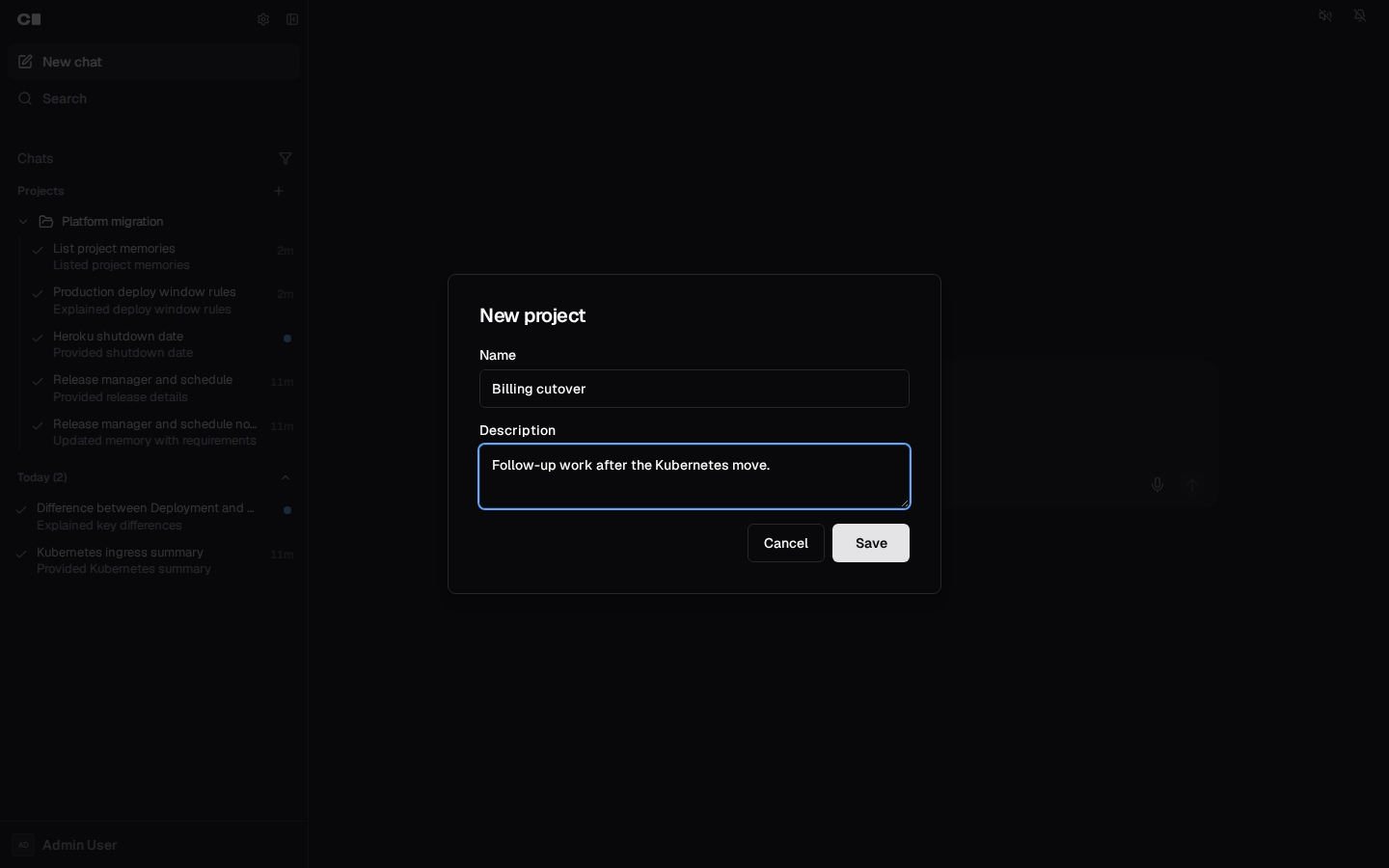 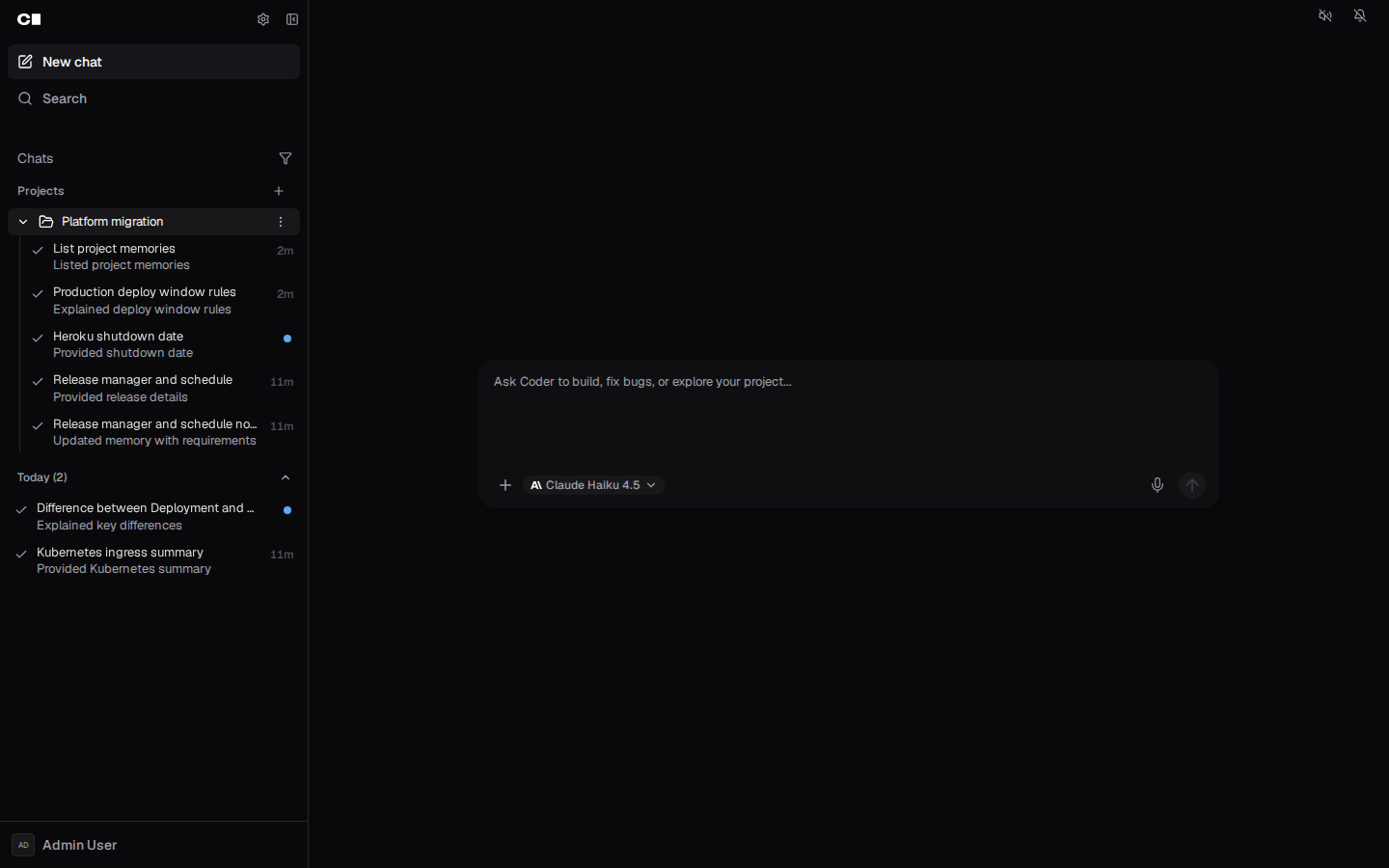 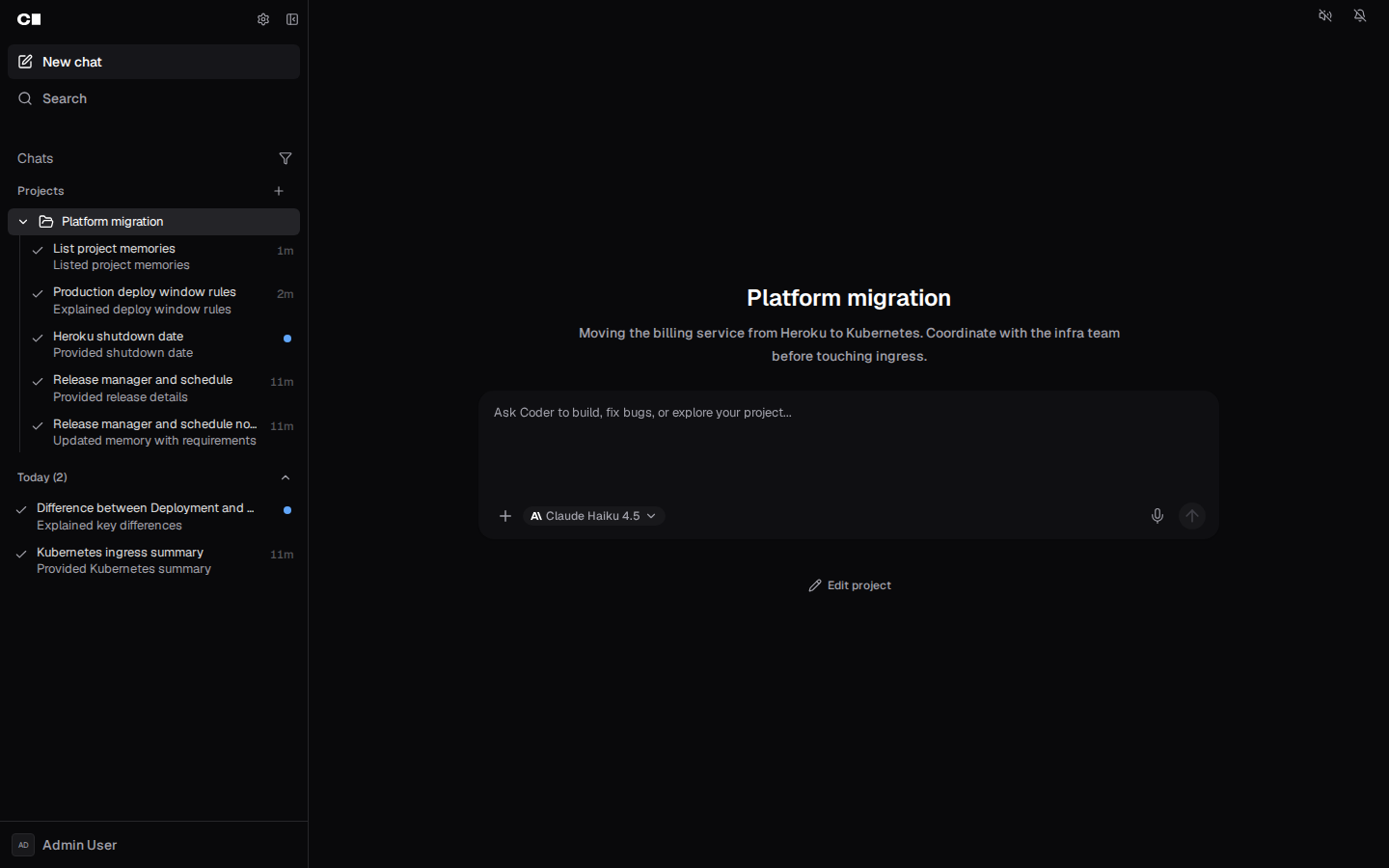 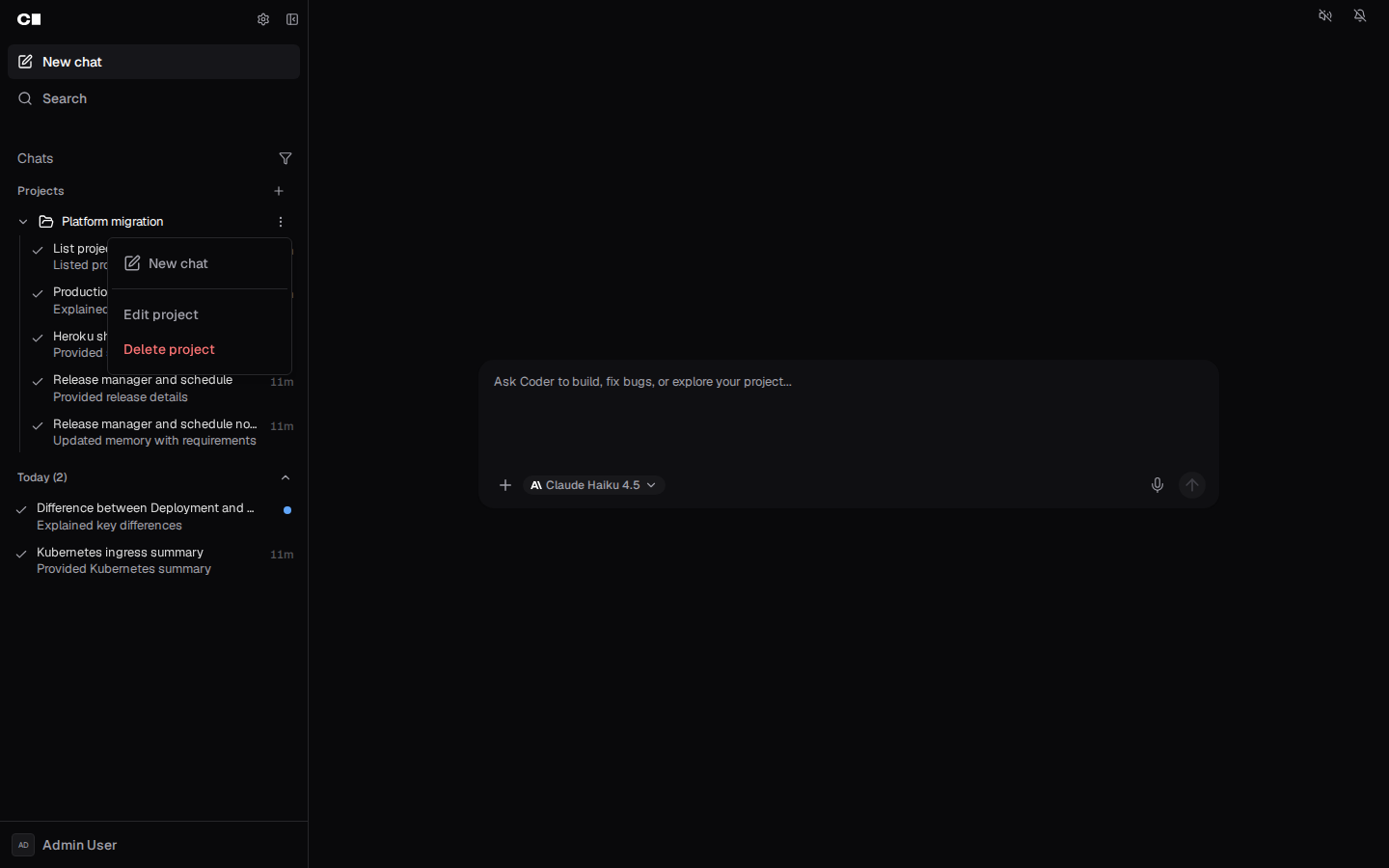 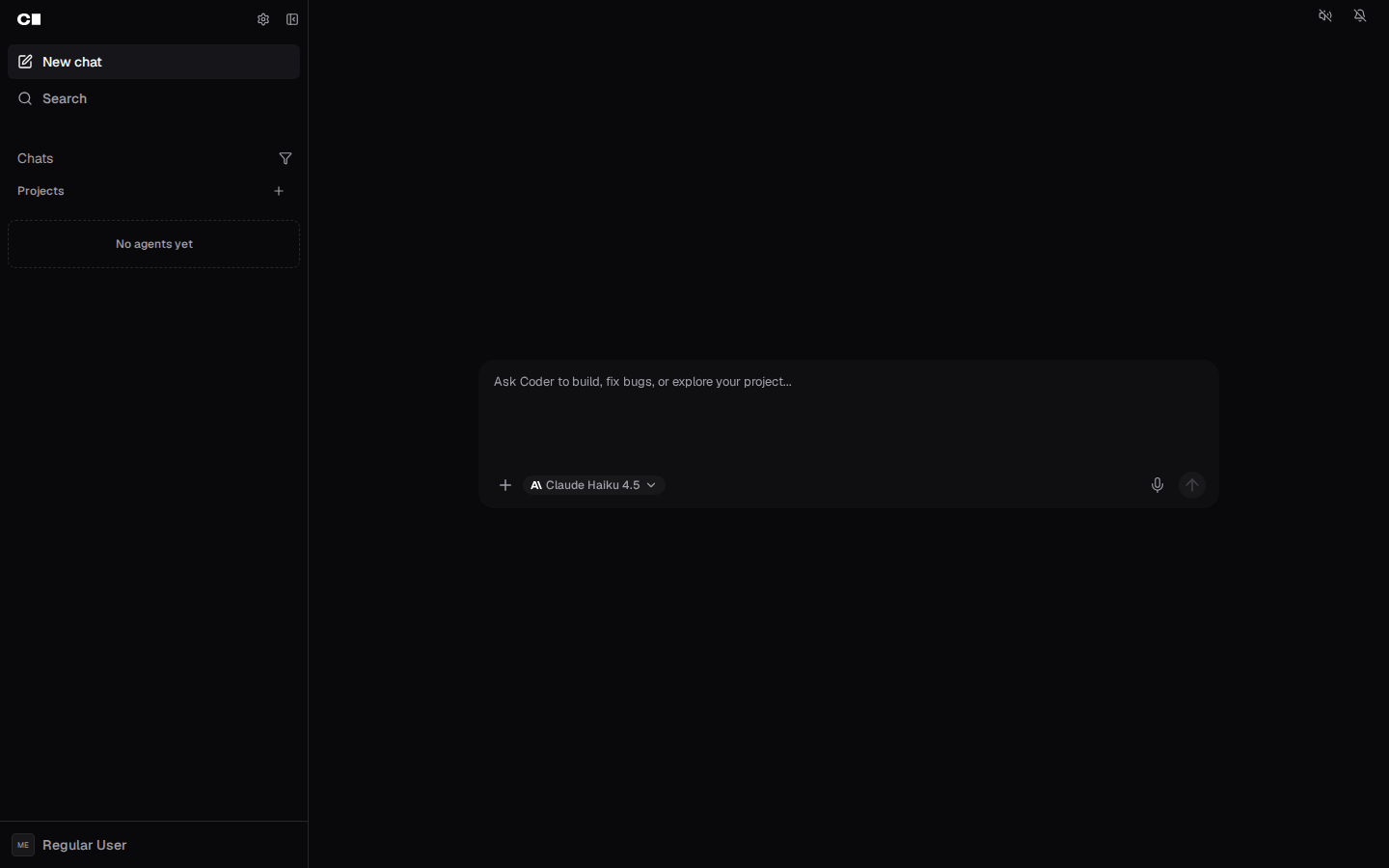 </details> --- Generated with Coder Agents on behalf of @f0ssel. --------- Co-authored-by: Claude Opus 5.5 (1M context) <noreply@anthropic.com> |
||
|
Thomas Kosiewski
|
7b40aa7fa6 |
fix(coderd): keep user chat renames made during title generation (#30254)
Automatic title generation captured the chat title when it was scheduled, ran the model call, then wrote the generated title with an unconditional UPDATE. A rename that landed while the model call ran was silently overwritten. Add UpdateChatTitleByIDIfTitle, a compare-and-set variant that only writes when the stored title still equals the title generation started from. When it matches no rows, generation keeps the current title and skips recording and publishing the generated one. --- _Generated with [`xum`](https://github.com/coder/xum) • Model: `anthropic:claude-opus-5-5` • Thinking: `high`_ |
||
|
Thomas Kosiewski
|
d11809f095 |
fix(coderd): enforce chatd concurrent-agent capacity on every path into running (#30243)
## Problem

The concurrent-agent cap (5 root chats and 10 subagent chats per
deployment by default) could be exceeded. Three paths put more chats in
`running` with a fresh lease than the pool allows:

1. **Interrupting a waiting chat.** A user sends a message with
`busy_behavior=interrupt` to a chat that is waiting for capacity. The
chat becomes `interrupting` while unowned, a worker acquires it without
admission, and `FinishInterruption` promotes the queued message into a
running turn under that ownership.
2. **Taking over an orphaned `requires_action` chat.** A replica dies
while its chat is in `requires_action`, its lease goes stale and another
chat takes the slot. A worker acquires the `requires_action` chat
without admission, and a tool result, an interrupt or the action
deadline returns it to `running` under that ownership.
3. **Heartbeat reviving a stale lease.** A replica loses the database
for longer than the 30 second stale threshold and another replica admits
a second chat into the slot. When the first replica comes back, its
heartbeat upsert renews the stale lease unconditionally, and its runner
keeps generating until the turn ends.

## Root cause

`agentCapacityLimiter.Admit` returned `true` without taking the
admission lock or counting for every status other than `running`. The
count query already treats every owned chat with a fresh lease as
holding a slot, so the shortcut let chats acquire a slot uncounted and
later move back to `running` under that ownership. Separately,
`BatchUpsertChatHeartbeats` had no freshness or ownership condition.

## Fix

- **Admission for every runnable status.** `Admit` now counts for
`running`, `interrupting` and `requires_action`, and a refused pool
skips the rest of its candidates in the pass regardless of status. An
owned chat holds its slot until it releases ownership, so every later
transition back to `running` stays within capacity.
- **Fenced heartbeat renewal.** `BatchUpsertChatHeartbeats` is replaced
by `RenewChatHeartbeats`, which only extends rows that are still fresh
and still own their chat, using `statement_timestamp()` read after the
capacity admission lock is granted. The renewal runs under that lock
with a `lock_timeout` (`HeartbeatLockTimeout`) and a per-tick timeout
(`HeartbeatRenewalTimeout`, a third of the stale threshold). Admission
also waits at most 5 seconds for the lock.
- **Stop runners that lost their lease.** `heartbeatOnce` requests
cleanup of every runner whose lease was not renewed, which cancels its
generation. The chat stays owned by the stale lease until an admitted
worker takes it over. A tick that fails or times out cleans up no
runners and retries on the next tick.
- **Instant Stop on a queued chat.** Requiring admission for
`interrupting` would have made Stop on a chat waiting for capacity hang
until a slot frees. When `Interrupt`, or `SendMessage` with
`busy_behavior=interrupt`, runs on a running chat with no owner, the
transition now applies `FinishInterruption` in the same transaction and
cancels orphaned tool calls. An empty queue lands in `waiting`;
otherwise the queue head is promoted into `running`, still unowned, so
it goes through admission.
- **Queued metric.** `CountChatCapacityQueuedByPool` (behind
`coderd_chatd_agents_queued_for_capacity`) now also counts
`interrupting` and `requires_action` chats without a fresh lease, since
they also wait for admission.

## How it was found

A TLA+ model of capacity admission found a counterexample for each path.
Go tests reproduced all three against the previous code (each failed
with `"2" is not less than or equal to "1"` for a root pool of capacity
1), and the model with the fix enabled passes the safety invariant and
the liveness properties. The model itself is not part of this PR.

## Tests

The three reproductions are kept as regression tests in
`coderd/x/chatd/agentcapacity_regression_internal_test.go`:
`TestAdmission_InterruptWithMessageOnWaitingChatStaysWithinCapacity`,
`TestAdmission_RequiresActionTakeoverStaysWithinCapacity` and
`TestRunnerManager_HeartbeatDoesNotReviveStaleLease`. The original
reproductions failed on the base commit. Restoring the admission
shortcut makes the `requires_action` test fail, and restoring the
unconditional heartbeat upsert, or dropping the runner cleanup, makes
the heartbeat test fail. New coverage also includes
`TestAdmission_StopWaitingChatNeedsNoCapacity`,
`TestRenewChatHeartbeats_OnlyRenewsFreshOwnedLeases`,
`TestRunnerManager_FailedHeartbeatTickKeepsRunners`, and chatstate tests
for the unowned interrupt paths. Existing tests that encoded the old
behavior (`requires_action` chats holding no slot, interrupting chats
always acquirable, unconditional heartbeat renewal) were updated.

## Behavior / API change

- `POST /api/v2/chats/{chat}/messages` with `busy_behavior=interrupt` on
a chat that no worker owns (for example one waiting for capacity) now
returns the promoted message with `queued=false` instead of a queued
message, and the chat stays in `running` instead of `interrupting`. If
the chat already had queued messages, the queue head is promoted and the
new message stays queued.
- `POST /api/v2/chats/{chat}/interrupt` on such a chat lands it in
`waiting` immediately (or in `running` with the queue head promoted)
instead of `interrupting`.
- An unowned `interrupting` or `requires_action` chat (for example after
its replica died) now waits for a free slot before its runner starts,
which also delays enforcing its action deadline while the pool is full.
- New internal chat worker settings `HeartbeatRenewalTimeout` and
`HeartbeatLockTimeout`, defaulting to a third of the stale threshold and
half of that.
- Heartbeat ticks now take the capacity admission advisory lock briefly
on each replica.

## Out of scope / follow-ups

- Interrupting a chat still owned by a dead runner (stale lease,
`worker_id` set) still waits for a slot.
- An admission lock timeout should end the acquisition pass instead of
logging a warning per candidate.
- The per-chat `queued_for_capacity` flag in the chat API still reports
only `running` chats.
- Alert on failed heartbeat ticks.

`coderd/x/chatd/ARCHITECTURE.md` gains TODO lines for the affected
sections; the prose is left for the owner.

---
_Generated with [`xum`](https://github.com/coder/xum) • Model:
`anthropic:claude-opus-5-5` • Thinking: `high`_
|
||
|
Thomas Kosiewski
|
cdc87ee047 |
fix(coderd): recheck auto-archive candidates under the family lock (#30242)
Auto-archive read its candidates without locks and then archived each family without rechecking, so a chat that became active after selection (a new message in the root or a child, a pin, a status change) could still be archived. SetFamilyArchivedInput gains an optional Precondition that runs after the root and every family member row are locked root-first; auto-archive uses it to rerun the candidate filters for that root through the new GetAutoArchiveInactiveChatCandidateByID query and skips chats that no longer qualify. A parity test keeps the batch and by-ID queries in sync, regression tests cover root, pin and child activity races, and ARCHITECTURE.md describes the recheck. Builds on #30240. --- _Generated with [`xum`](https://github.com/coder/xum) • Model: `anthropic:claude-opus-5-5` • Thinking: `high`_ |
||
|
Danielle Maywood
|
63a95d87f3 |
feat(coderd): key chat diff statuses by ref (#29081)
Part 1 of 6. `chat_diff_statuses` had one row per chat, so a chat could only track one PR, and switching branches overwrote the old branch's PR data. The primary key is now `(chat_id, git_remote_origin, git_branch)`, so each ref the agent reports gets its own row. The API still returns a single `diff_status`: the first row of the chat's statuses, ordered by `updated_at`, newest report first. The primary ref changes only when the agent reports a ref: refreshes, claims, backoffs and URL writes do not advance `updated_at`, so they cannot reorder the primary. The gitsync worker now claims, backs off and clears rows by the full key, not the whole chat. When the diff GET discovers a PR URL, it updates the existing ref row and no longer inserts one. Telemetry picks one row per chat. **NOTE**: Migration `000606` swaps the primary key under an ACCESS EXCLUSIVE lock. The table is small. Existing rows already fit the new key, so no data is rewritten. The down migration keeps only the primary row per chat. Stop old coderd instances before migrating: their `ON CONFLICT (chat_id)` upserts fail once the old key is gone. Generated by Coder Agents. |
||
|
Thomas Kosiewski
|
a0b00b5e4b |
feat: store experiment rules with revisions and audit types (#29898)
Slice 2 of 4 for runtime experiment rules: persist one rule per experiment in `site_configs`, with revisions that only increase, and add an audit record type. Nothing calls this code yet, so behavior does not change. ## What's in it - **Queries** in `siteconfig.sql`, all checked by dbauthz against `ResourceDeploymentConfig`: - `GetExperimentRules` (read) lists `experiment_rule:` keys with `starts_with`, not `LIKE`, because `_` is a `LIKE` wildcard. - `GetExperimentRule` (read) reads one row. - `UpsertExperimentRule` (update) writes one row. - **`experiments.WriteRule(ctx, db, actor, ex, rule, expectedRevision)`** validates the rule first, then does everything in one `READ COMMITTED` transaction: - It takes an advisory lock for that experiment, waiting at most 5 s. - It reads the current row; a missing row counts as revision 0. - It returns `*RevisionConflictError` when the expected revision is stale. - An identical mode and condition writes nothing and returns `changed=false`. The first `inherit` on a missing row is a change and stores revision 1. - Otherwise it writes `revision+1` with the actor and time, and returns the old and new rule as read and written inside the transaction. - **`experiments.NewDBStore(db)`** implements the evaluator's `Store`. It reads rules by prefix, plus the user's id, username, email, explicit site roles, member org names, and `<org>/<group>` group names (including `<org>/Everyone`). It runs as the system. - **Audit:** - A new `resource_type` enum value `experiment_rule` (migration `000602`; the down migration is a comment because PostgreSQL cannot drop enum values). - A new struct `database.ExperimentRule`. `experiments.AuditRecord` derives its ID from the experiment name, so audit history groups by experiment. - In the audit table, `experiment`, `mode` `revision` and `condition` are tracked (`ActionTrack`), so the audit diff shows the old and new condition. In Enterprise, the slog audit backend also writes that diff to the server log. Admins and auditors can already read the condition through the rules API. - The audit page filter includes the new resource type. ## Testing - `WriteRule` and `NewDBStore` tests run against real PostgreSQL. They cover stale revisions after a reset and a recreate, two concurrent writers with the same expected revision (exactly one wins), no-ops, and rollback after a forced error. - dbauthz method tests and an audit diff test that shows both condition texts. Remote dogfood UAT through Coder Agents passed the upgrade from slice 1 (existing state kept, enum value added), a fresh install, unchanged `/api/v2/experiments`, and the `WriteRule` tests under `-race`. The licensed audit-page check could not run: the test workspace has no premium license. That round tested `015979ca96`. The commit after it only adds `AuditRecord`, and a follow-up UAT round will cover the final head. > [!NOTE] > Migration `000604` was the next free number when this was written. Recheck it before merging. ## Stack 1. #29869: evaluator library 2. **This PR:** storage and audit types 3. Enforcement and discovery (`/api/v2/experiments`, meta tag, chatd `mcp-tool-search`, ruleguard) 4. Control plane (experimental API, `coder exp experiment-rules` CLI, docs) > [!NOTE] > This PR was written by an AI agent (Xum). --- _Generated with [`xum`](https://github.com/coder/xum) • Model: `anthropic:claude-opus-5-5` • Thinking: `high`_ --------- Signed-off-by: Thomas Kosiewski <tk@coder.com> |
||
|
Michael Suchacz
|
756ffb97af |
feat: add a collapse_assistant_steps user preference (#29416)
## Stack context Bottom of a six-PR stack that adds the **Collapse assistant steps** chat preference (Agents > Settings, off by default). With it on, each turn's consecutive tool-step rows fold into one disclosure: "Worked for 2m 14s (7 steps)" once the turn completes, or a ticking "Working for 12s" while it runs. The stack was split out of #29115 for review size; #29115 now sits at the top with the full feature description and the UAT record. 1. #29416 feat: add a collapse_assistant_steps user preference (this PR) 2. #29417 feat(site): group assistant steps into working blocks 3. #29418 feat(site): add the working block disclosure 4. #29419 feat(site): fold assistant steps in the conversation timeline 5. #29420 fix(site): keep streaming text alive inside expanded working blocks 6. #29115 feat(site): add the collapse assistant steps chat preference ## Why The chat UI reads a per-user boolean to decide whether to fold steps. This layer stores it and exposes it through the preference settings API and SDK. `collapse_assistant_steps` follows the existing `task_notification_alert_dismissed` boolean pattern: a `user_configs` key with dbauthz wrappers, no migration. The generated API docs and TypeScript types are regenerated, and the frontend preference mocks gain the new required field. > This PR was prepared by Xum, an AI coding agent, on behalf of @ibetitsmike. |
||
|
Ethan
|
acebdf5b60 |
feat: add chat_mcp_servers table with encrypted headers (#29517)
This is the second PR in the stack that adds experimental support for attaching MCP servers to a chat; https://github.com/coder/coder/pull/29466 is the first. This one is just the persistence layer, nothing reads from the table yet. It adds a `chat_mcp_servers` table, unique on `(chat_id, slug)` and cascading on chat deletion. Each row stores the server URL, a JSON object of request headers, per-server tool allow and deny lists, and three flags that later PRs in the stack use to decide when the server gets connected: `allow_in_plan_mode` (mirroring the existing column on `mcp_server_configs`), `allow_in_subagents`, and `forward_coder_headers`. All three default to `false`. Headers are the sensitive part, so they're encrypted at rest via `dbcrypt` in the same way `external_auth_links` are: `headers_key_id` records which key was used, and `NULL` means plaintext. Empty or `{}` headers are stored as `{}` with no key, so servers that don't need auth never produce ciphertext. The `dbcrypt` wrappers cover the chat-scoped reads and writes, plus `GetChatMCPServersByChatOwnerID` and `UpdateEncryptedChatMCPServerHeaders`, which follow the per-user shape that `Rotate` and `Decrypt` in `cliutil.go` use. I haven't wired those two into `coder server dbcrypt rotate` and `decrypt` in this PR. For authz, reading a chat's servers requires read on the chat, and upserting or deleting them requires update on the chat. The two owner-scoped queries above are system-only. Part of CODAGT-1131 |
||
|
Bobby Ho
|
9fd0131d04 |
feat: accept redirect_uris on the OAuth2 app admin API and deprecate callback_url (#29502)
- Add `redirect_uris` to admin OAuth2 app responses and create/update requests. - Deprecate `callback_url` while preserving compatibility; it maps to the first redirect URI. - Reject empty `redirect_uris` lists instead of silently ignoring them. - Update fixtures, tests, and docs. Part of PLAT-619. Builds on #29440; admin UI support follows in #29603. |
||
|
Ehab Younes
|
817fc77612 |
feat: store session usage per app and family in template usage stats (#29109)
Store per-app session minutes in a child table instead of fixed family-minute columns, so adding an IDE no longer needs a rollup schema change. API, Prometheus, and telemetry output are unchanged. - Add `template_usage_stats_session_apps`, keyed by start time, template, user, and app name, replacing the `ssh_mins`, `sftp_mins`, `reconnecting_pty_mins`, `vscode_mins`, and `jetbrains_mins` columns. - Group app names into families at read time through the `codersdk` registry, so the registry never reaches SQL and attribution covers all history rather than only the buckets the rollup still revisits. - Group `GetTemplateInsightsByTemplate` by app name so that Prometheus and the API report a family identically. - Drop the `@app_families` query parameter and its dbauthz validation. - Report a family total as the sum of its apps rather than the distinct minutes any of them was active. Numbers are unchanged today, because every agent reports one canonical name per family. - Keep the child table window index-usable and count minutes with `COUNT(DISTINCT)` in the grouping, so a dashboard-sized range uses an index scan and a large deployment does not spill the sort to disk. Part of #27410 |
||
|
Jake Howell
|
dd4f5ae48a |
fix: load AI Gateway session provider filter without AIProvider read (#28966)
> 🤖 This PR was modified by Coder Agents on behalf of Jake Howell.

The Provider filter on `/ai-gateway` called the owner-only
provider-config API (`GET /api/v2/ai/providers`). Site auditors can read
sessions but not that config, so the dropdown was empty, and typing
`provider_name:…` failed the whole sessions list because search looked
up the name with the same permission.

- Add `GET /api/v2/ai-gateway/providers`, returning display metadata
only (`name`, `type`, `display_name`, `icon`) from `ai_providers`,
including disabled and soft-deleted rows that past sessions still
reference. When a name was reused, the live row wins.
- Authorize it in `dbauthz` on `aibridge_interception` read rather than
`ai_provider` read, so owners and auditors get labels and icons without
access to configuration. Members get 404.
- Match `provider_name` as a plain string in session search instead of
looking up `ai_providers`. Unknown names return an empty page, not a
validation error.
- Point the Provider dropdown at the new endpoint; filter by name, show
`display_name`, and render the icon from `type`/`icon`.

The endpoint reads the small `ai_providers` table instead of grouping
`aibridge_interceptions`, so it needs no new index and does not inherit
the scan cost noted for the models/clients lists. It is registered only
under `/ai-gateway`, not the legacy `/aibridge` alias.
|
||
|
Michael Suchacz
|
2e03073938 |
feat(coderd/database): add paginated organization AI spend user query (#29219)
First of a four-PR stack that reworks the AI spend page onto the
released organization spend export, `GET
/api/v2/organizations/{organization}/ai/spend/export`, and a sibling
per-user endpoint, `GET
/api/v2/organizations/{organization}/ai/spend/users`, instead of the
deployment-wide `/api/v2/ai-gateway/spend/*` endpoints this stack
previously proposed. Every PR in the stack was rewritten in place from
current main; the head branch name predates the rework. The export's
accounting rules are unchanged: token usage by `created_at` in
`[period_start, period_end)`, attributed to the organization through the
effective budget group, so the page reconciles with the CSV and with
daily budget accounting.

Adds `ListOrganizationAISpendUsers`, the per-user aggregate behind the
users endpoint. It shares the export query's joins and predicates,
groups to one row per user with priced cost, a count of unpriced usage,
and the sorted distinct providers, clients, and models the user spent
through (a missing client is reported as `Unknown`, as in the sessions
list), carries the window totals (`count`, `total_cost_micros`,
`total_unpriced_usage_count`) as window aggregates ahead of
`LIMIT`/`OFFSET`, and orders by cost, then username, then user ID.
Because every row carries those totals, dbauthz requires read access to
every group member in the organization before running the query, instead
of filtering rows by the caller's own membership.

Includes the dbauthz wrapper and test, the dbmetrics and dbmock
regeneration, and querier tests for grouping, totals across pages,
filters, providers, clients, and models, shifted period windows
(including token usage recorded outside the window of the interception
that produced it), and organization isolation.

> Xum prepared this PR on behalf of @ibetitsmike.
|
||
|
Cian Johnston
|
2cf819bfca |
feat: add break-glass user email update (#29256)
Adds an owner-only experimental API and hidden CLI command for break-glass user email corrections. The operation verifies the existing email, updates it transactionally, clears outstanding password-reset state, revokes the target user's Coder sessions and API tokens, and records successful and failed authenticated attempts in the audit log. External-auth links remain unchanged. Generated by Coder Agents. |
||
|
Bobby Ho
|
7a57b17b7b |
fix: make OAuth2 refresh token redemption single-use under concurrency (#28752)
Make OAuth2 refresh token redemption single-use under concurrency using DELETE ... RETURNING, ensuring exactly one request succeeds and losing requests return invalid_grant. Remove the redundant API-key lookup to prevent 500s on missing keys, explicitly use READ COMMITTED for both grant transactions, and replace whitespace-only stored-scope echoes with a fixed error message. Add regression coverage for concurrent redemption, revoked or missing keys, and invalid stored scopes. |
||
|
Steven Masley
|
d5fcd99213 |
revert(coderd/database): purge identified terraform modules via dbpurge (#29234)
<!-- Coder Agents generated on behalf of @Emyrk. --> Reverts #28802. - Migration `000589_delete_tf_modules` (#28798) already deletes the identified cached module archives for the same window. - The recurring dbpurge query is redundant with a one-time migration and is no longer needed. - Removes the `DeleteCachedModuleFilesCreatedBetween` query, its dbauthz, dbmetrics, and dbmock wiring, and the dbpurge tests. --- <sub>Coder Agents on behalf of @Emyrk.</sub> |
||
|
Michael Suchacz
|
b957e66ccc |
feat!: drop the Coder Tasks tables and queries (#29086)
Drops the `tasks`, `task_workspace_apps` and `task_snapshots` tables, the `tasks_with_status` view and the `task_status` enum, and recreates `workspaces_expanded` without the `tasks` join and `task_id` column. Deletes `queries/tasks.sql` and every wrapper, fixture and test that existed only for those queries (dbauthz, dbmock, dbmetrics, dbfake, dbgen, querier_test), plus the `task_id` projection in `GetWorkspaceAgentAndWorkspaceByAuthToken`. **Breaking change:** migration 000594 deletes all task rows. The down migration restores the schema (tables, constraints, indexes, views), not the data. **Review changes:** the schema-only migration test was removed per review (`TestMigrate/UpDownUp` still exercises the down path), the test file no longer reorders existing tests, and the migration moved from 000593 to 000594. The `dump.sql` reorder is pg_dump dependency ordering: `tasks_with_status` pulled its four workspace tables ahead of it, and without the view they return to alphabetical positions. **Stack context:** Coder Tasks removal stack (CODAGT-642): #28743 frontend → #28788 CLI → #28789 API → #28790 provisioner → #29084 notifications → #29085 build reasons → **#29086 tables** → #28750 permissions. The last four PRs replace the single data-drop migration that used to live in #28750; each carries one concern and its own migration number. > Created by Xum (AI agent) on behalf of @ibetitsmike. ## Delivery record **Decision (2026-09-11 ~14:40Z): merge** through the stack merge endpoint, squash, pinned to head `f1d236a0c82f123b8a0d6878799c227ef9bd5776` (merge SHA appended below once landed). **Independent substantive reviews on this PR (3):** | # | Kind | Reviewed commit | Findings and disposition | Source | |---|---|---|---|---| | 1 | Codex code review (bot), PR opened | `24535f8410` | No findings, no threads | [summary](https://github.com/coder/coder/pull/29086#issuecomment-5583877627) | | 2 | Human review, spikecurtis (COMMENTED) | `24535f8410` | 4 findings: dump.sql reorder question (answered: pg_dump dependency hoisting by `tasks_with_status`); two moved tests (undone, the test file is no longer touched); schema-only migration test (deleted). All resolved. | [review](https://github.com/coder/coder/pull/29086#pullrequestreview-5142045164) | | 3 | Human review, spikecurtis (APPROVED) | `f1d236a0c8` (this head) | Approval on the exact final head | [review](https://github.com/coder/coder/pull/29086#pullrequestreview-5179353695) | The four COMMENTED reviews by @ibetitsmike on `f35688f40b` are thread-reply wrappers and are not counted. **Pre-split history relevant to this diff:** this layer's content lived in the monolithic #28750 until 2026-09-08, which received 10 completed Codex code reviews (2026-08-28 to 2026-09-01) and spikecurtis's CHANGES_REQUESTED review of 2026-09-04 that asked for the split. Counting those, the completed-review total relevant to this diff exceeds the six-review budget, so no further discretionary review or fresh final advisory was commissioned. The usable final recommendation for the final diff is review 3 above: the reviewer who authored every finding on this layer approved the exact head. **Exact-head checks:** `required` SUCCESS in [run 34580949353](https://github.com/coder/coder/actions/runs/34580949353/job/103205933212); rollup 15 success, 8 skipped, 1 failure. The failure is the non-required `Analyze PR for Documentation Updates Needed` job ([103204101137](https://github.com/coder/coder/actions/runs/34580949071/job/103204101137)), caused by the dormant `doc-check-pr-29086` review workspace (CODAGT-1025), not a code finding; GitHub flags only `required` as required for this PR. Merge-ref freshness: `refs/pull/29086/merge` has the exact head as second parent and `25af21b5d5d` (the #29085 squash) as first parent; main has since gained #29231, #28639 and #29218 (12 files, none overlapping this PR). The composed tree (`git merge-tree` of current main and this head) builds (`go build ./...`) and vets (`go vet` on `coderd`, `coderd/database/...`, `coderd/wsrelated/...`) cleanly. Layer diff parity with the previously pushed layer verified by numstat after both GitHub restacks. `gh stack push` did not run the local pre-push suite; CI is the validation evidence. **Deferred:** the dormant doc-check workspace (CODAGT-1025) is outside this PR. Next in the stack, #28750, stays blocked: CHANGES_REQUESTED, its approval and CI predate the restack, and its review budget is exhausted. |
||
|
Michael Suchacz
|
f809776229 |
feat!: remove the task notification templates (#29084)
Removes the six Coder Tasks notification templates (their preferences and inbox history go with them via cascade) and the `preference_task_notification_alert_dismissed` user setting with its two queries. The `task` value of `ai_seat_usage_reason` stays: seats consumed through tasks remain consumed, and remapping their reason would misstate billing history. **Breaking change:** migration 000592 deletes data. The down migration restores the template definitions, not the deleted preferences or notification history. **Review changes:** dropped the `ai_seat_state` remap and enum swap and the migration unit test (both per review); moved the migration from 000591 to 000592 because main took 000591. **Stack context:** Coder Tasks removal stack (CODAGT-642): #28743 frontend → #28788 CLI → #28789 API → #28790 provisioner → **#29084 notifications** → #29085 build reasons → #29086 tables → #28750 permissions. The last four PRs replace the single data-drop migration that used to live in #28750; each carries one concern and its own migration number. > Created by Xum (AI agent) on behalf of @ibetitsmike. |
||
|
Ehab Younes
|
0aae890d03 |
feat: return per-app session counts from workspace agent stats queries (#29134)
- Make all six raw session-count queries return a session_counts JSONB object keyed by app name instead of fixed per-family columns. Fold the results into existing family fields in Go using the shared SDK registry, including unrecognized names under unknown. - Remove the registry parameters and associated dbauthz validation from these queries, which no longer perform family attribution in SQL. Preserve existing deployment stats, Prometheus, and telemetry outputs. - Select session maps directly in the two latest-row queries instead of decomposing and reaggregating a single row. Keep byte, connection, and latency aggregates independent of per-app expansion. - Add regressions for latest eligible rows, empty session maps, distinct same-family app names, labels, and unchanged traffic aggregates. |
||
|
Ehab Younes
|
da45488208 |
feat: attribute session counts by app family (#28337)
- Centralize app-to-family attribution in the SDK registry so recognized app aliases contribute to their family's session counts and usage minutes without duplicating name lists across SQL queries. - Pass the registry into agent stats queries, insights, and usage rollups. - Validate its structure in dbauthz so missing or renamed families fail explicitly instead of silently producing zero counts. - Decompose session maps once per row for per-agent sums while retaining the key-presence checks used by insights. Update reporting consumers and add coverage for alias attribution and registry validation. |
||
|
Bobby Ho
|
96ee8d171a |
fix: make OAuth2 code redemption single-use under concurrency (#28744)
TL;DR Third PR in the PLAT-480 stack, on top of #28740. Fixes a race where the same authorization code could be redeemed twice concurrently. The redeeming delete now returns the deleted row. If another request already redeemed the code, the delete returns sql.ErrNoRows and redemption fails with invalid_grant. Each redemption runs in its own transaction, so concurrent requests serialize on the code row and only one succeeds. The test now races two concurrent redemptions to verify single-use behavior. No scope logic, new endpoints, or schema changes. Depends on #28740. Stack: #28237, #28740, this PR. |
||
|
Danielle Maywood
|
a6938e69db | fix: re-resolve PR when stored URL's branch is stale (#28983) | ||
|
dylanhuff-at-coder
|
4875ae218a |
feat: enforce user secret file policy (#28518)
Adds the deployment option `--user-secrets-disable-file-path` / `CODER_USER_SECRETS_DISABLE_FILE_PATH` / `userSecretsDisableFilePath` (default `false`). When it is set, the create and batch-create user-secret endpoints reject requests with a non-empty file path, and PATCH validates the post-update state under a `SELECT ... FOR UPDATE` row lock, rejecting a new or changed file path as well as enabled states that would have no effective delivery target. Legacy stored paths are preserved, so users can still edit, disable, clear the path, or migrate the secret to env delivery. This is PR 1 of a 4-PR stack; follow-ups cover manifest filtering, the dashboard, and CLI/docs. Refs #27488 Reviewed and updated by Coder Agents on behalf of @dylanhuff-at-coder. |
||
|
Michael Suchacz
|
6db09ed9a6 | fix: sync pinned chat MCP context resources on agent push (#28796) | ||
|
Bartek Gatz
|
55340de360 |
feat: add deployment setting to disable the Codernauts game (#27662)
Adds a `codernauts_enabled` runtime setting (default: enabled) that controls whether the Codernauts game link appears in the user dropdown menu. A toggle at the bottom of the Deployment > Appearance page controls it, and the value persists in `site_configs`, so it survives restarts and upgrades without any CLI flags or environment variables. The setting works on all licenses: `GET /api/v2/appearance` reports it from both the enterprise and the default (AGPL) appearance fetchers, and `PUT /api/v2/appearance` persists it gated only by the deployment-config RBAC permission, not by an entitlement. On the Appearance page the toggle renders outside the Premium paywall introduced in #27948; the other appearance fields keep their existing licensing behavior. Note: a pure AGPL-only build of coderd does not register the `/api/v2/appearance` routes at all, so the toggle cannot be saved there. The standard `coder server` binary is unaffected regardless of license state. <details> <summary>Implementation notes</summary> - `coderd/database/queries/siteconfig.sql`: new `GetCodernautsEnabled` / `UpsertCodernautsEnabled` queries backed by a `codernauts_enabled` key in `site_configs`; defaults to `true` when unset (no migration needed). - `coderd/database/dbauthz`: read has no authz checks (matching other appearance reads); write requires `ResourceDeploymentConfig` update. Coverage added to `dbauthz_test.go`. - `codersdk`: `codernauts_enabled` added to `AppearanceConfig` and `UpdateAppearanceConfig`. - `coderd/appearance`: the default fetcher takes a `database.Store` and reads the setting from the database so unlicensed deployments serve it too. - `enterprise/coderd/appearance.go`: fetches the value in `Fetch` and persists it in `putAppearance`. - Frontend: "Codernauts game" toggle section on Deployment > Appearance saving immediately via the existing appearance mutation; `codernauts_enabled` threaded from `useDashboard().appearance` through Navbar to `UserDropdownContent`, which renders the menu item only when enabled. Storybook stories with `play` functions cover toggling (entitled and not) and the dropdown hiding the link when disabled. </details> --- 🤖 This PR was generated by Coder Agents on behalf of @bartekgatzcoder. |
||
|
Steven Masley
|
dc1a54cd37 | chore: purge identified terraform modules via dbpurge (#28802) | ||
|
Jaayden HalkoandMathias Fredriksson
|
8bf271c503 |
feat: add Prometheus metrics for the usage publisher (#28368)
The Tallyman usage publisher (`enterprise/coderd/usage/publisher.go`)
had no metrics; failures were only visible in logs and the
`usage_events.failure_message` column.

This adds five metrics under `coderd_usage_events_*`:

| Metric | Type | Meaning |
|---|---|---|
| `publish_results_total{result, event_type}` | counter | Per-event
outcomes from real Tallyman responses (`accepted`,
`rejected_temporarily`, `rejected_permanently`; events missing from the
response count as temporary) |
| `publish_send_errors_total` | counter | Ingest requests that failed
entirely (HTTP error, non-200, decode error), one per request |
| `pending` | gauge | Unpublished events still inside the 30-day
publishing window |
| `pending_oldest_age_seconds` | gauge | Age of the oldest pending event
(0 when none) |
| `expired` | gauge | Unpublished events older than 30 days that will
never be published |

Send errors and per-event results never double-count: when a request
fails, the publisher fakes an all-temporarily-rejected response for the
DB update, but only `publish_send_errors_total` increments, so
`publish_results_total` reflects only real Tallyman verdicts.

The gauges are backed by a new read-only `GetUsageEventsStats` query
(authorized as `ActionRead` on `ResourceUsageEvent`) and refreshed from
the publish loop after each attempt, so they update roughly every 17
minutes.

Metrics are created with `promauto.With(reg)` where the registerer
defaults to nil, so existing callers and tests need no changes;
`enterprise/cli/server.go` wires in the deployment's
`PrometheusRegistry` via the new `PublisherWithPrometheusRegisterer`
option.

Closes
https://linear.app/codercom/issue/CODAGT-833/e3-prometheus-metrics-for-the-usage-publisher

---------

Co-authored-by: Mathias Fredriksson <mafredri@gmail.com>
|
||
|
Yevhenii Shcherbina
|
0bc2858b6e |
feat: report unpriced AI models to owners (#28419)
Closes [AIGOV-568](https://linear.app/codercom/issue/AIGOV-568/notify-admins-about-unpriced-ai-models). AI Bridge records token usage for a model with no price at a NULL cost, so its spend is neither reported nor enforced against any budget. Until now that only reached admins through an info log and a Prometheus metric. Owners now receive a weekly report listing models used without a price in the past week. The report links to documentation explaining how Coder calculates spend from the default price book and how owners can configure missing prices with `coder exp ai-model-prices`. ## Screenshots <img width="726" height="531" alt="image" src="https://github.com/user-attachments/assets/168ae378-60cb-4c96-8f60-36c6edc0b268" /> <img width="470" height="417" alt="image" src="https://github.com/user-attachments/assets/7dc71a1e-0c57-44f1-86f7-df800603c865" /> ## Design **Derived, not tracked.** The unpriced set is computed at report time from interceptions that recorded token usage, joined against the current `ai_model_prices` table. Requests that produced no token usage are excluded. **No new loop or table.** `reportUnpricedAIModels` is a sibling of `reportFailedWorkspaceBuilds` in the existing report generator, reusing its ticker and `notification_report_generator_logs`. Each report runs in its own transaction under a separate advisory lock, so failures and lock contention do not couple otherwise independent reports. The weekly frequency is enforced by the persisted timestamp rather than by the ticker, which restarts with the process and runs on a different phase in each replica. ## Behaviour | Situation | Outcome | |---|---| | Model used without a price | Listed in the next weekly report | | Price set | Disappears from the next report | | Still unpriced and still in use | Reported again each week | | Model stops being used | Drops out of the report | | Nothing unpriced | No notification; window still advances | | More than 100 unpriced models | Top 100 by usage, with the total reported alongside | | openai-compat models | Excluded, they cannot be priced | | Many replicas | Exactly one report per week | | First ever run | Reports models used in the preceding week immediately | ## Design choices 1. **openai-compat** is excluded because it cannot be priced and would produce permanent, unactionable notifications. 2. **Token volume** orders the list but is not shown. The 100-model cap therefore prioritizes models responsible for the most unpriced usage. 3. **Placement** remains in the generic report generator rather than `aibridgedserver`. This keeps one periodic-report lifecycle at the cost of coupling the notifications package to an AI cost-control query. 4. **No license gate.** The reporter runs even when AI Gateway is disabled. With no recorded token usage the query is empty and no notification is sent. --- Created by Coder Agents on behalf of @evgeniy-scherbina. |
||
|
Garrett Delfosse
|
378ac91b49 |
fix: stem chat search terms with the english text search config (#28319)
Chat message search used the `simple` text search config, which folds case but does no stemming, so `refactor` did not match messages containing `refactoring`. Message bodies now index and query with the `english` config, which stems both sides. Titles, PR titles, and all other filters are unchanged. Migration `000585` adds a `chat_messages.search_tsv_config` enum column recording which config produced each stored vector and stamps existing vectors `'simple'` (a column-only update; vectors and indexes are untouched, since rewriting `search_tsv` would block message writes on large tables). The dbpurge sweep gains a bounded `ReindexStaleChatMessagesSearchTsv` pass that rewrites stale vectors newest first and stops for the process lifetime once drained. Until a row is rewritten, `GetChats` matches it with the config that produced it, so pre-migration exact-form searches keep working during the drain. Vectors written by old binaries mid rolling upgrade cannot stamp the config, stay pending, and self-heal on the next upgraded sweep. Steady-state DB load is unchanged. The down migration resets `english` vectors to `NULL` so the parent version's existing sweep rewrites them with `simple`. Closes [CODAGT-867](https://linear.app/codercom/issue/CODAGT-867/backend-search-improvements-to-handle-partial-matches) <details> <summary>Decision log</summary> - **`english` stemming over prefix matching.** On a 300k-row corpus a stemmed lookup is a single GIN entry-tree probe, while `term:*` prefix matching unions posting lists of every lexeme sharing the prefix (up to a full scan for short prefixes), is asymmetric, and loses the `websearch_to_tsquery` phrase/OR/negation UX. `pg_trgm` rejected as a heavier index with different semantics. - **Scope to message bodies only** (review). Titles and PR titles keep their `simple` FTS expressions and indexes, identical to main. - **Config-versioned queue over migration-time reset** (review). An unqualified `UPDATE ... SET search_tsv = NULL` rewrites every indexed row in the migration transaction, and an old replica could backfill reset rows with `simple` vectors that permanently leave the `search_tsv IS NULL` queue. The config column makes staleness explicit and both problems disappear. - **Enum over `text`** (review) for the config column. - **Trade-offs.** English stopwords are dropped from message search (stopword-only queries match no messages); stemming is English-specific; titles do not stem; prefix matching remains out of scope. </details> --- 🤖 This PR was generated by Coder Agents on behalf of @f0ssel. |
||
|
Spike Curtis
|
6a58d50f1d |
feat(coderd): add queue-position-free provisioner job query (#28367)
Follow-up to #28302 ([GRU-82](https://linear.app/codercom/issue/GRU-82), [RFC](https://app.notion.com/p/coderhq/Lite-Workspace-API-Requests-3aad579be5928060b5e7cc65c539717f)). That PR added related-data selection but noted that selecting `latest_build.job` still ran the expensive `GetProvisionerJobsByIDsWithQueuePosition` query, which computes queue position and size with window functions over pending jobs and provisioner daemons and is consistently the top resource consumer in scale tests. This PR adds a cheaper `GetProvisionerJobsByIDs` query that fetches jobs by ID without the queue-position computation, and selects between the two based on whether `latest_build.job.queue_position` is requested. When the queue position is not selected, `QueuePosition` and `QueueSize` are left zero and the rest of the response is unchanged. Both paths go through a single `provisionerJobsByIDs` API method that takes the `jobRelated` selection, switches on it, and reshapes the cheaper query's rows into `GetProvisionerJobsByIDsWithQueuePositionRow` so downstream conversion is uniform. The new query has the same dbauthz properties as the queue-position variant (system-level pass-through pending the proper provisioner-job RBAC check tracked in #16160), with a matching authorization test. No behavior change for existing callers: they select `queue_position` (via `allLatestBuildRelated`), so they continue to use the queue-position query. --- *Generated by Coder Agents on behalf of @spikecurtis.* |
||
|
Ethan
|
c275327fb7 |
feat: audit operational agent settings (#28369)
Depends on #28394. Audit changes to seven operational agent settings through a typed `chat_operational_settings` resource. Each handler serializes baseline capture and mutation with a per-setting advisory lock, keeps both operations in one transaction, and records field-specific diffs. Effective no-op requests now skip both the database upsert and the success audit, including absent rows whose effective value is already the default. The change also retains the allowlisted raw `site_configs` query, updates generated audit and API surfaces, adds failure and concurrency coverage, and reuses the existing AuditPage resource-filter story pattern. Relates to CODAGT-720. |
||
|
Michael SuchaczandEthan Dickson
|
0ef331fcd0 |
feat!: scope chat model override settings to organizations (#28442)
Moves chat model override settings from deployment scope to organization scope, following the org-scoping of chat model configs in #28440. Depends on #28440 (based on `ethan/chat-models-availability-consolidation`). Remote dogfood UAT passed on this change, including multi-organization scenarios on a licensed deployment with real models. ## Problem Chat model configs are now owned by organizations, but the override settings that reference them stayed deployment-wide: admin subagent/title/compaction overrides in `site_configs`, personal overrides in `user_configs`, and the advisor model embedded in the advisor runtime JSON. A single deployment-level override can only point at one organization's model config, so overrides effectively worked for the default organization only, and title generation had to soften its hard-failure contract to tolerate unusable overrides. ## Fix Admin overrides (general, explore, title generation, compaction, advisor) and personal overrides (root, general, explore) become organization-scoped rows in two new typed tables, `chat_organization_model_overrides` and `chat_user_model_overrides`. Composite foreign keys on `(organization_id, model_config_id)` make cross-organization model references unrepresentable. The migration deletes the legacy serialized `site_configs`/`user_configs` override keys instead of migrating them; admins and users re-select models in the new organization-scoped settings. New endpoints live under `/api/experimental/organizations/{organization}/chats/model-overrides` (admin defaults) and `/api/experimental/organizations/{organization}/members/{user}/chats/model-overrides` (personal overrides); the legacy deployment-level routes are removed. chatd resolves overrides via the chat's organization, restoring the hard-failure contract for configured-but-unusable title generation overrides. The deployment-level `AllowUsers` switch and advisor runtime limits stay deployment-scoped. The Coder Agents settings UI gains a per-organization "Defaults & overrides" page under AI Settings > Models, and the personal overrides page gains an organization selector for users in multiple organizations. Advisor telemetry now reports per-organization override rows. **BREAKING CHANGE**: Existing deployment-level overrides are dropped, not migrated. Every organization starts with no overrides after upgrade, and model selections must be re-applied in the new settings. The legacy deployment-level override endpoints are removed. Closes https://linear.app/coder/issue/CODAGT-872 > [!NOTE] > Xum (AI agent) authored this PR on behalf of @ibetitsmike. <!-- xum-attribution: model=claude-opus-4-6 thinking=high --> --------- Co-authored-by: Ethan Dickson <ethan@coder.com> |
||
|
Ethan
|
aefc761fcf |
feat!: enforce organization scope for chat models (#27959)
## Summary Move chat model management and runtime availability to organization-scoped API routes. The API now identifies the organization in every model-management operation, applies chat model RBAC and ACLs within that organization, and returns only models the caller can use there. Depends on #27958. ## Problem Chat model configurations now belong to organizations, but the existing experimental management and discovery APIs are deployment-shaped. Their routes do not identify an organization, SDK methods do not accept an organization ID, and item operations address a model configuration by ID alone. That contract cannot safely expose organization-owned model configurations. It also does not provide the organization-specific provider information, authorization behavior, ACL management, or recovery guidance needed by the settings and chat clients later in the stack. ## Fix Add organization-scoped chat model endpoints under: ```text /api/experimental/organizations/{organization}/chats/models ``` The new API provides: - Organization-scoped model listing and creation. - Model get, update, and delete operations scoped by both organization and model ID. - Model ACL read and update operations. - Organization-scoped runtime availability and provider status. - Redacted provider descriptors for model-management clients. - Chat model RBAC and row ACL enforcement for writes, runtime discovery, and Chatd model selection. - Recovery guidance when a chat's organization has no usable local model. Historical chats can retain a model reference owned by another organization, but runtime selection uses an authorized local default when one is available. Foreign, inaccessible, disabled, and otherwise unusable models are not exposed as usable selections for the organization. The existing collection and availability routes remain as default-organization compatibility endpoints in this layer: ```text GET /api/experimental/chats/model-configs POST /api/experimental/chats/model-configs GET /api/experimental/chats/models ``` These compatibility routes do not provide access to models in non-default organizations. The previous unscoped item update and delete routes are removed because item operations must include the owning organization. ## Breaking change This changes the experimental HTTP API and Go SDK contracts for chat model management. Clients must migrate model-management and availability requests to the organization-scoped routes and provide an organization identifier. In the Go SDK, the following methods now require an organization ID: - `ChatModelAvailability` - `ChatModels` - `CreateChatModel` - `UpdateChatModel` - `DeleteChatModel` `ChatModels` also changes its return value from `[]ChatModel` to `OrganizationChatModelsResponse`, which includes the organization models and the redacted provider descriptors required by management clients. New item and ACL methods likewise require both the organization ID and model ID. The default-organization compatibility routes reduce the immediate impact for collection and availability callers, but they do not preserve the previous item API or SDK method signatures. Generated clients and direct consumers of the experimental API must be updated before adopting this change. _This pull request description was generated by Coder Agents._ |
||
|
Ethan
|
cbe24a3da5 |
feat: add chat model config RBAC resource (#27957)
Add the `chat_model_config` RBAC resource, actions, and API key scopes. This layer includes the scope migration and generated API types. Model list queries apply token scopes, SQL authorization filters, and row ACLs. Write and default-management handlers keep deployment configuration authorization until the next API layer replaces it. Depends on #27956 _This pull request description was generated by Coder Agents._ |
||
|
Ethan
|
f32592ec6b |
feat!: scope chat model configs to organizations (#27955)
## Summary Scope chat model configurations and runtime model resolution to organizations. Each model configuration now belongs to exactly one organization, each organization can have its own default model, and Chatd only uses models that belong to the chat's organization. Depends on #27968. ## Problem Chat model configurations are currently deployment-wide even though chats belong to organizations. A default model, explicitly selected model, or configured model override can therefore reference the same model configuration from every organization. This prevents model catalogs and defaults from being isolated by organization and allows a chat to retain or select a model that its organization does not own. Existing model configurations also have no organization ownership or organization-scoped ACL data, and the database enforces a single live default across the entire deployment. ## Fix Add required organization ownership and ACL storage to chat model configurations. The migration assigns every existing configuration to the default organization, seeds organization-wide read access, and replaces the deployment-wide default constraint with a per-organization constraint. Scope Chatd lookup, admission, fallback, and queue-promotion behavior to the chat's organization: - New chats use the usable default model from their organization. - Explicit model selections from another organization are rejected. - Deployment or personal overrides that point to a foreign model are not used for the chat. - Historical cross-organization model references remain unchanged in the database, but runtime generation falls back to a usable local default. - Queue promotion resolves unavailable, disabled, missing, or foreign stored models to the usable local default and fails when no usable local default exists. The existing model configuration management and availability routes remain compatibility routes for the default organization in this layer. A later layer in the stack adds organization-scoped management routes and updates clients to use them. ## Breaking change This changes chat model behavior from deployment-wide to organization-scoped. Existing configurations are migrated only to the default organization; they are not copied into every organization. As a result: - A non-default organization no longer inherits the deployment's existing default model. - Creating a chat in an organization without a usable local default fails with `400: No default chat model config is configured.` - Explicitly selecting a configuration owned by another organization fails with `400: Model config does not belong to the specified organization.` - Existing chats whose stored model belongs to another organization can generate only if a usable local default is available; otherwise generation fails. Deployments using Agents in non-default organizations must configure a usable default chat model separately for each organization after the organization-scoped management layers in this stack are available. _This pull request description was generated by Coder Agents._ |
||
|
Ethan
|
cd1362abfd |
fix(coderd): prevent stale chat model config writes (#27968)
Chat model updates could merge PATCH fields from a row read before the serialized transaction. Deletes could also succeed after another request deleted the row. Merge updates from the row read after the write lock. Make soft deletes report missing rows, and validate provider availability and model compatibility in the same transaction. This PR also removes `DeleteChatModelConfigsByAIProviderID`. The query has no production callers, including the AI provider deletion path, and only remained in generated database wrappers and mocks. Its removal is intentional dead-code cleanup and does not change provider deletion behavior. _This pull request description was generated by Coder Agents._ |
||
|
Susana Ferreira
|
9390e51422 |
feat: distinguish default and custom AI model prices (#28204)
## Description Prices in `ai_model_prices` come from two places: the price book embedded in each Coder release, and prices set through the experimental CLI (https://github.com/coder/coder/pull/27926). Until now, they were indistinguishable, so the startup seeder re-applied the book over every row, and a price someone set would silently revert on the next restart. This adds a `source` column with values `default` and `custom`, and keeps a row for each. Readers resolve a model to its custom price when one exists and fall back to the book, including the cost path that prices an interception. Keeping both rows means the price book stays current underneath an override, so a future delete can restore it. Note: the endpoint still only accepts models the price book does not cover. Overriding a price the book already carries is handled by the follow-up issue https://linear.app/codercom/issue/AIGOV-594. ## Changes - Add a migration for the `ai_model_price_source` enum and a `source` column, backfilled to `default` and then `NOT NULL`. `source` joins the primary key, so a model can hold one row per source. - Take a `source` parameter on `UpsertAIModelPrices`. Each source keeps its own row, so the price book and a custom price never overwrite each other. - Resolve to the custom price in `GetAIModelPriceByProviderModel` and `GetAIModelPrices`, so both the interception cost snapshot and the list endpoint use it. - Seed the price book as `default`, and write prices set through the endpoint as `custom`. Closes https://linear.app/codercom/issue/AIGOV-592 > [!NOTE] > Initially generated by Claude Opus 5, modified and reviewed by @ssncferreira |
||
|
Asher
|
7ba2e6e22a |
fix: add distributed protection for external auth refresh (#27479)
Before refreshing, the caller has to put a lease on the row to prevent any other replicas from trying to refresh using the same token. Callers unable to get a lease enter a holding pattern waiting for the results. Also use this same lease query to re-read the link. This more or less functions the same as the re-read we used to have after a refresh failure, except it also allows us to avoid making the failed request in the first place. The downside is that we have to refetch the link every time even if the caller just fetched it, but since we have to make a database call to set the lease anyway... |
||
|
Michael Suchacz
|
a3eb1ee930 |
fix: gate MCP user tokens on owner-scoped personal RBAC (#27945)
Re-gates every `mcp_server_user_tokens` dbauthz method from `rbac.ResourceDeploymentConfig` onto owner-scoped personal actions, mirroring the `external_auth_links` prior art. These are per-user credential rows, not deployment config, and the old gate forced every call site to elevate with `dbauthz.AsSystemRestricted`. ## Summary - Reads gate on `ActionReadPersonal` and writes on `ActionUpdatePersonal` against the token owner (`MCPServerUserToken.RBACObject()` derives from `user_id`). The id-keyed refresh and refresh-failure mutations resolve the owner via a `GetMCPServerUserTokenByID` prefetch inside dbauthz; the mutation queries cannot retarget a row's owner, so there is no fetch-authorize race. - All seven token-path `AsSystemRestricted` elevations in `coderd/mcp.go` and all four in chatd are removed along with their `//nolint:gocritic` markers; handlers use the request actor. - The daemon-wide chatd subject keeps only `ActionReadPersonal` on `ResourceUser`. Background token refresh and failure persistence use a new per-user `AsChatdTokenOwner` subject holding only user-level `ActionUpdatePersonal` scoped to the token owner (both mutations resolve the row via the underlying store, so the subject needs no read grant), and chatd never holds site-wide personal-write access. `TestAsChatd` pins the complete `ResourceUser` action set and `TestMCPServerUserTokensAuth` exercises both subjects against the real authorizer. - New strict-authorizer test (`rbac.NewAuthorizer` against real rows): owner passes get/upsert/delete, a stranger fails, and an org admin of another org fails. No user-visible behavior change. Stacked on #27944. Completes the MCP org-separation stack. Closes https://linear.app/codercom/issue/CODAGT-806 UAT: regression pass on a dogfood instance: OAuth2 connect redirect, member list/status with redaction, self-scoped disconnect (cannot touch another user's token), end-to-end chat MCP tool invocation, and lower-stack audit/ACL smoke checks. > Mux (AI agent) authored this PR on Mike's behalf. <!-- mux-attribution: model=claude-fable-5 thinking=high --> |
||
|
Michael Suchacz
|
7ca7c30f40 |
feat: add group and user ACLs to MCP server configs (#27944)
Adds group and user ACLs to org-scoped MCP server configs so
organizations can restrict specific MCP servers to subsets of members,
mirroring the template ACL pattern.

## Summary

- Migration adds `group_acl`/`user_acl` JSONB columns (nested `{"<id>":
{"permissions": [...]}}` shape) and seeds every existing config with its
organization's Everyone group read entry (the Everyone group ID equals
the org ID), so member access is unchanged by default. Creation seeds
the same entry.
- The blanket org-member read grant from the base PR is replaced by ACL
evaluation: Rego requires org membership for every ACL grant, and
`GetAuthorizedMCPServerConfigs` compiles ACL-aware SQL filters.
- New `ActionShare` (org admins) gates `GET|PATCH
/api/experimental/organizations/{organization}/mcp-servers/{mcpserverconfig}/acl`
(nested under the organization like the rest of the config surface).
PATCH validates principals against the config's organization, merges
sparse updates under a row lock, stamps `updated_by`/`updated_at`, and
is audited as a Write with `Old` captured before authorization. A config
deleted concurrently between the middleware fetch and the locked
re-fetch is concealed as 404, matching the update and delete handlers.
ACL columns are tracked in the audit table.
- ACL management is available in all editions (no enterprise
entitlement), documented in the MCP servers page. Revoking an ACL does
not retro-strip already-selected configs from existing chats; new
selection is blocked at chat create.
- Force On respects the ACL: the forced set is loaded as the chat owner,
so a `force_on` server whose ACL denies the owner never attaches at
create, send, or generation time.
- No rolling-upgrade machinery: upgrades run in scheduled maintenance
downtime, so the migration only backfills existing rows; the API sets
the Everyone read grant explicitly on every insert.

Stacked on #27943. Part of the MCP org-separation stack.

Closes https://linear.app/codercom/issue/CODAGT-712

UAT: verified on a dogfood instance with two members and a custom group:
Everyone-seed default visibility, group grant with Everyone removal
(non-member loses list/fetch/selection), foreign-principal rejection,
non-admin share denial (audited 403 / concealed 404), user_acl restore,
and audited ACL diffs.

> Mux (AI agent) authored this PR on Mike's behalf.

<!-- mux-attribution: model=claude-fable-5 thinking=high -->
|
||
|
Michael SuchaczandMathias Fredriksson
|
443e3b9b80 |
feat!: org-scope MCP server configs with RBAC (#27942)
Moves `mcp_server_configs` from deployment scope to organization scope
so each organization fully controls the MCP servers its members can use
with Coder Agents.

## Summary

- Migration: adds `organization_id` (NOT NULL, FK) and keeps existing
rows as the default organization's originals with credentials intact.
Other organizations start with no MCP servers and configure their own;
nothing is copied across organizations. Chats outside the default
organization keep any now-cross-organization `mcp_server_ids` entries;
the runtime already ignores IDs that do not resolve in the chat's
organization, so no data rewrite is needed. Slug uniqueness becomes
`(organization_id, slug)`.
- RBAC: new org-scoped `ResourceMCPServerConfig` with regosql converter
and `GetAuthorizedMCPServerConfigs`; org admins get in-org CRUD, org
members get read (replaced by ACL evaluation in the follow-up ACL PR in
this stack).
- API: all config routes nest under the organization, matching
templates: `POST|GET
/api/experimental/organizations/{organization}/mcp-servers` and
`GET|PATCH|DELETE .../mcp-servers/{mcpserverconfig}` (plus
`oauth2/connect`), resolved by a read-only param middleware that
conceals read-denied and cross-organization access as 404. Two routes
stay on the frozen `/api/experimental/mcp/servers/{mcpServer}` block:
the OAuth2 callback (the redirect URI baked into existing AS-side client
registrations) and `oauth2/disconnect`, which must remain reachable by
users removed from the organization so they can still revoke their token
grant.
- Chat runtime: selection validation and generation resolve configs
strictly by IDs, enabled state, and the chat's organization in SQL;
requested duplicates are normalized; invalid or cross-org IDs are
rejected with the precise ID list. IDs already persisted on a chat are
exempt from message-time rejection so disabling a selected server never
blocks sends; generation skips servers that are no longer usable.
- Frontend: API layer and admin settings pages target the new endpoints.
The admin page manages the default organization's servers; the org
picker is tracked separately (CODAGT-714).

- Security hardening from review: OAuth user grants are additionally
bound to `oauth2_revocation_url` (changing it invalidates grants, and a
racing OAuth callback gets 409 instead of recreating a grant).
Stack-wide SSRF protection for MCP config-directed traffic was split
into its own PR at the top of this stack (#28242) to keep this diff
reviewable; this PR keeps main's existing discovery IP-range guard.
OAuth2 auto-discovery now completes before the config row is inserted: a
failed discovery persists nothing, and there is no provisional row that
concurrent updates could race against.

Two follow-up PRs in this stack were split out to keep this diff
reviewable: #28064 completes the swagger annotations for the moved
routes (main already ships these experimental MCP handlers unannotated),
and #28065 carries hardening fixes and regression pins on top of the
cutover.

- Force On enforcement (landed on main mid-review) is org-scoped: the
forced set is read per chat organization
(`GetForcedMCPServerConfigsByOrganization`), so another organization's
`force_on` server never attaches to a chat.

## Breaking changes (experimental API)

The MCP server config endpoints move from the deployment-scoped
`/api/experimental/mcp/servers` block to organization-nested paths:
`POST|GET /api/experimental/organizations/{organization}/mcp-servers`
and `GET|PATCH|DELETE
/api/experimental/organizations/{organization}/mcp-servers/{mcpserverconfig}`
(plus `oauth2/connect`). The old paths are removed, so API consumers
must supply an organization. Two routes intentionally stay on the frozen
`/api/experimental/mcp/servers/{mcpServer}` block: the OAuth2 callback
(its redirect URI is baked into existing AS-side client registrations)
and `oauth2/disconnect` (must remain reachable by users removed from the
organization). These endpoints are under `/api/experimental`, so no
deprecation window is provided.

## Rolling upgrades

During a rolling deploy, an old replica creating an MCP config can fail
the new `NOT NULL organization_id` constraint until it is upgraded
(reads are unaffected: old binaries' generated queries select their own
column lists). This matches the repo's existing precedent for additive
NOT NULL migrations (000562) and affects only the admin config-create
path in the upgrade window.

Upgrades are expected to run in scheduled maintenance downtime with the
database locked during migration, so the migration ships no
rolling-upgrade compatibility machinery. The down migration deletes
organization-created configs (their chat references are cleaned by the
000510 delete trigger) and restores deployment-wide slug uniqueness.

Part of the MCP org-separation stack (CODAGT-711 -> CODAGT-717 audit ->
CODAGT-712 ACLs -> CODAGT-806 token RBAC).

Closes https://linear.app/codercom/issue/CODAGT-711

UAT: validated end to end on a two-org dogfood deployment, including a
real pre-migration to post-migration upgrade, cross-org isolation
(404s), same-slug-two-orgs, chat selection gating, and a live MCP tool
call through the org-scoped generation path. The migration was later
revised to keep existing rows in the default organization only (no
per-organization copies); that revision is covered by the migration test
suite.

> Mux (AI agent) authored this PR on Mike's behalf.

<!-- mux-attribution: model=claude-fable-5 thinking=high -->

---------

Co-authored-by: Mathias Fredriksson <mafredri@gmail.com>
|
||
|
Michael Suchacz
|
119f2b1dd9 |
feat: limit concurrent chat agents with pooled admission (#27902)
Limits concurrent chat generation on capped deployments to 5 root chats and 10 delegated subagent chats. The pools are deployment-wide and independent, so delegated work can continue while root capacity is full. The default caps live in AGPL code. Enterprise contributes only a licensing unlock, so unlicensed deployments stay capped and cannot fail open. Licensed deployments are uncapped while Agent Hours usage stays below an explicit hard limit. Deployments without a hard limit remain uncapped, and reaching the Agent Hours allocation only triggers warnings. Admission happens before a worker takes chat ownership. Capped deployments serialize admission across replicas with a transaction-scoped advisory lock and derive active and queued state from current ownership plus fresh runner heartbeats, rather than persisted queue markers or per-replica state. The acquisition query returns a bounded, pool-interleaved candidate set instead of ranking the whole backlog; a migration replaces the acquisition index with a pool-aware one. Refused chats stay running but unowned, and interrupt requests bypass admission so users can stop queued or over-cap chats. The single-chat API derives `queued_for_capacity` from live pool state; list endpoints do not report it. The UI polls that value every 5 seconds while a chat is running and shows a callout when the chat is waiting for capacity. Updates the administrator documentation and deployment-wide Prometheus gauges for active and queued agents. Replica-level values must be aggregated with `max`, not `sum`. > Mux updated this PR on Mike's behalf. |
||
|
Jaayden Halko
|
fa8ffe4eda |
feat: report agent runtime hours usage in entitlements (#27985)
Populate `FeatureAgentRuntimeHours.Actual` on every entitlements refresh for licenses that grant the feature. A new `GetTotalUsageHBAgentRuntimeV1` query sums `runtime_ms` over the license's usage period, reading `usage_events` directly: `hb_agent_runtime_v1` is exactly one row per hourly bucket deployment-wide with `created_at` at the bucket start, enforced by the unique partial index introduced in #27983. The measurement reuses the shared `measureUsage` policy from #27984 through a new `AgentRuntimeMsFn` closure (usage publisher subject): failures publish the stable `LicenseAgentRuntimeUsageUnavailableErrorText` and log the cause. Usage is floored to whole hours, matching the unit of the `agent_runtime_hours_*` claims, and at most one warning is emitted per refresh: reaching the allocation supersedes the advisory soft limit. The dashboard renders the soft-limit advisory muted without a sales link and treats the runtime usage-unavailable text as a diagnostic. **Precise usage.** `Feature.ActualMs` (JSON `actual_ms`), set only for `agent_runtime_hours`, carries the exact stored milliseconds backing the floored `Actual` so clients can render fractional hours (e.g. `10.3`). It has the same freshness as `Actual`; the whole-hour warning thresholds are unchanged. **Unlimited licenses.** A license minted with the unlimited (`-1`) allocation decodes to an enabled feature with a nil `Limit` (#27984), so the warning write-back now guards the allocation dereference: no thresholds can exist for an unlimited license, so no runtime hours warning is ever emitted, while `Actual` is still measured and published. `Feature.Compare` is unchanged; for usage-period features the issued-at/end dates decide first, so a metered feature outranks an unlimited one only on an exact timestamp tie, an edge pinned by a `TestFeatureComparison` case and documented on `decodeAgentRuntimeHours`. **Grandfathered premium licenses.** Premium licenses without `agent_runtime_hours_*` claims are now granted the feature disabled with a zero limit over the license term, identical to an explicit `allocation: 0`: usage is measured and published for every Premium deployment, and chatd's pooled admission (#27902) caps concurrent agentic chats until a license with a positive allocation is added. The default carries a fixed early `UsagePeriod.IssuedAt` (2026-08-01, the same mechanism as the managed-agents default) so any license actually carrying the claims outranks it in the `AddFeature` merge regardless of the licenses' relative issue dates; the constant must stay earlier than the earliest legitimately issued claim-bearing license. Zero allocations (explicit or grandfathered) emit no deployment-wide warning banner: those deployments are steered by the in-page upgrade CTA and the concurrency cap. Enterprise licenses are unchanged. Part 3 of a 3-PR stack splitting up #27796 (see there for review history). Stack: #27983 → #27984 → this PR. Closes CODAGT-852. |
||
|
Susana Ferreira
|
2d9b6eda8f |
feat: add experimental CLI to price unpriced AI models (#27926)
## Description AI Gateway computes the cost of an interception from `ai_model_prices`, which is seeded on every server start from a price book embedded in the binary. A model the price book does not cover records a NULL cost, so its spend is invisible to cost reporting and is not enforced against budgets. The only fix was to wait for a Coder release that added the model. This adds an experimental CLI, backed by an experimental HTTP endpoint, for pricing those models. Models the price book already covers are rejected, because the seeder re-applies the book on every start and would overwrite an operator price. Support for custom pricing will be handled in https://linear.app/codercom/issue/AIGOV-589/extend-experimental-cli-command-to-set-custom-ai-model-prices. ## Commands ``` coder exp ai-model-prices list [--provider] [--model] coder exp ai-model-prices update [file|-] [--provider] [--model] [--input-price] [--output-price] [--cache-read-price] [--cache-write-price] [--yes] ``` ## Changes - Add `GET` and `POST /api/experimental/ai/model-prices`, gated behind the AI Bridge entitlement and the existing `ai_model_price` RBAC resource. - Add a `GetAIModelPrices` query with optional `provider` and `model` filters applied in SQL. - Validate the whole request before writing anything, so one bad entry cannot leave the table half updated, and report every problem at once. - Reject prices for models the embedded price book already covers, through a new `prices.IsDefaultPriced`. - Add the `coder exp ai-model-prices` command with `list` and `update`. `update` accepts a JSON document or the single-model flags and prints a plan, asking to confirm unless the document is piped in or `--yes` is passed. - Consolidate the supported provider list into `coderd/aibridge/prices/providers` so the price generator and the server share one definition. - Add `codersdk` types and client methods for both endpoints, and bound the request body at 1 MiB. - Document the command in the AI Gateway cost controls page. Closes https://linear.app/codercom/issue/AIGOV-567/experimental-cli-command-to-set-prices-for-unpriced-ai-models > [!NOTE] > Initially generated by Claude Opus 5, modified and reviewed by @ssncferreira |
||
|
Danielle Maywood
|
c424a76a12 | feat: wire chat search box to full-text search (#27973) | ||
|
J. Scott Miller
|
866e676320 |
feat: invalidate provisioner daemon sessions on key deletion (#26532)
## Summary Closes PLAT-305. When a provisioner key is deleted, the associated daemon kept operating on its existing WebSocket connection, because authentication was only checked at connection establishment and deletion was a bare `DELETE` with no session invalidation. This adds four layers of defense so a deleted key promptly stops doing work: 1. **Publish on delete.** `deleteProvisionerKey` publishes to a new per-key pubsub channel (`coderd/pubsub.ProvisionerKeyDeletedChannel`) after a successful delete. Publish errors are logged but still return `204`, since layer 3 is the durable backstop. 2. **Subscribe and tear down.** The daemon serve handler subscribes to its key's channel and terminates the DRPC session on a deletion event. Termination is deferred while a job claimed by the session is active: the daemon may finish and report the in-flight job (`UpdateJob`/`CompleteJob` have no key check), and the last active job's completion performs the cancellation. Because Postgres `LISTEN`/`NOTIFY` does not buffer for non-listeners, the handler also performs a synchronous key-existence re-check immediately after subscribing to close the race between auth and subscription. The subscription uses `SubscribeWithErr` so that an `ErrDroppedMessages` signal (emitted when the pubsub listener reconnects) triggers the same key re-check, closing the listener-outage window in which a deletion notification could be missed. 3. **Backstop on acquire.** `AcquireJob` and `AcquireJobWithCancel` verify the key still exists before waiting for a job, and the `Acquirer` claims jobs in a transaction that first locks the worker's deletable key (`LockProvisionerKeyByIDForShare`, a `FOR KEY SHARE` row lock held until commit) before running the `AcquireProvisionerJob` claim, so a claim cannot commit after the key's deletion. This guards against a missed pubsub message. A missing key row surfaces as its own result rather than overloading the claim query's no-rows response: the acquire terminates with `ErrProvisionerKeyDeleted` (terminating the session, with the same active-job deferral) and hands the consumed wakeup to another waiting daemon in the same domain, rather than silently re-parking and starving peers of job postings. 4. **Heartbeat watchdog.** The per-session heartbeat loop (1m interval) also re-checks the key, so even a session whose deletion notification was silently lost terminates within one heartbeat interval instead of living until the connection breaks (same active-job deferral as layer 2). Reserved keys skip the check. A job that is claimed but never delivered (the session or connection dies between the database claim and the stream send) is marked failed immediately on a fresh context, instead of staying assigned to the worker until the job reaper. Reserved keys (built-in, user-auth, PSK) are exempt throughout, since they are not deletable rows. The acquire-time lookup runs as `dbauthz.AsSystemReadProvisionerDaemons`, because the provisionerd role cannot read provisioner keys and a provisioner key's RBAC object is a provisioner daemon. A single key can back many daemons (and span HA replicas), so the per-key channel fans out to invalidate all of them at once. Per-key channels keep the `LISTEN` count proportional to distinct keys rather than waking every daemon on unrelated deletions. ### Known limitations - **`UpdateJob`/`CompleteJob` intentionally have no key check.** By the time those RPCs arrive the work has already run; rejecting completion would strand a build in "running" (until the job reaper fails it) with real infrastructure left unreconciled. Session termination is deferred while a job is active so the completion can be reported; the daemon may not receive the final RPC response when the deferred termination fires, but the job's outcome is already persisted. - **After termination, the daemon process redials and receives 401s until restarted.** The dial-time exit logic only triggers on 403, and the auth middleware returns 401 for an invalid key; this dial behavior predates this PR and is tracked as a follow-up in [PLAT-452](https://linear.app/codercom/issue/PLAT-452) (return 403 for invalid provisioner keys). ## Tests - `coderd/provisionerdserver`: `TestAcquireJob_ProvisionerKeyDeleted` (both RPC variants), `TestAcquireJob_ReservedProvisionerKey`, `TestHeartbeat_ProvisionerKeyDeleted` (heartbeat watchdog cancels the session after key deletion), `TestAcquirer_ProvisionerKeyDeleted` (a dead-key acquiree exits terminally and its clearance is promoted to a peer in the same domain), and `TestTerminateSession_Deferral` (termination is immediate when idle and deferred until the last active job finishes). - `coderd/database`: `TestAcquireProvisionerJob/ProvisionerKeyLock` covers the lock query against real Postgres: it returns the key ID while the row exists and no rows once it is deleted. The lock-then-claim composition is pinned by `TestAcquirer_ProvisionerKeyDeleted`. - `enterprise/coderd`: `TestProvisionerDaemonServe/KeyDeletionClosesSession` asserts an active session closes after its key is deleted. `KeyDeletedDuringSetupClosesSession` covers the post-subscribe re-check when a key is deleted between auth and subscription, and `DroppedMessageClosesSession` covers the `ErrDroppedMessages` re-check when a deletion is missed during a listener outage. ## Validation - `make` pre-commit (gen/fmt/lint/build) passed via git hooks. - Targeted tests pass; existing acquire tests pass with no regression. - Manual: brought up a dev deployment (coder-in-coder) with a Premium license, created a deletable provisioner key, and started an external daemon with `coder provisionerd start`. Confirmed it authenticated via the key and connected, appearing as `idle` in both `coder provisioner list` (with the key name) and the organization Provisioners UI. - Manual, idle teardown: deleted the key while the daemon was idle. The server logged `provisioner key deleted, terminating session`, the daemon's session closed immediately, and it dropped from `coder provisioner list` (then entered the known 401 redial loop, PLAT-452). - Manual, deferred termination: ran a workspace build (tagged template, `sleep 45` in `local-exec`) pinned to the external daemon and deleted the key mid-build. The server logged `deferring session cancellation until active jobs finish`; the heartbeat watchdog re-checked mid-build and re-deferred rather than force-killing. The build ran to completion (`Apply complete`, workspace `Started`) and only then did `canceling session after job completion` fire. The documented caveat reproduced: the daemon lost the final `CompleteJob` ack, and the build outcome was still persisted correctly. <details> <summary>Implementation plan and design decisions</summary> ### Design - **Per-key vs global channel:** chose per-key (`provisioner_key_deleted:<keyID>`) so daemons do not wake on unrelated deletions. The cost is one `LISTEN` per distinct key per replica on the shared listener connection, which is negligible against Coder's existing channels. - **Missing-key behavior on acquire:** returns an error that tears down the acquire rather than silently returning an empty job. - **Subscribe-startup race:** ordering is `authorize -> UpsertProvisionerDaemon -> Subscribe -> GetProvisionerKeyByID`. The post-subscribe re-check handles a deletion that committed before the `LISTEN` registered (Postgres does not buffer notifications for non-listeners; the in-process buffer only smooths bursts and drops on overflow). - **`NewServer` change:** `KeyID` was added to `provisionerdserver.Options` to avoid a positional signature change across call sites. The in-memory (built-in) daemon leaves it unset and is therefore exempt. ### Files - `coderd/pubsub/provisionerkeydeleted.go` (new) — channel helper. - `enterprise/coderd/provisionerkeys.go` — publish on delete. - `enterprise/coderd/provisionerdaemons.go` — subscribe, re-check, cancel session; pass `KeyID`. - `coderd/provisionerdserver/provisionerdserver.go` — `KeyID` option and acquire-time existence check. </details> --- This pull request was created by Coder Agents on behalf of @jscottmiller. |
||
|
Michael Suchacz
|
57f38b5c24 |
fix: keep chat attachments while a linking chat exists
Fixes https://linear.app/codercom/issue/CODAGT-616/keep-chat-attachments-while-chats-remain-unarchived Chat attachments could disappear even though the chat was still available. This happened when a message was saved without recording which attachments it used, or when cleanup deleted attachments before an archived chat itself was removed. Creating a chat, sending or queuing a message, and editing a message now record both the message and which attachments it uses as one operation. If the chat is already at the 50-attachment limit, the chat change fails without being partially saved. Concurrent attachment writes serialize the 50-file cap per chat. Cleanup locks candidates and checks again for new links before deleting. If a file becomes unavailable after input validation, create, send, and edit return a clear client error and roll back the chat change. An attachment stays available while any chat that uses it still exists. After an archived chat reaches the end of its retention period and is deleted, an old attachment that no remaining chat uses can be cleaned up. The retention guide and unavailable-attachment UI text document this lifecycle. This change cannot restore attachments that were already deleted. The database migration adds two indexes so attachment cleanup stays fast as attachments accumulate. > This PR was authored by Mux (AI) on Mike's behalf. |
||
|
Andrew Aquino
|
6e07e2610f |
feat: add paginated API endpoint for groups (#27603)
backend-only changes from #27271; see that PR for summary of changes + implementation details |
||
|
Ethan
|
d2f9280138 |
chore: remove legacy chat template allowlist (#27515)
Relates to CODAGT-713 Depends on #27514 Removes the legacy deployment-wide allowlist now that the API and frontend use per-template `agents_allowed`: the experimental `/template-allowlist` routes, SDK methods and generated types, site config queries, frontend bindings, and the now-unused `xjson` utility. Migration `000563` deletes the obsolete `agents_template_allowlist` value. It's irreversible for deployments that configured an allowlist, which I think is fine, since `000562` already drops `agents_allowed` on the way down, and this release ships `000548` and `000555` with the same property. Two side effects of the model change worth writing down, both from #27514 rather than here. The value used to need `ActionRead` on `ResourceDeploymentConfig` to read and deployment config update to write. `AgentsAllowed` is now a plain field on the template response, readable by anyone who can read the template, and it's set with a template update, so org admins manage it themselves. That's the delegation we wanted, and it's tracked in the audit log. The rest of the stack adds `--agents-allowed` to the CLI and updates the platform controls docs. |
||
|
Michael Suchacz
|
6b8f820493 |
feat: remove native chat cost tracking in favor of AI Gateway cost data (#27330)
## Stack Context This stack makes AI Gateway data and budgets the source of truth for AI spend controls. 1. Re-back the per-chat cost endpoint with AI Gateway data (#27328, merged). 2. Remove native chat usage limits (#27329, merged). 3. **This PR, now based on `main`:** remove native chat cost tracking and its dedicated admin UI. ## Summary Removes native per-message price calculation, model pricing fields, cost persistence, aggregate cost queries, and admin cost API types. It also deletes the Analytics and Spend pages plus their legacy redirects. The AI Gateway-backed per-chat cost row and compact budget indicators remain. The spend documentation is renamed to `spend-management.md` and updated for the remaining surfaces, group budget APIs, CSV export, upgrade handling for native pricing and cost history, and the absence of a deployment-wide spend dashboard. The per-chat cost API documents that data follows AI Gateway retention and reports zero after all matching requests are purged. No schema is dropped in this release. `chat_messages.total_cost_micros` remains nullable and unwritten so replicas from the previous release can continue inserting messages during rolling upgrades. #27600 tracks removal after the compatibility window. > Mux prepared this PR on Mike's behalf. |
||
|
Michael Suchacz
|
f0e6ac64b3 |
feat: remove native chat usage limits in favor of AI Gateway budgets (#27329)
## Stack Context This stack makes AI Gateway data and budgets the source of truth for AI spend controls. 1. Re-back the per-chat cost endpoint with AI Gateway data (#27328, merged). 2. **This PR:** remove native chat usage limits. 3. Remove native chat cost tracking and its dedicated admin UI (#27330). ## Summary Removes the native usage-limit API, SDK types, SQL, and chat enforcement for deployment, user, and group chat limits. Compact AI Gateway budget indicators remain in the Agents sidebar, user menu, and group settings. Gateway budget rejections and provider quota failures continue to classify as usage-limit errors, including a 409 response for synchronous title generation. Budget-period labels now use the API's UTC boundaries, so users see the same dates in every browser timezone. The documentation explains the AI Gateway replacement, its licensing requirements, and the differences from native limits. No schema is dropped in this release. The usage-limit table, index, user and group columns, constraints, audit mappings, and generated scan fields remain for mixed-version rolling upgrades. #27600 tracks their removal after the compatibility window. ## Breaking change Native day, week, and month chat spend limits are removed and are not migrated. AI Gateway budgets are month-based, group-scoped with per-user overrides, and require the AI Gateway entitlement. Deployments without that entitlement no longer have chat spend enforcement. > Mux prepared this PR on Mike's behalf. |




