mirror of
https://github.com/coder/coder.git
synced 2026-11-23 20:38:59 +08:00
5ccbef037bc9fba3d29c8682bb669abed32f3327
848
Commits
| Author | SHA1 | Message | Date | |
|---|---|---|---|---|
 Nick Vigilante |
c4d983420d |
docs(docs/admin/templates): reformat to one sentence per line (#30699)
Reformats the template docs under `docs/admin/templates` to one sentence per line, as the [docs style guide](https://github.com/coder/coder/blob/main/docs/.style/style-guide/formatting.md#one-sentence-per-line) requires. Hard-wrapped paragraphs are unwrapped and lines holding several sentences are split, so a later edit to one sentence shows up as a one-line diff. Apart from the exception below, only whitespace inside paragraphs and list items changes, and the rendered pages are the same. Comparing the changed files against `main` word for word, ignoring whitespace and blockquote `>` markers, finds differences only on the reworded lines. `git diff --word-diff` is easier to read than the line diff. 4 lines that already contained an em or en dash were reworded by hand, because `lint/emdash` treats every reflowed line as newly added. Each uses a parenthetical, a separate sentence, or a colon after a lead-in. Dashes on lines the reflow did not touch are left alone. Applied with an in-progress formatter, limited to pages listed in `docs/manifest.json` and excluding generated reference docs. This is one of a batch of PRs that split the docs by area (38 files changed, 934 insertions(+), 1556 deletions(-)). --- 🤖 Built with AI assistance. |
||
|
George K
|
6d34557d74 |
feat: add script ordering adoption telemetry (#30860)
Count `coder_script_order` declarations and literal `rule` blocks in coderd from the existing START plan in `CompletedJob.TemplateImport.Plan`, including child modules, without multiplying counts by resource or module instances. Persist these counts per template version on successful import after START plan graph validation, without changing the provisioner API. Report a deployment-wide `script_order_summary` with the number of templates using script ordering and total declaration and rule counts. Include only active, successfully imported versions of non-deleted templates so repeated imports do not inflate adoption. Elect one reporting replica per snapshot period and report explicit zeros when no templates use ordering. The summary contains only aggregate counts, without template identifiers or rule contents. Dynamic rule blocks are not counted because Terraform omits them from configuration JSON. Configuration-decoding failures are logged and skip updating the counts without independently failing the import. Script-order summary collection failures are logged and omit that summary while allowing the rest of the snapshot to proceed. Refs: https://linear.app/codercom/issue/PLAT-551 |
||
|
Steven Masley
|
fa926fcc77 |
docs(docs/admin/security): document workspace secrets (#30252)
Adds a short "Workspace secrets" section to the secrets security page, explaining what workspace secrets are and how they differ from template parameters. Part of [RELAY-7](https://linear.app/codercom/issue/RELAY-7/agent-relay-deliver-provider-credentials-via-coder-secrets-instead-of). **Stack** (design decisions in #30248) 1. #30248 Database schema, queries, and RBAC 2. #30249 Encryption at rest 3. #30250 Set secrets on workspace builds 4. #30251 Deliver secrets to the agent 5. **#30252 Docs (this PR)** 6. #30388 List a build's secrets 7. #30459 Audit a build's secrets - Workspace secrets are set on the create workspace or create build request. - They never reach the provisioner, so they stay out of build parameters, Terraform state, insights, and metrics. - The agent delivers them the same way as user secrets, and they can't be read back through the API. The section is intentionally brief. The API reference covers the request fields. --- *Created by Coder Agents on behalf of @Emyrk.* |
||
|
Nick Vigilante
|
c6a47c4428 |
docs: replace references to the retired Enterprise license tier (#30853)
## Summary Coder has only Community and Premium license tiers, but several docs pages, CLI help strings, and SDK field comments still called features "Enterprise" or "enterprise-only". This PR changes them to say Premium and regenerates the reference docs built from those strings. Resolves [DOCS-1298](https://linear.app/codercom/issue/DOCS-1298/remove-references-to-the-retired-enterprise-license-tier). ## Changes - `docs/admin/users/quotas.md`: Replace "scoped to Groups in Enterprise and organizations in Premium" with a correct sentence. Quotas are Premium, allowances are set on groups, and each user's budget is calculated separately in each organization (per `GetQuotaAllowanceForUser`). - `docs/user-guides/workspace-lifecycle.md`: Replace "Enterprise" with Premium, and correct the quotas sentence to match the quotas page. - `docs/ai-coder/agents/platform-controls/mcp-servers.md`: Replace "enterprise entitlement" with Premium license. - `cli/templatecreate.go`, `cli/templateedit.go`: Update `--require-active-version`, `--allow-user-autostart`, and `--allow-user-autostop` help text. Point the `--require-active-version` help at the renamed `#template-update-policies` section, because the old `#require-automatic-updates-enterprise` anchor is broken. Make the errors for these flags tier-neutral. - `enterprise/cli/features.go`: `coder features` now says "List license features and entitlements", and its AGPL error no longer names a tier. - `codersdk/templates.go`, `codersdk/organizations.go`: Update field comments that feed the API reference and TypeScript types. - `docs/reference/glossary.md`: The Premium entry now says "paid license tier" instead of "paid enterprise tier". - `docs/.style/style-guide/voice-and-tone.md`: The example sentence now says "Premium licensing". - Regenerated: CLI golden files, `docs/reference/cli/`, `docs/manifest.json`, `docs/manifest/generated/cli.json`, `docs/reference/api/`, `coderd/apidoc/`, and `site/src/api/typesGenerated.ts`. ## Testing - `go test ./cli -run 'TestCommandHelp|TestCliTemplateCreate'` and `go test ./enterprise/cli -run 'TestEnterpriseCommandHelp|TestTemplateCreate|TestTemplateEdit|TestFeaturesList'` pass. - The pre-commit hook passed, including `make gen`, `fmt`, `lint/go`, `lint/ts`, `lint/markdown`, and a slim build. <details> <summary>Decisions and out-of-scope items</summary> ### Decisions - **Premium wording and legacy Enterprise licenses:** Coder still accepts existing Enterprise licenses, and `FeatureSetEnterprise` includes the features labeled Premium here. Docs and help text say "Premium" because that is the tier sold today, and about 25 other docs pages already use "Premium feature". Error strings are tier-neutral, so they're accurate for every license holder. - **Glossary and style guide:** The issue marked these as borderline. Both were one-word changes, so I made them. ### Not changed - `docs/reference/api/enterprise.md` keeps the "Enterprise" sidebar title. It comes from the swagger tag on the `enterprise/` Go package, so renaming it is a larger change. - Other "Enterprise" references the review flagged as out of scope: the `coder server --help` option group, quiet hours SDK comments, internal `coderd` comments, and the dashboard's "Enterprise" badge on the require-active-version option. - No docs page says that legacy Enterprise licenses are still valid. - Uses that don't refer to the license tier: GitHub Enterprise, Red Hat Enterprise Linux, "enterprise environments", and `enterprise/` package paths. </details> --- _This PR was generated by Coder Agents on behalf of @nickvigilante._ |
||
|
Bobby Ho
|
603dd420d1 |
feat: add ServerTailnet logs and metrics for unreachable agents (#30133)
Add default-level metrics and warn-level diagnostics to investigate ServerTailnet reachability failures causing agent-specific 502s, without restarting coderd or enabling debug logging. - Enrich request logs and PTY/chatd warnings with agent ID, failure reason, wait duration, coordinator state, WireGuard handshake and byte counts, and DERP regions. - Add metrics for unreachable attempts by reason, reachability latency, embedded DERP connections, and offline app/terminal requests. - Distinguish reachability failures from subsequent TCP dial failures, cap reverse proxy dials at one minute, and exclude expected chatd readiness polls and superseded-agent dials from unreachable counts. - Report missing handshakes as zero time instead of 1970, also fixing `coder ping`. Part of PLAT-680, a sub-issue of PLAT-360. |
||
|
Nick Vigilante
|
1872b183ee |
docs(docs/admin): reformat setup and integrations docs to one sentence per line (#30704)
Reformats the setup and integrations docs under `docs/admin/setup` and `docs/admin/integrations` to one sentence per line, as the [docs style guide](https://github.com/coder/coder/blob/main/docs/.style/style-guide/formatting.md#one-sentence-per-line) requires. Hard-wrapped paragraphs are unwrapped and lines holding several sentences are split, so a later edit to one sentence shows up as a one-line diff. Apart from the exception below, only whitespace inside paragraphs and list items changes, and the rendered pages are the same. Comparing the changed files against `main` word for word, ignoring whitespace and blockquote `>` markers, finds differences only on the reworded lines. `git diff --word-diff` is easier to read than the line diff. 1 lines that already contained an em or en dash were reworded by hand, because `lint/emdash` treats every reflowed line as newly added. Each uses a parenthetical, a separate sentence, or a colon after a lead-in. Dashes on lines the reflow did not touch are left alone. Applied with an in-progress formatter, limited to pages listed in `docs/manifest.json` and excluding generated reference docs. This is one of a batch of PRs that split the docs by area (25 files changed, 380 insertions(+), 572 deletions(-)). --- 🤖 Built with AI assistance. |
||
|
Garrett Delfosse
|
2b9fad8bba |
feat: add chat project sharing database layer (#30479)
Database and authorization layer for chat project sharing (experiment `chat-projects`), part 1 of 2. #30439 adds the API on top of it. Nothing here changes behavior: projects start with empty ACLs, no endpoint writes them yet, and deleting a project still detaches its chats. Project deletion is in #30683. - **Schema:** migration `000621` adds `user_acl` and `group_acl` jsonb columns to `chat_projects`, typed as `ChatACL` like chats, with GIN indexes. It also adds the `chat_project:share` API key scope. - **Queries:** - `GetChatProjectsOwnedOrSharedWithUserID`: owned projects plus projects with an ACL entry for the user directly, through a group, or through the Everyone group (whose ID is the organization ID). Entries count only for members of the project's organization. Keys match regardless of actions, so dbauthz filters the rows. - `IsChatProjectAccessibleByUserID`: whether a user owns a project or holds a `read` or `*` grant on it, for code running under a system subject. With sharing disabled, dbauthz answers owner-only. - `GetChatProjectByIDForUpdate`: lets the ACL update read, modify, and write in one transaction. - `UpdateChatProjectACLByID`. - **RBAC:** - New `share` action on `chat_project`. dbauthz requires it to update the ACL. - `ChatProject.RBACObject` attaches the project ACL. Memory objects get a derived ACL: project `read` grants memory read, and `read` with `update` grants memory create and delete. Wildcard grants count. Read sharees change memories through their chats' agents, which #30439 gates. Project instructions authorize through the same object, so a `read` grant reads them and an `update` grant edits them. - `--disable-chat-sharing` also covers projects: ACLs are ignored, the ACL update is rejected, and roles deny `chat_project:share`. The help text and chat sharing docs say so. - **Audit:** `user_acl` and `group_acl` changes are tracked. - **Tests:** - Querier tests run the access queries both raw and through dbauthz (owner, direct user, group, Everyone, wildcard grants, a member of another org, grants without read). - RBAC object and memory ACL tests, with an authorizer check, in both sharing modes. - dbauthz cases including the disabled guards, and the `chat_project:share` negation in the roles test. The generated TypeScript changes only add the new scope value. > Generated by Coder Agents. |
||
|
Michael Suchacz
|
fa7cd62c8b |
feat: send RFC 8707 resource parameter on MCP server OAuth2 flows (#30651)
Coder's MCP OAuth2 client never sent the RFC 8707 `resource` parameter, which the MCP authorization spec requires on authorization and token requests. Authorization servers that enforce it cannot be connected: with Dagster+, discovery and dynamic client registration succeed, then the authorize request fails with "MCP OAuth requests must include resource". MCP server configs get an `oauth2_resource` field (migration 000618, admin-only in API responses, audited). Coder sends it on the authorize redirect, the authorization-code exchange, and token refresh. Refresh now goes through `clientcredentials` with `grant_type=refresh_token`, because `oauth2.Config` cannot add parameters to refresh requests; it keeps the same auth-style detection and error types, and adds no dependency. Auto-discovery fills the field with the most specific Protected Resource Metadata `resource` that covers the server URL, stored as advertised. As in the MCP SDKs, a resource covers URLs on its origin at or under its path, so `/mcp` covers `/mcp/` but `/mcp/` does not cover `/mcp`. URLs compare in RFC 3986 normal form (default ports, percent-encodings, dot segments, and an empty path as `/`), ports ignore leading zeros, IPv6 literals compare by address, and `%2F` stays inside its segment. Unlike the SDKs, a resource with a query, even an empty one, only covers a server URL with the same query. When none covers it, Coder uses the server URL with the scheme and host lowercased and user information and fragment removed, or sends no resource when that is not a valid resource indicator. An explicit value in the create request wins. Manual configurations send no `resource` unless an admin sets one, because some providers reject it (Microsoft Entra ID v2 fails with AADSTS901002). Values must be absolute RFC 3986 URIs without a fragment, user information, or an IPv6 zone identifier. The resource binds grants like the other OAuth settings: changing it deletes stored user tokens, and a callback whose config resource changed after the user started connecting returns 409 before the code is redeemed. The connect step records the resource in a callback-scoped cookie for that check. Discovery only runs when a configuration is created, so existing auto-discovered configurations, including the Dagster+ one that prompted this, keep an empty resource until an admin sets the new "Resource URL" field or re-creates the server.  ## Testing - Go: discovery (most specific match, path and trailing-slash boundaries, query matching including empty queries, equivalent ports, IPv6 literals, escapes, and dot segments including escaped ones, the normalized fallback and an invalid one, explicit override), validation (URI characters, brackets, IP literals, user information, trimming), grant deletion on change, clearing on an auth type change, redaction for members, refresh with and without a resource, the 409 when the resource changes mid-flow (the authorization server never receives the code), and a connect and callback flow against an authorization server that rejects requests without the resource. Each new test was checked to fail when the behavior it covers is broken, except two malformed IP literal hosts that Go's URL parser already rejects. - Vitest: the form round-trips the stored value, and clearing the field sends `""` on update. - Remote UAT through Coder Agents ([chat](https://dogfood.cdr.dev/agents/58695d5b-2112-400b-88f7-ab64c678f756)) on a test deployment with loopback MCP and authorization server mocks: - Round 1 on |
||
|
Michael Suchacz
|
db7f5a7703 |
feat: add organization skill API routes (#30610)
## Stack Part of [CODAGT-1341](https://linear.app/codercom/issue/CODAGT-1341/support-organization-level-skills-in-coder-agents). This stack adds organization skills to Coder Agents: admins publish a skill once per organization, share it with groups or members, and chats in that organization load it next to personal and workspace skills. It replaces the 21-PR draft stack #30584 to #30604 with five PRs, bottom to top: 1. #30609 data model: one migration, queries, RBAC and dbauthz 2. **#30610** organization skill API routes and the scope-neutral SDK (this PR) 3. #30611 sharing ACL routes 4. #30612 settings UI: shared skills table, admin page, member section 5. #30613 chats: chatd loading, `/` menu, docs ## What changes This PR adds the organization skill CRUD routes and makes the skill SDK types owner-neutral so personal and organization skills share them. **API contract change (experimental API, personal and organization skills):** skill list and get responses gain `enabled`, and `PATCH .../skills/{skillName}` now takes `{content?, enabled?}`, so `content` is optional and a toggle doesn't resend it. A PATCH with neither field returns 400; `content`, when present, is validated as before. In the SDK, `UserSkill`, `UserSkillMetadata`, `CreateUserSkillRequest` and `UpdateUserSkillRequest` become `Skill`, `SkillMetadata`, `CreateSkillRequest` and `UpdateSkillRequest` (`codersdk/userskills.go` moves to `codersdk/skills.go`), and `UpdateSkillRequest.Content` is now `*string`. The personal client method names are unchanged. The site changes are the handwritten edits that rename forces (`api.ts`, `queries/userSkills.ts`, `testHelpers/skills.ts` and three call sites), with no UI change. Organization routes under `/api/experimental/organizations/{organization}/skills`, not gated by an experiment or license, like the personal ones: - `GET` lists with the caller's own permissions, so admins, the site owner and org auditors see every skill and members see only skills shared with them. `GET /{skillName}` goes through the new `httpmw.ExtractOrganizationSkillParam` and admits only read, so a missing skill and a denied one both return 404. - `POST` checks `create` on the organization before reading the body, then seeds `group_acl` with the Everyone group (whose ID is the organization ID) so a new skill reaches every member until an admin narrows it. The 100-skill cap and a duplicate name return 409. - `PATCH` admits only callers who can read the skill, because its response includes the content; `DELETE` admits callers who can read or delete it. A reader who can't change the skill gets a write-specific 403 from the database wrapper, and everyone else gets 404. PATCH locks the row as system, updates as the caller in the same transaction, and audits the locked row only after the transaction commits. - Audit: `database.AuditableOrganizationSkill` records resource type `organization_skill` with the organization ID; personal skills keep `user_skill`. Personal and organization handlers share one create and update path in `coderd/userskills.go` (`createSkill`, `updateSkill`, and a `skillWriteErrors` table per owner and action). ## Commits The first commit reproduces the reviewed code from the old stack; each later commit is a labeled trim or fix. - `49cb2c84276` feat: add organization skill API routes. Reproduction: every file this commit changes, including the SDK layer's site edits, equals the reviewed old `write-routes` head `aa597100f28`; the rest of the tree differs only by #30609's migration merge and main. - `dc893bc60d6` refactor(coderd): share the skill create and update path across owners (production +164/-188). It keeps the organization create check before the body read, the lock as system then update as caller order, and audit assignment after the transaction. No swagger, `codersdk` or `typesGenerated.ts` change; `make gen` is clean. - `f94925425ef` test(coderd): merge duplicate personal and organization skill tests. `TestSkillsCRUD`, `TestSkillValidationAndConflicts` and `TestSkillAudit` are table-driven over Personal, OrgAdmin and SiteOwner, alongside `TestOrganizationSkillAuditsDeniedWrites` and one `ScopedAPIKeys` subtest; `TestPatchUserSkill` is deleted because none of its blocks were unique. Coverage of `userskills.go`, `organizationskills.go` and `httpmw/organizationskillparam.go` is 101 of 117 blocks before and after, the same block set. - `ad0a7a37504` fix(coderd): require read access to patch an organization skill. The organization PATCH route now admits only `read`, because its response carries the skill's content: a key scoped to `organization_skill:update` without read gets 404, like GET, instead of 200 with the content. Readers without update still get 403, and DELETE is unchanged. `TestOrganizationSkillAccess/ScopedAPIKeys` asserts the 404, that the response has no content, and that the skill is unchanged; against the old route it fails with 200. - `69d00ded0b6` and `f67b79343ec` merge the updated #30609 layer, including main; `69d00ded0b6` resolves a conflict in the personal skills page with main. No other changes of their own. - `18373ffd59e` merges the updated #30609 layer (main at `e7b76872098`) and reapplies the `AuditableOrganizationSkill` entry in `enterprise/audit/table.go` alongside main's new `AuditableChatProjectInstructions` entries. ## Size Production +838/-308, tests +733/-322, generated +801/-274; total +2372/-904. This is above the 500-line reviewer-friendly limit on purpose: Mike asked for 4 to 5 PRs instead of the 21 small ones this stack replaces. ## Replaces #30587 (scope-neutral SDK and personal enabled state), #30588 (read routes), #30589 (write routes and audit). ## Validation - The coverage comparison above, before and after the test merge. - `make gen` leaves no diff after the shared create and update refactor. - On `18373ffd59e`: `make gen` is clean; build, vet, the `coderd` and `enterprise/coderd` skill tests, `rbac`, `httpmw`, `dbauthz` and `enterprise/audit` pass; `pnpm check`, `pnpm lint` and `make pre-commit` pass. - Remote UAT round 7 through Coder Agents passed on the whole stack; see #30613's Validation for scope and findings. > Xum opened this PR on behalf of @ibetitsmike. |
||
|
Michael Suchacz
|
b67587c875 |
feat: add the organization skills data model (#30609)
## Stack Part of [CODAGT-1341](https://linear.app/codercom/issue/CODAGT-1341/support-organization-level-skills-in-coder-agents). This stack adds organization skills to Coder Agents: admins publish a skill once per organization, share it with groups or members, and chats in that organization load it next to personal and workspace skills. It replaces the 21-PR draft stack #30584 to #30604 with five PRs, bottom to top: 1. **#30609** data model: one migration, queries, RBAC and dbauthz (this PR) 2. #30610 organization skill API routes and the scope-neutral SDK 3. #30611 sharing ACL routes 4. #30612 settings UI: shared skills table, admin page, member section 5. #30613 chats: chatd loading, `/` menu, docs ## What changes This PR adds the data model and authorization for organization skills. Personal skills keep working unchanged: `git diff origin/main -- codersdk site` shows only generated RBAC and API key scope additions (`apikey_scopes_gen.go`, `rbacresources_gen.go`, `rbacresourcesGenerated.ts`, the RBAC and scope unions in `typesGenerated.ts`) and `codersdk.ResourceTypeOrganizationSkill` with its friendly string. No personal route, SDK type or site component changes, and `coderd/userskills_test.go` changes only by mechanical constant renames. **One migration, `000621_skills`** (please review it closely): - renames `user_skills` to `skills` with its constraints, index and triggers, and recreates the cap function and `delete_deleted_user_resources`, whose PL/pgSQL bodies name the table; - adds `organization_id` and `project_id` (`ON DELETE CASCADE`), `enabled` (default true), and `group_acl` / `user_acl` (`jsonb`, default `{}`), with CHECKs for exactly one owner, ACLs that are JSON objects, and ACLs that stay empty unless an organization owns the row, plus partial unique name indexes per owner kind; - replaces the cap trigger with `enforce_skills_per_owner_limit()`: 100 rows per owner, disabled rows included, locking the owner row `FOR NO KEY UPDATE` so unrelated foreign key checks are not blocked; - adds a `BEFORE DELETE` trigger on `organization_members` that removes a departing member from `user_acl` on that organization's skills, so rejoining doesn't restore a direct grant; - adds the `organization_skill` `resource_type` and `api_key_scope` enum values last; nothing in the migration uses them. The down migration undoes the three old migrations in reverse order: it drops organization and project rows and restores `user_skills`, its names, the cap function and `user_id NOT NULL`. Authorization: a new RBAC resource `organization_skill` (create, read, update, delete, share). Owner and org admin get it; site and org auditors get read; members read only through the skill's ACL, which applies only to members of its organization. `Skill.RBACObject()` returns the organization object with both ACLs; project rows stay denied to everyone. New sqlc queries cover organization insert, get, list (SQL-filtered through `GetAuthorizedOrganizationSkillMetadata` and a `regosql` converter), update and delete, with dbauthz wrappers and the audit table entries. No routes yet. ## Commits The first commit reproduces the reviewed code from the old stack; each later commit is a labeled trim or fix. - `baa3150e3b7` feat: add the organization skills data model. Reproduction: every non-site file this commit changes equals the reviewed old `authz` head `1e16b3004c4`, except that the old stack's migrations 000615, 000616 and 000617 are merged into one migration (then `000615_skills`, now `000621_skills`) with one fixture (`testdata/fixtures/000621_skills.up.sql`) and one migration test (now `testMigration000621Skills`). At that commit, `dump.sql` was byte-identical to the old head's. - `1b84e83463a` test(coderd/database): keep only the SQL paths of the org skill matrix. `TestOrganizationSkillAuthorization` becomes `TestOrganizationSkillQueries` instead of being deleted, because coverage showed it is this PR's only run of the `GetAuthorizedOrganizationSkillMetadata` row scan (80% to 65% without it) and of the organization update and delete queries (100% to 0%). Swapping `group_acl` and `user_acl` in the converter makes `GrantedMember` fail. The removed cases are decided by `TestRolePermissions`, `TestSkillRBACObjectOrganizationACL` and the dbauthz method suite. - `e2931b412e9` test(coderd/database): fold the skill cap cases into existing coverage. The user case is covered by `TestUserSkillLimit` and `TestUserSkillLimitConcurrentCreates`; the organization case folds into `ConcurrentOrganizationInsertsHonorCap`, which now also checks that disabled rows count and another organization is unaffected (mutation checked); the project case stays. - `be62aea9021` test(coderd/rbac): drop `TestOrganizationSkillReadScope`, covered by `TestExternalScopeNames` and the generated scope file. - `0c275ba37de` merges main at `454a2fcc697`, which took 000615 to 000618: it renumbers the migration to 000619 and resolves `dump.sql`, `check_constraint.go` and the generated API docs. `8f2b4b87ee2` merges main at `ad85646164e`, which took 000619: it renumbers the migration to 000620. - `5248d56b64f` merges main at `e7b76872098`, which took 000620 (`000620_audit_chat_project_instructions_resource_type`): it renumbers the migration, fixture and migration test to `000621_skills` (step `Migration000621Skills`, version 621), and resolves `enterprise/audit/table.go` (keeping main's `AuditableChatProjectInstructions` entries and the `Skill` entry), `dump.sql` and `models.go` (the `resource_type` enum gets `chat_project_instructions`, then `organization_skill`) and the regenerated `schemas.md`. The up and down SQL are unchanged by every renumbering. ## Size Production +549/-67, tests +728/-33, generated +881/-314; total +2158/-414. This is above the 500-line reviewer-friendly limit on purpose: Mike asked for 4 to 5 PRs instead of the 21 small ones this stack replaces. ## Replaces #30584 (rename `user_skills` to `skills`), #30585 (skill owners), #30586 (organization skill authorization). ## Validation - Migration test: up keeps the existing personal row and its ID; down restores the `user_skills` names, cap function and `NOT NULL`, and drops organization rows; soft-deleting a user removes their skills after up, after down, and after re-up. - `go test` passed on `be62aea9021`, before the main merges, for `coderd` (skill tests), `coderd/database`, `dbauthz`, `migrations`, `gentest`, `coderd/rbac/...`, `coderd/x/chatd`, `coderd/x/skills`, `enterprise/audit` and `enterprise/coderd`; `make lint/check-scopes` passed; the four personal skills Vitest files pass unchanged. - On `5248d56b64f`: build, vet, `TestMigrate`, `TestMigrationChain`, the `migrations`, `database`, `dbauthz`, `gentest`, `rbac` and `enterprise/audit` packages pass; `make gen` run twice is clean, and `make pre-commit` passes. - Remote UAT round 7 through Coder Agents passed on the whole stack; see #30613's Validation for scope and findings. > Xum opened this PR on behalf of @ibetitsmike. |
||
|
|
97c5260adb |
feat: add chat project instructions API (#30368)
Adds the experimental API for chat project instructions: `GET`, `PUT`,
and `DELETE
/api/experimental/organizations/{organization}/chats/projects/{project}/instructions`,
behind the `chat-projects` experiment.

- `GET` returns 200 with empty instructions and null
`updated_by`/`updated_at` when nothing is set, so clients don't need a
404 path.
- `PUT` requires update access only (the read-back runs under a system
context, so a custom role with update but not read can save). It
sanitizes the text with `SanitizePromptText`. It rejects blank text with
400, pointing the caller to `DELETE`, and rejects text over the chat
prompt byte limit. It records the caller as `updated_by`. The upsert and
the read-back that returns the editor's profile run in one transaction.
- `DELETE` returns 204, including when nothing is set.
- Users without access to the project get 404, like the other project
routes.
- `PUT` and `DELETE` are audited as a new `chat_project_instructions`
resource (`write` and `delete`), with the project as the resource ID and
its name as the target. The diff tracks only the instruction text.
Saving unchanged text and deleting unset instructions are not audited. A
per-project advisory lock serializes reading the previous value with the
write, so concurrent edits produce accurate diffs. Migration `000615`
adds the enum value.

The codersdk client gains `ChatProjectInstructions`,
`UpdateChatProjectInstructions`, and `DeleteChatProjectInstructions`.

**What to scrutinize:** writes are last-writer-wins with no version
precondition, matching the deployment, user, and organization prompt
settings.

**Generated:** `coderd/apidoc/docs.go`, `coderd/apidoc/swagger.json`,
and `docs/reference/api/schemas.md` come from the Swagger annotations;
`site/src/api/typesGenerated.ts` comes from `codersdk`;
`docs/admin/security/audit-logs.md`, `coderd/database/dump.sql`, and
`coderd/database/models.go` come from the audit table and migration.
Together they are about 400 of this PR's lines.

**Validation:** `make gen` leaves no diff. `go test ./coderd -run
TestChatProject` and `go test ./enterprise/coderd -run
TestChatProjectInstructions` pass. `TestChatProjectInstructionsAudit`
checks the audit entries for create, update, and delete, and that no-op
saves and deletes are not audited. It covers unset GET, create, update,
blank and oversized PUT, delete, access denial, and cascade on project
delete.

---

Stack (merge top to bottom). #30377 through #29583 are f0ssel's split of
the original #29583, and this stack sits on #29583:
- #30377 data layer and project dialog (f0ssel)
- #30378 new-chat form locked to a project (f0ssel)
- #30379 project page route (f0ssel)
- #29583 sidebar folders (f0ssel), the base of this stack
- #30291 composer frame
- #30292 project chat list caches
- #30293 project page header
- #30294 project chats list
- #30367 instructions storage and prompt injection
- #30368 instructions API 👈
- #30369 instructions editor dialog
- #30370 instructions Details panel

---------

Co-authored-by: Garrett Delfosse <delfossegarrett@gmail.com>
Co-authored-by: Claude Opus 5.5 (1M context) <noreply@anthropic.com>
|
||
|
Ehab Younes
|
2f2169ed19 |
fix: deduplicate template insights family metrics (#30497)
coderd_insights_applications_usage_seconds summed each family's per-app minutes, so a user with VS Code and Cursor open in the same minute was counted as two VS Code minutes. GetTemplateInsightsByTemplate now takes the registry's app-to-family mapping as jsonb, groups the raw agent stats by family, and counts each minute once per user and family. - Keep the metric's four built-in series (Visual Studio Code, JetBrains, Web Terminal, SSH) and their labels; only their values change. The HELP text now says built-in apps are grouped by family. - Add AppFamilyName.DisplayName() and remove the duplicate TemplateBuiltinAppDisplayName* constants from codersdk. The template insights handler returns the same display names. - Pin how the migration 000596 rollback approximates family minutes from per-app rows. Family values can drop wherever the old per-app sum double-counted overlapping apps. No migration or storage changes. |
||
|
Ehab Younes
|
5b060beeb1 |
feat: separate connection log methods from app names (#30466)
Connection logs now record how a connection was made (`connection_method`) separately from which app made it (`app_name`). Storage, the HTTP API, search filters, and the UI move to the new fields. Legacy agent reports and the deprecated `type` field keep working. - Add `connection_method` (`ssh`, `reconnecting_pty`, `workspace_app`, `port_forwarding`, `tunnel`) and optional `app_name` and `app_display_name` to `GET /api/v2/connectionlog`. Deprecate `type` and make it a plain string in the API and the Go SDK. - Add `method:` and repeatable `app:` search filters. `type:` keeps its old results but can't be combined with the new filters. - Replace the Type menu with a Method menu, show the app next to the method in each row, and warn when a filter uses `type:`. - Change the Active SSH connections preset to `method:ssh`, so it also includes SSH sessions from VS Code and JetBrains apps. - Generate `codersdk.ConnectionLogMethod` from the database enum with `typegen dbenums`. - Migration 000617 rewrites `connection_logs` under an ACCESS EXCLUSIVE lock, which takes about 50 seconds for 10 million rows. `vscode` and `jetbrains` rows become `ssh` rows with that app. Rolling back folds apps into the old types and loses per-app names. - Document the new filters and how to replace each `type:` value. Closes #27412 |
||
|
Thomas Kosiewski
|
f923f4a525 |
chore!: remove the chat automations experiment (#30412)
Removes the experimental Chat Automations feature (`chat-automations` experiment) from main. This reverts the 16-PR stack that added it and adds two forward migrations that undo its schema and credential changes.
> [!WARNING]
> **Upgrade consequences**
>
> - **Automation data is deleted.** Migration 000615 drops the `chat_automations` table and deletes every queued message an automation delivered. Chats, their messages and ordinary queued messages stay. Messages lose their automation provenance (`automation_id`, `input_id`).
> - **Automation-only credentials are revoked.** Migration 000616 deletes API keys, OAuth2 codes and OAuth2 tokens whose only scopes (or allow-list entries) were `chat_automation:*`. Mixed credentials keep their other scopes. Custom roles lose their `chat_automation` permissions. OAuth2 apps that allowed only `chat_automation` scopes get the whitespace allowlist that grants nothing, as in 000595.
> - **A coordinated restart is required.** Stop all old replicas before the new version runs the migrations. Old replicas read the dropped table and columns, so a rolling deploy is not supported.
> - **Remove `--chat-max-automations-per-owner` before upgrading.** The flag, the YAML key `chat.maxAutomationsPerOwner` and the env var `CODER_CHAT_MAX_AUTOMATIONS_PER_OWNER` are removed. A deployment that still sets the flag or the YAML key will not start (`unknown flag` / `unknown option`). The env var is ignored. This includes dogfood. No release or tag contains the flag.
> - **Down migrations restore the schema only.** 000616 down and 000615 down recreate the 000611 schema with empty tables. They do not restore deleted automations, webhook secrets, provenance, queued deliveries, revoked credentials, stripped permissions or the deleted experiment rule.
## What is removed
- The `chat-automations` experiment and its stored runtime rule (`experiment_rule:chat-automations`).
- The `--chat-max-automations-per-owner` deployment option.
- The `chat_automation` RBAC resource, its member and chatd grants, and the `chat_automation:*` API key scopes.
- The automation sqlc queries, dbauthz wrappers and audit table entries.
- The management routes under `/api/experimental/organizations/{organization}/chat-automations`, and the webhook route `POST /api/experimental/chat-automations/{automation}/events` with its rate limiter.
- The chatd management service, webhook publish, schedule loop, the `manage_automations` tool, and the chatstate admission seam and queue promotion guard that only automations used.
- The Agents Automations page, editor, nav entry, chat labels, the Manage automations toggle and the API client.
- The `archived:any` chat search value that the automations "View chats" dialog added.
- `docs/ai-coder/agents/automations.md`, its manifest entry, the glossary entry and the related rows.
Reverted PRs: #30085, #30096, #30112, #30117, #30127, #30134, #30160, #30166, #30167, #30171, #30187, #30207, #30214, #30217, #30219, #30220.
## What stays, and why
- Migrations 000609, 000610 and 000611, their fixture, and the #30297 lock fix with `migration000609_test.go` stay unchanged. Deployments such as dogfood already ran them.
- New migration **000615** reverses the schema changes of 000609 and 000611 against the current schema. It uses the same short-wait lock-and-retry block as 000609, and it rebuilds `chats_expanded` from main's current definition minus the two automation columns. New migration **000616** follows the 000595 Tasks removal for credentials and recreates `api_key_scope` without the five `chat_automation:*` values. It keeps the `chat_project_memory:*` values from 000612.
- The `chat_automation` value stays in the `resource_type` enum, and `codersdk.ResourceTypeChatAutomation` stays. Old audit log rows stay readable, as with `task` after the Tasks removal.
- The 000615 delete fires the existing queue-version trigger, so `queue_version` moves to `snapshot_version` for each affected chat. `snapshot_version` is not bumped: the coordinated restart restarts every stream loop from an empty state, and the site does not read the version fields.
- `coderd/x/chatd/ARCHITECTURE.md` drops the sections the stack added and gets back its pre-stack wording, merged with the later main edits to the same file.
## Notes for reviewers
- #30379 (chat project page) merged while this PR was in progress. It passed `manageAutomationsEnabled` in `AgentCreatePage.test.tsx` and listed an `automations` route in `AgentsPageLayout.test.tsx`. Later main commits also added automation props in `ConversationTimeline.test.tsx` and `ConversationTimelineWorkingBlocks.stories.tsx`. This PR removes all of them.
- Remaining `automation` matches under `coderd`, `codersdk`, `enterprise`, `site/src` and `docs` are intended:
- migrations 000609 to 000611, their fixture and `migration000609_test.go`;
- the new 000615 and 000616 migrations and `migration000615_test.go`;
- the `chat_automation` resource type in `dump.sql`, `models.go`, `codersdk/audit.go`, the generated API docs, `swagger.json` and `typesGenerated.ts`;
- unrelated uses of the word "automation" (docs, `chatlabels_test.go`, `ratelimit.go`, `autostop.go`, `subagent_catalog.go`, `WorkspaceSharingSection.tsx`, `AgentChatPage.stories.tsx`).
Remote UAT on an isolated dev deployment passed. It upgraded a populated pre-removal database, then checked chats, queued messages, tokens, the 404 routes, the removed page and nav entry, and the experiments list.
---
_Generated with [`xum`](https://github.com/coder/xum) • Model: `anthropic:claude-opus-5-5` • Thinking: `high`_

|
||
|
McKayla はな
|
86ebc72236 | chore: remove unused autofill-parameters endpoint and experiment (#30525) | ||
|
Atif Ali
|
261269aff0 |
fix: support path-aware OAuth discovery for remote MCP (#30168)
## Problem VS Code discovers Coder's MCP endpoint as a path-qualified OAuth resource, but Coder advertises the deployment root. Accepting MCP-bound tokens also requires keeping REST-backed tool calls within the originating MCP resource rather than granting those tokens direct REST access. ## Fix - Publish path-aware protected resource metadata and authentication challenges; keep authorization-server metadata at the root. - Validate the MCP audience and delegate tool requests through a private in-process transport that retains identity, scopes, expiry, revocation, and streaming cancellation. - Reject unsupported MCP path aliases and validate SDK path components before URL resolution. - Add discovery, audience, authorization, endpoint-isolation, and transport lifecycle regression tests and update integration docs. ## Validation VS Code completed OAuth and returned the authenticated user through a real MCP tool. Official MCP SDK 1.30.1 completed discovery, registration, PKCE, tool execution, and refresh. These live checks preceded the final path hardening; the hardened paths are covered by automated regressions. Affected Go package tests, targeted race tests, backend/SDK lint, and targeted documentation checks passed during self-review. The exact PR commit was also checked separately from the uncommitted consent-scope fix. > [!NOTE] > Tokens are MCP-audience-bound, but grants still include `coder:all`; least-privilege scopes remain a separate requirement ([PLAT-639](https://linear.app/codercom/issue/PLAT-639)). Preview: https://coder.com/docs/@fix/mcp-internal-delegation/ai-coder/mcp-server <details> <summary>Implementation decisions and review context</summary> 1. Treat `/api/experimental/mcp/http` and its single-trailing-slash form as supported MCP resource paths; reject other aliases and descendants before route authentication. 2. Preserve deployment-root discovery and authorization-server metadata for existing REST integrations. 3. Bind private delegation to the authenticated API-key ID. Revalidate the original credential and enforce normal RBAC/scopes on every internal REST request; do not derive delegation from HTTP headers. 4. Keep internal HTTP, streaming, and WebSocket traffic in-process with no network fallback. Close the transport on outer-request cancellation and normal completion. 5. Validate workspace owner/name path segments before SDK URL construction, including tool-level tests that malformed arguments cannot select a different REST endpoint. 6. Keep compatibility and delegated tool execution together: discovery-only changes would allow authentication while leaving real MCP tool calls broken. </details> > 🤖 This PR was created with the help of Coder Agents, and needs a human review. 🧑💻 |
||
|
Andrew G. Dunn
|
c11d60ad8d |
docs: note the pubsub cluster port between HA replicas (#30290)
HA replicas connect to each other's embedded NATS pubsub on TCP 6222. The port is hardcoded ([`coderd/x/nats/pubsub.go`](https://github.com/coder/coder/blob/7f3d35353eddcd8a9e573094e5e2531bd2d73659/coderd/x/nats/pubsub.go#L62)) with no flag or environment variable, and since #29283 NATS pubsub is on by default. The HA page explains `CODER_CLUSTER_HOST` but doesn't name the port, so a firewall or default-deny NetworkPolicy between `coderd` nodes blocks it. This adds the port, and what happens without it, next to `CODER_CLUSTER_HOST`. Measured on v2.37.3 (`CODER_EXPERIMENTS=nats_pubsub`, the default on main) with two replicas on GKE under a default-deny NetworkPolicy, port 8080 open between the replicas in both runs. Through a port-forward to replica B, `PUT /api/v2/workspaces/{id}/extend` publishes a workspace update in the request path. A watcher on `/api/v2/workspaces/{id}/watch` through replica A counts the events. The control sends the same request through A. 6222 blocked: ```text label=blocked A=coder-699ccb59f8-695bj B=coder-699ccb59f8-w8glp baseline_data_events=1 control: extend via A -> HTTP 409; data events on A: 1 (expect 1) test: 5x extend via B -> HTTP 409 409 409 409 409; data events on A: 0 coder-699ccb59f8-695bj :6222 established: 0 coder-699ccb59f8-w8glp :6222 established: 0 ``` 6222 allowed between the replicas (same pods, no restart): ```text label=allowed A=coder-699ccb59f8-695bj B=coder-699ccb59f8-w8glp baseline_data_events=1 control: extend via A -> HTTP 409; data events on A: 1 (expect 1) test: 5x extend via B -> HTTP 409 409 409 409 409; data events on A: 5 coder-699ccb59f8-695bj :6222 established: 4 coder-699ccb59f8-w8glp :6222 established: 4 ``` The 409s are expected because the workspace is stopped; the handler publishes the update before it returns ([`coderd/workspaces.go`](https://github.com/coder/coder/blob/3a248167f6e58462a8a8cddba3b49a8ff72a9f80/coderd/workspaces.go#L1711) at v2.37.3). Would it also make sense for the chart to declare 6222 as a container port, or for the port to be configurable? I left both out of this change. AI involvement: I used an AI assistant to draft this change, and verified it with the runs above against a two-replica deployment. |
||
|
Jakub Domeracki
|
b4fb7901e6 |
docs: clarify that disable-password-auth also applies to owners (#30362)
The `--disable-password-auth` help text says owners can still sign in with a password "to avoid potential lock out", and a comment in `coderd/userauth.go` says the same. Neither is true. #6193 removed the owner bypass on purpose, so the flag blocks password login for everyone. The recovery advice was also wrong. It named a command that doesn't exist (`create-admin`), and any admin that `create-admin-user` creates while the flag is on still can't sign in. This PR changes docs and comments only: - Rewrites the flag description to say it applies to owners too and how to recover access. Regenerated the CLI and config reference docs and the golden files. - Fixes the misleading comment in `coderd/userauth.go`. - Adds the same warning and recovery steps to `docs/admin/users/password-auth.md`. > [!NOTE] > Generated by Coder Agents on behalf of @jdomeracki-coder. |
||
|
Ehab Younes
|
fc01bee831 |
fix: keep new API keys within the caller's scopes and allow list (#30256)
A scoped key holding api_key:create could mint a broader key, e.g. a token scoped to [api_key:create user:read] could mint coder:all.

- New keys must be covered by the caller's scopes and allow list, and inherit them when none are requested
- Requests beyond the caller return 403
- New key expiry is capped at the caller's
- Covers POST /users/{user}/keys/tokens, POST /users/{user}/keys, app auth-redirect, and /oauth2/authorize (invalid_scope on excess grants or a restricted session allow list)
- coder:all sessions, including browser logins, behave as before
- Not addressed: workspace start still mints a coder:all key for the owner
|
||
|
Mathias Fredriksson
|
cc76b62009 |
refactor!: drop edit_files search/replace wire compat (#29221)
Remove the deprecated `search`/`replace` keys from the `edit_files` wire type. `FileEdit` now encodes and decodes `old_text`/`new_text` only; the shims that carried the old keys through the rename (#28467) are gone. **Breaking change:** chat lifecycle hook consumers must use `old_text` and `new_text` for `edit_files`. A `pre_tool_use` `input_override` that still sends `search`/`replace` fails with `old_text must not be empty`. Fixes CODAGT-483 |
||
|
Michael Suchacz
|
7993c73c87 |
feat: add organization-scoped Coder Agents instructions (#30272)
Adds organization-scoped Coder Agents instructions. Organization admins
set them in **Admin settings** > **AI** > **Coder Agents** >
**Organization settings**, or with `GET`/`PUT
/api/v2/organizations/{organization}/chats/config/system-prompt`.
Implements [CODAGT-984](https://linear.app/codercom/issue/CODAGT-984).
The instructions add to the deployment system prompt and never replace
it. When a chat is created, chatd stores the organization prompt as its
own system row right after the deployment row, only for chats in that
organization. Subagents resolve their parent organization's current
prompt when they spawn, and existing chats keep their stored rows.
Access reuses the organization `chat_model_config` permission: owners
and organization admins edit, auditors read, members get 404 on read and
403 on write. Writes reuse the deployment prompt's sanitization, size
limit (128 KiB by default), and audit behavior, with a new
`chat_organization_system_prompt` audit resource type. Migration
`000613` (the next number after `000612` on `main`) adds the
`chat_organization_system_prompts` table.
## Testing
- Go: enterprise authorization (including an update-only custom role),
validation, and audit tests; chatd row order and subagent tests.
- Frontend: Vitest interaction tests and stories for the card (loading,
load error, refetch error over the cached value, save error, read-only).
- Remote dogfood UAT, [evidence
chat](https://dogfood.cdr.dev/agents/b595a709-0709-44e6-9535-96a922974d61):
round 1 **PASS** on `b027cb5ca67` (permission matrix, validation, UI,
row order, cross-organization isolation, audit, subagents, regression).
Round 2 **PASS** on `618bff67c75` (loading and load-error states,
refetch error over the cached value with unsaved edits kept, update-only
custom role saves over the API, row order, the documented size limit,
rapid organization switching, double-click save).
- CI: rebased onto `main` (`98332c739b0`) as `3850fbaa922`; other commit
SHAs in this description are from before the rebase. Every check passed
on `3850fbaa922`, with `test-go-pg` green on the first attempt. After
the review fixes in item 7, `main` was merged in as `006c4951749` to
resolve new conflicts in generated files and renumber the migration to
`000613`. Every check passes on `006c4951749`. Before the rebase, every
check passed on `b4e76543df2`. `test-go-pg (ubuntu-latest)` passed on
its fourth attempt; the first three failed only the `cli` package
goroutine leak check, with every test passing. Two of those leaked a
coderd instance, which also happens intermittently on `main`:
`TestServer/Logging` cancels `coder server` during startup, and an early
return in `cli/server.go` skips closing coderd. That fix is in #30280.
The first attempt leaked an idle HTTP connection instead (not
investigated).
## Screenshots
From remote UAT on a test deployment (test data only).
| Organization admin saves instructions (`b027cb5ca67`) | Auditor sees
read-only instructions, no save actions (`b027cb5ca67`) |
|---|---|
| 
| 
|
| **Loading state while the first fetch is pending (`618bff67c75`)** |
**Refetch error shown above the field; the unsaved edit is kept and Save
stays enabled (`618bff67c75`)** |
| 
| 
|
## Review record
1. Codex,
[review](https://github.com/coder/coder/pull/30272#pullrequestreview-5387245297)
on `c42b5f9e05c`: 6 findings. Fixed the missing loading state, refetch
failures hiding cached instructions, and two docs style issues
(`58eab5603a4`, `cc73b714630`). Two were first declined in error, then
corrected: the read-only test now checks that typing leaves the value
unchanged (`cc73b714630`), and update-only custom roles no longer get a
500 on save (`618bff67c75`).
2. Independent security review by a clean-context agent,
[comment](https://github.com/coder/coder/pull/30272#issuecomment-5943505041)
on `c42b5f9e05c`: no P0 to P2 findings. A stale P3 comment was fixed in
`34c17aadb7f`; returning `err.Error()` in 500 details was kept to match
the deployment prompt handlers.
3. Codex,
[review](https://github.com/coder/coder/pull/30272#pullrequestreview-5387323380)
on `58eab5603a4`: 2 findings (refetch errors not surfaced, docs line
breaks), both fixed in `cc73b714630`.
4. Codex, blockers only,
[review](https://github.com/coder/coder/pull/30272#pullrequestreview-5387462070)
on `618bff67c75`: 1 P2 (a failed refresh right after a successful save
shows the previous value). Not a blocker, deferred.
5. Final fresh advisory by a clean-context agent,
[comment](https://github.com/coder/coder/pull/30272#issuecomment-5944285083)
on `618bff67c75`: **READY**, no blockers and nothing to cut. It
independently checked authorization, audit, the migration, chatd row
insertion and subagent inheritance, the tests, and soft-deleted
organization handling, and agreed with every deferral. No code changes
followed: the snapshot behavior it suggested documenting is already
documented, and its docs wording note joins the deferred docs item.
6. Codex,
[comment](https://github.com/coder/coder/pull/30272#issuecomment-5952100918)
on `b4e76543df2` (the docs-only follow-up below): no major issues. Mike
asked for a passing Codex review loop after item 5, so this review goes
past the planned stop at the final advisory. No code changes followed.
7. ethanndickson,
[review](https://github.com/coder/coder/pull/30272#pullrequestreview-5409332502)
on `3850fbaa922`: approved with 4 comments. Fixed 3: the audit target is
now empty (`91e77d3fa8c`), the docs no longer re-explain audit logs
(`a0fb6891af5`), and the organization instructions stories went from 9
to 5 (`e836097f93f`). Not fixed: the organization prompt read fails open
on a database error, like the deployment prompt, and ethanndickson is
changing both after merge
([thread](https://github.com/coder/coder/pull/30272#discussion_r4180191267)).
UAT did not rerun for these changes.
Not counted as reviews: the pre-PR frontend self-review, simplify pass,
and test audit (`de8377e94e1`), and a second test audit of
`de8377e94e1..cc73b714630` (pass with nits; the update-only test case
was added after it).
Docs-only follow-up after the advisory, requested by Mike: `b4e76543df2`
adds audit log guidance for prompt changes to the platform controls page
and an update-only custom role note to the organizations page. Codex
reviewed it (item 6). No UAT covers it, and the code is unchanged since
`618bff67c75`. The deferred claim that the Instructions page path is
outdated was wrong, so it's dropped. Item 7 removed the audit log
guidance again; the custom role note stays.
## Soft-deleted organizations
UAT found that a soft-deleted organization's prompt stays readable and
writable by UUID. This is inherited behavior, not new exposure:
`ExtractOrganizationParam` resolves UUIDs without a deleted filter, so
the sibling organization chat routes (MCP servers, model overrides,
models) behave the same. The same `chat_model_config` RBAC still
applies, nobody gains access to another organization, and writes are
audited.
## Deferred (owner: Mike)
- A failed refresh right after a successful save shows the previous
value with an error alert, so a further edit from that view starts from
the old text (Codex round 4, UAT round 2). Trigger: reports of stale
values after saving on unreliable networks.
- Update-only custom roles can save over the API, but the card stays
hidden without read access. Trigger: a customer uses such a role.
- Soft-deleted organization access by UUID, above. Trigger: the platform
starts rejecting deleted organizations in `ExtractOrganizationParam` or
purging their configuration.
- A contrived "code word" instruction was refused as possible prompt
injection; neutral instructions work. Trigger: reports of ignored
organization instructions.
- UX polish: there is no retry action after a failed first load, the
save toast can cover Cancel, there is no unsaved-changes guard, the
oversize error omits the limit, and whitespace-only text clears the
prompt without notice. Trigger: the next settings UX pass.
- Docs: the 413 response and organization name paths are undocumented.
Trigger: the next Coder Agents docs pass.
- Test audit nits: a redundant `waitFor` and an optional read-only plus
refetch story. Trigger: the next change to these tests.
> Xum, an AI coding agent, implemented, tested, and opened this PR on
behalf of @ibetitsmike.
|
||
|
Garrett DelfosseandClaude Opus 5.5
|
a08ba6a70c |
feat: add shared project memory API for chats in a project (#29301)
- Experiment, stacked on #29242. UI is in #29583. - Adds **project memory**: `chat_project_memories` rows with a name (lowercase slug, unique per project), a one-line description (150 characters) and a body (8KB). Up to 200 per project, shared by every root chat in the project. Chats outside a project and subagents have no memory. - Memories are immutable: they are created and deleted, never edited. Agent tools are `read_memory`, `save_memory`, `delete_memory` and `consolidate_memory`. Saving an existing name fails and points the agent at `consolidate_memory` to replace it. - **Consolidation is agent-driven, in the turn**, modeled on how Claude Code compacts its memory index when warned it is near its limit. From 160 memories (80%), save results ask the agent to get under 140 (70%) with `consolidate_memory`, choosing what to merge and drop. That tool deletes and saves memories in one transaction under the per-project advisory lock, and rolls back entirely if a delete is missing, a name is taken, or the result exceeds 200. There is no background extraction or consolidation. - **The memory index reaches the model as model-only conversation messages**, not in a tool description or the system prompt. At turn start the chat gets a full `<project-memory-index>` snapshot when its prompt has none (first turn, or after compaction), otherwise a `<project-memory-index-update>` listing only what changed. Tool definitions and the system prompt carry no memory state, so memory writes never invalidate the provider's cached prompt prefix. Writes by other chats, or by this chat mid-turn, reach the model at its next turn. - REST API (create, list, get, delete) under `/api/experimental/organizations/{organization}/chats/projects/{project}/memories`. Memory permissions follow projects onto the `agents-access` role. - **Every memory change is audited** as `ChatProjectMemory` create or delete. REST changes are attributed to the caller. Tool changes (`save_memory`, `delete_memory`, `consolidate_memory`) are attributed to the chat owner, carry the `chat_id`, and record one entry per memory after the change commits, so a rolled-back consolidation records nothing. ### Examples **What the model sees.** The system prompt gets a fixed guidance block with no memory state: ```text <memory> Memory is durable context shared by every chat in the project "platform". Save facts that will matter in future chats: … The memory index is in the conversation: a <project-memory-index> message lists every saved memory, and <project-memory-index-update> messages at the start of later turns list what changed. Changes made during a turn, including your own, appear in the next turn's update. … Memories cannot be edited: replace one that no longer holds with consolidate_memory, or delete it. </memory> ``` On the first turn, after the user's message, the chat gets a model-only row with the full index (hidden in the UI): ```text <project-memory-index> - deploy-day: Deploys happen on Tuesdays - release-owner: Alice owns releases; ping her before tagging </project-memory-index> ``` On a later turn where memories changed, it gets only the difference: ```text <project-memory-index-update> Added or changed: - deploy-day: Deploys happen on Wednesdays (changed 2026-09-30) - staging-url: Staging lives at staging.example.com Removed: - old-ci-notes </project-memory-index-update> ``` Resulting request layout, with the provider's cached prefix unchanged by memory writes: ```text [tools: fixed] [system: fixed <memory> guidance] [turn 1 user] [index snapshot] [assistant/tools …] [turn 2 user] [index update] [assistant …] ``` **Tool calls and results** (produced by the tools in this PR): ```text save_memory {"name":"staging-url","description":"Staging lives at staging.example.com","body":"Staging is https://staging.example.com; deploys from main."} → {"count":3,"saved":"staging-url"} save_memory {"name":"deploy-day", …} // name already exists → error: a memory named "deploy-day" already exists; read it, then replace it with consolidate_memory by deleting "deploy-day" and saving the new version in one call consolidate_memory {"delete":["deploy-day"],"save":[{"name":"deploy-day","description":"Deploys happen on Wednesdays (changed 2026-09-30)","body":"The team deploys every Wednesday since 2026-09-30."}]} → {"count":3,"deleted":["deploy-day"],"saved":["deploy-day"]} read_memory {"name":"deploy-day"} → {"name":"deploy-day","description":"…","body":"…","created_at":"2026-09-30T15:04:05Z","created_by":"alice"} ``` Near and at the cap: ```text save_memory … → {"count":160,"saved":"one-more","warning":"memory is 160/200, approaching the limit. Consolidate it to under 140 memories now with consolidate_memory: merge overlapping memories into one, and drop stale, wrong, or superseded ones."} save_memory … → error: memory is full (200/200); use consolidate_memory to merge overlapping memories and drop stale ones, and include this memory in its save list ``` **REST memory object** (`GET .../chats/projects/{project}/memories`): ```json { "id": "59500000-0000-4000-8000-000000000001", "project_id": "7c0e4a3e-5b1f-4f7d-9a51-2f3c8f6d2b10", "organization_id": "bb640d07-ca8a-4869-b6bc-ae61ebb2fda1", "name": "deploy-day", "description": "Deploys happen on Wednesdays (changed 2026-09-30)", "body": "The team deploys every Wednesday since 2026-09-30.", "created_by": "0ed9befc-4911-4ccf-a8e2-559bf72daa94", "created_by_username": "alice", "created_at": "2026-09-30T15:04:05Z" } ``` Create takes `{"name", "description", "body"}` and answers 409 on a duplicate name or at the cap. <details> <summary>Screenshots (predate the immutable-memory rework; tool output shape has since changed)</summary> 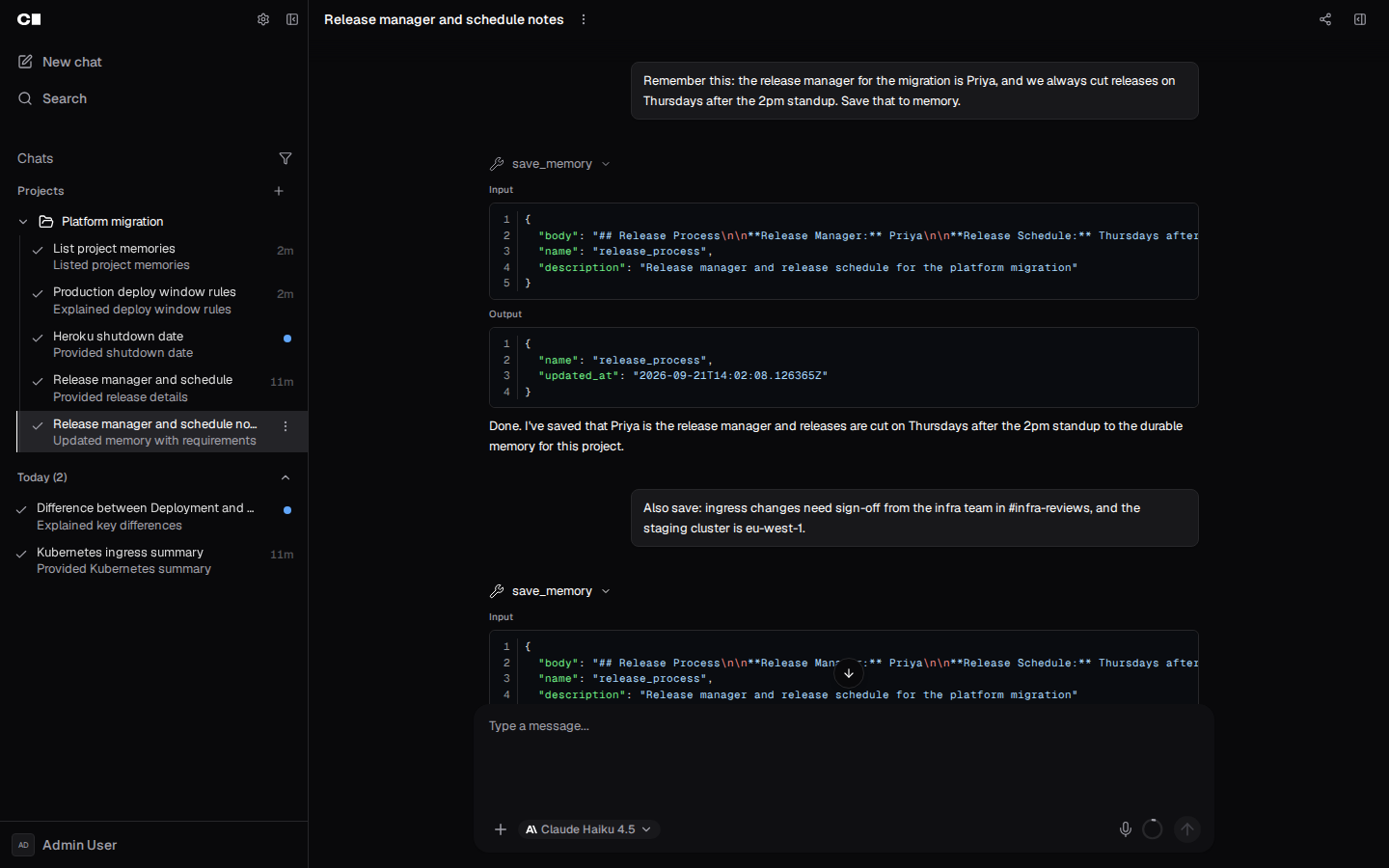 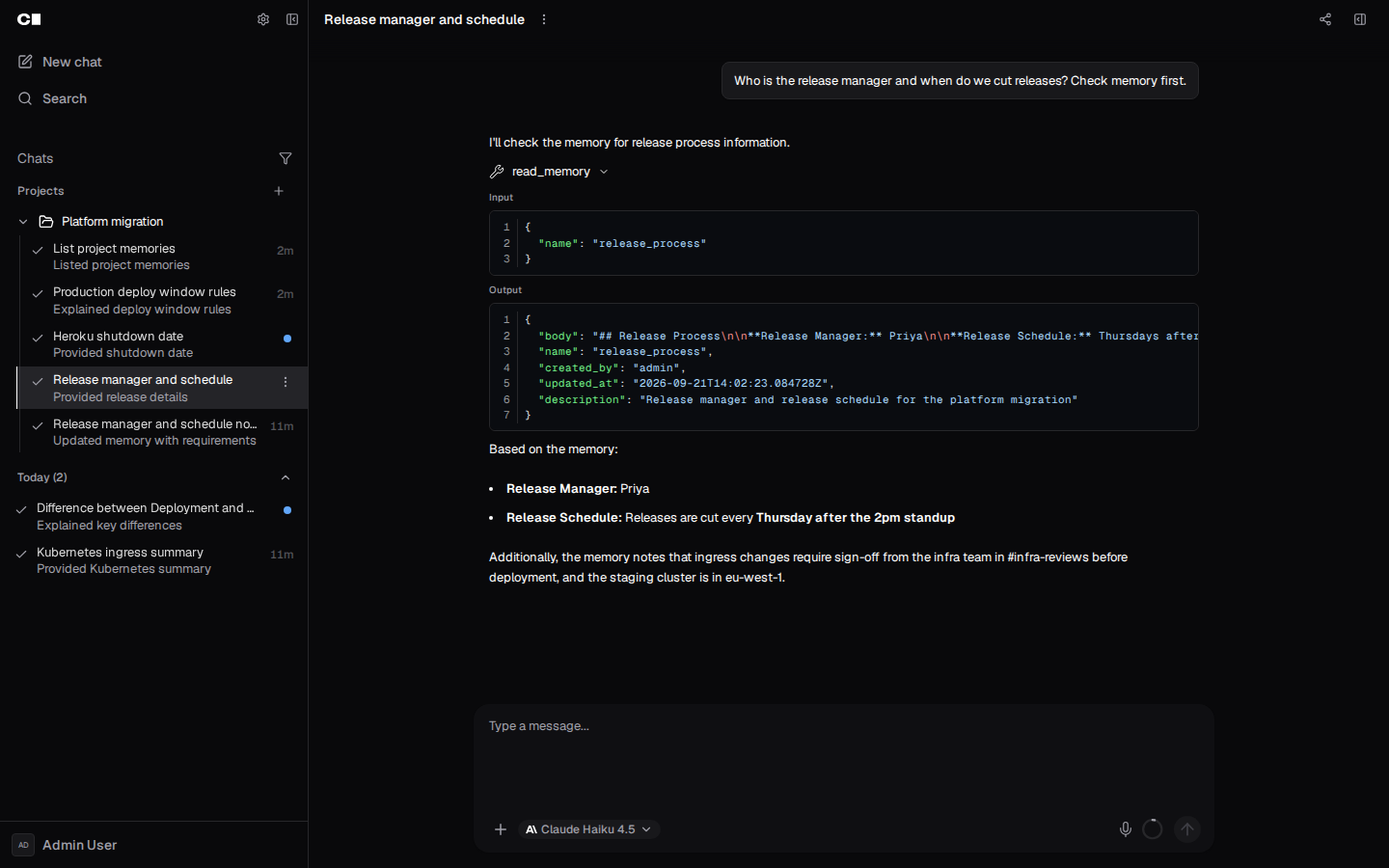 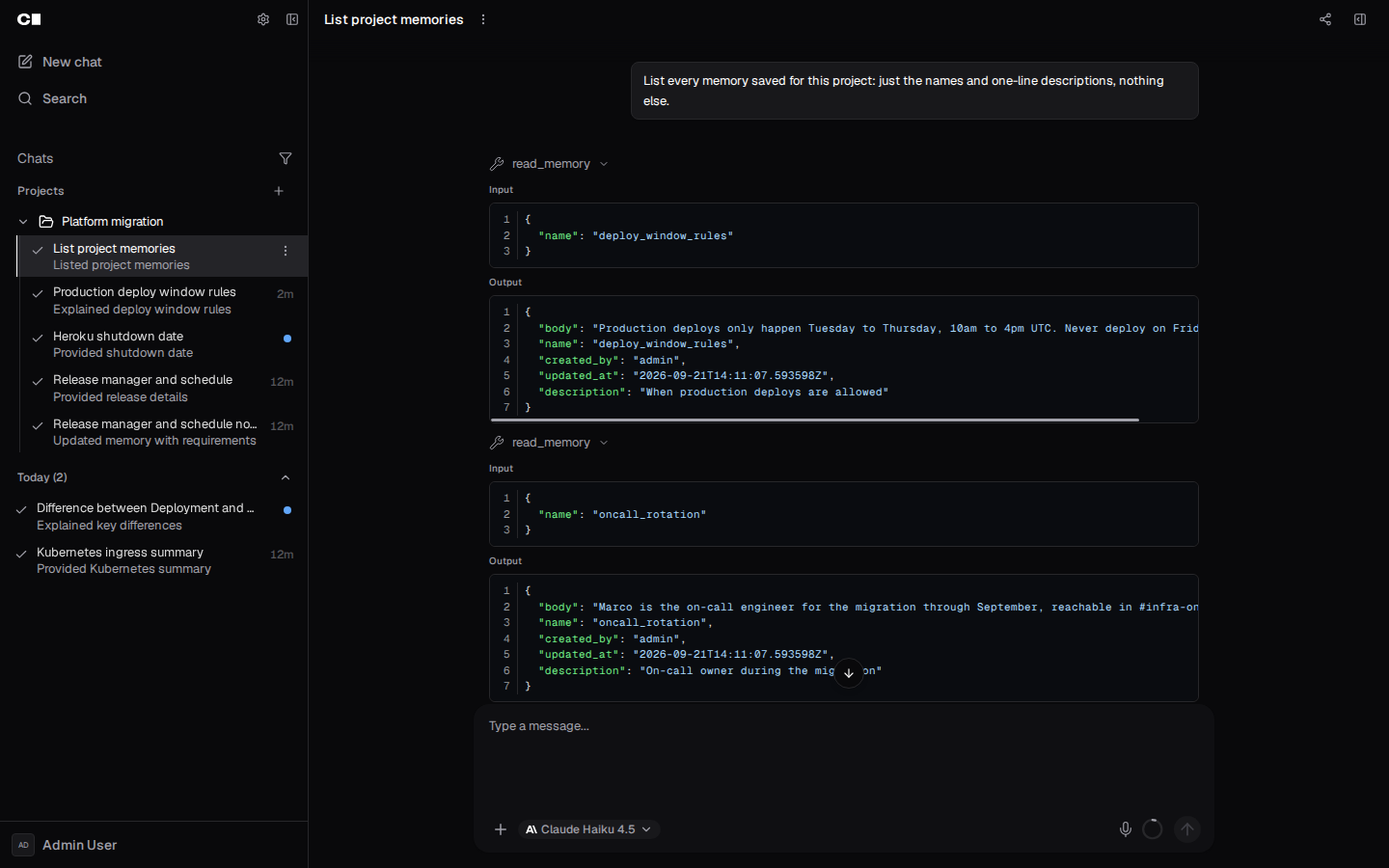 </details> --- Generated with Coder Agents on behalf of @f0ssel. --------- Co-authored-by: Claude Opus 5.5 (1M context) <noreply@anthropic.com> |
||
|
Nick Vigilante
|
3f408825b5 |
docs: add playback controls and descriptions to autoplaying videos (#30263)
## Summary Four docs pages embed autoplaying, looping screencasts with no controls, so readers cannot pause them (WCAG 2.2.2, Level A). This adds `controls` and `muted` to each `<video>` and a one-sentence text description after each video. The renderer-side companion for the beta docs is coder/docs-engine#203. ## Changes - Add `controls` and `muted` to the `<video autoplay playsinline loop>` tag in `external-auth.md`, `open-in-coder.md`, `ai-coder/agents/index.md`, and `compute-engine.md`. `autoplay`, `playsinline`, and `loop` stay. - Add a one-sentence description of each screencast directly below it. - `extending-templates/external-auth.md` is not in `docs/manifest.json`, so it is unpublished. It is fixed for consistency. ## Testing - `pnpm lint-docs` (markdownlint-cli2): 0 errors across 519 files. - `make lint/emdash`, `go run ./scripts/docshtmlcheck`, `go run ./scripts/styleclaims`: pass. - The repo pre-commit hook passed. - Not run: rendering the pages in a browser. The descriptions are inferred from the surrounding prose and file names, not from watching the videos. Linear: [DOCS-1050](https://linear.app/codercom/issue/DOCS-1050) _Generated by Coder Agents on behalf of @nickvigilante._ |
||
|
Nick Vigilante
|
fcbf45c571 |
docs: render audit log resources as one table per resource (#29797)
## Summary The audit logs page now lists each tracked resource in its own section with a simple two-column table, replacing the nested HTML tables that rendered poorly and overflowed on phones. ## Before and after Before, the generated block was a single Markdown table with a malformed `|<b>Resource</b>||` header. Each row held the resource name and its actions in one cell, then split a raw HTML `<table>` of fields across the remaining cells. The result rendered unevenly across renderers, was far wider than the page on mobile, and was hard to navigate with a screen reader. After, each resource gets an `###` heading under **Tracked Events**, which also gives it a linkable anchor. Below the heading, an `Actions:` line lists the audited actions as inline code, followed by a two-column Field and Tracked table with `Yes` or `No` values. Every table uses the same fixed column widths (Field 75%, Tracked 25%), so the Tracked column lines up across all resources. Two narrow columns fit at phone width without horizontal scrolling. Resources with no mapped actions skip the `Actions:` line instead of rendering an empty one. Resource ordering is unchanged. ## Changes - `scripts/auditdocgen/main.go` writes one section per resource. Each fields table is a small HTML table with `width` attributes, because Markdown tables size columns to their content and cannot align across tables. GitHub and the docs site sanitizer both keep `width` but strip inline `style` and `<colgroup>`. - The generator no longer panics when its start marker is the last thing in the file. - New `scripts/auditdocgen/main_test.go` covers section output, marker handling, and idempotent regeneration. - `docs/admin/security/audit-logs.md` is regenerated, and the intro sentence above the block now explains the actions line and the Tracked column. ## How it was regenerated `make docs/admin/security/audit-logs.md`, which builds the generator and runs `markdownlint-cli2 --fix` and `markdown-table-formatter` over the output. Running it a second time produces no diff. ## Testing - `go test ./scripts/auditdocgen/...` passes. - `pnpm exec markdownlint-cli2 docs/admin/security/audit-logs.md` reports 0 errors. Linear: https://linear.app/codercom/issue/DOCS-894 --- 🤖 Built with AI assistance. |
||
|
Thomas Kosiewski
|
fb0951b850 |
feat: add the manage_automations chat tool switch and read actions (#30214)
Adds the `manage_automations` chat tool with its read and stop actions
(`list`, `get`, `disable`, `delete`), gated by an interim per-chat
switch. Tool sets have not landed, so this ships
`chats.manage_automations_enabled` as the RFC describes for that case;
tool sets later replace it and migrate its values.

Part of CODAGT-1212 (slice 12a of 3). Part of CODAGT-1135.

## What changes

- **Switch.** Migration `000611` adds `chats.manage_automations_enabled`
(default off). It is set through `POST /api/v2/chats` and `PATCH
/api/v2/chats/{chat}`. After creation only the chat owner may send the
field (403 otherwise). Turning it on returns 400 when the
`chat-automations` experiment is off for the chat owner (POST checks the
resolved `owner_id`, not the caller) or when the chat is a sub-agent
chat. Turning it off is always accepted. The audit table tracks it.
- **Offering.** The tool is offered only in root chats, outside plan
mode and explore mode, with the switch on, and with the experiment on
for the chat owner (decided once per turn, like `mcp-tool-search`). It
is not on the plan-mode or explore allowlists, and sub-agent chats are
created with the switch off.
- **Per-call recheck.** Every call reloads the chat and checks all rules
again, with a fresh experiment evaluation, before doing anything.
- **Scoping.** Owner and organization come from the chat, never from
arguments. Reads run as the owner through a new query that filters on
organization and owner. Other members' automations are "not found", even
when the chat owner is an organization admin.
- **Automation-reached turns.** Detected at call time from the full
history (compaction replays user rows without `automation_id`, so the
prompt window is not enough). In such turns only automations that target
the chat or created it (`chats.automation_id`) are visible.
- **Visibility of prompts and deletes.** `list` leaves out prompts (tool
results stay in the chat, which may be shared); `get` returns the prompt
of the automation it names. In a turn an automation reached, `delete`
only removes the triggering automation; the others can still be
disabled.
- **Audit.** `disable` and `delete` go through the management service
and write a background audit entry with `chat_id`, plus the triggering
`automation_id` and `input_id` in reached turns. Results use the API
shape and never contain a secret or secret hash.

`create`, `update`, `enable`, and `run_now` come in the next PR and
return "not available in this version" here.

Follow-up: CODAGT-1270 (bound the history read that reached-turn
detection does on each call).

## Size

About 1,380 hand-written lines: about 460 production, 680 tests, and 240
SQL that has to be there (the `chats_expanded` view rebuilt in both
migrations and the 17 inline column lists). Generated: +649/-280 (sqlc,
dbmock, dbmetrics, dump.sql, apidoc, API and audit docs,
`typesGenerated.ts`).

## Validation

- Unit and DB tests for every rule above (switch 403/400 cases, offering
rules, per-call recheck, owner/org scoping with an org-admin owner,
reached-turn detection including compaction replay, audit fields, secret
scan), plus a separate test audit. Full `make pre-push` passed before
push.
- Remote dogfood UAT passed on this slice: switch API cases, tool absent
with the switch off, in plan mode, in sub-agents and with the experiment
off for the owner (checked in the server's per-step tool lists),
list/get/disable/delete, and a secret scan of all tool output. Audit
entries are verified in Go tests only.

> [!NOTE]
> ARCHITECTURE.md prose was drafted by an agent at the user's request;
the user will review it.

## Stack

Stacked on the Automations for Coder Agents stack (30085 ... 1214b).
Next: slice 12b (write actions), then 12c (composer toggle).

---
_Generated with [`xum`](https://github.com/coder/xum) • Model:
`anthropic:claude-opus-5-5` • Thinking: `high`_
|
||
|
Thomas Kosiewski
|
9316d67440 |
feat: add chat automations management API behind chat-automations (#30112)
Adds the management API for chat automations under
`/api/experimental/organizations/{organization}/chat-automations`,
behind the new user-scoped `chat-automations` experiment. This is the
first of two PRs for RFC step 3; nothing publishes automation messages
yet.

- **Experiment:** `chat-automations` is in `ExperimentsKnown`,
`ExperimentsUserScoped`, and the ruleguard list in `scripts/rules.go`.
Every route asks `chatd.AutomationsEnabled(ctx, api.ExperimentEvaluator,
callerID)`, which fails closed on a missing subject or evaluator; the
routes stay mounted and return 404 when the experiment is off for the
caller, so a runtime rule for one user applies on the next request
without a restart. There is no `/api/v2` alias.
- **Routes:** list, create (201), get, `PATCH`, delete (204), with
Swagger annotations and audit entries. List returns the automations in
the organization the caller can read (members see their own,
organization admins see all).
- **Service** (`coderd/x/chatd/automations.go`): create validates kind
and target shape, a non-empty prompt, a five-field cron and IANA time
zone, model access, and that an `existing_chat` target is a root chat of
the owner in the same organization. It defaults `when_busy` to `skip`
for schedules and `queue` for webhooks and computes the first schedule
cursor. `PATCH` runs the same per-field validation on each changed
field, rejects `kind` and `target_mode`, bumps `schedule_revision` on
prompt, cron, or time zone changes, and recomputes the cursor on cron or
time zone changes.
- **Owner-only:** only the owner can `PATCH` an automation, even with
organization-admin or site-owner roles (403); admins can list, read, and
delete.
- **Secrets:** a webhook's secret (`coder_automation_` prefix) is
returned once in the create response. Only its SHA-256 is stored, and it
appears in no list, get, audit, or log output.
- **Cap:** new option `--chat-max-automations-per-owner` (default 50)
caps automations per owner across all organizations; creating one more
returns 409. Creates serialize on a per-owner advisory lock.
- **Cron:** `cron.Standard(spec, timeZone)` accepts any standard
five-field expression (the existing `Weekly` rejects day-of-month and
month restrictions). Responses include the next five run times of an
enabled schedule.

PR 3b (stacked on this one) adds disable and re-enable with the queue
cutoff, makes delete run disable first, and adds secret rotation and the
schedule preview route. Until then, the queue promotion guard from
#30096 discards queued rows whose automation was deleted.

Dogfood UAT ran on a real dev instance and passed:
create/list/get/patch/delete via curl, owner-only 403s for an
organization admin and the site owner, the cap (including concurrent
creates and cross-organization counting), a runtime rule turning the
experiment off for one user without a restart, and `/api/v2` 404s.

Part of CODAGT-1209 (PR 3b closes it)
Part of CODAGT-1135
Refs CODAGT-1217

Stack: PR 3 of the Automations for Coder Agents stack, on top of #30096
(which is on top of #30085).

> This PR was written by an AI agent (xum) and reviewed by the agent's
own test audit and UAT. A human has not reviewed it yet.

---
_Generated with [`xum`](https://github.com/coder/xum) • Model:
`anthropic:claude-opus-5-5` • Thinking: `high`_

---------

Signed-off-by: Thomas Kosiewski <tk@coder.com>
|
||
|
Thomas Kosiewski
|
f55aa6c50d |
feat: add chat automations schema, RBAC resource, and audit entries (#30085)
Adds the storage and authorization pieces for Automations for Coder Agents. No route, SDK request type, or chatd code uses them yet, so nothing is exposed. This is the bottom PR of the Automations stack (RFC step 1). Later PRs add the chatd acceptance seam, management routes, webhooks, and schedules on top of these names and constraints. **Schema** (migrations 000609, 000610) - `chat_automations` table with enums `chat_automation_kind`, `chat_automation_target_mode`, `chat_automation_webhook_use`, and `chat_automation_when_busy`. It includes `created_by_chat_id`, the webhook secret hash and version, the single-use `webhook_consumed_at` marker, the schedule cursor and revision, and `queue_generation`. Named CHECKs enforce the target and kind shapes from the RFC. A composite foreign key keeps `new_chat_model_config_id` in the automation's organization, the same pattern the model override tables use. A trigger (`chat_automations_chat_organization`) keeps `target_chat_id` and `created_by_chat_id` in that organization too. A composite foreign key cannot do that while keeping `ON DELETE SET NULL` on PostgreSQL 13. The trigger validates a reference only on insert or when it changes, so chat deletion can still clear both references. Indexes cover the owner and both chat references for cascades and `SET NULL`. - Provenance columns with partial indexes and no foreign key to `chat_automations`: `automation_id`, `input_id`, `queue_generation` on `chat_queued_messages` (all set or all null), `automation_id` and `input_id` on `chat_messages`, and `chats.automation_id`. `chats_expanded` is recreated to include `automation_id`. - `chat_automation` values for `api_key_scope` and `resource_type`. The down migration is a no-op because enum values cannot be dropped. **Authorization** - New organization-scoped RBAC resource `chat_automation` (create, read, update, delete). The `agents-access` role grants it for the member's own automations. It is excluded from the member role's user-level permissions, so a member without `agents-access` gets nothing. Site owners and organization admins get it through their existing all-permissions lists. The owner-only update, enable, and run rule from the RFC belongs to the management service in a later PR. - The generated scopes stay out of `externalLowLevel`, so API keys gain no user-requestable scopes. - `dbauthz` wrappers for the three queries this PR adds: `InsertChatAutomation`, `GetChatAutomationByID`, and `DeleteChatAutomationByID`. `InsertChatAutomation` also requires update on the target chat, read on the creating chat, and read on the new-chat model config (its user and group ACL). There is also a `dbgen.ChatAutomation` helper. **Audit** - `enterprise/audit/table.go` entries for `ChatAutomation`, with `webhook_secret_hash` and `prompt` marked `ActionSecret`. The prompt is treated as chat content, like chat titles. The schedule cursor, revision, and queue generation are ignored as internal bookkeeping. `Chat.automation_id` is tracked. **Required checks from the ticket** - Migrations apply and roll back: `TestMigrate` and `TestMigrateUpWithFixtures` (new fixture for 000609). Dogfood UAT also applied the migrations on a dev instance, rolled them back, re-applied them, and compared schema dumps. After rollback, the only differences from main were the enum values that cannot be dropped and develop.sh's own `_develop` schema. After re-applying, the only difference from this branch's `dump.sql` was the `_develop` schema. - Secret hash marked secret: `Test_chatAutomationSecretFieldsRedacted` checks the table entries and that an audit diff contains neither the raw hash, its base64 form, nor the prompt text. Also covered: `TestRolePermissions` cases for own, other owner, other organization, and a member without `agents-access`. `TestChatAutomationShapeConstraints` covers the named CHECKs, the cross-organization foreign key and trigger, a cross-organization retarget, and deleting referenced chats. Under `site/`, only generated files changed (`typesGenerated.ts`, `rbacresourcesGenerated.ts`). Closes CODAGT-1207 Part of CODAGT-1135 --- _Generated with [`xum`](https://github.com/coder/xum) • Model: `anthropic:claude-opus-5-5` • Thinking: `high`_ --------- Signed-off-by: Thomas Kosiewski <tk@coder.com> |
||
|
Mathias Fredriksson
|
ff158c0589 |
feat: preserve user-supplied chat titles (#29486)
Chats created through the API or MCP couldn't be given a title, and automatic title generation could overwrite a title the user had set, at creation or by renaming during generation. #30254 tried to keep renames by comparing title text, but text can't tell a user title from a generated one that has the same text. Chat creation over the API and MCP now accepts a title. Each chat records where its title came from: fallback (derived from the prompt), generated, or user. A title can only be replaced by a title from the same source or a higher one, so automatic generation never overwrites a user's title. Title changes no longer reorder the chat list, and clients apply them in the order they were written. Chats created before this change are treated as having fallback titles. Closes CODAGT-1047 Reverts #30254 |
||
|
Nick Vigilante
|
2e0f97e5de |
feat: add type and secret status to the configuration reference (DOCS-896) (#29310)
## Summary The generated configuration reference told a reader how to set each deployment option but not what the option accepts. Every entry carried the environment variable, CLI flag, YAML key, and default, while serpent's value type stayed in the source. A reader could not tell a `duration` from an `int`, or discover an enum's accepted values, without following the flag link into the CLI reference. - **Type** is now rendered for all 200 options from the serpent value. Enums expand into their choices (`- Type: `enum`, one of `password`, `awsiamrds``) rather than printing serpent's escaped `enum[a\|b]` spelling, which is meant for its own table output. - **Secrets** are now marked. The nine options carrying the `secret` annotation that `codersdk.IsSecretDeploymentOption` reads are deliberately excluded from YAML, so the page now says where to set them instead of leaving the omission unexplained. ## Correction to the issue DOCS-896 claimed the page showed a YAML key for secret options. It does not: all nine secret options have an empty `YAML` field, so the generator already omitted that bullet. The real gap was that nothing explained *why* the YAML key is missing. The page header and the per-option marker now cover it. ## Verification - `go test ./scripts/configdocgen` passes, with new cases for the enum-choice parsing, plain and nil value types, and the secret marker rendering exactly once for the annotated option. - Regenerated page has 200 `- Type:` lines for 200 rendered options and 9 secret markers. - `make lint/emdash`, markdownlint, `markdown-table-formatter`, and Vale are clean on the regenerated page. `golangci-lint` clean on the package. Full `make pre-commit` passed. <details> <summary>Local pre-push note</summary> The repository pre-push hook runs the full Go suite locally. In this workspace it segfaults the `make` process outright, and an isolated `make test` run produces ~1,000 failures unrelated to this change (embedded NATS servers failing to start within 10s, chatd state-machine tests), which reproduce independently of this diff. I verified the change with `go build ./...`, the package tests above, and the full pre-commit suite instead, and disabled the hook for this worktree only using its documented `git config coder.pre-push` knob, restoring the setting immediately after the push. No `--no-verify`. CI is the authority on the full suite here. </details> --- Generated with Coder Agents on behalf of @nickvigilante. Linear: [DOCS-896](https://linear.app/codercom/issue/DOCS-896/configdocgen-render-option-type-and-secret-status) |
||
|
Nick Vigilante
|
4a184ca54a |
feat: add generated API key scopes reference (DOCS-135) (#29307)
## Summary Coder validates every requested API key scope against a curated public catalog in `coderd/rbac`, but the docs never listed it. Readers had to infer the requestable set from the `codersdk.APIKeyScope` enum, which is a superset that includes internal scopes a token cannot carry. This adds `scripts/scopesdocgen`, which renders `docs/reference/api-key-scopes.md` from `rbac.ExternalScopeNames` and the policy definitions behind it: - built-in scopes (`coder:all`, `coder:application_connect`) - composite `coder:*` scopes, each with the permissions it expands to - low-level `resource:action` scopes, with the action descriptions the policy declares - the deprecated `all` / `application_connect` aliases and their canonical spellings The generator is wired into `make gen`, so CI fails when the scope catalog and the page drift apart. ## Also in this change - `coderd/apikey.go`: the unrequestable-scope `400` detail pointed at `admin/users/sessions-tokens#api-key-scopes`, which only ever held a partial list. It now points at the generated reference. - `docs/admin/users/sessions-tokens.md`: the partial enumeration and the "read the schema, but not all of it applies" caveat are replaced with a link to the reference. The how-to content stays. ## Verification - `go test ./scripts/scopesdocgen` covers the sentence formatting, the scope partitioning, and a guard that every name in `rbac.ExternalScopeNames()` appears on the rendered page. - `go test ./coderd -run 'TestTokenScoped|TestCreateTokenScopes|TestExternalScopesAreStorable|TestTokenLegacySingularScopeCompat'` passes, confirming the page's claims about the default scope and the rejection of internal scopes. - `make lint/emdash`, `make lint/docs-html`, `make lint/check-scopes`, `pnpm run check-docs`, and Vale on the changed pages are clean. Full `make pre-commit` passed. <details> <summary>Context and scope decisions</summary> Part of the DOCS Automated reference documentation project, which tracks generating reference pages from product source of truth instead of maintaining them by hand. DOCS-135 is the first item: it was filed as "wire up the existing generator," but `scripts/apikeyscopesgen` emits Go (`codersdk/apikey_scopes_gen.go`), not documentation, so there was no generator output to surface and this adds one. Decisions made while implementing: - **Placement.** `docs/reference/api-key-scopes.md`, as a direct child of Reference rather than inside `docs/reference/api/`, because that directory is owned by the swagger generator. - **Page shape.** Follows the `scripts/docgenenv` convention for generated reference pages: the generated marker and page metadata in front matter, the generated-content banner in the body, and sections starting at level two because the front-matter title renders as the page heading. - **Public scopes only.** The page lists what `rbac.IsExternalScope` accepts. Internal `resource:action` pairs are deliberately excluded, which is the distinction the old schema link failed to make. - **Acronym handling.** Policy action descriptions are lowercase source strings (`"ssh into a given workspace"`). The generator restores the casing of a small set of leading acronyms rather than editing the RBAC package, so the change stays inside the docs pipeline. Sibling backlog items turned out to be already delivered and are being rescoped separately: `metricsdocgen` and `auditdocgen` already write into their docs pages, and `scripts/configdocgen` already generates the configuration reference. </details> --- Generated with Coder Agents on behalf of @nickvigilante. Linear: [DOCS-135](https://linear.app/codercom/issue/DOCS-135/wave-1-wire-up-api-key-scopes-reference-to-docs) ## Product UI impact, please read This PR corrects three RBAC action description strings in `coderd/rbac/policy/policy.go`: | Action | Before | After | |---|---|---| | `workspace:start` | allows starting a workspace | start a workspace | | `workspace:stop` | allows stopping a workspace | stop a workspace | | `api_key:update` | update an api key, eg expires | update an api key, for example its expiry | These were internal-facing until this PR, which is what made them worth fixing: the new reference page renders them verbatim to operators, and "eg expires" is not decodable by a reader without codebase context. **They are not docs-only.** `make gen` propagates them to `coderd/rbac/object_gen.go` and `site/src/api/rbacresourcesGenerated.ts`, and `CreateEditRolePageView.tsx` renders the description next to each action in the custom roles editor. So this changes admin UI copy, and `CreateEditRolePageView.stories.tsx` means Pixel may now report a genuine snapshot diff on that component rather than the pre-existing failure noted below. The new wording matches the convention the rest of the table already follows (`ssh into a given workspace`, `create an AI Gateway key`), so this makes the UI more internally consistent, not less. Flagging it explicitly because a docs PR changing product copy deserves an owner's eyes rather than a silent merge. Happy to split it out if RBAC or frontend would rather own it, with the caveat that the reference page would then publish `eg expires` in the meantime. <details> <summary>CI note: Storybook / Pixel failure</summary> The `Storybook` check fails at its `Snapshot` step, and `Pixel / Review` reports `build failed` with no snapshots processed. **Updated:** this note originally said the branch touched no files under `site/`. That is no longer true. Correcting the RBAC policy description strings (CRF-24) required `make gen`, which regenerated `site/src/api/rbacresourcesGenerated.ts` alongside `coderd/rbac/object_gen.go`. That file is a generated string table with no rendered component behind it, so it still cannot account for a Storybook snapshot or Pixel build failure, but the original justification no longer holds and is replaced by this one. The failure predates that change: it was present when the branch genuinely had no `site/` diff. Every other check passes. </details> |
||
|
Nick Vigilante
|
149366a459 |
feat: validate documented experiment keys (DOCS-139) (#29316)
## Summary
The docs name specific experiment keys wherever an individual
experimental feature is documented, and nothing verifies those keys
still exist in the code.
When an experiment is renamed or graduated, the enablement example keeps
telling operators to set a key the server no longer accepts.
This adds `scripts/checkexperimentkeys`, which fails when a key named in
`docs/**` is absent from `codersdk.ExperimentsKnown`, and wires it into
`make lint` as `lint/check-experiment-keys`.
**The data flows one way.**
The check reads keys the docs already name and validates them against
code.
It does not generate a page, add a manifest route, or write any key into
`docs/`.
That is deliberate: #29113 retired the generated feature-stage lists
because the team decided not to advertise which features are currently
experimental or beta.
A guard against stale keys is compatible with that decision; an index is
not.
The five key references the check currently guards are the per-feature
ones that decision left in place: `chat-advisor`,
`chat-virtual-desktop`, `auto-fill-parameters`, `agent-lifecycle-hooks`,
and `mcp-server-http`.
### Recognition rules
Only explicit enablement forms are matched: `--experiments=<key-list>`
and `CODER_EXPERIMENTS=<key-list>`, including every key in a
comma-separated list.
Values may be single- or double-quoted.
Explicit shell line continuations are joined before matching, preserving
the first physical line for a finding.
Bare identifiers in prose are ignored on purpose.
A check that guesses at prose produces false positives, and a check with
false positives gets deleted by the first person it blocks.
`*`, `feature1`, `feature2`, and angle-bracketed values are recognized
placeholders.
The recognized forms are documented in the script's README.
Known gap: the space-separated `--experiments <key>` form is not
matched.
No prose uses it today, so this is latent rather than broken, and
closing it is a small follow-up if the form reappears.
### Also fixed
`ExperimentMCPToolSearch` had no case in `DisplayName()`, so it rendered
as a title-cased guess in the product UI as well as anywhere else
display names surface.
`TestExperimentDisplayNames` now pins the display name of every known
experiment against an expected map, with a length assertion, so a new
experiment cannot silently fall back to the title-cased key.
## Verification
- `go test ./scripts/checkexperimentkeys ./codersdk` passes.
Coverage includes known and unknown keys, quoted values, shell
continuations, placeholders, multi-key lists, bare-prose exclusion, and
failure-output formatting.
- `golangci-lint run ./scripts/checkexperimentkeys/... ./codersdk/...`
reports 0 issues.
- `make lint/check-experiment-keys` is clean against current `docs/`.
- Negative control: a fixture containing
`CODER_EXPERIMENTS=not-a-real-key` exits 1 with the expected finding.
- The full `pre-commit` hook passes, including
`lint/check-experiment-keys` inside aggregate `make lint`.
<details>
<summary>History: the deferred lint wiring, now resolved</summary>
This PR previously landed the tool and a standalone `make` target while
leaving the one-line addition to aggregate `make lint` for a follow-up,
and stayed draft, because three documented `oauth2` keys were stale and
owned by another PR:
- `docs/admin/integrations/oauth2-provider.md:34`
- `docs/ai-coder/mcp-server.md:108`
- `docs/ai-coder/mcp-server.md:114`
#29268 merged on 2026-09-15 and removed all three in favor of
`CODER_OAUTH2_PROVIDER_ENABLE`.
The branch is rebased onto that, the check is green against `main`, the
wiring is folded into this PR, and the merge-order constraint recorded
as CRF-5 no longer applies.
The rebase also collided with `DisplayName()`, which gained new cases on
`main`.
Resolved in favor of `main`'s switch rather than this branch's earlier
map refactor, keeping the production diff to the one missing case and
moving the exhaustiveness expectations into the test.
</details>
<details>
<summary>Why this replaced a generated reference page</summary>
DOCS-139 originally asked for a generated
`docs/reference/experiments.md` listing every key in `ExperimentsKnown`.
That was built and opened as #29311, then closed without merging.
Commit
|
||
|
Nick Vigilante
|
72e31ffb4c |
fix: prevent Prometheus metrics reference drift (#29314)
## Summary The Prometheus metrics reference merged scanner output with a hand-maintained file, and changes to the hand-maintained half could not fail CI. 66 of the 76 static families had no scanner coverage: four files sat in a skip list pending `WrapRegistererWithPrefix` support, and the `aibridge/` tree was outside the scan roots entirely. Rename or add a metric in any of them and `make gen` regenerated the page unchanged, so `check_unstaged.sh` passed while the published table quietly went wrong. The scanner now resolves the prefixes a registerer applies: - Indexes `WrapRegistererWithPrefix` and `NewMetricAliasRegisterer` call sites, resolving the prefix from a string literal or an imported constant. - Maps that prefix to the package whose constructor receives the wrapped registerer, covering the two shapes the codebase uses: a constructor that **forwards** its registerer to another package (`aibridge.NewMetrics` to `aibridge/metrics.NewMetrics`), and a collector **registered directly** against the wrapped registerer (`gatewayRegisterer.MustRegister(keypool.NewStateCollector(...))`). - Indexes only the canonical prefix of an alias registerer. The legacy `coder_aibridged_` and `coder_aibridgeproxyd_` aliases are deprecated per AIGOV-447 and should not be taught in the reference. With prefixes resolved: skip list deleted, `aibridge` added to the scan roots, and all 29 `coder_ai_gateway_*` families removed from the static file, which now holds only genuine externals (`go_*`, `process_*`, and metrics built dynamically). `enterprise/scaletest/agentfake` is excluded deliberately: its fake-agent metrics are not part of a deployment's surface, so documenting them would send operators looking for series they will never see. **Also fixes two extraction and merge gaps.** Label lists written as `append(baseLabels, "status", "route")` now resolve, and any unresolvable element returns no labels rather than a partial list. Static runtime-label overrides now replace generated labels only: generated name, type, and HELP remain authoritative. ## Verification The prefix-scanning refactor itself preserves the existing AI Gateway rows. However, the page is **not byte-identical** to `main` because this round fixes two already-published stale HELP strings. Its SHA-256 changes from `7ced1e7e9f2d4caf5e3b5e484ef4af14f955b8b4cd1a14fe81360bbdd49bb150` to `a68774275a3b21d5bae65024cc8ee65b52c51e52786c9aea45e3981e4e7f1643`. | Metric | Before | After | | --- | --- | --- | | `coderd_agentstats_connection_median_latency_seconds` | The median agent connection latency | The median agent connection latency in seconds | | `coderd_agentstats_startup_script_seconds` | The number of seconds the startup script took to execute. | Amount of time taken to run the startup script in seconds. | - `go test ./scripts/metricsdocgen/...` covers prefix resolution from a literal and imported constant, alias-registerer argument selection, collector registration, forwarder propagation, scan-to-emit prefix application, all-or-nothing label extraction, static-label merging, and the exclusion predicate. - `golangci-lint run ./scripts/metricsdocgen/...` and full `make pre-commit` pass. ## What this does not fix Ten metrics are still skipped for having no `HELP` text, with a warning to stderr rather than an error. Making that fatal means writing accurate descriptions for ten metrics in the agent and SSH server packages, which is a behavioral claim I would rather not guess at. Follow-up filed as DOCS-906. The scanner still uses package-level syntactic prefix inference. Broader validation of prefix scan roots, mixed registration within a package, and parameter-passed registerers belongs in DOCS-908 rather than this focused drift fix. <details> <summary>Local pre-push note</summary> The pre-push hook cannot run in this workspace: GNU Make 4.4.1 segfaults on the repo's `.SHELLFLAGS = $@ -ceu` configuration for a target named `test`, tracked in DOCS-903 with a minimal reproduction. I verified with the package tests, `golangci-lint`, and full pre-commit, and disabled the hook for this worktree only through its documented `git config coder.pre-push` knob, restoring it right after the push. No `--no-verify`. </details> --- Generated with Coder Agents on behalf of @nickvigilante. Linear: [DOCS-897](https://linear.app/codercom/issue/DOCS-897/metricsdocgen-static-metrics-file-can-go-stale-without-failing-ci) |
||
|
Garrett DelfosseandClaude Opus 5.5
|
7cd1b2040b |
feat: add chat projects API (#29242)
- Experiment, behind `chat-projects` (off by default). First of three stacked PRs: #29301 (memory), #29583 (UI). This PR is API only; the screenshots below are from the UI in #29583. - CRUD under `/api/experimental/organizations/{organization}/chats/projects/{project}`. `GET /api/experimental/chats/projects` lists the caller's projects across all organizations. - `project_id` on chat create and as a chat list filter. A chat joins a project only at creation; there is no move. - Projects are identified by ID. Names are display labels (64 characters, description 1024) with no uniqueness constraint. An optional `icon` URL (usually an emoji image under `/emojis`) is capped at 256 characters and audited. - A user can own at most 100 projects across all organizations; creating another answers 409. Creates count and insert under a per-owner advisory lock so concurrent requests cannot overshoot. - Projects are private to their `owner_id`. Members may only create their own, and a chat can only be bound to a project its owner owns. An unreadable or foreign project on chat create answers 404 so IDs cannot be probed; a project from another organization answers 400. - Permissions ride on the `agents-access` role next to chats (after #30004), so whoever can use Coder Agents can use projects. Owners and org admins reach every project. ### Examples Create a project in an organization: ```http POST /api/experimental/organizations/{organization}/chats/projects {"name": "Platform", "description": "Infra and deploy work", "icon": "/emojis/1f680.png"} ``` ```json { "id": "7c0e4a3e-5b1f-4f7d-9a51-2f3c8f6d2b10", "organization_id": "bb640d07-ca8a-4869-b6bc-ae61ebb2fda1", "owner_id": "0ed9befc-4911-4ccf-a8e2-559bf72daa94", "name": "Platform", "description": "Infra and deploy work", "icon": "/emojis/1f680.png", "created_at": "2026-09-30T15:04:05Z", "updated_at": "2026-09-30T15:04:05Z" } ``` List the caller's projects across organizations with `GET /api/experimental/chats/projects` (an array of the object above). Update with `PATCH .../chats/projects/{project}` and any of `name`, `description`, `icon`; delete with `DELETE`, which detaches its chats. Create a chat in the project, and list only its chats: ```http POST /api/v2/chats {"organization_id": "bb640d07-…", "project_id": "7c0e4a3e-…", "content": [{"type": "text", "text": "Plan the deploy"}]} GET /api/v2/chats?project_id=7c0e4a3e-… ``` At the limit: ```json 409 {"message": "You can have at most 100 chat projects. Delete a project to create another."} ``` <details> <summary>Screenshots (UI from #29583)</summary>      </details> --- Generated with Coder Agents on behalf of @f0ssel. --------- Co-authored-by: Claude Opus 5.5 (1M context) <noreply@anthropic.com> |
||
|
Nick Vigilante
|
1fd383e4fd |
docs: flatten lone index pages to single files (#30129)
The beta docs engine turns a directory that holds only an `index.md` into an empty collapsible section in the sidebar. Two pages on `main` have that shape: `docs/admin/external-auth/index.md` and `docs/ai-coder/agents/tools/index.md`. docs-engine is handling the shape in its own code (the sidebar render fix in https://github.com/coder/docs-engine/pull/196 and the sync-side handling in https://github.com/coder/docs-engine/pull/195), and this change removes it at the source by moving each page to a flat file: `docs/admin/external-auth.md` and `docs/ai-coder/agents/tools.md`. Both directories held only `index.md`, with no images or other files. The change updates the two `docs/manifest.json` paths, 29 inbound relative links across 17 pages, and the relative links inside the moved pages (three images and two page links in `external-auth.md`, one page link in `tools.md`), which now resolve one directory up. The ESR upgrade table in `docs/install/operate/upgrade/esr-2.29-2.34-upgrade.md` is re-padded because its link cells shrank, which is why that file shows 28 changed lines. No generator under `scripts/`, the docs-preview workflow, or `docs/.style` references either path. Published URLs stay the same, so no redirect is needed. coder.com's `convertPathToRoute` strips the `index.md` or `.md` suffix, the docs-preview workflow's `map_doc_path` maps `<dir>/index.md` and `<dir>.md` to the same route, and docs-engine's `mapMdPath` returns `admin/external-auth` and `ai-coder/agents/tools` for both the old and new paths. For verification, `docs/manifest.json` parses and all 471 of its paths exist. `make pre-commit-light` passes, which covers markdownlint, the table formatter, typos, emdash, and shellcheck, and `go run ./scripts/docshtmlcheck` passes. A local script resolved all 306 relative links in the changed files, and every one that the move touched points at an existing file and heading. linkspector runs on this PR in CI. A backport PR for `release/2.37` moves the same two pages plus `admin/licensing` and `install/other`: https://github.com/coder/coder/pull/30130. This change was prepared with AI assistance. The AI agent that prepared it ran the checks described above. --- 🤖 Built with AI assistance. |
||
|
J. Scott Miller
|
fc0af7fbd8 |
feat: open a chat_turn span per prompt (#29771)
**TL;DR:** Wraps each prompt in a `chat_turn` root span with every lifecycle stage parented under it. The span records one outcome per turn (`completed`, `interrupted`, `error`, `abandoned`), and the new `coderd_chatd_turn_outcomes_total` counter counts those outcomes. Turns stay correct when tasks are canceled, replaced, or retried. Each prompt runs inside a `chat_turn` root span owned by the runner (`runnerTurnSpan`). The generation step, prepare, MCP connect, stream, TTFT, provider attempt, commit, thinking, tool call, compaction, and retry backoff stages are parented under it, activating the stages from #29770. `chat_turn` spans are standalone roots: the turn runs on a worker, often on another replica, and no trace context is persisted. **Lifecycle** - **Start.** Each generation loop iteration calls `Ensure`, which opens the turn if none is open and returns a `turnToken`. The span is backdated to the trigger: the latest of the last user prompt, a dynamic tool's result message after it, and a pending compaction request. An `acquisition` stage covers trigger to pickup. - **Stale trigger / takeover.** A trigger at or before the previous anchor opens the turn at now with no `acquisition` and counts `stale_anchor`. A runner that took the chat over from an owner with a stale heartbeat (`TakenOver`, from acquisition) opens its first turn at now with no `acquisition`, so the dead owner's run is not reported as pickup delay. - **Newer prompt.** `Ensure` on the current turn with a newer trigger closes it and opens a new one. The closed turn is `abandoned` unless the task that ran it records an outcome before releasing it. - **Finish.** After `FinishTurn` or `EnterRequiresAction` commits, the step calls `Complete`; `Settle` closes the span after the step's own stage ends, so the finishing step is inside the turn. A chat waiting in `requires_action` is outside any turn; the generation resumed by its tool results opens a new one. - **Emission.** Closing a turn fixes its end time; its span is emitted once every task that joined it (`Ensure` takes the task ID) has called `Release`, which `runTask` does after the task returns. A finishing task whose `FinishTurn` promoted a queued prompt therefore still counts its turn as `completed` even when the promoted task's `Ensure` runs before its `Complete`. `End` at runner exit emits whatever is left. - **Failure.** A step that commits `FinishError`, or fails closed, invalidates the turn as `error` after the commit. Errors the task runner retries, including task timeouts, keep the same turn open; an expected, non-retryable exit records no outcome and leaves the turn open until the interrupt task, a newer prompt, or runner exit closes it. A canceled generation task records no outcome and cannot obtain a turn token, so a replaced task never touches its successor's turn. - **Interrupt.** The interrupt task marks the open turn `interrupted` before `FinishInterruption` commits and closes it after. Only a stop (by the user or a parent agent) is `interrupted`; it ends with unset span status, since error status is reserved for `error` turns. runner shutdown, loss of ownership, and message edits close the turn as `abandoned` with unset status. - **Promotion.** Every promoting transition (`FinishTurn`, `FinishInterruption`, a send to an errored chat, `PromoteQueued`) returns the promoted message's queued time in its result, and one `recordQueueWait` helper records a standalone `queue_wait` to the promotion. The promoted turn opens at the promotion time. `chat_turn` is observed on `coderd_chatd_stage_duration_seconds` only for completed turns, so the histogram is completed-turn latency; every turn still emits its span. `coderd_chatd_turn_outcomes_total{outcome, chat_kind}` counts every closed turn exactly once (`completed`, `interrupted`, `error`, `abandoned`), matching the span's `turn_outcome`, under the `chat-stage-metrics` experiment. Turn time accounting is in draft #29772. **Stages and identity** - `tool_call` is a live stage around each local tool call in `chatloop`; the tool runs on its context, and it ends errored only when the tool fails to execute. Calls that never run (inactive, unknown, or rejected by policy) record no stage. - `mcp_connect` carries connected and failed server counts and ends errored only when servers were configured and none connected. - The compaction stage carries the model that runs the summary. - `withStageIdentity` puts scope and chat kind on the turn context. Detached background work runs in `background` scope as its own trace roots. - The `advisor` tool's nested model call appears only as its enclosing `tool_call`. ARCHITECTURE.md gains a "Lifecycle tracing" section. <details> <summary>Review decisions</summary> - Turn identity stays timestamp-based with targeted fixes (clamped acquisition, rotation on a newer trigger, invalidate after commit, fail-closed invalidation, settle closing invalidated turns) plus a takeover flag; keying turns on message IDs would not detect takeover and cannot express interrupted/abandoned outcomes. - Outcome classification: the interrupt task owns `interrupted`, and cancellation or a fence mismatch alone never records an outcome, so shutdown, ownership loss, and edits are `abandoned`. Only `error` turns set error span status. Remaining ordering races between a step and an interrupt are documented as known limitations in ARCHITECTURE.md. - Turns are emitted after the tasks that ran them return, not when they close, so an outcome a replaced task records while unwinding reaches its own turn; the successor task is not delayed. Chosen over an after-commit, pre-publish hook on `ChatMachine.Update`, which would fix only the `FinishTurn` ordering. - `requires_action` ends the turn rather than pausing it, so `chat_turn` measures chatd time; a prompt with client tools counts as several turns. - Promoted turns anchor at promotion time and `queue_wait` is always standalone, so `chat_turn` never includes time spent queued behind another turn. - The former `capacity_wait` stage (#29805) was dropped: it was a per-worker lower bound, excluded from accounting, and needed its own SQL and bookkeeping. #29805's remaining helpers are folded into this PR. </details> Supersedes #28972, #28973, and #29805. 🤖 This PR was generated by Coder Agents on behalf of @jscottmiller. |
||
|
J. Scott Miller
|
e988ddb11d |
feat: trace chatd provider stages and count only output parts as first token (#29770)
**TL;DR:** Traces the model provider call: a `stream` stage, a nested `time_to_first_token` stage, and one `provider_attempt` per HTTP round trip, labelled with provider type and model. Behavior change: `coderd_chatd_ttft_seconds` now counts only a real output part as the first token, so error, warning, and finish parts no longer count. Instruments the provider call. **Stream and time to first token.** `GenerateAssistant` records a `stream` stage from stream open to close and a nested `time_to_first_token` stage. The TTFT window closes once, on the first streamed output part: any part other than warnings, finish, or error, including start markers such as `text_start`. A closed window observes the stage and the pre-existing `coderd_chatd_ttft_seconds` with the same elapsed time. A failed open, an error part, or a release without an output part ends the TTFT span with the error (a silence timeout is classified as such) and observes nothing. The `stream` span ends once, with the error `GenerateAssistant` returns, so content-filter and no-output attempts end errored. Failed `stream` windows are observed like successful ones. The attempt is released before the stream span ends, so the TTFT window always falls inside its stream. The compaction summary stream passes a nil tracer, so it records neither. Without #29771, production emits only `provider_attempt`; #29771 passes the tracer to `GenerateAssistant`. **Provider attempts.** The provider HTTP transport is wrapped in `stageSpanRoundTripper`, which emits one `provider_attempt` stage per round trip, so retries each get a span. The span closes on response headers; a status >= 400 marks it errored without changing what the client sees. `resolveModelCall` resolves the `StageModel` (wire provider, configured `provider_type`, model, effective reasoning effort) and threads it to the transport, so span attributes and labels match the call. `provider_type` is read from `ai_providers.type`, so types outside the fantasy set (copilot) keep their configured name. `chatd.New` builds the tracer with the server clock. **Behavior change to `coderd_chatd_ttft_seconds`:** only an output part counts as a first token. Error parts no longer close the window as a success, and warnings and finish parts are skipped; the help text says so. `StageSpan.End` returns the span's elapsed window, which `ttft_seconds` observes. Callers pass `Stages` and `StageModel` through `GenerateAssistantOptions`; a nil tracer discards (TTFT still records `ttft_seconds`). `Server` gains the `stages` tracer and a `TracerProvider` option, wired from `coderd`. <details> <summary>Review decisions</summary> - Start markers close the TTFT window: they are the first sign the model is producing output, and waiting for a delta would fold hidden reasoning time into TTFT. - Failed `stream` and `provider_attempt` windows are observed: that time was spent. TTFT is the exception because a first token that never arrived has no duration. - `http_host` was dropped from `provider_attempt`; every request goes through the local AI Gateway transport, so it was constant. - The advisor tool's nested model call is intentionally not instrumented as `stream`/TTFT. </details> Supersedes #28970 and #28971. 🤖 This PR was generated by Coder Agents on behalf of @jscottmiller. |
||
|
J. Scott Miller
|
7a9442014e |
feat: add chatd lifecycle stage tracer (#29769)
**TL;DR:** Adds a stage tracer that turns each chat lifecycle stage into
both an OpenTelemetry span and a Prometheus histogram observation, so
traces and metrics always agree. The metrics are only registered with
the `chat-stage-metrics` experiment. Nothing calls the tracer until the
next PRs.

Adds `chatloop.StageTracer`, which emits each chat lifecycle stage as an
OpenTelemetry span and a `coderd_chatd_stage_duration_seconds{stage,
scope, chat_kind}` observation from one `End` call, so trace and metric
durations cannot disagree. The provider-bound stages (`stream`,
`provider_attempt`) are also observed on
`coderd_chatd_model_stage_duration_seconds{stage, provider_type,
chat_kind, model}`, the only family carrying `provider_type` and
`model`, and only for turn-scoped stages. Time to first token per model
stays on the existing `coderd_chatd_ttft_seconds`. Nothing calls the
tracer yet; the next PRs instrument the provider call and the runner.

- The families are registered only when the `chat-stage-metrics`
experiment is enabled (safe and known, so
`--experiments=chat-stage-metrics` or `--experiments=*` turns it on).
Spans are emitted regardless. `NewMetrics` leaves the families off;
`chatd.New` opts in from the experiment, and a test asserts the
experiment decides whether they reach the server's registry.
- `Stage`, `Scope`, `ChatKind`, and `StageAnomaly` are typed string
constants. `scope` separates latency attributable to a prompt (`turn`)
from detached `background` work; `chat_kind` is `root` or `subagent`,
empty without a known chat.
- `StageModel` carries the wire `provider`, `provider_type`, `model`,
and `reasoning_effort`. All are span attributes; only `provider_type`
and `model` are metric labels, on the model family. No family carries an
organization label.
- Observed stages: `chat_turn`, `queue_wait`, `acquisition`,
`mcp_connect`, `stream`, `time_to_first_token`, `provider_attempt`,
`tool_call`, `commit`, `retry_backoff`. `generation_step`, `prepare`,
`thinking`, and `compaction` are span-only. A test keeps the stage sets
and help text consistent.
- API: `Start` / `StartRootAt` for live spans (span timestamps come from
the tracer clock), `Record` for stages reconstructed from timestamps
(the scope comes from the context). `End` is idempotent;
`EndWithoutObservation` ends the span without a sample. A nil tracer,
provider, or metrics discards.
- `coderd_chatd_stage_anomalies_total{reason}` counts observations
dropped, adjusted, or inconsistent (`negative_elapsed`,
`inverted_window`, `missing_timestamp`, `future_start`, `stale_anchor`).
Span-only stages never feed it.
- Buckets are 12 round edges (`0.1 0.25 0.5 1 2.5 5 10 30 60 300 1800
3600`).
- Moves the body of the `for` loop in `StartGeneration` into
`runGenerationStep` so the step has a function boundary for a deferred
stage end. Control flow and error wrapping are unchanged.

<details>
<summary>Series cost (approximate, whole stack)</summary>

A histogram label set is 12 edges + `+Inf` + `_sum` + `_count`: 15
series. Per replica, each `chat_kind` costs about 150 stage series and 4
turn outcome counters; each `(chat_kind, model)` costs 30 (2 stages x
15). Both chat kinds on `M` models: about `308 + 60*M` per replica, plus
background-scope stage series.

Dogfood `main`, 3 replicas: ~3.4k `coderd_*` series per replica (~10.1k
total).

| Models used per replica | Added series (3 replicas) | vs. baseline |
|---:|---:|---:|
| 1 | ~1.1k | +11% |
| 5 | ~1.8k | +18% |
| 10 | ~2.7k | +27% |
| 35 | ~7.2k | +72% |

Most deployments run four or fewer models, so a typical replica adds
roughly 370 to 550 series. The experimental turn accounting in #29772
would add 88 more per replica (11 categories x 4 outcomes x 2 chat
kinds). Series appear lazily and do not grow with organizations.

</details>

<details>
<summary>Review decisions</summary>

- Experiment gate only; no deployment flag or metric levels. If the
experiment graduates, the families become always on like the other chatd
families; a flag is added then only if dogfood shows a cardinality
problem.
- Organization is on neither metrics nor spans, and `effort` is
span-only; `provider_type` (configured type), not the wire `provider`,
is the model-family label.
- `time_to_first_token` is not on the model family; per-model TTFT is
`ttft_seconds`, which observes the same measured window.
- The model family records only turn-scoped stages.
- Nil guards are kept so a nil or zero tracer is always safe to call.
- HTTP attribute keys stay snake_case like the rest of the chatd span
attributes.

</details>

Supersedes #28968 and #28969.

🤖 This PR was generated by Coder Agents on behalf of @jscottmiller.
|
||
|
Nick Vigilante
|
4a62b0fc9c |
docs: add YAML front matter to remaining pages (#30115)
## Summary Add YAML front matter to the remaining published documentation pages so all published pages expose a title through front matter. ## Changes - Add front matter to the 13 published pages that were missing it. - Preserve the page titles and feature states in the manifest. - Remove duplicate H1 headings where the front matter supplies the page title. ## Testing - `pnpm check-docs` passed. - Repository pre-commit checks passed. - Verified all 439 published manifest route entries have YAML front matter. Depends on #30109. Refs DOCS-1124. This pull request was generated by Coder Agents. |
||
|
Nick VigilanteandIan Evans
|
c2d243891f |
docs: remove feature states from page titles (#30109)
## Summary Remove feature-state suffixes from page titles and H1s, keeping availability states in `docs/manifest.json` navigation metadata. ## Changes - Remove Premium and Beta suffixes from eight page titles. - Update the docs content guidelines and doc-check skill to require state metadata instead of title suffixes. - Preserve the existing `premium` and `beta` state values in `docs/manifest.json`. ## Testing - `pnpm check-docs` passed. - Verified all eight affected manifest entries retain their feature state and no affected title retains a state suffix. Refs DOCS-1126. This pull request was generated by Coder Agents. --------- Co-authored-by: Ian Evans <5760366+ianjevans@users.noreply.github.com> |
||
|
Cian Johnston
|
9fa17a12ef |
fix: strip client actor headers unconditionally (#30037)
Strip all client-supplied headers matching `IsActorHeader()` in `PrepareClientHeaders`, regardless of `send_actor_headers`. This reserves the case-insensitive `X-AI-Bridge-Actor` prefix for identity injected by the gateway. Remove the redundant deletion of the three standard actor headers from `BuildUpstreamHeaders`. Generated with Coder Agents on behalf of @johnstcn. |
||
|
Cian Johnston
|
8742d2484c |
feat: add opt-in AI Gateway actor email headers (#29930)
Add opt-in forwarding of the authenticated Coder account email through `--ai-gateway-actor-header-meta-email`, `CODER_AI_GATEWAY_ACTOR_HEADER_META_EMAIL`, or `ai_gateway.actor_header_meta_email`. The option defaults to empty: enabling `send_actor_headers` alone does not forward email. Set a destination header explicitly to opt in; accounts without an email omit it. Carry authenticated email through the Gateway authorization response and strip client-supplied standard/configured email headers before applying trusted identity. The additive protocol field joins unreleased Gateway API v1.3 alongside workspace attribution. Includes email configuration precedence, authorization compatibility, captured upstream request tests, and matching documentation. Refs https://linear.app/codercom/issue/AIGOV-601 Generated with Coder Agents on behalf of @johnstcn. |
||
|
Cian Johnston
|
05d1fa8a4c |
feat: configure AI Gateway actor identity headers (#29929)
Allows configuring AI Gateway actor ID and username headers independently through `--ai-gateway-actor-header-id` and `--ai-gateway-actor-header-username` or associated environment variables and YAML settings. - Defaults to existing header name, an empty string disables that attribute. - Existing `send_actor_headers` gate remains off by default. - Validates header names, case-insensitive collisions, and protected destinations for embedded and standalone gateways. - Strips standard and configured identity destinations before injecting authenticated values. - Adds coverage for configuration precedence, captured upstream request, and generated help/API documentation. Refs https://linear.app/codercom/issue/AIGOV-601 Generated with Coder Agents on behalf of @johnstcn. |
||
|
Susana Ferreira
|
34db9ca638 |
feat: price AI Gateway token usage by provider model (#30090)
## Description When the requested model has no price, price AI Gateway token usage by the model the provider reports instead of leaving it unpriced. This covers providers that resolve an alias to a specific model, such as `codex-auto-review` served as `gpt-5.6-luna`. Stacked on #30086, which records the provider model. Closes https://linear.app/codercom/issue/AIGOV-650 ## Changes - Look up the price for the requested model first, then the provider model, preferring a custom price over the price book for each model. - Store the provider model and the model used for pricing (`priced_model`) on each token usage. - Add a `provider_model` label to `unpriced_token_usage_records_total`. - Document the lookup order and the new metric label. > [!NOTE] > Generated by Claude Code on behalf of @ssncferreira. |
||
|
Thomas Kosiewski
|
a0b00b5e4b |
feat: store experiment rules with revisions and audit types (#29898)
Slice 2 of 4 for runtime experiment rules: persist one rule per experiment in `site_configs`, with revisions that only increase, and add an audit record type. Nothing calls this code yet, so behavior does not change. ## What's in it - **Queries** in `siteconfig.sql`, all checked by dbauthz against `ResourceDeploymentConfig`: - `GetExperimentRules` (read) lists `experiment_rule:` keys with `starts_with`, not `LIKE`, because `_` is a `LIKE` wildcard. - `GetExperimentRule` (read) reads one row. - `UpsertExperimentRule` (update) writes one row. - **`experiments.WriteRule(ctx, db, actor, ex, rule, expectedRevision)`** validates the rule first, then does everything in one `READ COMMITTED` transaction: - It takes an advisory lock for that experiment, waiting at most 5 s. - It reads the current row; a missing row counts as revision 0. - It returns `*RevisionConflictError` when the expected revision is stale. - An identical mode and condition writes nothing and returns `changed=false`. The first `inherit` on a missing row is a change and stores revision 1. - Otherwise it writes `revision+1` with the actor and time, and returns the old and new rule as read and written inside the transaction. - **`experiments.NewDBStore(db)`** implements the evaluator's `Store`. It reads rules by prefix, plus the user's id, username, email, explicit site roles, member org names, and `<org>/<group>` group names (including `<org>/Everyone`). It runs as the system. - **Audit:** - A new `resource_type` enum value `experiment_rule` (migration `000602`; the down migration is a comment because PostgreSQL cannot drop enum values). - A new struct `database.ExperimentRule`. `experiments.AuditRecord` derives its ID from the experiment name, so audit history groups by experiment. - In the audit table, `experiment`, `mode` `revision` and `condition` are tracked (`ActionTrack`), so the audit diff shows the old and new condition. In Enterprise, the slog audit backend also writes that diff to the server log. Admins and auditors can already read the condition through the rules API. - The audit page filter includes the new resource type. ## Testing - `WriteRule` and `NewDBStore` tests run against real PostgreSQL. They cover stale revisions after a reset and a recreate, two concurrent writers with the same expected revision (exactly one wins), no-ops, and rollback after a forced error. - dbauthz method tests and an audit diff test that shows both condition texts. Remote dogfood UAT through Coder Agents passed the upgrade from slice 1 (existing state kept, enum value added), a fresh install, unchanged `/api/v2/experiments`, and the `WriteRule` tests under `-race`. The licensed audit-page check could not run: the test workspace has no premium license. That round tested `015979ca96`. The commit after it only adds `AuditRecord`, and a follow-up UAT round will cover the final head. > [!NOTE] > Migration `000604` was the next free number when this was written. Recheck it before merging. ## Stack 1. #29869: evaluator library 2. **This PR:** storage and audit types 3. Enforcement and discovery (`/api/v2/experiments`, meta tag, chatd `mcp-tool-search`, ruleguard) 4. Control plane (experimental API, `coder exp experiment-rules` CLI, docs) > [!NOTE] > This PR was written by an AI agent (Xum). --- _Generated with [`xum`](https://github.com/coder/xum) • Model: `anthropic:claude-opus-5-5` • Thinking: `high`_ --------- Signed-off-by: Thomas Kosiewski <tk@coder.com> |
||
|
Sas Swart
|
813b8c151f |
feat: make AI Gateway content recording optional (#30031)
Add `--ai-gateway-disable-content-recording`, which stops user prompts,
tool
calls and model thoughts from being stored. Cost control reads none of
those
tables, so budgets, spend accounting and enforcement are unaffected.

A dropped record is still logged, so pairing the option with
`--ai-gateway-structured-logging-source=gateway` keeps the SIEM export
for
records that are never persisted. The gateway warns at startup when
content is
dropped while coderd is the only emitter, since those records then reach
neither
the database nor a SIEM.

Covered end to end for the embedded and the standalone gateway, and
documented
alongside cost controls.

<details>
<summary>Why the stack is ordered this way</summary>

The final design is a chain of recorder decorators:

    +---------------------+
    |    AsyncRecorder    |  all records except the interception start
    +---------------------+
    |     LogRecorder     |  emit the structured record
    +---------------------+
    | ValidatingRecorder  |  refuse malformed records
    +---------------------+
    |  caller middleware  |  record policy, e.g. drop content
    +---------------------+
    |    TraceRecorder    |
    +---------------------+
    |    DRPCRecorder     |  acquire client, send to coderd
    +---------------------+

Ordering constraints:

- The record type constants (1) are the vocabulary both emitters and the
  validator use, so they come first.
- Validation (5) rejects unset timestamps, so records must already be
stamped
where they are created (3). Stamping at creation leaves
`WrappedRecorder`
  doing nothing but client acquisition, which is why it is folded into
  `DRPCRecorder` (4) and not before.
- coderd's server-time fallback (2) is what keeps a gateway of an older
version
  from persisting zero times once the gateway owns stamping (3).
- PRs 1 to 5 change no user-visible surface. Each deployment option then
lands
with the code that reads it: the log source with gateway-side emission
(6),
content recording with the filter that drops the records (7). Pool
options are
plumbed to the serving pool in 6, where the first option that needs them
  arrives, rather than as an unused hook beforehand.

</details>

---
🤖 Raised by [Coder Agents](https://coder.com) on behalf of @SasSwart.
|
||
|
Sas Swart
|
23fb35d185 |
feat: let the AI Gateway emit the structured interception records (#30030)
coderd emitted the structured interception records as they arrived over
DRPC, so
a record the gateway never sends cannot be exported.

- Add `--ai-gateway-structured-logging-source` (`coderd`, `gateway`,
`both`) and
teach the gateway's `LogRecorder` to emit the same format where the
records
originate. Gateway lines omit `thread_parent_id` and `thread_root_id`,
which
  are resolved by a database lookup only coderd can perform.
- Reaching the serving pool required repairing the pool options: they
were
derived at construction sites and discarded, so the server always built
its
pool with the defaults. They are now derived from the deployment
configuration
in one place and passed to the pool that serves requests. The server
reports
those options, and its ownership of the `key_pool_state` collector, so a
second
  registration cannot silently reappear and panic startup.
- The standalone gateway inherits both structured logging options, since
it is
  now one of the processes that can emit.

This is the keystone of the stack: the flag, the mechanism that carries
it and
the behavior it selects land together, so
`TestAIGatewayStart_InheritedOptions`
and the gateway help output stay truthful at every commit.

<details>
<summary>Why the stack is ordered this way</summary>

The final design is a chain of recorder decorators:

    +---------------------+
    |    AsyncRecorder    |  all records except the interception start
    +---------------------+
    |     LogRecorder     |  emit the structured record
    +---------------------+
    | ValidatingRecorder  |  refuse malformed records
    +---------------------+
    |  caller middleware  |  record policy, e.g. drop content
    +---------------------+
    |    TraceRecorder    |
    +---------------------+
    |    DRPCRecorder     |  acquire client, send to coderd
    +---------------------+

Ordering constraints:

- The record type constants (1) are the vocabulary both emitters and the
  validator use, so they come first.
- Validation (5) rejects unset timestamps, so records must already be
stamped
where they are created (3). Stamping at creation leaves
`WrappedRecorder`
  doing nothing but client acquisition, which is why it is folded into
  `DRPCRecorder` (4) and not before.
- coderd's server-time fallback (2) is what keeps a gateway of an older
version
  from persisting zero times once the gateway owns stamping (3).
- PRs 1 to 5 change no user-visible surface. Each deployment option then
lands
with the code that reads it: the log source with gateway-side emission
(6),
content recording with the filter that drops the records (7). Pool
options are
plumbed to the serving pool in 6, where the first option that needs them
  arrives, rather than as an unused hook beforehand.

</details>

---
🤖 Raised by [Coder Agents](https://coder.com) on behalf of @SasSwart.
|
||
|
Nick Vigilante
|
d40e24cf7d |
docs: nest the CLI reference by subcommand (#29956)
## Summary Nests the CLI reference by subcommand so the Command Line sidebar collapses from 156 flat entries to 49 top-level verbs. Each page's URL follows the invocation, its page title is the full command as inline code, and its sidebar label is only its own verb as inline code. | | Before | After | | --- | --- | --- | | File | `docs/reference/cli/oauth2-provider_dcr_disable.md` | `docs/reference/cli/oauth2-provider/dcr/disable.md` | | URL | `/reference/cli/oauth2-provider_dcr_disable` | `/reference/cli/oauth2-provider/dcr/disable` | | Page title (front matter) | `oauth2-provider dcr disable` | `` `coder oauth2-provider dcr disable` `` | | Sidebar label (manifest) | `oauth2-provider dcr disable` | `` `disable` `` | Resolves DOCS-140 (coder/coder half). Also fixes the Makefile part of DOCS-1073 / DOCS-912, which this change depends on. ## Changes - `scripts/clidocgen`: pages nest by command path. A command with visible subcommands becomes its directory's `index.md`, so `oauth2-provider/index.md` and `oauth2-provider/dcr/index.md` sit above `oauth2-provider/dcr/disable.md`. Subcommand table links are relative to the parent page. - `scripts/clidocgen`: the manifest "Command Line" section is built from the command tree (nested, sorted by name, hidden commands skipped) instead of a flat list. The redundant `coder` child that pointed back at `reference/cli/index.md` is gone. - `Makefile`: the CLI rule now replaces `docs/reference/cli/` wholesale, so stale pages get removed. The manifest rule now runs `clidocgen -manifest-only` on top of the API staging manifest, so the CLI nav is generated instead of edited by hand. As a result, the nine pages that had no nav entry (`ai-gateway*`, `secret enable/disable`, `server fix-oidc-links`) now have one. - `scripts/configdocgen` and 48 prose pages: links point at the new paths (for example `reference/cli/server.md` is now `reference/cli/server/index.md`). ## How to review/QA this PR - `docs/reference/cli/**/*` (approximately 190 pages): Each of these pages are generated automatically. Some pages appear deleted, and some pages appear new. Every deleted page corresponds to a new page somewhere else, so no information is being deleted. The docs in this section should adhere to the following, so a test in the build preview for each of these items should be satisfactory: - [ ] Each subcommand of a command gets nested as a child instead of being displayed as a flat list. - [ ] Each parent command is stored in an `index.md` file. - [ ] The title of each page inside the page should now feature the full `coder XYZ` command. - [ ] The title of each page inside the page should now be formatted as inline code. - [ ] The title of each page in the sidebar should be the most granular subcommand of the whole command string (if the page's title is `coder ai-gateway keys create`, the sidebar label is `create`). - [ ] The title of each page in the sidebar should now be formatted as inline code. - [ ] The page slug for each page is now the most granular subcommand. - [ ] All links now point to the correct page. - `docs/manifest.json`: The changes here reflect the updated structure of the `docs/reference/cli` section. - `docs/**/*.md` outside of `docs/reference/cli/**/*` (approximately 50 pages): The extent of the changes in these pages are just updating the paths to point to the new page locations. - [ ] The links on the page all point to the correct new path in `docs/reference/cli`. - `scripts/clidocgen` (4 files): This is the Go code responsible for generating everything inside of `docs/reference/cli/**/*`. A typical code review here should be satisfactory. - `scripts/configdocgen` (2 files): these two files just have updates to the raw `.md` path used by `docs/admin/setup/configuration-reference.md` and updates the tests to reflect that. - `Makefile`: This updates the `make` targets for generating the CLI docs to fit the new structure. ## Merge ordering Without the renderer PRs deployed, both docs sites show literal backticks in titles and sidebar labels. Without the redirects, the old flat URLs return 404. 1. Deploy before merging this PR: coder/docs-engine#176 (beta-docs renders these titles as inline code) and coder/coder.com#1111 (classic docs renders them as inline code). Both are safe to ship first, because titles without backticks render as before. 2. Merge this PR. 3. Merge coder/coder.com#1112 (redirects from the old flat URLs) only once this content reaches the mainline release branch that serves unversioned `/docs`. ## Testing - `go test ./scripts/clidocgen/ ./scripts/configdocgen/ ./scripts/docshtmlcheck/`: pass. New tests cover page paths, subcommand links, the nested manifest, and front matter quoting. - `make docs/reference/cli/index.md docs/manifest.json docs/admin/setup/configuration-reference.md`, then a forced rerun: the second run produced no diff. - Checked the manifest: all 164 CLI entries resolve to a file, no page is missing a nav entry, and everything outside "Command Line" is byte-identical. - Relative `.md` links across `docs/`: 0 broken, same as `main`. - `make pre-commit` and `make pre-push`: pass. On earlier pre-push attempts, different unrelated vitest files timed out under host load. Those files pass when run alone, and the final push passed with `PARALLEL_JOBS=1`. <details> <summary>Implementation plan and decision log</summary> **Goal (from DOCS-140 and the requester):** URLs follow the command hierarchy. Pages are titled with the full command, and sidebar entries with the last verb only. Both are formatted as inline code. **Contract with the renderers:** a title wrapped entirely in one pair of backticks (``^`[^`]+`$``) renders as inline code. Plain-text consumers (`<title>`, meta, search, llms corpus) strip the backticks. Page title comes from front matter `title`, and the sidebar label from the manifest node `title`. **Decisions** - A parent command is `dir/index.md` rather than a sibling `dir.md`. The root CLI page is already `index.md`, and both docs-engine and the legacy coder.com renderer map `x/index.md` to `/x`. - The manifest is built from the command tree, not from the written files, so ordering is deterministic and the nesting matches the pages exactly. - The manifest discard bug (DOCS-1073 item 1) is fixed here, because without that fix the generated nested manifest would never reach the tree. DOCS-1073 items 2 through 4 (a prose fix and a hidden-command policy) are out of scope. - `-manifest-only` keeps the existing parallel `make gen` layout: the API rule still owns `_gen/manifest-staging.json`, and CLI regeneration doesn't retrigger swag. - The renderer and redirect work lives in the companion PRs in coder/docs-engine and coder/coder.com. It is linked above and not duplicated here. </details> --- > [!NOTE] > Generated by Coder Agents on behalf of @nickvigilante. |
||
|
John T Skarbek
|
0733e8984c |
docs: use opencode auth login for OpenCode auth instead of editing auth.json (#30054)
OpenCode moved to an `opencode auth login` flow for storing provider credentials rather than manually editing `~/.local/share/opencode/auth.json`. Updates both the Centralized API Key and BYOK sections of the OpenCode AI Gateway client docs to have users run `opencode auth login`, select the provider, and paste the API token/key they obtained in the earlier step. |
||
|
Bobby Ho
|
631fe09e11 |
fix: narrow OAuth2 client registration scope to the catalog (#29952)
fix: filter unsupported scopes in OAuth2 dynamic client registration - Filter scopes against the external catalog during registration and RFC 7592 updates, storing and returning only supported names. - Reject non-empty lists with no supported scopes using `400 invalid_client_metadata` to avoid creating unrestricted allowlists. - Preserve legacy scope lists when resent unchanged; leave existing records and the admin app API unchanged. - Add filtering tests and verify stored scopes in registration tests. Not a security fix: authorization already rejects unsupported scopes. Closes PLAT-674. |
||
|
Nick Vigilante
|
d43dd98baf |
docs: rewrite gerund-leading headings and page titles (#30049)
Rewrites the headings and page titles that `Coder.GerundHeading` flags as gerund-leading, using the imperative for tasks and the noun form for concepts. This PR covers only changes that don't rename a page slug. ## Changes - Rewrites 121 in-page headings, bringing `Coder.GerundHeading` findings in `docs/` to zero. - Adds an empty `<a id="old-slug"></a>` above each renamed heading, so existing bookmarks and inbound deep links still land on the section. The legacy IDs were computed with the same slugger the classic renderer uses (`rehype-slug`), and all 115 that exist on production today match the live `id` attributes; the other 6 are on pages not published yet. - Updates the 18 in-docs links that targeted old anchors to use the new slugs, and the link text that quoted the old heading. - De-gerunds seven page titles (frontmatter and `manifest.json`) whose slugs don't change, for example `Upgrading Best Practices` to `Upgrade best practices`. - Scopes a Vale exception around the glossary term `Coding agent`, where "Coding" is an adjective. ## Not in this PR - **Pages with gerund slugs** (`creating-templates`, `getting-started`, `working-with-dev-containers`, `cloning-git-repositories`, `configuring-okta`, and others) keep their current titles, so the title and slug change together in the slug-rename PR. The redirects for those renames come in a third PR. - **Links outside `docs/`** to old anchors (Go notification strings, an applied SQL migration, golden files, and the generated `prometheus.md`) still target old slugs. They keep working through the legacy anchors, and updating them would need code changes. ## Known limitation `coder/docs-engine` prefixes raw-HTML `id` attributes with `user-content-` (DOM-clobbering protection), and inbound deep links aren't rewritten. Once the docs move to docs-engine, these legacy anchors resolve only as `#user-content-<old-slug>` unless docs-engine adds a fragment fallback. They work on the current coder.com renderer and on GitHub. ## Testing - `vale --filter='.Name=="Coder.GerundHeading"' docs`: zero findings, down from 122. - `make lint/markdown`, `make lint/docs-html`, `make lint/emdash`, and the pre-commit hook: all pass. - Scripted check that every relative `#fragment` link into a changed file resolves to a heading slug or a legacy anchor (177 links). - Scripted check that no legacy ID collides with a heading slug on the same page, and that no untouched heading's duplicate-suffix slug shifted. <details> <summary>Heading renames and legacy anchors (121)</summary> | File | Old heading | New heading | Legacy anchor | | --- | --- | --- | --- | | `admin/integrations/opentofu.md` | Using a custom Terraform binary | Use a custom Terraform binary | `#using-a-custom-terraform-binary` | | `admin/monitoring/connection-logs.md` | Capturing/Exporting Connection Logs | Capture and export connection logs | `#capturingexporting-connection-logs` | | `admin/monitoring/metrics.md` | Setting up metrics | Set up metrics | `#setting-up-metrics` | | `admin/networking/port-forwarding.md` | Accessing workspace ports | Access workspace ports | `#accessing-workspace-ports` | | `admin/networking/port-forwarding.md` | Sharing ports | Share ports | `#sharing-ports` | | `admin/networking/port-forwarding.md` | Configuring port protocol | Configure port protocol | `#configuring-port-protocol` | | `admin/networking/workspace-proxies.md` | Running on Kubernetes | Run on Kubernetes | `#running-on-kubernetes` | | `admin/networking/workspace-proxies.md` | Running on a VM | Run on a VM | `#running-on-a-vm` | | `admin/networking/workspace-proxies.md` | Running as a system service | Run as a system service | `#running-as-a-system-service` | | `admin/networking/workspace-proxies.md` | Running in Docker | Run in Docker | `#running-in-docker` | | `admin/networking/workspace-proxies.md` | Selecting a proxy | Select a proxy | `#selecting-a-proxy` | | `admin/security/audit-logs.md` | Capturing/Exporting Audit Logs | Capture and export audit logs | `#capturingexporting-audit-logs` | | `admin/security/audit-logs.md` | Purging Old Audit Logs | Purge old audit logs | `#purging-old-audit-logs` | | `admin/security/database-encryption.md` | Enabling encryption | Turn on encryption | `#enabling-encryption` | | `admin/security/database-encryption.md` | Rotating keys | Rotate keys | `#rotating-keys` | | `admin/security/database-encryption.md` | Disabling encryption | Turn off encryption | `#disabling-encryption` | | `admin/security/database-encryption.md` | Deleting Encrypted Data | Delete encrypted data | `#deleting-encrypted-data` | | `admin/security/secrets.md` | Displaying Secrets | Display secrets | `#displaying-secrets` | | `admin/setup/data-retention.md` | Keeping Data Indefinitely | Keep data indefinitely | `#keeping-data-indefinitely` | | `admin/setup/index.md` | Migrating from the built-in database to an external database | Migrate from the built-in database to an external database | `#migrating-from-the-built-in-database-to-an-external-database` | | `admin/setup/index.md` | Configuring Coder behind a proxy | Configure Coder behind a proxy | `#configuring-coder-behind-a-proxy` | | `admin/setup/telemetry.md` | Toggling | Turn telemetry on or off | `#toggling` | | `admin/templates/creating-templates.md` | Disabling the template builder | Turn off the template builder | `#disabling-the-template-builder` | | `admin/templates/extending-templates/agent-metadata.md` | Managing the database load | Manage the database load | `#managing-the-database-load` | | `admin/templates/extending-templates/docker-in-workspaces.md` | Authenticating with a Private Registry | Authenticate with a private registry | `#authenticating-with-a-private-registry` | | `admin/templates/extending-templates/index.md` | Running scripts on workspace lifecycle | Run scripts on workspace lifecycle events | `#running-scripts-on-workspace-lifecycle` | | `admin/templates/extending-templates/parameters.md` | Validating parameters | Validate parameters | `#validating-parameters` | | `admin/templates/extending-templates/prebuilt-workspaces.md` | Invalidating prebuilds | Invalidate prebuilds | `#invalidating-prebuilds` | | `admin/templates/extending-templates/prebuilt-workspaces.md` | Managing resource quotas | Manage resource quotas | `#managing-resource-quotas` | | `admin/templates/extending-templates/prebuilt-workspaces.md` | Managing prebuild provisioning queues | Manage prebuild provisioning queues | `#managing-prebuild-provisioning-queues` | | `admin/templates/extending-templates/prebuilt-workspaces.md` | Preventing resource replacement | Prevent resource replacement | `#preventing-resource-replacement` | | `admin/templates/extending-templates/prebuilt-workspaces.md` | Preventing prebuild queue contention (recommended) | Prevent prebuild queue contention (recommended) | `#preventing-prebuild-queue-contention-recommended` | | `admin/templates/extending-templates/process-logging.md` | Configuring custom templates to use workspace process logging | Configure custom templates to use workspace process logging | `#configuring-custom-templates-to-use-workspace-process-logging` | | `admin/templates/extending-templates/process-logging.md` | Viewing workspace process logs | View workspace process logs | `#viewing-workspace-process-logs` | | `admin/templates/extending-templates/process-priority.md` | Verifying the feature is enabled | Verify the feature is enabled | `#verifying-the-feature-is-enabled` | | `admin/templates/extending-templates/resource-metadata.md` | Hiding resources in the dashboard | Hide resources in the dashboard | `#hiding-resources-in-the-dashboard` | | `admin/templates/extending-templates/resource-metadata.md` | Using a custom resource icon | Use a custom resource icon | `#using-a-custom-resource-icon` | | `admin/templates/extending-templates/resource-ordering.md` | Using "order" property | Use the "order" property | `#using-order-property` | | `admin/templates/extending-templates/resource-persistence.md` | Disabling persistence | Turn off persistence | `#disabling-persistence` | | `admin/templates/index.md` | Extending templates | Extend templates | `#extending-templates` | | `admin/templates/managing-templates/change-management.md` | Testing and Publishing Coder Templates in CI/CD | Test and publish Coder templates in CI/CD | `#testing-and-publishing-coder-templates-in-cicd` | | `admin/templates/managing-templates/index.md` | Creating templates | Create templates | `#creating-templates` | | `admin/templates/managing-templates/index.md` | Editing templates | Edit templates | `#editing-templates` | | `admin/templates/managing-templates/index.md` | Updating templates | Update templates | `#updating-templates` | | `admin/templates/troubleshooting.md` | Debugging the startup script | Debug the startup script | `#debugging-the-startup-script` | | `admin/users/groups-roles.md` | Creating custom roles | Create custom roles | `#creating-custom-roles` | | `admin/users/index.md` | Configuring SSO | Configure SSO | `#configuring-sso` | | `admin/users/index.md` | Resetting a password on Kubernetes | Reset a password on Kubernetes | `#resetting-a-password-on-kubernetes` | | `admin/users/quotas.md` | Establishing Costs | Establish costs | `#establishing-costs` | | `admin/users/quotas.md` | Establishing Budgets | Establish budgets | `#establishing-budgets` | | `admin/users/sessions-tokens.md` | Creating tokens with scopes | Create tokens with scopes | `#creating-tokens-with-scopes` | | `ai-coder/agent-firewall/index.md` | Getting Started with Agent Firewall | Get started with Agent Firewall | `#getting-started-with-agent-firewall` | | `ai-coder/agent-firewall/index.md` | Viewing Audit Logs | View audit logs | `#viewing-audit-logs` | | `ai-coder/agent-firewall/nsjail/k8s.md` | Running without user namespaces | Run without user namespaces | `#running-without-user-namespaces` | | `ai-coder/agent-firewall/version.md` | Using Coder Before v2.30.0 with Claude Code Module v4.7.0+ | Coder before v2.30.0 with Claude Code module v4.7.0+ | `#using-coder-before-v2300-with-claude-code-module-v470` | | `ai-coder/agent-firewall/version.md` | Using Claude Code Module Before v4.7.0 | Claude Code module before v4.7.0 | `#using-claude-code-module-before-v470` | | `ai-coder/agents/getting-started.md` | Providing feedback | Provide feedback | `#providing-feedback` | | `ai-coder/agents/models.md` | Managing personal API keys | Manage personal API keys | `#managing-personal-api-keys` | | `ai-coder/agents/models.md` | Removing a personal key | Remove a personal key | `#removing-a-personal-key` | | `ai-coder/agents/models.md` | Using an LLM proxy | Use an LLM proxy | `#using-an-llm-proxy` | | `ai-coder/agents/platform-controls/git-providers.md` | Checking logs | Check logs | `#checking-logs` | | `ai-coder/ai-gateway/audit.md` | Navigating the UI | Navigate the UI | `#navigating-the-ui` | | `ai-coder/ai-gateway/audit.md` | Conducting a forensic audit | Conduct a forensic audit | `#conducting-a-forensic-audit` | | `ai-coder/ai-gateway/clients/jetbrains.md` | Using the AI Assistant | Use the AI Assistant | `#using-the-ai-assistant` | | `install/operate/upgrade/best-practices.md` | Diagnosing liveness probe issues | Diagnose liveness probe issues | `#diagnosing-liveness-probe-issues` | | `install/operate/upgrade/best-practices.md` | Recovering from failed database migrations | Recover from failed database migrations | `#recovering-from-failed-database-migrations` | | `install/operate/upgrade/esr-2.24-2.29-upgrade.md` | Upgrading | Upgrade recommendations | `#upgrading` | | `install/operate/upgrade/esr-2.29-2.34-upgrade.md` | Upgrading | Upgrade recommendations | `#upgrading` | | `install/prepare/licensing.md` | Adding your license key | Add your license key | `#adding-your-license-key` | | `install/server/cloud/azure-vm.md` | Creating and Uploading Your First Template | Create and upload your first template | `#creating-and-uploading-your-first-template` | | `install/server/cloud/compute-engine.md` | Configuring the control plane | Configure the control plane | `#configuring-the-control-plane` | | `reference/releases.md` | Installing stable | Install stable | `#installing-stable` | | `start/first-workspace.md` | Creating your first coder workspace | Create your first Coder workspace | `#creating-your-first-coder-workspace` | | `start/local-deploy.md` | Setting up a Coder deployment | Set up a Coder deployment | `#setting-up-a-coder-deployment` | | `tutorials/best-practices/organizations.md` | Managing Organizations at Scale | Manage organizations at scale | `#managing-organizations-at-scale` | | `tutorials/example-guide.md` | Adding Photos | Add photos | `#adding-photos` | | `tutorials/example-guide.md` | Setting the author data | Set the author data | `#setting-the-author-data` | | `tutorials/example-guide.md` | Setting up the routes | Set up the routes | `#setting-up-the-routes` | | `tutorials/persistent-shared-workspaces.md` | Finding shared workspaces | Find shared workspaces | `#finding-shared-workspaces` | | `tutorials/reverse-proxy-caddy.md` | Getting started | Get started | `#getting-started` | | `tutorials/reverse-proxy-caddy.md` | Generating wildcard certificates | Generate wildcard certificates | `#generating-wildcard-certificates` | | `tutorials/reverse-proxy-nginx.md` | Adding Coder deployment subdomain | Add the Coder deployment subdomain | `#adding-coder-deployment-subdomain` | | `tutorials/testing-templates.md` | Creating the headless user | Create the headless user | `#creating-the-headless-user` | | `user-guides/desktop/desktop-connect-sync.md` | Accessing web apps in a secure browser context | Access web apps in a secure browser context | `#accessing-web-apps-in-a-secure-browser-context` | | `user-guides/desktop/index.md` | Testing Your Connection | Test your connection | `#testing-your-connection` | | `user-guides/desktop/index.md` | Getting Help | Get help | `#getting-help` | | `user-guides/desktop/index.md` | Uninstalling | Uninstall Coder Desktop | `#uninstalling` | | `user-guides/devcontainers/index.md` | Getting started | Get started | `#getting-started` | | `user-guides/devcontainers/troubleshooting-dev-containers.md` | Finding your dev container agent | Find your dev container agent | `#finding-your-dev-container-agent` | | `user-guides/devcontainers/troubleshooting-dev-containers.md` | Getting more help | Get more help | `#getting-more-help` | | `user-guides/devcontainers/working-with-dev-containers.md` | Using the Coder CLI | Use the Coder CLI | `#using-the-coder-cli` | | `user-guides/devcontainers/working-with-dev-containers.md` | Using OpenSSH (config-ssh) | Use OpenSSH (config-ssh) | `#using-openssh-config-ssh` | | `user-guides/devcontainers/working-with-dev-containers.md` | Exposing ports on the parent workspace | Expose ports on the parent workspace | `#exposing-ports-on-the-parent-workspace` | | `user-guides/devcontainers/working-with-dev-containers.md` | Rebuilding dev containers | Rebuild dev containers | `#rebuilding-dev-containers` | | `user-guides/shared-workspaces.md` | Getting Started | Get started | `#getting-started` | | `user-guides/shared-workspaces.md` | Sharing your Workspace | Share your workspace | `#sharing-your-workspace` | | `user-guides/shared-workspaces.md` | Using a shared workspace | Use a shared workspace | `#using-a-shared-workspace` | | `user-guides/shared-workspaces.md` | Accessing workspace apps in shared workspaces | Access workspace apps in shared workspaces | `#accessing-workspace-apps-in-shared-workspaces` | | `user-guides/workspace-access/emacs-tramp.md` | Connecting To A Workspace | Connect to a workspace | `#connecting-to-a-workspace` | | `user-guides/workspace-access/emacs-tramp.md` | Using SSH | Use SSH | `#using-ssh` | | `user-guides/workspace-access/index.md` | Running remote commands with quoting | Run remote commands with quoting | `#running-remote-commands-with-quoting` | | `user-guides/workspace-access/jetbrains/gateway.md` | Configuring the Gateway plugin to use internal certificates | Configure the Gateway plugin to use internal certificates | `#configuring-the-gateway-plugin-to-use-internal-certificates` | | `user-guides/workspace-access/jetbrains/gateway.md` | Using an existing JetBrains installation in the workspace | Use an existing JetBrains installation in the workspace | `#using-an-existing-jetbrains-installation-in-the-workspace` | | `user-guides/workspace-access/port-forwarding.md` | Accessing workspace ports | Access workspace ports | `#accessing-workspace-ports` | | `user-guides/workspace-access/port-forwarding.md` | Sharing ports | Share ports | `#sharing-ports` | | `user-guides/workspace-access/port-forwarding.md` | Configuring port protocol | Configure port protocol | `#configuring-port-protocol` | | `user-guides/workspace-access/vscode.md` | Using the public extensions marketplaces | Use the public extensions marketplaces | `#using-the-public-extensions-marketplaces` | | `user-guides/workspace-access/vscode.md` | Adding extensions to custom images | Add extensions to custom images | `#adding-extensions-to-custom-images` | | `user-guides/workspace-access/vscode.md` | Installing extensions using its `vsix` file at the command line | Install extensions using a `vsix` file at the command line | `#installing-extensions-using-its-vsix-file-at-the-command-line` | | `user-guides/workspace-access/vscode.md` | Installing from a marketplace at the command line | Install from a marketplace at the command line | `#installing-from-a-marketplace-at-the-command-line` | | `user-guides/workspace-access/vscode.md` | Using VS Code Desktop | Use VS Code Desktop | `#using-vs-code-desktop` | | `user-guides/workspace-access/web-terminal.md` | Accessing the Terminal | Access the terminal | `#accessing-the-terminal` | | `user-guides/workspace-lifecycle.md` | Stopping workspaces | Stop workspaces | `#stopping-workspaces` | | `user-guides/workspace-lifecycle.md` | Deleting workspaces | Delete workspaces | `#deleting-workspaces` | | `user-guides/workspace-management.md` | Creating workspaces | Create workspaces | `#creating-workspaces` | | `user-guides/workspace-management.md` | Updating workspaces | Update workspaces | `#updating-workspaces` | | `user-guides/workspace-management.md` | Updating via the CLI | Update with the CLI | `#updating-via-the-cli` | | `user-guides/workspace-management.md` | Starting and stopping workspaces | Start and stop workspaces | `#starting-and-stopping-workspaces` | | `user-guides/workspace-management.md` | Repairing workspaces | Repair workspaces | `#repairing-workspaces` | | `user-guides/workspace-scheduling.md` | Working hours | Work schedule | `#working-hours` | | `user-guides/workspace-scheduling.md` | Basing solely on activity detection | Rely solely on activity detection | `#basing-solely-on-activity-detection` | </details> <details> <summary>Plan</summary> The de-gerund work ships as three PRs: 1. This PR: in-page headings and page titles that do not require a page slug rename. 1. Page slug renames for pages whose filenames are gerunds. 1. Redirects for the renamed slugs. Heading rewrites follow the style guide section "No gerund-leading headings": imperative for task headings, noun form for concept headings, sentence case, and "turn on"/"turn off" instead of "enable"/"disable" per word-choice guidance. The legacy anchor sits on its own line above the heading (with a blank line between) rather than inside the heading, so it does not leak into heading text, TOC entries, or Fumadocs slugs. </details> --- _Generated by Coder Agents on behalf of @nickvigilante._ |









