mirror of
https://github.com/coder/coder.git
synced 2026-11-22 11:28:40 +08:00
90948802e2439d2641f392e6229dd058a1dcafe3
169
Commits
| Author | SHA1 | Message | Date | |
|---|---|---|---|---|
 Michael Suchacz |
2b875068e0 |
feat: send RFC 8707 resource parameter on MCP server OAuth2 flows
Store an oauth2_resource indicator on MCP server configs. Auto-discovery fills it from the Protected Resource Metadata entry that covers the server URL (else the canonical server URL); admins can set or clear it. When set, Coder sends it as the resource parameter on authorization, code exchange, and refresh requests. Manual configs without it send no resource parameter, so providers that reject it keep working. |
||
|
Thomas Kosiewski
|
f923f4a525 |
chore!: remove the chat automations experiment (#30412)
Removes the experimental Chat Automations feature (`chat-automations` experiment) from main. This reverts the 16-PR stack that added it and adds two forward migrations that undo its schema and credential changes.
> [!WARNING]
> **Upgrade consequences**
>
> - **Automation data is deleted.** Migration 000615 drops the `chat_automations` table and deletes every queued message an automation delivered. Chats, their messages and ordinary queued messages stay. Messages lose their automation provenance (`automation_id`, `input_id`).
> - **Automation-only credentials are revoked.** Migration 000616 deletes API keys, OAuth2 codes and OAuth2 tokens whose only scopes (or allow-list entries) were `chat_automation:*`. Mixed credentials keep their other scopes. Custom roles lose their `chat_automation` permissions. OAuth2 apps that allowed only `chat_automation` scopes get the whitespace allowlist that grants nothing, as in 000595.
> - **A coordinated restart is required.** Stop all old replicas before the new version runs the migrations. Old replicas read the dropped table and columns, so a rolling deploy is not supported.
> - **Remove `--chat-max-automations-per-owner` before upgrading.** The flag, the YAML key `chat.maxAutomationsPerOwner` and the env var `CODER_CHAT_MAX_AUTOMATIONS_PER_OWNER` are removed. A deployment that still sets the flag or the YAML key will not start (`unknown flag` / `unknown option`). The env var is ignored. This includes dogfood. No release or tag contains the flag.
> - **Down migrations restore the schema only.** 000616 down and 000615 down recreate the 000611 schema with empty tables. They do not restore deleted automations, webhook secrets, provenance, queued deliveries, revoked credentials, stripped permissions or the deleted experiment rule.
## What is removed
- The `chat-automations` experiment and its stored runtime rule (`experiment_rule:chat-automations`).
- The `--chat-max-automations-per-owner` deployment option.
- The `chat_automation` RBAC resource, its member and chatd grants, and the `chat_automation:*` API key scopes.
- The automation sqlc queries, dbauthz wrappers and audit table entries.
- The management routes under `/api/experimental/organizations/{organization}/chat-automations`, and the webhook route `POST /api/experimental/chat-automations/{automation}/events` with its rate limiter.
- The chatd management service, webhook publish, schedule loop, the `manage_automations` tool, and the chatstate admission seam and queue promotion guard that only automations used.
- The Agents Automations page, editor, nav entry, chat labels, the Manage automations toggle and the API client.
- The `archived:any` chat search value that the automations "View chats" dialog added.
- `docs/ai-coder/agents/automations.md`, its manifest entry, the glossary entry and the related rows.
Reverted PRs: #30085, #30096, #30112, #30117, #30127, #30134, #30160, #30166, #30167, #30171, #30187, #30207, #30214, #30217, #30219, #30220.
## What stays, and why
- Migrations 000609, 000610 and 000611, their fixture, and the #30297 lock fix with `migration000609_test.go` stay unchanged. Deployments such as dogfood already ran them.
- New migration **000615** reverses the schema changes of 000609 and 000611 against the current schema. It uses the same short-wait lock-and-retry block as 000609, and it rebuilds `chats_expanded` from main's current definition minus the two automation columns. New migration **000616** follows the 000595 Tasks removal for credentials and recreates `api_key_scope` without the five `chat_automation:*` values. It keeps the `chat_project_memory:*` values from 000612.
- The `chat_automation` value stays in the `resource_type` enum, and `codersdk.ResourceTypeChatAutomation` stays. Old audit log rows stay readable, as with `task` after the Tasks removal.
- The 000615 delete fires the existing queue-version trigger, so `queue_version` moves to `snapshot_version` for each affected chat. `snapshot_version` is not bumped: the coordinated restart restarts every stream loop from an empty state, and the site does not read the version fields.
- `coderd/x/chatd/ARCHITECTURE.md` drops the sections the stack added and gets back its pre-stack wording, merged with the later main edits to the same file.
## Notes for reviewers
- #30379 (chat project page) merged while this PR was in progress. It passed `manageAutomationsEnabled` in `AgentCreatePage.test.tsx` and listed an `automations` route in `AgentsPageLayout.test.tsx`. Later main commits also added automation props in `ConversationTimeline.test.tsx` and `ConversationTimelineWorkingBlocks.stories.tsx`. This PR removes all of them.
- Remaining `automation` matches under `coderd`, `codersdk`, `enterprise`, `site/src` and `docs` are intended:
- migrations 000609 to 000611, their fixture and `migration000609_test.go`;
- the new 000615 and 000616 migrations and `migration000615_test.go`;
- the `chat_automation` resource type in `dump.sql`, `models.go`, `codersdk/audit.go`, the generated API docs, `swagger.json` and `typesGenerated.ts`;
- unrelated uses of the word "automation" (docs, `chatlabels_test.go`, `ratelimit.go`, `autostop.go`, `subagent_catalog.go`, `WorkspaceSharingSection.tsx`, `AgentChatPage.stories.tsx`).
Remote UAT on an isolated dev deployment passed. It upgraded a populated pre-removal database, then checked chats, queued messages, tokens, the 404 routes, the removed page and nav entry, and the experiments list.
---
_Generated with [`xum`](https://github.com/coder/xum) • Model: `anthropic:claude-opus-5-5` • Thinking: `high`_

|
||
|
Thomas Kosiewski
|
fb0951b850 |
feat: add the manage_automations chat tool switch and read actions (#30214)
Adds the `manage_automations` chat tool with its read and stop actions
(`list`, `get`, `disable`, `delete`), gated by an interim per-chat
switch. Tool sets have not landed, so this ships
`chats.manage_automations_enabled` as the RFC describes for that case;
tool sets later replace it and migrate its values.

Part of CODAGT-1212 (slice 12a of 3). Part of CODAGT-1135.

## What changes

- **Switch.** Migration `000611` adds `chats.manage_automations_enabled`
(default off). It is set through `POST /api/v2/chats` and `PATCH
/api/v2/chats/{chat}`. After creation only the chat owner may send the
field (403 otherwise). Turning it on returns 400 when the
`chat-automations` experiment is off for the chat owner (POST checks the
resolved `owner_id`, not the caller) or when the chat is a sub-agent
chat. Turning it off is always accepted. The audit table tracks it.
- **Offering.** The tool is offered only in root chats, outside plan
mode and explore mode, with the switch on, and with the experiment on
for the chat owner (decided once per turn, like `mcp-tool-search`). It
is not on the plan-mode or explore allowlists, and sub-agent chats are
created with the switch off.
- **Per-call recheck.** Every call reloads the chat and checks all rules
again, with a fresh experiment evaluation, before doing anything.
- **Scoping.** Owner and organization come from the chat, never from
arguments. Reads run as the owner through a new query that filters on
organization and owner. Other members' automations are "not found", even
when the chat owner is an organization admin.
- **Automation-reached turns.** Detected at call time from the full
history (compaction replays user rows without `automation_id`, so the
prompt window is not enough). In such turns only automations that target
the chat or created it (`chats.automation_id`) are visible.
- **Visibility of prompts and deletes.** `list` leaves out prompts (tool
results stay in the chat, which may be shared); `get` returns the prompt
of the automation it names. In a turn an automation reached, `delete`
only removes the triggering automation; the others can still be
disabled.
- **Audit.** `disable` and `delete` go through the management service
and write a background audit entry with `chat_id`, plus the triggering
`automation_id` and `input_id` in reached turns. Results use the API
shape and never contain a secret or secret hash.

`create`, `update`, `enable`, and `run_now` come in the next PR and
return "not available in this version" here.

Follow-up: CODAGT-1270 (bound the history read that reached-turn
detection does on each call).

## Size

About 1,380 hand-written lines: about 460 production, 680 tests, and 240
SQL that has to be there (the `chats_expanded` view rebuilt in both
migrations and the 17 inline column lists). Generated: +649/-280 (sqlc,
dbmock, dbmetrics, dump.sql, apidoc, API and audit docs,
`typesGenerated.ts`).

## Validation

- Unit and DB tests for every rule above (switch 403/400 cases, offering
rules, per-call recheck, owner/org scoping with an org-admin owner,
reached-turn detection including compaction replay, audit fields, secret
scan), plus a separate test audit. Full `make pre-push` passed before
push.
- Remote dogfood UAT passed on this slice: switch API cases, tool absent
with the switch off, in plan mode, in sub-agents and with the experiment
off for the owner (checked in the server's per-step tool lists),
list/get/disable/delete, and a secret scan of all tool output. Audit
entries are verified in Go tests only.

> [!NOTE]
> ARCHITECTURE.md prose was drafted by an agent at the user's request;
the user will review it.

## Stack

Stacked on the Automations for Coder Agents stack (30085 ... 1214b).
Next: slice 12b (write actions), then 12c (composer toggle).

---
_Generated with [`xum`](https://github.com/coder/xum) • Model:
`anthropic:claude-opus-5-5` • Thinking: `high`_
|
||
|
Thomas Kosiewski
|
a3fbd2384d |
feat: add the Agents automations list page and chat-list automation filter (#30171)
Closes CODAGT-1213. Part of CODAGT-1135 (Automations for Coder Agents,
RFC step 7).

Adds an Automations list to the Agents UI and an `automation_id` filter
on the chat list, so users can see their automations and find the chats
an automation created or wrote to.

## Changes

- **Chat-list filter:** `GET /api/v2/chats?automation_id=<uuid>` returns
root chats whose `chats.automation_id` matches (chats the automation
created) and chats with a non-deleted message whose
`chat_messages.automation_id` matches (chats it wrote to). The nil UUID
is rejected, because the query uses it as "no filter". It is honored
only when the `chat-automations` experiment is on for the caller;
otherwise it is ignored, as the RFC says, and the evaluator runs only
when the parameter is present. Chat authorization is unchanged. Swagger
documents the parameter, and `codersdk.ListChatsOptions` gains
`AutomationID`. The existing partial indexes back the filter.
- **List page:** `/agents/automations`, with an **Automations** sidebar
entry. Both are hidden when the experiment is off for the viewer
(per-user experiment list). The page lists the automations of the
organization selected in the Agents organization picker; it shares the
stored selection with the new-chat form and has its own picker. Columns:
name (with the creating chat for agent-created automations), trigger
(cron and time zone, or webhook single or multi use), target (chat link,
"New chat each run", or a **Missing target** badge for a deleted or
archived target), next run from the server's `next_run_times`, an
enabled switch (PATCH; a non-owner cannot re-enable), **Run now** (owner
only, schedules only, disabled for a missing target and while another
run is pending), and **View chats** (owner only; a paged dialog backed
by the new filter). Chat titles are looked up only for the viewer's own
automations. The list refetches every minute so the next run stays
current. On mobile, the chats header links to the page, which opens full
width with a back link. A Run now failure, such as `409` for a busy chat
with skip or `429` for a full queue or share, shows the server message
in an alert above the table.
- Out of scope, per the ticket: the **Last skipped run** column, and the
editor (CODAGT-1214). The empty state points to the API because the
`manage_automations` tool is not in this stack yet.

## Validation

- Go: `TestListChats/AutomationFilter` covers:
- created and written-to chats, deleted messages, and another user's
chat;
  - an unknown id, a malformed id (`400`), and the nil UUID (`400`);
- the experiment turned off by a per-user rule, where the parameter is
ignored, including a malformed id.
- Vitest (`AgentAutomationsPage.test.tsx`), all asserting requests:
- the selected organization's list is requested, and switching the
picker refetches and stores the choice;
  - the switch sends `PATCH {enabled:false}`;
  - Run now sends its POST when the server answers `409` or `429`;
- View chats requests `?automation_id=`, and Load more requests the next
page;
  - nothing is requested with the experiment off.
- Storybook (Pixel): `WithAutomations`, `OtherOwner`, `Empty`,
`MissingTarget`, `RunNowError`, `ChatsDialog`,
`ChatsDialogLoadMoreError`, `Loading`, `RefetchError`, `ListError`, and
`ChatsSidebar/MobileWithAutomations`.
- Remote dogfood UAT: PASS in round 1 (`fa60a15767`) and round 2 on the
current head `b37e9d99d0`. Round 2 repeated every criterion and verified
the review fixes. Screenshots are in the comments below.
- `coder-frontend-review` self-review: every role passes after fixes on
each update, except two items:
- the experiment-off test waits for the not-found page only as a sync
point before asserting that no request was sent;
- there is no story for a chat-title lookup error, because the Storybook
query helper cannot inject errors.
- Codex review: 4 rounds (8, 4, 4 and 6 P2 findings, no P0 or P1).
- Rounds 1 to 3 were fixed, except the model-availability item
(CODAGT-1244).
- Round 4 found no blocker and is tracked in CODAGT-1246, together with
the minor UAT round 2 findings.
- All threads are resolved. There is no clean Codex verdict on the
current head. Further rounds were not requested because findings were
not converging and none was a blocker; the stack orchestrator accepted
stopping at round 4.
- CI: `ci` run 36703512580, started with workflow_dispatch, is green on
the current head `b37e9d99d0`. Pushes to existing stacked PRs did not
start the pull_request `ci` run (noted in the comments). The earlier
head `8f2ee30d8f` was green through a normal pull_request run.

Size: about 1,370 hand-written lines (about 560 of them tests and
stories), plus generated code. This is over the 1,000-line guideline,
mostly from review fixes.

## Stack

Stacked on #30085, #30096, #30112, #30117, #30127, #30134, #30160,
#30166 and #30167 (CODAGT-1215). Base:
`tk/codagt-1215-automations-chat-labels`, merged in (not rebased).
Follow-ups: CODAGT-1244, CODAGT-1246.

---
_Generated with [`xum`](https://github.com/coder/xum) • Model:
`anthropic:claude-opus-5-5` • Thinking: `high`_
|
||
|
Thomas Kosiewski
|
f55aa6c50d |
feat: add chat automations schema, RBAC resource, and audit entries (#30085)
Adds the storage and authorization pieces for Automations for Coder Agents. No route, SDK request type, or chatd code uses them yet, so nothing is exposed. This is the bottom PR of the Automations stack (RFC step 1). Later PRs add the chatd acceptance seam, management routes, webhooks, and schedules on top of these names and constraints. **Schema** (migrations 000609, 000610) - `chat_automations` table with enums `chat_automation_kind`, `chat_automation_target_mode`, `chat_automation_webhook_use`, and `chat_automation_when_busy`. It includes `created_by_chat_id`, the webhook secret hash and version, the single-use `webhook_consumed_at` marker, the schedule cursor and revision, and `queue_generation`. Named CHECKs enforce the target and kind shapes from the RFC. A composite foreign key keeps `new_chat_model_config_id` in the automation's organization, the same pattern the model override tables use. A trigger (`chat_automations_chat_organization`) keeps `target_chat_id` and `created_by_chat_id` in that organization too. A composite foreign key cannot do that while keeping `ON DELETE SET NULL` on PostgreSQL 13. The trigger validates a reference only on insert or when it changes, so chat deletion can still clear both references. Indexes cover the owner and both chat references for cascades and `SET NULL`. - Provenance columns with partial indexes and no foreign key to `chat_automations`: `automation_id`, `input_id`, `queue_generation` on `chat_queued_messages` (all set or all null), `automation_id` and `input_id` on `chat_messages`, and `chats.automation_id`. `chats_expanded` is recreated to include `automation_id`. - `chat_automation` values for `api_key_scope` and `resource_type`. The down migration is a no-op because enum values cannot be dropped. **Authorization** - New organization-scoped RBAC resource `chat_automation` (create, read, update, delete). The `agents-access` role grants it for the member's own automations. It is excluded from the member role's user-level permissions, so a member without `agents-access` gets nothing. Site owners and organization admins get it through their existing all-permissions lists. The owner-only update, enable, and run rule from the RFC belongs to the management service in a later PR. - The generated scopes stay out of `externalLowLevel`, so API keys gain no user-requestable scopes. - `dbauthz` wrappers for the three queries this PR adds: `InsertChatAutomation`, `GetChatAutomationByID`, and `DeleteChatAutomationByID`. `InsertChatAutomation` also requires update on the target chat, read on the creating chat, and read on the new-chat model config (its user and group ACL). There is also a `dbgen.ChatAutomation` helper. **Audit** - `enterprise/audit/table.go` entries for `ChatAutomation`, with `webhook_secret_hash` and `prompt` marked `ActionSecret`. The prompt is treated as chat content, like chat titles. The schedule cursor, revision, and queue generation are ignored as internal bookkeeping. `Chat.automation_id` is tracked. **Required checks from the ticket** - Migrations apply and roll back: `TestMigrate` and `TestMigrateUpWithFixtures` (new fixture for 000609). Dogfood UAT also applied the migrations on a dev instance, rolled them back, re-applied them, and compared schema dumps. After rollback, the only differences from main were the enum values that cannot be dropped and develop.sh's own `_develop` schema. After re-applying, the only difference from this branch's `dump.sql` was the `_develop` schema. - Secret hash marked secret: `Test_chatAutomationSecretFieldsRedacted` checks the table entries and that an audit diff contains neither the raw hash, its base64 form, nor the prompt text. Also covered: `TestRolePermissions` cases for own, other owner, other organization, and a member without `agents-access`. `TestChatAutomationShapeConstraints` covers the named CHECKs, the cross-organization foreign key and trigger, a cross-organization retarget, and deleting referenced chats. Under `site/`, only generated files changed (`typesGenerated.ts`, `rbacresourcesGenerated.ts`). Closes CODAGT-1207 Part of CODAGT-1135 --- _Generated with [`xum`](https://github.com/coder/xum) • Model: `anthropic:claude-opus-5-5` • Thinking: `high`_ --------- Signed-off-by: Thomas Kosiewski <tk@coder.com> |
||
|
Mathias Fredriksson
|
ff158c0589 |
feat: preserve user-supplied chat titles (#29486)
Chats created through the API or MCP couldn't be given a title, and automatic title generation could overwrite a title the user had set, at creation or by renaming during generation. #30254 tried to keep renames by comparing title text, but text can't tell a user title from a generated one that has the same text. Chat creation over the API and MCP now accepts a title. Each chat records where its title came from: fallback (derived from the prompt), generated, or user. A title can only be replaced by a title from the same source or a higher one, so automatic generation never overwrites a user's title. Title changes no longer reorder the chat list, and clients apply them in the order they were written. Chats created before this change are treated as having fallback titles. Closes CODAGT-1047 Reverts #30254 |
||
|
Garrett DelfosseandClaude Opus 5.5
|
7cd1b2040b |
feat: add chat projects API (#29242)
- Experiment, behind `chat-projects` (off by default). First of three stacked PRs: #29301 (memory), #29583 (UI). This PR is API only; the screenshots below are from the UI in #29583. - CRUD under `/api/experimental/organizations/{organization}/chats/projects/{project}`. `GET /api/experimental/chats/projects` lists the caller's projects across all organizations. - `project_id` on chat create and as a chat list filter. A chat joins a project only at creation; there is no move. - Projects are identified by ID. Names are display labels (64 characters, description 1024) with no uniqueness constraint. An optional `icon` URL (usually an emoji image under `/emojis`) is capped at 256 characters and audited. - A user can own at most 100 projects across all organizations; creating another answers 409. Creates count and insert under a per-owner advisory lock so concurrent requests cannot overshoot. - Projects are private to their `owner_id`. Members may only create their own, and a chat can only be bound to a project its owner owns. An unreadable or foreign project on chat create answers 404 so IDs cannot be probed; a project from another organization answers 400. - Permissions ride on the `agents-access` role next to chats (after #30004), so whoever can use Coder Agents can use projects. Owners and org admins reach every project. ### Examples Create a project in an organization: ```http POST /api/experimental/organizations/{organization}/chats/projects {"name": "Platform", "description": "Infra and deploy work", "icon": "/emojis/1f680.png"} ``` ```json { "id": "7c0e4a3e-5b1f-4f7d-9a51-2f3c8f6d2b10", "organization_id": "bb640d07-ca8a-4869-b6bc-ae61ebb2fda1", "owner_id": "0ed9befc-4911-4ccf-a8e2-559bf72daa94", "name": "Platform", "description": "Infra and deploy work", "icon": "/emojis/1f680.png", "created_at": "2026-09-30T15:04:05Z", "updated_at": "2026-09-30T15:04:05Z" } ``` List the caller's projects across organizations with `GET /api/experimental/chats/projects` (an array of the object above). Update with `PATCH .../chats/projects/{project}` and any of `name`, `description`, `icon`; delete with `DELETE`, which detaches its chats. Create a chat in the project, and list only its chats: ```http POST /api/v2/chats {"organization_id": "bb640d07-…", "project_id": "7c0e4a3e-…", "content": [{"type": "text", "text": "Plan the deploy"}]} GET /api/v2/chats?project_id=7c0e4a3e-… ``` At the limit: ```json 409 {"message": "You can have at most 100 chat projects. Delete a project to create another."} ``` <details> <summary>Screenshots (UI from #29583)</summary> 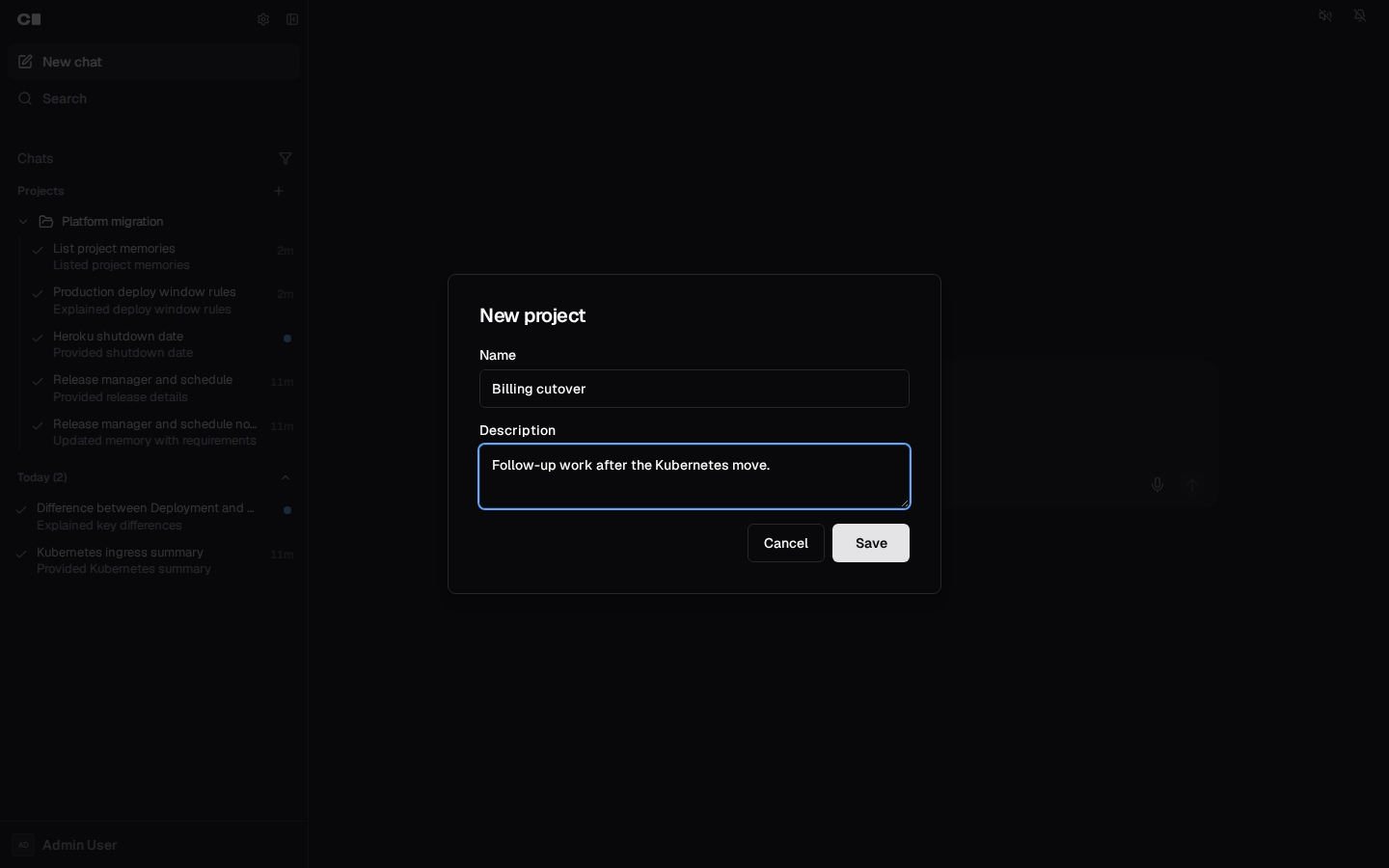 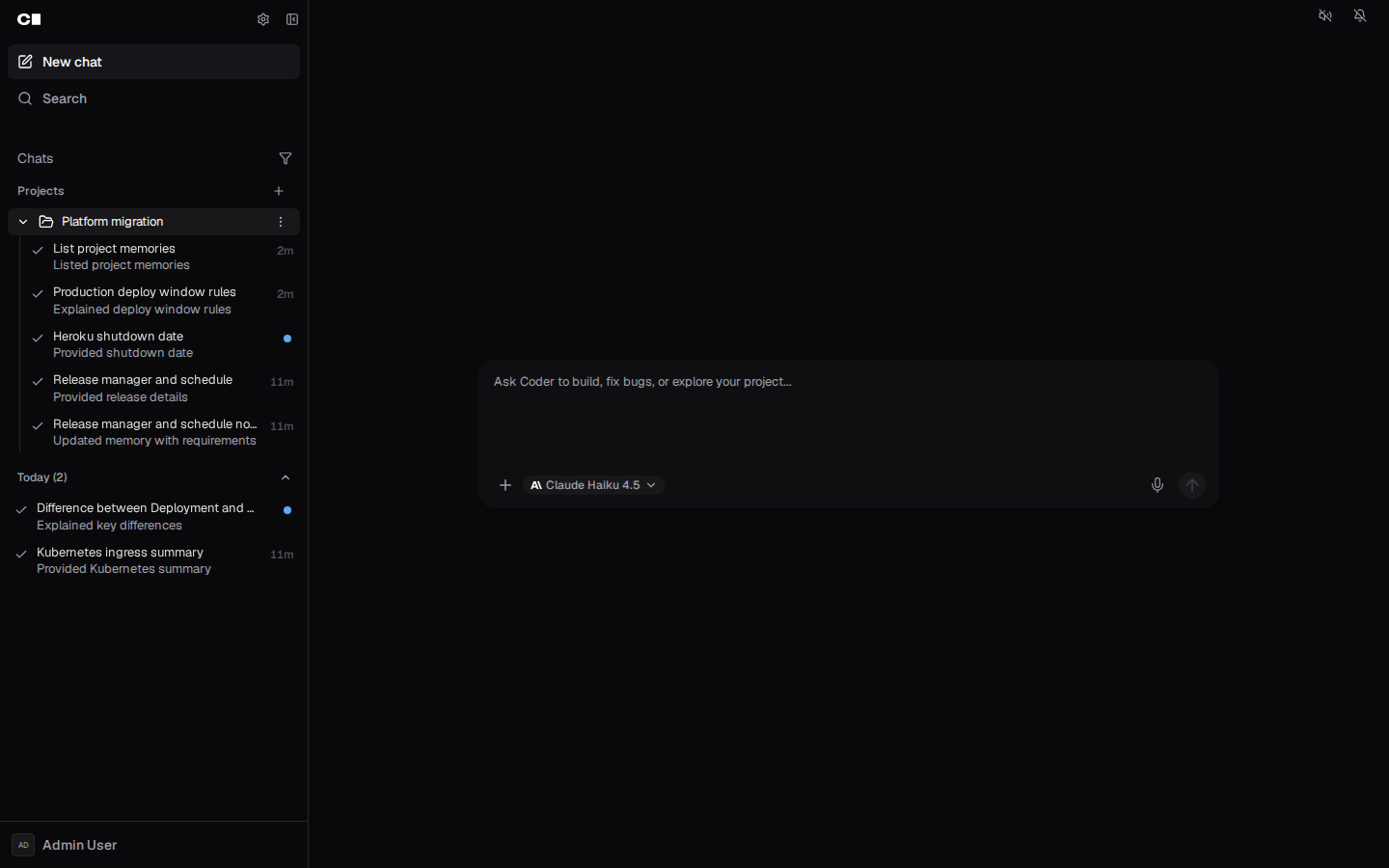 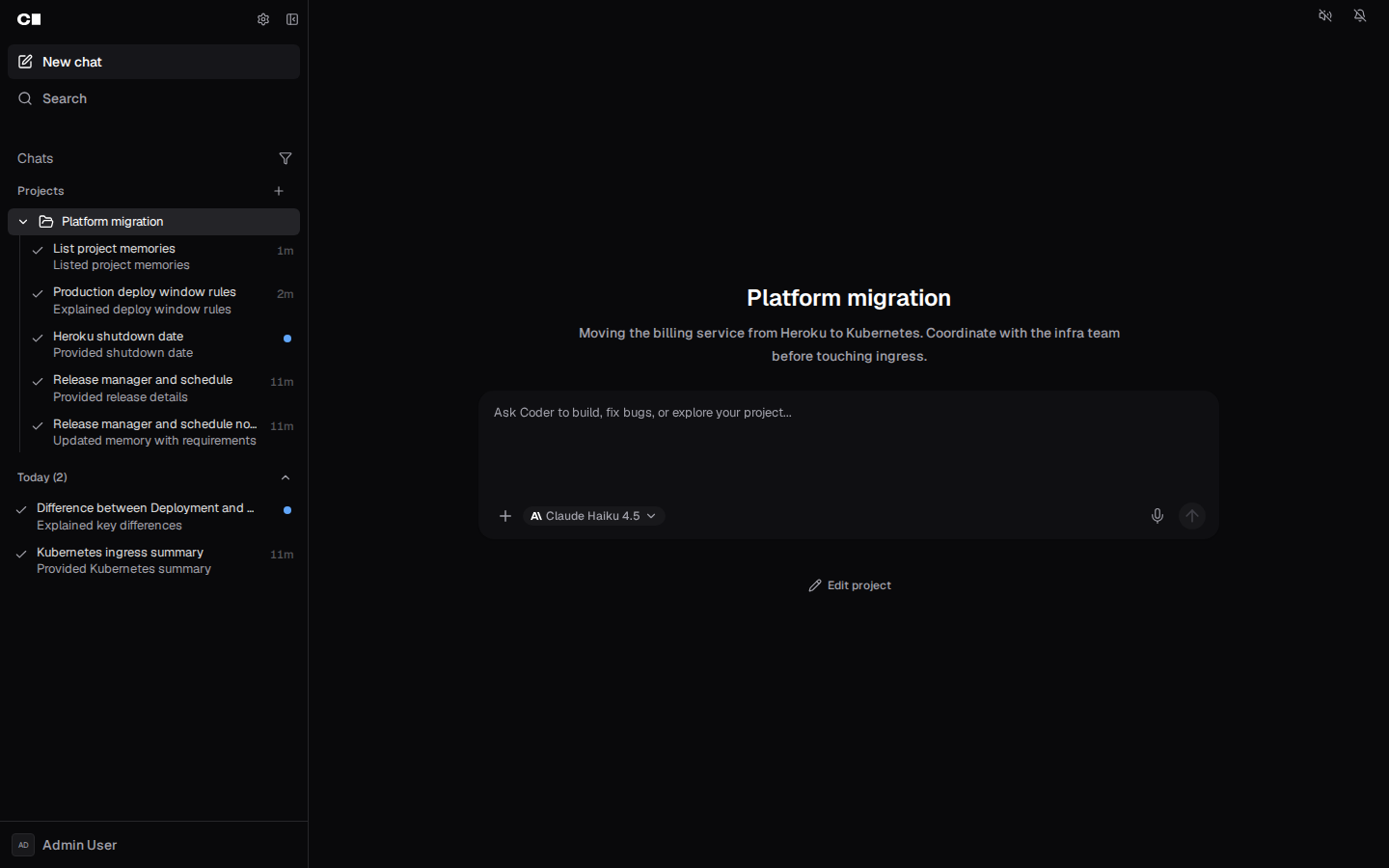 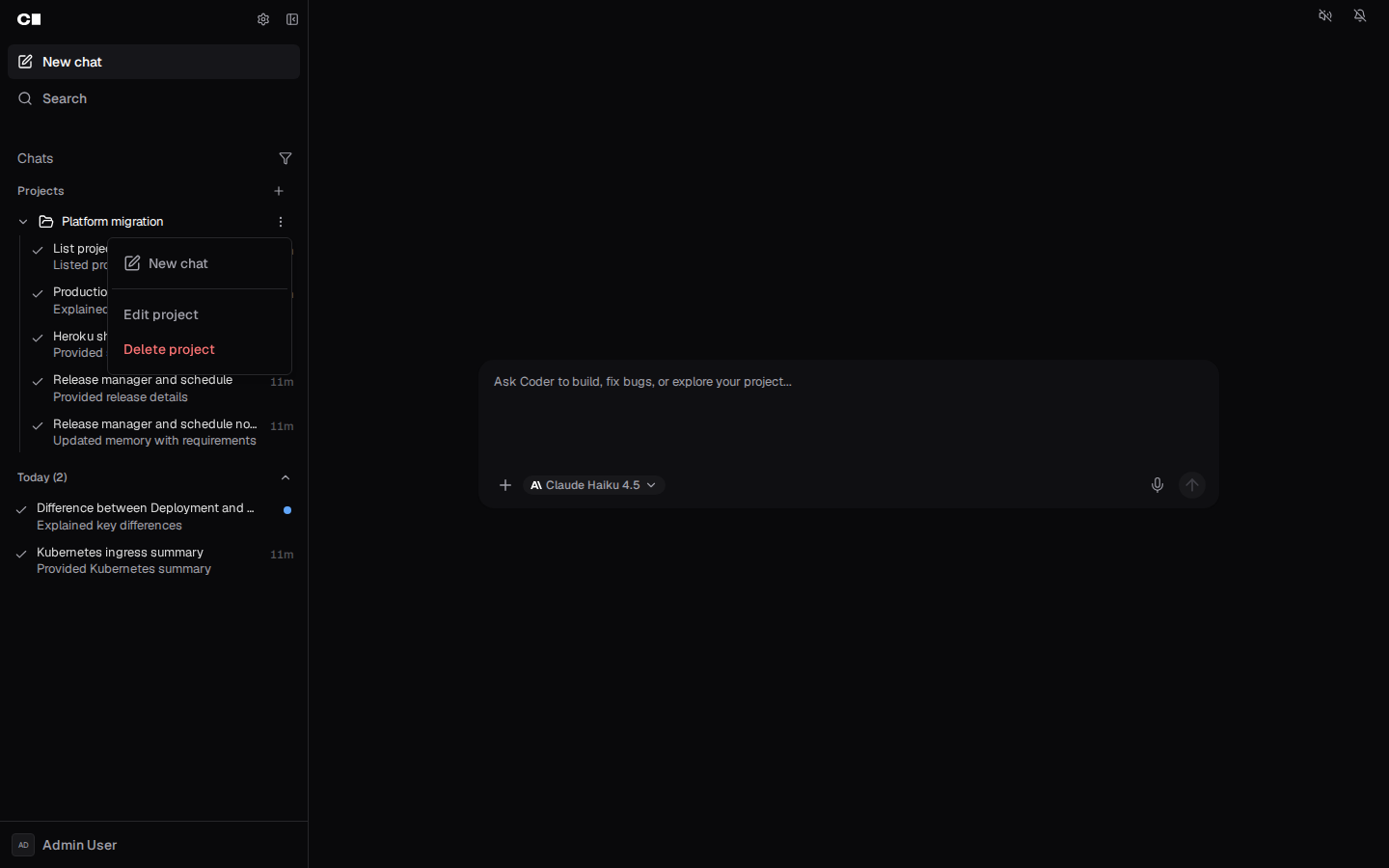  </details> --- Generated with Coder Agents on behalf of @f0ssel. --------- Co-authored-by: Claude Opus 5.5 (1M context) <noreply@anthropic.com> |
||
|
Jake Howell
|
d853893e8a |
feat: filter agent chats by chat status (#30009)
> 🤖 This PR was written by Coder Agents on behalf of Jake Howell. The sidebar's `Chat status` filter only offered `Read`/`Unread`. This turns it into a real status filter backed by the `chat_status` enum, the same value the row icon already shows. Stacked on #30006. - New `status:<waiting|running|error|requires_action|interrupting>` search filter (repeated or comma-separated) plus a `chat_statuses` param on `GetChats`. - Sidebar `Status` submenu offers `Requires action`, `Error`, `Working` and `Idle`; `Working` covers `interrupting`, since stopping a turn is too brief to be worth its own option. A full selection emits no filter. - `Unread` moves out to its own checkbox (`unread=true` in the URL), so it narrows a status selection instead of competing with it. - Grouping by status now sections by the five statuses instead of `Unread`/`Read`, reusing `getChatStatusDisplay` for labels and icons. <img width="439" height="177" alt="image" src="https://github.com/user-attachments/assets/82ef2ef0-cde9-4169-bb29-caa7b9bfdb9e" /> |
||
|
Asher
|
957aefa475 |
feat: add client_session_id to connection_logs table (#29686)
The client session ID is not populated yet; this just adds the ability for agents to send a client session ID with the rest of the connection data, once it gets piped through. |
||
|
Thomas Kosiewski
|
60cc826f2b | feat: sign forwarded MCP identity headers (#29669) | ||
|
McKayla はな
|
66a433985e | feat: add user workspace search filter (#29442) | ||
|
Cian Johnston
|
19076beb8d |
feat: attribute AI Gateway usage to workspaces (#29235)
- Adds nullable `workspace_id` to AI Gateway interceptions without a foreign key or index. - Derives direct attribution from strictly parsed server-minted workspace session-token names, excluding user-created tokens and validating the embedded owner. - Derives delegated Coder Agents attribution from the persisted chat workspace ID. - Records `workspace_id` through the additive v1.3 gateway protocol and structured interception logs. - Exposes attribution in session details through `interception_attributions`, including tool-less interceptions and null values for unknown attribution. Closes AIGOV-637 Generated by Coder Agents. |
||
|
Jake Howell
|
d671150abc |
feat: filter templates using classic parameters (#29171)
> 🤖 This PR was modified by Coder Agents on behalf of Jake Howell.

Adds a `compatibility-mode` template filter and exposes it as a
templates page preset.

The classic parameters warning now links administrators to the filtered
template list so they can identify and update affected templates.
|
||
|
Michael Suchacz
|
b957e66ccc |
feat!: drop the Coder Tasks tables and queries (#29086)
Drops the `tasks`, `task_workspace_apps` and `task_snapshots` tables, the `tasks_with_status` view and the `task_status` enum, and recreates `workspaces_expanded` without the `tasks` join and `task_id` column. Deletes `queries/tasks.sql` and every wrapper, fixture and test that existed only for those queries (dbauthz, dbmock, dbmetrics, dbfake, dbgen, querier_test), plus the `task_id` projection in `GetWorkspaceAgentAndWorkspaceByAuthToken`. **Breaking change:** migration 000594 deletes all task rows. The down migration restores the schema (tables, constraints, indexes, views), not the data. **Review changes:** the schema-only migration test was removed per review (`TestMigrate/UpDownUp` still exercises the down path), the test file no longer reorders existing tests, and the migration moved from 000593 to 000594. The `dump.sql` reorder is pg_dump dependency ordering: `tasks_with_status` pulled its four workspace tables ahead of it, and without the view they return to alphabetical positions. **Stack context:** Coder Tasks removal stack (CODAGT-642): #28743 frontend → #28788 CLI → #28789 API → #28790 provisioner → #29084 notifications → #29085 build reasons → **#29086 tables** → #28750 permissions. The last four PRs replace the single data-drop migration that used to live in #28750; each carries one concern and its own migration number. > Created by Xum (AI agent) on behalf of @ibetitsmike. ## Delivery record **Decision (2026-09-11 ~14:40Z): merge** through the stack merge endpoint, squash, pinned to head `f1d236a0c82f123b8a0d6878799c227ef9bd5776` (merge SHA appended below once landed). **Independent substantive reviews on this PR (3):** | # | Kind | Reviewed commit | Findings and disposition | Source | |---|---|---|---|---| | 1 | Codex code review (bot), PR opened | `24535f8410` | No findings, no threads | [summary](https://github.com/coder/coder/pull/29086#issuecomment-5583877627) | | 2 | Human review, spikecurtis (COMMENTED) | `24535f8410` | 4 findings: dump.sql reorder question (answered: pg_dump dependency hoisting by `tasks_with_status`); two moved tests (undone, the test file is no longer touched); schema-only migration test (deleted). All resolved. | [review](https://github.com/coder/coder/pull/29086#pullrequestreview-5142045164) | | 3 | Human review, spikecurtis (APPROVED) | `f1d236a0c8` (this head) | Approval on the exact final head | [review](https://github.com/coder/coder/pull/29086#pullrequestreview-5179353695) | The four COMMENTED reviews by @ibetitsmike on `f35688f40b` are thread-reply wrappers and are not counted. **Pre-split history relevant to this diff:** this layer's content lived in the monolithic #28750 until 2026-09-08, which received 10 completed Codex code reviews (2026-08-28 to 2026-09-01) and spikecurtis's CHANGES_REQUESTED review of 2026-09-04 that asked for the split. Counting those, the completed-review total relevant to this diff exceeds the six-review budget, so no further discretionary review or fresh final advisory was commissioned. The usable final recommendation for the final diff is review 3 above: the reviewer who authored every finding on this layer approved the exact head. **Exact-head checks:** `required` SUCCESS in [run 34580949353](https://github.com/coder/coder/actions/runs/34580949353/job/103205933212); rollup 15 success, 8 skipped, 1 failure. The failure is the non-required `Analyze PR for Documentation Updates Needed` job ([103204101137](https://github.com/coder/coder/actions/runs/34580949071/job/103204101137)), caused by the dormant `doc-check-pr-29086` review workspace (CODAGT-1025), not a code finding; GitHub flags only `required` as required for this PR. Merge-ref freshness: `refs/pull/29086/merge` has the exact head as second parent and `25af21b5d5d` (the #29085 squash) as first parent; main has since gained #29231, #28639 and #29218 (12 files, none overlapping this PR). The composed tree (`git merge-tree` of current main and this head) builds (`go build ./...`) and vets (`go vet` on `coderd`, `coderd/database/...`, `coderd/wsrelated/...`) cleanly. Layer diff parity with the previously pushed layer verified by numstat after both GitHub restacks. `gh stack push` did not run the local pre-push suite; CI is the validation evidence. **Deferred:** the dormant doc-check workspace (CODAGT-1025) is outside this PR. Next in the stack, #28750, stays blocked: CHANGES_REQUESTED, its approval and CI predate the restack, and its review budget is exhausted. |
||
|
Michael Suchacz
|
25af21b5d5 |
feat!: remove has_ai_task and the task build reasons (#29085)
Drops the `has_ai_task` column from `template_versions` and `workspace_builds` (with its index and view projections) and removes the three task build reasons (`task_auto_pause`, `task_manual_pause`, `task_resume`) from the `build_reason` enum. Existing rows are remapped before the enum swap: automatic pauses become `autostop`, manual pauses and resumes become `initiator`, and `workspace_build_orchestrations.child_reason` follows the same mapping. The query filters, provisionerdserver flag writes, and audit ignore entries for the column go with it. **Migration cost:** recreating `build_reason` rewrites `workspace_builds`. `TestMigration000593TaskBuildReasonRewriteTiming` seeds 1,000 workspaces, 100,000 builds (30,000 with task reasons) and 5,000 orchestrations and asserts the migration stays under a two-minute bound; locally it takes about 0.7 to 1.0 s. The test is skipped under `-short`. **Breaking change:** the down migration re-adds `has_ai_task` as `false` and restores the enum values; remapped reasons keep their new values. **Review changes:** the migration test now asserts only the row remaps (schema and enum introspection removed per review); renumbered from 000592 to 000593. **Stack context:** Coder Tasks removal stack (CODAGT-642): #28743 frontend → #28788 CLI → #28789 API → #28790 provisioner → #29084 notifications → **#29085 build reasons** → #29086 tables → #28750 permissions. The last four PRs replace the single data-drop migration that used to live in #28750; each carries one concern and its own migration number. > Created by Xum (AI agent) on behalf of @ibetitsmike. |
||
|
McKayla はな
|
29995c9ef8 | feat: add a per-template workspace rename setting (#27558) | ||
|
Ethan
|
aefc761fcf |
feat!: enforce organization scope for chat models (#27959)
## Summary Move chat model management and runtime availability to organization-scoped API routes. The API now identifies the organization in every model-management operation, applies chat model RBAC and ACLs within that organization, and returns only models the caller can use there. Depends on #27958. ## Problem Chat model configurations now belong to organizations, but the existing experimental management and discovery APIs are deployment-shaped. Their routes do not identify an organization, SDK methods do not accept an organization ID, and item operations address a model configuration by ID alone. That contract cannot safely expose organization-owned model configurations. It also does not provide the organization-specific provider information, authorization behavior, ACL management, or recovery guidance needed by the settings and chat clients later in the stack. ## Fix Add organization-scoped chat model endpoints under: ```text /api/experimental/organizations/{organization}/chats/models ``` The new API provides: - Organization-scoped model listing and creation. - Model get, update, and delete operations scoped by both organization and model ID. - Model ACL read and update operations. - Organization-scoped runtime availability and provider status. - Redacted provider descriptors for model-management clients. - Chat model RBAC and row ACL enforcement for writes, runtime discovery, and Chatd model selection. - Recovery guidance when a chat's organization has no usable local model. Historical chats can retain a model reference owned by another organization, but runtime selection uses an authorized local default when one is available. Foreign, inaccessible, disabled, and otherwise unusable models are not exposed as usable selections for the organization. The existing collection and availability routes remain as default-organization compatibility endpoints in this layer: ```text GET /api/experimental/chats/model-configs POST /api/experimental/chats/model-configs GET /api/experimental/chats/models ``` These compatibility routes do not provide access to models in non-default organizations. The previous unscoped item update and delete routes are removed because item operations must include the owning organization. ## Breaking change This changes the experimental HTTP API and Go SDK contracts for chat model management. Clients must migrate model-management and availability requests to the organization-scoped routes and provide an organization identifier. In the Go SDK, the following methods now require an organization ID: - `ChatModelAvailability` - `ChatModels` - `CreateChatModel` - `UpdateChatModel` - `DeleteChatModel` `ChatModels` also changes its return value from `[]ChatModel` to `OrganizationChatModelsResponse`, which includes the organization models and the redacted provider descriptors required by management clients. New item and ACL methods likewise require both the organization ID and model ID. The default-organization compatibility routes reduce the immediate impact for collection and availability callers, but they do not preserve the previous item API or SDK method signatures. Generated clients and direct consumers of the experimental API must be updated before adopting this change. _This pull request description was generated by Coder Agents._ |
||
|
Ethan
|
cbe24a3da5 |
feat: add chat model config RBAC resource (#27957)
Add the `chat_model_config` RBAC resource, actions, and API key scopes. This layer includes the scope migration and generated API types. Model list queries apply token scopes, SQL authorization filters, and row ACLs. Write and default-management handlers keep deployment configuration authorization until the next API layer replaces it. Depends on #27956 _This pull request description was generated by Coder Agents._ |
||
|
Michael Suchacz
|
7ca7c30f40 |
feat: add group and user ACLs to MCP server configs (#27944)
Adds group and user ACLs to org-scoped MCP server configs so
organizations can restrict specific MCP servers to subsets of members,
mirroring the template ACL pattern.

## Summary

- Migration adds `group_acl`/`user_acl` JSONB columns (nested `{"<id>":
{"permissions": [...]}}` shape) and seeds every existing config with its
organization's Everyone group read entry (the Everyone group ID equals
the org ID), so member access is unchanged by default. Creation seeds
the same entry.
- The blanket org-member read grant from the base PR is replaced by ACL
evaluation: Rego requires org membership for every ACL grant, and
`GetAuthorizedMCPServerConfigs` compiles ACL-aware SQL filters.
- New `ActionShare` (org admins) gates `GET|PATCH
/api/experimental/organizations/{organization}/mcp-servers/{mcpserverconfig}/acl`
(nested under the organization like the rest of the config surface).
PATCH validates principals against the config's organization, merges
sparse updates under a row lock, stamps `updated_by`/`updated_at`, and
is audited as a Write with `Old` captured before authorization. A config
deleted concurrently between the middleware fetch and the locked
re-fetch is concealed as 404, matching the update and delete handlers.
ACL columns are tracked in the audit table.
- ACL management is available in all editions (no enterprise
entitlement), documented in the MCP servers page. Revoking an ACL does
not retro-strip already-selected configs from existing chats; new
selection is blocked at chat create.
- Force On respects the ACL: the forced set is loaded as the chat owner,
so a `force_on` server whose ACL denies the owner never attaches at
create, send, or generation time.
- No rolling-upgrade machinery: upgrades run in scheduled maintenance
downtime, so the migration only backfills existing rows; the API sets
the Everyone read grant explicitly on every insert.

Stacked on #27943. Part of the MCP org-separation stack.

Closes https://linear.app/codercom/issue/CODAGT-712

UAT: verified on a dogfood instance with two members and a custom group:
Everyone-seed default visibility, group grant with Everyone removal
(non-member loses list/fetch/selection), foreign-principal rejection,
non-admin share denial (audited 403 / concealed 404), user_acl restore,
and audited ACL diffs.

> Mux (AI agent) authored this PR on Mike's behalf.

<!-- mux-attribution: model=claude-fable-5 thinking=high -->
|
||
|
Michael SuchaczandMathias Fredriksson
|
443e3b9b80 |
feat!: org-scope MCP server configs with RBAC (#27942)
Moves `mcp_server_configs` from deployment scope to organization scope
so each organization fully controls the MCP servers its members can use
with Coder Agents.

## Summary

- Migration: adds `organization_id` (NOT NULL, FK) and keeps existing
rows as the default organization's originals with credentials intact.
Other organizations start with no MCP servers and configure their own;
nothing is copied across organizations. Chats outside the default
organization keep any now-cross-organization `mcp_server_ids` entries;
the runtime already ignores IDs that do not resolve in the chat's
organization, so no data rewrite is needed. Slug uniqueness becomes
`(organization_id, slug)`.
- RBAC: new org-scoped `ResourceMCPServerConfig` with regosql converter
and `GetAuthorizedMCPServerConfigs`; org admins get in-org CRUD, org
members get read (replaced by ACL evaluation in the follow-up ACL PR in
this stack).
- API: all config routes nest under the organization, matching
templates: `POST|GET
/api/experimental/organizations/{organization}/mcp-servers` and
`GET|PATCH|DELETE .../mcp-servers/{mcpserverconfig}` (plus
`oauth2/connect`), resolved by a read-only param middleware that
conceals read-denied and cross-organization access as 404. Two routes
stay on the frozen `/api/experimental/mcp/servers/{mcpServer}` block:
the OAuth2 callback (the redirect URI baked into existing AS-side client
registrations) and `oauth2/disconnect`, which must remain reachable by
users removed from the organization so they can still revoke their token
grant.
- Chat runtime: selection validation and generation resolve configs
strictly by IDs, enabled state, and the chat's organization in SQL;
requested duplicates are normalized; invalid or cross-org IDs are
rejected with the precise ID list. IDs already persisted on a chat are
exempt from message-time rejection so disabling a selected server never
blocks sends; generation skips servers that are no longer usable.
- Frontend: API layer and admin settings pages target the new endpoints.
The admin page manages the default organization's servers; the org
picker is tracked separately (CODAGT-714).

- Security hardening from review: OAuth user grants are additionally
bound to `oauth2_revocation_url` (changing it invalidates grants, and a
racing OAuth callback gets 409 instead of recreating a grant).
Stack-wide SSRF protection for MCP config-directed traffic was split
into its own PR at the top of this stack (#28242) to keep this diff
reviewable; this PR keeps main's existing discovery IP-range guard.
OAuth2 auto-discovery now completes before the config row is inserted: a
failed discovery persists nothing, and there is no provisional row that
concurrent updates could race against.

Two follow-up PRs in this stack were split out to keep this diff
reviewable: #28064 completes the swagger annotations for the moved
routes (main already ships these experimental MCP handlers unannotated),
and #28065 carries hardening fixes and regression pins on top of the
cutover.

- Force On enforcement (landed on main mid-review) is org-scoped: the
forced set is read per chat organization
(`GetForcedMCPServerConfigsByOrganization`), so another organization's
`force_on` server never attaches to a chat.

## Breaking changes (experimental API)

The MCP server config endpoints move from the deployment-scoped
`/api/experimental/mcp/servers` block to organization-nested paths:
`POST|GET /api/experimental/organizations/{organization}/mcp-servers`
and `GET|PATCH|DELETE
/api/experimental/organizations/{organization}/mcp-servers/{mcpserverconfig}`
(plus `oauth2/connect`). The old paths are removed, so API consumers
must supply an organization. Two routes intentionally stay on the frozen
`/api/experimental/mcp/servers/{mcpServer}` block: the OAuth2 callback
(its redirect URI is baked into existing AS-side client registrations)
and `oauth2/disconnect` (must remain reachable by users removed from the
organization). These endpoints are under `/api/experimental`, so no
deprecation window is provided.

## Rolling upgrades

During a rolling deploy, an old replica creating an MCP config can fail
the new `NOT NULL organization_id` constraint until it is upgraded
(reads are unaffected: old binaries' generated queries select their own
column lists). This matches the repo's existing precedent for additive
NOT NULL migrations (000562) and affects only the admin config-create
path in the upgrade window.

Upgrades are expected to run in scheduled maintenance downtime with the
database locked during migration, so the migration ships no
rolling-upgrade compatibility machinery. The down migration deletes
organization-created configs (their chat references are cleaned by the
000510 delete trigger) and restores deployment-wide slug uniqueness.

Part of the MCP org-separation stack (CODAGT-711 -> CODAGT-717 audit ->
CODAGT-712 ACLs -> CODAGT-806 token RBAC).

Closes https://linear.app/codercom/issue/CODAGT-711

UAT: validated end to end on a two-org dogfood deployment, including a
real pre-migration to post-migration upgrade, cross-org isolation
(404s), same-slug-two-orgs, chat selection gating, and a live MCP tool
call through the org-scoped generation path. The migration was later
revised to keep existing rows in the default organization only (no
per-organization copies); that revision is covered by the migration test
suite.

> Mux (AI agent) authored this PR on Mike's behalf.

<!-- mux-attribution: model=claude-fable-5 thinking=high -->

---------

Co-authored-by: Mathias Fredriksson <mafredri@gmail.com>
|
||
|
Michael Suchacz
|
57f38b5c24 |
fix: keep chat attachments while a linking chat exists
Fixes https://linear.app/codercom/issue/CODAGT-616/keep-chat-attachments-while-chats-remain-unarchived Chat attachments could disappear even though the chat was still available. This happened when a message was saved without recording which attachments it used, or when cleanup deleted attachments before an archived chat itself was removed. Creating a chat, sending or queuing a message, and editing a message now record both the message and which attachments it uses as one operation. If the chat is already at the 50-attachment limit, the chat change fails without being partially saved. Concurrent attachment writes serialize the 50-file cap per chat. Cleanup locks candidates and checks again for new links before deleting. If a file becomes unavailable after input validation, create, send, and edit return a clear client error and roll back the chat change. An attachment stays available while any chat that uses it still exists. After an archived chat reaches the end of its retention period and is deleted, an old attachment that no remaining chat uses can be cleaned up. The retention guide and unavailable-attachment UI text document this lifecycle. This change cannot restore attachments that were already deleted. The database migration adds two indexes so attachment cleanup stays fast as attachments accumulate. > This PR was authored by Mux (AI) on Mike's behalf. |
||
|
Steven Masley
|
9a57dfa642 |
feat: include agent metadata in workspace list responses (#27934)
Closes #27933. Related: #27897 (single-agent GET). Agent metadata is only readable via a per-agent watch stream, so reading it across N workspaces costs N+1 requests. This adds a batch read to the list endpoint: ```text GET /api/v2/workspaces?q=param:"pool=demo" include_agent_metadata:task_status ``` - New `include_agent_metadata` search key, repeatable and key-scoped. It expands the response, it does not filter workspaces. - `GetWorkspaces` aggregates the requested keys as JSON behind a `CASE`: without opt-in the response is unchanged and the subquery never runs. Runs only for the returned page, inside the same authorized query. - Agents in the response gain `metadata` (`[]codersdk.WorkspaceAgentMetadata`, `omitempty`), mapped by the `workspace_agent_id` each element carries. The collection script is omitted; it can be long. - `codersdk.WorkspaceFilter` gains `IncludeAgentMetadata []string`. - No wildcard, no schema change, no migration. --- Authored by Coder Agents on behalf of @Emyrk. |
||
|
Ethan
|
b3485d9b3a |
chore: add agents_allowed to templates (#27284)
Relates to CODAGT-713 This adds `templates.agents_allowed` as a default-true, auditable template attribute, along with nullable database filtering. Migration `000562` translates the effective legacy `agents_template_allowlist` state for existing templates: a valid nonempty list allows matching templates and blocks the rest, missing or empty values leave templates allowed, whilst corrupt values fail closed by blocking all existing templates. As per the linear issue, new templates deliberately default to allowed under the per-template model. This is the database-only first PR in the stack. #27285 makes the field authoritative in the API and chatd whilst temporarily retaining the compatibility routes needed by the shipped frontend. Later PRs migrate the UI, remove the legacy storage, routes, SDK types, and utility, then add CLI flags. |
||
|
Jaayden HalkoandCursor
|
3c7a1d33e3 |
feat: add persisted whole-chat summary with background generation (#26657)
Adds a persisted whole-chat summary that backs the chat summary popover. A new nullable `chats.summary` column is populated in the background after a successful root-chat turn and pushed to clients via a new `chat_summary_change` watch event (distinct from `summary_change`, which is bound to `last_turn_summary`), so the popover reads `chat.summary` straight off the loaded `Chat` with no extra query. This is the data source for the popover and per-chat cost UI built in #26649; the popover can consume `chat.summary` once this lands (the field is nullable, so merge order does not matter). ## How it works - **Generation** runs in the existing successful-turn finalize hook, detached from the request so the user's turn is never blocked. A cadence gate generates the first summary after one completed turn, then regenerates every three turns, using the `chats.summary_generated_at` freshness marker. Generation reads compaction-aware history, renders it to a bounded plain-text transcript (short transcripts are skipped), and asks for a 1-3 sentence summary via structured output. Failures never clear an existing summary. - **Staleness** is guarded by `history_version` (mirroring `last_turn_summary`), so a background write racing a newer turn loses while worker lifecycle transitions cannot reject a fresh write. - **Model selection** uses the chat's configured model. ## Deferred to follow-ups - **Cost accounting**: the `chat_messages.cost_source` discriminator and summary/title usage recording were removed from this PR so summary persistence is not blocked by hidden accounting rows advancing `history_version`. Title usage recording stays on main's `InsertChatMessages` path. - **Model override**: deployment-wide summary generation model selection is split into #26803; the base feature always uses the chat model. ## Notes - Migration `000540` adds `chats.summary` and `chats.summary_generated_at`, and recreates `chats_expanded` to expose the new columns. - Root chats only; shared viewers pick up the summary on their next refetch (live watch events are owner-only). Refs #26649 --------- Co-authored-by: Cursor <cursoragent@cursor.com> |
||
|
Sas SwartandClaude Opus 4.8
|
a9a1dcc65d |
feat: add network calls column to AI sessions table (#27269)
Add a "Total/blocked network calls" column to the AIBridge sessions table. Update `ListAIBridgeSessions` query to calculate network called made and blocked per session. See query plan [here](https://explain.dalibo.com/plan/54355c90b165ggb4). --------- Co-authored-by: Claude Opus 4.8 <noreply@anthropic.com> |
||
|
Michael Suchacz
|
3227cac217 |
feat: add manual chat compaction via /compact (#27081)
Adds a user-triggered `/compact` action for Coder Agents chats: typing
`/compact` in the composer (or picking it from the `/` trigger menu)
summarizes the conversation so far to free up context window space.

## How it works

- New `POST /api/experimental/chats/{chat}/compact` endpoint
(owner-only, RBAC `ActionUpdate`, excluded from the public API reference
via `x-apidocgen skip`). It marks the chat with a durable one-shot
`chats.compaction_requested_at` signal and moves it `waiting -> running`
via a new `RequestCompaction` state transition; no message row is
inserted. AI Gateway attribution needs no per-request key: generation
preparation resolves the owner's synthetic API key (#27170) like any
other turn.
- `RequestCompaction` hands off chat ownership (clears
`worker_id`/`runner_id`) so a worker acquisition hint is published;
since the transition changes no history, the previous runner could
otherwise miss the request under reordered pubsub delivery.
- The background chat worker picks the chat up like any other turn. A
pending manual request takes precedence over turn completion in the
generation decision, and forces compaction even below the automatic
threshold (and when compaction is disabled via threshold=100). The
commit step consumes the request marker in the same transaction; any
transition that ends the turn clears stale markers.
- The summary triplet reuses the automatic-compaction path, now tagged
with a `source` (`automatic` | `manual`) that is plumbed through
streamed progress parts, persisted tool JSON, and the UI label
("Summarized (manual)").
- Validation order: busy chats reject with 409 (state-machine conflict),
empty/already-compacted chats with 409 "nothing to compact", archived
chats with 400; the owner usage-limit check runs last so no-op requests
surface the specific conflict instead of a limit error.
- Web UI: the `/` trigger menu now has a built-in "Commands" group
listing `/compact`; submit intercepts exactly `/compact` and calls the
endpoint instead of sending a message. A personal or workspace skill
named `compact` takes precedence over the built-in command; while skill
collisions are still resolving, an exact `/compact` submission is
blocked with a retryable hint instead of leaking as message text.
History and queued-message edits are never intercepted. After
compaction, the context usage indicator resets to its unknown state
until the next assistant response reports fresh usage, instead of
showing the stale pre-compaction number.
- codersdk: `ExperimentalClient.CompactChat`.

Worker-path execution (rather than compacting synchronously in the
handler) reuses the existing lock fencing, live "Summarizing..."
streaming, retry accounting, restart resilience, and debug-run
observability. Rationale documented in `coderd/x/chatd/ARCHITECTURE.md`.

## Testing

- State machine: transition-matrix coverage for `RequestCompaction`,
marker lifecycle tests (carried by lease renewals/queue appends, cleared
by terminal transitions, consumed by commit), ownership handoff +
acquisition hint assertions.
- Worker: decision-ordering and forced-compaction unit tests;
active-server end-to-end test (manual compact below threshold produces a
`source=manual` summary, returns to `waiting`, no assistant follow-up;
busy chat rejected).
- API: success, archived, non-owner, RBAC-denied, empty-chat, no-daemon
cases; usage-limit ordering (at-limit owners still get
state/nothing-to-compact conflicts for no-op requests, with marker
rollback).
- Frontend: Storybook play tests for the Commands menu group, submit
intercept, skill-name collision, queued-edit passthrough, and
manual/automatic tool rendering; unit tests for command availability
resolution and the post-compaction context usage reset.

> This PR was created by Mux, an AI coding agent, working on Mike's
behalf.
|
||
|
Cian Johnston
|
f7481c5d08 |
feat: Add full text search over chat messages (#27126)
Closes CODAGT-721 Closes CODAGT-722 Closes CODAGT-723 Closes CODAGT-724 Closes CODAGT-725 This PR adds the database and API pieces necessary to support full-text chat message search. - Adds required chat schema for full-text search - Adds dbpurge job to populate search_tsv in the background - Adds `search` parameter to GetChats query - Adds `search` filter to `searchquery.Chats` - Wires chat search filter into chats API > Implemented by Coder Agents, reviewed and tested by a human. |
||
|
Danielle Maywood
|
d66e4d794f | feat: add configurable reasoning effort to Coder agents (#26974) | ||
|
Danny Kopping
|
63497ee9d8 |
feat(coderd/database): add error columns to aibridge interception records (#26960)
Adds a nullable `aibridge_interception_error_type` enum and an `error_message` column to `aibridge_interceptions`, so a failed interception's terminal upstream error can be persisted. Schema only: the write path and API exposure land in the stacked backend PR. *This PR was produced by opencode (agent) using the `anthropic/claude-opus-4-8` model, under human direction and review.* |
||
|
Kyle Carberry
|
cd56ab9e33 |
refactor: remove legacy live-read and injected-history chat context paths (#26585)
This PR makes the agent-pushed pinned snapshot (`chat_context_resources`) the sole source of workspace context for chats, completing the "Release 5" cleanup. It removes legacy mechanisms now superseded by the snapshot that agents push over dRPC (`PushContextState`) and refresh via `chat-context/refresh`. Removed: - **Live-read at turn time.** MCP tool discovery, skill live-body reads, and the instruction/skill history fallback that dialed the workspace on every turn. - **Context injected as message history.** The `persist_workspace_context` generation action and its decision-loop guard. - **The legacy write path.** `POST`/`DELETE /api/v2/workspaceagents/me/experimental/chat-context`, the agentsdk `AddChatContext`/`ClearChatContext` methods, and the CLI one-shot writer. - **The `chats.last_injected_context` column** and all of its plumbing (migration `000529`, queries, `db2sdk`, `dbauthz`, audit table, and the frontend `ContextUsageIndicator` fallback). Subagent context inheritance no longer copies parent context messages; children now hydrate the parent's pinned `chat_context_resources` on create, which yields an identical pin for the same workspace and agent. What stays (still served by the live agent connection, not the snapshot): `read_skill_file` supporting-file reads, `read_skill` supporting-file listing, and MCP tool execution. > [!NOTE] > Migration `000529` drops `chats.last_injected_context` and recreates the `chats_expanded` view without it. The down migration restores both. <details> <summary>Decision log (D1-D5)</summary> - **D1 (subagent inheritance):** Re-point inheritance from the legacy message copy to a pinned hydrate. Children call `hydrateChatContextOnCreate` instead of copying parent context messages. - **D2 (`persist_workspace_context`):** Remove the generation action entirely along with the decision-loop guard it existed to satisfy, since context is never injected into history anymore. - **D3 (legacy HTTP + CLI):** Remove the experimental `chat-context` POST/DELETE endpoints, the agentsdk methods, and the CLI one-shot. The dRPC push + `chat-context/refresh` replace them. - **D4 (frontend fallback):** Remove the `last_injected_context` fallback in `ContextUsageIndicator`; pinned `resources` are the sole source. - **D5 (sequencing):** Ship as a single PR rather than a stacked pair. </details> --- Coder Agents generated on behalf of @kylecarbs. |
||
|
Jon Ayers
|
401aa58eeb | feat: add schema changes for autostop notification (#26417) | ||
|
Kyle Carberry
|
210261b143 |
feat: add chat context pinning storage and push trigger (#26385)
Foundation for the Workspace Context Sources RFC (phase 3). The agent push (#25983) and coderd snapshot storage (#26145) already persist per-agent context snapshots; this PR lands the **chat-side storage** plus the **`agentapi` push trigger** that a follow-up will use to read them. It does **not** touch `chatd` and changes no behavior — nothing wires an implementation yet. ## What changed - Adds four nullable columns to `chats` — `context_aggregate_hash`, `context_dirty_since`, `context_dirty_resources`, and `context_error` — and rebuilds the `chats_expanded` view. - Adds three queries — `SetChatContextSnapshot`, `HydrateAgentChatsContext`, `MarkChatsContextDirtyByAgent` — with `dbauthz` wrappers and `audit` entries. They are store-interface methods covered by a Postgres test (`TestChatContextHydration`). - Adds the `agentapi.ContextDirtyMarker` interface and invokes it inside the `PushContextState` transaction, publishing collected events only after commit. ## Intentionally inert There are **no production callers** of the three queries and **no implementation** wired for `ContextDirtyMarker`, so the push trigger is dormant. This is deliberate: the PR is the durable storage/query foundation only. The actual integration — the `chatd` implementation that hydrates/dirties chats and backs a refresh endpoint, consuming the pinned context in prompt building, the rich SDK types + UI, and retiring the live per-turn pull — lands as a single follow-up PR. Splitting this way keeps the schema/query layer reviewable on its own and keeps the integration whole in one place. Refs #25983, #26145. <details> <summary>Decision log</summary> - **Columns over a side table.** The four `chats` columns are the durable model (accepting the one-time `chats_expanded` view/CTE churn). `last_injected_context` is deliberately left untouched — it is load-bearing for the live per-turn context pull. - **Keep `agentapi`, drop `chatd`.** The earlier revision wired the hydrate/dirty implementation through `chatd` and added a `PUT /chats/{chat}/context` refresh endpoint. Those were removed so this PR is pure foundation; `agentapi` defines the trigger + interface (it does not import `chatd`), and the `chatd` implementation arrives with the full integration. - **No new experiment flag.** The columns are dark and unread by prompt building. - **Authz.** The new query wrappers authorize chat updates under the chat RBAC object / `ResourceChat`, consistent with the existing system chat mutators. </details> --- 🤖 Generated by Coder Agents on behalf of @kylecarbs. |
||
|
Sas Swart
|
e1c7e61eb9 |
feat(coderd): add Agent Firewall correlation columns to aibridge_interceptions (#24817)
Add `agent_firewall_session_id` (UUID NULL) and `agent_firewall_sequence_number` (INT NULL) to `aibridge_interceptions` with a partial index on `agent_firewall_session_id`. No FK to `boundary_sessions` (soft reference, resolved at query time). `RecordInterception` reads the new fields from the proto request (merged in #25884) via `parseOptionalUUID` / `parseOptionalInt32` helpers. > This PR was authored by Coder Agents. |
||
|
Hugo Dutka
|
4debd23cbb |
fix: chatd refactor (#26270)
Implements the chatd stabilization RFC. Combines: - https://github.com/coder/coder/pull/25908 - https://github.com/coder/coder/pull/25923 - https://github.com/coder/coder/pull/26109 - https://github.com/coder/coder/pull/26110 - https://github.com/coder/coder/pull/26111 - https://github.com/coder/coder/pull/26112 |
||
|
Danny Kopping
|
4a07f61c50 |
refactor!: remove interceptions API, request logs view, and associated code (#26213)
## Summary Removes the deprecated `/api/v2/aibridge/interceptions` endpoint and the Request Logs frontend page, both replaced by the session-based view. Closes https://linear.app/codercom/issue/AIGOV-266 Closes https://linear.app/codercom/issue/AIGOV-324 ## Changes ### Backend - Remove `GET /api/v2/aibridge/interceptions` HTTP handler and route - Remove SDK types and client method (`AIBridgeInterception`, `AIBridgeTokenUsage`, `AIBridgeUserPrompt`, `AIBridgeToolUsage`, `AIBridgeListInterceptionsResponse`, `AIBridgeListInterceptionsFilter`) - Remove SQL queries `CountAIBridgeInterceptions` and `ListAIBridgeInterceptions` - Remove `searchquery.AIBridgeInterceptions` parser - Remove dbauthz wrappers, in-memory implementations, metrics, and mocks for the interceptions list queries - Remove the `coder aibridge interceptions list` CLI command and golden files - Regenerate API docs, swagger, mocks, and metrics The `/models`, `/clients`, and `/sessions` endpoints stay; the sessions list page still consumes all three. ### Frontend - Delete the entire `RequestLogsPage/` directory (page, view, row, filter, stories, tests) - Remove the `/aibridge/request-logs` route and its lazy import - Remove the `getAIBridgeInterceptions` API method, `paginatedInterceptions` query, and mock interception entities - `git mv` the shared filter and icon components used by the sessions pages: - `RequestLogsPage/RequestLogsFilter/{Client,Model,Provider}Filter.tsx` → `AIBridgePage/filters/` - `RequestLogsPage/icons/AIBridge{Client,Model,Provider}Icon.tsx` → `AIBridgePage/icons/` - Drop the `getProviderIconName` hack and the duplicate `anthropic-neue` icon case now that the FIXME no longer applies ## Commits 1. `refactor: remove interceptions API and request logs view` — the bulk removal, with explicit renames for the shared filter/icon files. 2. `refactor(site/src/pages/AIBridgePage): drop getProviderIconName hack` — cleanup of the FIXME that depended on RequestLogsPage existing. > [!NOTE] > Generated by Coder Agents on behalf of @dannykopping |
||
|
Danielle Maywood
|
d751b46a19 | fix: scope combined chat source filters (#26137) | ||
|
Danielle Maywood
|
1e5dd83a95 | fix: limit shared chats to ACL grants (#26123) | ||
|
Steven Masley
|
4591212482 |
feat: implement SCIM handler for SCIM 2.0 compliance (#25572)
Rewrites the SCIM 2.0 user provisioning handler to be RFC 7644 compliant. Verified against an external IdP Okta. Behavior is OPT IN |
||
|
Danny Kopping
|
4ddda3a9db |
feat: filter interceptions and sessions by provider name (#25640)
Allows filtering sessions & interceptions by provider name, and adds a test to vaidate that provider name is immutable (at least until #25606 lands). |
||
|
Cian Johnston
|
15ada66e14 |
feat: add pr, repo, pr_title chat search filters (#25569)
Relates to CODAGT-432 Adds three new search filters to the chat list endpoint (`GET /api/experimental/chats/`): - `pr:<number>` - exact PR number match - `repo:<owner/repo>` - substring match against git remote origin or URL - `pr_title:<text>` - case-insensitive PR title substring match Includes SQL filter clauses (EXISTS against `chat_diff_statuses`), parser with validation, handler wiring, unit tests, swagger annotation update, and a new search syntax documentation page. > 🤖 Generated with [Coder Agents](https://coder.com/agents) |
||
|
|
b7525a9b40 |
feat: add search and filter support to chats endpoint (#25391)
Fixes https://linear.app/codercom/issue/CODAGT-432 Adds structured search/filter capabilities to the `GET /api/experimental/chats/` endpoint via the `q` query parameter. All filters use explicit `key:value` syntax; bare terms are rejected to reserve them for potential future full-text search. > Generated by Coder Agents Co-authored-by: Danielle Maywood <danielle@themaywoods.com> Co-authored-by: Jaayden Halko <jaayden.halko@gmail.com> |
||
|
Danielle Maywood
|
170a6e1fe9 | feat: add chat sharing foundation (#25041) | ||
|
Danielle Maywood
|
9ddfafe2b1 | feat: add chat ACL database foundation (#25080) | ||
|
Kyle Carberry
|
5040ab6fca |
feat: filter chats by diff URL via the q search parameter (#24970)
Adds a `diff_url:` term to the `q` search parameter on `GET /api/experimental/chats` so callers can look up the chat associated with a particular pull request, merge request, or any other URL persisted on the chat's diff status. ``` q=diff_url:"https://github.com/coder/coder/pull/123" ``` Match is case-insensitive. When the URL lives on a delegated sub-agent's diff status, the parent chat is returned so the relationship surfaces from a single lookup. <details> <summary>Design notes</summary> - **Forge-agnostic.** Reuses the existing `chat_diff_statuses.url` column rather than introducing a `pr:` vocabulary, since the SDK already documents the URL as "may point to a pull request or a branch page depending on whether a PR has been opened." Works for GitHub PRs, GitLab MRs, branch pages, etc. - **Composes with `archived:`.** The two terms can be combined: `q=archived:true diff_url:"..."`. - **Case handling.** The parser used to lowercase the entire `q` string up front, which would mangle URL path segments. Switched to lowercasing only the field key inside `searchTerms` (already happens there) and keeping the value as the caller typed it. The SQL comparison lowercases on both sides. - **Validation.** `diff_url` must be a syntactically valid HTTP(S) URL with a non-empty host. No forge-specific validation. - **Index.** Adds `idx_chat_diff_statuses_url_lower` on `LOWER(url)` so the lookup is cheap even on large datasets. - **Sub-agent fan-in.** `EXISTS` clause matches when the URL lives on the chat itself or any chat with `root_chat_id` equal to the chat's id, so a delegated sub-agent's PR pulls in its parent. - **Deferred.** Sentinels like `pr:any` / `pr:none` and a forge-agnostic state filter (`diff_state:open|merged|closed`) were intentionally left out of this change. They couple cleanly to a second forge or a clearer product call, and shipping them now would lock in vocabulary we may want to revisit. </details> ## Tests - `coderd/searchquery`: parser tests for valid URLs, case handling (key insensitive, value preserved), composition with `archived:`, and validation errors (non-HTTP scheme, missing host, malformed URL). - `coderd/exp_chats_test.go`: end-to-end coverage hitting `ListChats`. Verifies a root chat matches its own URL, a parent chat surfaces when only a sub-agent has the URL, lookups are case-insensitive, non-matching URLs return empty, and invalid URLs return `400`. --- _This PR was authored by a Coder Agent on behalf of @kylecarbs._ |
||
|
Michael Suchacz
|
0bfb9f6f13 |
feat: show agent turn summary in agents sidebar (#24942)
Persists the agent-generated turn-end summary on `chats` and shows it as the Agents sidebar subtitle when present, falling back to the model name. Errors still take precedence. > Mux is acting on Mike's behalf. ## What changes **Storage.** New nullable `last_turn_summary` column on `chats` (migration `000486`). New `UpdateChatLastTurnSummary` query normalizes blank/whitespace input to `NULL`, preserves `updated_at` (so the chat does not jump to the top of the sidebar on summary writes), and uses an `expected_updated_at` stale-write guard so an older async summary cannot overwrite a newer turn. **Backend.** `coderd/x/chatd/chatd.go` decouples summary generation from webpush. Generated summaries persist for completed parent turns even when webpush is unconfigured or has no subscriptions. The same generated text is reused as the webpush body when webpush is configured, so the summary model is not called twice. Generic fallback push text is no longer persisted; it clears any stale summary instead. Error/interrupt/pending-action terminal paths clear `last_turn_summary` for the latest turn. **Frontend.** `AgentsSidebar.tsx` subtitle priority is now `errorReason || lastTurnSummary || modelName`, normalized via the existing `asNonEmptyString` helper from `blockUtils.ts`. ## Tests - `TestUpdateChatLastTurnSummary` (database): success, whitespace-to-NULL, stale guard rejects, `updated_at` preserved. - `TestUpdateLastTurnSummaryRejectsStaleWrites` (chatd internal): direct stale-`expected_updated_at` test. - `TestSuccessfulChatPersistsTurnSummaryWithoutWebPush`: persistence works without webpush subscriptions. - `TestSuccessfulChatSendsWebPushWithSummary`: same generated text drives both DB and push body. - `TestSuccessfulChatSendsWebPushFallbackWithoutSummaryForEmptyAssistantText`: fallback text is not persisted. - `TestErroredChatClearsLastTurnSummaryAndSendsWebPush`: error path clears the field. - `TestInterruptChatDoesNotSendWebPushNotification`: interrupt path clears the field, no push fires. - `AgentsSidebar.test.tsx`: subtitle priority for summary-present, error-wins, no-summary fallback, whitespace fallback. - `AgentsSidebar.stories.tsx`: `ChatWithTurnSummary` and `ChatWithTurnSummaryAndError`. ## Notes - No backfill. Existing chats keep showing the model name until their next turn completes. - Parent chats only in this iteration; the field is rendered on any `Chat` if a future change extends generation to children. - Decoupling generation from webpush adds quickgen model calls for completed parent turns that previously skipped generation when no subscriptions existed. Existing parent-only, assistant-text-present, `PushSummaryModel` configured, and bounded-timeout gates keep this behavior bounded. |
||
|
Jeremy RuppelandClaude Sonnet 4.6
|
c23abc691f |
feat: sort AI sessions by last prompt time (#24440)
Previously, the sessions list sorted by `MIN(started_at)` across interceptions, so sessions with old start times but recent activity would sink to the bottom of the list regardless of how recently they were used. `ListAIBridgeSessions` now sorts by `COALESCE(MAX(prompt.created_at), MIN(started_at)) DESC`, exposed as the non-nullable `last_active_at` field. Sessions with prompts surface by last activity; sessions with no prompts fall back to their start time. The original implementation used two separate columns (`last_active_at` as a nullable prompt timestamp and `sort_at` as the non-nullable cursor key). This revision collapses them into a single `last_active_at` that is always set — simplifying the SQL, the Go conversion, the API type, and the frontend. 🤖 Generated with [Claude Code](https://claude.ai/claude-code) --------- Co-authored-by: Claude Sonnet 4.6 <noreply@anthropic.com> |
||
|
Dean Sheather
|
3452ab3166 |
chore: add client_type field to chats and telemetry (#24342)
Add a `chat_client_type` enum (`ui` | `api`) and `client_type` column to the `chats` table. The column defaults to `api` for new rows so API callers don't need to set it explicitly. Existing rows are backfilled to `ui`. The field flows through `CreateChatRequest`, `chatd.CreateOptions`, `InsertChat`, and is returned in the `Chat` response via `db2sdk`. <details> <summary>Implementation notes (Coder Agents generated)</summary> ### Changes **Database migration (000469)** - New enum `chat_client_type` with values `ui`, `api`. - New `client_type` column, `NOT NULL DEFAULT 'api'`. - Backfill: `UPDATE chats SET client_type = 'ui'`. **SQL query** — `InsertChat` now includes `client_type`. **SDK** — `ChatClientType` type added; `ClientType` field added to both `CreateChatRequest` (optional, defaults server-side to `api`) and `Chat` response. **Handler** — `postChats` maps the request field (defaulting to `api`) and passes it through `chatd.CreateOptions`. **Sub-agent** — Child chats inherit their parent's `client_type`. **db2sdk** — Maps the database value to the SDK type. ### Decision log - Default is `api` (not `ui`) so existing API integrations get the correct value without code changes. - Backfill sets existing rows to `ui` per requirement. - Child chats inherit `client_type` from parent rather than defaulting. </details> |
||
|
Michael Suchacz
|
1cf0354f72 |
feat: add plan mode with restricted tool boundary (#24236)
> This PR was authored by Mux on behalf of Mike. ## Summary - add persistent plan mode for chats and the chat-specific plan file flow - add structured planning tools such as `ask_user_question` and `propose_plan` - keep `write_file` and `edit_files` constrained to the chat-specific plan file during plan turns - allow shell exploration in plan mode, including subagents, via `execute` and `process_output` - block implementation-oriented, provider-native, MCP, dynamic, and computer-use tools during plan turns - update the chat UI, tests, and docs for the new planning flow |
||
|
Cian JohnstonandMathias Fredriksson
|
22062ec52e |
feat: add organization scoping to chats (#23827)
Fixes https://github.com/coder/internal/issues/1436 * Adds organization_id to chats with backfill (workspace org → user org membership → default org) * No support yet for ACLs (follow-up issue) - Cross-org workspace binding rejected (both in `CreateChatRequest` and in `create_workspace` tool - Adds `OrganizationAutocomplete` to `AgentCreateForm` - Docs updated with `organization_id` in chats-api.md > 🤖 Written by a Coder Agent. Reviewed by many humans and many agents. --------- Co-authored-by: Mathias Fredriksson <mafredri@gmail.com> |
||
|
Yevhenii Shcherbina
|
7f496c2f18 |
feat: byok-observability for aibridge (#23808)
## Summary Adds `credential_kind` and `credential_hint` columns to `aibridge_interceptions` to record how each LLM request was authenticated and provide a masked credential identifier for audit purposes. This enables admins to distinguish between centralized API keys, personal API keys, and subscription-based credentials in the interceptions audit log. ## Changes - New migration adding `credential_kind`and `credential_hint` to `aibridge_interceptions` - Updated `InsertAIBridgeInterception` query and proto definition to carry the new fields - Wired proto fields through `translator.go` and `aibridgedserver.go` to the database Depends on https://github.com/coder/aibridge/pull/239 |




