mirror of
https://github.com/coder/coder.git
synced 2026-11-30 01:47:32 +08:00
90948802e2439d2641f392e6229dd058a1dcafe3
185
Commits
| Author | SHA1 | Message | Date | |
|---|---|---|---|---|
 Thomas Kosiewski |
f923f4a525 |
chore!: remove the chat automations experiment (#30412)
Removes the experimental Chat Automations feature (`chat-automations` experiment) from main. This reverts the 16-PR stack that added it and adds two forward migrations that undo its schema and credential changes.
> [!WARNING]
> **Upgrade consequences**
>
> - **Automation data is deleted.** Migration 000615 drops the `chat_automations` table and deletes every queued message an automation delivered. Chats, their messages and ordinary queued messages stay. Messages lose their automation provenance (`automation_id`, `input_id`).
> - **Automation-only credentials are revoked.** Migration 000616 deletes API keys, OAuth2 codes and OAuth2 tokens whose only scopes (or allow-list entries) were `chat_automation:*`. Mixed credentials keep their other scopes. Custom roles lose their `chat_automation` permissions. OAuth2 apps that allowed only `chat_automation` scopes get the whitespace allowlist that grants nothing, as in 000595.
> - **A coordinated restart is required.** Stop all old replicas before the new version runs the migrations. Old replicas read the dropped table and columns, so a rolling deploy is not supported.
> - **Remove `--chat-max-automations-per-owner` before upgrading.** The flag, the YAML key `chat.maxAutomationsPerOwner` and the env var `CODER_CHAT_MAX_AUTOMATIONS_PER_OWNER` are removed. A deployment that still sets the flag or the YAML key will not start (`unknown flag` / `unknown option`). The env var is ignored. This includes dogfood. No release or tag contains the flag.
> - **Down migrations restore the schema only.** 000616 down and 000615 down recreate the 000611 schema with empty tables. They do not restore deleted automations, webhook secrets, provenance, queued deliveries, revoked credentials, stripped permissions or the deleted experiment rule.
## What is removed
- The `chat-automations` experiment and its stored runtime rule (`experiment_rule:chat-automations`).
- The `--chat-max-automations-per-owner` deployment option.
- The `chat_automation` RBAC resource, its member and chatd grants, and the `chat_automation:*` API key scopes.
- The automation sqlc queries, dbauthz wrappers and audit table entries.
- The management routes under `/api/experimental/organizations/{organization}/chat-automations`, and the webhook route `POST /api/experimental/chat-automations/{automation}/events` with its rate limiter.
- The chatd management service, webhook publish, schedule loop, the `manage_automations` tool, and the chatstate admission seam and queue promotion guard that only automations used.
- The Agents Automations page, editor, nav entry, chat labels, the Manage automations toggle and the API client.
- The `archived:any` chat search value that the automations "View chats" dialog added.
- `docs/ai-coder/agents/automations.md`, its manifest entry, the glossary entry and the related rows.
Reverted PRs: #30085, #30096, #30112, #30117, #30127, #30134, #30160, #30166, #30167, #30171, #30187, #30207, #30214, #30217, #30219, #30220.
## What stays, and why
- Migrations 000609, 000610 and 000611, their fixture, and the #30297 lock fix with `migration000609_test.go` stay unchanged. Deployments such as dogfood already ran them.
- New migration **000615** reverses the schema changes of 000609 and 000611 against the current schema. It uses the same short-wait lock-and-retry block as 000609, and it rebuilds `chats_expanded` from main's current definition minus the two automation columns. New migration **000616** follows the 000595 Tasks removal for credentials and recreates `api_key_scope` without the five `chat_automation:*` values. It keeps the `chat_project_memory:*` values from 000612.
- The `chat_automation` value stays in the `resource_type` enum, and `codersdk.ResourceTypeChatAutomation` stays. Old audit log rows stay readable, as with `task` after the Tasks removal.
- The 000615 delete fires the existing queue-version trigger, so `queue_version` moves to `snapshot_version` for each affected chat. `snapshot_version` is not bumped: the coordinated restart restarts every stream loop from an empty state, and the site does not read the version fields.
- `coderd/x/chatd/ARCHITECTURE.md` drops the sections the stack added and gets back its pre-stack wording, merged with the later main edits to the same file.
## Notes for reviewers
- #30379 (chat project page) merged while this PR was in progress. It passed `manageAutomationsEnabled` in `AgentCreatePage.test.tsx` and listed an `automations` route in `AgentsPageLayout.test.tsx`. Later main commits also added automation props in `ConversationTimeline.test.tsx` and `ConversationTimelineWorkingBlocks.stories.tsx`. This PR removes all of them.
- Remaining `automation` matches under `coderd`, `codersdk`, `enterprise`, `site/src` and `docs` are intended:
- migrations 000609 to 000611, their fixture and `migration000609_test.go`;
- the new 000615 and 000616 migrations and `migration000615_test.go`;
- the `chat_automation` resource type in `dump.sql`, `models.go`, `codersdk/audit.go`, the generated API docs, `swagger.json` and `typesGenerated.ts`;
- unrelated uses of the word "automation" (docs, `chatlabels_test.go`, `ratelimit.go`, `autostop.go`, `subagent_catalog.go`, `WorkspaceSharingSection.tsx`, `AgentChatPage.stories.tsx`).
Remote UAT on an isolated dev deployment passed. It upgraded a populated pre-removal database, then checked chats, queued messages, tokens, the 404 routes, the removed page and nav entry, and the experiments list.
---
_Generated with [`xum`](https://github.com/coder/xum) • Model: `anthropic:claude-opus-5-5` • Thinking: `high`_

|
||
|
Michael Suchacz
|
782fb30f09 |
feat: load whole chat turns per history page (#30524)
Closes [CODAGT-1372](https://linear.app/codercom/issue/CODAGT-1372/load-whole-turns-per-history-page-so-collapsed-working-blocks-fill-in). With collapsed working blocks, a long agent turn renders as one row, but chat history pages hold a fixed 50 messages. A 400-step turn took about eight sequential page loads to fill, and its block showed partial labels ("at least", "or more") until then. `GET /api/v2/chats/{chat}/messages` now returns `turn_start_id` on newest-first pages: the ID of the user prompt that starts the turn containing the page's oldest message. It comes from a new `GetChatTurnStartID` query on the existing `idx_chat_messages_user_prompts` index, so there is no migration. Soft-deleted prompts and model-only user rows never start a turn. The history query then fills each page back to that prompt with requests of up to 200 messages, capped at 1000 messages per page, so a page holds whole turns and a complete block renders without partial labels. Past the cap, or when a fill request fails or returns no messages, the page keeps what loaded and ends mid-turn, and the next page continues it, as before. Because the fill runs inside the page fetch, a chat now waits for its fill requests (one to five) before it first renders: with an injected 500 ms per-request delay, a chat whose newest turn hits the cap appeared after 3.8 s instead of 1.1 s. ## Screenshots From the dogfood UAT, the same 200-step turn with its next history request held, so each label shows only what loaded before it: **Before**, on the base commit `29e876df4da`, after two 50-message pages: "Worked for at least 1m 35s (48 steps or more)", partly hidden by the loading indicator.  **After**, on `186a9b053a0`, after the first page: "Worked for 6m 39s (200 steps)".  A 750-step turn, larger than one 1000-message page, is exact once the next page loads:  A malformed fill response keeps the loaded messages and the partial label instead of showing "Failed to load chat", as `ecdfb27ec29` did:  ## Testing - Go: `TestGetChatMessages_TurnStartID` (pages spanning turns, deleted prompts, model-only user rows, polling and empty pages) and the dbauthz suite entry. - Vitest: fill request parameters, the 1000-message cap, failed, malformed, and empty fill responses, and servers without `turn_start_id`. - Dogfood UAT through Coder Agents: PASS on `186a9b053a0` (round 4): whole-turn first pages, the 1000-message cap and its continuation, fill failures, a live turn, and API checks for deleted prompts and model-only user rows. Round 3 on `ecdfb27ec29` failed: a malformed fill failed the chat load, and an empty fill reporting `has_more` repeated forever. `7266f468290` fixes both, with regression tests. ## Review record - Test audit with mutation checks: the Go test now covers a page spanning two turns, which catches a lookup keyed on the newest message. A re-audit of later test changes changed nothing; the one surviving mutation drops the `!older.has_more` stop, costing one extra request when the prompt is deleted mid-fill. - Frontend review (8 roles, 5 rounds): fixed doc, naming, loose-type, and test findings. Its suggestions to catch only the fill request (DF5) and drop the empty-page stop (SD4) caused the round 3 failures and are reverted. Kept: SD1 (`MAX_MESSAGES_PER_REQUEST` is used once, named like `MESSAGES_PAGE_SIZE`) and round 5 SD4 (`!older.has_more` is the endpoint's pagination signal). Declined DF6: the `queued_messages` refetch race predates this change, and a failed refetch fill only unloads older history that reloads on scroll. - Codex: no findings on `186a9b053a0`. - Known: a hung fill delays the first render (no client timeout); fills are not cancelled when the user leaves; the top of history costs one extra empty request; injected malformed fill rows break the page as they do on the first page. > Xum opened this PR on behalf of @ibetitsmike. |
||
|
Michael Suchacz
|
28fe61ffa1 |
feat(coderd): evaluate read_template parameters for the chat owner (#29561)
The chat `read_template` tool returned the parameter defaults recorded at template import. Defaults that depend on the workspace owner, such as a region chosen from the owner's groups, were therefore wrong for many users, and an agent that omitted the parameter in `create_workspace` built a workspace with a different value than the tool had shown. `read_template` now evaluates the active version's parameters for the chat owner with no inputs, through `dynamicparameters.Prepare` and the same `Render` call `wsbuilder` makes for a first build, via a `RenderTemplateParametersFn` hook wired from coderd like the other chat hooks. The result carries a `parameters_note` naming the source: owner-evaluated build values, import rows for templates on the classic parameter flow (which `wsbuilder` also builds from), a retry note while the version is still importing, or import rows with a warning when evaluation fails. A parameter whose evaluated default fails its own validation is reported as `error` instead of a usable `default`. Only an evaluated default is checked: without one, preview and the static renderer validate an empty value, so required parameters and unevaluated defaults are never reported as broken, and their remaining errors surface at build time. Fields preview cannot evaluate before the build are shown as evaluated rather than filled from the import row, because preview's output does not distinguish a default, option set, or validation bound that is unknown (it depends on `data.coder_provisioner`) from one that is null for this owner: an unevaluated default carries a `default_note` saying so, an option with an unknown value is omitted, with preview's invalid-options error surfaced as `error` when the parameter has an evaluated default, and bounds appear exactly as rendered. The one import-row fill is for parameters a `module_not_loaded` render dropped, keyed on the same diagnostic code `wsbuilder` uses. Import rows carry no module provenance, so that fill also restores root-level rows the render omitted for this owner; every restored row carries a `note` marking it an import-time estimate. The build-values note is scoped to a request that omits every parameter and matches no preset, since a default that depends on another parameter is re-evaluated against the values `create_workspace` passes, a preset can match without a `preset_id`, and a claimed prebuilt workspace can keep its own values. When evaluation falls back, the warning logs only diagnostic codes, because diagnostic text can quote owner attributes. Measured on dogfood, evaluation adds about 4 ms for a two-parameter template and about 70 ms for the 6-parameter, 19-module `coder` template per `read_template` call, matching the workspace create form's evaluate endpoint, with no file cache growth across repeated calls. > Xum acted for Mike on this pull request. |
||
|
Michael Suchacz
|
7993c73c87 |
feat: add organization-scoped Coder Agents instructions (#30272)
Adds organization-scoped Coder Agents instructions. Organization admins
set them in **Admin settings** > **AI** > **Coder Agents** >
**Organization settings**, or with `GET`/`PUT
/api/v2/organizations/{organization}/chats/config/system-prompt`.
Implements [CODAGT-984](https://linear.app/codercom/issue/CODAGT-984).
The instructions add to the deployment system prompt and never replace
it. When a chat is created, chatd stores the organization prompt as its
own system row right after the deployment row, only for chats in that
organization. Subagents resolve their parent organization's current
prompt when they spawn, and existing chats keep their stored rows.
Access reuses the organization `chat_model_config` permission: owners
and organization admins edit, auditors read, members get 404 on read and
403 on write. Writes reuse the deployment prompt's sanitization, size
limit (128 KiB by default), and audit behavior, with a new
`chat_organization_system_prompt` audit resource type. Migration
`000613` (the next number after `000612` on `main`) adds the
`chat_organization_system_prompts` table.
## Testing
- Go: enterprise authorization (including an update-only custom role),
validation, and audit tests; chatd row order and subagent tests.
- Frontend: Vitest interaction tests and stories for the card (loading,
load error, refetch error over the cached value, save error, read-only).
- Remote dogfood UAT, [evidence
chat](https://dogfood.cdr.dev/agents/b595a709-0709-44e6-9535-96a922974d61):
round 1 **PASS** on `b027cb5ca67` (permission matrix, validation, UI,
row order, cross-organization isolation, audit, subagents, regression).
Round 2 **PASS** on `618bff67c75` (loading and load-error states,
refetch error over the cached value with unsaved edits kept, update-only
custom role saves over the API, row order, the documented size limit,
rapid organization switching, double-click save).
- CI: rebased onto `main` (`98332c739b0`) as `3850fbaa922`; other commit
SHAs in this description are from before the rebase. Every check passed
on `3850fbaa922`, with `test-go-pg` green on the first attempt. After
the review fixes in item 7, `main` was merged in as `006c4951749` to
resolve new conflicts in generated files and renumber the migration to
`000613`. Every check passes on `006c4951749`. Before the rebase, every
check passed on `b4e76543df2`. `test-go-pg (ubuntu-latest)` passed on
its fourth attempt; the first three failed only the `cli` package
goroutine leak check, with every test passing. Two of those leaked a
coderd instance, which also happens intermittently on `main`:
`TestServer/Logging` cancels `coder server` during startup, and an early
return in `cli/server.go` skips closing coderd. That fix is in #30280.
The first attempt leaked an idle HTTP connection instead (not
investigated).
## Screenshots
From remote UAT on a test deployment (test data only).
| Organization admin saves instructions (`b027cb5ca67`) | Auditor sees
read-only instructions, no save actions (`b027cb5ca67`) |
|---|---|
| 
| 
|
| **Loading state while the first fetch is pending (`618bff67c75`)** |
**Refetch error shown above the field; the unsaved edit is kept and Save
stays enabled (`618bff67c75`)** |
| 
| 
|
## Review record
1. Codex,
[review](https://github.com/coder/coder/pull/30272#pullrequestreview-5387245297)
on `c42b5f9e05c`: 6 findings. Fixed the missing loading state, refetch
failures hiding cached instructions, and two docs style issues
(`58eab5603a4`, `cc73b714630`). Two were first declined in error, then
corrected: the read-only test now checks that typing leaves the value
unchanged (`cc73b714630`), and update-only custom roles no longer get a
500 on save (`618bff67c75`).
2. Independent security review by a clean-context agent,
[comment](https://github.com/coder/coder/pull/30272#issuecomment-5943505041)
on `c42b5f9e05c`: no P0 to P2 findings. A stale P3 comment was fixed in
`34c17aadb7f`; returning `err.Error()` in 500 details was kept to match
the deployment prompt handlers.
3. Codex,
[review](https://github.com/coder/coder/pull/30272#pullrequestreview-5387323380)
on `58eab5603a4`: 2 findings (refetch errors not surfaced, docs line
breaks), both fixed in `cc73b714630`.
4. Codex, blockers only,
[review](https://github.com/coder/coder/pull/30272#pullrequestreview-5387462070)
on `618bff67c75`: 1 P2 (a failed refresh right after a successful save
shows the previous value). Not a blocker, deferred.
5. Final fresh advisory by a clean-context agent,
[comment](https://github.com/coder/coder/pull/30272#issuecomment-5944285083)
on `618bff67c75`: **READY**, no blockers and nothing to cut. It
independently checked authorization, audit, the migration, chatd row
insertion and subagent inheritance, the tests, and soft-deleted
organization handling, and agreed with every deferral. No code changes
followed: the snapshot behavior it suggested documenting is already
documented, and its docs wording note joins the deferred docs item.
6. Codex,
[comment](https://github.com/coder/coder/pull/30272#issuecomment-5952100918)
on `b4e76543df2` (the docs-only follow-up below): no major issues. Mike
asked for a passing Codex review loop after item 5, so this review goes
past the planned stop at the final advisory. No code changes followed.
7. ethanndickson,
[review](https://github.com/coder/coder/pull/30272#pullrequestreview-5409332502)
on `3850fbaa922`: approved with 4 comments. Fixed 3: the audit target is
now empty (`91e77d3fa8c`), the docs no longer re-explain audit logs
(`a0fb6891af5`), and the organization instructions stories went from 9
to 5 (`e836097f93f`). Not fixed: the organization prompt read fails open
on a database error, like the deployment prompt, and ethanndickson is
changing both after merge
([thread](https://github.com/coder/coder/pull/30272#discussion_r4180191267)).
UAT did not rerun for these changes.
Not counted as reviews: the pre-PR frontend self-review, simplify pass,
and test audit (`de8377e94e1`), and a second test audit of
`de8377e94e1..cc73b714630` (pass with nits; the update-only test case
was added after it).
Docs-only follow-up after the advisory, requested by Mike: `b4e76543df2`
adds audit log guidance for prompt changes to the platform controls page
and an update-only custom role note to the organizations page. Codex
reviewed it (item 6). No UAT covers it, and the code is unchanged since
`618bff67c75`. The deferred claim that the Instructions page path is
outdated was wrong, so it's dropped. Item 7 removed the audit log
guidance again; the custom role note stays.
## Soft-deleted organizations
UAT found that a soft-deleted organization's prompt stays readable and
writable by UUID. This is inherited behavior, not new exposure:
`ExtractOrganizationParam` resolves UUIDs without a deleted filter, so
the sibling organization chat routes (MCP servers, model overrides,
models) behave the same. The same `chat_model_config` RBAC still
applies, nobody gains access to another organization, and writes are
audited.
## Deferred (owner: Mike)
- A failed refresh right after a successful save shows the previous
value with an error alert, so a further edit from that view starts from
the old text (Codex round 4, UAT round 2). Trigger: reports of stale
values after saving on unreliable networks.
- Update-only custom roles can save over the API, but the card stays
hidden without read access. Trigger: a customer uses such a role.
- Soft-deleted organization access by UUID, above. Trigger: the platform
starts rejecting deleted organizations in `ExtractOrganizationParam` or
purging their configuration.
- A contrived "code word" instruction was refused as possible prompt
injection; neutral instructions work. Trigger: reports of ignored
organization instructions.
- UX polish: there is no retry action after a failed first load, the
save toast can cover Cancel, there is no unsaved-changes guard, the
oversize error omits the limit, and whitespace-only text clears the
prompt without notice. Trigger: the next settings UX pass.
- Docs: the 413 response and organization name paths are undocumented.
Trigger: the next Coder Agents docs pass.
- Test audit nits: a redundant `waitFor` and an optional read-only plus
refetch story. Trigger: the next change to these tests.
> Xum, an AI coding agent, implemented, tested, and opened this PR on
behalf of @ibetitsmike.
|
||
|
Danielle Maywood
|
49b1a2cf5d |
feat: expose per-ref diff statuses (#29082)
Part 2 of 6. Depends on #29081. The API now exposes every ref a chat tracks. All API changes are additive. - `Chat.diff_statuses` lists every ref on the chat GET and in chat lists (including child chats). The order is stable: refs are listed by first report, so the list does not change order when a ref gets a new git report. - `Chat.diff_status` is the primary: the ref with the most recent git report. It is the same rule as before. Use it to find the primary, not the list position. - `ChatDiffStatus` gains `remote_origin` and `git_branch`. - `diff_status_change` watch events carry `changed_diff_status` (`{ref, status}`) naming the ref that changed. If that ref's row is gone, `status` contains only `chat_id`. - `GET /chats/{chat}/diff` accepts optional `origin` and `branch` query parameters. Set both or omit both (otherwise 400). A selector that matches no stored ref returns 404. Without a selector the endpoint returns the primary, as before. The Go SDK adds `WithChatDiffStatusRef` for this. - A git report without a chat ID (for example, from a terminal or an agent older than v2.32) now refreshes only the chats that already track that ref. It does not add the ref to other chats. Such a report can no longer give a chat its first ref. Generated by Coder Agents. |
||
|
Thomas Kosiewski
|
fb0951b850 |
feat: add the manage_automations chat tool switch and read actions (#30214)
Adds the `manage_automations` chat tool with its read and stop actions
(`list`, `get`, `disable`, `delete`), gated by an interim per-chat
switch. Tool sets have not landed, so this ships
`chats.manage_automations_enabled` as the RFC describes for that case;
tool sets later replace it and migrate its values.

Part of CODAGT-1212 (slice 12a of 3). Part of CODAGT-1135.

## What changes

- **Switch.** Migration `000611` adds `chats.manage_automations_enabled`
(default off). It is set through `POST /api/v2/chats` and `PATCH
/api/v2/chats/{chat}`. After creation only the chat owner may send the
field (403 otherwise). Turning it on returns 400 when the
`chat-automations` experiment is off for the chat owner (POST checks the
resolved `owner_id`, not the caller) or when the chat is a sub-agent
chat. Turning it off is always accepted. The audit table tracks it.
- **Offering.** The tool is offered only in root chats, outside plan
mode and explore mode, with the switch on, and with the experiment on
for the chat owner (decided once per turn, like `mcp-tool-search`). It
is not on the plan-mode or explore allowlists, and sub-agent chats are
created with the switch off.
- **Per-call recheck.** Every call reloads the chat and checks all rules
again, with a fresh experiment evaluation, before doing anything.
- **Scoping.** Owner and organization come from the chat, never from
arguments. Reads run as the owner through a new query that filters on
organization and owner. Other members' automations are "not found", even
when the chat owner is an organization admin.
- **Automation-reached turns.** Detected at call time from the full
history (compaction replays user rows without `automation_id`, so the
prompt window is not enough). In such turns only automations that target
the chat or created it (`chats.automation_id`) are visible.
- **Visibility of prompts and deletes.** `list` leaves out prompts (tool
results stay in the chat, which may be shared); `get` returns the prompt
of the automation it names. In a turn an automation reached, `delete`
only removes the triggering automation; the others can still be
disabled.
- **Audit.** `disable` and `delete` go through the management service
and write a background audit entry with `chat_id`, plus the triggering
`automation_id` and `input_id` in reached turns. Results use the API
shape and never contain a secret or secret hash.

`create`, `update`, `enable`, and `run_now` come in the next PR and
return "not available in this version" here.

Follow-up: CODAGT-1270 (bound the history read that reached-turn
detection does on each call).

## Size

About 1,380 hand-written lines: about 460 production, 680 tests, and 240
SQL that has to be there (the `chats_expanded` view rebuilt in both
migrations and the 17 inline column lists). Generated: +649/-280 (sqlc,
dbmock, dbmetrics, dump.sql, apidoc, API and audit docs,
`typesGenerated.ts`).

## Validation

- Unit and DB tests for every rule above (switch 403/400 cases, offering
rules, per-call recheck, owner/org scoping with an org-admin owner,
reached-turn detection including compaction replay, audit fields, secret
scan), plus a separate test audit. Full `make pre-push` passed before
push.
- Remote dogfood UAT passed on this slice: switch API cases, tool absent
with the switch off, in plan mode, in sub-agents and with the experiment
off for the owner (checked in the server's per-step tool lists),
list/get/disable/delete, and a secret scan of all tool output. Audit
entries are verified in Go tests only.

> [!NOTE]
> ARCHITECTURE.md prose was drafted by an agent at the user's request;
the user will review it.

## Stack

Stacked on the Automations for Coder Agents stack (30085 ... 1214b).
Next: slice 12b (write actions), then 12c (composer toggle).

---
_Generated with [`xum`](https://github.com/coder/xum) • Model:
`anthropic:claude-opus-5-5` • Thinking: `high`_
|
||
|
Thomas Kosiewski
|
a3fbd2384d |
feat: add the Agents automations list page and chat-list automation filter (#30171)
Closes CODAGT-1213. Part of CODAGT-1135 (Automations for Coder Agents,
RFC step 7).

Adds an Automations list to the Agents UI and an `automation_id` filter
on the chat list, so users can see their automations and find the chats
an automation created or wrote to.

## Changes

- **Chat-list filter:** `GET /api/v2/chats?automation_id=<uuid>` returns
root chats whose `chats.automation_id` matches (chats the automation
created) and chats with a non-deleted message whose
`chat_messages.automation_id` matches (chats it wrote to). The nil UUID
is rejected, because the query uses it as "no filter". It is honored
only when the `chat-automations` experiment is on for the caller;
otherwise it is ignored, as the RFC says, and the evaluator runs only
when the parameter is present. Chat authorization is unchanged. Swagger
documents the parameter, and `codersdk.ListChatsOptions` gains
`AutomationID`. The existing partial indexes back the filter.
- **List page:** `/agents/automations`, with an **Automations** sidebar
entry. Both are hidden when the experiment is off for the viewer
(per-user experiment list). The page lists the automations of the
organization selected in the Agents organization picker; it shares the
stored selection with the new-chat form and has its own picker. Columns:
name (with the creating chat for agent-created automations), trigger
(cron and time zone, or webhook single or multi use), target (chat link,
"New chat each run", or a **Missing target** badge for a deleted or
archived target), next run from the server's `next_run_times`, an
enabled switch (PATCH; a non-owner cannot re-enable), **Run now** (owner
only, schedules only, disabled for a missing target and while another
run is pending), and **View chats** (owner only; a paged dialog backed
by the new filter). Chat titles are looked up only for the viewer's own
automations. The list refetches every minute so the next run stays
current. On mobile, the chats header links to the page, which opens full
width with a back link. A Run now failure, such as `409` for a busy chat
with skip or `429` for a full queue or share, shows the server message
in an alert above the table.
- Out of scope, per the ticket: the **Last skipped run** column, and the
editor (CODAGT-1214). The empty state points to the API because the
`manage_automations` tool is not in this stack yet.

## Validation

- Go: `TestListChats/AutomationFilter` covers:
- created and written-to chats, deleted messages, and another user's
chat;
  - an unknown id, a malformed id (`400`), and the nil UUID (`400`);
- the experiment turned off by a per-user rule, where the parameter is
ignored, including a malformed id.
- Vitest (`AgentAutomationsPage.test.tsx`), all asserting requests:
- the selected organization's list is requested, and switching the
picker refetches and stores the choice;
  - the switch sends `PATCH {enabled:false}`;
  - Run now sends its POST when the server answers `409` or `429`;
- View chats requests `?automation_id=`, and Load more requests the next
page;
  - nothing is requested with the experiment off.
- Storybook (Pixel): `WithAutomations`, `OtherOwner`, `Empty`,
`MissingTarget`, `RunNowError`, `ChatsDialog`,
`ChatsDialogLoadMoreError`, `Loading`, `RefetchError`, `ListError`, and
`ChatsSidebar/MobileWithAutomations`.
- Remote dogfood UAT: PASS in round 1 (`fa60a15767`) and round 2 on the
current head `b37e9d99d0`. Round 2 repeated every criterion and verified
the review fixes. Screenshots are in the comments below.
- `coder-frontend-review` self-review: every role passes after fixes on
each update, except two items:
- the experiment-off test waits for the not-found page only as a sync
point before asserting that no request was sent;
- there is no story for a chat-title lookup error, because the Storybook
query helper cannot inject errors.
- Codex review: 4 rounds (8, 4, 4 and 6 P2 findings, no P0 or P1).
- Rounds 1 to 3 were fixed, except the model-availability item
(CODAGT-1244).
- Round 4 found no blocker and is tracked in CODAGT-1246, together with
the minor UAT round 2 findings.
- All threads are resolved. There is no clean Codex verdict on the
current head. Further rounds were not requested because findings were
not converging and none was a blocker; the stack orchestrator accepted
stopping at round 4.
- CI: `ci` run 36703512580, started with workflow_dispatch, is green on
the current head `b37e9d99d0`. Pushes to existing stacked PRs did not
start the pull_request `ci` run (noted in the comments). The earlier
head `8f2ee30d8f` was green through a normal pull_request run.

Size: about 1,370 hand-written lines (about 560 of them tests and
stories), plus generated code. This is over the 1,000-line guideline,
mostly from review fixes.

## Stack

Stacked on #30085, #30096, #30112, #30117, #30127, #30134, #30160,
#30166 and #30167 (CODAGT-1215). Base:
`tk/codagt-1215-automations-chat-labels`, merged in (not rebased).
Follow-ups: CODAGT-1244, CODAGT-1246.

---
_Generated with [`xum`](https://github.com/coder/xum) • Model:
`anthropic:claude-opus-5-5` • Thinking: `high`_
|
||
|
Mathias Fredriksson
|
ff158c0589 |
feat: preserve user-supplied chat titles (#29486)
Chats created through the API or MCP couldn't be given a title, and automatic title generation could overwrite a title the user had set, at creation or by renaming during generation. #30254 tried to keep renames by comparing title text, but text can't tell a user title from a generated one that has the same text. Chat creation over the API and MCP now accepts a title. Each chat records where its title came from: fallback (derived from the prompt), generated, or user. A title can only be replaced by a title from the same source or a higher one, so automatic generation never overwrites a user's title. Title changes no longer reorder the chat list, and clients apply them in the order they were written. Chats created before this change are treated as having fallback titles. Closes CODAGT-1047 Reverts #30254 |
||
|
Garrett DelfosseandClaude Opus 5.5
|
7cd1b2040b |
feat: add chat projects API (#29242)
- Experiment, behind `chat-projects` (off by default). First of three stacked PRs: #29301 (memory), #29583 (UI). This PR is API only; the screenshots below are from the UI in #29583. - CRUD under `/api/experimental/organizations/{organization}/chats/projects/{project}`. `GET /api/experimental/chats/projects` lists the caller's projects across all organizations. - `project_id` on chat create and as a chat list filter. A chat joins a project only at creation; there is no move. - Projects are identified by ID. Names are display labels (64 characters, description 1024) with no uniqueness constraint. An optional `icon` URL (usually an emoji image under `/emojis`) is capped at 256 characters and audited. - A user can own at most 100 projects across all organizations; creating another answers 409. Creates count and insert under a per-owner advisory lock so concurrent requests cannot overshoot. - Projects are private to their `owner_id`. Members may only create their own, and a chat can only be bound to a project its owner owns. An unreadable or foreign project on chat create answers 404 so IDs cannot be probed; a project from another organization answers 400. - Permissions ride on the `agents-access` role next to chats (after #30004), so whoever can use Coder Agents can use projects. Owners and org admins reach every project. ### Examples Create a project in an organization: ```http POST /api/experimental/organizations/{organization}/chats/projects {"name": "Platform", "description": "Infra and deploy work", "icon": "/emojis/1f680.png"} ``` ```json { "id": "7c0e4a3e-5b1f-4f7d-9a51-2f3c8f6d2b10", "organization_id": "bb640d07-ca8a-4869-b6bc-ae61ebb2fda1", "owner_id": "0ed9befc-4911-4ccf-a8e2-559bf72daa94", "name": "Platform", "description": "Infra and deploy work", "icon": "/emojis/1f680.png", "created_at": "2026-09-30T15:04:05Z", "updated_at": "2026-09-30T15:04:05Z" } ``` List the caller's projects across organizations with `GET /api/experimental/chats/projects` (an array of the object above). Update with `PATCH .../chats/projects/{project}` and any of `name`, `description`, `icon`; delete with `DELETE`, which detaches its chats. Create a chat in the project, and list only its chats: ```http POST /api/v2/chats {"organization_id": "bb640d07-…", "project_id": "7c0e4a3e-…", "content": [{"type": "text", "text": "Plan the deploy"}]} GET /api/v2/chats?project_id=7c0e4a3e-… ``` At the limit: ```json 409 {"message": "You can have at most 100 chat projects. Delete a project to create another."} ``` <details> <summary>Screenshots (UI from #29583)</summary> 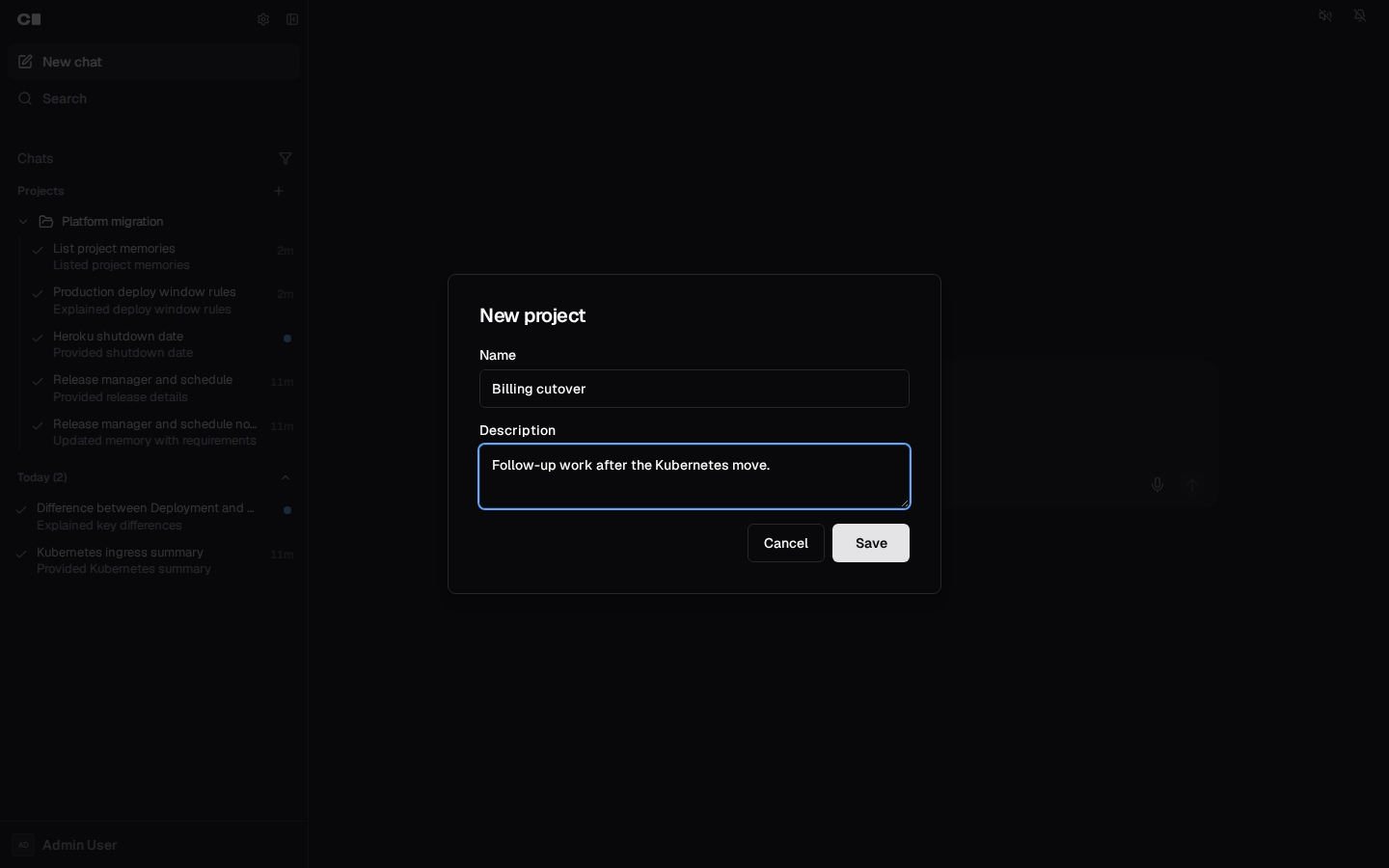 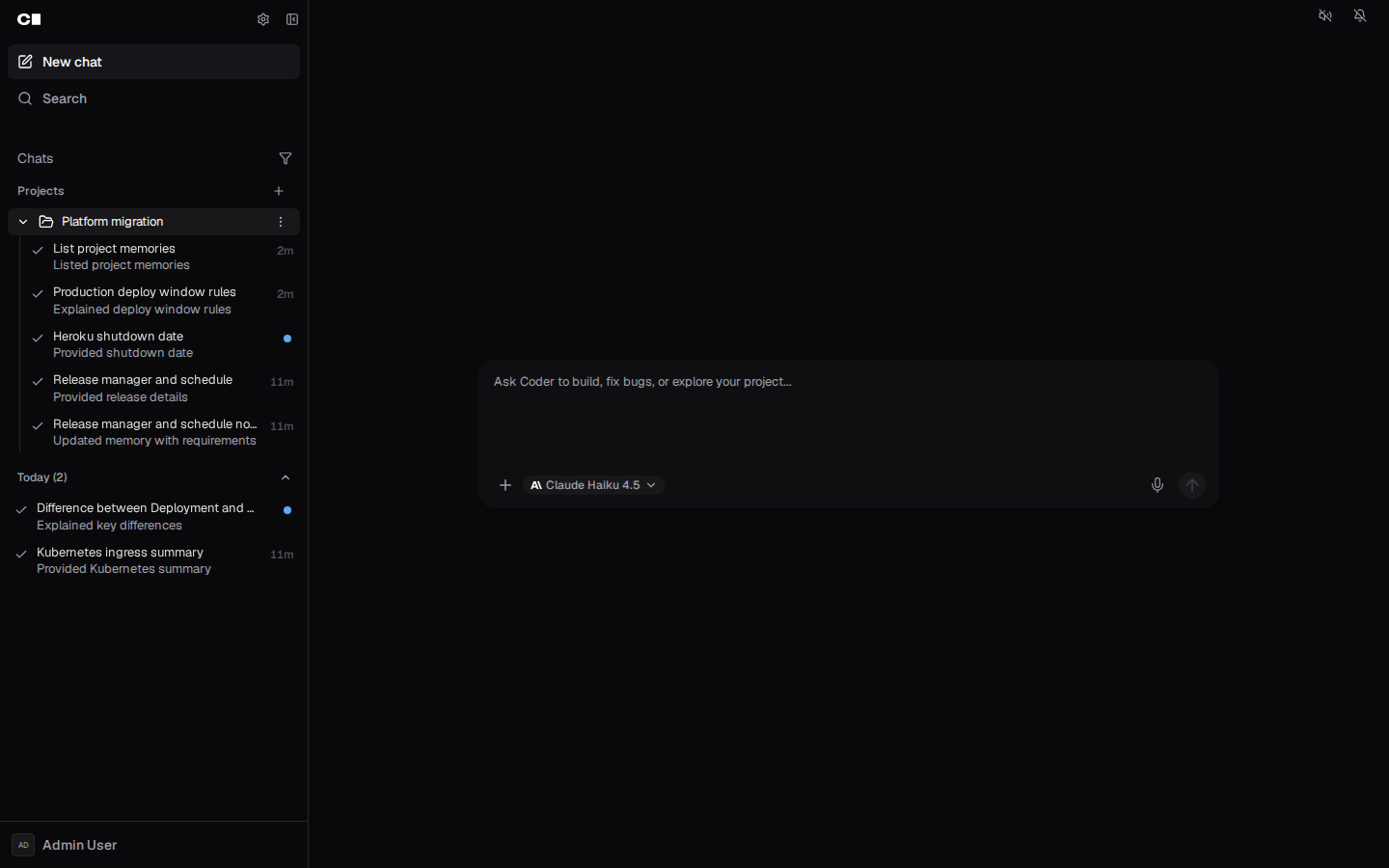 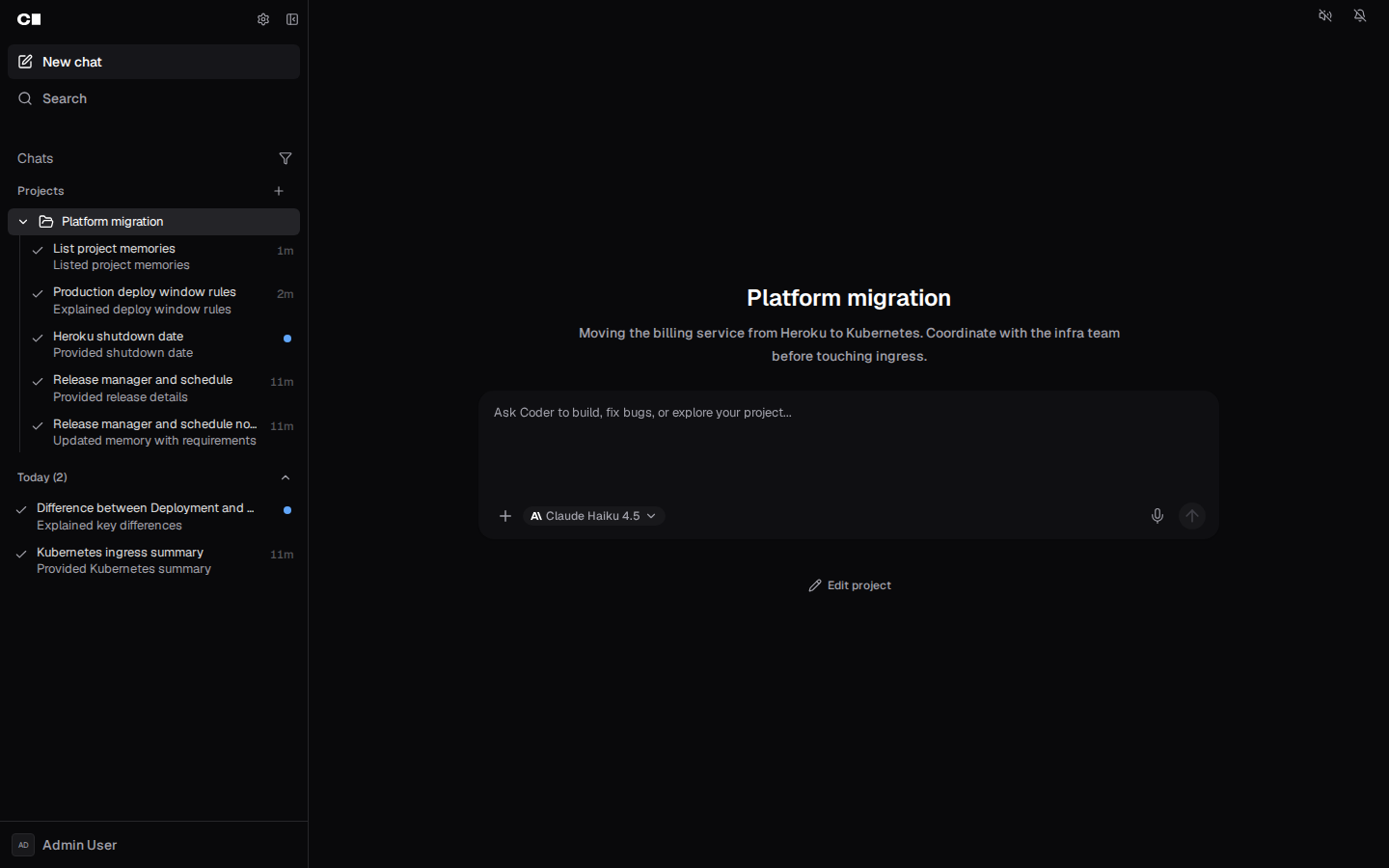 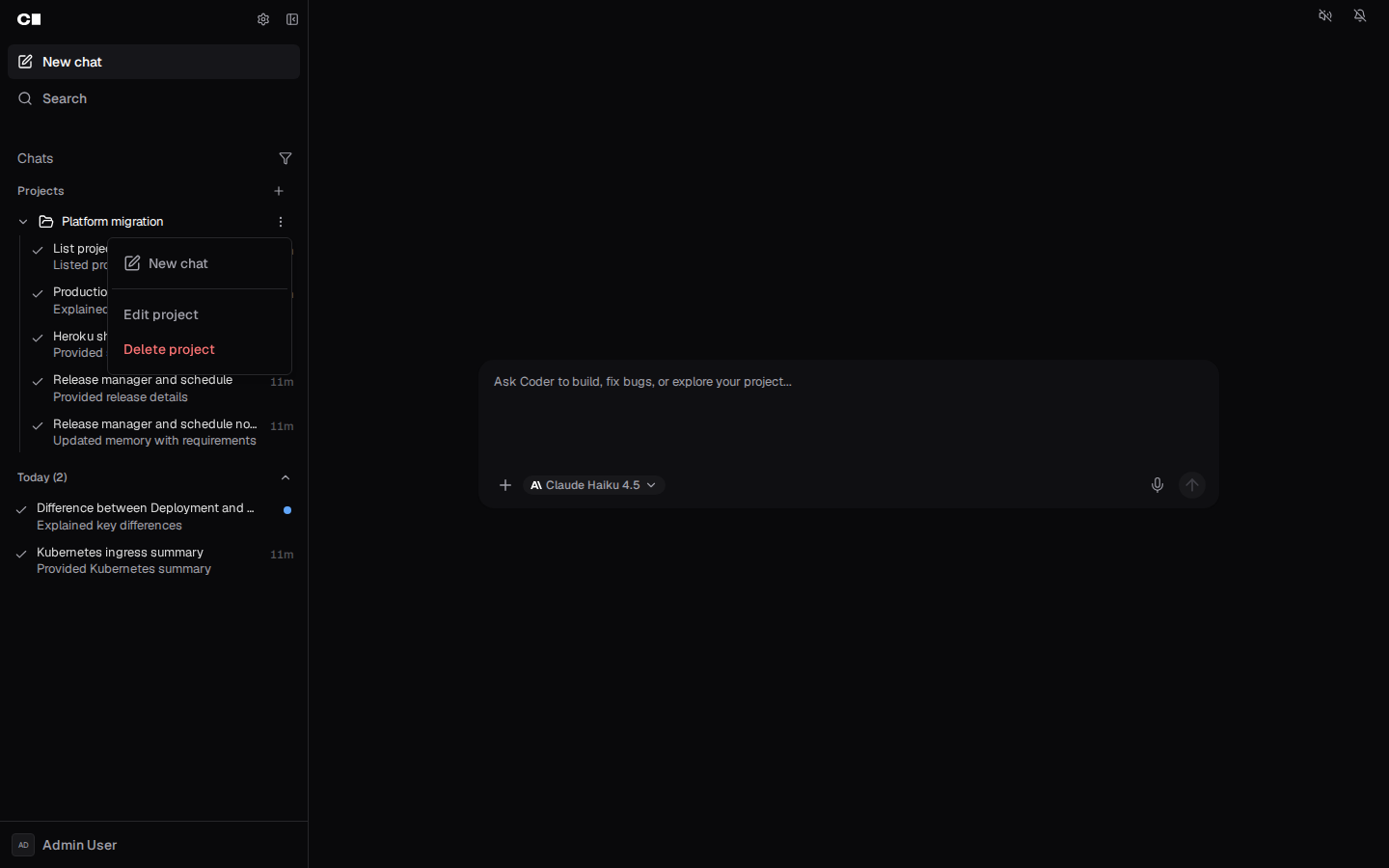  </details> --- Generated with Coder Agents on behalf of @f0ssel. --------- Co-authored-by: Claude Opus 5.5 (1M context) <noreply@anthropic.com> |
||
|
Danielle Maywood
|
63a95d87f3 |
feat(coderd): key chat diff statuses by ref (#29081)
Part 1 of 6. `chat_diff_statuses` had one row per chat, so a chat could only track one PR, and switching branches overwrote the old branch's PR data. The primary key is now `(chat_id, git_remote_origin, git_branch)`, so each ref the agent reports gets its own row. The API still returns a single `diff_status`: the first row of the chat's statuses, ordered by `updated_at`, newest report first. The primary ref changes only when the agent reports a ref: refreshes, claims, backoffs and URL writes do not advance `updated_at`, so they cannot reorder the primary. The gitsync worker now claims, backs off and clears rows by the full key, not the whole chat. When the diff GET discovers a PR URL, it updates the existing ref row and no longer inserts one. Telemetry picks one row per chat. **NOTE**: Migration `000606` swaps the primary key under an ACCESS EXCLUSIVE lock. The table is small. Existing rows already fit the new key, so no data is rewritten. The down migration keeps only the primary row per chat. Stop old coderd instances before migrating: their `ON CONFLICT (chat_id)` upserts fail once the old key is gone. Generated by Coder Agents. |
||
|
Seth ShelnuttandCian Johnston
|
faa9815cd6 |
feat: configure Claude Platform for AWS on Anthropic providers (#29049)
This PR adds configuration plumbing for Claude Platform on AWS ## Summary Makes Claude Platform for AWS configurable as a settings variant of `type=anthropic`, discriminated by `_type: "claude_platform_aws"`. Settings contain only `region` and `workspace_id`, plus the schema version. No new provider type or database enum is introduced. The API persists and projects those settings to the gateway. Provider keys can be added or removed independently: allowed BYOK takes precedence, followed by stored keys, then ambient SigV4 when neither key source applies. Model-availability hints and keyless provider construction reflect that ambient capability. Rejected or exhausted keys do not fall back to IAM. Removes Claude Platform-specific AWS identity fields, secret redaction/merge behavior, external-ID handling, and mode/key consistency checks. Bedrock configuration remains intact. Environment-based provider seeding was removed upstream and is not restored. The Claude Platform form and Experimental label remain follow-up work in #29050. ## Authentication limitation Each Claude Platform provider uses either the gateway's ambient AWS credentials when no provider keys are stored, or its stored API-key pool. In either case, a client credential takes precedence when BYOK is enabled. Rejected BYOK or an exhausted provider key pool does not fall back to ambient IAM. There is no per-provider AWS identity selection: keyless providers on the same gateway share its ambient AWS credential chain and cannot configure separate AWS access keys or assumed roles. Each provider still has its own Claude Platform workspace ID and separate provider attribution in Coder's usage/cost records; this does not imply separate AWS billing accounts. ## Validation - Race tests passed for SDK, daemon projection, db2sdk, chatprovider, and targeted CLI/API configuration tests. - Installed pre-commit hook passed, including generation, frontend/Go lint, and build. - Tests cover settings round trips, validation, adding/removing the last key without settings changes, keyless construction, model availability, and Bedrock regressions. Generated by Coder Agents on behalf of @johnstcn and @Shelnutt2 Co-authored-by: Cian Johnston <cian@coder.com> |
||
|
Jake Howell
|
d853893e8a |
feat: filter agent chats by chat status (#30009)
> 🤖 This PR was written by Coder Agents on behalf of Jake Howell. The sidebar's `Chat status` filter only offered `Read`/`Unread`. This turns it into a real status filter backed by the `chat_status` enum, the same value the row icon already shows. Stacked on #30006. - New `status:<waiting|running|error|requires_action|interrupting>` search filter (repeated or comma-separated) plus a `chat_statuses` param on `GetChats`. - Sidebar `Status` submenu offers `Requires action`, `Error`, `Working` and `Idle`; `Working` covers `interrupting`, since stopping a turn is too brief to be worth its own option. A full selection emits no filter. - `Unread` moves out to its own checkbox (`unread=true` in the URL), so it narrows a status selection instead of competing with it. - Grouping by status now sections by the five statuses instead of `Unread`/`Read`, reusing `getChatStatusDisplay` for labels and icons. <img width="439" height="177" alt="image" src="https://github.com/user-attachments/assets/82ef2ef0-cde9-4169-bb29-caa7b9bfdb9e" /> |
||
|
Michael Suchacz
|
f5092aaa4a |
feat: make chat limits configurable deployment options (#28927)
Adds deployment options for the chat limits that shape turn behavior and API acceptance, replacing hardcoded constants in `coderd/x/chatd` and the chat API. Defaults are unchanged. | Option | Default | Limit | |---|---|---| | `CODER_CHAT_MAX_STEPS_PER_TURN` | 1200 | steps (model responses) in a chat turn | | `CODER_CHAT_MAX_GENERATION_RETRIES` | 25 | consecutive retries after a model generation fails with a transient error | | `CODER_CHAT_MAX_QUEUED_MESSAGES_PER_CHAT` | 20 | messages that can be queued in a chat | | `CODER_CHAT_MAX_ATTACHMENTS_PER_CHAT` | 50 | files linked to a chat; linking more deletes the earliest uploads | | `CODER_CHAT_MAX_PROMPT_BYTES` | 131072 | system prompt, plan mode instructions, and each user's custom prompt | | `CODER_CHAT_MAX_CONCURRENT_RECORDING_UPLOADS` | 25 | desktop recordings each server stores at the same time | `codersdk.DefaultChat*` constants remain the single source of truth. Values below 1 fail startup validation, and each option's description ends with "Must be at least 1." `chatd.New` fills any zero field in `chatd.Config.Limits` with its default once, `LimitsFromConfig` is a plain conversion, and the code that receives a limit as a parameter (the `chatstate` queue and file link checks, the turn step check, `chatretry.Retry`, and `chatadvisor.NewRuntime`) returns an error for a limit below 1 instead of choosing a default or disabling the limit. The options are documented in the generated configuration reference and in the platform controls docs. `CODER_CHAT_MAX_GENERATION_RETRIES` counts consecutive retries, and the count resets after each successful step. The default allows 25 retries (26 attempts) where the old constants allowed 24. The same limit now applies to each nested advisor model call and to background title, summary, and turn status label generation, which previously used fixed `chatretry` budgets. Chat creation and tool result bodies keep the fixed 256 KiB limit from main. The prompt-saving endpoints accept bodies up to twice the prompt limit, for JSON escaping and characters that sanitization removes, but never less than 256 KiB, so small prompt limits still return the 400 length error. At the default this equals the 256 KiB limit on main. Four settings from earlier revisions were removed, and the fixed limits from main are back: - `CODER_CHAT_MAX_TOOL_OUTPUT_BYTES`: the agent already keeps a 16 KiB head and a 16 KiB tail of command output, so raising it had no effect and lowering it cut the tail. - `CODER_CHAT_MAX_DYNAMIC_TOOLS_PER_CHAT`: tool definitions share the 256 KiB chat creation body limit, so raising the count did little. - `CODER_CHAT_DEBUG_MAX_BODY_BYTES`: one setting covered two unrelated debug caps. - `CODER_CHAT_DEBUG_MAX_TEXT_RUNES`: the name did not say what it applied to. Root and subagent concurrency caps stay fixed because they are licensing behavior, and `MaxChatFileSizeBytes` stays fixed because the web UI hardcodes the generated constant for client-side checks. `codersdk.MaxChatFileIDs` is removed; the web UI's "Attachment expired" tooltip no longer quotes the number because the cap is now per deployment, and it says that attaching a file beyond the limit permanently deletes the chat's earliest-uploaded attachments. ## Review record | Round | Reviewed head | Result | Disposition | |---|---|---|---| | Codex 1 and 2 (Sep 2 to 3) | `7f10a1572f8`, `8ee09f8fa3b`, `197bb78d5b` | 10 findings, then OK on `197bb78d5b` | all threads resolved | | Codex 3 (Sep 17) | `e4efac249a5` (pre-rebase) | 4 findings | advisor retry limit confirmed and fixed in `9e462b7b3d0` (rebased from `67341e458e8`); ARCHITECTURE.md TODOs added; JSON-escaping body sizing and streamed-argument rune cap declined as pre-existing design (evidence in threads) | | Codex 4 (Sep 18) | `9e462b7b3d0` | 6 findings | recording evicted at attachment cap 1 confirmed and fixed in `5b61895decb`; `Limits` field docs and zero-value fallback documented; prompt retro-enforcement, generated multi-sentence lines, and tool-output truncation metadata declined as pre-existing design (evidence in threads) | | Codex 5 (Sep 18) | `5b61895decb` | 1 finding | over-cap batch of already-linked files accepted after lowering the cap: confirmed and fixed in `f44063e74e5` | | mafredri (Sep 23) | `f44063e74e5` | 24 threads, changes requested | all fixed in `05e3e3d622a`, `c1f78e09e8b`, `709ddb67977`, `d0587a49829`, `ca4347b24de`, and `1f6c9e2a46f`, then answered and resolved; the ARCHITECTURE.md text was written at the author's direction and approved by the author | | Sibling sweep (Sep 24) | `1f6c9e2a46f` | author-requested audit of all 24 mafredri threads for sibling issues, plus a test refactor | fixed in `37eaf07d34d` through `1f14ac041b7`: the advisor retry limit, `chatretry.Retry`, and the turn step check reject values below 1 instead of disabling retries or the limit; limit tests run against both the default and configured values set through `chatd.Config` or `DeploymentValues`; the expired-attachment tooltip is concrete. A required coder-frontend-review run (8 roles in one agent, CD re-run once) found a stale story comment, removed. | | Codex 6 (Sep 27) | `a71383e3a31` | OK, no findings | requested after the rebase at the author's direction, past the six-pass review budget | The branch was rebased onto main `4851c7b60c8` on Sep 27; the previous head was `91b84000adb`, and the earlier SHAs in the review record predate the rebase. Conflicts in the `chatstate` transitions and `CreateChat` keep both main's `InitialStatus` and this PR's `MaxFileLinks`, and main's rewrite of `advisor_internal_test.go` in #28754 keeps main's version plus this PR's limit tests. Two tests added on main needed the new retry arguments: `TestGenerateStructuredTitleWithUsage_FallsBackToTextWhenToolChoiceRejected` and `TestAdvisorRunStreamsReasoningDeltasSeparatelyFromAdvice`. Validation on `a71383e3a31`: the pre-commit hook (generation, golangci-lint, build), the full `coderd/x/chatd/...` suite (20 packages), the chat tests in `codersdk`, `coderd`, and `enterprise/coderd`, the CLI help tests, race-detector runs of the `chatd`, `chatstate`, `chatadvisor`, and `chatretry` packages, and `go build` plus `go vet` on each of the 27 commits. No remote UAT was run. > Xum acted on behalf of @ibetitsmike for this pull request. |
||
|
Jake Howell
|
4f2fd36e8f |
feat: add pr_status:none filter for chats without a pull request (#30006)
> 🤖 This PR was written by Coder Agents on behalf of Jake Howell. Adds `none` to the `pr_status` chat filter, matching chats with no linked pull request. Stacked on #30005. - `none` means no diff-status row, or a row whose `pull_request_state` is null/empty (so chats whose PR was cleared still match), and it ORs with the other statuses, e.g. `pr_status:none,open`. - Frontend picks it up from the shared `CHAT_LIST_PR_STATUS_ORDER`, shown as `No PR`; `searchQuery.ts` now derives its valid set from that list instead of a duplicated literal. - Swagger, API docs and the `list_chats` tool schema regenerated/updated. <img width="508" height="464" alt="image" src="https://github.com/user-attachments/assets/bd6c70e3-c634-499d-ae16-e7953f6da2f9" /> |
||
|
Jake Howell
|
cdf50f8b2c |
feat: add mark as read and unread to agent chat menus (#30015)
> 🤖 This PR was written by Coder Agents on behalf of Jake Howell. The chat read cursor only moved when a chat's stream connected or disconnected, so there was no way to clear an unread dot without opening the chat, or to flag a chat to come back to. `UpdateChatRequest` gains a `read` field that either advances the owner's read cursor to the latest assistant message or clears it, and the agents sidebar exposes it as a **Mark as read** / **Mark as unread** item directly under **Show subagents** in both the right-click and the ⋮ menus. Notes: - The cursor is owner-scoped, so `PATCH /api/v2/chats/{chat}` returns 403 for `read` when the caller is not the owner, even when they may otherwise update the chat. - The item is hidden for the chat that is already open, because opening a chat marks it read and would immediately undo the toggle. That also matches the sidebar, which never shows an unread dot for the active chat. <img width="292" height="215" alt="image" src="https://github.com/user-attachments/assets/31e9e249-70ea-4582-9391-66c4c51621b9" /> <details> <summary>Implementation notes</summary> Backend: - `UpdateChatLastReadMessageID` takes a nullable `last_read_message_id`; `NULL` clears the cursor so every assistant message counts as unread again. - `markChatAsRead` (stream connect/disconnect) now wraps `advanceChatReadCursor`; `clearChatReadCursor` is the new unread path. Both return errors so the HTTP handler can report failures instead of only logging them. Frontend: - `markChatRead` / `markChatUnread` mutations mirror `pinChat` / `unpinChat`: optimistic `has_unread` update, rollback plus invalidation on error, invalidation on settle. - `onMarkChatRead` / `onMarkChatUnread` thread from `AgentsPageLayout` through `ChatsSidebar` → `ChatsPanel` → `ChatTreeContext` → `ChatTreeNode`. `ChatTopBar` deliberately does not pass them, since it only ever renders the active chat's menu. Checks run: `make gen`, `make fmt`, `golangci-lint run ./coderd/...`, `go test ./coderd -run TestChatReadState`, `go test ./coderd -run 'TestSharedReaderStreamChat|TestChatPinOrder'`, `go test ./coderd/database -run TestChatHasUnread`, `go test ./coderd/database/dbauthz -run TestMethodTestSuite`, `tsc --noEmit`, `biome check`, and the AgentsPage Vitest unit and Storybook projects. </details> |
||
|
Michael Suchacz
|
0eed5465f2 |
feat: allow creating chats without an initial message (#27111)
> Written by Mux on behalf of Mike.

## What

`POST /api/v2/chats` now accepts an empty `content` array. The chat is
created idle (`waiting`) with system messages only: no user message is
inserted, no ownership hint is published, and no chat worker picks it
up. Generation starts when the first message is POSTed to
`/chats/{chat}/messages`.

## Why

The new-chat page needs to upload files into the chat's workspace before
the first turn, and `POST /chats/{chat}/workspace-files` requires a chat
ID. There was previously no way to sequence "create chat, upload files,
send first message": creation required non-empty content and started
generation immediately. This PR adds the enabling primitive; the UI
lands in the next PR of the stack.

## How

- `chatstate.CreateChat` takes an explicit `InitialStatus` (`waiting` or
`running`, validated). The existing `IsRunnable()` gate keeps ownership
hints suppressed for `waiting` chats.
- `chatd.CreateChat` derives the status from `InitialUserContent`: empty
content means `waiting` with system messages only, and `APIKeyID` is
only required when a user message is inserted.
- `createChatInputFromRequest` returns empty blocks for empty content
instead of rejecting; the `/messages` path still rejects empty sends.
- Chats created this way carry the `New Chat` placeholder title. Title
generation now treats that placeholder as replaceable. When the first
message lands on such a chat, `chatd.SendMessage` detects the first user
turn inside its transaction (under the chat row lock), writes the
fallback title in the same transaction, and reports `FirstUserTurn`;
`postChatMessages` then fires `GenerateChatTitleForMessagesAsync` to
upgrade it. A failed title call therefore still leaves a meaningful
title.
- `ARCHITECTURE.md` carries `TODO (#27111)` items in the transition list
and the `POST /api/v2/chats` section for the new `N -> Create -> W`
transition (the doc text and the diagram edge are left for the author
per the chatd guardrail).

## Follow-ups

- Automatic title generation (both the create path and the first-message
path added here) writes the generated title unconditionally, so a user
rename that lands while the title model call is in flight is
overwritten; a compare-and-set title update would close that
pre-existing window.
- `chats.last_reasoning_effort` is derived from inserted messages, so an
idle chat created with `reasoning_effort` does not persist it until its
first message; the first message applies the owner's personal
reasoning-effort override (when it targets the same model) if the
request omits an effort, matching `POST /chats` with content.

## Testing

- chatstate: `N -> W` lands in `StateW` with no ownership hint; invalid
initial statuses are rejected.
- chatd: empty create produces a `waiting` chat with system messages
only.
- HTTP: empty create + first message (`W -> R0`, inserts directly, not
queued), immediate archive of an idle chat, workspace file upload
against an empty-created chat, and title generation on the first
message.
|
||
|
Michael Suchacz
|
5dde49dffb |
feat: add chat workspace file upload endpoint (#27079)
## What

Adds `POST /api/v2/chats/{chat}/workspace-files`, which streams the
request body to the chat's bound workspace agent and returns the final
path/name/size, plus the `workspace-file-reference` message part type
that carries the uploaded file's metadata through chat messages:

- `coderd/exp_chats.go`: owner-only middleware (chat RBAC update +
reject archived), workspace exec authorization (403/409 like the
existing chat exec paths), agent selection (prefer the chat's bound
agent, else deterministic `agentselect.FindChatAgent`, without
persisting a binding), 30s dial timeout, chat/ancestor tracking headers
on the agent connection, and agent error passthrough (agent HTTP status
preserved, 502 with a generic detail for transport failures; the real
error is logged). Deleted and non-running workspaces get a specific 409
("Workspace is stopped. Start the workspace before uploading files.")
before agent lookup. Each failed upload logs one structured warning, and
`coderd_chat_workspace_upload_total{status}` counts outcomes. The route
shares the files rate limit and documents its 429.
- Input validation: client-supplied `workspace-file-reference` parts
must point inside `/.coder/chats/<chat-id>/files/` with a matching
basename, non-negative size, and a `workspace_file_workspace_id` equal
to the chat's currently bound workspace (the upload response echoes it
as `workspace_id`). References uploaded before a workspace rebind are
rejected instead of silently sending the agent an unreadable path. The
file name must already be in sanitized form
(`SanitizeWorkspaceUploadName(name) == name`), and the cleaned path and
base media type are what gets persisted; message edits share the same
validation. Parts are rejected on chat creation (no chat ID exists yet).
- `coderd/x/chatd/chatprompt`: references render into the prompt as text
only, `[workspace file: <name> (<size>) at <path>]`; file bytes never
reach the LLM. Title derivation (`TitleText`) uses the bare file name,
so fallback titles carry no internal marker.
- `codersdk`: part-type constants/fields,
`ChatMessageWorkspaceFileReference` builder, and
`Client.UploadChatWorkspaceFile` (RFC 5987 filename in
`Content-Disposition`).

No DB migration: parts persist as JSON in `chat_messages.content`.

## Why

Bridges chat and the workspace filesystem for CODAGT-211: users drop a
file in chat, the bytes land where the agent's tools can operate on
them, and the model learns the path from the reference part.

## How tested

- `go test ./coderd -run 'WorkspaceFile|ChatInput|UploadChat'` including
an integration test that runs a real in-memory agent, uploads through
the coderd route, verifies bytes on disk, and exercises collision
suffixes.
- `go test ./codersdk ./coderd/x/chatd/...`, `make gen`
(swagger/types/docs), `make lint`.
- Rebased onto main 2026-09-21: the chat API moved from
`/api/experimental` to `/api/v2`, so the route is registered in
`coderd/chat_routes.go` and the SDK method lives on `codersdk.Client`.

## Follow-ups

- The files rate limit counts requests, not bytes or concurrency;
whether this route should use a per-user concurrency cap instead, and
whether the new-chat page should keep partial successes on a 429, is
still open
([CODAGT-1171](https://linear.app/codercom/issue/CODAGT-1171)).

Part of CODAGT-211. Stack: agent API -> coderd endpoint (this PR) -> UI.

> This PR was authored by Mux (AI) working on Mike's behalf.
|
||
|
Ethan
|
f64ccfb836 |
feat: add experimental inline MCP servers (#29546)
Closes CODAGT-1131 Fifth PR in the inline MCP servers stack, on top of #29520. A chat owner can now declare MCP servers by URL and headers on their own chat, and chatd connects to them every turn alongside the org-configured ones. They go in a new `inline_mcp_servers` field on `POST /api/v2/chats` and `POST /api/v2/chats/{chat}/messages`, which replaces the whole set (omit to keep, `[]` to remove). Root chats only. `GET /api/v2/chats/{chat}` returns them, with the URL blanked for non-owners and header values never returned. Subagents only get servers marked `allow_in_subagents`, a root chat in explore mode gets none, and a root chat in plan mode gets all of them. URLs must be `https`, or `http` to an IP literal in `CODER_MCP_ALLOWED_PRIVATE_CIDRS`. Header values have no minimum length, so anything under the redactor's 8 byte floor from #29518 is accepted but not redacted, which the docs call out. Every cap is exported from `codersdk`. It's behind the `chat-inline-mcp-servers` experiment, and the `--disable-chat-caller-supplied-tools` kill switch from #29466 covers it too. With either off, declaring servers gets a 403 and existing chats stop connecting to theirs, but `[]` still works so a client can detach. Load failures show up in the chat debug panel as failed connections, as do org servers with an invalid config. Docs are hand-written in `mcp-servers.md`. |
||
|
Ethan
|
c1af0793e5 |
feat: add caller-supplied tools kill switch for chats (#29466)
This is the first PR in a stack that adds experimental support for attaching MCP servers to a chat when it's created, and then deprecates `unsafe_dynamic_tools` in favour of them. Both are "caller-supplied tools", i.e. tools the client hands to coderd at chat creation rather than tools an admin has configured, so we want a single switch admins can use to turn all of them off. This PR adds that switch: `--disable-chat-caller-supplied-tools` (`CODER_DISABLE_CHAT_CALLER_SUPPLIED_TOOLS`). It follows the existing `disable-*` deployment flag pattern (`--disable-chat-sharing` etc.), so there's no new API route and it's independent of any experiment. When set, `POST /api/v2/chats` returns a `403` if the request includes `unsafe_dynamic_tools`, and chats that already have dynamic tools run without them; a call to one gets a tool error result and the model just continues. Later in the stack, chat-attached MCP servers are gated behind the same flag. It's unset by default, so nothing changes unless you opt in. Part of CODAGT-1131 |
||
|
Michael Suchacz
|
efd8e8ca12 |
fix(coderd): require read and update chat permissions for delegated chat owners (#29684)
`POST /api/v2/chats` with `owner_id` (#29581) checks that the delegated owner holds `chat:create` before creating the chat under the owner's context. Creation also inserts the first message (`chat:update`) and reads the chat back (`chat:read`) inside the same transaction, so an owner whose custom organization role grants only `chat:create` passed the preflight and then failed inside the transaction with a generic 403 instead of the intended 400 `Chat owner does not have permission to use chats.` The transaction rolls back, so no chat is left behind; only the status code and message were wrong. The preflight now requires create, read, and update for the owner. Regular organization members hold all three through the member role, so this only changes the response for service accounts and custom roles with partial chat grants. Found by Codex on the 2.37 backport (#29683), which carries this same commit. The code is identical on main. ## Validation - `TestPostChats_OwnerID/OwnerWithCreateOnlyChatPermission`: red on the unfixed head (403 instead of 400), green with the fix. - `go test ./coderd/ -run 'TestPostChats|TestPatchChat' -count=1`: pass. - Pre-commit hook (gen, fmt, lint, slim build) passed on this commit. > Xum opened this PR on behalf of @ibetitsmike. |
||
|
Michael Suchacz
|
af0ef00f91 |
feat: add owner_id to CreateChatRequest to create chats for another user (#29581)
Owners and owner-level service accounts can now start a Coder Agents
chat on behalf of another user by setting `owner_id` on `POST
/api/v2/chats`. The field is optional and defaults to the caller, so
existing clients are unaffected. A delegated owner must be an active,
non-system member of the requested organization; anything else returns
400 `Chat owner must be an active member of the organization.` once the
caller has passed the authorization gates below.

A chat runs entirely with its owner's credentials (synthetic API key,
workspace access, OIDC and provider tokens), so creating one for someone
else is acting as that user. On top of org-scoped `chat:create` for the
owner, the caller must hold the authority to create API keys for that
user, which is what the token endpoint demands to mint their session.
Org admins therefore cannot use it; site owners and owner-role service
accounts can. For the same reason the workspace binding, model config,
and MCP server IDs are validated as the owner rather than the caller,
and the owner must themselves hold `chat:create` (organization service
accounts do not). The initial user message is attributed to the caller
through `chatd.CreateOptions.CreatedBy`.

An earlier revision of this PR exposed the same behavior as `POST
/api/v2/users/{user}/chats`; that route and
`codersdk.Client.CreateUserChat` were removed in `62a8be3dd32` in favor
of the request field. An explicit zero `owner_id` is rejected with 400
rather than silently defaulting to the caller. Coverage lives in
`TestPostChats_OwnerID`.

<details>
<summary>Review record (path-based revision, gates unchanged)</summary>

- Two-axis code review (Standards, Spec) plus a simplicity audit ran as
Xum sub-agents on `1f3189898f0`. The Spec axis found the workspace
binding was authorized as the caller, fixed in `363d45281d8` with
red-green coverage in `WorkspaceNotAccessibleToOwner`. The additional
API-key gate and the `CreatedBy` attribution go beyond the workspaces
pattern and were kept deliberately for the reasons above.
- Codex review on `363d45281d8`: one P2, suspended, dormant, or system
users could be targeted and would get a chat that can never run because
AI Bridge refuses to authorize them. Fixed in `c065437e359` with
`OwnerSuspended` (red on the old head); thread replied to and resolved.
- Codex review on `c065437e359`: one P2, an explicit or
personal-override model config the caller can read but the owner cannot
was accepted and chatd would silently fall back to the default model at
run time. Fixed in `aa88b608182` by resolving the model config and MCP
server IDs under the owner's context, with
`ModelConfigNotAccessibleToOwner` (red on the old head); thread replied
to and resolved.
- Codex review on `aa88b608182`: one P2, an organization service account
(which deliberately holds no chat permissions) could be targeted because
the chat permission check ran as the caller. Fixed in `a6fe8075c30` by
also requiring the owner subject to hold `chat:create`, with
`OwnerWithoutChatPermission` (red on the old head); thread replied to
and resolved.
- Codex review on `a6fe8075c30`: one P2, the active/non-system check was
skipped when the caller could not read the owner's user object. Fixed in
`0dd8bb4dd44` by moving the check behind the authorization gates with a
system-restricted lookup; thread replied to and resolved. In
`62a8be3dd32` that lookup became a single `OrganizationMembers` query,
which also covers membership and excludes system and deleted users.
- Codex review on `62a8be3dd32` (the `owner_id` revision): two P2s. An
explicit zero `owner_id` was treated as omitted and created the chat for
the caller; fixed in `f54b4f33d36` with a 400 and `OwnerIDNil` (red on
the old head). Creation and the read-back still ran as the caller while
the preflight ran as the owner; fixed in the same commit by passing
`ownerCtx` to `CreateChat`, `GetChatByID`, title generation, and the
file-metadata fetch. That second scenario is unreachable today (only the
built-in `owner` role holds `api_key:create` for others, and site-wide
custom roles are refused by both the API and dbauthz), so it has no
dedicated red test. Both threads replied to and resolved.
</details>

<details>
<summary>Remote UAT record (path-based revision)</summary>

Remote UAT on dogfood (chat `d7442df3-693f-4403-805f-2de52f7bdbed`, Xum
sub-agent as critical runner) tested head `21ed6b389cc`, the last
path-based revision. Licensed dev server, real Haiku 4.5 model, 77
logged API requests, 23 inspected screenshots. Endorsed verdict:
**PASS**. Site owner creates a chat for member X: X sees it, gets real
answers to the admin prompt and to follow-ups, and state survives reload
and mid-response refresh. The creating admin gets `403 Only the chat
owner may send messages.` and a read-only view; an unrelated member gets
404. Org admin, member, user-admin, and template-admin callers get 403;
owner-role service account 201. Suspended, dormant, and service-account
targets 400; owner-inaccessible workspace, model config, or MCP server
400; 300 KiB body 413. The `owner_id` revision changes only how the
owner is supplied and the non-member response (400 instead of 404); the
authorization and eligibility gates it exercised are unchanged and
covered by `TestPostChats_OwnerID`.

Non-blocking findings for the author's judgment, none of them
regressions of this PR:
1. X's UI shows no author on the admin-written first message and offers
X "Edit" on it; `created_by` carries the admin but the frontend does not
surface it.
2. A site owner who is not a member of the organization can still create
a chat for its members (201), while a self-owned `POST /chats` returns
403 for the same organization; same asymmetry as `postUserWorkspaces`.
3. The creating admin can archive, rename, and interrupt X's chat
although it cannot message it (pre-existing chat authz).
4. Owner-inaccessible model config or MCP server is reported as "not
found or disabled" with no hint that the owner, not the caller, lacks
access.
5. Dormant (never logged in) targets are refused because AI Bridge
rejects non-active users; a new hire cannot be given a chat until first
login.
6. The endpoint docs list only 201 and 413.
</details>

> Xum (an AI agent) acted on behalf of @ibetitsmike for this PR.
|
||
|
Michael Suchacz
|
988520477e |
feat!: remove the experimental chat API mounts after the transition window (#29548)
Remove the `/api/experimental` duplicates of the promoted chat API. #28496 double-mounted the chat, organization chat and MCP server, member model-override, AI provider key, and MCP OAuth2 disconnect routes under both prefixes for the one-release compatibility window decided in CODAGT-921; that window closed with v2.37.0, so these routes now answer only on `/api/v2`. The change also deletes what existed only for the dual mount: the `chatAPIPrefix` plumbing, the shared cross-prefix files rate limiter (`RateLimitByAPICompatibilityEndpoint`), the 410 tombstones for the legacy `chats/providers` and `chats/user-provider-configs` collections with their `ExperimentalClient` SDK methods, and the `/providers` and `/user-provider-configs` 404 reservations on `/api/v2`. Signed chat file download URLs now point at `/api/v2`. Routes that were never promoted stay on `/api/experimental`: the experiment-gated `chats/config/advisor` and `chats/config/computer-use-provider`, `chats/{chat}/stream/desktop`, `chats/{chat}/debug/runs`, and the MCP OAuth2 callback, whose path is pinned as a registered redirect URI with external providers. The frontend already calls `/api/v2` for every promoted route, so only `typesGenerated.ts` changes. Because the experimental mount no longer reserves the removed collection segments, requests such as `GET /api/experimental/chats/models` now fall into the `{chat}` wildcard and return 400 instead of 404; the experimental prefix carries no stability guarantee and the compatibility window is over, so no new reservations were added. `coderd/x/chatd/ARCHITECTURE.md` now describes the single `/api/v2` mount and the remaining experimental routes, and its endpoint headings use the `/api/v2` paths. Closes CODAGT-922 (https://linear.app/codercom/issue/CODAGT-922/remove-experimental-chats-api-paths-after-transition-window). Refs #28496. ## Delivery record - Remote dogfood UAT (Coder Agents chat https://dogfood.cdr.dev/agents/c016b549-201a-4eca-a50f-3c0b7c339db6): verdict PASS on b008976a4dfba3524b220ca846ea3c3492e9cc9c. The branch was since rebased onto main (which had a duplicate migration 000596 until #29568) and gained one docs-only commit (`coderd/x/chatd/ARCHITECTURE.md` only); the current head |
||
|
Paweł Banaszewski
|
f69f545429 |
chore: clean up ChatProviderAPIKeysFromDeploymentValues (#29666)
Removes not needed `ChatProviderAPIKeysFromDeploymentValues` function. |
||
|
Michael Suchacz
|
2bf0f567d8 |
feat: add OpenAI Pro reasoning mode to chat model configs (#29584)
Adds `provider_options.openai.reasoning_mode` (`pro`) to chat model configs so admins can turn on OpenAI's Pro reasoning mode for a model, alongside the other OpenAI request options on the model form such as `service_tier`. The field is offered for any model on an OpenAI provider; the field description says Pro is supported from the GPT-5.6 Sol generation and that requests fail when Pro is set on a model that does not support it. There is deliberately no supported-model list anywhere: a newly released model that supports Pro works with no code change, and OpenAI rejects the request when the model does not. Validation rejects only values other than `pro`, non-OpenAI providers, and configs that explicitly force plain sampling (`reasoning_model=false`) or Chat Completions (`use_responses_api=false`), including partial updates that move a configured model onto such a provider or transport. A configured mode implies the Responses API and reasoning-model treatment when `openai_config` leaves those unset (`chatprovider.effectiveOpenAIConfig`), so an alias the pinned SDK has never seen, such as `gpt-daybreak-blue-latest`, still gets `effort` and `summary` and drops `temperature`. The same effective config feeds the client options and the recorded transport, so the two cannot disagree. The pinned fantasy OpenAI provider options do not carry `reasoning.mode`, so the mode is applied as a client-scoped `openai-go` request option when the model client is built rather than per call. The SDK merges pre-serialization `WithJSONSet` overlays by top-level key, so the key is escaped (`reasoning\.mode`) to add `mode` to the existing `reasoning` object instead of replacing `effort` and `summary`. `TestResolveModelCallReasoningModeWire` pins the resulting request body for streaming and non-streaming calls and checks that the fixed computer-use model does not inherit the mode; AI Gateway forwarding of the `reasoning` object is covered in `aibridge`. Because the option is bound to the model client, every call made through a Pro model config carries it, including title generation and quick generation when those fall back to the chat's model; deployments that want cheaper auxiliary calls should point the title generation override at another model. Frontend: the field renders through the existing schema-driven provider options with no hand-written field logic. Two generic changes: `visible_for_providers` is now honored for provider fields the way it already was for general fields (render and payload), so the OpenAI-scoped select does not appear or serialize for Azure, which shares the OpenAI field group; and the add/update model save toasts now carry the server's error detail, so a rejected combination such as Pro with Use Responses API at Off tells the admin which field to change. Docs: `docs/ai-coder/agents/models.md` gains a Reasoning Mode row in the OpenAI provider-specific options table (from the documentation check comment https://github.com/coder/coder/pull/29584#issuecomment-5752457808), and its Azure note now says Azure OpenAI lacks that one option. Not changed: `coderd/x/chatd/ARCHITECTURE.md`. Its OpenAI transport selection table needs a `reasoning_mode` row (client-applied, neither transport) to match `TestProviderOptionsTransportParity`; left for the human author. <details> <summary>Delivery record</summary> - Local validation on every pushed head: targeted Go tests (chatopenai, chatprovider, chatd wire test, aibridge integration test, coderd DB tests for persistence, invalid input, and partial updates), red/green on the wire test (injection removed, and unescaped key), Vitest (`modelConfigFormLogic`, `ModelForm`), Storybook tests for `ModelFormProviderConfig`, biome, tsc, oxlint, golangci-lint on touched packages, pre-commit hook. - Codex round 1 on `e7dbaefeafc`: 3 findings (Storybook assertions, ARCHITECTURE.md TODO, `gpt-daybreak-blue-latest` alias). Disposition: assertions moved to Vitest and alias accepted in `8fccf111111`; ARCHITECTURE.md left untouched by author instruction. Threads replied to and resolved. - Codex round 2 on `8fccf111111`: 1 finding (fixture naming, FE9), renamed in `23449e92317`. Round 3 on `23449e92317`: 1 finding (fixture location, FE9), moved to `testHelpers/chatModels.ts` in `c3bd5aa370f`. Round 4 on `c3bd5aa370f`: "Didn't find any major issues" (https://github.com/coder/coder/pull/29584#issuecomment-5735119236). All threads resolved. - Remote UAT round 1 (chat https://dogfood.cdr.dev/agents/f5ed1d16-be1d-4d39-952b-126a6a829ef1) exercised `e7dbaefeafc`: endorsed PASS. Real `gpt-5.6-sol` turns showed `"mode": "pro"` / `"standard"` / no key in the Debug tab with effort and summary intact; 14 POST and 6 PATCH rejections captured; UI select visibility, persistence, reload, and clearing verified. Low, non-blocking notes: the `gpt-5.6` alias revert in the model identifier field is pre-existing; Pro is dropped silently when a model or transport change makes it unsupported; Pro applies to auxiliary calls (see above). - Remote UAT round 2 on `c3bd5aa370f` (same chat, alias and core re-verify): core PASS, alias FAIL. With `gpt-daybreak-blue-latest` the request carried `{"mode": "pro"}` without the configured effort and summary and kept sending `temperature` (provider 400 then retry on quick generation and title calls), because the SDK does not classify the alias as a reasoning model. Fixed in `d4c338de767`: a configured mode now implies a reasoning model unless `openai_config.reasoning_model` is set, and a mode on a config that forces plain sampling is rejected. Alias UI/API behavior, rejections, and known-model Pro/Default turns all passed on `c3bd5aa370f`. - Codex round 5 on `d4c338de767`: "Didn't find any major issues" (https://github.com/coder/coder/pull/29584#issuecomment-5736190356). Zero unresolved threads. CI green on `d4c338de767`. - Remote UAT round 3 on `d4c338de767` (same chat): endorsed PASS. Alias runs are single-attempt 200s with `{"effort", "summary", "mode": "pro"}` and no `temperature` (quick generation and title calls no longer retry); `reasoning_model=false` plus a mode is rejected by POST and PATCH with the stored config unchanged; the Reasoning Model override at Off hides the select and drops the mode on save; `gpt-5.6-sol` Pro turn unchanged. Remaining low notes, none introduced here: rejection detail for a non-OpenAI provider names the model rather than the provider; Pro is dropped silently when an override makes it unsupported; `PATCH model_config` replaces the whole object (pre-existing on main). - coder-frontend-review on `d4c338de767` (8 role reviewers, 3 passes): 13 failing checkpoints, chiefly a TS mirror of the Go model regex, the `json_name === "reasoning_mode"` gate duplicated in the render filter and payload builder, a defaulted `model` parameter, and comment and type nits. Fixed in `554c90d5fd9`: the pattern and provider scope are generated onto the field schema, one predicate is shared by both call sites, `buildModelConfigFromForm(provider, model, form)` requires the model, and the ModelForm test also asserts the select disappears for an unsupported model. Red/green: stripping `supported_models` or `visible_for_providers` from the generated schema fails 21 and 1 Vitest cases respectively. Declined with rationale: RO4 (move the fixture to `ModelsPage/testFixtures.ts`; FE9 in `FRONTEND_PATTERNS.md` names `testHelpers/chatModels.ts`, and Codex round 3 required it) and a DF5 nit to gate on the committed identifier and warn when a saved mode is dropped (behavior change, separate follow-up). Final pass: all checkpoints PASS or N/A. - Remote UAT round 4 on `554c90d5fd9` (same chat, focused regression after the frontend-review refactor): endorsed PASS. All six claims held (Pro round trip with effort and tier intact; unsupported identifiers hide the select and a save drops the stale mode while keeping the other options; Azure never shows or saves it; the alias shows it only with the Responses override On; Reasoning Model Off hides it and drops it; three real `gpt-5.6-sol` Pro turns were single-attempt 200s with `{"effort","summary","mode":"pro"}` and no `temperature`). Probes aimed at the refactor also passed: `gpt-5X6-sol` is rejected (dot escaping survived the JSON round trip), whitespace-padded identifiers still match, the other 11 OpenAI fields and the Anthropic section still render. Remaining low notes are carried over from round 3 plus one naming note ("Reasoning Mode" versus "Reasoning Model"). The final head `abb58df77d8` differs from `554c90d5fd9` only in `ModelForm.test.tsx`, so it ships the same production code. - Codex round 6 on `554c90d5fd9`: 1 finding (https://github.com/coder/coder/pull/29584#pullrequestreview-5260492465): the two `toBeInTheDocument` assertions added in the frontend-review round violate FE1. Confirmed against `site/AGENTS.md`; removed in `abb58df77d8` (test-only, 7 deletions; the payload assertion keeps the behavior coverage and the `ProviderConfigOpenAI` story captures the hidden state). Thread replied to and resolved. - Codex round 7 on `abb58df77d8`: "Didn't find any major issues" (https://github.com/coder/coder/pull/29584#issuecomment-5749626071). Zero unresolved threads. CI green on `abb58df77d8` (23 success, 8 skipped, `required` pass). - Design change on `e99152e5c57` (owner direction: no model gating; "none or pro" for any model; tooltip states the GPT-5.6 Sol constraint and that requests fail on unsupported models). Removed `codersdk.ChatModelReasoningModeModels`, the generated `supported_models`, `isFieldApplicableToModel`, the `gpt-daybreak-blue-latest` special case, and the `standard` enum value; `ValidateReasoningMode(provider, config)` no longer takes the model; `effectiveOpenAIConfig` makes a mode imply Responses and reasoning-model treatment. PR footprint went from +1130/-22 to +769/-18. Local validation: `go test` for chatopenai, chatprovider, chatd wire test, and the coderd API tests (persistence now covers `gpt-5.6-sol`, `gpt-4o`, `gpt-daybreak-blue-latest`, `gpt-7-nova`; invalid input now rejects `standard`), golangci-lint on touched packages, Vitest (187 tests across `modules/aiModels` and `ModelsPage`), biome, tsc, pre-commit hook. - coder-frontend-review on `e99152e5c57` (8 roles, 1 pass plus a TS and CD confirmation pass): 9 failing checkpoints (SD4, CD1, CD3, CD4, TS3, TS7 x2, RO3, RO5, TN4, DF5). Fixed in `e06bfbe4299`: the ModelForm test edits `mockGPT5` so its provider matches the selected provider state, types the update mock like the sibling story, and drops an unused route; the story spreads `mockGPT5` with a saved mode instead of a dedicated shared fixture (`MockGPT56Pro` removed, `testHelpers/chatModels.ts` back to base); a `ProviderConfigAzure` story captures the panel without `reasoning_mode`; comment nits. Left as a nit with justification: RO3 (the one-line `!hidden && isFieldVisibleForProvider` predicate now appears in both `getVisibleProviderFields` and `getVisibleGeneralFields`; hoisting a helper for two call sites is not worth it). Confirmation pass: TS all PASS; CD flagged one wording nit, fixed before commit. - CI green on `e06bfbe4299` (23 success, 8 skipped, `required` pass). - Codex round 8 on `e06bfbe4299`: 1 P2 finding (https://github.com/coder/coder/pull/29584#discussion_r4057659673): the form still offers Pro with Use Responses API or Reasoning Model at Off, a combination the server rejects, and the failure was not actionable. Disposition: the select stays visible by owner direction (no client-side gating of this field beyond the provider scope; an explicit rejection is preferred over the earlier silent drop), and `e2b43c3aee7` makes the add/update save toasts show the server detail so the admin sees which field to change. Thread replied to and resolved; zero unresolved threads. - Remote UAT round 5 on `e06bfbe4299` (same chat): endorsed PASS with two UI issues to land before release. All seven probes passed: the select offers only Default and Pro for `gpt-5.6-sol` and `gpt-4o` with the tooltip text verbatim; Pro saves on `gpt-4o` and the real turn fails visibly with the provider's "reasoning.mode is not supported with this model" after a single 400 attempt, and works again once Pro is cleared; `gpt-daybreak-blue-latest` with Pro and no overrides is a single 200 to `/v1/responses` with `{effort, summary, mode: "pro"}` and no `temperature`; the `gpt-5.6-sol` Pro turn is unchanged; POST and PATCH reject `standard`, `PRO`, empty, Responses Off, Reasoning Model Off, and Azure, openai-compat, and Anthropic providers with the stored config unchanged, while a model-only PATCH to `gpt-4o` now succeeds; the Azure form shows no Reasoning Mode; the alias with an explicit Responses override still works. Reservations: (1) medium, the UI conflict path only showed "Invalid model config." without the detail (fixed in `e2b43c3aee7`, not yet UAT-exercised); (2) low-medium, a dev-DB row still holding `standard` from round 2 renders an empty red select whose message is the whole field description plus "has an invalid value." and blocks saving unrelated fields (pre-existing generic behavior of `yupTestForField` using the description as the label; no released data can hold `standard`, so no migration); (3) low, no hint next to older identifiers (documented design); (4) low, a chat on such a stored row fails with a generic headline (pre-existing). - Final head `e2b43c3aee7` differs from `e06bfbe4299` only in the two save-toast handlers (`AddModelPage.tsx`, `UpdateModelPage.tsx`, 8 insertions). CI is green on `e2b43c3aee7` (skipped=8, success=23, `required` success). Codex has not run on `e2b43c3aee7`. - Remote UAT round 6 on `e2b43c3aee7` (same chat, https://dogfood.cdr.dev/agents/f5ed1d16-be1d-4d39-952b-126a6a829ef1, settled 2026-09-20T19:02Z): endorsed PASS on the exact final head. Build proven by `/api/v2/buildinfo` (`v2.37.2-devel+e2b43c3aee`, `external_url` at the full SHA) and the UI badge. The round 5 toast issue is resolved: Add and Update saves with Pro plus Use Responses API Off or Reasoning Model Off show "Invalid model config." with the server detail as the description, one 400 each, nothing stored. Compact regression of every round 5 probe held (dropdown and tooltip; Pro on `gpt-4o` fails visibly with the provider's `reasoning.mode is not supported with this model` and works after clearing; alias with and without the Responses override and `gpt-5.6-sol` all send `{effort, summary, mode: "pro"}` with no `temperature` in a single 200; POST and PATCH rejection matrices with stored config unchanged; Azure form without the field). Legacy `standard` row: fails closed on chat, and re-picking Pro or Default saves. Remaining notes, none blocking: the malformed validation copy for an invalid stored enum (pre-existing `yupTestForField` label choice, dev-DB rows only), Pro offered for models that cannot accept it (documented design), and a pre-existing `quickgen` status quirk on `gpt-4o` unrelated to this field. Secret scan clean. - Final head `4f3c6106dfe` adds one docs-only commit on top of `e2b43c3aee7` (`docs/ai-coder/agents/models.md`, 9 insertions, 8 deletions, no code). Remote UAT round 6 exercised `e2b43c3aee7`; the docs commit is not UAT-relevant. Validated with `markdown-table-formatter`, `markdownlint-cli2`, and the pre-commit hook (`fmt/markdown`, `lint/markdown`, `lint/emdash`, `lint/typos`). CI is green on `4f3c6106dfe` (success=24, skipped=7, `required` success) and the documentation check re-run marked its item addressed (https://github.com/coder/coder/pull/29584#issuecomment-5752457808). - Review tally for this PR: Codex 8 completed rounds; coder-frontend-review 34 role passes (24 on `d4c338de767`, 10 on `e99152e5c57`); remote UAT 5 rounds; no human review yet. This is far past the six-review guardrail, so no further Codex or agent review has been requested. Whether to spend another Codex pass on `e2b43c3aee7` is an owner decision; human review is still required before merge. </details> > Xum acted on behalf of @ibetitsmike. |
||
|
Michael Suchacz
|
6c7f6b855b |
feat: add openai_config.reasoning_model override and bump fantasy (#29230)
## Why The coder/fantasy fork classifies OpenAI reasoning models by name. The pinned version did not know `gpt-6-astra`, so the Responses client omitted the `reasoning` parameter (the reasoning effort picker did nothing) and forwarded `temperature` (quickgen title calls got HTTP 400 `Unsupported parameter: 'temperature'` and retried). Every new model generation would need a fork release to fix this. Admins need a switch in the model config instead. ## What - Bump `charm.land/fantasy` to coder/fantasy `a511353f83eb`, the `coder_2_33` commit that squash-merged coder/fantasy#57 (the pin also carries coder/fantasy#58, Gemini media tool results): gpt-6 and later generations are recognized as reasoning models, and the provider gains `WithReasoningModelFunc` to override the classification. - New tri-state `openai_config.reasoning_model` on `ChatModelCallConfig`: unset keeps fantasy's name heuristics, `true` forces reasoning-model handling (effort and summary sent, temperature/top_p dropped), `false` forces plain sampling. It is applied once at client construction next to `use_responses_api`. The generated model editor shows it for `openai` and `bedrock` providers, since Bedrock Mantle also serves OpenAI-format models; it is ignored for Anthropic models on Bedrock. - Remove the `IsGPT6Astra` transport fallback in `chatopenai.UsesResponsesAPI`; the bumped SDK recognizes gpt-6 itself (`IsGPT6Astra` stays for the effort clamp). - Regenerated API docs, swagger, TypeScript types, and the model options schema; ARCHITECTURE.md documents the flag. ## Validation - New tests: `TestChatModelCallConfig_ReasoningModelRoundTrip`, `TestModelFromConfig_OpenAIReasoningModelOverride` (request body has `reasoning` and no `temperature` when forced on an unknown model; forced off on gpt-5 drops `reasoning` and keeps `temperature`; unset unchanged), `TestAIGatewayModelBedrockReasoningModelOverride` (Bedrock provider path), `TestIsZeroChatModelCallConfigReasoningModel`, and form-logic cases serializing the field for openai and bedrock. Red-green: removing the constructor wiring fails the request-body assertions. - `go test ./coderd/x/chatd/... -count=1` (full), `go test ./codersdk/... -run ChatModel`, `go test ./coderd/ -run 'ChatModel|Chats'`, `golangci-lint run ./coderd/x/chatd/... ./codersdk/... ./coderd/` (0 issues), `make gen` (stable on rerun), Vitest for `src/modules/aiModels` and `src/api/chatModelOptions` (174 tests), Biome, `tsc --noEmit`, `make pre-commit`. - Remote dogfood UAT (Coder Agents) exercised the editor and chat on the dev AI gateway: the switch shows for OpenAI and Bedrock providers only, persists true/false/unset, and `gpt-daybreak-blue-latest` (an alias the SDK does not recognize) sends `reasoning` without `temperature` when forced on and gets OpenAI's temperature 400 when off or unset. UAT also found the new switch colliding with `Use Responses API` at 375px; tri-state switches now take the full row below `sm`. One open observation for follow-up: in Coder chats on `gpt-6-astra` the upstream stream carried no reasoning-summary events even though `reasoning.summary=detailed` was sent, while the same model returns summaries to a standalone fantasy client; not attributed to this change. - Merged `origin/main` (`eceae296e8d`; the only conflict was the ARCHITECTURE.md TODO block, resolved by keeping main's transport-selection prose and adding a TODO for the GPT-6 Astra sentence this PR makes stale) and moved the pin (`553bfb86bf5`). On that head: `go build ./...`, `go vet ./coderd/x/chatd/... ./codersdk/`, `go test ./coderd/x/chatd/ -run 'ReasoningModel|TestAIGateway|Bedrock|ChatModelCallConfig|Quickgen|Transport'`, `go test ./coderd/x/chatd/chatopenai/... ./coderd/x/chatd/chatprovider/... ./coderd/x/chatd/chatdebug/...`, `go test ./codersdk/ -run 'ChatModel|Reasoning'`, and the pre-commit hook on both commits. The `providers/openai` tree at `a511353f83eb` is byte-identical to the previously pinned PR head `f5b3f253c112`. - The local `pre-push` hook fails in this checkout only on unrelated tests (umask-dependent `TestGetModulesArchive`, two untouched site tests), so the push bypassed it; CI is the gate. For the pin-bump push the hook ran once in full (31,276 tests passed; the only 2 failures were `TestGetModulesArchive`, proven to be this checkout's 0600 file modes: passes after normalizing modes and on an untouched `origin/main` worktree) and was then opted out for this worktree per Mike's instruction. coder/fantasy#57 is merged (`a511353f83eb` on `coder_2_33`) and the pin points at it. Related: #29229 (Bedrock `reasoning_summary` coercion). > Xum acted on behalf of @ibetitsmike for this PR. |
||
|
Ethan
|
3787528621 |
fix: accept SVG chat attachments as download-only files (#29330)
Closes https://linear.app/codercom/issue/CODAGT-1032/allow-svg-uploads-without-inline-rendering SVG uploads to the agents chat were rejected with `Unsupported file type`, as was SVG markup pasted as text. Pastes are wrapped as a `text/plain` file, `ClassifyStoredMediaType` relabels the bytes `image/svg+xml`, and `IsCompatibleUploadMediaType` didn't allow that refinement. This PR adds `image/svg+xml` to `codersdk.AllChatAttachmentMediaTypes` and treats it like we already treat PDF: storable, but served with `Content-Disposition: attachment` and never rendered inline, since SVG can carry script. The model receives the source as inlined text rather than an image part. No provider accepts SVG as a native part, so `AcceptsFilePartMediaType` returns false for it up front; the Google branch would otherwise accept it. Whilst here, I've collapsed the three hand-synced lists of text types the model can read (`isInlinableTextMediaType`, the `text/plain` refinement switch, and `IsSyntheticPaste`) into `chatfiles.IsTextAttachmentMediaType`. On the frontend, the `startsWith("image/")` checks go through `isRasterImageMediaType`, so SVG gets a file card instead of an `<img>`, thumbnail, or resize. Dropping an unsupported file onto the composer now shows a toast naming the rejected files instead of silently ignoring them. Supersedes #26969. |
||
|
Michael Suchacz
|
9cd38b5373 |
feat!: remove the Tasks API from coderd and codersdk (#28789)
Removes the Tasks API and task orchestration from coderd and codersdk: the `/api/v2/tasks` handlers, task middleware and search filters, task name generation, autobuild pause/resume logic, task notification enqueues, telemetry, and the codersdk task types. Regenerates apidoc, the API reference docs, and `typesGenerated.ts`. **Breaking change:** the Tasks API is removed; requests to `/api/v2/tasks` fail. Tasks was deprecated in v2.34. **Stack context:** Coder Tasks removal stack (CODAGT-642): #28743 frontend → #28788 CLI → #28789 API → #28790 provisioner → #29084 notifications → #29085 build reasons → #29086 tables → #28750 permissions. The last four PRs replace the single data-drop migration that used to live in #28750; each carries one concern and its own migration number. **Why:** with the UI (#28743) and CLI (#28788) gone, this deletes the server surface. Database tables, RBAC, and notification templates stay until the top of the stack so every layer builds and migrates independently. **What to scrutinize:** - The `enable-ai-tasks` option is removed outright (review feedback): configs still carrying `enableAITasks` fail to parse until the key is deleted. - provisionerdserver now writes `HasAITask: false` on template/build flags; the column and these lines are dropped in #29085. - `codersdk.ResourceTypeTask` stays so audit logs recorded before the removal keep rendering. **Validation:** `go build ./...`, `go vet ./...`, `go test ./codersdk/...`, site biome and tsc, CLI goldens regenerated, pre-commit hooks. **Size:** +242/-10,792 over 76 files; additions are regenerated docs/goldens and test fixture updates. > Created by Xum (AI agent) on behalf of @ibetitsmike. |
||
|
Ethan
|
d8e3f4fcf7 |
feat: evict the oldest attachments at the chat file cap (#29063)
Closes CODAGT-933 Long agent sessions were hitting the 50 attachment cap, after which every upload, screenshot and `attach_file` call was rejected, so people were abandoning otherwise healthy chats. Rather than raise the cap (which just moves the cliff and multiplies the worst-case per-chat `bytea` storage), a chat now keeps its 50 most recent attachments. `LinkChatFilesAfterLock` deletes the oldest `chat_files` rows in the same statement and the cascade drops their links. Files in the incoming batch are never evicted, so the only remaining rejection is a single message with more than 50 files. Nothing in the product ever linked one file to two chats, so rather than guard the eviction against it, this adds `UNIQUE (file_id)` on `chat_file_links`, with the migration dropping any existing duplicates in favour of the oldest chat. Evicted attachments render as the existing "Attachment expired" tile. A `pinned` flag is the obvious follow-up if someone needs to keep a specific file around. |
||
|
Michael Suchacz
|
ac824cd235 |
chore(coderd): remove dead code from chatd (#29008)
Removes production code in `coderd/x/chatd` that nothing reaches, the tests that only existed to exercise it, and option/config fields that callers filled in but chatd never read. No runtime behaviour changes; the only edits outside `coderd/x/chatd` drop the now-nonexistent fields at their three call sites (`coderd/coderd.go`, `coderd/exp_chats.go`, `coderd/coderdtest`). Net: 42 files, +147 / -1065. Verification method for every item: `golang.org/x/tools/cmd/deadcode` (with and without `-test`) rooted at `cmd/coder`, `enterprise/cmd/coder` and every package that imports chatd; a `go/packages` pass counting `TypesInfo.Uses` per declared type, const, var, field and method across the same roots, split into test and non-test use sites, plus a read-vs-write split for struct fields; `rg` over the whole repo including `site/src` for json tag names; then `go build ./...`, `go vet ./coderd/x/chatd/...`, `golangci-lint run ./coderd/x/chatd/... ./coderd/ ./coderd/coderdtest/`, and `go test ./coderd/x/chatd/...` (all 20 packages) locally. <details> <summary>Evidence per deletion</summary> | Removed | What it was | Why unused | |---|---|---| | `subagent.go` `resolveConfiguredModelOverride`, `parseModelOverride`, `parsedModelOverride` (~135 lines) + `TestResolveConfiguredModelOverride_*`, `TestParseModelOverride` | raw-string model override resolver | Only callers were its two tests; production resolves overrides through `resolveOrganizationModelOverride` (`title_override.go`, `compaction_override.go`, `subagent.go`). | | `chatd.go` `removeSkillIndexMessages`, `isSkillIndexMessage` + `TestSkillIndexRefreshReplacesStaleAliases` | skill-index refresh helpers | Zero production references; the test simulated a refresh path no production code performs. | | `chatd.go` `chatMessage`, `newChatMessage`, `withCreatedBy`, `appendMessageFields`, `BuildSingleChatMessageInsertParams` (~90 lines) | insert-params builder | Exported, but every caller was a `chatd_test` file (6 sites). Replaced by a 25-line `singleChatMessageInsertParams` helper in `chatd_helpers_test.go`. | | `chatd.go` `Server.closeInflightAdmission` | one-line wrapper around `inflightClosed.Store(true)` | Single call site (`Close`); inlined. | | `chatd.go` `Server.workerID`, `instructionLookupTimeout`, `pendingChatAcquireInterval`, `maxChatsPerAcquire`, `chatHeartbeatInterval` | Server struct fields | Assigned in `New` and never read anywhere (the values reach the worker through `chatWorkerOptions`, not these fields). | | `Config.InstructionLookupTimeout`, `homeInstructionLookupTimeout`, `coderd.Options.ChatdInstructionLookupTimeout`, `coderdtest.Options.ChatdInstructionLookupTimeout` | timeout plumbing | The value only landed in the dead `Server.instructionLookupTimeout`; no CLI flag sets it and nothing reads it. | | `PromoteQueuedOptions.CreatedBy` | option field | Set by `coderd/exp_chats.go` and three tests, never read in chatd (promotion keeps the queued row's `created_by`). | | `SubmitToolResultsOptions.DynamicTools` | option field | Set by `coderd/exp_chats.go` (which re-read `chat.DynamicTools` just to pass it) and three tests, never read in chatd. | | `attachments.go` `buildAssistantPartsForPersist` (whole file) | assistant part builder | Stale copy left by #26270; production uses `buildAssistantParts` in `message_conversion.go`. Its six tests were retargeted to the live function (now `message_conversion_internal_test.go`) and a dead-copy assertion in `subagent_internal_test.go` was dropped. | | `chatloop.RunOptions` (94 lines) | old loop options struct | Only two of 23 fields were ever populated, for one internal call to `prepareMessagesForRequest`, which now takes `model, logger` directly and no longer returns the ignored canonical slice. `GenerateAssistantOptions` / `ExecuteLocalToolsOptions` are the live types. | | `chatloop.ErrDynamicToolCall`, `ErrStopAfterTool`, `PendingToolCall`, `PersistedStep.PendingDynamicToolCalls` | dynamic-tool exit protocol | Zero references outside their declarations (one stale comment in `chatdebug/service.go` updated). | | `chatloop.CompactionOptions.Persist`, `.OnError` | callbacks | `Persist` had zero references; `OnError` was set only by two tests that asserted it was never invoked. | | `chatloop` `stepResult.shouldContinue` + its computation | flag | Written once, never read. | | `chatloop.StateWaiting` | metric label const | Zero references. | | `generation.go` `generationOutcome.InsertedMessages`, `runnerActionMessage` | outcome field | Built on every commit, never read. | | `chatstate` `ExecutionState.IsArchived`, `AllOwnershipStates`, `OwnershipState`/`StateU`/`StateO`, `TransitionAcquire` | state-machine leftovers | Zero references (the ownership consts became dead once `AllOwnershipStates` went). | | `chatstate` `ExecutionState.QueueNonEmpty` | predicate | Only referenced by the test asserting its own table; the sibling `IsRunnable` check in that test is kept. | | `chatdebug.Attempt.RetryClassification`, `.RetryDelayMs` | json fields | Never assigned anywhere, `omitempty`, and `retry_classification`/`retry_delay_ms` do not appear in `site/src` or `typesGenerated.ts`. | | `chatdebug.RunContext.Kind`, `StepContext.HistoryTipMessageID`, `RecorderOptions.Provider`/`.Model`, `stepHandle.opts`/`.usage`/`.err` | context/handle fields | Written (from `chatd.go`, `chatloop/compaction.go`, `modelcall.go`, `recorder.go`) and never read. The DB run row keeps its own `kind` column. | | `chatprovider.MergeProviderAPIKeys` + `TestMergeProviderAPIKeys_PreservesProviderRegions` | key merge | Superseded by `ResolveUserProviderKeys`, whose region test already covers the same behaviour. | | `chatprovider` `providerCreationError` | one-line `xerrors.Errorf` wrapper | Single call site; inlined with identical message. | | `chatretry.IsRetryable` | classifier wrapper | Zero references. | | `computeruse.IsTool` + `TestComputerUseTool` | one-line forwarder to `fantasyopenai.IsComputerUseTool` | No production caller; two test assertions now call the fantasy function directly, and the dropped test only asserted the library's own constructor. | | `chatprompt.ToolResultToPart` | one-line forwarder to `codersdk.ChatMessageToolResult` | Single call site; inlined. | | `subagent_catalog.go` `formatSubagentDefinitions` | forwarder with `nil` overrides | Single call site; inlined. | | `worker.go` `chatWorker.chatWorkerID` | getter | Only tests called it; they read `opts.WorkerID` directly now. | | `chattest.AnthropicErrorResponse`, `OpenAIServerErrorResponse`, `ChatMessageWithParts` (`messages.go` removed) | test fixtures | Zero references. | | `chattest` `AnthropicRequest.Options`, `OpenAIRequest.Options` | `json:",inline"` map fields | `encoding/json` has no inline tag (the TODO on each said so); never populated, never read. | </details> <details> <summary>Considered and kept</summary> - `chatstate.CreateChat` (test-only thin wrapper over `insertChat`, production uses `CreateChatWithID`): documented package API with 25 test call sites; not worth the churn. - `chatprompt.MarshalContent` / `MarshalToolResult`: test-only, but they deliberately produce legacy-format DB rows so the read path's legacy handling stays covered. - `chatstate.AllowedExecutionTransitionsFrom` / `AllowedInputStates` / `AllowedExecutionTransitionOutputs`, `chatdebug.StepFromContext`, `WithClock`, `WithStaleThreshold`, `WaitUntilIdleForTest`, `PublishBuffer.BufferedChannels`, `chattool.NewWorkspaceMCPTool`: test seams that tests actively use to reach otherwise unexported state. - `AgentCapacityLimiter` interface (one production implementation): tests inject fakes. - `applyHookResultMessages` / `appendHookResultMessages`: a named pair over one placement enum, both used. - Nil-receiver guards on `*Metrics`, `*Result`, `*streamSyncPoller`, `*runnerDebugTurn`: nil is a supported "disabled" value on those paths. - Tests flagged by heuristics as assertion-light (`TestNopMetrics_DoesNotPanic`, `TestStepHandleFinish_NilHandle`, `TestRetry_OnRetryNilDoesNotPanic`, the `chatstate` synthetic-cancellation tests that assert through helpers): they cover real nil-safety or delegate assertions to helpers; kept. </details> <details> <summary>Out-of-scope findings (not changed here)</summary> - `chatdebug.Service.FinalizeStale` has had no production caller since #26270 removed the background sweep loop; only its tests call it, and comments in `chatd_debug.go` and `database/querier.go` still describe the loop. Deleting it would erase the implementation a fix needs, so it is left for a decision. - `coderd_chatd_chats` (gauge) and `coderd_chatd_stream_buffer_dropped_total` (counter) are registered and documented in `docs/admin/integrations/prometheus.md` but never set or incremented in production; `Metrics.RecordStreamBufferDropped` is test-only. Removing them changes the exported metric set and the docs, so they are left alone. </details> ## Declined review findings None yet. > Xum (AI agent) opened this PR on behalf of @ibetitsmike. |
||
|
Ethan
|
9f7d08a26d | fix: default chat compaction threshold to 30% for large-context models (#28899) | ||
|
Ethan
|
638771f290 | test: deflake chat plan mode audit transaction failure test (#28718) | ||
|
Michael Suchacz
|
9c42b14857 |
feat: add /clear chat context command (#24745)
> [!NOTE]
> Xum acted on Mike's behalf in this pull request.
<!-- xum-attribution: model=claude-fable-5 thinking=high -->

Adds a `/clear` slash command to Agents chats that resets the model
context without deleting anything: the transcript stays visible, and the
next prompt runs as if the chat were brand new. It mirrors `/compact`'s
UX (slash menu entry, exact-text interception, dedicated endpoint,
synthetic tool block in the transcript) but generates no summary and
makes no model call.

## How it works

`POST /api/experimental/chats/{chat}/clear` commits synchronously inside
the API transaction through a new `chatstate` transition,
`ClearContext`, allowed from `waiting` and from `error` without queued
messages (`W -> W`, `E0 -> W`). No worker round-trip, no status flicker
to `running`, no migration. Clearing an errored chat clears
`last_error`, and any pending manual compaction request is dropped
rather than left to run against the cleared context.

The endpoint persists the same compressed boundary shape `/compact`
uses: a hidden model-only sentinel row, a visible synthetic
`chat_cleared` tool call, and its result. Prompt assembly already
selects the latest compressed model-only row as the context cutoff, so
the query is unchanged. Boundary detection is generalized to recognize
both `chat_summarized` and `chat_cleared`, so `/compact` after `/clear`
(and the reverse) never reach across the newer boundary, and
auto-compaction does not fire off stale pre-clear usage.

Busy chats, errored chats with queued messages, and clears with no
conversation after the latest boundary return 409. Archived chats are
rejected. The endpoint is owner-only for symmetry with `/compact`.

## Frontend

`/clear` joins the slash command menu, and the previously compact-only
send interception becomes a small built-in command dispatch shared by
both commands, so a personal or workspace skill named `clear` still
takes precedence. Because the clear commits synchronously, the UI keeps
the chat in `waiting`, refetches on success, and surfaces conflicts with
the standard error toast. The transcript renders a "Context cleared"
card via a new `ChatClearedTool` renderer.

## Docs

The user-facing agents architecture page documents `/clear`.
`coderd/x/chatd/ARCHITECTURE.md` carries TODO notes in the affected
sections for the PR author to write.

## Tests

- `chatstate`: transition matrix entries plus dedicated `ClearContext`
coverage (error-state entry, queued-message rejection, boundary row
requirement).
- `chatd`: end-to-end manual clear (fresh next prompt, error recovery,
boundary interplay with compaction, stale-usage auto-compaction
regression, busy rejection) plus boundary and message-builder units.
- `coderd`: HTTP authorization and error mapping for the endpoint.
- Frontend: slash command availability and skill collision units,
stories for the submit path, the conflict toast, and the cleared-card
renderer.
|
||
|
Ethan
|
0f5c7b3154 |
refactor!: remove default organization model routes (#28632)
> [!IMPORTANT]
> Most of the added lines in this PR are generated API reference content
for publishing the organization-scoped `GET` and `POST
/api/v2/organizations/{organization}/chats/models` replacements. There
is no matching generated-doc deletion because the three removed
default-organization endpoints are experimental and are not present in
the generated public API reference on the current base. The removed
paths remain only as explicit 404 reservations, with no
default-organization shim or functional handler.

## Summary

Remove the unused default-organization chat model collection routes:

```text
GET  /api/experimental/chats/models
GET  /api/experimental/chats/model-configs
POST /api/experimental/chats/model-configs
```

Use the organization-scoped collection instead:

```text
GET  /api/v2/organizations/{organization}/chats/models
POST /api/v2/organizations/{organization}/chats/models
```

## Context

The intention of PR #28440 was to consolidate model availability into
the organization-scoped models collection for CODAGT-898 and remove the
superseded collection routes. That PR removed
`/organizations/{organization}/chats/models/available`, but it missed
these older default-organization routes and explicitly retained one of
them. This PR completes the intended #28440 cutover. The repository has
no SDK, CLI, or frontend consumer for the removed routes.

This change also prevents PR #28496 from promoting the missed
default-organization `/chats/models` route into the stable `/api/v2`
API.

This change is separate from the one-release `/api/experimental`
compatibility window in CODAGT-921. That window preserves experimental
versions of the intended stable API. It does not require compatibility
routes for unused deployment-scoped endpoints.

Refs CODAGT-898.

## Breaking change

Clients that call the removed routes must use the organization-scoped
model collection and provide an organization.

## Changelog

Remove unused default-organization Coder Agents model API routes. API
clients must use the organization-scoped chat models collection.

> [!NOTE]
> Coder Agents generated this pull request on Ethan Dickson's behalf.
|
||
|
McKayla はな
|
2a8e390f0c |
refactor: replace most usage of ptr.Ref with new (#28282)
|
||
|
Michael Suchacz
|
351bb14032 |
feat: mount chat API routes under /api/v2 (#28496)
## Stack context This is the base of a 3-PR stack promoting the chat API from `/api/experimental` to `/api/v2`: server compatibility mounts (this PR), codersdk promotion (#28497), and frontend path updates (#28498). ## Summary Double-mount the stable chat and MCP handlers under `/api/v2` while retaining the existing experimental routes for the one-release compatibility window decided in CODAGT-921. CODAGT-922 tracks removing the compatibility mounts. The shared route builders preserve existing authentication and middleware behavior. Experiment-gated, debug, tombstone, and legacy default-organization model routes remain experimental-only. Signed file URLs, external OAuth callback URLs, and mixed-version replica relays also remain on the experimental prefix during the transition. Update Swagger and the generated API reference for the promoted routes, including the workspace lookup and a runnable raw-body chat file upload example. Retain internal endpoints outside the published reference, share chat-file rate limits across both prefixes, enable CORS for the v2 MCP routes, and cover dual mounts plus exclusions with compatibility tests. Remote dogfood UAT passed for the promoted chat, model, MCP, and file flows. > [!NOTE] > Xum acted on Mike's behalf in this pull request. <!-- xum-attribution: model=claude-fable-5 thinking=high --> |
||
|
Garrett Delfosse
|
378ac91b49 |
fix: stem chat search terms with the english text search config (#28319)
Chat message search used the `simple` text search config, which folds case but does no stemming, so `refactor` did not match messages containing `refactoring`. Message bodies now index and query with the `english` config, which stems both sides. Titles, PR titles, and all other filters are unchanged. Migration `000585` adds a `chat_messages.search_tsv_config` enum column recording which config produced each stored vector and stamps existing vectors `'simple'` (a column-only update; vectors and indexes are untouched, since rewriting `search_tsv` would block message writes on large tables). The dbpurge sweep gains a bounded `ReindexStaleChatMessagesSearchTsv` pass that rewrites stale vectors newest first and stops for the process lifetime once drained. Until a row is rewritten, `GetChats` matches it with the config that produced it, so pre-migration exact-form searches keep working during the drain. Vectors written by old binaries mid rolling upgrade cannot stamp the config, stay pending, and self-heal on the next upgraded sweep. Steady-state DB load is unchanged. The down migration resets `english` vectors to `NULL` so the parent version's existing sweep rewrites them with `simple`. Closes [CODAGT-867](https://linear.app/codercom/issue/CODAGT-867/backend-search-improvements-to-handle-partial-matches) <details> <summary>Decision log</summary> - **`english` stemming over prefix matching.** On a 300k-row corpus a stemmed lookup is a single GIN entry-tree probe, while `term:*` prefix matching unions posting lists of every lexeme sharing the prefix (up to a full scan for short prefixes), is asymmetric, and loses the `websearch_to_tsquery` phrase/OR/negation UX. `pg_trgm` rejected as a heavier index with different semantics. - **Scope to message bodies only** (review). Titles and PR titles keep their `simple` FTS expressions and indexes, identical to main. - **Config-versioned queue over migration-time reset** (review). An unqualified `UPDATE ... SET search_tsv = NULL` rewrites every indexed row in the migration transaction, and an old replica could backfill reset rows with `simple` vectors that permanently leave the `search_tsv IS NULL` queue. The config column makes staleness explicit and both problems disappear. - **Enum over `text`** (review) for the config column. - **Trade-offs.** English stopwords are dropped from message search (stopword-only queries match no messages); stemming is English-specific; titles do not stem; prefix matching remains out of scope. </details> --- 🤖 This PR was generated by Coder Agents on behalf of @f0ssel. |
||
|
Garrett Delfosse
|
eedc0ece47 | fix: avoid 500 when generating chat title from rename dialog and remove unused endpoint (#28306) | ||
|
Michael Suchacz
|
b6d7653231 |
fix: apply MCP server selection when editing a chat message (#28471)
## Problem

Editing a user message in an Agent chat silently dropped the MCP server
selection. The composer renders the MCP picker in edit mode and toggles
update local client state, so the picker displayed the new selection,
but the edit request omitted `mcp_server_ids` at every layer (frontend
request builder, `codersdk.EditChatMessageRequest`, the `PATCH
/chats/{chat}/messages/{message}` handler, and `chatd.EditMessage`). The
chat's persisted selection never changed and the regenerated turn ran
without the newly enabled MCP tools. Two dogfood users hit this within
hours; there is no error anywhere and the UI shows the opposite of the
server state.

## Changes

- `codersdk`: add `MCPServerIDs *[]uuid.UUID` to
`EditChatMessageRequest`, mirroring `CreateChatMessageRequest` (nil
preserves the current selection).
- `chatd`: extract the send path's MCP update block into one shared
`applyRequestedMCPServerIDs` helper (explore-subagent snapshot
immutability guard plus Force On enforcement, Cure53 CDM-02-010) and
call it from both `SendMessage` and `EditMessage`, so enforcement cannot
drift between the two paths.
- `coderd`: extract the send handler's request validation (dedupe,
enabled-in-organization check, persisted-ID exemption) into
`normalizeRequestedChatMCPServerIDs` and wire it into the edit handler,
which now threads the selection into `EditMessageOptions`.
- Frontend: the edit request now includes `mcp_server_ids:
[...effectiveMCPServerIds]`, exactly like the send path, making the
picker's displayed state real.
- `make gen` artifacts (swagger, API docs, `typesGenerated.ts`).

## Tests

Each layer is covered and was proven with independent red toggles
(removing one layer's wiring fails only that layer's tests):

- chatd (`TestEditMessage_MCPServerIDs`): edit applies a provided
selection, nil preserves it, an emptied list cannot remove a `force_on`
server, and explore subagent chats keep the spawn-time snapshot.
- API (`TestPatchChatMessage/MCPServerIDsApplied`,
`MCPServerIDsInvalidRejected`): persistence via the endpoint, omission
preserves, unknown IDs get the same 400 as the send path.
- Storybook (`EditAppliesMCPServerSelection`): toggling a server on
during an edit puts it in the edit request payload.

Note: the `AgentChatPage.stories.tsx` story "Queued For Capacity After
Polling" fails locally on current main as well (verified against the
main baseline with this branch's changes reverted); it is unrelated to
this diff.

Remote dogfood UAT ran on the exact head and passed, including proof
that the regenerated turn actually gains the newly enabled MCP server's
tools.

> 🤖 Xum acted on Mike's (@ibetitsmike) behalf. • Model:
`anthropic:claude-fable-5`
<!-- xum-attribution: model=anthropic:claude-fable-5 -->
|
||
|
Ethan
|
c275327fb7 |
feat: audit operational agent settings (#28369)
Depends on #28394. Audit changes to seven operational agent settings through a typed `chat_operational_settings` resource. Each handler serializes baseline capture and mutation with a per-setting advisory lock, keeps both operations in one transaction, and records field-specific diffs. Effective no-op requests now skip both the database upsert and the success audit, including absent rows whose effective value is already the default. The change also retains the allowlisted raw `site_configs` query, updates generated audit and API surfaces, adds failure and concurrency coverage, and reuses the existing AuditPage resource-filter story pattern. Relates to CODAGT-720. |
||
|
Ethan
|
2aba2685ad |
fix: require audit capture for chat settings (#28394)
Existing chat instruction setting handlers could complete a mutation without an audit event when advisory locking or old-state capture failed. Make system prompt and plan mode instruction updates fail closed: baseline capture and mutation stay in one transaction, audit infrastructure failures reject the request without changing the setting, and focused tests cover lock, read, transaction, and write failures. |
||
|
Michael SuchaczandEthan Dickson
|
0ef331fcd0 |
feat!: scope chat model override settings to organizations (#28442)
Moves chat model override settings from deployment scope to organization scope, following the org-scoping of chat model configs in #28440. Depends on #28440 (based on `ethan/chat-models-availability-consolidation`). Remote dogfood UAT passed on this change, including multi-organization scenarios on a licensed deployment with real models. ## Problem Chat model configs are now owned by organizations, but the override settings that reference them stayed deployment-wide: admin subagent/title/compaction overrides in `site_configs`, personal overrides in `user_configs`, and the advisor model embedded in the advisor runtime JSON. A single deployment-level override can only point at one organization's model config, so overrides effectively worked for the default organization only, and title generation had to soften its hard-failure contract to tolerate unusable overrides. ## Fix Admin overrides (general, explore, title generation, compaction, advisor) and personal overrides (root, general, explore) become organization-scoped rows in two new typed tables, `chat_organization_model_overrides` and `chat_user_model_overrides`. Composite foreign keys on `(organization_id, model_config_id)` make cross-organization model references unrepresentable. The migration deletes the legacy serialized `site_configs`/`user_configs` override keys instead of migrating them; admins and users re-select models in the new organization-scoped settings. New endpoints live under `/api/experimental/organizations/{organization}/chats/model-overrides` (admin defaults) and `/api/experimental/organizations/{organization}/members/{user}/chats/model-overrides` (personal overrides); the legacy deployment-level routes are removed. chatd resolves overrides via the chat's organization, restoring the hard-failure contract for configured-but-unusable title generation overrides. The deployment-level `AllowUsers` switch and advisor runtime limits stay deployment-scoped. The Coder Agents settings UI gains a per-organization "Defaults & overrides" page under AI Settings > Models, and the personal overrides page gains an organization selector for users in multiple organizations. Advisor telemetry now reports per-organization override rows. **BREAKING CHANGE**: Existing deployment-level overrides are dropped, not migrated. Every organization starts with no overrides after upgrade, and model selections must be re-applied in the new settings. The legacy deployment-level override endpoints are removed. Closes https://linear.app/coder/issue/CODAGT-872 > [!NOTE] > Xum (AI agent) authored this PR on behalf of @ibetitsmike. <!-- xum-attribution: model=claude-opus-4-6 thinking=high --> --------- Co-authored-by: Ethan Dickson <ethan@coder.com> |
||
|
Ethan
|
3809314b31 |
refactor!: consolidate chat model availability (#28440)
## Summary Consolidate chat model management and runtime availability into a single organization model collection contract. The organization model response now includes provider availability, unavailable reasons, and unsupported-provider details, so callers no longer need a separate availability request. Depends on #28439. ## Problem The organization-scoped API exposes two overlapping representations of the same chat models: ```text GET /api/experimental/organizations/{organization}/chats/models GET /api/experimental/organizations/{organization}/chats/models/available ``` The collection route returns organization-owned model configurations and redacted provider descriptors. The availability route returns a second catalog-oriented response with provider availability and synthetic catalog entries. Callers must fetch, reconcile, and cache both responses even though they describe the same effective set of models. This creates duplicated server logic and separate SDK, OpenAPI, and frontend types. It can also produce inconsistent client state when one request succeeds while the other fails or when the two responses are refreshed at different times. ## Fix Return all model-management and runtime-availability information from the organization model collection route: ```text GET /api/experimental/organizations/{organization}/chats/models ``` `OrganizationChatModelsResponse` continues to return the caller-readable organization model configurations and redacted provider descriptors. Provider descriptors now also include: - `available` - `unavailable_reason` The response additionally includes `unsupported_providers`, allowing clients to explain configurations that the Agents harness cannot use. Frontend model settings, agent creation, existing chat recovery, and model override surfaces now consume this single collection query. This keeps model ownership, caller visibility, provider availability, and unsupported-provider guidance in one cache entry and one authorization path. The default-organization compatibility route remains available: ```text GET /api/experimental/chats/models ``` It now returns the same consolidated `OrganizationChatModelsResponse` contract instead of the former availability response. ## Breaking change This removes the separate organization model availability endpoint: ```text GET /api/experimental/organizations/{organization}/chats/models/available ``` Clients using that endpoint must migrate to: ```text GET /api/experimental/organizations/{organization}/chats/models ``` This PR also removes the corresponding public experimental client and schema surface: - `ExperimentalClient.ChatModelAvailability` - `ChatModelAvailabilityResponse` - `ChatModelProvider` - `ChatModelCatalogEntry` - The generated OpenAPI schema and frontend API/query types for the availability endpoint Callers must use `ExperimentalClient.ChatModels` and `OrganizationChatModelsResponse` instead. Availability is now reported on each `ChatModelProviderDescriptor`, and unsupported providers are returned in `OrganizationChatModelsResponse.UnsupportedProviders`. The default-organization compatibility route retains its URL, but its response schema changes from `ChatModelAvailabilityResponse` to `OrganizationChatModelsResponse`. Direct HTTP clients and generated clients that decode the previous response type must be updated even if they do not use the removed organization-scoped `/available` route. |
||
|
Ethan
|
a53c6e6366 |
feat: audit chat model config changes (#28439)
Adds audit logging for chat model config creates, updates, deletes, ACL changes, and automatic default-model transitions. Audit records use the config display name or ID as the target and are emitted only after successful transactions. Depends on #27960. |
||
|
Ethan
|
aefc761fcf |
feat!: enforce organization scope for chat models (#27959)
## Summary Move chat model management and runtime availability to organization-scoped API routes. The API now identifies the organization in every model-management operation, applies chat model RBAC and ACLs within that organization, and returns only models the caller can use there. Depends on #27958. ## Problem Chat model configurations now belong to organizations, but the existing experimental management and discovery APIs are deployment-shaped. Their routes do not identify an organization, SDK methods do not accept an organization ID, and item operations address a model configuration by ID alone. That contract cannot safely expose organization-owned model configurations. It also does not provide the organization-specific provider information, authorization behavior, ACL management, or recovery guidance needed by the settings and chat clients later in the stack. ## Fix Add organization-scoped chat model endpoints under: ```text /api/experimental/organizations/{organization}/chats/models ``` The new API provides: - Organization-scoped model listing and creation. - Model get, update, and delete operations scoped by both organization and model ID. - Model ACL read and update operations. - Organization-scoped runtime availability and provider status. - Redacted provider descriptors for model-management clients. - Chat model RBAC and row ACL enforcement for writes, runtime discovery, and Chatd model selection. - Recovery guidance when a chat's organization has no usable local model. Historical chats can retain a model reference owned by another organization, but runtime selection uses an authorized local default when one is available. Foreign, inaccessible, disabled, and otherwise unusable models are not exposed as usable selections for the organization. The existing collection and availability routes remain as default-organization compatibility endpoints in this layer: ```text GET /api/experimental/chats/model-configs POST /api/experimental/chats/model-configs GET /api/experimental/chats/models ``` These compatibility routes do not provide access to models in non-default organizations. The previous unscoped item update and delete routes are removed because item operations must include the owning organization. ## Breaking change This changes the experimental HTTP API and Go SDK contracts for chat model management. Clients must migrate model-management and availability requests to the organization-scoped routes and provide an organization identifier. In the Go SDK, the following methods now require an organization ID: - `ChatModelAvailability` - `ChatModels` - `CreateChatModel` - `UpdateChatModel` - `DeleteChatModel` `ChatModels` also changes its return value from `[]ChatModel` to `OrganizationChatModelsResponse`, which includes the organization models and the redacted provider descriptors required by management clients. New item and ACL methods likewise require both the organization ID and model ID. The default-organization compatibility routes reduce the immediate impact for collection and availability callers, but they do not preserve the previous item API or SDK method signatures. Generated clients and direct consumers of the experimental API must be updated before adopting this change. _This pull request description was generated by Coder Agents._ |
||
|
Ethan
|
9bd8899359 |
refactor: clarify chat model resource names (#27958)
Rename the admin-managed SDK resource from `ChatModelConfig` to `ChatModel`. Rename catalog entries from `ChatModel` to `ChatModelCatalogEntry` and replace `ChatModelsResponse` with `ChatModelAvailabilityResponse`. API routes and JSON fields do not change. Experimental SDK and OpenAPI schema names do change. Depends on #27957 _This pull request description was generated by Coder Agents._ |
||
|
Ethan
|
cbe24a3da5 |
feat: add chat model config RBAC resource (#27957)
Add the `chat_model_config` RBAC resource, actions, and API key scopes. This layer includes the scope migration and generated API types. Model list queries apply token scopes, SQL authorization filters, and row ACLs. Write and default-management handlers keep deployment configuration authorization until the next API layer replaces it. Depends on #27956 _This pull request description was generated by Coder Agents._ |
||
|
Ethan
|
f32592ec6b |
feat!: scope chat model configs to organizations (#27955)
## Summary Scope chat model configurations and runtime model resolution to organizations. Each model configuration now belongs to exactly one organization, each organization can have its own default model, and Chatd only uses models that belong to the chat's organization. Depends on #27968. ## Problem Chat model configurations are currently deployment-wide even though chats belong to organizations. A default model, explicitly selected model, or configured model override can therefore reference the same model configuration from every organization. This prevents model catalogs and defaults from being isolated by organization and allows a chat to retain or select a model that its organization does not own. Existing model configurations also have no organization ownership or organization-scoped ACL data, and the database enforces a single live default across the entire deployment. ## Fix Add required organization ownership and ACL storage to chat model configurations. The migration assigns every existing configuration to the default organization, seeds organization-wide read access, and replaces the deployment-wide default constraint with a per-organization constraint. Scope Chatd lookup, admission, fallback, and queue-promotion behavior to the chat's organization: - New chats use the usable default model from their organization. - Explicit model selections from another organization are rejected. - Deployment or personal overrides that point to a foreign model are not used for the chat. - Historical cross-organization model references remain unchanged in the database, but runtime generation falls back to a usable local default. - Queue promotion resolves unavailable, disabled, missing, or foreign stored models to the usable local default and fails when no usable local default exists. The existing model configuration management and availability routes remain compatibility routes for the default organization in this layer. A later layer in the stack adds organization-scoped management routes and updates clients to use them. ## Breaking change This changes chat model behavior from deployment-wide to organization-scoped. Existing configurations are migrated only to the default organization; they are not copied into every organization. As a result: - A non-default organization no longer inherits the deployment's existing default model. - Creating a chat in an organization without a usable local default fails with `400: No default chat model config is configured.` - Explicitly selecting a configuration owned by another organization fails with `400: Model config does not belong to the specified organization.` - Existing chats whose stored model belongs to another organization can generate only if a usable local default is available; otherwise generation fails. Deployments using Agents in non-default organizations must configure a usable default chat model separately for each organization after the organization-scoped management layers in this stack are available. _This pull request description was generated by Coder Agents._ |
||
|
Ethan
|
cd1362abfd |
fix(coderd): prevent stale chat model config writes (#27968)
Chat model updates could merge PATCH fields from a row read before the serialized transaction. Deletes could also succeed after another request deleted the row. Merge updates from the row read after the write lock. Make soft deletes report missing rows, and validate provider availability and model compatibility in the same transaction. This PR also removes `DeleteChatModelConfigsByAIProviderID`. The query has no production callers, including the AI provider deletion path, and only remained in generated database wrappers and mocks. Its removal is intentional dead-code cleanup and does not change provider deletion behavior. _This pull request description was generated by Coder Agents._ |
||
|
Michael Suchacz
|
8eb1e43f0b |
feat: apply reasoning effort and surface thinking blocks for Google chat models (#28273)
## Problem

Selecting a reasoning effort on a Google (Gemini) chat model either got
dropped or broke the request outright, and even when the request
succeeded, Gemini chats never showed thinking blocks:

- The native `fantasygoogle` path had no case in `applyReasoningEffort`
at all, so effort was silently ignored. With only `include_thoughts`
configured, Gemini 3+ models default to no thinking, so chats produced
zero reasoning tokens.
- The path chat generation actually uses today routes Google providers
through aibridge as openai-compat clients and forwarded the raw effort
string as `reasoning_effort`. Google's OpenAI-compatible endpoint
validates that value against the model's supported thinking levels
instead of clamping, so out-of-range efforts fail the whole request with
HTTP 400. Verified against the live Gemini API: `gemini-3.1-pro-preview`
accepts low/medium/high and rejects none/minimal/xhigh/max. Because the
config's default effort is sent whenever the user selects nothing, a
config whose default falls outside the model's supported set failed
every no-selection message.
- Google's OpenAI-compatible endpoint never emits thought text for
`reasoning_effort` requests. Thoughts require
`extra_body.google.thinking_config` with `include_thoughts`, which is
mutually exclusive with `reasoning_effort`, and even then the thought
deltas come back inline in `content` (marked
`extra_content.google.thought`, wrapped in `<thought>` markers) rather
than in the `reasoning_content` field OpenAI-compatible clients parse.
So no reasoning parts were ever produced, persisted, or rendered for
Gemini chats (verified live in UAT).

## Fix

Reasoning effort:

- Map the global reasoning effort scale onto Google's `thinking_level`
in `applyReasoningEffort`, gated to Gemini 3+ models and clamped to each
model's supported subset (3.0 Pro launched with LOW/HIGH only, 3.1 Pro
added MEDIUM, Flash accepts all four through 3.6 while 3.7 and the
latest flash aliases drop MINIMAL, image models accept HIGH plus MINIMAL
for flash). Pre-Gemini-3 models reject `thinking_level`, so effort
degrades to a no-op for them and a config-pinned level is dropped at
call time instead of failing every generation.
- Add `thinking_level` to `ChatModelGoogleThinkingConfig` so admins can
pin a level for configs without user-selectable effort. A resolved
per-turn effort overrides the pinned level; an explicit
`thinking_budget` wins over both since the Google API rejects requests
that set `thinking_budget` and `thinking_level` together, and config
validation now rejects that combination up front. The admin panel picks
up the new field automatically through the generated model-options
schema.

Thinking blocks on the openai-compat path (the path chat generation
uses), translated in both directions at the existing Gemini transport
seam:

- chatd's OpenAI-compat request patch swaps `reasoning_effort` for an
equivalent `extra_body.google.thinking_config` with `include_thoughts`
enabled: `thinking_level` on Gemini 3+ (clamped to the model's supported
subset), `thinking_budget` on earlier models (effort `none` maps to
budget 0, which disables thinking). Non-Gemini models and non-Google
routes are untouched.
- The same transport rewrites Google's responses so thought output
surfaces as `reasoning_content`, which fantasy already converts into
reasoning parts: streaming bodies are rewritten per SSE line (preserving
streaming latency), JSON bodies in place, with the
`<thought>`/`</thought>` markers stripped at the transitions.
- aibridge's chat-completions interception preserves the `extra_body`
passthrough that openai-go's typed params silently drop, forwarding it
to Google upstreams only, so the chatd -> aibridge -> Google route
carries the thinking config end to end.

## Validation

- `go test ./coderd/x/chatd/... ./aibridge/... ./internal/googleopenai
./codersdk` pass; golangci-lint clean on touched packages.
- New unit tests cover the effort-to-level mapping for every effort
value, per-model clamping on both paths, the effort-to-thinking_config
request swap (level, budget, pinned-config precedence, non-Gemini
passthrough), SSE and JSON thought-response rewriting (fixtures mirror
live captures, including tool-call and no-thought streams), an
end-to-end fake-SSE test through the fantasy pipeline proving reasoning
deltas emerge with markers stripped, and aibridge `extra_body`
preservation (including proof the typed round trip drops it).
- Verified live against `generativelanguage.googleapis.com` on
`gemini-3-flash-preview` and `gemini-2.5-flash` through the real
chatprovider stack: reasoning deltas stream through with markers
stripped and answer text intact.
- Live UAT on a dogfood deployment (remote Coder Agents chat, 4 rounds):
effort clamping verified end to end (rounds 1-2), the missing-thoughts
limitation isolated (round 3), and the fix validated (round 4):
expandable, readable thinking blocks render for
`gemini-3.1-pro-preview`, `gemini-3-flash-preview`, and
`gemini-2.5-flash` at effort=high; no `<thought>` marker leaks;
effort=none produces no block and no 400; multi-turn history replay
works with a thinking block on each turn.
- `make gen` regenerated `typesGenerated.ts` and
`chatModelOptionsGenerated.json`; `pnpm -C site lint:types` passes.

> 🤖 Mux acted on Mike's behalf to create this pull request.

<!-- mux-attribution: model=claude-opus-4-6 thinking=high -->
|
||
|
Michael SuchaczandMathias Fredriksson
|
443e3b9b80 |
feat!: org-scope MCP server configs with RBAC (#27942)
Moves `mcp_server_configs` from deployment scope to organization scope
so each organization fully controls the MCP servers its members can use
with Coder Agents.

## Summary

- Migration: adds `organization_id` (NOT NULL, FK) and keeps existing
rows as the default organization's originals with credentials intact.
Other organizations start with no MCP servers and configure their own;
nothing is copied across organizations. Chats outside the default
organization keep any now-cross-organization `mcp_server_ids` entries;
the runtime already ignores IDs that do not resolve in the chat's
organization, so no data rewrite is needed. Slug uniqueness becomes
`(organization_id, slug)`.
- RBAC: new org-scoped `ResourceMCPServerConfig` with regosql converter
and `GetAuthorizedMCPServerConfigs`; org admins get in-org CRUD, org
members get read (replaced by ACL evaluation in the follow-up ACL PR in
this stack).
- API: all config routes nest under the organization, matching
templates: `POST|GET
/api/experimental/organizations/{organization}/mcp-servers` and
`GET|PATCH|DELETE .../mcp-servers/{mcpserverconfig}` (plus
`oauth2/connect`), resolved by a read-only param middleware that
conceals read-denied and cross-organization access as 404. Two routes
stay on the frozen `/api/experimental/mcp/servers/{mcpServer}` block:
the OAuth2 callback (the redirect URI baked into existing AS-side client
registrations) and `oauth2/disconnect`, which must remain reachable by
users removed from the organization so they can still revoke their token
grant.
- Chat runtime: selection validation and generation resolve configs
strictly by IDs, enabled state, and the chat's organization in SQL;
requested duplicates are normalized; invalid or cross-org IDs are
rejected with the precise ID list. IDs already persisted on a chat are
exempt from message-time rejection so disabling a selected server never
blocks sends; generation skips servers that are no longer usable.
- Frontend: API layer and admin settings pages target the new endpoints.
The admin page manages the default organization's servers; the org
picker is tracked separately (CODAGT-714).

- Security hardening from review: OAuth user grants are additionally
bound to `oauth2_revocation_url` (changing it invalidates grants, and a
racing OAuth callback gets 409 instead of recreating a grant).
Stack-wide SSRF protection for MCP config-directed traffic was split
into its own PR at the top of this stack (#28242) to keep this diff
reviewable; this PR keeps main's existing discovery IP-range guard.
OAuth2 auto-discovery now completes before the config row is inserted: a
failed discovery persists nothing, and there is no provisional row that
concurrent updates could race against.

Two follow-up PRs in this stack were split out to keep this diff
reviewable: #28064 completes the swagger annotations for the moved
routes (main already ships these experimental MCP handlers unannotated),
and #28065 carries hardening fixes and regression pins on top of the
cutover.

- Force On enforcement (landed on main mid-review) is org-scoped: the
forced set is read per chat organization
(`GetForcedMCPServerConfigsByOrganization`), so another organization's
`force_on` server never attaches to a chat.

## Breaking changes (experimental API)

The MCP server config endpoints move from the deployment-scoped
`/api/experimental/mcp/servers` block to organization-nested paths:
`POST|GET /api/experimental/organizations/{organization}/mcp-servers`
and `GET|PATCH|DELETE
/api/experimental/organizations/{organization}/mcp-servers/{mcpserverconfig}`
(plus `oauth2/connect`). The old paths are removed, so API consumers
must supply an organization. Two routes intentionally stay on the frozen
`/api/experimental/mcp/servers/{mcpServer}` block: the OAuth2 callback
(its redirect URI is baked into existing AS-side client registrations)
and `oauth2/disconnect` (must remain reachable by users removed from the
organization). These endpoints are under `/api/experimental`, so no
deprecation window is provided.

## Rolling upgrades

During a rolling deploy, an old replica creating an MCP config can fail
the new `NOT NULL organization_id` constraint until it is upgraded
(reads are unaffected: old binaries' generated queries select their own
column lists). This matches the repo's existing precedent for additive
NOT NULL migrations (000562) and affects only the admin config-create
path in the upgrade window.

Upgrades are expected to run in scheduled maintenance downtime with the
database locked during migration, so the migration ships no
rolling-upgrade compatibility machinery. The down migration deletes
organization-created configs (their chat references are cleaned by the
000510 delete trigger) and restores deployment-wide slug uniqueness.

Part of the MCP org-separation stack (CODAGT-711 -> CODAGT-717 audit ->
CODAGT-712 ACLs -> CODAGT-806 token RBAC).

Closes https://linear.app/codercom/issue/CODAGT-711

UAT: validated end to end on a two-org dogfood deployment, including a
real pre-migration to post-migration upgrade, cross-org isolation
(404s), same-slug-two-orgs, chat selection gating, and a live MCP tool
call through the org-scoped generation path. The migration was later
revised to keep existing rows in the default organization only (no
per-organization copies); that revision is covered by the migration test
suite.

> Mux (AI agent) authored this PR on Mike's behalf.

<!-- mux-attribution: model=claude-fable-5 thinking=high -->

---------

Co-authored-by: Mathias Fredriksson <mafredri@gmail.com>
|






