 Garrett DelfosseandClaude Opus 5.5
a08ba6a70c
- Experiment, stacked on #29242. UI is in #29583. - Adds **project memory**: `chat_project_memories` rows with a name (lowercase slug, unique per project), a one-line description (150 characters) and a body (8KB). Up to 200 per project, shared by every root chat in the project. Chats outside a project and subagents have no memory. - Memories are immutable: they are created and deleted, never edited. Agent tools are `read_memory`, `save_memory`, `delete_memory` and `consolidate_memory`. Saving an existing name fails and points the agent at `consolidate_memory` to replace it. - **Consolidation is agent-driven, in the turn**, modeled on how Claude Code compacts its memory index when warned it is near its limit. From 160 memories (80%), save results ask the agent to get under 140 (70%) with `consolidate_memory`, choosing what to merge and drop. That tool deletes and saves memories in one transaction under the per-project advisory lock, and rolls back entirely if a delete is missing, a name is taken, or the result exceeds 200. There is no background extraction or consolidation. - **The memory index reaches the model as model-only conversation messages**, not in a tool description or the system prompt. At turn start the chat gets a full `<project-memory-index>` snapshot when its prompt has none (first turn, or after compaction), otherwise a `<project-memory-index-update>` listing only what changed. Tool definitions and the system prompt carry no memory state, so memory writes never invalidate the provider's cached prompt prefix. Writes by other chats, or by this chat mid-turn, reach the model at its next turn. - REST API (create, list, get, delete) under `/api/experimental/organizations/{organization}/chats/projects/{project}/memories`. Memory permissions follow projects onto the `agents-access` role. - **Every memory change is audited** as `ChatProjectMemory` create or delete. REST changes are attributed to the caller. Tool changes (`save_memory`, `delete_memory`, `consolidate_memory`) are attributed to the chat owner, carry the `chat_id`, and record one entry per memory after the change commits, so a rolled-back consolidation records nothing. ### Examples **What the model sees.** The system prompt gets a fixed guidance block with no memory state: ```text <memory> Memory is durable context shared by every chat in the project "platform". Save facts that will matter in future chats: … The memory index is in the conversation: a <project-memory-index> message lists every saved memory, and <project-memory-index-update> messages at the start of later turns list what changed. Changes made during a turn, including your own, appear in the next turn's update. … Memories cannot be edited: replace one that no longer holds with consolidate_memory, or delete it. </memory> ``` On the first turn, after the user's message, the chat gets a model-only row with the full index (hidden in the UI): ```text <project-memory-index> - deploy-day: Deploys happen on Tuesdays - release-owner: Alice owns releases; ping her before tagging </project-memory-index> ``` On a later turn where memories changed, it gets only the difference: ```text <project-memory-index-update> Added or changed: - deploy-day: Deploys happen on Wednesdays (changed 2026-09-30) - staging-url: Staging lives at staging.example.com Removed: - old-ci-notes </project-memory-index-update> ``` Resulting request layout, with the provider's cached prefix unchanged by memory writes: ```text [tools: fixed] [system: fixed <memory> guidance] [turn 1 user] [index snapshot] [assistant/tools …] [turn 2 user] [index update] [assistant …] ``` **Tool calls and results** (produced by the tools in this PR): ```text save_memory {"name":"staging-url","description":"Staging lives at staging.example.com","body":"Staging is https://staging.example.com; deploys from main."} → {"count":3,"saved":"staging-url"} save_memory {"name":"deploy-day", …} // name already exists → error: a memory named "deploy-day" already exists; read it, then replace it with consolidate_memory by deleting "deploy-day" and saving the new version in one call consolidate_memory {"delete":["deploy-day"],"save":[{"name":"deploy-day","description":"Deploys happen on Wednesdays (changed 2026-09-30)","body":"The team deploys every Wednesday since 2026-09-30."}]} → {"count":3,"deleted":["deploy-day"],"saved":["deploy-day"]} read_memory {"name":"deploy-day"} → {"name":"deploy-day","description":"…","body":"…","created_at":"2026-09-30T15:04:05Z","created_by":"alice"} ``` Near and at the cap: ```text save_memory … → {"count":160,"saved":"one-more","warning":"memory is 160/200, approaching the limit. Consolidate it to under 140 memories now with consolidate_memory: merge overlapping memories into one, and drop stale, wrong, or superseded ones."} save_memory … → error: memory is full (200/200); use consolidate_memory to merge overlapping memories and drop stale ones, and include this memory in its save list ``` **REST memory object** (`GET .../chats/projects/{project}/memories`): ```json { "id": "59500000-0000-4000-8000-000000000001", "project_id": "7c0e4a3e-5b1f-4f7d-9a51-2f3c8f6d2b10", "organization_id": "bb640d07-ca8a-4869-b6bc-ae61ebb2fda1", "name": "deploy-day", "description": "Deploys happen on Wednesdays (changed 2026-09-30)", "body": "The team deploys every Wednesday since 2026-09-30.", "created_by": "0ed9befc-4911-4ccf-a8e2-559bf72daa94", "created_by_username": "alice", "created_at": "2026-09-30T15:04:05Z" } ``` Create takes `{"name", "description", "body"}` and answers 409 on a duplicate name or at the cap. <details> <summary>Screenshots (predate the immutable-memory rework; tool output shape has since changed)</summary> 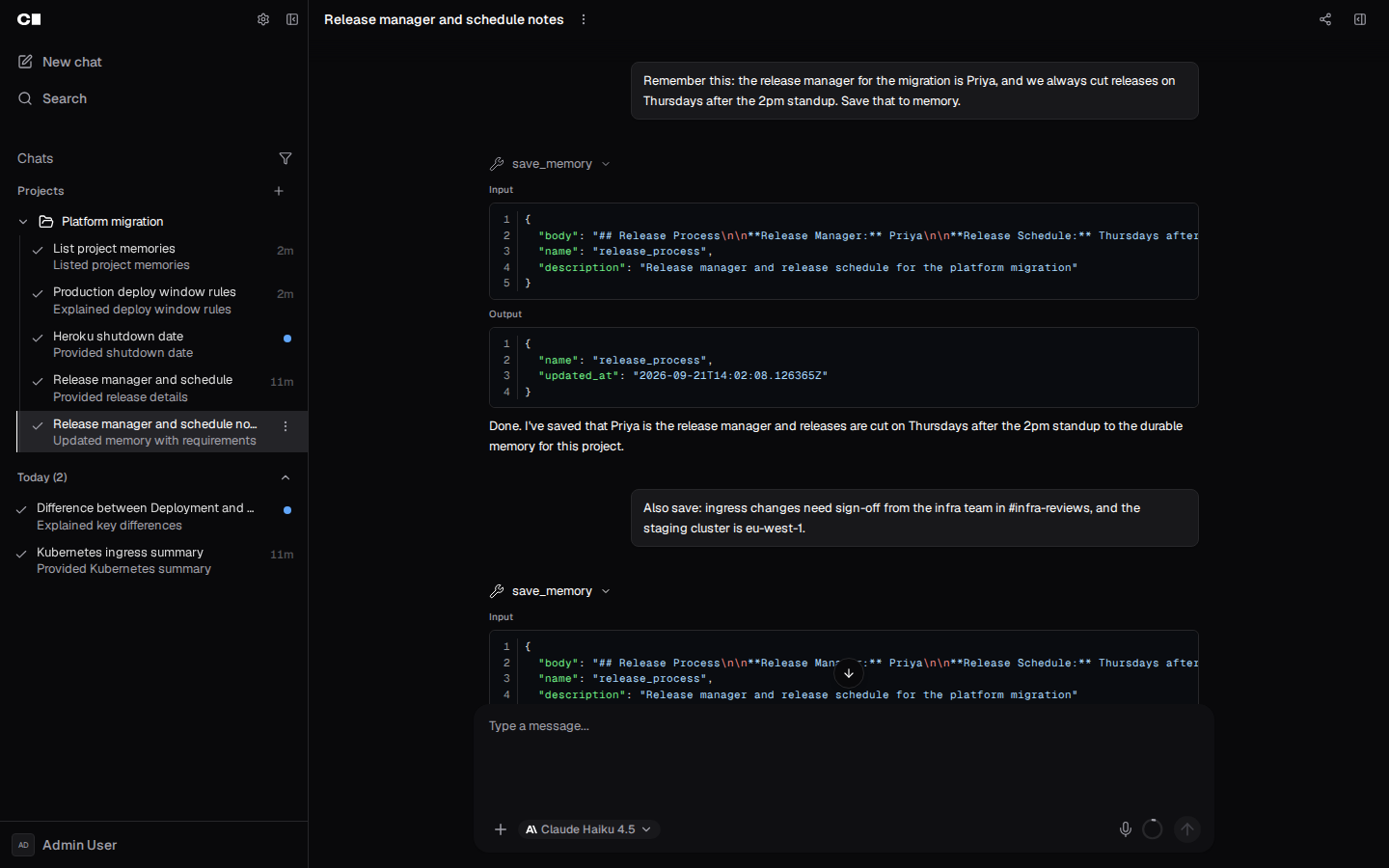 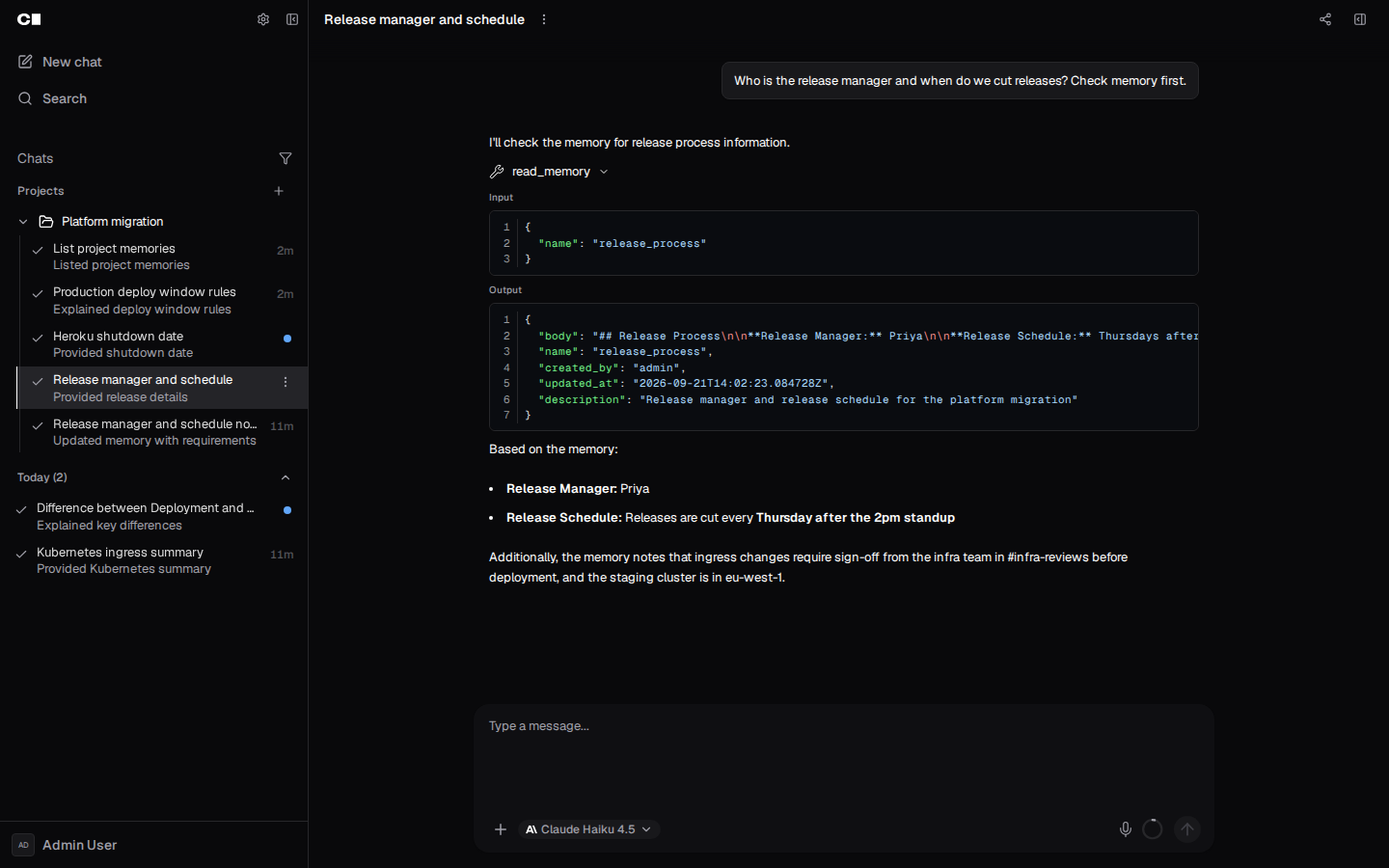 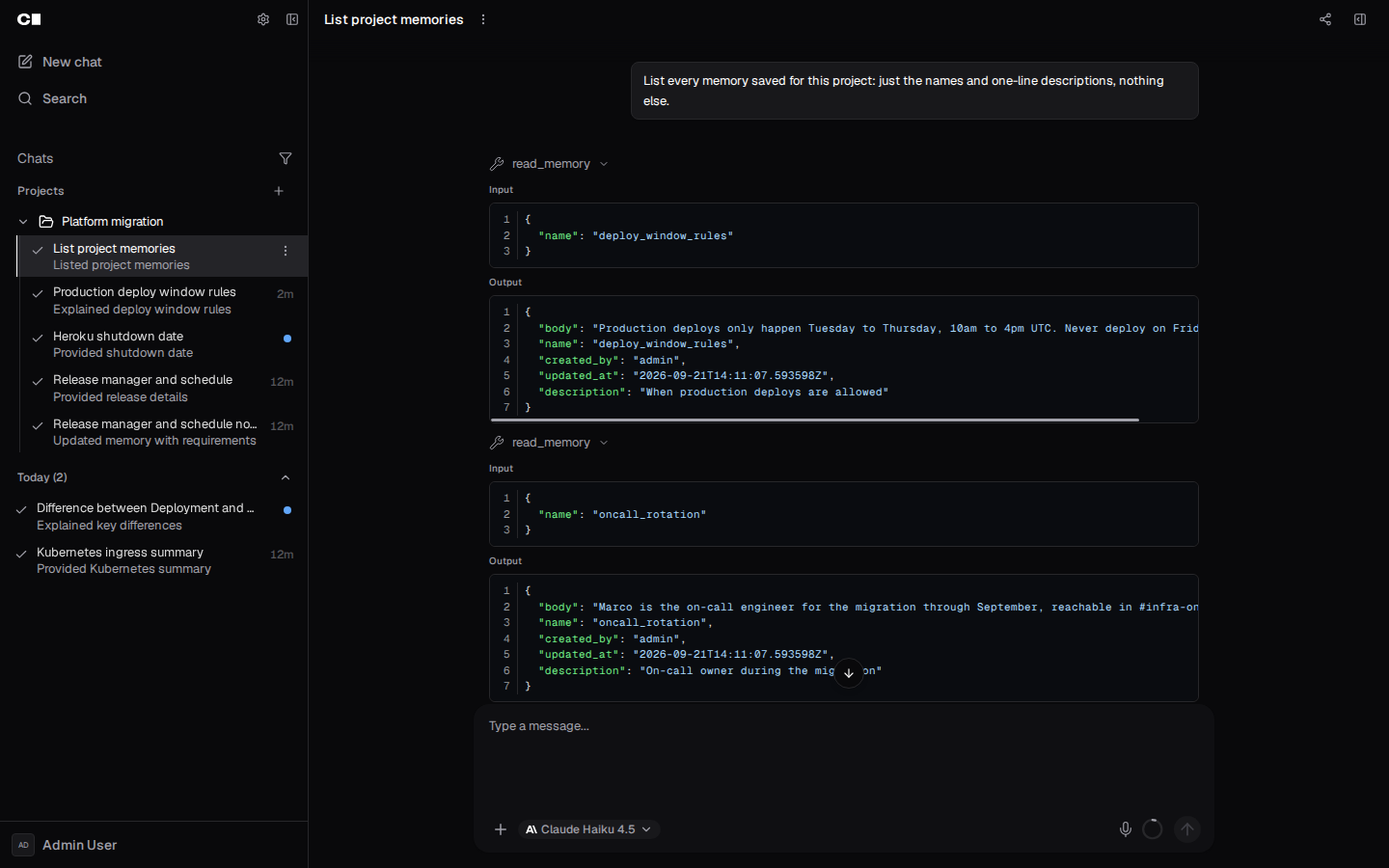 </details> --- Generated with Coder Agents on behalf of @f0ssel. --------- Co-authored-by: Claude Opus 5.5 (1M context) <noreply@anthropic.com>



594 lines
25 KiB
Go
594 lines
25 KiB
Go
package chattool
|
|
|
|
import (
|
|
"context"
|
|
"database/sql"
|
|
"errors"
|
|
"fmt"
|
|
"regexp"
|
|
"slices"
|
|
"strings"
|
|
"time"
|
|
"unicode/utf8"
|
|
|
|
"charm.land/fantasy"
|
|
"github.com/google/uuid"
|
|
"golang.org/x/xerrors"
|
|
|
|
"github.com/coder/coder/v2/coderd/database"
|
|
"github.com/coder/coder/v2/coderd/database/dbauthz"
|
|
"github.com/coder/coder/v2/codersdk"
|
|
)
|
|
|
|
const (
|
|
MaxMemories = 200
|
|
// MemoryConsolidateThreshold is the count from which save results ask the
|
|
// agent to consolidate, and MemoryConsolidateTarget is the count they ask
|
|
// it to get under. The 80% trigger and 70% target mirror the nudge Claude
|
|
// Code gives when its memory index approaches its read limit.
|
|
MemoryConsolidateThreshold = MaxMemories * 8 / 10
|
|
MemoryConsolidateTarget = MaxMemories * 7 / 10
|
|
|
|
MaxMemoryBodyBytes = 8192
|
|
MaxMemoryDescriptionChars = 150
|
|
|
|
ReadMemoryToolName = "read_memory"
|
|
SaveMemoryToolName = "save_memory"
|
|
DeleteMemoryToolName = "delete_memory"
|
|
ConsolidateMemoryToolName = "consolidate_memory"
|
|
)
|
|
|
|
var (
|
|
memoryNameRE = regexp.MustCompile(`^[a-z0-9][a-z0-9_-]{0,63}$`)
|
|
ErrMemoryNotFound = xerrors.New("memory not found")
|
|
ErrMemoryExists = xerrors.New("memory already exists")
|
|
// ErrMemoryLimit is returned when a write would leave a project with
|
|
// more than MaxMemories memories.
|
|
ErrMemoryLimit = xerrors.New("memory limit reached")
|
|
)
|
|
|
|
// writeProjectMemories runs a memory write in one transaction behind a
|
|
// per-project advisory lock, then rejects it if it left more than
|
|
// MaxMemories memories. The lock serializes writers so two of them cannot
|
|
// both observe room and overshoot the cap, and the transaction means a
|
|
// consolidation applies all of its deletes and saves or none of them. The
|
|
// count runs as the system because the caller has already been authorized
|
|
// to write memories in this project, and a create-only scope may lack the
|
|
// read the count would otherwise require.
|
|
func writeProjectMemories(ctx context.Context, db database.Store, projectID uuid.UUID, write func(tx database.Store) error) (int64, error) {
|
|
var count int64
|
|
err := db.InTx(func(tx database.Store) error {
|
|
if err := tx.AcquireLock(ctx, database.GenLockID("chat-project-memory:"+projectID.String())); err != nil {
|
|
return xerrors.Errorf("lock memories: %w", err)
|
|
}
|
|
if err := write(tx); err != nil {
|
|
return err
|
|
}
|
|
//nolint:gocritic // See writeProjectMemories.
|
|
n, err := tx.CountChatProjectMemoriesByProjectID(dbauthz.AsSystemRestricted(ctx), projectID)
|
|
if err != nil {
|
|
return xerrors.Errorf("count memories: %w", err)
|
|
}
|
|
if n > MaxMemories {
|
|
return ErrMemoryLimit
|
|
}
|
|
count = n
|
|
return nil
|
|
}, nil)
|
|
return count, err
|
|
}
|
|
|
|
// InsertProjectMemory creates a project memory under the cap and returns it
|
|
// with the project's memory count after the insert.
|
|
func InsertProjectMemory(ctx context.Context, db database.Store, params database.InsertChatProjectMemoryParams) (database.ChatProjectMemory, int64, error) {
|
|
var memory database.ChatProjectMemory
|
|
count, err := writeProjectMemories(ctx, db, params.ProjectID, func(tx database.Store) error {
|
|
var err error
|
|
memory, err = insertProjectMemoryTx(ctx, tx, params)
|
|
return err
|
|
})
|
|
return memory, count, err
|
|
}
|
|
|
|
// ConsolidateProjectMemories deletes and inserts project memories in one
|
|
// transaction and returns the deleted and inserted rows with the project's
|
|
// memory count afterward. Deletes run first, so an insert may reuse a deleted
|
|
// name to replace that memory. Any missing delete, duplicate insert, or result
|
|
// over the cap rolls back every change.
|
|
func ConsolidateProjectMemories(ctx context.Context, db database.Store, projectID uuid.UUID, deleteNames []string, inserts []database.InsertChatProjectMemoryParams) (deleted, inserted []database.ChatProjectMemory, count int64, err error) {
|
|
count, err = writeProjectMemories(ctx, db, projectID, func(tx database.Store) error {
|
|
// Reset so a retried transaction does not report rows twice.
|
|
deleted, inserted = nil, nil
|
|
for _, name := range deleteNames {
|
|
memory, err := deleteProjectMemory(ctx, tx, projectID, name)
|
|
if err != nil {
|
|
return err
|
|
}
|
|
deleted = append(deleted, memory)
|
|
}
|
|
for _, params := range inserts {
|
|
memory, err := insertProjectMemoryTx(ctx, tx, params)
|
|
if err != nil {
|
|
return err
|
|
}
|
|
inserted = append(inserted, memory)
|
|
}
|
|
return nil
|
|
})
|
|
if err != nil {
|
|
return nil, nil, 0, err
|
|
}
|
|
return deleted, inserted, count, nil
|
|
}
|
|
|
|
func insertProjectMemoryTx(ctx context.Context, db database.Store, params database.InsertChatProjectMemoryParams) (database.ChatProjectMemory, error) {
|
|
memory, err := db.InsertChatProjectMemory(ctx, params)
|
|
if database.IsUniqueViolation(err) {
|
|
return database.ChatProjectMemory{}, xerrors.Errorf("%w: %q", ErrMemoryExists, params.Name)
|
|
}
|
|
return memory, err
|
|
}
|
|
|
|
func deleteProjectMemory(ctx context.Context, db database.Store, projectID uuid.UUID, name string) (database.ChatProjectMemory, error) {
|
|
memory, err := db.DeleteChatProjectMemoryByName(ctx, database.DeleteChatProjectMemoryByNameParams{ProjectID: projectID, Name: name})
|
|
if errors.Is(err, sql.ErrNoRows) {
|
|
return database.ChatProjectMemory{}, xerrors.Errorf("%w: %q", ErrMemoryNotFound, name)
|
|
}
|
|
return memory, err
|
|
}
|
|
|
|
func memoryIntro(projectName string) string {
|
|
return fmt.Sprintf("Memory is durable context shared by every chat in the project %q.", projectName)
|
|
}
|
|
|
|
// Memory is a durable memory with its provenance.
|
|
type Memory struct {
|
|
Name string
|
|
Description string
|
|
Body string
|
|
CreatedAt time.Time
|
|
CreatedByUsername string
|
|
}
|
|
|
|
// MemoryInput is the content of a new durable memory.
|
|
type MemoryInput struct {
|
|
Name string
|
|
Description string
|
|
Body string
|
|
}
|
|
|
|
// MemoryIndexEntry is a compact memory entry for prompt injection.
|
|
type MemoryIndexEntry struct {
|
|
Name string
|
|
Description string
|
|
}
|
|
|
|
// MemoryStore stores durable memories in one scope. Memories are immutable:
|
|
// changing one means deleting it and saving its replacement, which
|
|
// Consolidate does atomically.
|
|
type MemoryStore interface {
|
|
Get(ctx context.Context, name string) (Memory, error)
|
|
List(ctx context.Context) ([]MemoryIndexEntry, error)
|
|
// Insert saves a new memory and returns the memory count afterward.
|
|
Insert(ctx context.Context, input MemoryInput) (int64, error)
|
|
Delete(ctx context.Context, name string) error
|
|
// Consolidate deletes and saves memories in one transaction and returns
|
|
// the memory count afterward.
|
|
Consolidate(ctx context.Context, deleteNames []string, saves []MemoryInput) (int64, error)
|
|
}
|
|
|
|
// MemoryAuditFunc records a committed memory change. oldMemory is zero for a
|
|
// create and newMemory is zero for a delete.
|
|
type MemoryAuditFunc func(ctx context.Context, action database.AuditAction, oldMemory, newMemory database.ChatProjectMemory)
|
|
|
|
type projectMemoryStore struct {
|
|
db database.Store
|
|
projectID uuid.UUID
|
|
organizationID uuid.UUID
|
|
ownerID uuid.UUID
|
|
audit MemoryAuditFunc
|
|
}
|
|
|
|
// NewProjectMemoryStore returns a store scoped to a chat project. New
|
|
// memories are attributed to ownerID. audit, when set, is called for every
|
|
// memory the store creates or deletes, after the change commits.
|
|
func NewProjectMemoryStore(db database.Store, projectID, organizationID, ownerID uuid.UUID, audit MemoryAuditFunc) MemoryStore {
|
|
return projectMemoryStore{db: db, projectID: projectID, organizationID: organizationID, ownerID: ownerID, audit: audit}
|
|
}
|
|
|
|
func (s projectMemoryStore) auditChange(ctx context.Context, action database.AuditAction, oldMemory, newMemory database.ChatProjectMemory) {
|
|
if s.audit != nil {
|
|
s.audit(ctx, action, oldMemory, newMemory)
|
|
}
|
|
}
|
|
|
|
func (s projectMemoryStore) Get(ctx context.Context, name string) (Memory, error) {
|
|
row, err := s.db.GetChatProjectMemoryByName(ctx, database.GetChatProjectMemoryByNameParams{ProjectID: s.projectID, Name: name})
|
|
if errors.Is(err, sql.ErrNoRows) {
|
|
return Memory{}, ErrMemoryNotFound
|
|
}
|
|
if err != nil {
|
|
return Memory{}, err
|
|
}
|
|
return Memory{Name: row.ChatProjectMemory.Name, Description: row.ChatProjectMemory.Description, Body: row.ChatProjectMemory.Body, CreatedAt: row.ChatProjectMemory.CreatedAt, CreatedByUsername: row.CreatedByUsername}, nil
|
|
}
|
|
|
|
func (s projectMemoryStore) List(ctx context.Context) ([]MemoryIndexEntry, error) {
|
|
rows, err := s.db.GetChatProjectMemoriesByProjectID(ctx, s.projectID)
|
|
if err != nil {
|
|
return nil, err
|
|
}
|
|
entries := make([]MemoryIndexEntry, len(rows))
|
|
for i, row := range rows {
|
|
entries[i] = MemoryIndexEntry{Name: row.ChatProjectMemory.Name, Description: row.ChatProjectMemory.Description}
|
|
}
|
|
return entries, nil
|
|
}
|
|
|
|
func (s projectMemoryStore) insertParams(input MemoryInput) database.InsertChatProjectMemoryParams {
|
|
return database.InsertChatProjectMemoryParams{
|
|
ID: uuid.NullUUID{}, ProjectID: s.projectID, OrganizationID: s.organizationID,
|
|
Name: input.Name, Description: input.Description, Body: input.Body, CreatedBy: s.ownerID,
|
|
}
|
|
}
|
|
|
|
func (s projectMemoryStore) Insert(ctx context.Context, input MemoryInput) (int64, error) {
|
|
memory, count, err := InsertProjectMemory(ctx, s.db, s.insertParams(input))
|
|
if err != nil {
|
|
return 0, err
|
|
}
|
|
s.auditChange(ctx, database.AuditActionCreate, database.ChatProjectMemory{}, memory)
|
|
return count, nil
|
|
}
|
|
|
|
func (s projectMemoryStore) Delete(ctx context.Context, name string) error {
|
|
memory, err := deleteProjectMemory(ctx, s.db, s.projectID, name)
|
|
if err != nil {
|
|
return err
|
|
}
|
|
s.auditChange(ctx, database.AuditActionDelete, memory, database.ChatProjectMemory{})
|
|
return nil
|
|
}
|
|
|
|
func (s projectMemoryStore) Consolidate(ctx context.Context, deleteNames []string, saves []MemoryInput) (int64, error) {
|
|
inserts := make([]database.InsertChatProjectMemoryParams, len(saves))
|
|
for i, input := range saves {
|
|
inserts[i] = s.insertParams(input)
|
|
}
|
|
deleted, inserted, count, err := ConsolidateProjectMemories(ctx, s.db, s.projectID, deleteNames, inserts)
|
|
if err != nil {
|
|
return 0, err
|
|
}
|
|
for _, memory := range deleted {
|
|
s.auditChange(ctx, database.AuditActionDelete, memory, database.ChatProjectMemory{})
|
|
}
|
|
for _, memory := range inserted {
|
|
s.auditChange(ctx, database.AuditActionCreate, database.ChatProjectMemory{}, memory)
|
|
}
|
|
return count, nil
|
|
}
|
|
|
|
// NormalizeMemoryName lowercases and validates a stable memory identifier.
|
|
func NormalizeMemoryName(name string) (string, error) {
|
|
name = strings.ToLower(strings.TrimSpace(name))
|
|
if !memoryNameRE.MatchString(name) {
|
|
return "", xerrors.Errorf("name %q must match %q", name, memoryNameRE.String())
|
|
}
|
|
return name, nil
|
|
}
|
|
|
|
// NormalizeMemoryInput sanitizes and validates a new memory. Memory text is
|
|
// shown to every chat in the project, so invisible characters that could
|
|
// hide instructions are stripped, and the description is folded onto one
|
|
// line because each one is a single line of the memory index.
|
|
func NormalizeMemoryInput(name, description, body string) (MemoryInput, error) {
|
|
name, err := NormalizeMemoryName(name)
|
|
if err != nil {
|
|
return MemoryInput{}, err
|
|
}
|
|
description = strings.Join(strings.Fields(codersdk.SanitizePromptText(description)), " ")
|
|
body = codersdk.SanitizePromptText(body)
|
|
if description == "" {
|
|
return MemoryInput{}, xerrors.Errorf("memory %q: description is required", name)
|
|
}
|
|
if utf8.RuneCountInString(description) > MaxMemoryDescriptionChars {
|
|
return MemoryInput{}, xerrors.Errorf("memory %q: description must be at most %d characters", name, MaxMemoryDescriptionChars)
|
|
}
|
|
if body == "" {
|
|
return MemoryInput{}, xerrors.Errorf("memory %q: body is required", name)
|
|
}
|
|
if len(body) > MaxMemoryBodyBytes {
|
|
return MemoryInput{}, xerrors.Errorf("memory %q: body must be at most %d bytes", name, MaxMemoryBodyBytes)
|
|
}
|
|
return MemoryInput{Name: name, Description: description, Body: body}, nil
|
|
}
|
|
|
|
// memoryGuidance tells the model what belongs in durable memory.
|
|
const memoryGuidance = "Save facts that will matter in future chats: who the people on this project are and how they like to work; " +
|
|
"corrections you received and approaches that were explicitly confirmed; ongoing work, deadlines, and decisions that cannot be derived from the code or git history; " +
|
|
"and where to find information outside the project, such as an issue tracker or dashboard.\n" +
|
|
"Save a memory as soon as durable information surfaces, without waiting to be asked. " +
|
|
"Do not save anything derivable from the codebase (architecture, file paths, debugging fixes), anything already stated in instructions, or temporary in-progress state. " +
|
|
"Never save that something is unknown or undecided. Convert relative dates to absolute dates. " +
|
|
"The memory index is in the conversation: a <project-memory-index> message lists every saved memory, and <project-memory-index-update> messages at the start of later turns list what changed. " +
|
|
"Changes made during a turn, including your own, appear in the next turn's update. " +
|
|
"When a question might be answered by a memory in the index, call read_memory before answering or asking the user. " +
|
|
"Memories may be stale or wrong; verify before relying on one. Memories cannot be edited: replace one that no longer holds with consolidate_memory, or delete it."
|
|
|
|
// FormatMemoryGuidance renders the stable durable-memory prompt block. It
|
|
// carries no memory state: the index travels in conversation messages
|
|
// instead, so tool definitions and the system prompt stay identical as
|
|
// memories change and the provider's cached prefix survives every write.
|
|
func FormatMemoryGuidance(projectName string) string {
|
|
return "<memory>\n" + memoryIntro(projectName) + "\n" + memoryGuidance + "\n</memory>"
|
|
}
|
|
|
|
const (
|
|
memoryIndexTag = "<project-memory-index>"
|
|
memoryIndexUpdateTag = "<project-memory-index-update>"
|
|
memoryIndexAddedHdr = "Added or changed:"
|
|
memoryIndexRemoveHdr = "Removed:"
|
|
)
|
|
|
|
// FormatMemoryIndexSnapshot renders the full memory index as a conversation
|
|
// message. Every entry is listed; descriptions are single lines, so the index
|
|
// at MaxMemories stays around 46KB.
|
|
func FormatMemoryIndexSnapshot(entries []MemoryIndexEntry) string {
|
|
var b strings.Builder
|
|
_, _ = b.WriteString(memoryIndexTag + "\n")
|
|
if len(entries) == 0 {
|
|
_, _ = b.WriteString("No memories saved yet.\n")
|
|
}
|
|
for _, entry := range entries {
|
|
_, _ = fmt.Fprintf(&b, "- %s: %s\n", entry.Name, entry.Description)
|
|
}
|
|
_, _ = b.WriteString("</project-memory-index>")
|
|
return b.String()
|
|
}
|
|
|
|
// FormatMemoryIndexUpdate renders the change to the memory index since the
|
|
// model last saw it.
|
|
func FormatMemoryIndexUpdate(changed []MemoryIndexEntry, removed []string) string {
|
|
var b strings.Builder
|
|
_, _ = b.WriteString(memoryIndexUpdateTag + "\n")
|
|
if len(changed) > 0 {
|
|
_, _ = b.WriteString(memoryIndexAddedHdr + "\n")
|
|
for _, entry := range changed {
|
|
_, _ = fmt.Fprintf(&b, "- %s: %s\n", entry.Name, entry.Description)
|
|
}
|
|
}
|
|
if len(removed) > 0 {
|
|
_, _ = b.WriteString(memoryIndexRemoveHdr + "\n")
|
|
for _, name := range removed {
|
|
_, _ = fmt.Fprintf(&b, "- %s\n", name)
|
|
}
|
|
}
|
|
_, _ = b.WriteString("</project-memory-index-update>")
|
|
return b.String()
|
|
}
|
|
|
|
// ReplayMemoryIndex rebuilds the index the model has seen from memory index
|
|
// messages in conversation order, as name to description. ok is false when
|
|
// no snapshot is present, for example on a chat's first turn or after
|
|
// compaction dropped the earlier snapshot. Text that is not an index message
|
|
// is ignored.
|
|
func ReplayMemoryIndex(texts []string) (seen map[string]string, ok bool) {
|
|
for _, text := range texts {
|
|
switch {
|
|
case strings.HasPrefix(text, memoryIndexTag):
|
|
seen = make(map[string]string)
|
|
ok = true
|
|
for _, line := range strings.Split(text, "\n")[1:] {
|
|
if name, description, found := parseMemoryIndexLine(line); found {
|
|
seen[name] = description
|
|
}
|
|
}
|
|
case strings.HasPrefix(text, memoryIndexUpdateTag) && ok:
|
|
removing := false
|
|
for _, line := range strings.Split(text, "\n")[1:] {
|
|
switch line {
|
|
case memoryIndexAddedHdr:
|
|
removing = false
|
|
continue
|
|
case memoryIndexRemoveHdr:
|
|
removing = true
|
|
continue
|
|
}
|
|
if removing {
|
|
if name, found := strings.CutPrefix(line, "- "); found {
|
|
delete(seen, name)
|
|
}
|
|
continue
|
|
}
|
|
if name, description, found := parseMemoryIndexLine(line); found {
|
|
seen[name] = description
|
|
}
|
|
}
|
|
}
|
|
}
|
|
return seen, ok
|
|
}
|
|
|
|
func parseMemoryIndexLine(line string) (name, description string, ok bool) {
|
|
rest, found := strings.CutPrefix(line, "- ")
|
|
if !found {
|
|
return "", "", false
|
|
}
|
|
name, description, found = strings.Cut(rest, ": ")
|
|
if !found || !memoryNameRE.MatchString(name) {
|
|
return "", "", false
|
|
}
|
|
return name, description, true
|
|
}
|
|
|
|
// DiffMemoryIndex returns the entries that are new or whose description
|
|
// changed since seen, and the names no longer present, both sorted by name.
|
|
func DiffMemoryIndex(seen map[string]string, current []MemoryIndexEntry) (changed []MemoryIndexEntry, removed []string) {
|
|
present := make(map[string]struct{}, len(current))
|
|
for _, entry := range current {
|
|
present[entry.Name] = struct{}{}
|
|
if description, ok := seen[entry.Name]; !ok || description != entry.Description {
|
|
changed = append(changed, entry)
|
|
}
|
|
}
|
|
for name := range seen {
|
|
if _, ok := present[name]; !ok {
|
|
removed = append(removed, name)
|
|
}
|
|
}
|
|
slices.SortFunc(changed, func(a, b MemoryIndexEntry) int { return strings.Compare(a.Name, b.Name) })
|
|
slices.Sort(removed)
|
|
return changed, removed
|
|
}
|
|
|
|
type readMemoryArgs struct {
|
|
Name string `json:"name" description:"The name of the memory to read."`
|
|
}
|
|
type saveMemoryArgs struct {
|
|
Name string `json:"name" description:"Stable lowercase name for the memory."`
|
|
Description string `json:"description" description:"One-line summary shown in the memory index."`
|
|
Body string `json:"body" description:"Full durable markdown memory body."`
|
|
}
|
|
type deleteMemoryArgs struct {
|
|
Name string `json:"name" description:"The name of the memory to delete."`
|
|
}
|
|
type consolidateMemoryArgs struct {
|
|
Delete []string `json:"delete,omitempty" description:"Names of memories to remove: stale, wrong, superseded, or folded into a memory in save."`
|
|
Save []saveMemoryArgs `json:"save,omitempty" description:"Memories to create, such as merged replacements for deleted ones. A name in delete may be reused here to replace that memory."`
|
|
}
|
|
|
|
// consolidateNudge asks the agent to consolidate once memory nears the cap,
|
|
// modeled on the in-turn nudge Claude Code gives when its memory index nears
|
|
// its read limit.
|
|
func consolidateNudge(count int64) string {
|
|
return fmt.Sprintf("memory is %d/%d, approaching the limit. Consolidate it to under %d memories now with %s: "+
|
|
"merge overlapping memories into one, and drop stale, wrong, or superseded ones.",
|
|
count, MaxMemories, MemoryConsolidateTarget, ConsolidateMemoryToolName)
|
|
}
|
|
|
|
func memoryWriteResult(result map[string]any, count int64) fantasy.ToolResponse {
|
|
result["count"] = count
|
|
if count >= MemoryConsolidateThreshold {
|
|
result["warning"] = consolidateNudge(count)
|
|
}
|
|
return toolResponse(result)
|
|
}
|
|
|
|
// ReadMemory returns a tool that reads a full memory body.
|
|
// Its description is fixed so memory writes never change tool definitions; the
|
|
// index the model picks names from is in the conversation.
|
|
func ReadMemory(store MemoryStore) fantasy.AgentTool {
|
|
return fantasy.NewAgentTool(ReadMemoryToolName, "Read a memory by name. The memory index in the conversation lists every saved memory.", func(ctx context.Context, args readMemoryArgs, _ fantasy.ToolCall) (fantasy.ToolResponse, error) {
|
|
if store == nil {
|
|
return fantasy.NewTextErrorResponse("memory store is not configured"), nil
|
|
}
|
|
name, err := NormalizeMemoryName(args.Name)
|
|
if err != nil {
|
|
return fantasy.NewTextErrorResponse(err.Error()), nil
|
|
}
|
|
memory, err := store.Get(ctx, name)
|
|
switch {
|
|
case errors.Is(err, ErrMemoryNotFound):
|
|
return fantasy.NewTextErrorResponse("memory was not found"), nil
|
|
case err != nil:
|
|
return fantasy.NewTextErrorResponse("failed to read memory"), nil
|
|
}
|
|
return toolResponse(map[string]any{"name": memory.Name, "description": memory.Description, "body": memory.Body, "created_at": memory.CreatedAt, "created_by": memory.CreatedByUsername}), nil
|
|
})
|
|
}
|
|
|
|
// SaveMemory returns a tool that creates a durable memory.
|
|
func SaveMemory(store MemoryStore, projectName string) fantasy.AgentTool {
|
|
return fantasy.NewAgentTool(SaveMemoryToolName, "Save a new durable memory. "+memoryIntro(projectName)+
|
|
" Memories cannot be edited; to change one, replace it with "+ConsolidateMemoryToolName+".", func(ctx context.Context, args saveMemoryArgs, _ fantasy.ToolCall) (fantasy.ToolResponse, error) {
|
|
if store == nil {
|
|
return fantasy.NewTextErrorResponse("memory store is not configured"), nil
|
|
}
|
|
input, err := NormalizeMemoryInput(args.Name, args.Description, args.Body)
|
|
if err != nil {
|
|
return fantasy.NewTextErrorResponse(err.Error()), nil
|
|
}
|
|
count, err := store.Insert(ctx, input)
|
|
switch {
|
|
case errors.Is(err, ErrMemoryExists):
|
|
return fantasy.NewTextErrorResponse(fmt.Sprintf("a memory named %q already exists; read it, then replace it with %s by deleting %q and saving the new version in one call", input.Name, ConsolidateMemoryToolName, input.Name)), nil
|
|
case errors.Is(err, ErrMemoryLimit):
|
|
// The agent resolves a full project itself, in this turn, with
|
|
// the tools it already has; there is no background cleanup.
|
|
return fantasy.NewTextErrorResponse(fmt.Sprintf("memory is full (%d/%d); use %s to merge overlapping memories and drop stale ones, and include this memory in its save list", MaxMemories, MaxMemories, ConsolidateMemoryToolName)), nil
|
|
case err != nil:
|
|
return fantasy.NewTextErrorResponse("failed to save memory"), nil
|
|
}
|
|
return memoryWriteResult(map[string]any{"saved": input.Name}, count), nil
|
|
})
|
|
}
|
|
|
|
// DeleteMemory returns a tool that deletes a durable memory.
|
|
func DeleteMemory(store MemoryStore, projectName string) fantasy.AgentTool {
|
|
return fantasy.NewAgentTool(DeleteMemoryToolName, "Delete a durable memory by name. "+memoryIntro(projectName), func(ctx context.Context, args deleteMemoryArgs, _ fantasy.ToolCall) (fantasy.ToolResponse, error) {
|
|
if store == nil {
|
|
return fantasy.NewTextErrorResponse("memory store is not configured"), nil
|
|
}
|
|
name, err := NormalizeMemoryName(args.Name)
|
|
if err != nil {
|
|
return fantasy.NewTextErrorResponse(err.Error()), nil
|
|
}
|
|
err = store.Delete(ctx, name)
|
|
switch {
|
|
case errors.Is(err, ErrMemoryNotFound):
|
|
return fantasy.NewTextErrorResponse("memory was not found"), nil
|
|
case err != nil:
|
|
return fantasy.NewTextErrorResponse("failed to delete memory"), nil
|
|
}
|
|
return toolResponse(map[string]any{"deleted": name}), nil
|
|
})
|
|
}
|
|
|
|
// ConsolidateMemory returns a tool that deletes and saves memories in one
|
|
// transaction, so the agent can rewrite the memory set without leaving it
|
|
// half-consolidated or letting another chat claim the freed room.
|
|
func ConsolidateMemory(store MemoryStore, projectName string) fantasy.AgentTool {
|
|
return fantasy.NewAgentTool(ConsolidateMemoryToolName, "Delete and save memories in one atomic step: either every change applies or none does. "+memoryIntro(projectName)+
|
|
" Use it when memory is nearly full, or to replace a memory that no longer holds. Read the memories you are merging first, then: "+
|
|
"merge overlapping memories into one, delete memories that are stale, contradicted, or superseded, and convert relative dates to absolute dates. "+
|
|
"Keep what future chats need; drop what they do not.", func(ctx context.Context, args consolidateMemoryArgs, _ fantasy.ToolCall) (fantasy.ToolResponse, error) {
|
|
if store == nil {
|
|
return fantasy.NewTextErrorResponse("memory store is not configured"), nil
|
|
}
|
|
if len(args.Delete) == 0 && len(args.Save) == 0 {
|
|
return fantasy.NewTextErrorResponse("delete or save at least one memory"), nil
|
|
}
|
|
if len(args.Delete) > MaxMemories || len(args.Save) > MaxMemories {
|
|
return fantasy.NewTextErrorResponse(fmt.Sprintf("delete and save take at most %d memories each", MaxMemories)), nil
|
|
}
|
|
deleteNames := make([]string, len(args.Delete))
|
|
for i, raw := range args.Delete {
|
|
name, err := NormalizeMemoryName(raw)
|
|
if err != nil {
|
|
return fantasy.NewTextErrorResponse(err.Error()), nil
|
|
}
|
|
deleteNames[i] = name
|
|
}
|
|
saves := make([]MemoryInput, len(args.Save))
|
|
savedNames := make([]string, len(args.Save))
|
|
for i, save := range args.Save {
|
|
input, err := NormalizeMemoryInput(save.Name, save.Description, save.Body)
|
|
if err != nil {
|
|
return fantasy.NewTextErrorResponse(err.Error()), nil
|
|
}
|
|
saves[i] = input
|
|
savedNames[i] = input.Name
|
|
}
|
|
count, err := store.Consolidate(ctx, deleteNames, saves)
|
|
switch {
|
|
case errors.Is(err, ErrMemoryNotFound), errors.Is(err, ErrMemoryExists):
|
|
return fantasy.NewTextErrorResponse(err.Error() + "; no changes were applied"), nil
|
|
case errors.Is(err, ErrMemoryLimit):
|
|
return fantasy.NewTextErrorResponse(fmt.Sprintf("this would leave more than %d memories; delete more and retry. No changes were applied", MaxMemories)), nil
|
|
case err != nil:
|
|
return fantasy.NewTextErrorResponse("failed to consolidate memory; no changes were applied"), nil
|
|
}
|
|
return memoryWriteResult(map[string]any{"deleted": deleteNames, "saved": savedNames}, count), nil
|
|
})
|
|
}
|