
Adnify
中文 | English
Connect AI to Your Code. A next-generation code editor with stunning visual experience and deeply integrated AI Agent.


Adnify is more than just an editor—it's your intelligent programming companion. It replicates and surpasses traditional IDE experiences, blending Cyberpunk glassmorphism design with a powerful built-in AI Agent that supports full-process automation from code generation to file operations.

Contact & Community
Join our community to discuss Adnify usage and development!
| WeChat Group | QQ Group | Author WeChat |
|---|---|---|
 |
 |
 |
| Scan to join WeChat group | QQ Group: 1076926858 |
WeChat ID: adnaan_worker |
💡 For issues or suggestions, submit them on Gitee Issues or Github Issues
Table of Contents
- Architecture Design
- Core Features
- Unique Advantages
- Quick Start
- Feature Details
- Keyboard Shortcuts
- Project Structure
- Contributing
🏗 Architecture Design
Adnify adopts Electron multi-process architecture combined with Web Workers and Node.js Worker Threads for high-performance concurrent processing.
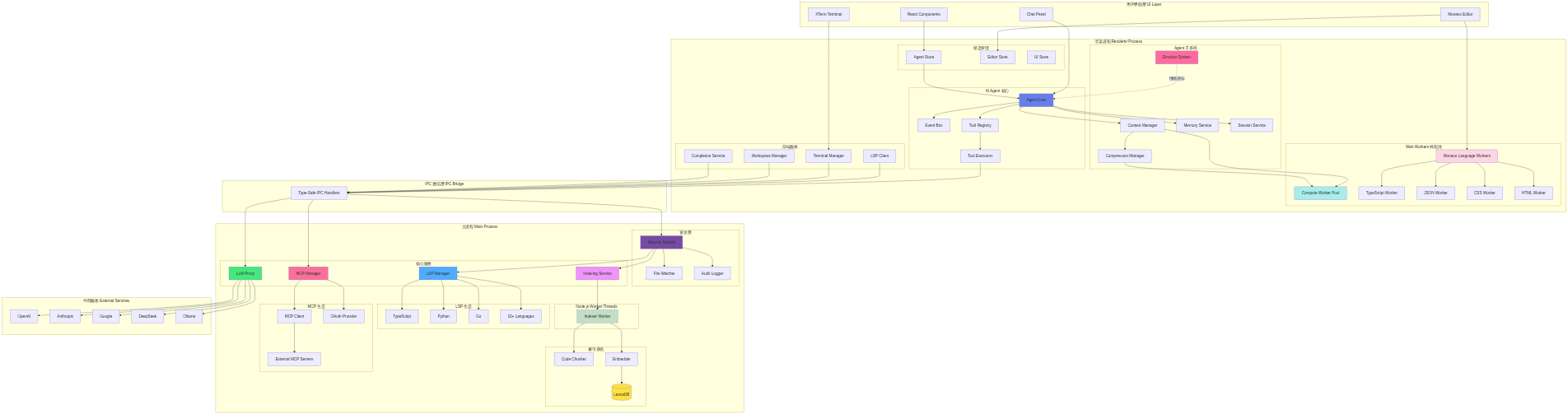
Multi-process + multi-thread architecture, fully utilizing multi-core CPUs for smooth UI responsiveness
💡 Click image to view and edit complete architecture diagram in Mermaid Live Editor
📊 Click to view Mermaid source code (editable at Mermaid Live)
graph TB
    subgraph "User Interface Layer"
        UI[React Components]
        Monaco[Monaco Editor]
        XTerm[XTerm Terminal]
        ChatUI[Chat Panel]
    end

    subgraph "Renderer Process"
        subgraph "AI Agent Core"
            AgentCore[Agent Core]
            EventBus[Event Bus]
            ToolRegistry[Tool Registry]
            ToolExecutors[Tool Executors]
        end

        subgraph "State Management"
            AgentStore[Agent Store]
            EditorStore[Editor Store]
            UIStore[UI Store]
        end

        subgraph "Frontend Services"
            TermMgr[Terminal Manager]
            LSPClient[LSP Client]
            WorkspaceMgr[Workspace Manager]
            CompletionSvc[Completion Service]
        end

        subgraph "Agent Subsystems"
            Context[Context Manager]
            Compression[Compression Manager]
            Memory[Memory Service]
            Session[Session Service]
            Emotion[Emotion System]
        end

        subgraph "Web Workers Thread Pool"
            ComputeWorker[Compute Worker Pool]
            MonacoWorkers[Monaco Language Workers]
            TSWorker[TypeScript Worker]
            JSONWorker[JSON Worker]
            CSSWorker[CSS Worker]
            HTMLWorker[HTML Worker]
        end
    end

    subgraph "IPC Communication Layer"
        IPC[Type-Safe IPC Handlers]
    end

    subgraph "Main Process"
        subgraph "Security Layer"
            Security[Security Module]
            FileWatcher[File Watcher]
            AuditLog[Audit Logger]
        end

        subgraph "Core Services"
            LSPMgr[LSP Manager]
            IndexSvc[Indexing Service]
            MCPMgr[MCP Manager]
            LLMProxy[LLM Proxy]
        end

        subgraph "Indexing System"
            Chunker[Code Chunker]
            Embedder[Embedder]
            VectorDB[(LanceDB)]
        end

        subgraph "Node.js Worker Threads"
            IndexWorker[Indexer Worker]
        end

        subgraph "LSP Ecosystem"
            TSServer[TypeScript]
            Pyright[Python]
            Gopls[Go]
            OtherLSP[10+ Languages]
        end

        subgraph "MCP Ecosystem"
            MCPClient[MCP Client]
            MCPAuth[OAuth Provider]
            MCPServers[External MCP Servers]
        end
    end

    subgraph "External Services"
        OpenAI[OpenAI]
        Claude[Anthropic]
        Gemini[Google]
        DeepSeek[DeepSeek]
        Ollama[Ollama]
    end

    UI --> AgentStore
    Monaco --> EditorStore
    Monaco --> MonacoWorkers
    XTerm --> TermMgr
    ChatUI --> AgentCore

    AgentCore --> ToolRegistry
    ToolRegistry --> ToolExecutors
    AgentCore --> Context
    AgentCore --> EventBus
    Context --> Compression
    AgentCore --> Memory
    AgentCore --> Session

    MonacoWorkers --> TSWorker
    MonacoWorkers --> JSONWorker
    MonacoWorkers --> CSSWorker
    MonacoWorkers --> HTMLWorker

    Context --> ComputeWorker
    Compression --> ComputeWorker

    AgentStore --> AgentCore
    ToolExecutors --> IPC
    LSPClient --> IPC
    TermMgr --> IPC
    WorkspaceMgr --> IPC
    CompletionSvc --> IPC

    IPC --> Security
    Security --> LSPMgr
    Security --> IndexSvc
    Security --> FileWatcher
    Security --> AuditLog

    IPC --> MCPMgr
    IPC --> LLMProxy

    IndexSvc --> IndexWorker
    IndexWorker --> Chunker
    IndexWorker --> Embedder
    Embedder --> VectorDB

    LSPMgr --> TSServer
    LSPMgr --> Pyright
    LSPMgr --> Gopls
    LSPMgr --> OtherLSP

    MCPMgr --> MCPClient
    MCPMgr --> MCPAuth
    MCPClient --> MCPServers

    LLMProxy --> OpenAI
    LLMProxy --> Claude
    LLMProxy --> Gemini
    LLMProxy --> DeepSeek
    LLMProxy --> Ollama

    Emotion -.emotion awareness.-> AgentCore

    style AgentCore fill:#667eea
    style Security fill:#764ba2
    style IndexSvc fill:#f093fb
    style LSPMgr fill:#4facfe
    style LLMProxy fill:#43e97b
    style MCPMgr fill:#fa709a
    style VectorDB fill:#fee140
    style Emotion fill:#ff6b9d
    style ComputeWorker fill:#a8edea
    style MonacoWorkers fill:#fed6e3
    style IndexWorker fill:#c1dfc4
Core Module Overview
Renderer Process (Frontend)
- Agent Core: AI agent core, coordinates message flow, tool execution, and context management
- Tool Registry: Tool registry, manages 23+ built-in tools' definitions, validation, and execution
- Context Manager: Context manager, supports 4-level compression and Handoff document generation
- Event Bus: Event bus, decouples inter-module communication
- Emotion System: Emotion system, real-time user state awareness with intelligent suggestions
- Agent Store: Zustand state management, persists conversation history, branches, and checkpoints
- Frontend Services: Terminal management, LSP client, workspace management, code completion
Web Workers (Renderer Process Thread Pool)
- Compute Worker Pool: Handles CPU-intensive tasks like Diff computation and text search
- Monaco Language Workers: Monaco editor's language service workers
- TypeScript/JavaScript Worker: Syntax highlighting, code completion
- JSON Worker: JSON formatting, validation
- CSS Worker: CSS syntax analysis
- HTML Worker: HTML syntax analysis
Main Process (Backend)
- Security Module: Security module with workspace isolation, path validation, command whitelist, and audit logging
- LSP Manager: Language server management, intelligent project root detection, supports 10+ languages
- Indexing Service: Codebase indexing with Tree-sitter parsing, semantic chunking, and vector storage
- MCP Manager: MCP protocol management, supports external tools, OAuth authentication, and config hot-reload
- LLM Proxy: LLM proxy layer, unified interface for multiple AI service providers with streaming response handling
Node.js Worker Threads (Main Process Thread Pool)
- Indexer Worker: Dedicated thread for code indexing, prevents blocking main process
- Code chunking
- Embedding generation
- Vector store updates
Communication Layer
- IPC Bridge: Type-safe inter-process communication, all main process features exposed via IPC
External Integration
- Multi-LLM Support: OpenAI, Claude, Gemini, DeepSeek, Ollama, and custom APIs
- MCP Ecosystem: Extensible external tools and services, supports community plugins
Concurrency Advantages
Multi-Process Isolation
- Renderer process crashes don't affect main process
- Main process handles heavy tasks: file system, LSP, indexing
- Secure inter-process communication via IPC
Multi-Thread Parallelism
- Web Workers handle frontend compute-intensive tasks (Diff, search)
- Monaco Workers independently handle language services without blocking UI
- Node.js Worker Threads handle code indexing, supporting large projects
Performance Optimization
- UI thread always remains responsive
- Fully utilizes multi-core CPUs
- Large file operations without freezing
✨ Core Features
🎨 Stunning Visual Experience
-
Multi-Theme Support: 4 carefully designed built-in themes
Adnify Dark- Default dark theme, soft and eye-friendlyMidnight- Deep midnight blue, focused codingCyberpunk- Neon cyberpunk styleDawn- Bright daytime theme
-
Glassmorphism Design: Global frosted glass style with subtle glowing borders and dynamic shadows
-
Immersive Layout: Frameless window, Chrome-style tabs, breadcrumb navigation


🤖 Deep AI Agent Integration
-
Three Core Working Modes:
- Chat Mode 💬: Pure conversation mode, quick Q&A, direct response, no active tool calls
- Agent Mode 🤖: Intelligent agent mode, single-thread task focus, full file system and terminal permissions
- Orchestrator Mode 🧠: [NEW] All-new orchestrator mode supporting multi-turn interactive requirements gathering. Automatically slices high-complexity tasks and distributes them to 8 exclusive core AI expert modules (including: Balanced, Concise, Coder, Architect, Code Reviewer, Analyst, UI/UX Designer, Orchestrator) for ultimate precision.
-
24 Built-in Native Core Tools: Building a universal foundation allowing AI to fully take over projects
- 📂 File System:
read_file,list_directory - ✍️ Polymorphic Writes:
write_file,edit_file,create_file_or_folder,delete_file_or_folder - 🔎 Full-scale Search Engine:
search_files(ultra-fast regex scan),codebase_search(LanceDB vector semantic insight) - 🧠 Language Service (LSP):
find_references,go_to_definition,get_hover_info,get_document_symbols,get_lint_errors - 💻 Sandbox Terminal:
run_command,read_terminal_output,send_terminal_input,stop_terminal - 🌐 Knowledge Networking:
web_search(multi-strategy fusion),read_url(Jina deep parsing) - 🤝 Human-like Interaction:
ask_user - ✨ Super-smart Planning:
create_task_plan,update_task_plan,start_task_execution - 🎨 Cutting-edge Design Search:
uiux_search(global design aesthetics and best practices)
- 📂 File System:
-
Smart Context:
@filenameReference file context@codebaseSemantic codebase search@gitReference Git changes@terminalReference terminal output@symbolsReference current file symbols@webWeb search- Drag & drop files/folders to chat
-
Multi-LLM Support: OpenAI, Anthropic Claude, Google Gemini, DeepSeek, Ollama, Custom API
-
Quick Model Switching: Dropdown selector at bottom of chat panel, grouped by provider
-
⚡ Skills System (NEW): Plugin-based system based on agentskills.io standard, supports installation from marketplace (skills.sh) or GitHub
-
🔌 MCP Protocol Support: Integrated Model Context Protocol for external tool extensions
-
💾 AI Memory & Approval: Project-level memory storage with manual approval mechanism for AI-written memories
-
🎨 Enhanced Response Preview: Tool results support rich rendering (Markdown, Images, Tables) with fluid typewriter animation
-
🪵 Eye Style Logs: Redesigned color-highlighted log system for both Main and Renderer processes

🚀 Unique Advantages (vs Cursor/Windsurf/Claude Code)
Adnify builds upon mainstream AI editors with multiple innovative features:
-
🔄 9-Strategy Smart Replace: When AI edits code, 9 fault-tolerant matching strategies (exact match, whitespace normalization, flexible indentation, etc.) ensure successful modifications even with slight format differences, dramatically improving edit success rate
-
⚡ Smart Parallel Tool Execution: Dependency-aware parallel execution - independent reads run in parallel, writes on different files can parallelize, 2-5x speed improvement for multi-file operations
-
🧠 4-Level Context Compression: Progressive compression (remove redundancy → compress old messages → generate summary → Handoff document), supports truly long conversations without context overflow interruption
-
📸 Checkpoint System: Auto-creates snapshots before AI modifications, rollback by message granularity, more fine-grained version control than Git
-
🌿 Conversation Branching: Create branches from any message to explore different solutions, visual management, like Git branches but for AI conversations
-
🔁 Smart Loop Detection: Multi-dimensional detection of AI repetitive operations, auto-interrupt with suggestions, avoids token waste
-
🩺 Auto Error Fix: After Agent execution, automatically calls LSP to detect code errors, immediately fixes issues found
-
💾 AI Memory System: Project-level memory storage, lets AI remember project-specific conventions and preferences
-
🎬 Streaming Edit Preview: Real-time Diff display as AI generates code, preview changes as they're generated
-
🎭 Role-based Tools: Different roles have exclusive toolsets, frontend and backend developers can have different tool capabilities
📝 Professional Code Editing
- Monaco Editor: Same editor core as VS Code
- Multi-Language LSP Support: TypeScript/JavaScript, Python, Go, Rust, C/C++, HTML/CSS/JSON, Vue, Zig, C#, and 10+ languages
- Complete LSP Features: Intelligent completion, go to definition, find references, hover info, code diagnostics, formatting, rename, etc.
- Smart Root Detection: Auto-detect monorepo sub-projects, start independent LSP for each
- AI Code Completion: Context-based intelligent code suggestions (Ghost Text)
- Inline Edit (Ctrl+K): Let AI modify selected code directly
- Diff Preview: Show diff comparison before AI modifies code, support accept/reject

🔍 Powerful Search & Tools
- Quick Open (Ctrl+P): Fuzzy search to quickly locate files
- Global Search (Ctrl+Shift+F): Support regex, case-sensitive, whole word match
- Semantic Search: AI Embedding-based codebase semantic search
- Hybrid Search: Combines semantic and keyword search, uses RRF algorithm to merge results
- Integrated Terminal: Based on xterm.js + node-pty, supports multi-shell, split view, AI fix
- Git Version Control: Complete Git operation interface, change management, commit history, diff view
- File Management: Virtualized rendering supports 10k+ files, Markdown preview, image preview
- Code Outline: Show file symbol structure, quick navigation
- Problems Panel: Real-time diagnostics showing errors and warnings

🔐 Security & Other Features
Security Features
- Workspace isolation, sensitive path protection, command whitelist, audit logging
- Git subcommand whitelist, permission confirmation, customizable security policies
Other Features
-
Command palette, multi-window/multi-workspace support, workspace restore
-
Session management, token statistics, complete Chinese and English support
-
Custom shortcuts, onboarding wizard, Tree-sitter parsing for 20+ languages
-
Internationalization: Complete Chinese and English support
-
Custom Shortcuts: Configurable keyboard bindings
-
Onboarding Wizard: Configuration guide for first-time use with beautiful animations
-
Tree-sitter Parsing: Support syntax tree parsing for 20+ languages
🚀 Quick Start
Requirements
- Node.js >= 18
- Git
- Python (optional, for compiling certain npm packages)
Development Environment
# 1. Clone project
git clone https://gitee.com/adnaan/adnify.git
cd adnify

# 2. Install dependencies
npm install

# 3. Start dev server
npm run dev
Build & Package
# 1. Generate icon resources (first run or when icons change)
node scripts/generate-icons.js

# 2. Build installer
npm run dist

# Generated files in release/ directory
📖 Feature Details
Configure AI Model
- Click settings icon in bottom-left or press
Ctrl+, - Select AI provider in Provider tab and enter API Key
- Select model and save
Supports OpenAI, Anthropic, Google, DeepSeek, Ollama, and custom APIs
Collaborate with AI
Context References: Type @ to select files, or use @codebase, @git, @terminal, @symbols, @web for special references
Slash Commands: /file, /clear, /chat, /agent and other quick commands
Code Modification: Switch to Agent Mode, enter instruction, AI generates Diff preview then accept or reject
Inline Edit: Select code and press Ctrl+K, enter modification instruction
Codebase Indexing
Open Settings → Index tab, select Embedding provider (recommend Jina AI), configure API Key and start indexing. After completion, AI can use semantic search.
Using Orchestrator Mode
Switch to Orchestrator Mode and engage in multi-turn conversations with the AI to clarify requirements. The AI will automatically create an in-depth step-by-step execution plan and distribute tasks to the most appropriate expert modules.

⚡ Skills System Usage
Skills are instruction packages that give AI specialized capabilities (e.g., optimization for specific frameworks, complex test writing).
- Browse & Install:
- Open Settings → Skills tab.
- Search Market: Click "Search Market" to find community-contributed skills on
skills.sh. - GitHub Install: Enter a GitHub repo URL containing a
SKILL.mdfile to clone it directly. - Create Manually: Create an exclusive skill for the current project and edit the generated
SKILL.mdtemplate.
- How it Works:
- Enabled skills are automatically injected into the AI's System Prompt.
- When a task touches on the skill's domain, the AI will automatically follow the expert instructions in the skill package.
- Management:
- You can enable/disable specific skills in settings at any time, or click the "Folder" icon to edit the skill's source code directly.
⌨️ Keyboard Shortcuts
| Category | Shortcut | Function |
|---|---|---|
| General | Ctrl + P |
Quick open file |
Ctrl + Shift + P |
Command palette | |
Ctrl + , |
Open settings | |
Ctrl + B |
Toggle sidebar | |
| Editor | Ctrl + S |
Save file |
Ctrl + K |
Inline AI edit | |
F12 |
Go to definition | |
Shift + F12 |
Find references | |
| Search | Ctrl + F |
In-file search |
Ctrl + Shift + F |
Global search | |
| AI Chat | Enter |
Send message |
@ |
Reference context | |
/ |
Slash commands |
Work Modes: Chat 💬 (pure conversation) / Agent 🤖 (general task agent) / Orchestrator 🧠 (expert orchestration)
📂 Project Structure
adnify/
├── resources/           # Icon resources
├── scripts/             # Build scripts
├── src/
│   ├── main/            # Electron main process
│   │   ├── ipc/         # IPC unified security intercept layer
│   │   ├── lsp/         # LSP service gateway and lifecycle governance
│   │   ├── memory/      # AI memory pool and multi-level caching engine
│   │   ├── security/    # Sandbox isolation and terminal whitelist defense net
│   │   ├── indexing/    # Global codebase parsing chain (Chunker, Embedding, LanceDB)
│   │   └── services/    # Core main stack subsystems
│   │       ├── agent/   # Agent log analysis and auto-correction
│   │       ├── debugger/# Node/VSCode protocol deep debugging core
│   │       ├── llm/     # LLM dynamic distribution gateway (routing, proxies)
│   │       ├── mcp/     # Model Context Protocol backend registry and auth
│   │       └── updater/ # Highly controllable silent updater module
│   ├── renderer/        # Frontend render process
│   │   ├── agent/       # Client AI brain core (engine queue, tools, instruction flow)
│   │   ├── components/  # Fully decoupled, modular UI component blocks
│   │   │   ├── editor/  # Editor components
│   │   │   ├── sidebar/ # Sidebar components
│   │   │   ├── panels/  # Bottom panels
│   │   │   ├── dialogs/ # Dialogs
│   │   │   └── settings/# Settings components
│   │   ├── modes/       # Multi-mode state machines (Agent, Chat, Orchestrator)
│   │   ├── services/    # Frontend services
│   │   │   └── TerminalManager.ts # Terminal manager
│   │   ├── store/       # Zustand state management
│   │   └── i18n/        # Internationalization
│   └── shared/          # Shared code
│       ├── config/      # Configuration definitions
│       │   ├── providers.ts # LLM provider configs
│       │   └── tools.ts     # Unified tool configs
│       ├── constants/   # Constants
│       └── types/       # Type definitions
└── package.json
🛠 Tech Stack
- Framework: Electron 39 + React 18 + TypeScript 5
- Build: Vite 6 + electron-builder
- Editor: Monaco Editor
- Terminal: xterm.js + node-pty + WebGL Addon
- State Management: Zustand
- Styling: Tailwind CSS
- LSP: typescript-language-server
- Git: dugite
- Vector Storage: LanceDB (high-performance vector database)
- Code Parsing: tree-sitter
- Validation: Zod
👥 Contributors
Many thanks to all the developers who have contributed to Adnify! You guys are the best 🎉




🤝 Contributing & Feedback
Issues and Pull Requests are welcome!
If you like this project, please give it a ⭐️ Star!
💖 Support the Project
If Adnify helps you, feel free to buy the author a coffee ☕️

Scan to support, thank you for your encouragement!
Your support is my motivation to keep developing ❤️
🏆 Hall of Fame: Supporters Wall
"Behind every line of code in Adnify, there's a spark of energy from our community!" ⚡️
A huge thank you to our generous supporters. Your coffee, milk tea, and energy drinks are what keep Adnify evolving!
| Supporter | Method | Honorary Title | Date | Message |
|---|---|---|---|---|
| okay. | 🧋 Milk Tea | Joy Source Injector | 2026-03-07 | A cup of joy for bug-free code! ✨ |
📄 License
This project uses a custom license with main terms:
- ✅ Allowed for personal learning, research, non-commercial use
- ✅ Allowed to modify and distribute (must retain copyright info)
- ⚠️ Commercial use requires written authorization from author
- ❌ Prohibited to remove software name, author copyright, repository address, etc.
For commercial licensing, contact: adnaan.worker@gmail.com
See LICENSE file for details
🙋 Q&A: About the License
Q: Why so many requirements in your license? Looks more complex than MIT?
A: Because I've been hurt before 😭
Seriously, I've seen too many of these operations:
- Fork an open-source project, change the name and skin, claim it's "independently developed"
- Delete author info and repo address completely, as if the code appeared from nowhere
- Sell it for money, take outsourcing projects, don't give the original author a penny, won't even give a star
- Even worse, some use it as training materials, students think the teacher wrote it
I'm not against commercialization, really. Want to use it commercially? Come on, send an email, maybe we can even collaborate. But sneakily erasing my name to make money? That's too much, right?
Q: Will I accidentally violate the rules if I use it for personal learning?
A: No! Personal learning, research, graduation projects, side projects—use it freely! As long as you:
- Don't delete my name and repo address
- Don't sell it for money
- If you build something new based on it, just say "Based on Adnify"
That simple, I'm not trying to make things difficult 😊
Q: If I want to use it internally at my company, does that count as commercial use?
A: If it's an internal company tool, not sold externally, doesn't generate direct revenue, generally doesn't count. But if unsure, send me an email, I'm easy to talk to (really).
Q: Why not just use GPL?
A: GPL is a good license, but it can't stop "deleting author info" operations. My license core is one thing: You can use it, modify it, distribute it, but don't pretend you wrote it.
Simply put, open source isn't "free for you to abuse," it's "I'm willing to share, but please respect my work."
If you agree with this philosophy, welcome to star ⭐️, that's more important than anything.