mirror of
https://github.com/coder/coder.git
synced 2026-11-23 20:38:59 +08:00
feea5ab959f59cd2135443ed2a0c19bf7643db8f
98
Commits
| Author | SHA1 | Message | Date | |
|---|---|---|---|---|
 Jaayden Halko |
1f1aa6ae3c |
feat: add chat project template schema and queries (#32309)
Adds the database layer for attaching workspace templates to chat projects: the schema, the queries, their authorization, and the audit type. Nothing calls the new queries yet, and the existing create and update handlers pass the new parameters unset. The API, the limit's enforcement, and the agent tools follow in the PRs above. - Attachments live in a `chat_project_templates` table (`project_id`, `template_id`, `created_by`, `created_at`), deleted with the project or the template. `chat_projects` gains `limit_templates` (default `false`), `default_template_id`, `default_template_version_preset_id`, and `default_parameters jsonb`. A project stores a default preset or default parameter values, not both. - `InsertChatProjectTemplates` needs project `update` and `use` on every template. It skips templates that are already attached, and templates outside the project's organization, so an attachment never crosses organizations. `DeleteChatProjectTemplate` needs project `update` and template `read`, and clears the project's default when it detaches the default template. Both checks are in dbauthz. - `GetChatProjectTemplatesByProjectIDs` is authorized through the project, and leaves out deleted, deprecated, and agent-disabled templates. It does not check the caller's access to each template, so callers do that before they expose one. - `UpdateChatProjectByID` changes the template settings only when the request sets them, so an update that omits them cannot write back a stale snapshot. - `AuditableChatProjectTemplates` is the audit form of a project's attached templates, logged as a write to the project. The new `chat_projects` columns are tracked in the project's own audit diff, with the default parameter values masked because they may hold credentials. **NOTE**: the migration adds one table and four columns and changes no existing rows. Existing projects keep unlimited template access. Stack (merge top to bottom): - #32309 👈 - #30754 - #32310 - #30755 - #30756 - #30898 |
||
|
Michael Suchacz
|
d1f308d9f3 |
feat: let organization members turn off organization skills in chats (#31134)
## Stack Organization skills load into every member's Coder Agents chats in their organization, with no way for a member to opt out. This stack adds a per-organization setting that lets members turn them off for their own chats, bottom to top: 1. **#31134** data model, API, and chatd (this PR) 2. #31135 admin and member controls in the dashboard, the `/` menu, and docs ## What changes Organizations get `members_can_disable_skills`, off by default. Users who can update organization skills change it with `PUT /api/experimental/organizations/{organization}/skill-settings`, which writes an organization audit entry. Anyone who can read the organization can `GET` it. While the setting is on, each member saves their own choices with `PATCH /api/experimental/organizations/{organization}/members/{user}/skill-preferences`: `all_skills_disabled` (a master switch that also covers skills created later) and `skills`, a sparse map from skill ID to on or off. `GET` returns the setting, the master switch, and `disabled_skill_ids`. The routes follow the personal-settings rules: without `read_personal` or `update_personal` on that user the caller gets 404, a PATCH while the setting is off gets 403, and a key that is not an organization skill that member can read gets a 400 that names the key. The check runs as the member, not the caller, so an owner or user admin editing someone else's choices is held to that member's skills. Turning the setting off keeps the choices but ignores them. Migration 000636 adds the column and two tables keyed by organization membership. Both cascade when the membership goes away, and the per-skill table also cascades when the skill is deleted, so a recreated skill loads by default. chatd reads the preferences as the chat owner when it builds the skill index and when it loads a body for `read_skill` or for a structured skill invocation (#30861). A skill the member turned off is left out of the index, and both loads report it as not found, including later in a running chat. If the preferences cannot be read, turn preparation fails, as it already does when the skill metadata cannot be read. Older migration tests created organizations with `dbgen.Organization` and `GetDefaultOrganization`, which now select the new column before it exists, so they insert organizations with raw SQL instead. ## Review focus - Authorization in `coderd/organizationskillpreferences.go` and the five new dbauthz methods (`read_personal` and `update_personal` on the user, `organization_skill` update for the setting). - `GetOrganizationSkillMemberPreferencesRow.Excludes` is the one rule chatd applies; #31135 mirrors it in `activeOrganizationSkills`. ## Testing - Go tests cover the queries and cascades, dbauthz, both routes (including the audit diff and each 400 case), and chatd (index, `read_skill`, skill invocations, master switch, a change during a chat). Each new test fails with its code path removed. - Remote dogfood UAT (10 scenarios, real model) passed on the pre-split branch head `186c28d81ab`, which has the same code except the fix below. It found one issue: two spellings of one skill ID with opposite values stored a random result. The PATCH now rejects every aliased key with a 400. A second run on the stack's top head at the time, `718dd6d1bd1`, passed: every aliased form returns 400 and stores nothing, and chats leave out a skill the member turned off, including in `read_skill`. - Polish and the test audit stayed inside the implementation diff. No new dependencies. - Rebased on main as one commit. The migration is now 000636, after main's 000634 and 000635. Every organization skill load passes the chat owner, including main's skill invocation path, so `/skill` invocations honor the opt-out too. The model's skill index leaves out a skill that is not model-invocable or that the member turned off. Apart from that, the diff is unchanged. > Xum, an AI agent, opened this PR for @ibetitsmike and wrote this description. |
||
|
Sas Swart
|
161b7233d9 |
feat(coderd): store the organization on AI Gateway interceptions (#31118)
Adds `organization_id` (FK to `organizations`, `ON DELETE RESTRICT`) and `organization_source` (new enum: `workspace`, `chatd`, `effective_group`) to `aibridge_interceptions`, with a check constraint that keeps them set or unset together. Cost and pricing run later, in `RecordTokenUsage`, so they need the organization that AIGOV-716a resolves once per request stored on the interception row. `RecordInterceptionRequest` gains `organization_id` (18) and `organization_source` (19), and the aibridged API moves to v1.5. `RecordInterception` stores a valid pair; any other combination is logged as a warning and stored as NULLs, so a gateway bug never turns into an HTTP 500 for the user. A well-formed ID for an organization that does not exist fails on the FK, like an unknown `initiator_id`. Nothing sends the fields yet, so behaviour is unchanged until AIGOV-716a. **Malformed values are stored as empty, not rejected.** A failed `RecordInterception` returns HTTP 500 to the user, so the server logs a warning and stores NULLs instead. The one exception is a well-formed ID for an organization that does not exist: the foreign key rejects it, the same as an unknown `initiator_id` today. Part of AIGOV-712 *This PR was generated by Coder Agents on behalf of @SasSwart.* |
||
|
Sas Swart
|
d14631df1a |
feat(coderd/database): add organization AI model config table (#30717)
Adds `ai_model_configs`: an organization's AI Governance configuration for one model on one configured provider. Token prices are its first settings. Migration `000630` is additive and needs no backfill. - Rows are soft deleted with a `deleted` flag. A surrogate `id` is the primary key, and a partial unique index allows one live row per `(organization_id, provider_id, model)`. Cascades on delete of the organization or provider. The organization is a column, as in other organization-scoped tables. - A check constraint rejects an empty model. - Pricing per provider ID is what lets `openai-compat` gateways be priced, and lets providers of the same type have different prices. - Site-wide prices per provider type stay in the existing `ai_model_prices` table, unchanged. Recording which price was used on each token usage record is deferred until its design settles. **Used later:** #30718 adds the queries that read and write the table, and #30719 looks prices up from it. The rest of the diff is generated. --- *This PR was generated by Coder Agents on behalf of @SasSwart.* |
||
|
Steven Masley
|
7aef110ca2 |
feat: add workspace secrets table, queries, and RBAC (#30248)
Adds the database table, queries, and permissions for workspace secrets: secrets set on a workspace build and delivered to the agent, never to Terraform. Each secret belongs to one workspace build. A new build copies the previous build's secrets, then the old copies lose their values but stay as history. |
||
|
Michael Suchacz
|
b67587c875 |
feat: add the organization skills data model (#30609)
## Stack Part of [CODAGT-1341](https://linear.app/codercom/issue/CODAGT-1341/support-organization-level-skills-in-coder-agents). This stack adds organization skills to Coder Agents: admins publish a skill once per organization, share it with groups or members, and chats in that organization load it next to personal and workspace skills. It replaces the 21-PR draft stack #30584 to #30604 with five PRs, bottom to top: 1. **#30609** data model: one migration, queries, RBAC and dbauthz (this PR) 2. #30610 organization skill API routes and the scope-neutral SDK 3. #30611 sharing ACL routes 4. #30612 settings UI: shared skills table, admin page, member section 5. #30613 chats: chatd loading, `/` menu, docs ## What changes This PR adds the data model and authorization for organization skills. Personal skills keep working unchanged: `git diff origin/main -- codersdk site` shows only generated RBAC and API key scope additions (`apikey_scopes_gen.go`, `rbacresources_gen.go`, `rbacresourcesGenerated.ts`, the RBAC and scope unions in `typesGenerated.ts`) and `codersdk.ResourceTypeOrganizationSkill` with its friendly string. No personal route, SDK type or site component changes, and `coderd/userskills_test.go` changes only by mechanical constant renames. **One migration, `000621_skills`** (please review it closely): - renames `user_skills` to `skills` with its constraints, index and triggers, and recreates the cap function and `delete_deleted_user_resources`, whose PL/pgSQL bodies name the table; - adds `organization_id` and `project_id` (`ON DELETE CASCADE`), `enabled` (default true), and `group_acl` / `user_acl` (`jsonb`, default `{}`), with CHECKs for exactly one owner, ACLs that are JSON objects, and ACLs that stay empty unless an organization owns the row, plus partial unique name indexes per owner kind; - replaces the cap trigger with `enforce_skills_per_owner_limit()`: 100 rows per owner, disabled rows included, locking the owner row `FOR NO KEY UPDATE` so unrelated foreign key checks are not blocked; - adds a `BEFORE DELETE` trigger on `organization_members` that removes a departing member from `user_acl` on that organization's skills, so rejoining doesn't restore a direct grant; - adds the `organization_skill` `resource_type` and `api_key_scope` enum values last; nothing in the migration uses them. The down migration undoes the three old migrations in reverse order: it drops organization and project rows and restores `user_skills`, its names, the cap function and `user_id NOT NULL`. Authorization: a new RBAC resource `organization_skill` (create, read, update, delete, share). Owner and org admin get it; site and org auditors get read; members read only through the skill's ACL, which applies only to members of its organization. `Skill.RBACObject()` returns the organization object with both ACLs; project rows stay denied to everyone. New sqlc queries cover organization insert, get, list (SQL-filtered through `GetAuthorizedOrganizationSkillMetadata` and a `regosql` converter), update and delete, with dbauthz wrappers and the audit table entries. No routes yet. ## Commits The first commit reproduces the reviewed code from the old stack; each later commit is a labeled trim or fix. - `baa3150e3b7` feat: add the organization skills data model. Reproduction: every non-site file this commit changes equals the reviewed old `authz` head `1e16b3004c4`, except that the old stack's migrations 000615, 000616 and 000617 are merged into one migration (then `000615_skills`, now `000621_skills`) with one fixture (`testdata/fixtures/000621_skills.up.sql`) and one migration test (now `testMigration000621Skills`). At that commit, `dump.sql` was byte-identical to the old head's. - `1b84e83463a` test(coderd/database): keep only the SQL paths of the org skill matrix. `TestOrganizationSkillAuthorization` becomes `TestOrganizationSkillQueries` instead of being deleted, because coverage showed it is this PR's only run of the `GetAuthorizedOrganizationSkillMetadata` row scan (80% to 65% without it) and of the organization update and delete queries (100% to 0%). Swapping `group_acl` and `user_acl` in the converter makes `GrantedMember` fail. The removed cases are decided by `TestRolePermissions`, `TestSkillRBACObjectOrganizationACL` and the dbauthz method suite. - `e2931b412e9` test(coderd/database): fold the skill cap cases into existing coverage. The user case is covered by `TestUserSkillLimit` and `TestUserSkillLimitConcurrentCreates`; the organization case folds into `ConcurrentOrganizationInsertsHonorCap`, which now also checks that disabled rows count and another organization is unaffected (mutation checked); the project case stays. - `be62aea9021` test(coderd/rbac): drop `TestOrganizationSkillReadScope`, covered by `TestExternalScopeNames` and the generated scope file. - `0c275ba37de` merges main at `454a2fcc697`, which took 000615 to 000618: it renumbers the migration to 000619 and resolves `dump.sql`, `check_constraint.go` and the generated API docs. `8f2b4b87ee2` merges main at `ad85646164e`, which took 000619: it renumbers the migration to 000620. - `5248d56b64f` merges main at `e7b76872098`, which took 000620 (`000620_audit_chat_project_instructions_resource_type`): it renumbers the migration, fixture and migration test to `000621_skills` (step `Migration000621Skills`, version 621), and resolves `enterprise/audit/table.go` (keeping main's `AuditableChatProjectInstructions` entries and the `Skill` entry), `dump.sql` and `models.go` (the `resource_type` enum gets `chat_project_instructions`, then `organization_skill`) and the regenerated `schemas.md`. The up and down SQL are unchanged by every renumbering. ## Size Production +549/-67, tests +728/-33, generated +881/-314; total +2158/-414. This is above the 500-line reviewer-friendly limit on purpose: Mike asked for 4 to 5 PRs instead of the 21 small ones this stack replaces. ## Replaces #30584 (rename `user_skills` to `skills`), #30585 (skill owners), #30586 (organization skill authorization). ## Validation - Migration test: up keeps the existing personal row and its ID; down restores the `user_skills` names, cap function and `NOT NULL`, and drops organization rows; soft-deleting a user removes their skills after up, after down, and after re-up. - `go test` passed on `be62aea9021`, before the main merges, for `coderd` (skill tests), `coderd/database`, `dbauthz`, `migrations`, `gentest`, `coderd/rbac/...`, `coderd/x/chatd`, `coderd/x/skills`, `enterprise/audit` and `enterprise/coderd`; `make lint/check-scopes` passed; the four personal skills Vitest files pass unchanged. - On `5248d56b64f`: build, vet, `TestMigrate`, `TestMigrationChain`, the `migrations`, `database`, `dbauthz`, `gentest`, `rbac` and `enterprise/audit` packages pass; `make gen` run twice is clean, and `make pre-commit` passes. - Remote UAT round 7 through Coder Agents passed on the whole stack; see #30613's Validation for scope and findings. > Xum opened this PR on behalf of @ibetitsmike. |
||
|
|
ad85646164 |
feat(coderd): add chat project instructions storage and prompt injection (#30367)
Adds storage for project-level instructions in Coder Agents chat projects and injects them into every chat in the project. This is the first of four stacked PRs that replace #30349. A new `chat_project_instructions` table (migration 000613) holds at most one row per project, scoped to the project's organization. It records `updated_by` and cascades on project delete. The dbauthz wrappers authorize against the parent project: read access to get the instructions, update access to upsert or delete them. No new RBAC resource is added; project RBAC comes in a later PR. chatd loads the instructions on every turn, so edits reach existing chats on their next turn. They are added to the system prompt as a `<project-instructions>` block after the memory guidance and before personal instructions, so a user's personal instructions still win a conflict. Subagent chats carry no `project_id`, so they use their root chat's project. A load error other than no rows is logged, and the turn continues without instructions. **What to scrutinize:** the prompt ordering in `buildSystemPrompt`, and the choice to inject per turn rather than snapshot at chat creation. Per-turn injection costs one prompt-cache miss after each edit; the org instructions in #30272 use a creation-time snapshot instead. **Generated** (`make gen` from the migration and `queries/chatprojectinstructions.sql`): `dump.sql`, `models.go`, `querier.go`, `queries.sql.go`, `dbmetrics/querymetrics.go`, `dbmock/dbmock.go`, and the `*_constraint.go` files. `coderd/x/chatd/ARCHITECTURE.md` gets two TODOs for the PR author to replace with the real description, per AGENTS.md. **Validation:** `make gen` leaves no diff. `go test ./coderd/database/dbauthz -run TestMethodTestSuite/TestChats`, `go test ./coderd/x/chatd -run 'SystemPrompt|ProjectInstructions|Memory'`, and `go test ./coderd/database/migrations/...` pass. --- Stack (merge top to bottom). #30377 through #29583 are f0ssel's split of the original #29583, and this stack sits on #29583: - #30377 data layer and project dialog (f0ssel) - #30378 new-chat form locked to a project (f0ssel) - #30379 project page route (f0ssel) - #29583 sidebar folders (f0ssel), the base of this stack - #30291 composer frame - #30292 project chat list caches - #30293 project page header - #30294 project chats list - #30367 instructions storage and prompt injection 👈 - #30368 instructions API - #30369 instructions editor dialog - #30370 instructions Details panel --------- Co-authored-by: Garrett Delfosse <delfossegarrett@gmail.com> Co-authored-by: Claude Opus 5.5 (1M context) <noreply@anthropic.com> |
||
|
Thomas Kosiewski
|
f923f4a525 |
chore!: remove the chat automations experiment (#30412)
Removes the experimental Chat Automations feature (`chat-automations` experiment) from main. This reverts the 16-PR stack that added it and adds two forward migrations that undo its schema and credential changes.
> [!WARNING]
> **Upgrade consequences**
>
> - **Automation data is deleted.** Migration 000615 drops the `chat_automations` table and deletes every queued message an automation delivered. Chats, their messages and ordinary queued messages stay. Messages lose their automation provenance (`automation_id`, `input_id`).
> - **Automation-only credentials are revoked.** Migration 000616 deletes API keys, OAuth2 codes and OAuth2 tokens whose only scopes (or allow-list entries) were `chat_automation:*`. Mixed credentials keep their other scopes. Custom roles lose their `chat_automation` permissions. OAuth2 apps that allowed only `chat_automation` scopes get the whitespace allowlist that grants nothing, as in 000595.
> - **A coordinated restart is required.** Stop all old replicas before the new version runs the migrations. Old replicas read the dropped table and columns, so a rolling deploy is not supported.
> - **Remove `--chat-max-automations-per-owner` before upgrading.** The flag, the YAML key `chat.maxAutomationsPerOwner` and the env var `CODER_CHAT_MAX_AUTOMATIONS_PER_OWNER` are removed. A deployment that still sets the flag or the YAML key will not start (`unknown flag` / `unknown option`). The env var is ignored. This includes dogfood. No release or tag contains the flag.
> - **Down migrations restore the schema only.** 000616 down and 000615 down recreate the 000611 schema with empty tables. They do not restore deleted automations, webhook secrets, provenance, queued deliveries, revoked credentials, stripped permissions or the deleted experiment rule.
## What is removed
- The `chat-automations` experiment and its stored runtime rule (`experiment_rule:chat-automations`).
- The `--chat-max-automations-per-owner` deployment option.
- The `chat_automation` RBAC resource, its member and chatd grants, and the `chat_automation:*` API key scopes.
- The automation sqlc queries, dbauthz wrappers and audit table entries.
- The management routes under `/api/experimental/organizations/{organization}/chat-automations`, and the webhook route `POST /api/experimental/chat-automations/{automation}/events` with its rate limiter.
- The chatd management service, webhook publish, schedule loop, the `manage_automations` tool, and the chatstate admission seam and queue promotion guard that only automations used.
- The Agents Automations page, editor, nav entry, chat labels, the Manage automations toggle and the API client.
- The `archived:any` chat search value that the automations "View chats" dialog added.
- `docs/ai-coder/agents/automations.md`, its manifest entry, the glossary entry and the related rows.
Reverted PRs: #30085, #30096, #30112, #30117, #30127, #30134, #30160, #30166, #30167, #30171, #30187, #30207, #30214, #30217, #30219, #30220.
## What stays, and why
- Migrations 000609, 000610 and 000611, their fixture, and the #30297 lock fix with `migration000609_test.go` stay unchanged. Deployments such as dogfood already ran them.
- New migration **000615** reverses the schema changes of 000609 and 000611 against the current schema. It uses the same short-wait lock-and-retry block as 000609, and it rebuilds `chats_expanded` from main's current definition minus the two automation columns. New migration **000616** follows the 000595 Tasks removal for credentials and recreates `api_key_scope` without the five `chat_automation:*` values. It keeps the `chat_project_memory:*` values from 000612.
- The `chat_automation` value stays in the `resource_type` enum, and `codersdk.ResourceTypeChatAutomation` stays. Old audit log rows stay readable, as with `task` after the Tasks removal.
- The 000615 delete fires the existing queue-version trigger, so `queue_version` moves to `snapshot_version` for each affected chat. `snapshot_version` is not bumped: the coordinated restart restarts every stream loop from an empty state, and the site does not read the version fields.
- `coderd/x/chatd/ARCHITECTURE.md` drops the sections the stack added and gets back its pre-stack wording, merged with the later main edits to the same file.
## Notes for reviewers
- #30379 (chat project page) merged while this PR was in progress. It passed `manageAutomationsEnabled` in `AgentCreatePage.test.tsx` and listed an `automations` route in `AgentsPageLayout.test.tsx`. Later main commits also added automation props in `ConversationTimeline.test.tsx` and `ConversationTimelineWorkingBlocks.stories.tsx`. This PR removes all of them.
- Remaining `automation` matches under `coderd`, `codersdk`, `enterprise`, `site/src` and `docs` are intended:
- migrations 000609 to 000611, their fixture and `migration000609_test.go`;
- the new 000615 and 000616 migrations and `migration000615_test.go`;
- the `chat_automation` resource type in `dump.sql`, `models.go`, `codersdk/audit.go`, the generated API docs, `swagger.json` and `typesGenerated.ts`;
- unrelated uses of the word "automation" (docs, `chatlabels_test.go`, `ratelimit.go`, `autostop.go`, `subagent_catalog.go`, `WorkspaceSharingSection.tsx`, `AgentChatPage.stories.tsx`).
Remote UAT on an isolated dev deployment passed. It upgraded a populated pre-removal database, then checked chats, queued messages, tokens, the 404 routes, the removed page and nav entry, and the experiments list.
---
_Generated with [`xum`](https://github.com/coder/xum) • Model: `anthropic:claude-opus-5-5` • Thinking: `high`_

|
||
|
Michael Suchacz
|
7993c73c87 |
feat: add organization-scoped Coder Agents instructions (#30272)
Adds organization-scoped Coder Agents instructions. Organization admins
set them in **Admin settings** > **AI** > **Coder Agents** >
**Organization settings**, or with `GET`/`PUT
/api/v2/organizations/{organization}/chats/config/system-prompt`.
Implements [CODAGT-984](https://linear.app/codercom/issue/CODAGT-984).
The instructions add to the deployment system prompt and never replace
it. When a chat is created, chatd stores the organization prompt as its
own system row right after the deployment row, only for chats in that
organization. Subagents resolve their parent organization's current
prompt when they spawn, and existing chats keep their stored rows.
Access reuses the organization `chat_model_config` permission: owners
and organization admins edit, auditors read, members get 404 on read and
403 on write. Writes reuse the deployment prompt's sanitization, size
limit (128 KiB by default), and audit behavior, with a new
`chat_organization_system_prompt` audit resource type. Migration
`000613` (the next number after `000612` on `main`) adds the
`chat_organization_system_prompts` table.
## Testing
- Go: enterprise authorization (including an update-only custom role),
validation, and audit tests; chatd row order and subagent tests.
- Frontend: Vitest interaction tests and stories for the card (loading,
load error, refetch error over the cached value, save error, read-only).
- Remote dogfood UAT, [evidence
chat](https://dogfood.cdr.dev/agents/b595a709-0709-44e6-9535-96a922974d61):
round 1 **PASS** on `b027cb5ca67` (permission matrix, validation, UI,
row order, cross-organization isolation, audit, subagents, regression).
Round 2 **PASS** on `618bff67c75` (loading and load-error states,
refetch error over the cached value with unsaved edits kept, update-only
custom role saves over the API, row order, the documented size limit,
rapid organization switching, double-click save).
- CI: rebased onto `main` (`98332c739b0`) as `3850fbaa922`; other commit
SHAs in this description are from before the rebase. Every check passed
on `3850fbaa922`, with `test-go-pg` green on the first attempt. After
the review fixes in item 7, `main` was merged in as `006c4951749` to
resolve new conflicts in generated files and renumber the migration to
`000613`. Every check passes on `006c4951749`. Before the rebase, every
check passed on `b4e76543df2`. `test-go-pg (ubuntu-latest)` passed on
its fourth attempt; the first three failed only the `cli` package
goroutine leak check, with every test passing. Two of those leaked a
coderd instance, which also happens intermittently on `main`:
`TestServer/Logging` cancels `coder server` during startup, and an early
return in `cli/server.go` skips closing coderd. That fix is in #30280.
The first attempt leaked an idle HTTP connection instead (not
investigated).
## Screenshots
From remote UAT on a test deployment (test data only).
| Organization admin saves instructions (`b027cb5ca67`) | Auditor sees
read-only instructions, no save actions (`b027cb5ca67`) |
|---|---|
| 
| 
|
| **Loading state while the first fetch is pending (`618bff67c75`)** |
**Refetch error shown above the field; the unsaved edit is kept and Save
stays enabled (`618bff67c75`)** |
| 
| 
|
## Review record
1. Codex,
[review](https://github.com/coder/coder/pull/30272#pullrequestreview-5387245297)
on `c42b5f9e05c`: 6 findings. Fixed the missing loading state, refetch
failures hiding cached instructions, and two docs style issues
(`58eab5603a4`, `cc73b714630`). Two were first declined in error, then
corrected: the read-only test now checks that typing leaves the value
unchanged (`cc73b714630`), and update-only custom roles no longer get a
500 on save (`618bff67c75`).
2. Independent security review by a clean-context agent,
[comment](https://github.com/coder/coder/pull/30272#issuecomment-5943505041)
on `c42b5f9e05c`: no P0 to P2 findings. A stale P3 comment was fixed in
`34c17aadb7f`; returning `err.Error()` in 500 details was kept to match
the deployment prompt handlers.
3. Codex,
[review](https://github.com/coder/coder/pull/30272#pullrequestreview-5387323380)
on `58eab5603a4`: 2 findings (refetch errors not surfaced, docs line
breaks), both fixed in `cc73b714630`.
4. Codex, blockers only,
[review](https://github.com/coder/coder/pull/30272#pullrequestreview-5387462070)
on `618bff67c75`: 1 P2 (a failed refresh right after a successful save
shows the previous value). Not a blocker, deferred.
5. Final fresh advisory by a clean-context agent,
[comment](https://github.com/coder/coder/pull/30272#issuecomment-5944285083)
on `618bff67c75`: **READY**, no blockers and nothing to cut. It
independently checked authorization, audit, the migration, chatd row
insertion and subagent inheritance, the tests, and soft-deleted
organization handling, and agreed with every deferral. No code changes
followed: the snapshot behavior it suggested documenting is already
documented, and its docs wording note joins the deferred docs item.
6. Codex,
[comment](https://github.com/coder/coder/pull/30272#issuecomment-5952100918)
on `b4e76543df2` (the docs-only follow-up below): no major issues. Mike
asked for a passing Codex review loop after item 5, so this review goes
past the planned stop at the final advisory. No code changes followed.
7. ethanndickson,
[review](https://github.com/coder/coder/pull/30272#pullrequestreview-5409332502)
on `3850fbaa922`: approved with 4 comments. Fixed 3: the audit target is
now empty (`91e77d3fa8c`), the docs no longer re-explain audit logs
(`a0fb6891af5`), and the organization instructions stories went from 9
to 5 (`e836097f93f`). Not fixed: the organization prompt read fails open
on a database error, like the deployment prompt, and ethanndickson is
changing both after merge
([thread](https://github.com/coder/coder/pull/30272#discussion_r4180191267)).
UAT did not rerun for these changes.
Not counted as reviews: the pre-PR frontend self-review, simplify pass,
and test audit (`de8377e94e1`), and a second test audit of
`de8377e94e1..cc73b714630` (pass with nits; the update-only test case
was added after it).
Docs-only follow-up after the advisory, requested by Mike: `b4e76543df2`
adds audit log guidance for prompt changes to the platform controls page
and an update-only custom role note to the organizations page. Codex
reviewed it (item 6). No UAT covers it, and the code is unchanged since
`618bff67c75`. The deferred claim that the Instructions page path is
outdated was wrong, so it's dropped. Item 7 removed the audit log
guidance again; the custom role note stays.
## Soft-deleted organizations
UAT found that a soft-deleted organization's prompt stays readable and
writable by UUID. This is inherited behavior, not new exposure:
`ExtractOrganizationParam` resolves UUIDs without a deleted filter, so
the sibling organization chat routes (MCP servers, model overrides,
models) behave the same. The same `chat_model_config` RBAC still
applies, nobody gains access to another organization, and writes are
audited.
## Deferred (owner: Mike)
- A failed refresh right after a successful save shows the previous
value with an error alert, so a further edit from that view starts from
the old text (Codex round 4, UAT round 2). Trigger: reports of stale
values after saving on unreliable networks.
- Update-only custom roles can save over the API, but the card stays
hidden without read access. Trigger: a customer uses such a role.
- Soft-deleted organization access by UUID, above. Trigger: the platform
starts rejecting deleted organizations in `ExtractOrganizationParam` or
purging their configuration.
- A contrived "code word" instruction was refused as possible prompt
injection; neutral instructions work. Trigger: reports of ignored
organization instructions.
- UX polish: there is no retry action after a failed first load, the
save toast can cover Cancel, there is no unsaved-changes guard, the
oversize error omits the limit, and whitespace-only text clears the
prompt without notice. Trigger: the next settings UX pass.
- Docs: the 413 response and organization name paths are undocumented.
Trigger: the next Coder Agents docs pass.
- Test audit nits: a redundant `waitFor` and an optional read-only plus
refetch story. Trigger: the next change to these tests.
> Xum, an AI coding agent, implemented, tested, and opened this PR on
behalf of @ibetitsmike.
|
||
|
Garrett DelfosseandClaude Opus 5.5
|
a08ba6a70c |
feat: add shared project memory API for chats in a project (#29301)
- Experiment, stacked on #29242. UI is in #29583. - Adds **project memory**: `chat_project_memories` rows with a name (lowercase slug, unique per project), a one-line description (150 characters) and a body (8KB). Up to 200 per project, shared by every root chat in the project. Chats outside a project and subagents have no memory. - Memories are immutable: they are created and deleted, never edited. Agent tools are `read_memory`, `save_memory`, `delete_memory` and `consolidate_memory`. Saving an existing name fails and points the agent at `consolidate_memory` to replace it. - **Consolidation is agent-driven, in the turn**, modeled on how Claude Code compacts its memory index when warned it is near its limit. From 160 memories (80%), save results ask the agent to get under 140 (70%) with `consolidate_memory`, choosing what to merge and drop. That tool deletes and saves memories in one transaction under the per-project advisory lock, and rolls back entirely if a delete is missing, a name is taken, or the result exceeds 200. There is no background extraction or consolidation. - **The memory index reaches the model as model-only conversation messages**, not in a tool description or the system prompt. At turn start the chat gets a full `<project-memory-index>` snapshot when its prompt has none (first turn, or after compaction), otherwise a `<project-memory-index-update>` listing only what changed. Tool definitions and the system prompt carry no memory state, so memory writes never invalidate the provider's cached prompt prefix. Writes by other chats, or by this chat mid-turn, reach the model at its next turn. - REST API (create, list, get, delete) under `/api/experimental/organizations/{organization}/chats/projects/{project}/memories`. Memory permissions follow projects onto the `agents-access` role. - **Every memory change is audited** as `ChatProjectMemory` create or delete. REST changes are attributed to the caller. Tool changes (`save_memory`, `delete_memory`, `consolidate_memory`) are attributed to the chat owner, carry the `chat_id`, and record one entry per memory after the change commits, so a rolled-back consolidation records nothing. ### Examples **What the model sees.** The system prompt gets a fixed guidance block with no memory state: ```text <memory> Memory is durable context shared by every chat in the project "platform". Save facts that will matter in future chats: … The memory index is in the conversation: a <project-memory-index> message lists every saved memory, and <project-memory-index-update> messages at the start of later turns list what changed. Changes made during a turn, including your own, appear in the next turn's update. … Memories cannot be edited: replace one that no longer holds with consolidate_memory, or delete it. </memory> ``` On the first turn, after the user's message, the chat gets a model-only row with the full index (hidden in the UI): ```text <project-memory-index> - deploy-day: Deploys happen on Tuesdays - release-owner: Alice owns releases; ping her before tagging </project-memory-index> ``` On a later turn where memories changed, it gets only the difference: ```text <project-memory-index-update> Added or changed: - deploy-day: Deploys happen on Wednesdays (changed 2026-09-30) - staging-url: Staging lives at staging.example.com Removed: - old-ci-notes </project-memory-index-update> ``` Resulting request layout, with the provider's cached prefix unchanged by memory writes: ```text [tools: fixed] [system: fixed <memory> guidance] [turn 1 user] [index snapshot] [assistant/tools …] [turn 2 user] [index update] [assistant …] ``` **Tool calls and results** (produced by the tools in this PR): ```text save_memory {"name":"staging-url","description":"Staging lives at staging.example.com","body":"Staging is https://staging.example.com; deploys from main."} → {"count":3,"saved":"staging-url"} save_memory {"name":"deploy-day", …} // name already exists → error: a memory named "deploy-day" already exists; read it, then replace it with consolidate_memory by deleting "deploy-day" and saving the new version in one call consolidate_memory {"delete":["deploy-day"],"save":[{"name":"deploy-day","description":"Deploys happen on Wednesdays (changed 2026-09-30)","body":"The team deploys every Wednesday since 2026-09-30."}]} → {"count":3,"deleted":["deploy-day"],"saved":["deploy-day"]} read_memory {"name":"deploy-day"} → {"name":"deploy-day","description":"…","body":"…","created_at":"2026-09-30T15:04:05Z","created_by":"alice"} ``` Near and at the cap: ```text save_memory … → {"count":160,"saved":"one-more","warning":"memory is 160/200, approaching the limit. Consolidate it to under 140 memories now with consolidate_memory: merge overlapping memories into one, and drop stale, wrong, or superseded ones."} save_memory … → error: memory is full (200/200); use consolidate_memory to merge overlapping memories and drop stale ones, and include this memory in its save list ``` **REST memory object** (`GET .../chats/projects/{project}/memories`): ```json { "id": "59500000-0000-4000-8000-000000000001", "project_id": "7c0e4a3e-5b1f-4f7d-9a51-2f3c8f6d2b10", "organization_id": "bb640d07-ca8a-4869-b6bc-ae61ebb2fda1", "name": "deploy-day", "description": "Deploys happen on Wednesdays (changed 2026-09-30)", "body": "The team deploys every Wednesday since 2026-09-30.", "created_by": "0ed9befc-4911-4ccf-a8e2-559bf72daa94", "created_by_username": "alice", "created_at": "2026-09-30T15:04:05Z" } ``` Create takes `{"name", "description", "body"}` and answers 409 on a duplicate name or at the cap. <details> <summary>Screenshots (predate the immutable-memory rework; tool output shape has since changed)</summary> 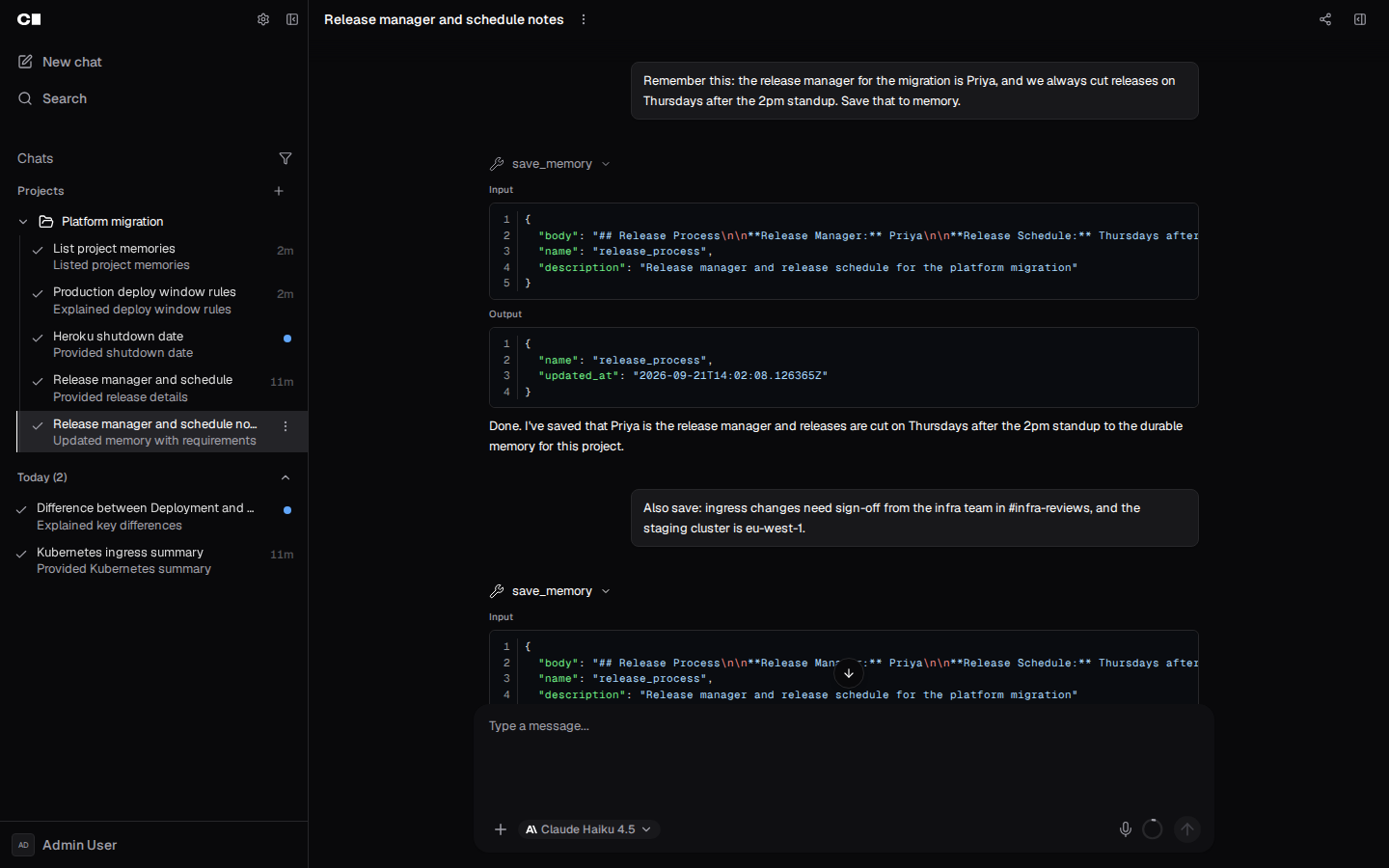 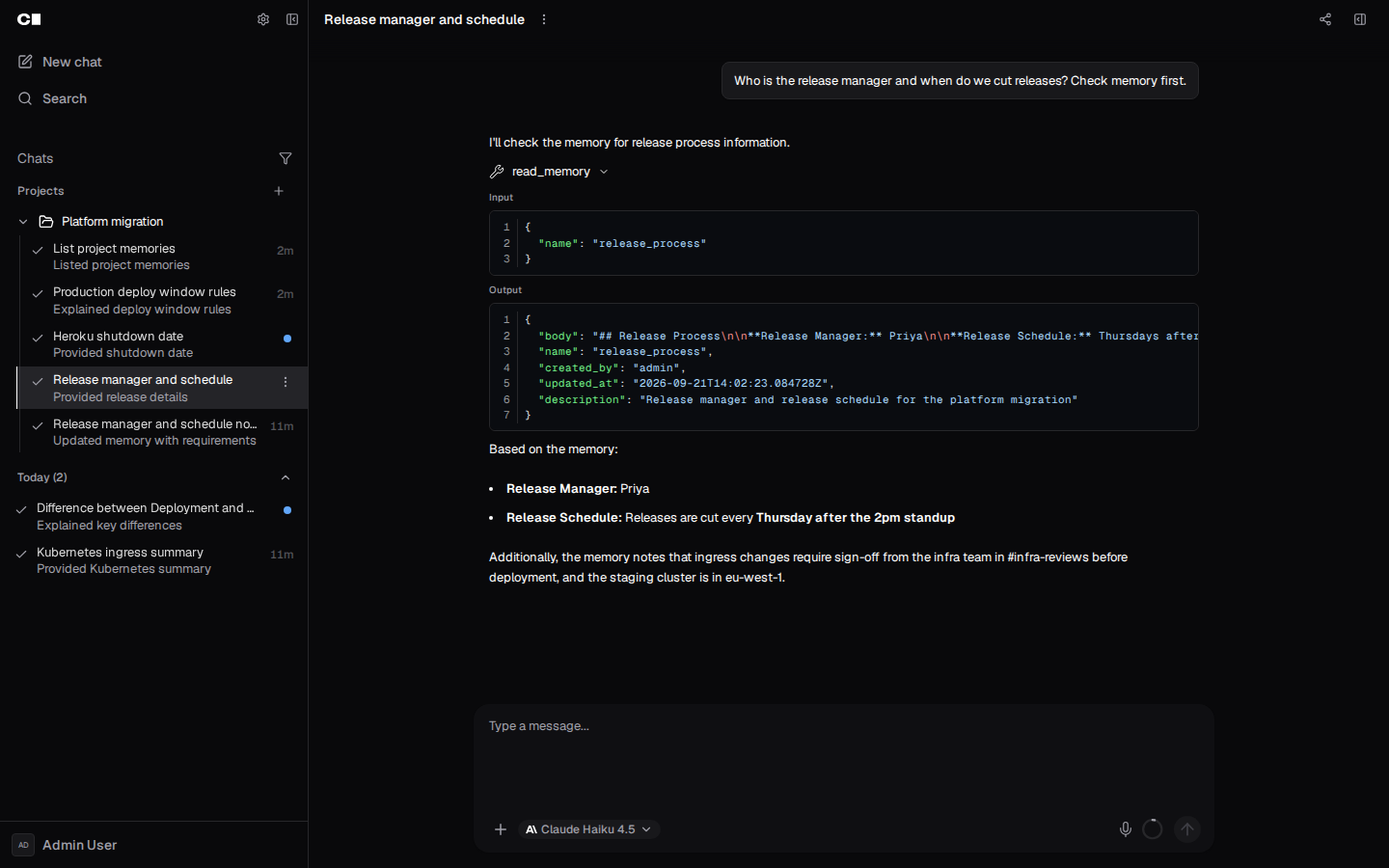 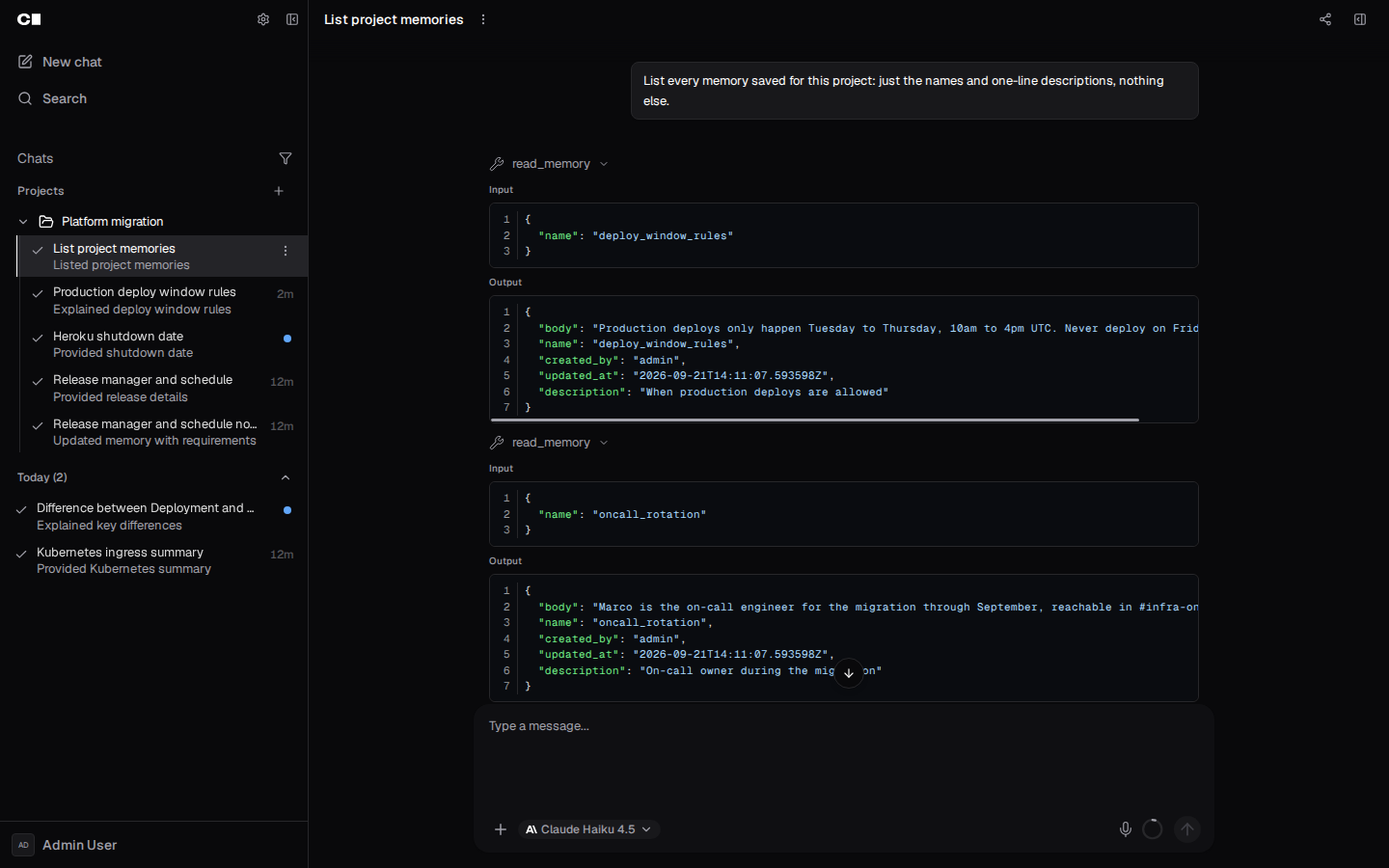 </details> --- Generated with Coder Agents on behalf of @f0ssel. --------- Co-authored-by: Claude Opus 5.5 (1M context) <noreply@anthropic.com> |
||
|
Thomas Kosiewski
|
f55aa6c50d |
feat: add chat automations schema, RBAC resource, and audit entries (#30085)
Adds the storage and authorization pieces for Automations for Coder Agents. No route, SDK request type, or chatd code uses them yet, so nothing is exposed. This is the bottom PR of the Automations stack (RFC step 1). Later PRs add the chatd acceptance seam, management routes, webhooks, and schedules on top of these names and constraints. **Schema** (migrations 000609, 000610) - `chat_automations` table with enums `chat_automation_kind`, `chat_automation_target_mode`, `chat_automation_webhook_use`, and `chat_automation_when_busy`. It includes `created_by_chat_id`, the webhook secret hash and version, the single-use `webhook_consumed_at` marker, the schedule cursor and revision, and `queue_generation`. Named CHECKs enforce the target and kind shapes from the RFC. A composite foreign key keeps `new_chat_model_config_id` in the automation's organization, the same pattern the model override tables use. A trigger (`chat_automations_chat_organization`) keeps `target_chat_id` and `created_by_chat_id` in that organization too. A composite foreign key cannot do that while keeping `ON DELETE SET NULL` on PostgreSQL 13. The trigger validates a reference only on insert or when it changes, so chat deletion can still clear both references. Indexes cover the owner and both chat references for cascades and `SET NULL`. - Provenance columns with partial indexes and no foreign key to `chat_automations`: `automation_id`, `input_id`, `queue_generation` on `chat_queued_messages` (all set or all null), `automation_id` and `input_id` on `chat_messages`, and `chats.automation_id`. `chats_expanded` is recreated to include `automation_id`. - `chat_automation` values for `api_key_scope` and `resource_type`. The down migration is a no-op because enum values cannot be dropped. **Authorization** - New organization-scoped RBAC resource `chat_automation` (create, read, update, delete). The `agents-access` role grants it for the member's own automations. It is excluded from the member role's user-level permissions, so a member without `agents-access` gets nothing. Site owners and organization admins get it through their existing all-permissions lists. The owner-only update, enable, and run rule from the RFC belongs to the management service in a later PR. - The generated scopes stay out of `externalLowLevel`, so API keys gain no user-requestable scopes. - `dbauthz` wrappers for the three queries this PR adds: `InsertChatAutomation`, `GetChatAutomationByID`, and `DeleteChatAutomationByID`. `InsertChatAutomation` also requires update on the target chat, read on the creating chat, and read on the new-chat model config (its user and group ACL). There is also a `dbgen.ChatAutomation` helper. **Audit** - `enterprise/audit/table.go` entries for `ChatAutomation`, with `webhook_secret_hash` and `prompt` marked `ActionSecret`. The prompt is treated as chat content, like chat titles. The schedule cursor, revision, and queue generation are ignored as internal bookkeeping. `Chat.automation_id` is tracked. **Required checks from the ticket** - Migrations apply and roll back: `TestMigrate` and `TestMigrateUpWithFixtures` (new fixture for 000609). Dogfood UAT also applied the migrations on a dev instance, rolled them back, re-applied them, and compared schema dumps. After rollback, the only differences from main were the enum values that cannot be dropped and develop.sh's own `_develop` schema. After re-applying, the only difference from this branch's `dump.sql` was the `_develop` schema. - Secret hash marked secret: `Test_chatAutomationSecretFieldsRedacted` checks the table entries and that an audit diff contains neither the raw hash, its base64 form, nor the prompt text. Also covered: `TestRolePermissions` cases for own, other owner, other organization, and a member without `agents-access`. `TestChatAutomationShapeConstraints` covers the named CHECKs, the cross-organization foreign key and trigger, a cross-organization retarget, and deleting referenced chats. Under `site/`, only generated files changed (`typesGenerated.ts`, `rbacresourcesGenerated.ts`). Closes CODAGT-1207 Part of CODAGT-1135 --- _Generated with [`xum`](https://github.com/coder/xum) • Model: `anthropic:claude-opus-5-5` • Thinking: `high`_ --------- Signed-off-by: Thomas Kosiewski <tk@coder.com> |
||
|
Garrett DelfosseandClaude Opus 5.5
|
7cd1b2040b |
feat: add chat projects API (#29242)
- Experiment, behind `chat-projects` (off by default). First of three stacked PRs: #29301 (memory), #29583 (UI). This PR is API only; the screenshots below are from the UI in #29583. - CRUD under `/api/experimental/organizations/{organization}/chats/projects/{project}`. `GET /api/experimental/chats/projects` lists the caller's projects across all organizations. - `project_id` on chat create and as a chat list filter. A chat joins a project only at creation; there is no move. - Projects are identified by ID. Names are display labels (64 characters, description 1024) with no uniqueness constraint. An optional `icon` URL (usually an emoji image under `/emojis`) is capped at 256 characters and audited. - A user can own at most 100 projects across all organizations; creating another answers 409. Creates count and insert under a per-owner advisory lock so concurrent requests cannot overshoot. - Projects are private to their `owner_id`. Members may only create their own, and a chat can only be bound to a project its owner owns. An unreadable or foreign project on chat create answers 404 so IDs cannot be probed; a project from another organization answers 400. - Permissions ride on the `agents-access` role next to chats (after #30004), so whoever can use Coder Agents can use projects. Owners and org admins reach every project. ### Examples Create a project in an organization: ```http POST /api/experimental/organizations/{organization}/chats/projects {"name": "Platform", "description": "Infra and deploy work", "icon": "/emojis/1f680.png"} ``` ```json { "id": "7c0e4a3e-5b1f-4f7d-9a51-2f3c8f6d2b10", "organization_id": "bb640d07-ca8a-4869-b6bc-ae61ebb2fda1", "owner_id": "0ed9befc-4911-4ccf-a8e2-559bf72daa94", "name": "Platform", "description": "Infra and deploy work", "icon": "/emojis/1f680.png", "created_at": "2026-09-30T15:04:05Z", "updated_at": "2026-09-30T15:04:05Z" } ``` List the caller's projects across organizations with `GET /api/experimental/chats/projects` (an array of the object above). Update with `PATCH .../chats/projects/{project}` and any of `name`, `description`, `icon`; delete with `DELETE`, which detaches its chats. Create a chat in the project, and list only its chats: ```http POST /api/v2/chats {"organization_id": "bb640d07-…", "project_id": "7c0e4a3e-…", "content": [{"type": "text", "text": "Plan the deploy"}]} GET /api/v2/chats?project_id=7c0e4a3e-… ``` At the limit: ```json 409 {"message": "You can have at most 100 chat projects. Delete a project to create another."} ``` <details> <summary>Screenshots (UI from #29583)</summary> 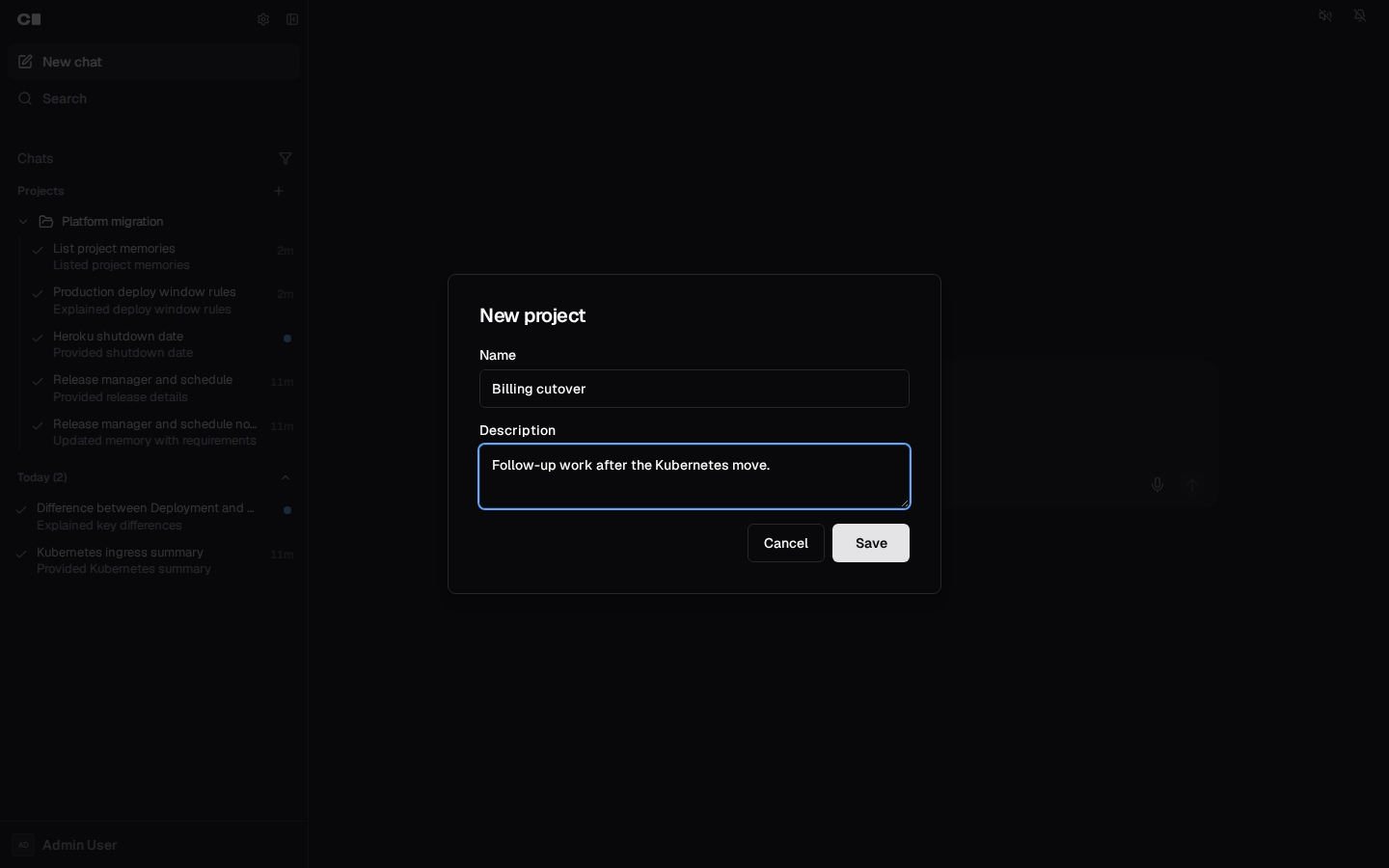     </details> --- Generated with Coder Agents on behalf of @f0ssel. --------- Co-authored-by: Claude Opus 5.5 (1M context) <noreply@anthropic.com> |
||
|
Ethan
|
acebdf5b60 |
feat: add chat_mcp_servers table with encrypted headers (#29517)
This is the second PR in the stack that adds experimental support for attaching MCP servers to a chat; https://github.com/coder/coder/pull/29466 is the first. This one is just the persistence layer, nothing reads from the table yet. It adds a `chat_mcp_servers` table, unique on `(chat_id, slug)` and cascading on chat deletion. Each row stores the server URL, a JSON object of request headers, per-server tool allow and deny lists, and three flags that later PRs in the stack use to decide when the server gets connected: `allow_in_plan_mode` (mirroring the existing column on `mcp_server_configs`), `allow_in_subagents`, and `forward_coder_headers`. All three default to `false`. Headers are the sensitive part, so they're encrypted at rest via `dbcrypt` in the same way `external_auth_links` are: `headers_key_id` records which key was used, and `NULL` means plaintext. Empty or `{}` headers are stored as `{}` with no key, so servers that don't need auth never produce ciphertext. The `dbcrypt` wrappers cover the chat-scoped reads and writes, plus `GetChatMCPServersByChatOwnerID` and `UpdateEncryptedChatMCPServerHeaders`, which follow the per-user shape that `Rotate` and `Decrypt` in `cliutil.go` use. I haven't wired those two into `coder server dbcrypt rotate` and `decrypt` in this PR. For authz, reading a chat's servers requires read on the chat, and upserting or deleting them requires update on the chat. The two owner-scoped queries above are system-only. Part of CODAGT-1131 |
||
|
Thomas Kosiewski
|
60cc826f2b | feat: sign forwarded MCP identity headers (#29669) | ||
|
Ehab Younes
|
817fc77612 |
feat: store session usage per app and family in template usage stats (#29109)
Store per-app session minutes in a child table instead of fixed family-minute columns, so adding an IDE no longer needs a rollup schema change. API, Prometheus, and telemetry output are unchanged. - Add `template_usage_stats_session_apps`, keyed by start time, template, user, and app name, replacing the `ssh_mins`, `sftp_mins`, `reconnecting_pty_mins`, `vscode_mins`, and `jetbrains_mins` columns. - Group app names into families at read time through the `codersdk` registry, so the registry never reaches SQL and attribution covers all history rather than only the buckets the rollup still revisits. - Group `GetTemplateInsightsByTemplate` by app name so that Prometheus and the API report a family identically. - Drop the `@app_families` query parameter and its dbauthz validation. - Report a family total as the sum of its apps rather than the distinct minutes any of them was active. Numbers are unchanged today, because every agent reports one canonical name per family. - Keep the child table window index-usable and count minutes with `COUNT(DISTINCT)` in the grouping, so a dashboard-sized range uses an index scan and a large deployment does not spill the sort to disk. Part of #27410 |
||
|
Michael Suchacz
|
b957e66ccc |
feat!: drop the Coder Tasks tables and queries (#29086)
Drops the `tasks`, `task_workspace_apps` and `task_snapshots` tables, the `tasks_with_status` view and the `task_status` enum, and recreates `workspaces_expanded` without the `tasks` join and `task_id` column. Deletes `queries/tasks.sql` and every wrapper, fixture and test that existed only for those queries (dbauthz, dbmock, dbmetrics, dbfake, dbgen, querier_test), plus the `task_id` projection in `GetWorkspaceAgentAndWorkspaceByAuthToken`. **Breaking change:** migration 000594 deletes all task rows. The down migration restores the schema (tables, constraints, indexes, views), not the data. **Review changes:** the schema-only migration test was removed per review (`TestMigrate/UpDownUp` still exercises the down path), the test file no longer reorders existing tests, and the migration moved from 000593 to 000594. The `dump.sql` reorder is pg_dump dependency ordering: `tasks_with_status` pulled its four workspace tables ahead of it, and without the view they return to alphabetical positions. **Stack context:** Coder Tasks removal stack (CODAGT-642): #28743 frontend → #28788 CLI → #28789 API → #28790 provisioner → #29084 notifications → #29085 build reasons → **#29086 tables** → #28750 permissions. The last four PRs replace the single data-drop migration that used to live in #28750; each carries one concern and its own migration number. > Created by Xum (AI agent) on behalf of @ibetitsmike. ## Delivery record **Decision (2026-09-11 ~14:40Z): merge** through the stack merge endpoint, squash, pinned to head `f1d236a0c82f123b8a0d6878799c227ef9bd5776` (merge SHA appended below once landed). **Independent substantive reviews on this PR (3):** | # | Kind | Reviewed commit | Findings and disposition | Source | |---|---|---|---|---| | 1 | Codex code review (bot), PR opened | `24535f8410` | No findings, no threads | [summary](https://github.com/coder/coder/pull/29086#issuecomment-5583877627) | | 2 | Human review, spikecurtis (COMMENTED) | `24535f8410` | 4 findings: dump.sql reorder question (answered: pg_dump dependency hoisting by `tasks_with_status`); two moved tests (undone, the test file is no longer touched); schema-only migration test (deleted). All resolved. | [review](https://github.com/coder/coder/pull/29086#pullrequestreview-5142045164) | | 3 | Human review, spikecurtis (APPROVED) | `f1d236a0c8` (this head) | Approval on the exact final head | [review](https://github.com/coder/coder/pull/29086#pullrequestreview-5179353695) | The four COMMENTED reviews by @ibetitsmike on `f35688f40b` are thread-reply wrappers and are not counted. **Pre-split history relevant to this diff:** this layer's content lived in the monolithic #28750 until 2026-09-08, which received 10 completed Codex code reviews (2026-08-28 to 2026-09-01) and spikecurtis's CHANGES_REQUESTED review of 2026-09-04 that asked for the split. Counting those, the completed-review total relevant to this diff exceeds the six-review budget, so no further discretionary review or fresh final advisory was commissioned. The usable final recommendation for the final diff is review 3 above: the reviewer who authored every finding on this layer approved the exact head. **Exact-head checks:** `required` SUCCESS in [run 34580949353](https://github.com/coder/coder/actions/runs/34580949353/job/103205933212); rollup 15 success, 8 skipped, 1 failure. The failure is the non-required `Analyze PR for Documentation Updates Needed` job ([103204101137](https://github.com/coder/coder/actions/runs/34580949071/job/103204101137)), caused by the dormant `doc-check-pr-29086` review workspace (CODAGT-1025), not a code finding; GitHub flags only `required` as required for this PR. Merge-ref freshness: `refs/pull/29086/merge` has the exact head as second parent and `25af21b5d5d` (the #29085 squash) as first parent; main has since gained #29231, #28639 and #29218 (12 files, none overlapping this PR). The composed tree (`git merge-tree` of current main and this head) builds (`go build ./...`) and vets (`go vet` on `coderd`, `coderd/database/...`, `coderd/wsrelated/...`) cleanly. Layer diff parity with the previously pushed layer verified by numstat after both GitHub restacks. `gh stack push` did not run the local pre-push suite; CI is the validation evidence. **Deferred:** the dormant doc-check workspace (CODAGT-1025) is outside this PR. Next in the stack, #28750, stays blocked: CHANGES_REQUESTED, its approval and CI predate the restack, and its review budget is exhausted. |
||
|
Michael SuchaczandEthan Dickson
|
0ef331fcd0 |
feat!: scope chat model override settings to organizations (#28442)
Moves chat model override settings from deployment scope to organization scope, following the org-scoping of chat model configs in #28440. Depends on #28440 (based on `ethan/chat-models-availability-consolidation`). Remote dogfood UAT passed on this change, including multi-organization scenarios on a licensed deployment with real models. ## Problem Chat model configs are now owned by organizations, but the override settings that reference them stayed deployment-wide: admin subagent/title/compaction overrides in `site_configs`, personal overrides in `user_configs`, and the advisor model embedded in the advisor runtime JSON. A single deployment-level override can only point at one organization's model config, so overrides effectively worked for the default organization only, and title generation had to soften its hard-failure contract to tolerate unusable overrides. ## Fix Admin overrides (general, explore, title generation, compaction, advisor) and personal overrides (root, general, explore) become organization-scoped rows in two new typed tables, `chat_organization_model_overrides` and `chat_user_model_overrides`. Composite foreign keys on `(organization_id, model_config_id)` make cross-organization model references unrepresentable. The migration deletes the legacy serialized `site_configs`/`user_configs` override keys instead of migrating them; admins and users re-select models in the new organization-scoped settings. New endpoints live under `/api/experimental/organizations/{organization}/chats/model-overrides` (admin defaults) and `/api/experimental/organizations/{organization}/members/{user}/chats/model-overrides` (personal overrides); the legacy deployment-level routes are removed. chatd resolves overrides via the chat's organization, restoring the hard-failure contract for configured-but-unusable title generation overrides. The deployment-level `AllowUsers` switch and advisor runtime limits stay deployment-scoped. The Coder Agents settings UI gains a per-organization "Defaults & overrides" page under AI Settings > Models, and the personal overrides page gains an organization selector for users in multiple organizations. Advisor telemetry now reports per-organization override rows. **BREAKING CHANGE**: Existing deployment-level overrides are dropped, not migrated. Every organization starts with no overrides after upgrade, and model selections must be re-applied in the new settings. The legacy deployment-level override endpoints are removed. Closes https://linear.app/coder/issue/CODAGT-872 > [!NOTE] > Xum (AI agent) authored this PR on behalf of @ibetitsmike. <!-- xum-attribution: model=claude-opus-4-6 thinking=high --> --------- Co-authored-by: Ethan Dickson <ethan@coder.com> |
||
|
Ethan
|
f32592ec6b |
feat!: scope chat model configs to organizations (#27955)
## Summary Scope chat model configurations and runtime model resolution to organizations. Each model configuration now belongs to exactly one organization, each organization can have its own default model, and Chatd only uses models that belong to the chat's organization. Depends on #27968. ## Problem Chat model configurations are currently deployment-wide even though chats belong to organizations. A default model, explicitly selected model, or configured model override can therefore reference the same model configuration from every organization. This prevents model catalogs and defaults from being isolated by organization and allows a chat to retain or select a model that its organization does not own. Existing model configurations also have no organization ownership or organization-scoped ACL data, and the database enforces a single live default across the entire deployment. ## Fix Add required organization ownership and ACL storage to chat model configurations. The migration assigns every existing configuration to the default organization, seeds organization-wide read access, and replaces the deployment-wide default constraint with a per-organization constraint. Scope Chatd lookup, admission, fallback, and queue-promotion behavior to the chat's organization: - New chats use the usable default model from their organization. - Explicit model selections from another organization are rejected. - Deployment or personal overrides that point to a foreign model are not used for the chat. - Historical cross-organization model references remain unchanged in the database, but runtime generation falls back to a usable local default. - Queue promotion resolves unavailable, disabled, missing, or foreign stored models to the usable local default and fails when no usable local default exists. The existing model configuration management and availability routes remain compatibility routes for the default organization in this layer. A later layer in the stack adds organization-scoped management routes and updates clients to use them. ## Breaking change This changes chat model behavior from deployment-wide to organization-scoped. Existing configurations are migrated only to the default organization; they are not copied into every organization. As a result: - A non-default organization no longer inherits the deployment's existing default model. - Creating a chat in an organization without a usable local default fails with `400: No default chat model config is configured.` - Explicitly selecting a configuration owned by another organization fails with `400: Model config does not belong to the specified organization.` - Existing chats whose stored model belongs to another organization can generate only if a usable local default is available; otherwise generation fails. Deployments using Agents in non-default organizations must configure a usable default chat model separately for each organization after the organization-scoped management layers in this stack are available. _This pull request description was generated by Coder Agents._ |
||
|
Michael SuchaczandMathias Fredriksson
|
443e3b9b80 |
feat!: org-scope MCP server configs with RBAC (#27942)
Moves `mcp_server_configs` from deployment scope to organization scope
so each organization fully controls the MCP servers its members can use
with Coder Agents.

## Summary

- Migration: adds `organization_id` (NOT NULL, FK) and keeps existing
rows as the default organization's originals with credentials intact.
Other organizations start with no MCP servers and configure their own;
nothing is copied across organizations. Chats outside the default
organization keep any now-cross-organization `mcp_server_ids` entries;
the runtime already ignores IDs that do not resolve in the chat's
organization, so no data rewrite is needed. Slug uniqueness becomes
`(organization_id, slug)`.
- RBAC: new org-scoped `ResourceMCPServerConfig` with regosql converter
and `GetAuthorizedMCPServerConfigs`; org admins get in-org CRUD, org
members get read (replaced by ACL evaluation in the follow-up ACL PR in
this stack).
- API: all config routes nest under the organization, matching
templates: `POST|GET
/api/experimental/organizations/{organization}/mcp-servers` and
`GET|PATCH|DELETE .../mcp-servers/{mcpserverconfig}` (plus
`oauth2/connect`), resolved by a read-only param middleware that
conceals read-denied and cross-organization access as 404. Two routes
stay on the frozen `/api/experimental/mcp/servers/{mcpServer}` block:
the OAuth2 callback (the redirect URI baked into existing AS-side client
registrations) and `oauth2/disconnect`, which must remain reachable by
users removed from the organization so they can still revoke their token
grant.
- Chat runtime: selection validation and generation resolve configs
strictly by IDs, enabled state, and the chat's organization in SQL;
requested duplicates are normalized; invalid or cross-org IDs are
rejected with the precise ID list. IDs already persisted on a chat are
exempt from message-time rejection so disabling a selected server never
blocks sends; generation skips servers that are no longer usable.
- Frontend: API layer and admin settings pages target the new endpoints.
The admin page manages the default organization's servers; the org
picker is tracked separately (CODAGT-714).

- Security hardening from review: OAuth user grants are additionally
bound to `oauth2_revocation_url` (changing it invalidates grants, and a
racing OAuth callback gets 409 instead of recreating a grant).
Stack-wide SSRF protection for MCP config-directed traffic was split
into its own PR at the top of this stack (#28242) to keep this diff
reviewable; this PR keeps main's existing discovery IP-range guard.
OAuth2 auto-discovery now completes before the config row is inserted: a
failed discovery persists nothing, and there is no provisional row that
concurrent updates could race against.

Two follow-up PRs in this stack were split out to keep this diff
reviewable: #28064 completes the swagger annotations for the moved
routes (main already ships these experimental MCP handlers unannotated),
and #28065 carries hardening fixes and regression pins on top of the
cutover.

- Force On enforcement (landed on main mid-review) is org-scoped: the
forced set is read per chat organization
(`GetForcedMCPServerConfigsByOrganization`), so another organization's
`force_on` server never attaches to a chat.

## Breaking changes (experimental API)

The MCP server config endpoints move from the deployment-scoped
`/api/experimental/mcp/servers` block to organization-nested paths:
`POST|GET /api/experimental/organizations/{organization}/mcp-servers`
and `GET|PATCH|DELETE
/api/experimental/organizations/{organization}/mcp-servers/{mcpserverconfig}`
(plus `oauth2/connect`). The old paths are removed, so API consumers
must supply an organization. Two routes intentionally stay on the frozen
`/api/experimental/mcp/servers/{mcpServer}` block: the OAuth2 callback
(its redirect URI is baked into existing AS-side client registrations)
and `oauth2/disconnect` (must remain reachable by users removed from the
organization). These endpoints are under `/api/experimental`, so no
deprecation window is provided.

## Rolling upgrades

During a rolling deploy, an old replica creating an MCP config can fail
the new `NOT NULL organization_id` constraint until it is upgraded
(reads are unaffected: old binaries' generated queries select their own
column lists). This matches the repo's existing precedent for additive
NOT NULL migrations (000562) and affects only the admin config-create
path in the upgrade window.

Upgrades are expected to run in scheduled maintenance downtime with the
database locked during migration, so the migration ships no
rolling-upgrade compatibility machinery. The down migration deletes
organization-created configs (their chat references are cleaned by the
000510 delete trigger) and restores deployment-wide slug uniqueness.

Part of the MCP org-separation stack (CODAGT-711 -> CODAGT-717 audit ->
CODAGT-712 ACLs -> CODAGT-806 token RBAC).

Closes https://linear.app/codercom/issue/CODAGT-711

UAT: validated end to end on a two-org dogfood deployment, including a
real pre-migration to post-migration upgrade, cross-org isolation
(404s), same-slug-two-orgs, chat selection gating, and a live MCP tool
call through the org-scoped generation path. The migration was later
revised to keep existing rows in the default organization only (no
per-organization copies); that revision is covered by the migration test
suite.

> Mux (AI agent) authored this PR on Mike's behalf.

<!-- mux-attribution: model=claude-fable-5 thinking=high -->

---------

Co-authored-by: Mathias Fredriksson <mafredri@gmail.com>
|
||
|
Bobby HoandClaude Sonnet 5
|
d814dfad88 |
feat(coderd): support public OAuth2 client tokens at the schema layer (#27712)
Layer 1 of a multi-PR split of #27195 (public/secretless PKCE-only OAuth2 clients), broken up for easier review: **database schema (this PR)** → oauth2provider handler logic → API/e2e integration tests. ## Goal Coder's OAuth2 provider only works correctly for confidential clients today. Public clients — native apps that can't safely hold a shared secret, such as the CLI's browser-based login flow, IDE plugins (VS Code, JetBrains), desktop apps, and MCP clients — cannot complete a real OAuth2 flow against Coder, even though OAuth 2.1 §2.1 explicitly defines this client type and RFC 8252 §8.5 requires PKCE alone to be sufficient authentication for it. Every MCP client, CLI login flow, and IDE plugin is a public client by construction, and none of them can complete a secretless flow against Coder today: dynamic registration always classifies a client as confidential regardless of what it asks for, the token endpoint unconditionally requires a `client_secret`, and discovery metadata never advertises `"none"` as a supported auth method. Full write-up: [ENG-3029](https://linear.app/codercom/issue/ENG-3029/oauth2-support-public-client) ### Overall design (end state across the full PR stack) `[PR2]` marks handler-layer changes landing in the next PR in this stack. The green box is what this PR implements. ```mermaid sequenceDiagram autonumber participant C as Public Client (CLI/MCP/IDE plugin) participant S as coderd (chi router) participant H as oauth2provider handlers participant DB as PostgreSQL Note over C,S: Discovery C->>S: GET /.well-known/oauth-authorization-server S->>H: GetAuthorizationServerMetadata() Note over H: [PR2] add "none" to<br/>the returned auth methods list H-->>C: [PR2] 200 { token_endpoint_auth_methods_supported:<br/>[..., "none"] } Note over C,S: Dynamic Client Registration C->>S: POST /oauth2/register<br/>{redirect_uris, token_endpoint_auth_method: "none"} S->>H: CreateDynamicClientRegistration() Note over H: [PR2] client type now reads<br/>the request -> "public" Note over H: [PR2] skip secret generation<br/>for public clients H->>DB: [PR2] INSERT app row<br/>(client_type = 'public') DB-->>H: app row Note over H: [PR2] skip secret insert entirely H-->>C: [PR2] 201 { client_id }<br/>(no client_secret field) Note over C,S: Authorization Code + PKCE flow C->>S: GET /oauth2/authorize?client_id=...&code_challenge=... C->>S: POST /oauth2/tokens (grant_type=authorization_code)<br/>no client_secret S->>H: extractTokenRequest() Note over H: [PR2] client_secret no longer required<br/>for public clients H->>H: authorizationCodeGrant() Note over H: [PR2] skip secret lookup for public clients Note over H: PKCE verification — already mandatory, unchanged rect rgb(198, 239, 206) Note over H,DB: [THIS PR] oauth2_provider_app_tokens.app_id<br/>column added (NOT NULL, populated at insert<br/>time from app.ID) and app_secret_id loosened<br/>to nullable. Revocation now checks app_id<br/>directly. Confidential-client behavior is<br/>unchanged — no public client can be created yet. H->>DB: [PR2] INSERT refresh token row<br/>(no secret reference, for public clients) end DB-->>H: token row H-->>C: 200 { access_token, refresh_token } ``` ## This PR: database schema A public client has no `client_secret`, so it has nothing to put in `oauth2_provider_app_tokens.app_secret_id`, which was `NOT NULL`. This PR makes that column nullable and instead attributes a token to its owning app through a new, always-populated `app_id` column — so ownership checks (e.g. revocation) work identically for public and confidential clients without joining through a secret that may not exist. | Column | Before | After (this PR) | |---|---|---| | `app_secret_id` | `uuid NOT NULL` | **nullable** | | `app_id` | — | **new**: `uuid NOT NULL`, `FOREIGN KEY → oauth2_provider_apps(id) ON DELETE CASCADE`, backfilled for every existing row and populated on every new insert from that point on | This is a single, complete migration — not staged across multiple PRs. An earlier version of this branch deferred `app_secret_id`'s nullability and the insert-time population of `app_id` to a later PR, keeping this PR's diff limited to `coderd/database`. [Automated review](https://github.com/coder/coder/pull/27712#discussion_r3686851911) correctly flagged that as unsafe: the migration would backfill existing rows once, but nothing would populate `app_id` for rows written afterward, so the moment this PR merged, new tokens would start accumulating a permanently `NULL` app_id — and if a release happened to be cut before the follow-up PR landed, that gap could ship to customers and would need a second, later backfill to close. Doing the full migration now avoids that: `app_id` is correct from the first row written, and the promised `NOT NULL` constraint requires no data repair because it's already enforced. Closing that gap requires a few mechanical, non-branching touches outside `coderd/database`: - `revoke.go`'s two ownership checks now compare `dbToken.AppID` directly instead of looking up the app through `app_secret_id` — a genuine simplification (and slightly less code), not a temporary shim. - `tokens.go`'s two `InsertOAuth2ProviderAppToken` call sites supply the new `app_id` column and wrap `app_secret_id` as a `NullUUID`. - `oauth2_test.go`'s one direct-insert test fixture does the same. None of these introduce client-type branching or new capability — every client today is still confidential-only, still always presents a secret, and behavior is unchanged. The full repo builds, vets, and all existing tests pass unmodified in behavior. ## Coming next - **PR2 (handler layer)**: `codersdk`'s `DetermineClientType()` reading the requested `token_endpoint_auth_method`; `registration.go` skipping secret generation for public clients (and wrapping the app+secret insert in a single transaction, fixing a pre-existing orphan-row/visibility-race gap); `tokens.go` making the secret check conditional so PKCE alone authenticates a public client; `metadata.go` advertising `"none"` in discovery. No further migration is needed — the schema this PR ships is already final. - **PR3 (API/e2e layer)**: integration tests through the real HTTP API (`coderd/oauth2_test.go`), the MCP OAuth2 e2e flow (`coderd/mcp/mcp_e2e_test.go`), and the manual test script (`scripts/oauth2/test-mcp-oauth2.sh`). Depends on: #27195 (original combined PR, being superseded by this stack) --------- Co-authored-by: Claude Sonnet 5 <noreply@anthropic.com> |
||
|
Michael Suchacz
|
997b5d0843 |
feat: add synthetic gateway keys (#27170)
> Mux is working on behalf of Mike. ## Summary Add a per-user synthetic API key for chatd AI Gateway attribution. Chatd resolves the key from the chat owner, extends it before expiry, and discards the generated bearer token so the key is never a usable credential. There is no mapping table. The key is resolved from `api_keys` by a deterministic token name (`chatd_<owner_id>_session_token`), mirroring the provisionerd session token model, with three deltas that chatd needs: - **Login type guard**: token names are unvalidated user input, so a user can create a bearer token with the colliding name. The lookup excludes `login_type = 'token'` rows, so chatd never picks up (or extends) a real user token. Synthetic keys are minted with the owner's login type, which is never `token`. - **In-place expiry extension instead of delete-and-reinsert**: chat generations have no stop boundary, and an in-flight generation may have already delegated the current key ID to aibridged. Extending `expires_at` keeps the key ID stable forever. - **Advisory-lock mint**: the unique index on token names is partial (`WHERE login_type = 'token'`), so nothing DB-enforces uniqueness for synthetic keys. A per-user advisory lock serializes concurrent mints. Keys carry a minimal scope (`api_key:read`) as defense in depth; the delegated gateway path never evaluates scopes and the secret is discarded at mint. Migration 000544 removes the foreign keys from the legacy message and queue `api_key_id` columns while chatd continues stamping them for rolling compatibility. Stale IDs are tolerated because routing uses `chats.owner_id`. Individual key deletion, delete-all, and password reset remove the key without changing chat history or queue versions, and the next lookup remints it. Suspension does not delete the key; delegated gateway authorization rejects inactive users at request time. This is the first PR in a three-PR rollout and must be fully deployed before #27171. Refs https://linear.app/codercom/issue/CODAGT-561/maintain-synthetic-api-key-per-user-per-chat |
||
|
George K
|
6af0f4d698 |
feat: add workspace restart functionality to API (#25757)
This models restart as durable orchestration of existing stop and start workspace builds instead of adding a new restart transition. Keeping restart as two existing transitions preserves the current build/provisioner model. The child start build is created only after the parent stop build succeeds, rather than being inserted immediately in a pending state. That keeps `workspace_builds` aligned with actual provisioner-ready work and avoids introducing a second pending-build lifecycle that the provisioner and build acquisition paths would need to understand. Refs: https://linear.app/codercom/issue/PLAT-143 |
||
|
Sas Swart
|
491a75294e |
feat: GET /api/v2/agent-firewall/sessions/{id} (#24814)
Add a GET endpoint at `/api/v2/agent-firewall/sessions/{id}` that
returns agent firewall session metadata (`id`, `workspace_id`,
`owner_id`, `confined_process`, `started_at`). The handler authorizes
against the `boundary_log` resource with `ActionRead` via dbauthz.

The endpoint is enterprise-only, gated behind the `FeatureBoundary`
entitlement.

The `GetBoundarySessionByID` SQL query JOINs through `workspace_agents`
→ `workspace_resources` → `workspace_builds` → `workspaces` to return
`workspace_id` and `workspace_owner_id` directly, avoiding a separate
query.

Also adds an `owner_id` column to the `boundary_logs` table (migration
000526) with a FK to `users(id)` and a backfill from
`boundary_sessions`. This enables user-scoped RBAC authorization for
`InsertBoundaryLogs` via `.WithOwner()`, ensuring workspace agents can
only insert logs for their own owner.

Depends on #24810

**RBAC behaviour:**

| Role    | Result |
|---------|--------|
| Owner   | read   |
| Auditor | read   |
| Member  | 404    |

> [!NOTE]
> This PR was authored by Coder Agents.
|
||
|
Kyle Carberry
|
53a6459ecd |
feat(coderd/database): add chat_context_resources table (#26430)
Adds chat_context_resources: a per-chat pinned copy of the agent context resources a chat is hydrated against. The agent-side table (workspace_agent_context_resources) is last-writer-wins with no history, so a chat copies its resources at hydration/refresh to keep a stable view while the agent drifts. Schema foundation only (no queries/dbauthz/prepareGeneration/SDK yet). chat_id FK ON DELETE CASCADE for cleanup parity; no agent FK so the pin survives agent replacement; PK (chat_id, source); reuses the 000522 enum types. |
||
|
Danny Kopping
|
a1330e3a8c |
refactor: rename Ai* database identifiers to AI* (AIGOV-369) (#26327)
Adds `ai` to sqlc's `gen.go.initialisms` in `coderd/database/sqlc.yaml` so the generated DB code follows Go's initialism convention. Adds the matching `ai` -> `AI` case to the dbgen PascalCase helper (`scripts/dbgen/main.go`) so the corresponding `dbmem` / mock identifiers stay in sync. `make gen` regenerates the rest; hand-written call sites that consume DB-generated identifiers (`enterprise/audit/table.go`, `coderd/database/modelmethods.go`, `enterprise/coderd/aigatewaykeys.go`, `coderd/database/dbauthz/*`, etc.) are updated to match. Scope is deliberately limited to the database layer: - `coderd/rbac/*` (resource and scope generators) is untouched — `ResourceAi*` / `ScopeAi*` constants stay on main's casing. - `codersdk/*` (Go SDK) is untouched — `codersdk.ResourceAi*` / `codersdk.APIKeyScopeAi*` constants stay on main's casing, so external Go SDK consumers see no source-level break. - `Aibridge*` identifiers (one SQL token `aibridge`, not `ai_bridge`) are out of scope. On-the-wire values are unchanged: enum strings, RBAC resource type strings, API key scope strings, and JSON tags all stay the same. The HTTP/JSON surface is unaffected. Refs: [AIGOV-369](https://linear.app/codercom/issue/AIGOV-369/change-ai-references-in-coderddatabasemodelsgo-to-ai) 🤖 Generated with [Coder Agents](https://coder.com) |
||
|
Kyle Carberry
|
b439b06ee6 |
feat: persist agent-pushed workspace context snapshots in coderd (#26145)
Replaces the v2.10 `PushContextState` stub with a real coderd write path. Phase 1 of the chat-side persistence story; nothing reads these rows yet. Follows [#25983](https://github.com/coder/coder/pull/25983) and unblocks [CODAGT-569](https://linear.app/codercom/issue/CODAGT-569/enable-agent-api-v210-pushcontextstate-bump-currentminor-wire-coderd). ## What ships ### Schema (`000517_workspace_agent_context.{up,down}.sql`) Two new tables plus `api_key_scope` enum extensions: - `workspace_agent_context_snapshots` (PK `workspace_agent_id` to `workspace_agents(id) ON DELETE CASCADE`): one row per agent, overwritten per push. Holds `version`, `schema_version`, `aggregate_hash`, `snapshot_error`, `received_at`. - `workspace_agent_context_resources` (PK `(workspace_agent_id, source)`): per-resource state. `body_kind` and `status` are `TEXT` + `CHECK` so adding new wire kinds (the RFC's reserved PLUGIN/HOOK/SUBAGENT/COMMAND) is a one-line CHECK update plus a Go switch case. ### SQLC queries (`coderd/database/queries/workspaceagentcontext.sql`) - `UpsertWorkspaceAgentContextSnapshot` - `UpsertWorkspaceAgentContextResource` - `DeleteStaleWorkspaceAgentContextResources` (delete-where-source-not-in) - `GetLatestWorkspaceAgentContextSnapshot` - `ListWorkspaceAgentContextResources` ### Handler (`coderd/agentapi/context.go`) `ContextAPI` is a new sub-API. `PushContextState`: 1. Rejects `schema_version > 1` with a non-`Unimplemented` error so a forward-incompatible agent fails loudly during rollout instead of slipping into the permanent fallback path the `Unimplemented` translation reserves for old coderd deployments. 2. Validates resources: no empty/duplicate sources, every variant maps to a known body kind, every status maps to a known enum value, the `Body` oneof is set (even when status is non-OK, mirroring the wire guarantee so coderd can attribute failures to a known kind). 3. Inside `Database.InTx`, reads the existing snapshot. If the push is not `initial` and `version` is not strictly greater, returns `accepted = false` and leaves stored state untouched. Otherwise upserts the snapshot row, upserts each resource, then runs the stale-source prune so the snapshot and resource rows always agree. 4. Returns `accepted = true` on success. Resource bodies are stored as `protojson(body oneof variant)` in `body JSONB` with `body_kind` as the discriminator. Adding a new field to an existing variant is zero work since `protojson` tolerates new fields; adding a new variant is a CHECK + switch case. ### RBAC + dbauthz - New `ResourceWorkspaceAgentContext` (Create/Read/Update/Delete). - New `SubjectTypeAgentContext` plus `subjectAgentContext` system role and `dbauthz.AsAgentContext` helper. The push handler elevates to this subject; the agent's own role does not get direct write access to the table. - New `workspace_agent_context:*` API key scopes registered in the enum migration; internal-only (not added to `externalLowLevel`). ### Audit These rows are agent-pushed state, not user-authored. They are intentionally not added to `AuditActionMap` and not enumerated in `enterprise/audit/table.go`, matching `boundary_logs`, `workspace_agent_memory_resource_monitor`, etc. `enterprise/audit` tests pass unchanged. ## Tests - `coderd/agentapi/context_test.go`: 12 subtests covering accepts/rejects (schema version, empty/duplicate source, unknown status, missing body), version semantics (stale dropped, same-version replay dropped, `initial=true` overwrites lower version), variant coverage, non-OK status persistence, and the empty-active-set prune case. - `coderd/database/dbauthz/dbauthz_test.go`: 5 `MethodTestSuite` cases covering the new queries. - `coderd/rbac/roles_test.go`: `WorkspaceAgentContext` permission row asserting no human role currently has access. - `coderd/database/migrations/testdata/fixtures/000517_workspace_agent_context.up.sql`: one snapshot + one resource per known body kind plus a non-OK status, so the migration test suite never lands with these tables empty. ## Out of scope (later phases) - Chat hydration (`chats.context_aggregate_hash`, `last_injected_context`). - Dirty-bit fan-out and `PUT /chats/{id}/context`. - Agent-side `POST /api/v0/context/resync` barrier and the `coder exp chat context` CLI. - `codersdk` chat-context wire types and the dashboard Sources drawer. - Removal of the chatd per-turn pull fallback. ## Compat property This is a pure write path. If anything here returns errors the agent's `RunPush` loop backs off, no chat behavior changes, and the workspace keeps behaving exactly like it did before v2.10. <details> <summary>Implementation plan and decision log</summary> Key design calls: 1. **Concurrency**: Accept iff `req.Initial || req.Version > existing.Version`. The strict RFC reading ("version comparison is authoritative") locks restarted agents out because their per-process counter resets to 1; honoring `initial=true` reflects the real reboot reality while still rejecting steady-state replays/out-of-order pushes. 2. **Body encoding**: `protojson` over the oneof variant body proto, stored in JSONB with `body_kind` discriminator. Structured at the API/Go layer, schema-tolerant at the storage layer, and Phase 2 readers round-trip back via `protojson.Unmarshal`. 3. **Schema version rejection**: returns a normal error, not `Unimplemented`. The agent's `RunPush` loop only short-circuits on `Unimplemented`; that escape hatch is reserved for old coderd deployments. A forward-incompatible agent should retry-and-back-off, not flip the connection into permanent fallback. 4. **Validation strictness**: empty sources, duplicate sources, `STATUS_UNSPECIFIED`, and missing `Body` oneof variants are rejected before any write so a misbehaving agent cannot poison the snapshot table. Phase 2 readers can trust every row maps to a known proto variant. </details> _This PR was authored by Coder Agents on Kyle Carberry's behalf._ |
||
|
Sas Swart
|
f0ac52e83c |
feat: persist boundary logs (#24812)
Add database persistence to `ReportBoundaryLogs`. On first log for a session, the handler lazy-creates a `boundary_sessions` row, then batch-inserts all `BoundaryLog` entries into `boundary_logs`. Structured logging and usage tracking are preserved. Old boundary clients (no `session_id`) fall back to log-only mode. > [!NOTE] > This PR was authored by Coder Agents. |
||
|
Hugo Dutka
|
4debd23cbb |
fix: chatd refactor (#26270)
Implements the chatd stabilization RFC. Combines: - https://github.com/coder/coder/pull/25908 - https://github.com/coder/coder/pull/25923 - https://github.com/coder/coder/pull/26109 - https://github.com/coder/coder/pull/26110 - https://github.com/coder/coder/pull/26111 - https://github.com/coder/coder/pull/26112 |
||
|
Zach
|
170c33a475 |
feat: encrypt gitsshkeys.private_key at rest via dbcrypt (#25872)
Adds an optional dbcrypt wrapper around gitsshkeys.private_key. The column is encrypted on insert and update through enterprise/dbcrypt when external token encryption is configured, and decrypted on read. A new private_key_key_id column references dbcrypt_keys(active_key_digest) so revocation safety is enforced by the existing foreign key. Rows with a NULL key_id stay plaintext and remain readable. Existing plaintext rows can be backfilled by running `coder server dbcrypt rotate`. Generated with assistance from Coder Agents. |
||
|
Yevhenii Shcherbina
|
1a91d31793 |
feat: add user AI budget override endpoints (#25439)
Implements https://linear.app/codercom/issue/AIGOV-285 Follow the structure established in https://github.com/coder/coder/pull/25203 ## Summary Adds the `user_ai_budget_overrides` table and CRUD API at `/api/v2/users/{user}/ai/budget`. An override sets a custom per-user spend cap that supersedes group-budget resolution, attributing spend to a specific group. ## Schema ```sql CREATE TABLE user_ai_budget_overrides ( user_id UUID PRIMARY KEY REFERENCES users(id) ON DELETE CASCADE, group_id UUID NOT NULL REFERENCES groups(id) ON DELETE CASCADE, spend_limit_micros BIGINT NOT NULL CHECK (spend_limit_micros >= 0), created_at TIMESTAMPTZ NOT NULL DEFAULT NOW(), updated_at TIMESTAMPTZ NOT NULL DEFAULT NOW() ); ``` ## Membership lifecycle The membership invariant — a user must be a member of the attributed group, including when that group is "Everyone" — would naturally be expressed as a composite FK on `(user_id, group_id) → group_members_expanded(user_id, group_id)`. PostgreSQL doesn't allow foreign keys to reference views, so enforcement is split across two mechanisms: - **Write-time check.** A CHECK constraint on the table (`user_ai_budget_overrides_must_be_group_member`) calls a `STABLE` function `is_group_member(user_id, group_id)` that queries `group_members_expanded`. The view surfaces both regular group memberships and the implicit "Everyone" group memberships from `organization_members`. Any INSERT or UPDATE that violates the predicate is rejected with a Postgres `check_violation`, which the handler maps to a 400. `is_group_member` is defined as a general predicate, reusable by any future table that needs the same check. - **Cascade on removal.** Two `BEFORE DELETE` triggers handle membership loss: - `trigger_delete_user_ai_budget_overrides_on_group_member_delete` on `group_members` — covers regular group removals (admin action, OIDC sync). - `trigger_delete_user_ai_budget_overrides_on_org_member_delete` on `organization_members` — covers the "Everyone" group, whose membership lives in `organization_members`. The single-column FKs on `users(id)` and `groups(id)` remain to cascade on user or group deletion (those paths don't pass through `group_members`). ## Authorization The dbauthz layer gates each operation against the `User` and (for writes) `Group` resources: | Operation | User resource | Group resource | |-----------|----------------|----------------| | `GET` | `ActionRead` | — | | `PUT` | `ActionUpdate` | `ActionUpdate` | | `DELETE` | `ActionUpdate` | `ActionUpdate` | For `DELETE`, the dbauthz layer fetches the existing override first to learn the attributed `group_id`, then runs both checks. ### Role matrix | Role | GET | PUT | DELETE | |--------------|-----|-----|--------| | Owner | ✅ | ✅ | ✅ | | UserAdmin | ✅ | ✅ | ✅ | | OrgAdmin | ✅ | ❌ | ❌ | | OrgUserAdmin | ✅ | ❌ | ❌ | Internal discussion: https://codercom.slack.com/archives/C096PFVBZKN/p1779392747885359 ## Audit logs Audit logs will be addressed in a follow-up PR. |
||
|
|
a586b7e5e0 |
feat: add boundary_log rbac resource (#24810)
RFC: [Bridge ↔ Boundaries Correlation RFC](https://www.notion.so/coderhq/Gateway-and-Firewall-Correlation-RFC-31ad579be592803aa8b3d48348ccdde9) Register a dedicated `boundary_log` RBAC resource type with `create`, `read`, and `delete` actions, replacing the placeholder `rbac.ResourceAuditLog` and `rbac.ResourceSystem` references previously used in the dbauthz layer. Create is granted at user-level so workspace agents can only write logs owned by their workspace owner, preventing cross-workspace log fabrication. Delete is restricted to `DBPurge` only; no human role (including owner) can delete boundary logs. | Subject | Create (own) | Create (other) | Read (all) | Delete | |---|---|---|---|---| | Workspace agent | yes | no | no | no | | Owner (site admin) | yes (via member) | no | yes | no | | Auditor | no | no | yes | no | | DBPurge | no | no | no | yes | ### Changes - **RBAC policy & resource definition**: add `boundary_log` to `policy.go` and generate `ResourceBoundaryLog` object, scope constants, and codersdk/TypeScript types. - **dbauthz authorization**: replace all `ResourceAuditLog`/`ResourceSystem` placeholders with `ResourceBoundaryLog`. `InsertBoundaryLog` and `InsertBoundarySession` derive the workspace owner from the agent and authorize with `.WithOwner()` for user-scoped create. - **Role assignments:** - **Owner (site):** read only. Excluded from `allPermsExcept` wildcard; create is inherited from member at user-level. - **Member (user-level):** create. User-scoped so agents can only write logs they own. - **Auditor (site):** read. - `boundary_log` is excluded from org-admin, org-member, and org-service-account `allPermsExcept` calls for consistency with `ResourceBoundaryUsage`. - **System subjects:** - **DB Purge** (`SubjectTypeDBPurge`): delete. The only subject that can remove boundary logs. - **Workspace agent scope**: `ResourceBoundaryLog` with wildcard ID in the agent scope allow-list (necessary for creation since no pre-existing ID exists). User-level role scoping prevents deployment-wide access. - **DB migration** (`000510_boundary_log_scopes`): add `boundary_log:*`, `boundary_log:create`, `boundary_log:delete`, `boundary_log:read` enum values to `api_key_scope`. - **Test coverage**: `BoundaryLogCreate` (user-scoped, only matching owner succeeds), `BoundaryLogDelete` (all human roles denied), `BoundaryLogRead` (owner + auditor). dbauthz mock tests set up workspace agent lookups for owner derivation. - **Generated docs**: update OpenAPI specs, API reference docs, and frontend type definitions. --------- Co-authored-by: Muhammad Danish <mdanishkhdev@gmail.com> Co-authored-by: Coder Agents <coder-agents-review[bot]@users.noreply.github.com> |
||
|
Michael Suchacz
|
8b1705eb65 |
feat: route chatd provider traffic through aibridge (#25629)
## Summary Routes chatd model calls backed by concrete AI Provider rows through the in-process aibridge transport by default, with deployment options to use direct provider routing when AI Gateway is disabled or chat AI Gateway routing is disabled. - Splits model routing into common, direct provider, and AI Gateway paths behind a single deployment-mode entry point. - Builds chatd models through explicit request, route, and options data. Active API key attribution is passed explicitly instead of being hidden inside generic model construction. - For AI Gateway BYOK routes, resolves the user's provider key in chatd, forwards it through provider-specific auth headers, and sets `X-Coder-AI-Governance-Token` to the `delegated` marker so aibridge preserves those headers while still stripping Coder-specific metadata. - Keeps central provider credentials and deployment fallback credentials out of forwarded provider auth headers, so AI Gateway central policy remains authoritative. - Redacts delegated provider auth from default string formatting to avoid accidental plaintext logging of user BYOK credentials. - Covers selected chat models, advisor overrides, title and quickgen paths, subagent overrides, computer use model selection, and an integration-style chat turn through the aibridge transport path. - Persists initiating API key IDs on chat and queued user messages, including subagent child messages, and fails closed for AI Gateway-routed model builds without an active key. - Removes unused `api_key_id` indexes while keeping the persistence columns and foreign keys. - Keeps the deployment option available through config and env parsing, but hides it from CLI help and generated docs. - Stabilizes the subagent poll fallback test so background CreateChat processing cannot win the state transition under slower CI environments. ## Tests - `go test ./coderd/x/chatd -run 'TestAIGatewayProviderAuthForUser|TestAIGatewayProviderAuthRedactsFormatting|TestResolveModelRouteForConfigAIGatewayProviderAuth|TestAIGatewayModelForwardsProviderAuth|TestProcessChat_AIGatewayRoutingUsesDelegatedAPIKey|TestAwaitSubagentCompletion' -count=1` - `go test ./coderd/aibridged -run 'TestServeHTTP_DelegatedAPIKey|TestServeHTTP_StripCoderToken' -count=1` - `git diff --check HEAD~1..HEAD` - `make lint` > Mux working on behalf of Mike. |
||
|
Sas Swart
|
3bf5f80277 |
feat(coderd/database): add boundary_sessions and boundary_logs tables (#25441)
RFC: [Bridge ↔ Boundaries Correlation RFC](https://www.notion.so/coderhq/Gateway-and-Firewall-Correlation-RFC-31ad579be592803aa8b3d48348ccdde9) Add up/down migrations and matching sqlc queries for persisting Boundary audit events, as specified in the Bridge/Boundaries Correlation RFC. **Tables:** - `boundary_sessions`: session metadata with `workspace_agent_id` FK, `confined_process_name`, and timestamps (`started_at`, `updated_at`). ID is externally supplied by the Boundary process (no DB-side default). Created lazily when the first log for a session arrives. - `boundary_logs`: individual audit events with `session_id` FK, `sequence_number` (INT, primary ordering key), protocol/method/detail fields, and `matched_rule` (nullable; non-NULL implies allowed). **Indexes (per RFC):** - `(session_id, sequence_number)` for the ordering query path - `(captured_at)` for the retention purge path **Queries:** - `InsertBoundarySession` / `GetBoundarySessionByID` - `InsertBoundaryLog` / `GetBoundaryLogByID` - `ListBoundaryLogsBySessionID` with nullable `seq_after`/`seq_before` exclusive bounds for fetching events between two known interception sequence numbers - `DeleteOldBoundaryLogs` with row limit to avoid long-running transactions **Also includes:** dbgen helpers (`BoundarySession`, `BoundaryLog`), dbauthz implementations (reads gated on `ResourceAuditLog`, deletes on `ResourceSystem`), and all generated wrappers (dbmock, dbmetrics). No callers yet. A follow-up PR will add the dedicated `boundary_log` RBAC resource type. > Generated by Coder Agents |
||
|
Michael Suchacz
|
ca1f6b19a2 | feat: remove legacy chat provider tables (#25416) | ||
|
Michael Suchacz
|
40878eeba4 | feat: add AI provider schema expansion (#25412) | ||
|
Michael Suchacz
|
5a8d0016a5 |
feat: add personal skill storage, API, and SDK (#25363)
> Mux updated this PR on behalf of Mike. ## Stack Context This PR is the storage, permissions, API, and SDK layer for experimental personal skills. #25362 has landed on `main`, so this branch is restacked directly on `main`. Stack order: 1. #25363 storage, permissions, API, and SDK 2. #25365 API test coverage 3. #25366 chattool and chatd integration 4. #25066 settings UI and docs 5. #25386 personal skills slash menu ## What? Adds the `user_skills` database table, generated queries, RBAC resources and scopes, audit resource handling, experimental user-scoped CRUD endpoints, SDK types, and generated API/site types. Follow-up review and restack fixes: - Enforce a bounded personal skill description in parser and database constraints. - Return `403 Forbidden` for unauthorized create and update attempts. - Return explicit conflict responses when soft-deleted users are targeted. - Keep user admins out of personal skills, while site owners can read and delete but not create or update. - Document trigger-raised constraint names and keep schema constants covered by tests. - Reuse `UserSkillMetadata` in the full `UserSkill` SDK response type. - Generate user skill IDs in Go instead of relying on a database default. - Rebase on latest `main` and renumber the user skills migration to `000502_user_skills`. ## Why? Personal skills need durable user-owned storage with owner authorization, limited site-owner moderation, and a hidden API surface before chatd can consume them. ## Validation - `make gen` - `go test ./coderd/database -run '^TestUserSkillSchemaConstants$' -count=1` - `go test ./coderd/database/dbauthz -run '^TestMethodTestSuite/TestUserSkills$' -count=1` - `go test ./coderd -run '^TestPatchUserSkill$' -count=1` - `go test ./codersdk ./coderd/database/db2sdk` - `make lint` - pre-commit hook on `97fd58108d` |
||
|
Yevhenii Shcherbina
|
238968cfa0 |
feat: add per-group AI budget table and endpoints (#25203)
Closes https://linear.app/codercom/issue/AIGOV-284/add-group-budgets-table-and-crud-api ## Summary Adds the `group_ai_budgets` table and the following endpoints: - `GET /api/v2/groups/{group}/ai/budget` - `PUT /api/v2/groups/{group}/ai/budget` - `DELETE /api/v2/groups/{group}/ai/budget` Each group may have at most one budget row. If no row exists, no budget is enforced. ### Feature gate Added `RequireFeatureMW(FeatureAIBridge)` on the `/ai/budget` sub-route. ## RBAC Authorization reuses `rbac.ResourceGroup` with the existing `.InOrganization(...).WithID(...)` scoping model. The `dbauthz` wrappers load the parent `groups` row and authorize against it. No new resource type is introduced. As a result, anyone with `group:update` permissions (Owner, OrgAdmin, or UserAdmin within the organization) can manage AI budgets for that group. ## Read access for group members `database.Group.RBACObject()` grants `policy.ActionRead` to all members of the group through the group ACL: ```go func (g Group) RBACObject() rbac.Object { return rbac.ResourceGroup.WithID(g.ID). InOrg(g.OrganizationID). // Group members can read the group. WithGroupACL(map[string][]policy.Action{ g.ID.String(): { policy.ActionRead, }, }) } ``` Because the `GET` endpoint authorizes against the same loaded `Group` object, any group member can call: ```text GET /api/v2/groups/{group}/ai/budget ``` `PUT` and `DELETE` remain admin-only. The group ACL grants only `ActionRead`, so write operations continue to require role-based `group:update` permissions. ## Alternative considered A dedicated `rbac.ResourceGroupAiBudget` resource would allow budget management to be separated from general group administration. We decided not to add that complexity for now. |
||
|
Danny Kopping
|
841b777ccd | feat: add ai_providers table, queries, dbauthz, audit, RBAC (#24892) | ||
|
Ethan
|
ad1906589d |
fix(coderd): allow deleting chat providers used in historical chats (#24568)
Drop the `chat_model_configs.provider -> chat_providers.provider` foreign key and soft-delete model configs when their provider is removed. The provider row is now hard-deleted inside a transaction that also tombstones its model configs and promotes a replacement default when needed. Historical chats and messages keep pointing at the soft-deleted model config rows, which are hidden from live/admin queries but still resolve for read. The runtime chat path already falls back to the default model config when a soft-deleted config is looked up. Replaces the lost FK validation in the create/update model-config handlers with an explicit provider lookup that returns the existing `Chat provider is not configured.` 400. ## UX **Admin deleting a chat provider that has historical usage** - Before: blocked with 400 `Provider models are still referenced by existing chats.` Admins had no in-product way to remove a provider that had ever been used. - After: delete succeeds (204). Any model configs under that provider are soft-deleted. If the removed provider owned the default model config, one of the remaining live configs is auto-promoted to the new default. The promotion is deterministic (`ensureDefaultChatModelConfig` picks the first live config by `provider ASC, model ASC, updated_at DESC, id DESC`); there is no picker, and no toast or response detail names which config became the new default. **End users with chats that used a deleted provider's model** - Old chats still open and their history still renders unchanged. - Sending a new turn in such a chat silently falls back to the current default model. No banner or warning tells the user the original model is gone. - The model picker no longer lists the deleted model. - If no default model config exists at all after the delete, sending a new turn fails with `no default chat model config is available`. **Admin creating or updating a model config against a provider that is not configured** - Same as before: 400 `Chat provider is not configured.` Only the detection mechanism changed (explicit `FOR UPDATE` lookup inside the transaction, which also serializes against a concurrent provider delete). **Admin updating a model config whose row disappears mid-transaction** - Now returns the standard 404 `Resource not found or you do not have access to this resource` instead of the previous 500 that leaked `sql: no rows in result set` in the detail. Unrelated internal races (for example a race on the promoted default candidate) are still reported as 500 so they are not misclassified as "your target is gone". Closes CODAGT-23 |
||
|
Thomas Kosiewski
|
6ab30123bf | feat: add chat debug log tables, queries, and SDK types (#23913) | ||
|
Cian JohnstonandMathias Fredriksson
|
22062ec52e |
feat: add organization scoping to chats (#23827)
Fixes https://github.com/coder/internal/issues/1436 * Adds organization_id to chats with backfill (workspace org → user org membership → default org) * No support yet for ACLs (follow-up issue) - Cross-org workspace binding rejected (both in `CreateChatRequest` and in `create_workspace` tool - Adds `OrganizationAutocomplete` to `AgentCreateForm` - Docs updated with `organization_id` in chats-api.md > 🤖 Written by a Coder Agent. Reviewed by many humans and many agents. --------- Co-authored-by: Mathias Fredriksson <mafredri@gmail.com> |
||
|
Cian Johnston
|
d5a1792f07 |
feat: track chat file associations with chat_file_links on chats (#23537)
Needed by #23833 Adds a `chat_file_links` association table to track which files are associated with each chat. - `AppendChatFileIDs` query links a file to a chat with deduplication - `GetChatFileMetadataByIDs` query returns lightweight file metadata by IDs - Tool-created files (e.g. `propose_plan`) are linked to the chat after insert - User-uploaded files are linked to the chat when the referencing message is sent - Single-chat GET endpoint hydrates `files: ChatFileMetadata[]` on the response > 🤖 Created by Coder Agents and massaged into shape by a human. |
||
|
Zach
|
990c006f28 |
feat(coderd/database): add value_key_id column to user_secrets for encryption (#23997)
Add a nullable `value_key_id` column to the `user_secrets` table with a foreign key to `dbcrypt_keys`. This is the column dbcrypt uses to track which encryption key encrypted a given secret's value. This is required for encryption of user secret values. The column was missing from the original migration (000357). |
||
|
Michael Suchacz
|
7d0a0c6495 | feat: provider key policies and user provider settings (#23751) | ||
|
Ethan
|
61e31ec5cc |
perf(coderd/x/chatd): persist workspace agent binding across chat turns (#23274)
## Summary This change removes the steady-state "resolve the latest workspace agent" query from chat execution. Instead of asking the database for the latest build's agent on every turn, a chat now persists the workspace/build/agent binding it actually uses and reuses that binding across subsequent turns. The common path becomes "load the bound agent by ID and dial it", with fallback paths to repair the binding when it is missing, stale, or intentionally changed. ## What changes - add `workspace_id`, `build_id`, and `agent_id` binding fields to `chats` - expose those fields through the chat API / SDK so the execution context is explicit - load the persisted binding first in chatd, instead of always resolving the latest build's agent - persist a refreshed binding when chatd has to re-resolve the workspace agent - keep child / subagent chats on the same bound workspace context by inheriting the parent binding - leave `build_id` / `agent_id` unset for flows like `create_workspace`, then bind them lazily on the next agent-backed turn ## Runtime behavior The binding is treated as an optimistic cache of the agent a chat should use: - if the bound agent still exists and dials successfully, we use it without a latest-build lookup - if the bound agent is missing or no longer reachable, chatd re-resolves against the latest build and persists the new binding - if a workspace mutation changes the chat's target workspace, the binding is updated as part of that mutation To avoid reintroducing a hot-path query, dialing uses lazy validation: - start dialing the cached agent immediately - only validate against the latest build if the dial is still pending after a short delay - if validation finds a different agent, cancel the stale dial, switch to the current agent, and persist the repaired binding ## Result The hot path stops issuing `GetWorkspaceAgentsInLatestBuildByWorkspaceID` for every user message, which is the source of the DB pressure this PR is addressing. At the same time, chats still converge to the correct workspace agent when the binding becomes stale due to rebuilds or explicit workspace changes. |
||
|
Kyle Carberry
|
d8ff67fb68 |
feat: add MCP server configuration backend for chats (#23227)
## Summary

Adds the database schema, API endpoints, SDK types, and encryption
wrappers for admin-managed MCP (Model Context Protocol) server
configurations that chatd can consume. This is the backend foundation
for allowing external MCP tools (Sentry, Linear, GitHub, etc.) to be
used during AI chat sessions.

## Database

Two new tables:
- **`mcp_server_configs`**: Admin-managed server definitions with URL,
transport (Streamable HTTP / SSE), auth config (none / OAuth2 / API key
/ custom headers), tool allow/deny lists, and an availability policy
(`force_on` / `default_on` / `default_off`). Includes CHECK constraints
on transport, auth_type, and availability values.
- **`mcp_server_user_tokens`**: Per-user OAuth2 tokens for servers
requiring individual authentication. Cascades on user/config deletion.

New column on `chats` table:
- **`mcp_server_ids UUID[]`**: Per-chat MCP server selection, following
the same pattern as `model_config_id` — passed at chat creation,
changeable per-message with nil-means-no-change semantics.

## API Endpoints

All routes are under `/api/experimental/mcp/servers/` and gated behind
the `agents` experiment.

**Admin endpoints** (`ResourceDeploymentConfig` auth):
- `POST /` — Create MCP server config
- `PATCH /{id}` — Update MCP server config (full-replace)
- `DELETE /{id}` — Delete MCP server config

**Authenticated endpoints** (all users, enabled servers only for
non-admins):
- `GET /` — List configs (admins see all, members see enabled-only with
admin fields redacted)
- `GET /{id}` — Get config by ID (with `auth_connected` populated
per-user)

**OAuth2 per-user auth flow:**
- `GET /{id}/oauth2/connect` — Initiate OAuth2 flow (state cookie CSRF
protection)
- `GET /{id}/oauth2/callback` — Handle OAuth2 callback, store tokens
- `DELETE /{id}/oauth2/disconnect` — Remove stored OAuth2 tokens

## Security

- **Secrets never returned**: `OAuth2ClientSecret`, `APIKeyValue`, and
`CustomHeaders` are never in API responses — only boolean indicators
(`has_oauth2_secret`, `has_api_key`, `has_custom_headers`).
- **Field redaction for non-admins**: `convertMCPServerConfigRedacted`
strips `OAuth2ClientID`, auth URLs, scopes, and `APIKeyHeader` from
non-admin responses.
- **dbcrypt encryption at rest**: All 5 secret fields use `dbcrypt_keys`
encryption with full encrypt-on-write / decrypt-on-read wrappers (11
dbcrypt method overrides + 2 helpers), following the same pattern as
`chat_providers.api_key`.
- **OAuth2 CSRF protection**: State parameter stored in `HttpOnly`
cookie with `HTTPCookies.Apply()` for correct `Secure`/`SameSite` behind
TLS-terminating proxies.
- **dbauthz authorization**: All 18 querier methods have authorization
wrappers. Read operations use `ActionRead`, write operations use
`ActionUpdate` on `ResourceDeploymentConfig`.

## Governance Model

| Control | Implementation |
|---------|---------------|
| **Global kill switch** | `enabled` defaults to `false` |
| **Availability policy** | `force_on` (always injected), `default_on`
(pre-selected), `default_off` (opt-in) |
| **Per-chat selection** | `mcp_server_ids` on `CreateChatRequest` /
`CreateChatMessageRequest` |
| **Auth gate** | OAuth2 servers require per-user auth before tools are
injected |
| **Tool-level allow/deny** | Arrays on `mcp_server_configs` for
granular tool filtering |
| **Secrets encrypted at rest** | Uses `dbcrypt_keys` (same pattern as
`chat_providers.api_key`) |

## Tests

8 test functions covering:
- Full CRUD lifecycle (create, list, update, delete)
- Non-admin visibility filtering (enabled-only, field redaction)
- `auth_connected` population for OAuth2 vs non-OAuth2 servers
- Availability policy validation (valid values + invalid rejection)
- Unique slug enforcement (409 Conflict)
- OAuth2 disconnect idempotency
- Chat creation with `mcp_server_ids` persistence

## Known Limitations (Deferred)

These are documented and intentional for an experimental feature:
- **Audit logging** not yet wired — will add when feature stabilizes
- **Cross-field validation** (e.g., OAuth2 fields required when
`auth_type=oauth2`) — admin-only endpoint, will add when stabilizing
- **`force_on` auto-injection** — query exists but not yet wired into
chatd tool injection (follow-up)
- **Additional test coverage** — 403 auth tests, GET-by-ID tests,
callback CSRF tests planned for follow-up

## What's NOT in this PR

- Frontend UI (admin panel + chat picker)
- Actual MCP client connections (`chatd/chatmcp/` manager)
- Tool injection into `chatloop/`
|
||
|
Steven Masley
|
cabb611fd9 |
chore: implement database crud for AI seat usage (#22681)
Creates a new table `ai_seat_state` to keep track of when users consume an ai_seat. Once a user consumes an AI seat, they will forever in this table (as it stands today). |
||
|
Mathias Fredriksson
|
a104d608a3 |
feat: add file/image attachment support to chat input (#22604)
This change adds support for image attachments to chat via add button and clipboard paste. Files are stored in a new `chat_files` table and referenced by ID in message content. File data is resolved from storage at LLM dispatch time, keeping the message content column small. Upload validates MIME types via content type or content sniffing against an allowlist (png, jpeg, gif, webp). The retrieval endpoint serves files with immutable caching headers. On the frontend, uploads start eagerly on attach with a background fetch to pre-warm the browser HTTP cache so the timeline renders instantly after send. |
||
|
Kyle CarberryandKyle Carberry
|
34d9392e37 |
chore(db): remove workspace_agent_id from chats table (#22442)
## Summary Remove the `workspace_agent_id` column from the `chats` table and dynamically look up the first workspace agent instead. ## Problem When a workspace is stopped and restarted, the workspace agent gets a new ID. The `workspace_agent_id` stored on the chat at creation time becomes stale, making the agent unreachable. This caused chats to break after workspace restarts. ## Solution Instead of persisting the agent ID, dynamically look up the first agent from the workspace's latest build via `GetWorkspaceAgentsInLatestBuildByWorkspaceID` whenever an agent connection is needed. The `workspace_id` on the chat remains stable across restarts. This behavior may be refined later (e.g., agent selection heuristics), but picking the first agent resolves the immediate breakage. ## Changes - **Migration 000425**: Drop `workspace_agent_id` column from `chats` - **SQL queries**: Remove `workspace_agent_id` from `InsertChat` and `UpdateChatWorkspace` - **chatd.go**: `getWorkspaceConn` and `resolveInstructions` now look up agents dynamically from workspace ID - **chatd.go**: Remove `refreshChatWorkspaceSnapshot` (no longer needed) - **createworkspace.go**: Stop persisting agent ID when associating workspace with chat - **subagent.go**: Stop passing agent ID to child chats - **SDK/frontend**: Remove `WorkspaceAgentID` / `workspace_agent_id` from Chat type --------- Co-authored-by: Kyle Carberry <kylecarbs@gmail.com> |
||
|
|
edee917d88 |
feat: add experimental agents support (#22290)
feat: add AI chat system with agent tools and chat UI Introduce the chatd subsystem and Agents UI for AI-powered chat within Coder workspaces. - Add chatd package with chat loop, message compaction, prompt management, and LLM provider integration (OpenAI, Anthropic) - Add agent tools: create workspace, list/read templates, read/write/ edit files, execute commands - Add chat API endpoints with streaming, message editing, and durable reconnection - Add database schema and migrations for chats, chat messages, chat providers, and chat model configs - Add RBAC policies and dbauthz enforcement for chat resources - Add Agents UI pages with conversation timeline, queued messages list, diff viewer, and model configuration panel - Add comprehensive test coverage including coderd integration tests, chatd unit tests, and Storybook stories - Gate feature behind experiments flag --------- Co-authored-by: Cian Johnston <cian@coder.com> Co-authored-by: Danielle Maywood <danielle@themaywoods.com> Co-authored-by: Jeremy Ruppel <jeremy@coder.com> Co-authored-by: Claude Sonnet 4.6 <noreply@anthropic.com> |









