mirror of
https://github.com/coder/coder.git
synced 2026-11-24 13:38:35 +08:00
feea5ab959f59cd2135443ed2a0c19bf7643db8f
56
Commits
| Author | SHA1 | Message | Date | |
|---|---|---|---|---|
 Callum Styan |
d412c38afb |
perf: validate chat transitions from the locked row (#30886)
One of the main costs in terms of DB load from chats is extra round trips during transactions. This results in locks being held for longer periods of time -> an increase in lock waits for chats related queries. One of the opportunities for reducing some of the round trips is to eliminate extra chat row reads after we have just read the row in order to lock it. In this PR `ChatMachine.Update` now seeds the transaction struct with the row returned by `LockChatAndBumpSnapshotVersion`, plus a queue count taken right after it. We can then pass it into `Update` as an optional parameter validate against it, so neither re-reads the chat row from the database while the row lock is held. `updateChat` (send, edit, promote, tool results, interrupt, compact, clear, reconcile), hook failure, family archive, and the worker's generation and task transitions use it instead of reloading the chat under the lock. This PR relative to main: |measurement | main | this PR | percent change | |-- | -- | -- | -- | | Round trips under lock | 180.9 | 142.0 | -39% | | Statements under lock | 86.1 | 66.6 | -23% | | GetChatByID under lock | 54.1 | 35.8 | -34% | | GetChatByID total | 75.5 | 57.1 | -25% | | Statements | 235.8 | 216.2 | -8% | Generated by Coder Agents on behalf of @cstyan. |
||
|
Mathias Fredriksson
|
d639ced1e0 |
fix: send only changed chat history over the stream (#29662)
A client could resume the chat stream only with after_id, a message ID. A message ID does not identify what a client has received. A reconnect could skip a message that another client sent, send no history_reset for an edit the client missed, or resend the whole history. A client can now resume with the chat's snapshot_version, which the newest messages page returns and the stream's events then include. The stream sends what changed at that version or later. For an edit it sends the ID of the edited message and the messages written since, not the whole history. A stream opened without snapshot_version sends the same events as before. A write outside a chat state transition does not increase snapshot_version, and a stream can miss it. The queries that only tests used for such writes are removed. When the stream cannot be set up, the server now returns 500 before the WebSocket upgrade. It used to upgrade and send an error event, which the web client shows as a chat error. The Tasks to Chats migration guide told clients to reconnect with after_id. It now describes snapshot_version. |
||
|
Mathias Fredriksson
|
3086d4f4c0 |
fix: run queued messages on the chat's model when theirs is unavailable (#31632)
A queued message whose model was disabled, had its provider disabled, or was deleted ran on the organization default, even when the chat was on another available model, and the chat then moved to the default. Promotion now tries the queued message's model, then the chat's last model, then the organization default, the order a message sent without a model already uses. Saving a queued edit without picking a model now sends the picker's model when the row's model is no longer selectable, as a history edit does. Refs CODAGT-971 |
||
|
Ethan
|
9fa68ac013 |
feat: hold every steer message while one is under edit (#31748)
Whilst a steer message is under edit, every steer message now waits, not just the one under edit and the ones behind it. Say Next step holds A, B and C, and you edit B. Before this, A went to the agent at the next model call whilst B and C waited. Now nothing goes out until the edit ends, then A, B and C go in together. If the turn ends whilst a steer message is under edit, the chat pauses, the same as it already does for a queue message. `GetChatQueuedMessageHead` now returns a steer message under edit first, so the paused check still finds it when it isn't the first row. Queue messages are unchanged: editing one holds it and the messages behind it. On the site, every other row shows "Waiting" whilst a steer message is under edit, and Enter on an empty composer won't send the first held message whilst it's waiting on an edit. The docs are updated to match. The first version of this PR refused edits on steer messages instead, following [Mathias's review of #30074](https://github.com/coder/coder/pull/30074#pullrequestreview-5352986208). Mathias has since suggested holding the whole steer lane, so the agent never starts working on part of what you sent. Part of CODAGT-1140 |
||
|
Ethan
|
a0be9d0e1d |
feat: make message_agent always steer (#31175)
`message_agent` no longer takes an `interrupt` flag, and always steers. If the child is busy, it gets the message before its next model call and keeps working. To correct or redirect a busy child, the parent just calls `message_agent`, and `interrupt_agent` only stops it, which is the same split the API has after #31174. The tool result also drops `interrupted`, as it was just whether the child was running before the send. That was the last caller of the interrupt busy behaviour, so chatd and chatstate drop it too. `SendMessage` never interrupts now. On a busy chat it only ever adds the message to a lane, so the sends that moved a running chat to interrupting, or a `requires_action` chat back to running, are gone, along with the send's inline interruption finish for chats with no worker. Most of the diff is deleted tests. A steer send to a paused chat, or to an errored chat whose next message is being edited, no longer fails with a 429 at the queue limit when it's delivered straight away, which is whenever the message being edited is a queue message. Part of CODAGT-1140 |
||
|
Ethan
|
a40ff12c8c |
feat!: steer chat messages by default and remove the interrupt busy behavior (#31174)
Breaking API Change for changelog:

> `POST /api/v2/chats/{chat}/messages` now steers by default. If the
chat is busy, the message is delivered before the agent's next model
call, instead of after the turn ends. `busy_behavior` accepts `steer` or
`queue`, and `interrupt` now returns a 400. To redirect the agent, just
send a message, and only call `POST /api/v2/chats/{chat}/interrupt` to
stop it. Queued messages now include their `busy_behavior`.

This is where steering becomes the default for API clients. A send
without a `busy_behavior` used to wait for the turn to end, and now it
goes in the steer lane, so the agent sees it before its next model call
and keeps going. `queue` still waits for the turn to end.

Interrupt isn't a busy behaviour any more. Since #31155 it just meant
"interrupt, then steer", so the API now returns a 400 for it, and
`codersdk.ChatBusyBehaviorInterrupt` is gone. `coder_send_chat_message`
in the MCP server gets the same default and enum. A steer message
already corrects a busy agent, and combining it with an interrupt goes
wrong in either order, so the docs and the MCP tool descriptions now say
to send a message to redirect the agent, and to interrupt only to stop
it.

Queued messages now report their `busy_behavior`, and the queue lists
the steer lane first, so clients can show which messages go in at the
next step and which wait for the turn to end. A message moved with Send
now reports `steer`.

The site doesn't send a `busy_behavior`, so its sends start steering
with this PR, but its queue UI doesn't know about the steer lane until
#31173. chatd still accepts `interrupt` internally, as `message_agent`
uses it, and #31175 removes both.

Part of CODAGT-1140
|
||
|
Ethan
|
63e08e231e |
feat(coderd): steer queued messages on Send now (#31156)
"Send now" on a queued message (`POST
/api/v2/chats/{chat}/queue/{queuedMessage}/promote`) now just moves it
to the end of the steer lane. It never interrupts the chat, so it can't
cancel the step that would have answered it. The endpoint's request
doesn't change. Before, it moved the message to the head of the queue
with `MIN(position) - 1`, so if you pressed "Send now" on two messages,
the second one went first. With a queue of `Q1 Q2 Q3 S4`, "Send now" on
`Q1` then `Q3` now delivers `S4 Q1 Q3`, and `Q2` keeps waiting.

If the chat has errored or is paused, the steer lane goes in straight
away, like a send. Otherwise it goes in at the next delivery point:
before the next model call, when the turn ends, or when an interrupt
finishes. Stop is the only thing that interrupts.

"Send now" and "Remove" on a message that's already been delivered now
return a 404 instead of a 409, the same as editing one, and "Remove" on
an archived chat returns a 400.

In chatstate, `SteerQueuedMessage` replaces `PromoteQueuedMessage`. It
moves the message to the end of the steer lane, and on an errored or
paused chat it also delivers the steer lane and resumes the chat, like a
send does. The `SteerChatQueuedMessage` query sets `position =
nextval(...)` and replaces `ReorderChatQueuedMessageToHead`. Most of the
diff is tests.

#31174 then makes `steer` the API default and removes `interrupt` as a
busy behaviour, #31175 makes `message_agent` always steer, and #31173
updates the site.

Part of CODAGT-1140
|
||
|
Ethan
|
5138fa300f |
feat: store interrupt sends in the steer lane (#31155)
An interrupt send to a running or interrupting chat now goes to the end of the steer lane, and the whole steer lane goes in once the interruption finishes. Before, it went to the head of the queue lane if it started the interruption, or the tail if the chat was already interrupting, and only the head went in. So if you sent two messages with interrupt whilst the agent was stopping, the second one went to the back of the queue. Now both go in once it stops, in the order you sent them. Interrupt is still a send option here, it just means "interrupt, then steer" now. #31174 removes it from the API and #31175 from `message_agent`, so you call the interrupt endpoint first, then send. There's one gap until #31156. "Send now" still only moves a message to the head of its own lane, so if you send with interrupt and then press "Send now" on a queued message before the agent stops, only the steer lane goes in when it stops, and the "Send now" message waits for the next turn end. #31156 makes "Send now" steer too, so both go in. The `codersdk` change is just the doc comment on `ChatBusyBehaviorInterrupt`. Part of CODAGT-1140 |
||
|
Ethan
|
ace278e2d6 |
feat(coderd/x/chatd): deliver steer messages before each model call (#30074)
This is where the steer lane gets delivered mid-turn. Before each assistant model call, the generation task now runs `DeliverSteerMessages`. If there are steer messages queued, they go into history and the task returns without calling the model, and the history change starts a new generation task that sends them to the model. It never cancels anything, it just waits for the in-flight call and that step's tool calls to finish. Queue messages still wait for turn end, and compaction calls don't deliver steer messages, as they don't answer the user. A delivered steer message is a new prompt, so tracing treats it like any other newer prompt: a new `chat_turn` span starts at it, and the span before it ends as `abandoned`. `chatd.SendMessage` now accepts `steer`, but the HTTP handler and `message_agent` still only pass `queue` or `interrupt`, so the API doesn't change in this PR. #31174 makes `steer` the API default. Outside of tests, nothing creates steer messages until #31155 stores interrupt sends in the steer lane, so this PR doesn't change behaviour for users on its own. I've split the earlier version of this PR up, so some of the review comments are now addressed elsewhere in the stack. #31153 moves queue delivery into one helper, #31154 adds the two lanes, #31155 stores interrupt sends in the steer lane, and #31156 makes "Send now" steer, which also fixes two presses being delivered in reverse order. This supersedes #29784. Since the first review, a steer message delivered before a model call also records `queue_wait`, like the other delivery points. Part of CODAGT-1140 |
||
|
Ethan
|
0616658cb5 |
feat(coderd): add a steer lane to queued chat messages (#31154)
As suggested on #30074, steer messages are now their own lane, rather than queue rows that jump ahead with a lower position. chatstate uses a queued message's `busy_behavior` as its lane, and the steer lane always goes first. `GetChatQueuedMessages` lists the steer lane first, so the queue is shown in the order it'll actually be delivered. At turn end, when an interruption finishes, and on a send to an errored chat, the whole steer lane goes in. If there aren't any steer messages, the queue head goes in like it does today. So with a queue of `Q1 S1 Q2 S2`, turn end delivers `S1 S2`, and `Q1` waits for the next turn end. chatstate accepts `steer` here, but nothing sends it yet, so users won't see a change. Until later in the stack, a few things still ignore the steer lane: - An interrupt send goes to the head of the queue lane, so it waits behind any steer messages. #31155 moves it to the end of the steer lane. - "Send now" on a running or interrupting chat only moves the message to the head of its own lane, so when the interruption finishes, the steer lane goes in instead of it. - "Send now" on an errored chat, or one waiting on tool results, puts the message into history straight away, ahead of any queued steer messages. #31156 fixes both "Send now" cases by making it steer. None of these can happen yet, as there are no steer messages to get in the way. I've added a "Queued message lanes" section to the chatd architecture doc. Most of the diff is new cases in the transition matrix tests. Since the first review, lane rule 3 in the architecture doc also says that delivery stops at a message under edit, and which model and reasoning effort a batch of delivered messages uses. Part of CODAGT-1140 |
||
|
Ethan
|
bfff9e6874 |
refactor(coderd): deliver queued chat messages through one helper (#31153)
`FinishTurn`, `FinishInterruption` and a send to an errored chat with a queue each had their own code for moving a queued message into history. They now share `deliverQueuedRows`, which takes a list of queued rows, so the next PR can deliver the whole steer lane at once instead of just the queue head. Delivery still only takes the queue head here, so this doesn't change behaviour. `PromotedMessages` on the turn and interruption results is now a slice to match. "Send now" on an errored chat, or one waiting on tool results, still has its own copy of that code in `PromoteQueuedMessage` for now. #31156 replaces it with a move into the steer lane, which then goes through `deliverQueuedRows` like everything else. I've also deleted `GetChatQueuedMessagesByPosition` and `GetChatQueuedMessageHead`, as `GetChatQueuedMessages` already returns the queue in delivery order. Part of CODAGT-1140 |
||
|
Ethan
|
8230004d73 |
chore(coderd): store a delivery mode on queued chat messages (#30073)
Queued chat messages now store a delivery mode. Later in this stack, `steer` messages go in before the next model call instead of at turn end, so chatd needs to know which queued rows are steer rows. The migration adds the enum `chat_busy_behavior` (`queue`, `steer`) and the column `chat_queued_messages.busy_behavior`. It's `NOT NULL DEFAULT 'queue'`, so existing rows get `queue`, and chatstate still passes `queue` on every insert for now, so this doesn't change behaviour. The old `InsertChatQueuedMessage` query doesn't set the column and just gets the default, but only tests use it. There's no `interrupt` value on purpose. An interrupt isn't a delivery mode, it's something that happens to the chat, and #31174 stops the API accepting it as a busy behaviour. This supersedes #29783. Part of CODAGT-1140 |
||
|
Mathias Fredriksson
|
f8a138065d |
refactor(coderd/x/chatd): link files inside message transitions (#31353)
`Tx.SendMessage`, `Tx.EditMessage` and `Tx.EditQueuedMessage` take `FileIDs` and `MaxFileLinks`, as `CreateChatInput` does, and call `LinkFiles` themselves, so a link failure rolls back the whole message write. `store_chat_attachment.go` keeps its direct call because it links a file without a message transition. Refs CODAGT-971 |
||
|
Mathias Fredriksson
|
c0f7663e95 |
feat: support editing queued chat messages (#29215)
The owner of a chat can edit a queued message through
`PATCH /api/v2/chats/{chat}/queue/{queuedMessage}`. chatd never sends
a row under edit (`editing_since`): rows ahead of it still send in
order, and a turn that ends at it puts the chat in the new `paused`
status. Ending the head's edit, deleting it, or promoting a queued row
continues the chat. Interrupting sends still run ahead of the queue.

The chat state machine classifies a queue whose head is under edit as
its own sub-state (R1P, I1P, A1P, E1P, XE1P, P), so every path to
`paused` is in the transition matrix. A chat whose family has a paused
member cannot be archived, and auto-archive skips that family. Queue
edit and delete are owner-only, because both can send the next message
with the owner's credentials.

`ChatQueuedMessage` gains `editing_since` and `reasoning_effort`, and
`ChatStatus` gains `paused`.

Closes CODAGT-1028
Refs CODAGT-971
|
||
|
Michael Suchacz
|
82288467d9 | refactor(coderd/x/chatd/chatstate): share one outstanding tool-call scan (#30883) | ||
|
Michael Suchacz
|
0968f97a43 |
feat: move a chat family between projects in chatd (#30893)
chatd can now move a root chat, together with its subagent chats, into a project, to another project, or out of its project. Nothing calls this yet. #30894 adds the API. **Stack** (moving chats between projects, bottom first): 1. **This PR**: the move in chatd 2. #30894: `PATCH /api/v2/chats/{chat}` takes `project_id` 3. #30895: **Move to project** in the chat menu 4. #30795: drag a chat onto a project folder in the sidebar **Why:** today a chat keeps the project it was created with. A move must follow the family rules of archiving, because a step that runs during a move would still have the memory tools of the old project. - `chatstate.Tx.SetProject` runs only from W, E0 and E1, like `SetArchived`. `SetFamilyProject()` locks the root row before its subagents, in the same order as archiving, so a busy family gets `ErrTransitionNotAllowed` and nothing changes. - A move to the project the chat is already in changes nothing, even while the chat runs. The check reads the locked root row, so it waits for a move that is still in flight. - Only the root row stores `project_id`, and subagents use the project of the root. After the commit, chatd publishes a new `project_change` watch event for each chat of the family. The move keeps `updated_at`, so lists keep their order. - A root chat outside a project now has an empty memory index. When a chat leaves its project, or its project is deleted, its next turn start commits one memory index update that removes the memories the model saw there. **What to scrutinize:** the lock order and the same-project check under the lock in `SetFamilyProject()` (`chatstate/family.go`), the turn-start condition in `memoryIndexMessage()` (`memory.go`), and whether the `ARCHITECTURE.md` text matches them. **Generated** (`make gen`): `queries.sql.go`, `querier.go`, `dbmock` and `dbmetrics` come from `queries/chats.sql`. `coderd/apidoc`, `docs/reference/api/schemas.md` and `typesGenerated.ts` come from the new watch event kind, which is also why two `chats.test.ts` fixtures gain `project_change: false`. **Architecture doc:** `coderd/x/chatd/ARCHITECTURE.md` lists `SetProject` among the transitions and in the execution state diagram (W, E0 and E1 back to themselves). It also says that a root chat's project can change after creation, and that a moved chat's next turn starts with a memory index update from the old project to the new one. ## Testing - `make pre-commit` passes. `go test` passes for `coderd/x/chatd/chatstate`, `coderd/database/dbauthz` (`TestMethodTestSuite`) and the chatd memory tests. - `TestSetFamilyProjectLocksRootFirst` fails with 55P03 when a subagent row is locked first. `TestSetFamilyProjectKeepsTheCurrentProject` covers the same-project move during a run. The transition matrix test gains `SetProject` cases for W, E0 and E1. - `TestMovedChatUsesNewProject` runs two real turns around a move: the second turn uses the instructions and memories of the new project, and `OutOfProject` fails without the memory index removal. > Xum opened this PR on behalf of @ibetitsmike. |
||
|
Ethan
|
60c6c0959e |
fix: run chat interrupt messages before earlier queued messages (#30729)
If an agent is working with a message already queued, and you send another message with `busy_behavior=interrupt`, the agent stops, but then answers the queued message first and yours second. The interrupt send appends to the end of the queue, and finishing the interruption promotes the head of the queue, which is the older message. To fix, we'll put the message that starts the interruption at the front of the queue, so it's the one promoted once the partial response is saved. Messages sent whilst an interruption is already in progress still go to the back, as they do today, so a burst of interrupts keeps the order it was sent in. On a chat waiting on dynamic tool results, or one that errored with messages still queued, an interrupt send now goes straight into history ahead of the queue (cancelling any pending tool calls), instead of waiting behind it. This is just a narrow fix to the current queue behaviour, and it doesn't change the API shape. It's compatible with the queued message delivery rework I've got in progress, which replaces these code paths. The one case this doesn't fix is a second interrupt sent during the first, which still waits behind earlier queued messages; that rework handles it properly. |
||
|
Thomas Kosiewski
|
f923f4a525 |
chore!: remove the chat automations experiment (#30412)
Removes the experimental Chat Automations feature (`chat-automations` experiment) from main. This reverts the 16-PR stack that added it and adds two forward migrations that undo its schema and credential changes.
> [!WARNING]
> **Upgrade consequences**
>
> - **Automation data is deleted.** Migration 000615 drops the `chat_automations` table and deletes every queued message an automation delivered. Chats, their messages and ordinary queued messages stay. Messages lose their automation provenance (`automation_id`, `input_id`).
> - **Automation-only credentials are revoked.** Migration 000616 deletes API keys, OAuth2 codes and OAuth2 tokens whose only scopes (or allow-list entries) were `chat_automation:*`. Mixed credentials keep their other scopes. Custom roles lose their `chat_automation` permissions. OAuth2 apps that allowed only `chat_automation` scopes get the whitespace allowlist that grants nothing, as in 000595.
> - **A coordinated restart is required.** Stop all old replicas before the new version runs the migrations. Old replicas read the dropped table and columns, so a rolling deploy is not supported.
> - **Remove `--chat-max-automations-per-owner` before upgrading.** The flag, the YAML key `chat.maxAutomationsPerOwner` and the env var `CODER_CHAT_MAX_AUTOMATIONS_PER_OWNER` are removed. A deployment that still sets the flag or the YAML key will not start (`unknown flag` / `unknown option`). The env var is ignored. This includes dogfood. No release or tag contains the flag.
> - **Down migrations restore the schema only.** 000616 down and 000615 down recreate the 000611 schema with empty tables. They do not restore deleted automations, webhook secrets, provenance, queued deliveries, revoked credentials, stripped permissions or the deleted experiment rule.
## What is removed
- The `chat-automations` experiment and its stored runtime rule (`experiment_rule:chat-automations`).
- The `--chat-max-automations-per-owner` deployment option.
- The `chat_automation` RBAC resource, its member and chatd grants, and the `chat_automation:*` API key scopes.
- The automation sqlc queries, dbauthz wrappers and audit table entries.
- The management routes under `/api/experimental/organizations/{organization}/chat-automations`, and the webhook route `POST /api/experimental/chat-automations/{automation}/events` with its rate limiter.
- The chatd management service, webhook publish, schedule loop, the `manage_automations` tool, and the chatstate admission seam and queue promotion guard that only automations used.
- The Agents Automations page, editor, nav entry, chat labels, the Manage automations toggle and the API client.
- The `archived:any` chat search value that the automations "View chats" dialog added.
- `docs/ai-coder/agents/automations.md`, its manifest entry, the glossary entry and the related rows.
Reverted PRs: #30085, #30096, #30112, #30117, #30127, #30134, #30160, #30166, #30167, #30171, #30187, #30207, #30214, #30217, #30219, #30220.
## What stays, and why
- Migrations 000609, 000610 and 000611, their fixture, and the #30297 lock fix with `migration000609_test.go` stay unchanged. Deployments such as dogfood already ran them.
- New migration **000615** reverses the schema changes of 000609 and 000611 against the current schema. It uses the same short-wait lock-and-retry block as 000609, and it rebuilds `chats_expanded` from main's current definition minus the two automation columns. New migration **000616** follows the 000595 Tasks removal for credentials and recreates `api_key_scope` without the five `chat_automation:*` values. It keeps the `chat_project_memory:*` values from 000612.
- The `chat_automation` value stays in the `resource_type` enum, and `codersdk.ResourceTypeChatAutomation` stays. Old audit log rows stay readable, as with `task` after the Tasks removal.
- The 000615 delete fires the existing queue-version trigger, so `queue_version` moves to `snapshot_version` for each affected chat. `snapshot_version` is not bumped: the coordinated restart restarts every stream loop from an empty state, and the site does not read the version fields.
- `coderd/x/chatd/ARCHITECTURE.md` drops the sections the stack added and gets back its pre-stack wording, merged with the later main edits to the same file.
## Notes for reviewers
- #30379 (chat project page) merged while this PR was in progress. It passed `manageAutomationsEnabled` in `AgentCreatePage.test.tsx` and listed an `automations` route in `AgentsPageLayout.test.tsx`. Later main commits also added automation props in `ConversationTimeline.test.tsx` and `ConversationTimelineWorkingBlocks.stories.tsx`. This PR removes all of them.
- Remaining `automation` matches under `coderd`, `codersdk`, `enterprise`, `site/src` and `docs` are intended:
- migrations 000609 to 000611, their fixture and `migration000609_test.go`;
- the new 000615 and 000616 migrations and `migration000615_test.go`;
- the `chat_automation` resource type in `dump.sql`, `models.go`, `codersdk/audit.go`, the generated API docs, `swagger.json` and `typesGenerated.ts`;
- unrelated uses of the word "automation" (docs, `chatlabels_test.go`, `ratelimit.go`, `autostop.go`, `subagent_catalog.go`, `WorkspaceSharingSection.tsx`, `AgentChatPage.stories.tsx`).
Remote UAT on an isolated dev deployment passed. It upgraded a populated pre-removal database, then checked chats, queued messages, tokens, the 404 routes, the removed page and nav entry, and the experiments list.
---
_Generated with [`xum`](https://github.com/coder/xum) • Model: `anthropic:claude-opus-5-5` • Thinking: `high`_

|
||
|
Michael Suchacz
|
9cfe27063d |
test(coderd): reduce chat test fixture and timer waits (#29523)
Reduce repeated database/server fixtures and fixed timer waits in chat tests without changing production code or assertions. `TestTransitionMatrix_AllCombinations` shares one database and seeded dependencies across 272 leaves, with a unique chat and recording publisher per leaf. `TestPostChatFile` shares one authenticated client across 20 upload leaves. `TestResolveFallbackModelConfigID` shares one database with independently seeded model configurations. The requires-action test closes its server after the expected state persists; the stopped-workspace test advances a trapped Quartz validation timer; two tool-filtering tests no longer start unused workspace agents. | Test | Before | After | |---|---|---| | `chatstate/TestTransitionMatrix_AllCombinations` (272 leaves) | 94.06s | 16.86s | | `coderd/TestPostChatFile` (20 leaves) | 31.23s | 0.95s | | `chatd/TestRequiresActionChatPersistsWaitingStatusLabel` | 11.21s | 1.25s | | `chatd/TestSubagentChatExcludesWorkspaceProvisioningTools` | 7.90s | 2.84s | | `chatd/TestPlanModeSubagentChatExcludesAskUserQuestion` | 8.25s | 3.00s | | `chatd/TestStoppedWorkspaceWithPersistedAgentBindingDoesNotBlockChat` | 6.91s | 1.91s | | `chatd/TestResolveFallbackModelConfigID` (12 leaves) | 7.58s | 0.34s | Independent review measurements on September 18, 2026: median summed leaf time from two runs per side in A/B/B/A order, comparing base `0ea777a341` with head `e378f9e936`. Every run used `-tags=testsmallbatch -count=1 -v -p 1 -parallel 8`, PostgreSQL 17, and the same test selection per package. Other agents shared the host, so absolute times varied. The speedups reproduced, but not the original ratios: the matrix improved 5.58x and uploads 32.87x. Summed leaf time excludes shared parent fixture setup and cleanup; it is not package wall time. Median package elapsed was 19.26s to 9.76s for the full `chatstate` package, 4.47s to 1.28s for `coderd` with only `TestPostChatFile`, and 11.43s to 3.36s for the five targeted `chatd` tests. Compilation time is excluded. <details> <summary>Investigation notes</summary> - Transition matrix: the shared user, organization, membership, provider, and model are not mutated by any leaf. Each leaf seeds its own chat, messages, and queue, and copies the fixture with a new recording publisher (`transitions_matrix_test.go:617,728,762`). `ChatMachine.Update` still opens real transactions on the shared database store; no outer transaction masks rollback assertions (`chatstate/machine.go:161`, `transitions_helpers_test.go:891`). Parent cleanup runs after every leaf. - Requires-action: the old idle hook reached its 10s timeout because the runner remains active while awaiting dynamic-tool results (`testhooks.go:14`, `worker.go:114`). The test now waits for the persisted status and label, closes and drains the server, and retains the no-web-push assertion (`chatd_test.go:3072`). - Stale binding: the test injects a new Quartz mock, traps the 5s validation timer, waits for `MustRelease` to finish timer registration and for the dial to start, then advances the clock (`chatd_test.go:4907`). The one-dial, model-call, and unavailable-workspace tool-result assertions remain intact. - Tool filtering: both tests create templates but no workspace, and their mocked model only invokes `spawn_agent` before returning text. The removed workspace agents could not authenticate and were never used by the tested flow; their shutdown added about 5s (`chatd_test.go:229,384`). - Fallback models: configurations and providers are independently inserted. Most leaves use unique organizations; the two default-organization cases insert distinct models, and only one inserts a default. No leaf mutates another leaf's model or provider (`chatd_internal_test.go:3512`). Validation: all changed tests passed with `-count=5` and `-race -count=2`; the full `chatstate` package passed both checks (2,350 and 940 test executions, including parents). All 272 matrix, 20 upload, and 12 fallback leaves remain present. `gofmt -l`, `git diff --check`, and `golangci-lint run` on the three changed packages were clean. The full `coderd` package was not run. No correctness changes were needed during review. `ARCHITECTURE.md` was read; this test-only PR does not affect the documented architecture, so no TODO or architecture edit is needed. </details> _Investigated, implemented, and validated by Coder Agents on behalf of @ibetitsmike._ |
||
|
Callum Styan
|
1a96da2b6a | perf(coderd/x/chatd): make chat stream reads lock-free (#30266) | ||
|
Thomas Kosiewski
|
fb0951b850 |
feat: add the manage_automations chat tool switch and read actions (#30214)
Adds the `manage_automations` chat tool with its read and stop actions
(`list`, `get`, `disable`, `delete`), gated by an interim per-chat
switch. Tool sets have not landed, so this ships
`chats.manage_automations_enabled` as the RFC describes for that case;
tool sets later replace it and migrate its values.

Part of CODAGT-1212 (slice 12a of 3). Part of CODAGT-1135.

## What changes

- **Switch.** Migration `000611` adds `chats.manage_automations_enabled`
(default off). It is set through `POST /api/v2/chats` and `PATCH
/api/v2/chats/{chat}`. After creation only the chat owner may send the
field (403 otherwise). Turning it on returns 400 when the
`chat-automations` experiment is off for the chat owner (POST checks the
resolved `owner_id`, not the caller) or when the chat is a sub-agent
chat. Turning it off is always accepted. The audit table tracks it.
- **Offering.** The tool is offered only in root chats, outside plan
mode and explore mode, with the switch on, and with the experiment on
for the chat owner (decided once per turn, like `mcp-tool-search`). It
is not on the plan-mode or explore allowlists, and sub-agent chats are
created with the switch off.
- **Per-call recheck.** Every call reloads the chat and checks all rules
again, with a fresh experiment evaluation, before doing anything.
- **Scoping.** Owner and organization come from the chat, never from
arguments. Reads run as the owner through a new query that filters on
organization and owner. Other members' automations are "not found", even
when the chat owner is an organization admin.
- **Automation-reached turns.** Detected at call time from the full
history (compaction replays user rows without `automation_id`, so the
prompt window is not enough). In such turns only automations that target
the chat or created it (`chats.automation_id`) are visible.
- **Visibility of prompts and deletes.** `list` leaves out prompts (tool
results stay in the chat, which may be shared); `get` returns the prompt
of the automation it names. In a turn an automation reached, `delete`
only removes the triggering automation; the others can still be
disabled.
- **Audit.** `disable` and `delete` go through the management service
and write a background audit entry with `chat_id`, plus the triggering
`automation_id` and `input_id` in reached turns. Results use the API
shape and never contain a secret or secret hash.

`create`, `update`, `enable`, and `run_now` come in the next PR and
return "not available in this version" here.

Follow-up: CODAGT-1270 (bound the history read that reached-turn
detection does on each call).

## Size

About 1,380 hand-written lines: about 460 production, 680 tests, and 240
SQL that has to be there (the `chats_expanded` view rebuilt in both
migrations and the 17 inline column lists). Generated: +649/-280 (sqlc,
dbmock, dbmetrics, dump.sql, apidoc, API and audit docs,
`typesGenerated.ts`).

## Validation

- Unit and DB tests for every rule above (switch 403/400 cases, offering
rules, per-call recheck, owner/org scoping with an org-admin owner,
reached-turn detection including compaction replay, audit fields, secret
scan), plus a separate test audit. Full `make pre-push` passed before
push.
- Remote dogfood UAT passed on this slice: switch API cases, tool absent
with the switch off, in plan mode, in sub-agents and with the experiment
off for the owner (checked in the server's per-step tool lists),
list/get/disable/delete, and a secret scan of all tool output. Audit
entries are verified in Go tests only.

> [!NOTE]
> ARCHITECTURE.md prose was drafted by an agent at the user's request;
the user will review it.

## Stack

Stacked on the Automations for Coder Agents stack (30085 ... 1214b).
Next: slice 12b (write actions), then 12c (composer toggle).

---
_Generated with [`xum`](https://github.com/coder/xum) • Model:
`anthropic:claude-opus-5-5` • Thinking: `high`_
|
||
|
Thomas Kosiewski
|
eaca2290b0 |
feat(coderd): add chatd automation admission seam and queue promotion guard (#30096)
Adds the backend-only seam that lets a later `Publish` operation admit an automation message inside chatd's existing create-chat and send-message transactions, and the guard that drops stale automation input when the queue promotes it. Only Go test callbacks use the seam in this PR, so ordinary chat behavior does not change. Closes CODAGT-1208 Part of CODAGT-1135 > Stack: PR 2, on top of #30085 (schema, RBAC resource, and audit entries). No migration changes; this PR adds and extends sqlc queries only. ARCHITECTURE.md prose was drafted by an agent at the user's request; the user will review it. ## Changes - **Admission seam.** `chatstate.AdmitFunc` is a nil-default `AdmitInTx` field on `chatd.CreateOptions`, `chatd.SendMessageOptions`, `chatstate.CreateChatInput`, and `chatstate.SendMessageInput`. `CreateChat` runs it after inserting the chat and before the initial history, and requires exactly one initial user message. `SendMessage` runs it on the locked chat before any write. The callback returns an `AutomationProvenance` (automation ID, input ID, queue generation), which is validated and stamped on the message. A callback error rolls back the whole transaction, so no chat, message, or queue row survives. `Server.CreateChat` and `Server.SendMessage` keep their signatures. - **Provenance.** `chatstate.Message.Automation` is written to queued rows (`automation_id`, `input_id`, `queue_generation`) and history rows (`automation_id`, `input_id`). `InsertChatMessages` and `InsertChatQueuedMessageWithCreator` gain the matching parameters, and `messageFromQueuedRow` copies them on promotion. - **Promotion guard.** `chatstate.LockAutomations` is the only way to lock automation rows: it locks them `FOR UPDATE` in ascending ID order, running as chatd. The chatd subject gains read on `chat_automation`. A queued automation row passes only if its automation exists, is enabled, and has the row's `queue_generation`. Two helpers apply the check: - `nextPromotableQueueHead` serves `sendMessageE1`, `FinishTurn`, and `FinishInterruption`. A head without an automation costs no extra query. Otherwise it locks every automation in the queue up front, deletes failing heads until one passes, and leaves rows behind that head alone. If the queue empties, `FinishTurn` and `FinishInterruption` land in `waiting`, as from `R0` and `I0`. - `guardQueuedRows` serves explicit `PromoteQueuedMessage`. A failing row is deleted and the transition returns `Rejected` without an error, so the delete commits. `Server.PromoteQueued` then returns `ErrQueuedMessageNotFound` (HTTP 404) without reordering, substituting a message, or changing status. - The steer paths (`DeliverSteerMessages` and the steer batches from #30073/#30074) add one `guardQueuedRows` call each, whichever PR lands second. - **Deadlocks.** `database.IsDeadlockError` is new. `ChatMachine.Update` reruns the transaction, at most 3 attempts with a fresh publish buffer each, only when an attempt that took automation locks hit a deadlock abort. Attempts without automation locks, and nested Updates, never retry. The `SendMessage` and `PromoteQueued` closures reset their results so a rerun is safe. - **Transition matrix.** Adds the outputs the guard can produce, such as `R1 -> FinishTurn -> W` and `E1 -> SendMessage -> R0`. - **`ARCHITECTURE.md`.** Describes the admission seam, provenance, the queue promotion guard, the lock order, and the deadlock retry, and adds the guard's outcomes to the state diagram. ## Validation - Go tests on real PostgreSQL cover the ticket's checks: - A callback error leaves no chat, message, or queue row. - A guard rejection deletes only the rejected heads, on every promotion path and for each failure reason (missing, disabled, disabled with the same generation, generation mismatch). - Explicit promotion of a failing row returns not found, and the delete is committed. - Provenance round-trips through queue and history. - `LockAutomations` works through dbauthz. - `Update` retries only when an attempt that took automation locks hits a deadlock. - A concurrency test of acceptance, promotion, and disable across mixed automation IDs sees zero deadlock aborts. - Mutation checks confirmed that the guard, retry, and permission tests fail when their behavior is removed. - Remote dogfood UAT passed on a real dev instance: sending, queueing, head and explicit promotion, interrupting, and deleting queued messages all behaved as before. --- _Generated with [`xum`](https://github.com/coder/xum) • Model: `anthropic:claude-opus-5-5` • Thinking: `high`_ |
||
|
Mathias Fredriksson
|
ff158c0589 |
feat: preserve user-supplied chat titles (#29486)
Chats created through the API or MCP couldn't be given a title, and automatic title generation could overwrite a title the user had set, at creation or by renaming during generation. #30254 tried to keep renames by comparing title text, but text can't tell a user title from a generated one that has the same text. Chat creation over the API and MCP now accepts a title. Each chat records where its title came from: fallback (derived from the prompt), generated, or user. A title can only be replaced by a title from the same source or a higher one, so automatic generation never overwrites a user's title. Title changes no longer reorder the chat list, and clients apply them in the order they were written. Chats created before this change are treated as having fallback titles. Closes CODAGT-1047 Reverts #30254 |
||
|
Thomas Kosiewski
|
15382ebd5d |
fix(coderd/x/chatd): finish interruption inline for unowned interrupting chats (#30259)
Interrupt and SendMessage(busy_behavior=interrupt) now finish the interruption in the same transaction for an unowned chat that is already interrupting, as they already did for an unowned running chat. Interrupt on an unowned interrupting chat was previously rejected with 409. Inline finishes now also run the post-interruption side effects a worker runs (clearing the cached turn summary) and record the promoted head's queue wait. --- _Generated with [`xum`](https://github.com/coder/xum) • Model: `anthropic:claude-opus-5-5` • Thinking: `high`_ |
||
|
Thomas Kosiewski
|
bb31a19e5b |
fix(coderd): return queued chat messages in promotion order (#30255)
Clients read the chat queue through GetChatQueuedMessages, which ordered by created_at, while chatstate promotes by position. Promoting a queued message changes only its position, and concurrent senders can commit with created_at and position in opposite orders, so clients showed the wrong next message. Order GetChatQueuedMessages by position, id. --- _Generated with [`xum`](https://github.com/coder/xum) • Model: `anthropic:claude-opus-5-5` • Thinking: `high`_ |
||
|
Garrett DelfosseandClaude Opus 5.5
|
7cd1b2040b |
feat: add chat projects API (#29242)
- Experiment, behind `chat-projects` (off by default). First of three stacked PRs: #29301 (memory), #29583 (UI). This PR is API only; the screenshots below are from the UI in #29583. - CRUD under `/api/experimental/organizations/{organization}/chats/projects/{project}`. `GET /api/experimental/chats/projects` lists the caller's projects across all organizations. - `project_id` on chat create and as a chat list filter. A chat joins a project only at creation; there is no move. - Projects are identified by ID. Names are display labels (64 characters, description 1024) with no uniqueness constraint. An optional `icon` URL (usually an emoji image under `/emojis`) is capped at 256 characters and audited. - A user can own at most 100 projects across all organizations; creating another answers 409. Creates count and insert under a per-owner advisory lock so concurrent requests cannot overshoot. - Projects are private to their `owner_id`. Members may only create their own, and a chat can only be bound to a project its owner owns. An unreadable or foreign project on chat create answers 404 so IDs cannot be probed; a project from another organization answers 400. - Permissions ride on the `agents-access` role next to chats (after #30004), so whoever can use Coder Agents can use projects. Owners and org admins reach every project. ### Examples Create a project in an organization: ```http POST /api/experimental/organizations/{organization}/chats/projects {"name": "Platform", "description": "Infra and deploy work", "icon": "/emojis/1f680.png"} ``` ```json { "id": "7c0e4a3e-5b1f-4f7d-9a51-2f3c8f6d2b10", "organization_id": "bb640d07-ca8a-4869-b6bc-ae61ebb2fda1", "owner_id": "0ed9befc-4911-4ccf-a8e2-559bf72daa94", "name": "Platform", "description": "Infra and deploy work", "icon": "/emojis/1f680.png", "created_at": "2026-09-30T15:04:05Z", "updated_at": "2026-09-30T15:04:05Z" } ``` List the caller's projects across organizations with `GET /api/experimental/chats/projects` (an array of the object above). Update with `PATCH .../chats/projects/{project}` and any of `name`, `description`, `icon`; delete with `DELETE`, which detaches its chats. Create a chat in the project, and list only its chats: ```http POST /api/v2/chats {"organization_id": "bb640d07-…", "project_id": "7c0e4a3e-…", "content": [{"type": "text", "text": "Plan the deploy"}]} GET /api/v2/chats?project_id=7c0e4a3e-… ``` At the limit: ```json 409 {"message": "You can have at most 100 chat projects. Delete a project to create another."} ``` <details> <summary>Screenshots (UI from #29583)</summary> 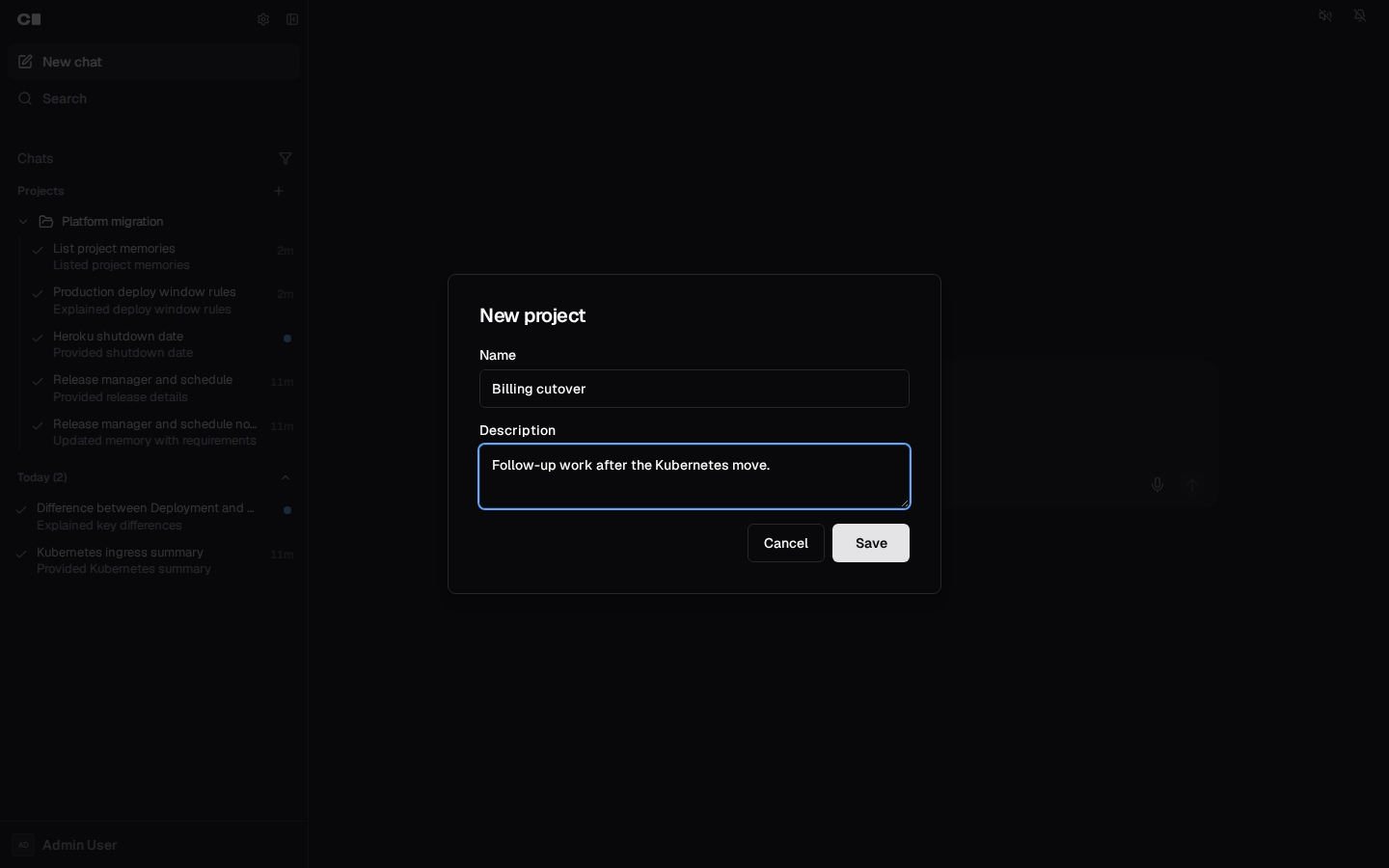 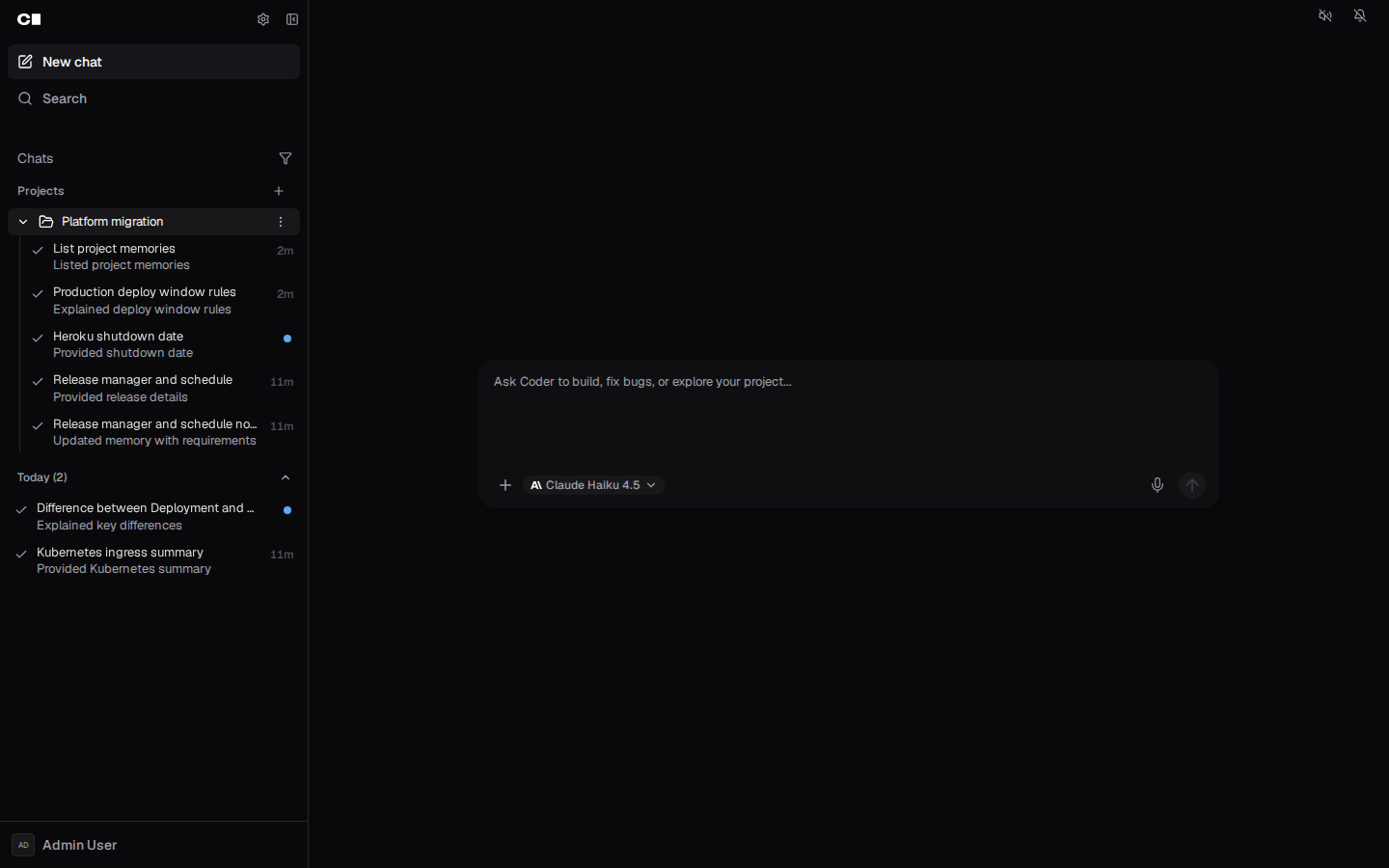 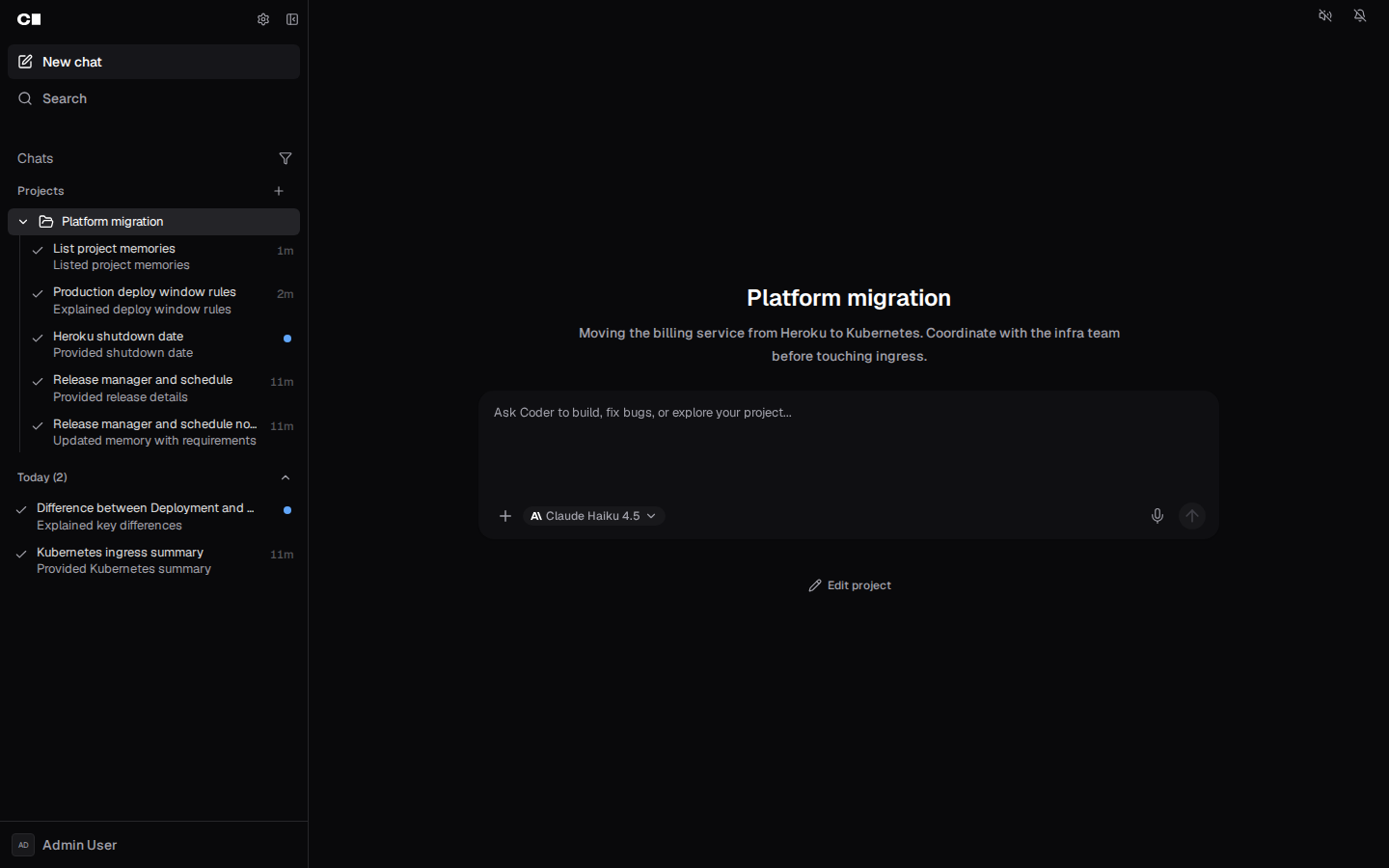 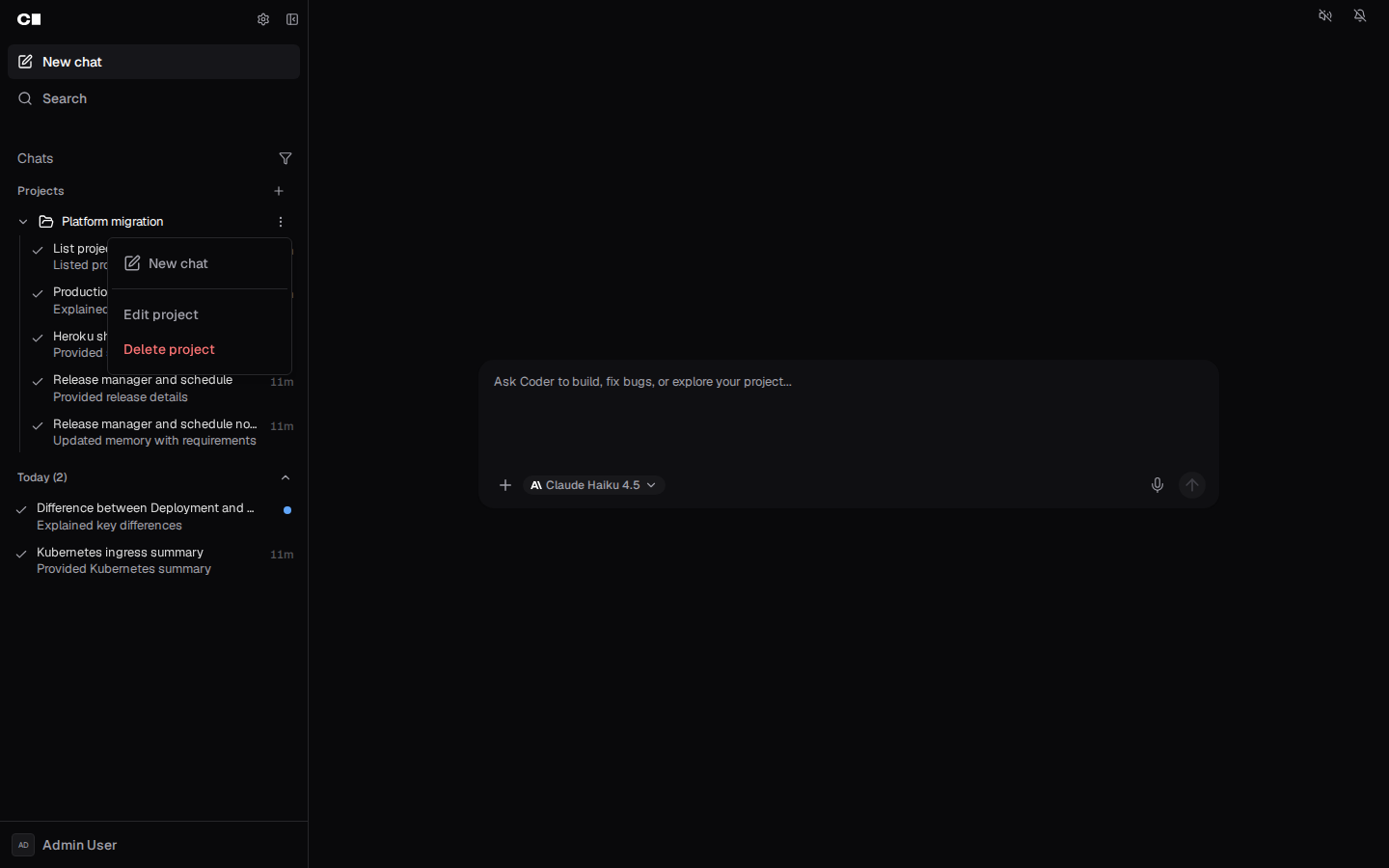  </details> --- Generated with Coder Agents on behalf of @f0ssel. --------- Co-authored-by: Claude Opus 5.5 (1M context) <noreply@anthropic.com> |
||
|
Thomas Kosiewski
|
d11809f095 |
fix(coderd): enforce chatd concurrent-agent capacity on every path into running (#30243)
## Problem

The concurrent-agent cap (5 root chats and 10 subagent chats per
deployment by default) could be exceeded. Three paths put more chats in
`running` with a fresh lease than the pool allows:

1. **Interrupting a waiting chat.** A user sends a message with
`busy_behavior=interrupt` to a chat that is waiting for capacity. The
chat becomes `interrupting` while unowned, a worker acquires it without
admission, and `FinishInterruption` promotes the queued message into a
running turn under that ownership.
2. **Taking over an orphaned `requires_action` chat.** A replica dies
while its chat is in `requires_action`, its lease goes stale and another
chat takes the slot. A worker acquires the `requires_action` chat
without admission, and a tool result, an interrupt or the action
deadline returns it to `running` under that ownership.
3. **Heartbeat reviving a stale lease.** A replica loses the database
for longer than the 30 second stale threshold and another replica admits
a second chat into the slot. When the first replica comes back, its
heartbeat upsert renews the stale lease unconditionally, and its runner
keeps generating until the turn ends.

## Root cause

`agentCapacityLimiter.Admit` returned `true` without taking the
admission lock or counting for every status other than `running`. The
count query already treats every owned chat with a fresh lease as
holding a slot, so the shortcut let chats acquire a slot uncounted and
later move back to `running` under that ownership. Separately,
`BatchUpsertChatHeartbeats` had no freshness or ownership condition.

## Fix

- **Admission for every runnable status.** `Admit` now counts for
`running`, `interrupting` and `requires_action`, and a refused pool
skips the rest of its candidates in the pass regardless of status. An
owned chat holds its slot until it releases ownership, so every later
transition back to `running` stays within capacity.
- **Fenced heartbeat renewal.** `BatchUpsertChatHeartbeats` is replaced
by `RenewChatHeartbeats`, which only extends rows that are still fresh
and still own their chat, using `statement_timestamp()` read after the
capacity admission lock is granted. The renewal runs under that lock
with a `lock_timeout` (`HeartbeatLockTimeout`) and a per-tick timeout
(`HeartbeatRenewalTimeout`, a third of the stale threshold). Admission
also waits at most 5 seconds for the lock.
- **Stop runners that lost their lease.** `heartbeatOnce` requests
cleanup of every runner whose lease was not renewed, which cancels its
generation. The chat stays owned by the stale lease until an admitted
worker takes it over. A tick that fails or times out cleans up no
runners and retries on the next tick.
- **Instant Stop on a queued chat.** Requiring admission for
`interrupting` would have made Stop on a chat waiting for capacity hang
until a slot frees. When `Interrupt`, or `SendMessage` with
`busy_behavior=interrupt`, runs on a running chat with no owner, the
transition now applies `FinishInterruption` in the same transaction and
cancels orphaned tool calls. An empty queue lands in `waiting`;
otherwise the queue head is promoted into `running`, still unowned, so
it goes through admission.
- **Queued metric.** `CountChatCapacityQueuedByPool` (behind
`coderd_chatd_agents_queued_for_capacity`) now also counts
`interrupting` and `requires_action` chats without a fresh lease, since
they also wait for admission.

## How it was found

A TLA+ model of capacity admission found a counterexample for each path.
Go tests reproduced all three against the previous code (each failed
with `"2" is not less than or equal to "1"` for a root pool of capacity
1), and the model with the fix enabled passes the safety invariant and
the liveness properties. The model itself is not part of this PR.

## Tests

The three reproductions are kept as regression tests in
`coderd/x/chatd/agentcapacity_regression_internal_test.go`:
`TestAdmission_InterruptWithMessageOnWaitingChatStaysWithinCapacity`,
`TestAdmission_RequiresActionTakeoverStaysWithinCapacity` and
`TestRunnerManager_HeartbeatDoesNotReviveStaleLease`. The original
reproductions failed on the base commit. Restoring the admission
shortcut makes the `requires_action` test fail, and restoring the
unconditional heartbeat upsert, or dropping the runner cleanup, makes
the heartbeat test fail. New coverage also includes
`TestAdmission_StopWaitingChatNeedsNoCapacity`,
`TestRenewChatHeartbeats_OnlyRenewsFreshOwnedLeases`,
`TestRunnerManager_FailedHeartbeatTickKeepsRunners`, and chatstate tests
for the unowned interrupt paths. Existing tests that encoded the old
behavior (`requires_action` chats holding no slot, interrupting chats
always acquirable, unconditional heartbeat renewal) were updated.

## Behavior / API change

- `POST /api/v2/chats/{chat}/messages` with `busy_behavior=interrupt` on
a chat that no worker owns (for example one waiting for capacity) now
returns the promoted message with `queued=false` instead of a queued
message, and the chat stays in `running` instead of `interrupting`. If
the chat already had queued messages, the queue head is promoted and the
new message stays queued.
- `POST /api/v2/chats/{chat}/interrupt` on such a chat lands it in
`waiting` immediately (or in `running` with the queue head promoted)
instead of `interrupting`.
- An unowned `interrupting` or `requires_action` chat (for example after
its replica died) now waits for a free slot before its runner starts,
which also delays enforcing its action deadline while the pool is full.
- New internal chat worker settings `HeartbeatRenewalTimeout` and
`HeartbeatLockTimeout`, defaulting to a third of the stale threshold and
half of that.
- Heartbeat ticks now take the capacity admission advisory lock briefly
on each replica.

## Out of scope / follow-ups

- Interrupting a chat still owned by a dead runner (stale lease,
`worker_id` set) still waits for a slot.
- An admission lock timeout should end the acquisition pass instead of
logging a warning per candidate.
- The per-chat `queued_for_capacity` flag in the chat API still reports
only `running` chats.
- Alert on failed heartbeat ticks.

`coderd/x/chatd/ARCHITECTURE.md` gains TODO lines for the affected
sections; the prose is left for the owner.

---
_Generated with [`xum`](https://github.com/coder/xum) • Model:
`anthropic:claude-opus-5-5` • Thinking: `high`_
|
||
|
Thomas Kosiewski
|
cdc87ee047 |
fix(coderd): recheck auto-archive candidates under the family lock (#30242)
Auto-archive read its candidates without locks and then archived each family without rechecking, so a chat that became active after selection (a new message in the root or a child, a pin, a status change) could still be archived. SetFamilyArchivedInput gains an optional Precondition that runs after the root and every family member row are locked root-first; auto-archive uses it to rerun the candidate filters for that root through the new GetAutoArchiveInactiveChatCandidateByID query and skips chats that no longer qualify. A parity test keeps the batch and by-ID queries in sync, regression tests cover root, pin and child activity races, and ARCHITECTURE.md describes the recheck. Builds on #30240. --- _Generated with [`xum`](https://github.com/coder/xum) • Model: `anthropic:claude-opus-5-5` • Thinking: `high`_ |
||
|
Thomas Kosiewski
|
303b822a85 |
fix(coderd/x/chatd): refuse to create a child chat under an archived root (#30240)
A late spawn_agent call, for example from a runner that lost its lease, could create a running, unarchived subagent under an archived root, breaking the family archive invariant. chatstate.CreateChat now locks the family root FOR SHARE in the insert transaction and returns ErrChatFamilyArchived when the root is archived, which serializes child creation with SetFamilyArchived (both lock the root first). spawn_agent also refuses an archived parent before prompt hooks run, and ARCHITECTURE.md documents the behavior. --- _Generated with [`xum`](https://github.com/coder/xum) • Model: `anthropic:claude-opus-5-5` • Thinking: `high`_ |
||
|
J. Scott Miller
|
fc0af7fbd8 |
feat: open a chat_turn span per prompt (#29771)
**TL;DR:** Wraps each prompt in a `chat_turn` root span with every lifecycle stage parented under it. The span records one outcome per turn (`completed`, `interrupted`, `error`, `abandoned`), and the new `coderd_chatd_turn_outcomes_total` counter counts those outcomes. Turns stay correct when tasks are canceled, replaced, or retried. Each prompt runs inside a `chat_turn` root span owned by the runner (`runnerTurnSpan`). The generation step, prepare, MCP connect, stream, TTFT, provider attempt, commit, thinking, tool call, compaction, and retry backoff stages are parented under it, activating the stages from #29770. `chat_turn` spans are standalone roots: the turn runs on a worker, often on another replica, and no trace context is persisted. **Lifecycle** - **Start.** Each generation loop iteration calls `Ensure`, which opens the turn if none is open and returns a `turnToken`. The span is backdated to the trigger: the latest of the last user prompt, a dynamic tool's result message after it, and a pending compaction request. An `acquisition` stage covers trigger to pickup. - **Stale trigger / takeover.** A trigger at or before the previous anchor opens the turn at now with no `acquisition` and counts `stale_anchor`. A runner that took the chat over from an owner with a stale heartbeat (`TakenOver`, from acquisition) opens its first turn at now with no `acquisition`, so the dead owner's run is not reported as pickup delay. - **Newer prompt.** `Ensure` on the current turn with a newer trigger closes it and opens a new one. The closed turn is `abandoned` unless the task that ran it records an outcome before releasing it. - **Finish.** After `FinishTurn` or `EnterRequiresAction` commits, the step calls `Complete`; `Settle` closes the span after the step's own stage ends, so the finishing step is inside the turn. A chat waiting in `requires_action` is outside any turn; the generation resumed by its tool results opens a new one. - **Emission.** Closing a turn fixes its end time; its span is emitted once every task that joined it (`Ensure` takes the task ID) has called `Release`, which `runTask` does after the task returns. A finishing task whose `FinishTurn` promoted a queued prompt therefore still counts its turn as `completed` even when the promoted task's `Ensure` runs before its `Complete`. `End` at runner exit emits whatever is left. - **Failure.** A step that commits `FinishError`, or fails closed, invalidates the turn as `error` after the commit. Errors the task runner retries, including task timeouts, keep the same turn open; an expected, non-retryable exit records no outcome and leaves the turn open until the interrupt task, a newer prompt, or runner exit closes it. A canceled generation task records no outcome and cannot obtain a turn token, so a replaced task never touches its successor's turn. - **Interrupt.** The interrupt task marks the open turn `interrupted` before `FinishInterruption` commits and closes it after. Only a stop (by the user or a parent agent) is `interrupted`; it ends with unset span status, since error status is reserved for `error` turns. runner shutdown, loss of ownership, and message edits close the turn as `abandoned` with unset status. - **Promotion.** Every promoting transition (`FinishTurn`, `FinishInterruption`, a send to an errored chat, `PromoteQueued`) returns the promoted message's queued time in its result, and one `recordQueueWait` helper records a standalone `queue_wait` to the promotion. The promoted turn opens at the promotion time. `chat_turn` is observed on `coderd_chatd_stage_duration_seconds` only for completed turns, so the histogram is completed-turn latency; every turn still emits its span. `coderd_chatd_turn_outcomes_total{outcome, chat_kind}` counts every closed turn exactly once (`completed`, `interrupted`, `error`, `abandoned`), matching the span's `turn_outcome`, under the `chat-stage-metrics` experiment. Turn time accounting is in draft #29772. **Stages and identity** - `tool_call` is a live stage around each local tool call in `chatloop`; the tool runs on its context, and it ends errored only when the tool fails to execute. Calls that never run (inactive, unknown, or rejected by policy) record no stage. - `mcp_connect` carries connected and failed server counts and ends errored only when servers were configured and none connected. - The compaction stage carries the model that runs the summary. - `withStageIdentity` puts scope and chat kind on the turn context. Detached background work runs in `background` scope as its own trace roots. - The `advisor` tool's nested model call appears only as its enclosing `tool_call`. ARCHITECTURE.md gains a "Lifecycle tracing" section. <details> <summary>Review decisions</summary> - Turn identity stays timestamp-based with targeted fixes (clamped acquisition, rotation on a newer trigger, invalidate after commit, fail-closed invalidation, settle closing invalidated turns) plus a takeover flag; keying turns on message IDs would not detect takeover and cannot express interrupted/abandoned outcomes. - Outcome classification: the interrupt task owns `interrupted`, and cancellation or a fence mismatch alone never records an outcome, so shutdown, ownership loss, and edits are `abandoned`. Only `error` turns set error span status. Remaining ordering races between a step and an interrupt are documented as known limitations in ARCHITECTURE.md. - Turns are emitted after the tasks that ran them return, not when they close, so an outcome a replaced task records while unwinding reaches its own turn; the successor task is not delayed. Chosen over an after-commit, pre-publish hook on `ChatMachine.Update`, which would fix only the `FinishTurn` ordering. - `requires_action` ends the turn rather than pausing it, so `chat_turn` measures chatd time; a prompt with client tools counts as several turns. - Promoted turns anchor at promotion time and `queue_wait` is always standalone, so `chat_turn` never includes time spent queued behind another turn. - The former `capacity_wait` stage (#29805) was dropped: it was a per-worker lower bound, excluded from accounting, and needed its own SQL and bookkeeping. #29805's remaining helpers are folded into this PR. </details> Supersedes #28972, #28973, and #29805. 🤖 This PR was generated by Coder Agents on behalf of @jscottmiller. |
||
|
Michael Suchacz
|
f5092aaa4a |
feat: make chat limits configurable deployment options (#28927)
Adds deployment options for the chat limits that shape turn behavior and API acceptance, replacing hardcoded constants in `coderd/x/chatd` and the chat API. Defaults are unchanged. | Option | Default | Limit | |---|---|---| | `CODER_CHAT_MAX_STEPS_PER_TURN` | 1200 | steps (model responses) in a chat turn | | `CODER_CHAT_MAX_GENERATION_RETRIES` | 25 | consecutive retries after a model generation fails with a transient error | | `CODER_CHAT_MAX_QUEUED_MESSAGES_PER_CHAT` | 20 | messages that can be queued in a chat | | `CODER_CHAT_MAX_ATTACHMENTS_PER_CHAT` | 50 | files linked to a chat; linking more deletes the earliest uploads | | `CODER_CHAT_MAX_PROMPT_BYTES` | 131072 | system prompt, plan mode instructions, and each user's custom prompt | | `CODER_CHAT_MAX_CONCURRENT_RECORDING_UPLOADS` | 25 | desktop recordings each server stores at the same time | `codersdk.DefaultChat*` constants remain the single source of truth. Values below 1 fail startup validation, and each option's description ends with "Must be at least 1." `chatd.New` fills any zero field in `chatd.Config.Limits` with its default once, `LimitsFromConfig` is a plain conversion, and the code that receives a limit as a parameter (the `chatstate` queue and file link checks, the turn step check, `chatretry.Retry`, and `chatadvisor.NewRuntime`) returns an error for a limit below 1 instead of choosing a default or disabling the limit. The options are documented in the generated configuration reference and in the platform controls docs. `CODER_CHAT_MAX_GENERATION_RETRIES` counts consecutive retries, and the count resets after each successful step. The default allows 25 retries (26 attempts) where the old constants allowed 24. The same limit now applies to each nested advisor model call and to background title, summary, and turn status label generation, which previously used fixed `chatretry` budgets. Chat creation and tool result bodies keep the fixed 256 KiB limit from main. The prompt-saving endpoints accept bodies up to twice the prompt limit, for JSON escaping and characters that sanitization removes, but never less than 256 KiB, so small prompt limits still return the 400 length error. At the default this equals the 256 KiB limit on main. Four settings from earlier revisions were removed, and the fixed limits from main are back: - `CODER_CHAT_MAX_TOOL_OUTPUT_BYTES`: the agent already keeps a 16 KiB head and a 16 KiB tail of command output, so raising it had no effect and lowering it cut the tail. - `CODER_CHAT_MAX_DYNAMIC_TOOLS_PER_CHAT`: tool definitions share the 256 KiB chat creation body limit, so raising the count did little. - `CODER_CHAT_DEBUG_MAX_BODY_BYTES`: one setting covered two unrelated debug caps. - `CODER_CHAT_DEBUG_MAX_TEXT_RUNES`: the name did not say what it applied to. Root and subagent concurrency caps stay fixed because they are licensing behavior, and `MaxChatFileSizeBytes` stays fixed because the web UI hardcodes the generated constant for client-side checks. `codersdk.MaxChatFileIDs` is removed; the web UI's "Attachment expired" tooltip no longer quotes the number because the cap is now per deployment, and it says that attaching a file beyond the limit permanently deletes the chat's earliest-uploaded attachments. ## Review record | Round | Reviewed head | Result | Disposition | |---|---|---|---| | Codex 1 and 2 (Sep 2 to 3) | `7f10a1572f8`, `8ee09f8fa3b`, `197bb78d5b` | 10 findings, then OK on `197bb78d5b` | all threads resolved | | Codex 3 (Sep 17) | `e4efac249a5` (pre-rebase) | 4 findings | advisor retry limit confirmed and fixed in `9e462b7b3d0` (rebased from `67341e458e8`); ARCHITECTURE.md TODOs added; JSON-escaping body sizing and streamed-argument rune cap declined as pre-existing design (evidence in threads) | | Codex 4 (Sep 18) | `9e462b7b3d0` | 6 findings | recording evicted at attachment cap 1 confirmed and fixed in `5b61895decb`; `Limits` field docs and zero-value fallback documented; prompt retro-enforcement, generated multi-sentence lines, and tool-output truncation metadata declined as pre-existing design (evidence in threads) | | Codex 5 (Sep 18) | `5b61895decb` | 1 finding | over-cap batch of already-linked files accepted after lowering the cap: confirmed and fixed in `f44063e74e5` | | mafredri (Sep 23) | `f44063e74e5` | 24 threads, changes requested | all fixed in `05e3e3d622a`, `c1f78e09e8b`, `709ddb67977`, `d0587a49829`, `ca4347b24de`, and `1f6c9e2a46f`, then answered and resolved; the ARCHITECTURE.md text was written at the author's direction and approved by the author | | Sibling sweep (Sep 24) | `1f6c9e2a46f` | author-requested audit of all 24 mafredri threads for sibling issues, plus a test refactor | fixed in `37eaf07d34d` through `1f14ac041b7`: the advisor retry limit, `chatretry.Retry`, and the turn step check reject values below 1 instead of disabling retries or the limit; limit tests run against both the default and configured values set through `chatd.Config` or `DeploymentValues`; the expired-attachment tooltip is concrete. A required coder-frontend-review run (8 roles in one agent, CD re-run once) found a stale story comment, removed. | | Codex 6 (Sep 27) | `a71383e3a31` | OK, no findings | requested after the rebase at the author's direction, past the six-pass review budget | The branch was rebased onto main `4851c7b60c8` on Sep 27; the previous head was `91b84000adb`, and the earlier SHAs in the review record predate the rebase. Conflicts in the `chatstate` transitions and `CreateChat` keep both main's `InitialStatus` and this PR's `MaxFileLinks`, and main's rewrite of `advisor_internal_test.go` in #28754 keeps main's version plus this PR's limit tests. Two tests added on main needed the new retry arguments: `TestGenerateStructuredTitleWithUsage_FallsBackToTextWhenToolChoiceRejected` and `TestAdvisorRunStreamsReasoningDeltasSeparatelyFromAdvice`. Validation on `a71383e3a31`: the pre-commit hook (generation, golangci-lint, build), the full `coderd/x/chatd/...` suite (20 packages), the chat tests in `codersdk`, `coderd`, and `enterprise/coderd`, the CLI help tests, race-detector runs of the `chatd`, `chatstate`, `chatadvisor`, and `chatretry` packages, and `go build` plus `go vet` on each of the 27 commits. No remote UAT was run. > Xum acted on behalf of @ibetitsmike for this pull request. |
||
|
Michael Suchacz
|
0eed5465f2 |
feat: allow creating chats without an initial message (#27111)
> Written by Mux on behalf of Mike.

## What

`POST /api/v2/chats` now accepts an empty `content` array. The chat is
created idle (`waiting`) with system messages only: no user message is
inserted, no ownership hint is published, and no chat worker picks it
up. Generation starts when the first message is POSTed to
`/chats/{chat}/messages`.

## Why

The new-chat page needs to upload files into the chat's workspace before
the first turn, and `POST /chats/{chat}/workspace-files` requires a chat
ID. There was previously no way to sequence "create chat, upload files,
send first message": creation required non-empty content and started
generation immediately. This PR adds the enabling primitive; the UI
lands in the next PR of the stack.

## How

- `chatstate.CreateChat` takes an explicit `InitialStatus` (`waiting` or
`running`, validated). The existing `IsRunnable()` gate keeps ownership
hints suppressed for `waiting` chats.
- `chatd.CreateChat` derives the status from `InitialUserContent`: empty
content means `waiting` with system messages only, and `APIKeyID` is
only required when a user message is inserted.
- `createChatInputFromRequest` returns empty blocks for empty content
instead of rejecting; the `/messages` path still rejects empty sends.
- Chats created this way carry the `New Chat` placeholder title. Title
generation now treats that placeholder as replaceable. When the first
message lands on such a chat, `chatd.SendMessage` detects the first user
turn inside its transaction (under the chat row lock), writes the
fallback title in the same transaction, and reports `FirstUserTurn`;
`postChatMessages` then fires `GenerateChatTitleForMessagesAsync` to
upgrade it. A failed title call therefore still leaves a meaningful
title.
- `ARCHITECTURE.md` carries `TODO (#27111)` items in the transition list
and the `POST /api/v2/chats` section for the new `N -> Create -> W`
transition (the doc text and the diagram edge are left for the author
per the chatd guardrail).

## Follow-ups

- Automatic title generation (both the create path and the first-message
path added here) writes the generated title unconditionally, so a user
rename that lands while the title model call is in flight is
overwritten; a compare-and-set title update would close that
pre-existing window.
- `chats.last_reasoning_effort` is derived from inserted messages, so an
idle chat created with `reasoning_effort` does not persist it until its
first message; the first message applies the owner's personal
reasoning-effort override (when it targets the same model) if the
request omits an effort, matching `POST /chats` with content.

## Testing

- chatstate: `N -> W` lands in `StateW` with no ownership hint; invalid
initial statuses are rejected.
- chatd: empty create produces a `waiting` chat with system messages
only.
- HTTP: empty create + first message (`W -> R0`, inserts directly, not
queued), immediate archive of an idle chat, workspace file upload
against an empty-created chat, and title generation on the first
message.
|
||
|
Ethan
|
f64ccfb836 |
feat: add experimental inline MCP servers (#29546)
Closes CODAGT-1131 Fifth PR in the inline MCP servers stack, on top of #29520. A chat owner can now declare MCP servers by URL and headers on their own chat, and chatd connects to them every turn alongside the org-configured ones. They go in a new `inline_mcp_servers` field on `POST /api/v2/chats` and `POST /api/v2/chats/{chat}/messages`, which replaces the whole set (omit to keep, `[]` to remove). Root chats only. `GET /api/v2/chats/{chat}` returns them, with the URL blanked for non-owners and header values never returned. Subagents only get servers marked `allow_in_subagents`, a root chat in explore mode gets none, and a root chat in plan mode gets all of them. URLs must be `https`, or `http` to an IP literal in `CODER_MCP_ALLOWED_PRIVATE_CIDRS`. Header values have no minimum length, so anything under the redactor's 8 byte floor from #29518 is accepted but not redacted, which the docs call out. Every cap is exported from `codersdk`. It's behind the `chat-inline-mcp-servers` experiment, and the `--disable-chat-caller-supplied-tools` kill switch from #29466 covers it too. With either off, declaring servers gets a 403 and existing chats stop connecting to theirs, but `[]` still works so a client can detach. Load failures show up in the chat debug panel as failed connections, as do org servers with an invalid config. Docs are hand-written in `mcp-servers.md`. |
||
|
Thomas Kosiewski
|
2de1f8b111 |
feat: link promoted chat messages to their queue entry (#29859)
Signed-off-by: Thomas Kosiewski <tk@coder.com> |
||
|
Michael Suchacz
|
fd5b37576a |
feat(coderd): record provider response IDs on chat messages (#29763)
Chat messages could only be linked to AI Gateway records per chat, so nothing recorded which model response produced a given message. fantasy surfaces the response ID the model endpoint returns on the stream's finish part: the Anthropic Messages ID as the part ID, and the OpenAI Responses ID in provider metadata. chatd now stores that ID in the existing `chat_messages.provider_response_id` column for assistant steps and the compaction summary row. No migration and no aibridge changes. What the stored value is depends on the route: | Route | Stored value | Joins to | |---|---|---| | Anthropic Messages API through the AI Gateway (Anthropic and Bedrock Claude) | The gateway's interception ID. The gateway replaces the message ID because injected MCP tool loops can fold several upstream messages into one response. | `aibridge_interceptions.id` | | OpenAI Responses API through the AI Gateway | The upstream `resp_` ID, passed through unchanged | `provider_response_id` on `aibridge_token_usages`, `aibridge_user_prompts`, and `aibridge_tool_usages` | | Direct to the provider | The provider's own ID (`msg_`, `resp_`) | Nothing in the gateway tables | To resolve messages to interceptions, then read usage by `interception_id`: ```sql SELECT cm.id AS chat_message_id, i.id AS interception_id FROM chat_messages cm JOIN aibridge_interceptions i ON i.id::text = cm.provider_response_id UNION SELECT cm.id, tu.interception_id FROM chat_messages cm JOIN aibridge_token_usages tu ON tu.provider_response_id = cm.provider_response_id; ``` Not covered, and left NULL: - Partial rows saved on interrupt, because fantasy only reports the ID in the finish part. - Chat Completions providers (OpenAI-compatible, OpenRouter, Vercel), because fantasy does not surface the chunk ID there. - User, tool, and system rows, and all existing messages. <details> <summary>Delivery record</summary> - `96a896c` replaced the earlier interception-link design (`59fa58f`, `7f93c18`, `9d04ccd`) in place: the aibridge hook, the `aibridge_interception_id` column and migration, the message part buffer tracking, and the `ARCHITECTURE.md` section are all removed. The net diff against the base touches only `coderd/database` and `coderd/x/chatd`. - Local validation on `96a896c`: pre-commit hook green (gen, fmt, lint, build); `go test ./coderd/x/chatd/... ./coderd/database/` green. Red-green: removing the finish-part capture fails both new end-to-end tests (`TestActiveServer_PersistsAnthropicMessageID`, `TestOpenAIResponsesPersistsProviderResponseID`). CI on `96a896c`: green. - Remote UAT round 2 on `96a896c` ([chat](https://dogfood.cdr.dev/agents/75353a23-cd9e-4c81-a99f-472c78f3ba32)): **FAIL** against this description's earlier claim that every stored ID joins the gateway usage rows directly. Anthropic rows routed through the gateway stored the interception ID, so 0 of 18 joined usage rows directly, while every checked Anthropic row equaled `aibridge_interceptions.id`. Both OpenAI Responses rows joined directly. Interrupted partial rows, Chat Completions rows, and user and tool rows were NULL, with no empty strings or duplicate IDs. Multi-step turns, manual compaction, edit and regenerate, a provider switch, and a retried 429 behaved as expected. One unattributed anomaly: a single duplicate user row after interrupt and continue, which did not reproduce and is outside this diff. - `2e889ba` corrects the doc comment on `PersistedStep.ProviderResponseID` and this description to match; behavior is unchanged. Pre-commit hook and CI green. - Remote UAT round 3 on `2e889ba` against the corrected contract ([same chat](https://dogfood.cdr.dev/agents/75353a23-cd9e-4c81-a99f-472c78f3ba32)): **PASS**. The query above resolved all 40 stamped rows to exactly one interception from the same chat, with none unresolved. Reading usage by interception recovered every usage row for 38 of them; the last two resolved but their usage rows were not counted. Fresh Anthropic and Responses calls, a seven-step tool turn, manual compaction, an Anthropic to Responses to Anthropic switch in one chat, and a UI reload behaved as described, and the NULL cases held. Three interrupt and continue attempts did not reproduce the round-2 duplicate, so it stays unattributed. Not tested: gateway-injected MCP tool loops (unreachable from chatd, whose delegated requests skip the gateway's MCP proxy), direct Anthropic `msg_` IDs, Bedrock, and threshold-triggered compaction. Both rounds had a verified isolation proof and a clean dogfood audit. - Codex rounds 1 to 3 reviewed the old design. Codex round 4 on `2e889ba` ([request](https://github.com/coder/coder/pull/29763#issuecomment-5796193371), 13:58Z): no major issues ([result](https://github.com/coder/coder/pull/29763#issuecomment-5796267231), reviewed commit `2e889ba05c`). No unresolved review threads. Review passes so far: 4 of 6. - Final head `2e889ba` is the exact commit remote UAT round 3 and Codex round 4 covered; required checks green. </details> > Xum updated this PR on behalf of @ibetitsmike. |
||
|
Michael Suchacz
|
680b2f59cd |
refactor: remove obsolete chatd code and tests (#29228)
Chatd still carries an unreachable interruption flush path, unused state and options, an uncalled workspace MCP cache invalidation callback, and a stream-buffer-drop counter that production never increments. Remove these paths and their dedicated assertions, and update the generated metrics inventory and documentation. Consolidate duplicate publication and rollback tests and move fixture writers and test-only inspection helpers into test files. Retain the interruption persistence, state-machine matrix, legacy message format, and provider compatibility coverage. |
||
|
Ethan
|
d8e3f4fcf7 |
feat: evict the oldest attachments at the chat file cap (#29063)
Closes CODAGT-933 Long agent sessions were hitting the 50 attachment cap, after which every upload, screenshot and `attach_file` call was rejected, so people were abandoning otherwise healthy chats. Rather than raise the cap (which just moves the cliff and multiplies the worst-case per-chat `bytea` storage), a chat now keeps its 50 most recent attachments. `LinkChatFilesAfterLock` deletes the oldest `chat_files` rows in the same statement and the cascade drops their links. Files in the incoming batch are never evicted, so the only remaining rejection is a single message with more than 50 files. Nothing in the product ever linked one file to two chats, so rather than guard the eviction against it, this adds `UNIQUE (file_id)` on `chat_file_links`, with the migration dropping any existing duplicates in favour of the oldest chat. Evicted attachments render as the existing "Attachment expired" tile. A `pinned` flag is the obvious follow-up if someone needs to keep a specific file around. |
||
|
Michael Suchacz
|
ac824cd235 |
chore(coderd): remove dead code from chatd (#29008)
Removes production code in `coderd/x/chatd` that nothing reaches, the tests that only existed to exercise it, and option/config fields that callers filled in but chatd never read. No runtime behaviour changes; the only edits outside `coderd/x/chatd` drop the now-nonexistent fields at their three call sites (`coderd/coderd.go`, `coderd/exp_chats.go`, `coderd/coderdtest`). Net: 42 files, +147 / -1065. Verification method for every item: `golang.org/x/tools/cmd/deadcode` (with and without `-test`) rooted at `cmd/coder`, `enterprise/cmd/coder` and every package that imports chatd; a `go/packages` pass counting `TypesInfo.Uses` per declared type, const, var, field and method across the same roots, split into test and non-test use sites, plus a read-vs-write split for struct fields; `rg` over the whole repo including `site/src` for json tag names; then `go build ./...`, `go vet ./coderd/x/chatd/...`, `golangci-lint run ./coderd/x/chatd/... ./coderd/ ./coderd/coderdtest/`, and `go test ./coderd/x/chatd/...` (all 20 packages) locally. <details> <summary>Evidence per deletion</summary> | Removed | What it was | Why unused | |---|---|---| | `subagent.go` `resolveConfiguredModelOverride`, `parseModelOverride`, `parsedModelOverride` (~135 lines) + `TestResolveConfiguredModelOverride_*`, `TestParseModelOverride` | raw-string model override resolver | Only callers were its two tests; production resolves overrides through `resolveOrganizationModelOverride` (`title_override.go`, `compaction_override.go`, `subagent.go`). | | `chatd.go` `removeSkillIndexMessages`, `isSkillIndexMessage` + `TestSkillIndexRefreshReplacesStaleAliases` | skill-index refresh helpers | Zero production references; the test simulated a refresh path no production code performs. | | `chatd.go` `chatMessage`, `newChatMessage`, `withCreatedBy`, `appendMessageFields`, `BuildSingleChatMessageInsertParams` (~90 lines) | insert-params builder | Exported, but every caller was a `chatd_test` file (6 sites). Replaced by a 25-line `singleChatMessageInsertParams` helper in `chatd_helpers_test.go`. | | `chatd.go` `Server.closeInflightAdmission` | one-line wrapper around `inflightClosed.Store(true)` | Single call site (`Close`); inlined. | | `chatd.go` `Server.workerID`, `instructionLookupTimeout`, `pendingChatAcquireInterval`, `maxChatsPerAcquire`, `chatHeartbeatInterval` | Server struct fields | Assigned in `New` and never read anywhere (the values reach the worker through `chatWorkerOptions`, not these fields). | | `Config.InstructionLookupTimeout`, `homeInstructionLookupTimeout`, `coderd.Options.ChatdInstructionLookupTimeout`, `coderdtest.Options.ChatdInstructionLookupTimeout` | timeout plumbing | The value only landed in the dead `Server.instructionLookupTimeout`; no CLI flag sets it and nothing reads it. | | `PromoteQueuedOptions.CreatedBy` | option field | Set by `coderd/exp_chats.go` and three tests, never read in chatd (promotion keeps the queued row's `created_by`). | | `SubmitToolResultsOptions.DynamicTools` | option field | Set by `coderd/exp_chats.go` (which re-read `chat.DynamicTools` just to pass it) and three tests, never read in chatd. | | `attachments.go` `buildAssistantPartsForPersist` (whole file) | assistant part builder | Stale copy left by #26270; production uses `buildAssistantParts` in `message_conversion.go`. Its six tests were retargeted to the live function (now `message_conversion_internal_test.go`) and a dead-copy assertion in `subagent_internal_test.go` was dropped. | | `chatloop.RunOptions` (94 lines) | old loop options struct | Only two of 23 fields were ever populated, for one internal call to `prepareMessagesForRequest`, which now takes `model, logger` directly and no longer returns the ignored canonical slice. `GenerateAssistantOptions` / `ExecuteLocalToolsOptions` are the live types. | | `chatloop.ErrDynamicToolCall`, `ErrStopAfterTool`, `PendingToolCall`, `PersistedStep.PendingDynamicToolCalls` | dynamic-tool exit protocol | Zero references outside their declarations (one stale comment in `chatdebug/service.go` updated). | | `chatloop.CompactionOptions.Persist`, `.OnError` | callbacks | `Persist` had zero references; `OnError` was set only by two tests that asserted it was never invoked. | | `chatloop` `stepResult.shouldContinue` + its computation | flag | Written once, never read. | | `chatloop.StateWaiting` | metric label const | Zero references. | | `generation.go` `generationOutcome.InsertedMessages`, `runnerActionMessage` | outcome field | Built on every commit, never read. | | `chatstate` `ExecutionState.IsArchived`, `AllOwnershipStates`, `OwnershipState`/`StateU`/`StateO`, `TransitionAcquire` | state-machine leftovers | Zero references (the ownership consts became dead once `AllOwnershipStates` went). | | `chatstate` `ExecutionState.QueueNonEmpty` | predicate | Only referenced by the test asserting its own table; the sibling `IsRunnable` check in that test is kept. | | `chatdebug.Attempt.RetryClassification`, `.RetryDelayMs` | json fields | Never assigned anywhere, `omitempty`, and `retry_classification`/`retry_delay_ms` do not appear in `site/src` or `typesGenerated.ts`. | | `chatdebug.RunContext.Kind`, `StepContext.HistoryTipMessageID`, `RecorderOptions.Provider`/`.Model`, `stepHandle.opts`/`.usage`/`.err` | context/handle fields | Written (from `chatd.go`, `chatloop/compaction.go`, `modelcall.go`, `recorder.go`) and never read. The DB run row keeps its own `kind` column. | | `chatprovider.MergeProviderAPIKeys` + `TestMergeProviderAPIKeys_PreservesProviderRegions` | key merge | Superseded by `ResolveUserProviderKeys`, whose region test already covers the same behaviour. | | `chatprovider` `providerCreationError` | one-line `xerrors.Errorf` wrapper | Single call site; inlined with identical message. | | `chatretry.IsRetryable` | classifier wrapper | Zero references. | | `computeruse.IsTool` + `TestComputerUseTool` | one-line forwarder to `fantasyopenai.IsComputerUseTool` | No production caller; two test assertions now call the fantasy function directly, and the dropped test only asserted the library's own constructor. | | `chatprompt.ToolResultToPart` | one-line forwarder to `codersdk.ChatMessageToolResult` | Single call site; inlined. | | `subagent_catalog.go` `formatSubagentDefinitions` | forwarder with `nil` overrides | Single call site; inlined. | | `worker.go` `chatWorker.chatWorkerID` | getter | Only tests called it; they read `opts.WorkerID` directly now. | | `chattest.AnthropicErrorResponse`, `OpenAIServerErrorResponse`, `ChatMessageWithParts` (`messages.go` removed) | test fixtures | Zero references. | | `chattest` `AnthropicRequest.Options`, `OpenAIRequest.Options` | `json:",inline"` map fields | `encoding/json` has no inline tag (the TODO on each said so); never populated, never read. | </details> <details> <summary>Considered and kept</summary> - `chatstate.CreateChat` (test-only thin wrapper over `insertChat`, production uses `CreateChatWithID`): documented package API with 25 test call sites; not worth the churn. - `chatprompt.MarshalContent` / `MarshalToolResult`: test-only, but they deliberately produce legacy-format DB rows so the read path's legacy handling stays covered. - `chatstate.AllowedExecutionTransitionsFrom` / `AllowedInputStates` / `AllowedExecutionTransitionOutputs`, `chatdebug.StepFromContext`, `WithClock`, `WithStaleThreshold`, `WaitUntilIdleForTest`, `PublishBuffer.BufferedChannels`, `chattool.NewWorkspaceMCPTool`: test seams that tests actively use to reach otherwise unexported state. - `AgentCapacityLimiter` interface (one production implementation): tests inject fakes. - `applyHookResultMessages` / `appendHookResultMessages`: a named pair over one placement enum, both used. - Nil-receiver guards on `*Metrics`, `*Result`, `*streamSyncPoller`, `*runnerDebugTurn`: nil is a supported "disabled" value on those paths. - Tests flagged by heuristics as assertion-light (`TestNopMetrics_DoesNotPanic`, `TestStepHandleFinish_NilHandle`, `TestRetry_OnRetryNilDoesNotPanic`, the `chatstate` synthetic-cancellation tests that assert through helpers): they cover real nil-safety or delegate assertions to helpers; kept. </details> <details> <summary>Out-of-scope findings (not changed here)</summary> - `chatdebug.Service.FinalizeStale` has had no production caller since #26270 removed the background sweep loop; only its tests call it, and comments in `chatd_debug.go` and `database/querier.go` still describe the loop. Deleting it would erase the implementation a fix needs, so it is left for a decision. - `coderd_chatd_chats` (gauge) and `coderd_chatd_stream_buffer_dropped_total` (counter) are registered and documented in `docs/admin/integrations/prometheus.md` but never set or incremented in production; `Metrics.RecordStreamBufferDropped` is test-only. Removing them changes the exported metric set and the docs, so they are left alone. </details> ## Declined review findings None yet. > Xum (AI agent) opened this PR on behalf of @ibetitsmike. |
||
|
Michael Suchacz
|
9c42b14857 |
feat: add /clear chat context command (#24745)
> [!NOTE]
> Xum acted on Mike's behalf in this pull request.
<!-- xum-attribution: model=claude-fable-5 thinking=high -->

Adds a `/clear` slash command to Agents chats that resets the model
context without deleting anything: the transcript stays visible, and the
next prompt runs as if the chat were brand new. It mirrors `/compact`'s
UX (slash menu entry, exact-text interception, dedicated endpoint,
synthetic tool block in the transcript) but generates no summary and
makes no model call.

## How it works

`POST /api/experimental/chats/{chat}/clear` commits synchronously inside
the API transaction through a new `chatstate` transition,
`ClearContext`, allowed from `waiting` and from `error` without queued
messages (`W -> W`, `E0 -> W`). No worker round-trip, no status flicker
to `running`, no migration. Clearing an errored chat clears
`last_error`, and any pending manual compaction request is dropped
rather than left to run against the cleared context.

The endpoint persists the same compressed boundary shape `/compact`
uses: a hidden model-only sentinel row, a visible synthetic
`chat_cleared` tool call, and its result. Prompt assembly already
selects the latest compressed model-only row as the context cutoff, so
the query is unchanged. Boundary detection is generalized to recognize
both `chat_summarized` and `chat_cleared`, so `/compact` after `/clear`
(and the reverse) never reach across the newer boundary, and
auto-compaction does not fire off stale pre-clear usage.

Busy chats, errored chats with queued messages, and clears with no
conversation after the latest boundary return 409. Archived chats are
rejected. The endpoint is owner-only for symmetry with `/compact`.

## Frontend

`/clear` joins the slash command menu, and the previously compact-only
send interception becomes a small built-in command dispatch shared by
both commands, so a personal or workspace skill named `clear` still
takes precedence. Because the clear commits synchronously, the UI keeps
the chat in `waiting`, refetches on success, and surfaces conflicts with
the standard error toast. The transcript renders a "Context cleared"
card via a new `ChatClearedTool` renderer.

## Docs

The user-facing agents architecture page documents `/clear`.
`coderd/x/chatd/ARCHITECTURE.md` carries TODO notes in the affected
sections for the PR author to write.

## Tests

- `chatstate`: transition matrix entries plus dedicated `ClearContext`
coverage (error-state entry, queued-message rejection, boundary row
requirement).
- `chatd`: end-to-end manual clear (fresh next prompt, error recovery,
boundary interplay with compaction, stale-usage auto-compaction
regression, busy rejection) plus boundary and message-builder units.
- `coderd`: HTTP authorization and error mapping for the endpoint.
- Frontend: slash command availability and skill collision units,
stories for the submit path, the conflict toast, and the cleared-card
renderer.
|
||
|
Garrett Delfosse
|
378ac91b49 |
fix: stem chat search terms with the english text search config (#28319)
Chat message search used the `simple` text search config, which folds case but does no stemming, so `refactor` did not match messages containing `refactoring`. Message bodies now index and query with the `english` config, which stems both sides. Titles, PR titles, and all other filters are unchanged. Migration `000585` adds a `chat_messages.search_tsv_config` enum column recording which config produced each stored vector and stamps existing vectors `'simple'` (a column-only update; vectors and indexes are untouched, since rewriting `search_tsv` would block message writes on large tables). The dbpurge sweep gains a bounded `ReindexStaleChatMessagesSearchTsv` pass that rewrites stale vectors newest first and stops for the process lifetime once drained. Until a row is rewritten, `GetChats` matches it with the config that produced it, so pre-migration exact-form searches keep working during the drain. Vectors written by old binaries mid rolling upgrade cannot stamp the config, stay pending, and self-heal on the next upgraded sweep. Steady-state DB load is unchanged. The down migration resets `english` vectors to `NULL` so the parent version's existing sweep rewrites them with `simple`. Closes [CODAGT-867](https://linear.app/codercom/issue/CODAGT-867/backend-search-improvements-to-handle-partial-matches) <details> <summary>Decision log</summary> - **`english` stemming over prefix matching.** On a 300k-row corpus a stemmed lookup is a single GIN entry-tree probe, while `term:*` prefix matching unions posting lists of every lexeme sharing the prefix (up to a full scan for short prefixes), is asymmetric, and loses the `websearch_to_tsquery` phrase/OR/negation UX. `pg_trgm` rejected as a heavier index with different semantics. - **Scope to message bodies only** (review). Titles and PR titles keep their `simple` FTS expressions and indexes, identical to main. - **Config-versioned queue over migration-time reset** (review). An unqualified `UPDATE ... SET search_tsv = NULL` rewrites every indexed row in the migration transaction, and an old replica could backfill reset rows with `simple` vectors that permanently leave the `search_tsv IS NULL` queue. The config column makes staleness explicit and both problems disappear. - **Enum over `text`** (review) for the config column. - **Trade-offs.** English stopwords are dropped from message search (stopword-only queries match no messages); stemming is English-specific; titles do not stem; prefix matching remains out of scope. </details> --- 🤖 This PR was generated by Coder Agents on behalf of @f0ssel. |
||
|
Ethan
|
f32592ec6b |
feat!: scope chat model configs to organizations (#27955)
## Summary Scope chat model configurations and runtime model resolution to organizations. Each model configuration now belongs to exactly one organization, each organization can have its own default model, and Chatd only uses models that belong to the chat's organization. Depends on #27968. ## Problem Chat model configurations are currently deployment-wide even though chats belong to organizations. A default model, explicitly selected model, or configured model override can therefore reference the same model configuration from every organization. This prevents model catalogs and defaults from being isolated by organization and allows a chat to retain or select a model that its organization does not own. Existing model configurations also have no organization ownership or organization-scoped ACL data, and the database enforces a single live default across the entire deployment. ## Fix Add required organization ownership and ACL storage to chat model configurations. The migration assigns every existing configuration to the default organization, seeds organization-wide read access, and replaces the deployment-wide default constraint with a per-organization constraint. Scope Chatd lookup, admission, fallback, and queue-promotion behavior to the chat's organization: - New chats use the usable default model from their organization. - Explicit model selections from another organization are rejected. - Deployment or personal overrides that point to a foreign model are not used for the chat. - Historical cross-organization model references remain unchanged in the database, but runtime generation falls back to a usable local default. - Queue promotion resolves unavailable, disabled, missing, or foreign stored models to the usable local default and fails when no usable local default exists. The existing model configuration management and availability routes remain compatibility routes for the default organization in this layer. A later layer in the stack adds organization-scoped management routes and updates clients to use them. ## Breaking change This changes chat model behavior from deployment-wide to organization-scoped. Existing configurations are migrated only to the default organization; they are not copied into every organization. As a result: - A non-default organization no longer inherits the deployment's existing default model. - Creating a chat in an organization without a usable local default fails with `400: No default chat model config is configured.` - Explicitly selecting a configuration owned by another organization fails with `400: Model config does not belong to the specified organization.` - Existing chats whose stored model belongs to another organization can generate only if a usable local default is available; otherwise generation fails. Deployments using Agents in non-default organizations must configure a usable default chat model separately for each organization after the organization-scoped management layers in this stack are available. _This pull request description was generated by Coder Agents._ |
||
|
Michael Suchacz
|
1458d27d78 |
fix: allow manual chat compaction from the error state (#28022)
A chat that fails generation with a context overflow (for example `Input
length 262625 exceeds the maximum allowed input length of 262112
tokens`) is stuck in a catch-22: `POST /chats/{id}/compact` returns 409
because the `RequestCompaction` transition is only allowed from the
waiting state, and the only other way out of the error state is sending
or editing a message, which re-runs generation with the same oversized
prompt and fails again. Compaction is exactly the recovery a
context-overflowed chat needs, and it is unreachable exactly when it is
needed.

Three semantic changes:

- Allow `RequestCompaction` from the error states: `E0 -> R0` and `E1 ->
R1` (queued messages are preserved and processed after the compaction
turn).
- Clear `last_error` in `Tx.RequestCompaction`, matching the
architecture rule that transitions leaving `E0`/`E1` clear the stored
error. Without this a successful compaction would land in waiting with a
stale persisted error.
- Grant the compaction turn a fresh history epoch: a
`grant_history_epoch` flag on `UpdateChatExecutionState` sets
`history_version = snapshot_version`, resets `generation_attempt`, and
clears `retry_state` in the same atomic update that clears `last_error`
(mirroring the `chat_messages` trigger postcondition). The transition
inserts no history, so without this the turn inherits the failed turn's
spent retry budget, and resetting the counter alone could collide with
message part episode keys still retained on the erroring replica.

No frontend change is required: the chat input is already enabled in the
error state and `/compact` submission already handles both the success
and 409 paths. Also updates ARCHITECTURE.md (transition matrix,
endpoint, and manual compaction sections), the endpoint's swagger
description, and SDK comments.

> Mux created this PR on Mike's behalf.

<!-- mux-attribution: model=claude-sonnet-4-6 thinking=high -->
|
||
|
Michael Suchacz
|
57f38b5c24 |
fix: keep chat attachments while a linking chat exists
Fixes https://linear.app/codercom/issue/CODAGT-616/keep-chat-attachments-while-chats-remain-unarchived Chat attachments could disappear even though the chat was still available. This happened when a message was saved without recording which attachments it used, or when cleanup deleted attachments before an archived chat itself was removed. Creating a chat, sending or queuing a message, and editing a message now record both the message and which attachments it uses as one operation. If the chat is already at the 50-attachment limit, the chat change fails without being partially saved. Concurrent attachment writes serialize the 50-file cap per chat. Cleanup locks candidates and checks again for new links before deleting. If a file becomes unavailable after input validation, create, send, and edit return a clear client error and roll back the chat change. An attachment stays available while any chat that uses it still exists. After an archived chat reaches the end of its retention period and is deleted, an old attachment that no remaining chat uses can be cleaned up. The retention guide and unavailable-attachment UI text document this lifecycle. This change cannot restore attachments that were already deleted. The database migration adds two indexes so attachment cleanup stays fast as attachments accumulate. > This PR was authored by Mux (AI) on Mike's behalf. |
||
|
Michael Suchacz
|
6b8f820493 |
feat: remove native chat cost tracking in favor of AI Gateway cost data (#27330)
## Stack Context This stack makes AI Gateway data and budgets the source of truth for AI spend controls. 1. Re-back the per-chat cost endpoint with AI Gateway data (#27328, merged). 2. Remove native chat usage limits (#27329, merged). 3. **This PR, now based on `main`:** remove native chat cost tracking and its dedicated admin UI. ## Summary Removes native per-message price calculation, model pricing fields, cost persistence, aggregate cost queries, and admin cost API types. It also deletes the Analytics and Spend pages plus their legacy redirects. The AI Gateway-backed per-chat cost row and compact budget indicators remain. The spend documentation is renamed to `spend-management.md` and updated for the remaining surfaces, group budget APIs, CSV export, upgrade handling for native pricing and cost history, and the absence of a deployment-wide spend dashboard. The per-chat cost API documents that data follows AI Gateway retention and reports zero after all matching requests are purged. No schema is dropped in this release. `chat_messages.total_cost_micros` remains nullable and unwritten so replicas from the previous release can continue inserting messages during rolling upgrades. #27600 tracks removal after the compatibility window. > Mux prepared this PR on Mike's behalf. |
||
|
Michael Suchacz
|
91c7232d97 |
feat: add chat suffix messages, idle failure, and content update support (#27428)
Adds generic chat state and query capabilities that the lifecycle hooks integration (#27429) builds on. Part of the lifecycle hooks stack (#27401, #27429, #27430). - `chatstate`: `EditMessage` accepts caller-provided suffix messages inserted after the replacement in the same transaction, transitions can carry a typed error kind, and `FinishError` is also allowed from waiting chats so admission-time failures can park an idle chat in error. - `chatstate`: `ValidateToolResults` holds the submitted-tool-result rules (duplicate, invalid JSON, missing, unexpected) in one place, so `CompleteRequiresAction` and API-level prechecks reject the same payloads with the same typed causes. - `database`: `InsertChat` accepts an optional caller-provided ID. No hook-specific state or behavior is introduced here; these primitives are usable by any caller. An earlier revision added a message-content rewrite primitive so a `pre_tool_use` override could update an already-committed tool call. Message content is immutable by design, and @hugodutka pushed back on changing that. The rewrite is gone: #27429 now dispatches the hook before the assistant message is stored, so the stored input is the one that runs and nothing needs updating. > This PR was written by Mux, an AI coding agent, on Mike's behalf. |
||
|
Michael Suchacz
|
e96d8646e2 |
fix(coderd): give chat message ids an append-order guarantee (#27495)
Chat message ordering was derived from `created_at`, which is `now()` and therefore the transaction start time. That makes it unusable as an append-order column for two independent reasons: every row in one `InsertChatMessages` batch shares a single timestamp, and two concurrent transactions can commit in the opposite order to the one they started in. This PR gives `chat_messages.id` a real append-order guarantee and moves the history reads onto it. ## Changes **`InsertChatMessages` had no input-order guarantee.** Callers index the returned slice by input position. That only worked because PostgreSQL happens to evaluate the `BIGSERIAL` default in row order. Ids are now allocated up front and the k-th smallest is assigned to input index k, so the pairing does not depend on where the column default is evaluated. Returned rows are explicitly `ORDER BY id`. **Three history reads now order by `id`.** | Query | Was | Now | |---|---|---| | `GetChatMessagesByChatID` | `created_at ASC` | `id ASC` | | `GetChatMessagesByRevisionForStream` | `created_at ASC, id ASC` | `id ASC` | | `GetLastChatMessageByRole` | `created_at DESC, id DESC` | `id DESC` | `GetChatMessagesByChatID` paginated by `id` while ordering by `created_at`, which is incoherent on its own terms. The other two matter because of who consumes them. The stream query supplies incremental updates on the same socket that emits a full `GetChatMessagesByChatID` snapshot on history reset, so once that snapshot moved to `id` the two disagreed under timestamp skew. `GetLastChatMessageByRole` returns an id that is then used as an id cursor, both as `AfterID` when synthesizing tool cancellations and as `chats.last_read_message_id`, where a stale anchor leaves later assistant messages permanently unread. A tie-breaker would not have fixed either one. It only resolves equal timestamps; leading with `created_at` is the actual defect. **`GetLastChatMessageByRole` loses its index, so this adds one.** `ORDER BY created_at DESC, id DESC` could take an ordered scan of `idx_chat_messages_chat_created`. Nothing in the schema can supply `ORDER BY id DESC LIMIT 1` for a given `chat_id` and `role`, so the planner switches to a backward scan of the primary key and filters every newer row in the table, scanning all of it when the chat has no message in that role, which is the routine case for a fresh chat. Migration `000559` adds `(chat_id, role, id DESC) WHERE deleted = false`, the same shape as the existing `idx_chat_messages_user_prompts`. This matters because the query is hot: it runs on every stream connect and disconnect, and once per turn when synthesizing tool cancellations. `GetChatMessagesForPromptByChatID` has the same defect and is fixed in the stacked PR, because its compaction boundary change is semantic and deserves a separate review. Auto-archive stays timestamp-based deliberately: it measures activity, not order. Wrapping the insert in a CTE (needed because `INSERT` cannot take `ORDER BY`) makes sqlc synthesize `InsertChatMessagesRow`. It is structurally identical to `ChatMessage`, so the call sites use a direct struct conversion that stops compiling if the two ever diverge. ## Testing Behavior tests write `created_at` values inverted against id order, so a reader that leads with `created_at` returns the batch backwards. All three queries were verified red by reverting the `ORDER BY` and regenerating: the stream query returned `[3,2,1]` for `[1,2,3]`, and `GetLastChatMessageByRole` picked id 1 instead of id 3. `TestInsertChatMessagesOrderContract` asserts against the generated SQL, covering what a behavior test cannot: PostgreSQL evaluates the id default in row order anyway, so a batch still looks ordered once the guarantee is removed. `TestChatMessagesSequenceCacheIsOne` guards the cross-batch half of the invariant. Ids follow chat row lock order only while the sequence hands out one value at a time; sequence cache blocks are per session, so with a cache above one a backend holding stale cached values can lock second and still commit lower ids. Bumping a sequence cache is an ordinary throughput tweak, and it would silently corrupt history order. The index was checked on a 200k row fixture. Without it, the zero-match lookup filters all 200,000 rows over 2763 buffers; with it, the plan is an index scan with both `chat_id` and `role` in the index condition, no sort node, and 3 buffers. Note that the within-batch mapping does not depend on the cache size. It is established by `ROW_NUMBER() OVER (ORDER BY id)` over the allocated ids, so it holds regardless of `nextval` evaluation order. ## Note on the deleted subagent hand-sort The subagent history reader's hand-sort stays deleted, but calling it redundant was imprecise. It sorted by `created_at` then `id`, so it is only equivalent to `id` ordering when the two agree. When they disagree the old code selected a different "latest assistant". This is a deliberate behavior change to match the new invariant, not dead-code removal. > Opened by Mux on behalf of Mike. |
||
|
Michael Suchacz
|
3227cac217 |
feat: add manual chat compaction via /compact (#27081)
Adds a user-triggered `/compact` action for Coder Agents chats: typing
`/compact` in the composer (or picking it from the `/` trigger menu)
summarizes the conversation so far to free up context window space.

## How it works

- New `POST /api/experimental/chats/{chat}/compact` endpoint
(owner-only, RBAC `ActionUpdate`, excluded from the public API reference
via `x-apidocgen skip`). It marks the chat with a durable one-shot
`chats.compaction_requested_at` signal and moves it `waiting -> running`
via a new `RequestCompaction` state transition; no message row is
inserted. AI Gateway attribution needs no per-request key: generation
preparation resolves the owner's synthetic API key (#27170) like any
other turn.
- `RequestCompaction` hands off chat ownership (clears
`worker_id`/`runner_id`) so a worker acquisition hint is published;
since the transition changes no history, the previous runner could
otherwise miss the request under reordered pubsub delivery.
- The background chat worker picks the chat up like any other turn. A
pending manual request takes precedence over turn completion in the
generation decision, and forces compaction even below the automatic
threshold (and when compaction is disabled via threshold=100). The
commit step consumes the request marker in the same transaction; any
transition that ends the turn clears stale markers.
- The summary triplet reuses the automatic-compaction path, now tagged
with a `source` (`automatic` | `manual`) that is plumbed through
streamed progress parts, persisted tool JSON, and the UI label
("Summarized (manual)").
- Validation order: busy chats reject with 409 (state-machine conflict),
empty/already-compacted chats with 409 "nothing to compact", archived
chats with 400; the owner usage-limit check runs last so no-op requests
surface the specific conflict instead of a limit error.
- Web UI: the `/` trigger menu now has a built-in "Commands" group
listing `/compact`; submit intercepts exactly `/compact` and calls the
endpoint instead of sending a message. A personal or workspace skill
named `compact` takes precedence over the built-in command; while skill
collisions are still resolving, an exact `/compact` submission is
blocked with a retryable hint instead of leaking as message text.
History and queued-message edits are never intercepted. After
compaction, the context usage indicator resets to its unknown state
until the next assistant response reports fresh usage, instead of
showing the stale pre-compaction number.
- codersdk: `ExperimentalClient.CompactChat`.

Worker-path execution (rather than compacting synchronously in the
handler) reuses the existing lock fencing, live "Summarizing..."
streaming, retry accounting, restart resilience, and debug-run
observability. Rationale documented in `coderd/x/chatd/ARCHITECTURE.md`.

## Testing

- State machine: transition-matrix coverage for `RequestCompaction`,
marker lifecycle tests (carried by lease renewals/queue appends, cleared
by terminal transitions, consumed by commit), ownership handoff +
acquisition hint assertions.
- Worker: decision-ordering and forced-compaction unit tests;
active-server end-to-end test (manual compact below threshold produces a
`source=manual` summary, returns to `waiting`, no assistant follow-up;
busy chat rejected).
- API: success, archived, non-owner, RBAC-denied, empty-chat, no-daemon
cases; usage-limit ordering (at-limit owners still get
state/nothing-to-compact conflicts for no-op requests, with marker
rollback).
- Frontend: Storybook play tests for the Commands menu group, submit
intercept, skill-name collision, queued-edit passthrough, and
manual/automatic tool rendering; unit tests for command availability
resolution and the post-compaction context usage reset.

> This PR was created by Mux, an AI coding agent, working on Mike's
behalf.
|
||
|
Michael Suchacz
|
4ed6fcced7 |
refactor(coderd): stop storing chat gateway key IDs and drop the columns (#27171)
> Mux is working on behalf of Mike. ## Summary Stop reading and writing the legacy `api_key_id` columns on chat messages and queued messages, and drop the columns in the same PR. Runtime AI Gateway attribution continues to use the per-user synthetic key introduced by #27170. With the columns gone, `sqlc` generates `database.ChatMessage` and `database.ChatQueuedMessage` without `api_key_id`, so no transitional query scaffolding is needed. Migration `000548` drops the `api_key_id` columns. #27170 already removed their foreign keys, so the down migration re-adds nullable text columns without constraints. Previous column values cannot be restored. Also moves the model config validation in `CreateChat` above the message-building work so a disabled or invalid model fails fast. On main this mattered more: the old ordering minted a synthetic API key before rejecting the request. Deploy note: replicas still running the previous release write `api_key_id` on insert, so chat message inserts on old replicas fail during the rolling window after the column drop. This was previously split across two PRs to avoid that window; per review feedback the split added more churn than it was worth for an experimental surface. Depends on #27170 (merged). |
||
|
Cian Johnston
|
f7481c5d08 |
feat: Add full text search over chat messages (#27126)
Closes CODAGT-721 Closes CODAGT-722 Closes CODAGT-723 Closes CODAGT-724 Closes CODAGT-725 This PR adds the database and API pieces necessary to support full-text chat message search. - Adds required chat schema for full-text search - Adds dbpurge job to populate search_tsv in the background - Adds `search` parameter to GetChats query - Adds `search` filter to `searchquery.Chats` - Wires chat search filter into chats API > Implemented by Coder Agents, reviewed and tested by a human. |
||
|
Michael Suchacz
|
6f6d7539c8 |
feat: remove unused chat statuses pending, paused, and completed (#27064)
The chatd state machine only recognizes `waiting`, `running`, `error`, `requires_action`, and `interrupting`. Remove the unused `pending`, `paused`, and `completed` values from the database enum, backend, SDK, frontend, generated queries, and API docs. Migration `000543_chat_status_remove_unused` remaps existing `pending` rows to `running`, remaps `paused` and `completed` rows to `waiting`, drops the obsolete `idx_chats_pending` index, and recreates `chats_expanded` around the enum swap. It also removes the dead `AcquireChats` query and all remaining query literals for the deleted statuses. **NOTE**: The enum swap can break chat queries from older replicas during a mixed-version rollout because they still reference `'pending'::chat_status`. Chats are experimental, so this PR accepts that limited rollout window instead of adding a two-release expand and contract sequence. > This PR was authored by Mux (AI agent) on Mike's behalf. |




