mirror of
https://github.com/coder/coder.git
synced 2026-11-29 17:27:14 +08:00
feea5ab959f59cd2135443ed2a0c19bf7643db8f
16
Commits
| Author | SHA1 | Message | Date | |
|---|---|---|---|---|
 Michael Suchacz |
0a71846385 |
refactor(coderd/x/chatd/chattool): drop the read_skill alias fallback (#31123)
When `ReadSkillOptions.ResolveAlias` is nil, `read_skill` and
`read_skill_file` build a workspace skill from `GetSkills` and serve it.
Only tests leave the resolver nil. The one production caller,
`skillOpts` in `turn_environment.go`, always sets it to
`skillspkg.Lookup` over the merged personal, organization, project, and
workspace skills.
This PR deletes `resolveSkillAlias` and that fallback. Without a
resolver, both tools now return `skill alias resolver is not
configured`, as they already do for the other unset options. The tests
resolve names with the real `skillspkg.MergeSkills` and
`skillspkg.Lookup` instead of hand-written fakes. `read_skill_file`
still serves a workspace skill hidden from the model (#31147): it checks
for a nil resolver before `resolveSkillFileTarget`, which now calls
`ResolveAlias` directly. The PR adds 89 lines and removes 160.
## Why it is safe
- `git grep 'ReadSkillOptions{'` finds one non-test caller, and it sets
`ResolveAlias`. Behavior with a resolver does not change.
- `GetSkills` and `findSkill` stay. They still supply the pinned body,
the directory, and the supporting files of a resolved workspace skill.
- `TestReadSkillTool/ModelHiddenSkill` is deleted. It checked that the
fallback hid a skill that disables model invocation. With the real
resolver, `TestModelHiddenWorkspaceSkillsLeftOutOfModelSkills` checks
that, and it fails when the model-invocable filter in
`workspaceSkillsForResolution` is removed.
`ListedSkillServesFileThatDisablesModelInvocation` now sets a resolver.
Mutants of `skill.go` (`go test -overlay`, `-run TestReadSkill`), on
`main` at
|
||
|
Michael SuchaczandEthan Dickson
|
f10eabbb0c |
fix: confine read_skill_file reads to the skill directory (#31462)
> Xum opened this PR for Mike.
`read_skill_file` checked the requested path lexically, then read
`<skill dir>/<path>` through the agent's general file reader, which
follows symlinks. A supporting file that is a symlink to a file outside
the skill directory returned that file's contents to the model.
The agent's `read-file` endpoint now accepts an optional `root`
parameter. With it, the agent opens `root` with Go's `os.OpenRoot`,
refuses it if `root` itself is a symlink, and opens the file with
`Root.Open`, which follows symlinks only while they stay beneath `root`
and refuses absolute symlinks. `os.Root` opens one path component at a
time relative to the directory it already holds and resolves each
symlink itself, so a file swapped for a symlink during the walk cannot
slip through. `codersdk` adds `AgentConn.ReadFileInRoot`, and
`read_skill_file` reads supporting files through it. Reads without
`root` are unchanged.
- Relative symlinks that never leave the skill directory still work.
Absolute symlinks, and links that climb out of the directory, are
refused. Refusal messages never name the link target.
- The agent refuses a `root` that is itself a symlink, because
`os.OpenRoot` follows it: a skill directory replaced with a symlink to
`/etc` would otherwise become `/etc`. It compares the opened directory
with an `Lstat` of `root`, so a swap between the two calls is also
refused. Symlinks in the parent directories of `root` still work.
- Agents older than this change reject the `root` parameter, so
`read_skill_file` fails closed in a workspace until it restarts with the
new agent.
- Not in this PR: the agent's `resolve-path` endpoint joins a relative
link target to the parent path before resolving the parent's own
symlinks, so it can return the wrong file. Plan path checks still use
it; skill reads no longer do.
Fixes CODAGT-1496
## Testing
- New tests: `TestReadFileInRoot` (handler, real symlinks),
`TestReadFileInRootSwap` (swaps `root` for a symlink while reads run),
`TestReadFileInRootRegularDirectory` (no symlinks, so it also runs on
Windows), `TestAgentConnReadFileInRoot` (SDK over tailnet against the
real handler), `TestReadSkillFileTool/AgentRefusalIsToolError`. The
refusal tests fail when the protection is removed (plain open instead of
`os.Root`, no check that `root` is not a symlink, SDK joining root and
path, or the tool dropping the agent error). Without the `root` check,
`TestReadFileInRootSwap` returned outside bytes in 45 of 500 reads.
- Remote dogfood UAT passed on
|
||
|
|
514f23979a |
feat: honor disable-model-invocation in skill frontmatter (#31147)
Extends #30882's `model_invocable` semantics to workspace skills and to stored skills created through the API. Claude Code and Xum let skill authors set `disable-model-invocation: true` in SKILL.md frontmatter, so agents never pick the skill on their own and it runs only when a person invokes it. Coder Agents honored the key only when someone imported a SKILL.md file while adding a project skill (#30884). ## What changes - **Workspace skills:** when the pinned SKILL.md sets the key to the YAML boolean `true`, chatd leaves the skill out of `<available-skills>` before merging sources, so a listed skill with the same name keeps its bare name, and `read_skill` reports it as not found. The skill stays in the `/` menu, and invoking it still loads its body. `read_skill_file` serves its supporting files under the bare name or `workspace/<name>` and refuses its `SKILL.md` (case-insensitive, after `path.Clean`). Skills without the key behave as on the base. - **Invoked workspace skills:** invoking a workspace skill now stores the pinned skill directory on the invocation part, and the prompt renders it as `dir` on `<invoked-skill>`, escaped as an attribute value. Before, only `read_skill` gave the model a skill's directory, and it refuses a hidden skill, so a hidden skill could not run the scripts it bundles. The part also stores the chat's workspace, and the prompt shows `dir` only while the chat stays bound to it, as it does for workspace file references. This changes #30861's invocation code. Hook payloads drop the directory and its workspace like the body, and API responses strip both. - **Stored skills:** a create request whose content sets the key and that omits `model_invocable` stores `model_invocable = false`. An explicit value wins, and PATCH is unchanged. This covers personal, organization, and project skills, which share `createSkill`. - `workspacesdk.SkillDisablesModelInvocation` reads the key. The `CreateSkillRequest.ModelInvocable` doc comment, the generated API docs, and `extending-agents.md` (the SKILL.md format, a new "Turn off automatic use" section, and the notes on the skill index, the skill tools, and aliases) describe the new behavior. ## Follow-ups - The personal and organization skill editors have no "Agents can use it automatically" switch yet. Only the project editor from #30884 has one. ## Testing - Go tests cover the parser, the turn's skill index and aliases, `read_skill`, `read_skill_file`, invocation of a hidden skill and the directory it carries (attribute escaping, no directory after the chat changes workspace, no directory in hook payloads), and the create default for personal and organization skills. Each new test fails when its code path is removed. - Remote dogfood UAT with a real model failed rounds 1 to 3. Rounds 1 and 2 found the hidden SKILL.md still readable through `read_skill_file` by symlinks and stale pins, plus a bare-name lookup bug and a docs gap that round 2 fixed. Round 3 found that the content check added against those bypasses refused a listed skill's file whose own frontmatter sets the key. After round 3 we narrowed the rule to the hidden skill's `SKILL.md` path. The key decides what agents are offered (the index and `read_skill`), not which files they can read: `read_file` and `execute` already open any workspace file, so a content check in `read_skill_file` protected nothing and kept producing edge cases. - Round 4 passed on `c9ff25dc29f`. Later commits added a behavior-neutral cleanup (`cd617533c2e`), one test case from the test audit (`044c1e6e23a`), and a comment fix (`9ec3768b18b`), which passed validation without another UAT round. Round 5 passed on `2b518c6c2b1`, which adds the skill directory. A real model ran hidden skills' scripts from the `dir` on `<invoked-skill>`, including directories whose paths contain `&`, `'`, `"`, `<` and `>`, and API responses carried no directory. Merging main after #30884 landed (`2d7d3cb9674`) did not change this PR's diff, so UAT was not rerun. `8f043b2a342`, which shows the directory only while the chat stays bound to the skill's workspace, has Go tests but no UAT round. - The doc-check skill ran in author self-check mode on `2d7d3cb9674`, and `27de7f5c6d7` fixes its findings: the skill index sentence said every skill is listed, the stored-skill sentence claimed any project editor import honors the key and presented the API default as fixed, the API path came before the UI path, and some wording broke the docs style rules. The fix is docs-only, so UAT was not rerun. - Polish and the test audit stayed inside the implementation diff. No new dependencies. - Codex review found no major issues on `9ec3768b18b`, then raised one P2 on the same head when the PR was marked ready: an invoked hidden skill gets no skill directory. A probe confirmed it, and `2b518c6c2b1` fixes it. Its earlier finding on that head (honor `CODER_AGENT_EXP_SKILL_META_FILE`) was refuted, because the pinned skill snapshot always reads `SKILL.md`. Both threads are resolved, and Codex found no major issues on `2b518c6c2b1` or on the merge `2d7d3cb9674`. - On `27de7f5c6d7`, Codex raised two P2s. One was confirmed: an invoked skill's directory stayed in the prompt after the chat moved to another workspace, which a prompt test showed on that head, and `8f043b2a342` fixes it. The other was declined: on Windows, `scripts\..\SKILL.md` gets past the `SKILL.md` check in `read_skill_file`, but that check is not an access boundary (`read_file` opens any path), and Windows has more aliases (`SKILL.md.`, `SKILL.md::$DATA`, `SKILL~1.MD`) that normalizing backslashes would not stop. On `8f043b2a342`, Codex asked to bind the directory to the workspace build instead. That was declined: every workspace start is a new build with new agent IDs, so the directory would drop after each stop and start, and the pinned body and the live files can diverge without a rebuild anyway, as they do for `read_skill`. A later request on that head asked to limit a hidden skill's `read_skill_file` access to invocations in the current workspace. That was declined too: `read_skill_file` resolves names against the current pin for listed skills on main as well, and the key decides which skills agents are offered, not which files they can read. All four threads are resolved. `a697dcd927f` adds the `format:"uuid"` tag that `TestSDKFieldsFormatted` requires on the new field, and Codex found no major issues on `a697dcd927f`. `ae70b2c533f` is docs-only: it applies the doc-check suggestion to say that an invoked skill's directory is included only while the chat stays in that workspace. The author doc-check self-check found no blocking findings on it, and Codex found no major issues on `ae70b2c533f`. > Xum, an AI agent, opened this PR for @ibetitsmike and wrote this description. --------- Co-authored-by: Jaayden Halko <jaayden.halko@gmail.com> Co-authored-by: Cursor <cursoragent@cursor.com> |
||
|
Jaayden HalkoandCursor
|
ffd24861a1 |
feat: send skill invocations as structured message parts (#30861)
Adds a structured `skill-invocation` chat part so a user message can carry an explicit skill. chatd loads that exact skill when the message is sent and puts its body into the user's prompt, so the skill always applies instead of relying on the model to notice it in `<available-skills>`. The composer chip that sends these parts comes in the next PR. - codersdk: a `skill-invocation` input part and message part with `skill_source` (`personal`, `org`, `project`, `workspace`) and `skill_name`. The resolved body is stored on the part as internal `skill_body`; it's hidden from TypeScript and stripped from every API response. - coderd rejects an unknown source or an invalid name with 400. - chatd resolves each invocation on create, send and edit with the chat owner's permissions, through the same loaders as `read_skill`: stored skills by source and name (project skills through the chat's project, with the root chat fallback for subagents) and workspace skills from the pinned context snapshot. The body is saved at send time so past turns show what the model received. A missing, disabled or unreadable skill rejects the send with 400 "Skill project/triage is not available." - The prompt renders a line saying the user invoked the skill, followed by `<invoked-skill name="project/triage">` with the sanitized body. Titles and hook prompt text show the invocation as `/project/triage`. - The site only gets no-op cases so the regenerated types compile. `coderd/x/chatd/ARCHITECTURE.md` gets a TODO for the author. Stack (merge top to bottom): - #30826 - #30827 - #30838 - #30840 - #30854 - #30855 - #30856 - #30861 👈 - #30880 - #30881 - #30882 - #30884 - #31122 - #31126 --------- Co-authored-by: Cursor <cursoragent@cursor.com> |
||
|
Jaayden Halko
|
3216580614 |
feat: load project skills in chats (#30838)
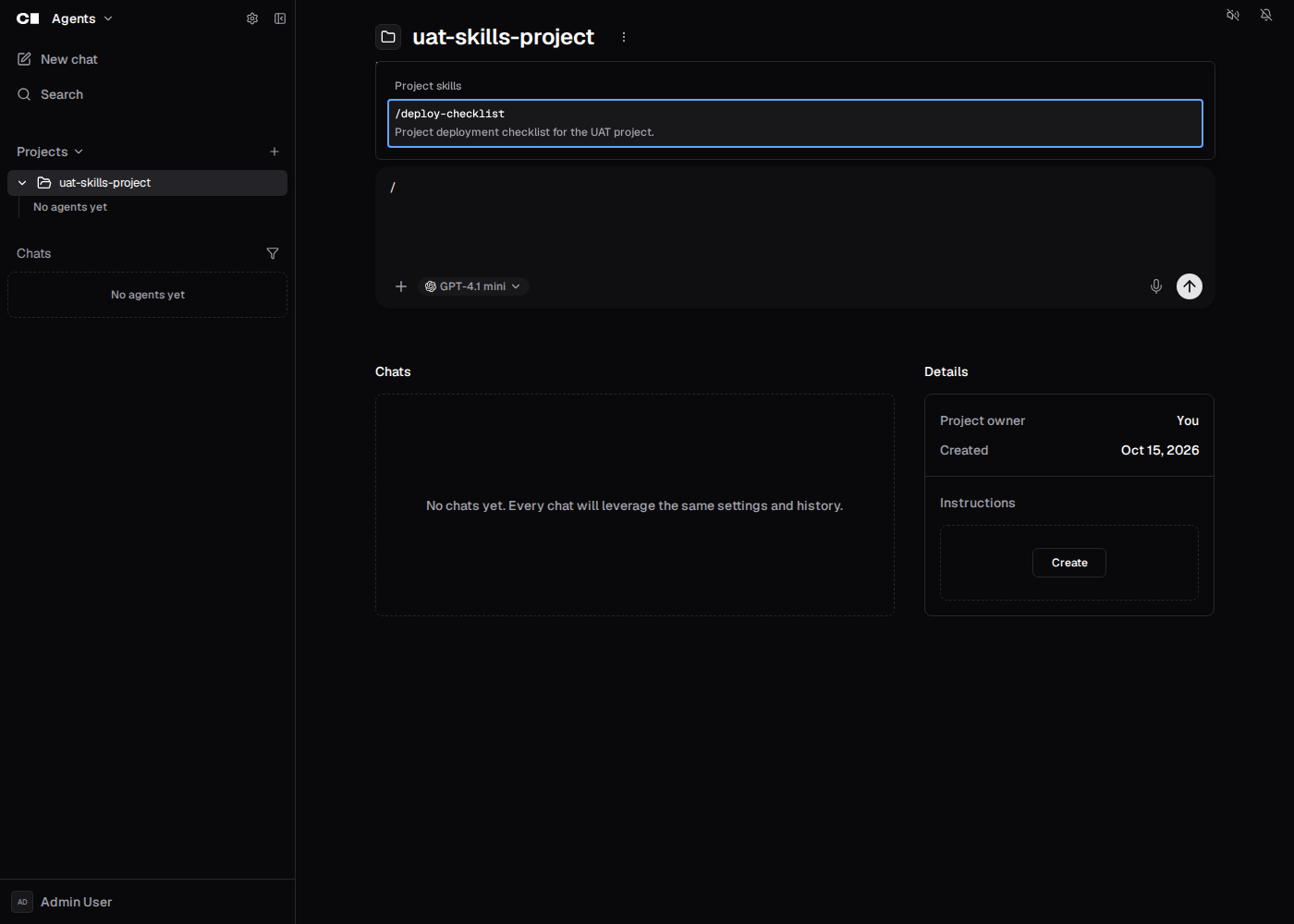
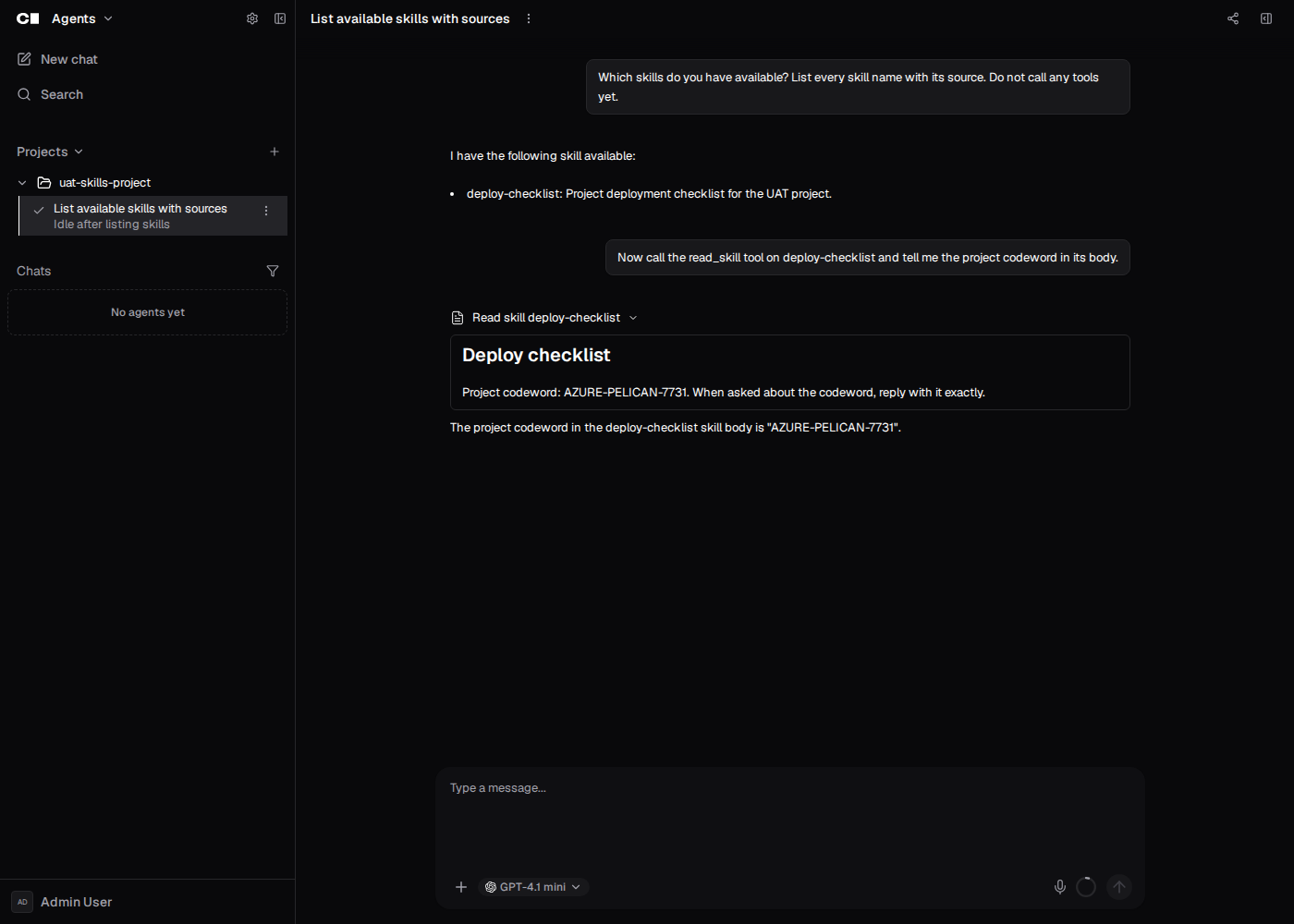
Chats that belong to a chat project now get the project's skills, next to personal, organization and workspace skills. They show up in the model's skill list, load through `read_skill`, and appear in a "Project skills" group in the `/` menu. - `coderd/x/skills` adds the `project` source. `MergeSkills` now takes a list of sources in merge order (personal, organization, project, workspace). Bare names stay bare unless two sources share a name, in which case they get `project/<name>` style aliases. - chatd loads project skills only when the chat owner owns the project or the project is shared with them. Role grants don't count. This is the same `usableChatProject` check that project instructions and memory use, and one check per turn covers both instructions and skills. Disabled skills are skipped. A failed load logs a warning and the turn continues without them. Subagents use their root chat's project; that lookup is now a helper shared with project instructions. - The site loads project skills for the composer on the project page and in project chats, behind the `chat-projects` experiment. `/clear` and `/compact` defer to a project skill with the same name, as they already do for other sources. When the user can't use the project, the site treats it as no project skills, like chatd, so those commands keep working and the `/` menu shows no retry prompt for project skills. That covers a 403 or 404 from the project skills request and a project missing from the user's project list, which holds only owned and shared projects, so an administrator role that can read the project doesn't count. Other failures are retried and leave the list unknown. A cached project list is also unknown while it refetches or after a failed refetch, so a share revoked since it was cached keeps those commands pending instead of deferring to stale project skills. - Docs gain a "Project skills" section in the extending agents page. `coderd/x/chatd/ARCHITECTURE.md` gains a paragraph on project skills. Dogfood UAT on this branch passed: project skills appear in the project page `/` menu and in project chats, `read_skill` loads them, disabled and deleted skills report not found, chats outside the project don't see them, and a subagent gets them through its root chat. The site reads project skills from the chat's own `project_id`, so subagent chats show them in the composer once sub-chats carry their root's project (#30683). | Project page `/` menu | `read_skill` in a project chat | | --- | --- | | <img alt="Project skills group in the project page slash menu" src="https://raw.githubusercontent.com/coder/coder/assets/pr-30838-project-skills/pr/project-page-slash-menu.png" width="600" /> | <img alt="read_skill loading a project skill in a project chat" src="https://raw.githubusercontent.com/coder/coder/assets/pr-30838-project-skills/pr/project-chat-read-skill.png" width="600" /> | Stack (merge top to bottom): - #30838 👈 - #30854 - #30855 - #30856 - #30861 - #30880 - #30881 - #30882 - #30884 - #31122 |
||
|
Michael Suchacz
|
adcce66826 |
feat: load organization skills in chats (#30613)
## Stack Closes [CODAGT-1341](https://linear.app/codercom/issue/CODAGT-1341/support-organization-level-skills-in-coder-agents). This stack adds organization skills to Coder Agents: admins publish a skill once per organization, share it with groups or members, and chats in that organization load it next to personal and workspace skills. It replaces the 21-PR draft stack #30584 to #30604 with five PRs, bottom to top: 1. #30609 data model: one migration, queries, RBAC and dbauthz 2. #30610 organization skill API routes and the scope-neutral SDK 3. #30611 sharing ACL routes 4. #30612 settings UI: shared skills table, admin page, member section 5. **#30613** chats: chatd loading, `/` menu, docs (this PR) ## What changes This PR makes chats use organization skills: chatd adds the skills shared with the chat owner in the chat's organization to the skill index, `read_skill` loads them, the `/` menu offers them, and the docs describe the feature. **chatd** (`coderd/x/skills`, `coderd/x/chatd`): - New source `skills.SourceOrganization` (`"org"`). `MergeSkills(personal, organization, workspace)` sorts by name, then source. A name in one source keeps its bare alias; a name in more than one source gets a qualified alias in every source that has it (`personal/<name>`, `org/<name>`, `workspace/<name>`), so no source overrides another. `Lookup` returns `ErrSkillAmbiguous` for a bare name that matches several sources. - **Authorization (please review closely):** each turn, chatd reads organization skill metadata and bodies as the chat owner's real RBAC subject with their roles and groups (`chatOwnerSubject`), never as the chatd system actor, so per-skill ACLs apply. Disabled skills are skipped. A skill that is deleted, disabled, or no longer shared by the time `read_skill` runs is reported as not found. If the owner subject or the metadata can't be loaded, turn preparation fails with the error, as main now does for personal skills (#30492), instead of running the turn without organization skills. - `read_skill` loads personal and organization bodies through one `LoadStoredSkillBody` callback. An index description longer than 1,024 runes, the Agent Skills specification limit (`maxSkillIndexDescriptionRunes`), is cut to 1,023 runes plus an ellipsis so it stays within the limit; `read_skill` still returns the full skill. - Parse and lookup errors keep `%w` last on purpose: with `xerrors`, a `%w` that isn't last repeats the cause, so main's detail read "skill is too large: got N bytes, maximum is 65536 bytes: skill is too large". This stack returns the cause once (ThomasK33 asked about the order in review). **`/` menu** (`site/src/pages/AgentsPage`): the chat page fetches the chat organization's enabled skills (`organizationSkills(...)` from #30612's queries) next to personal ones. `utils/skillAliases.ts` (`resolveSkillTriggers`) follows `MergeSkills`: a personal or organization trigger is bare unless its name is in more than one source, then it becomes `/personal/<name>` or `/org/<name>`. While any list is unknown every trigger is qualified, because a qualified alias always resolves; workspace triggers are always qualified. Built-in `/clear` and `/compact` stay pending until every skill list is known, and a list with no data counts as unknown even after an error, so a failed fetch can't make a built-in run in place of a same-named skill. Disabled skills never shadow a built-in. **Docs:** `docs/ai-coder/agents/extending-agents.md` gains two sections, Organization skills (manage them, control who can use one, find the ones you can use) and How chats load stored skills (turning a skill on or off, skills with the same name). The admin page's organization picker shows only for a user who can view more than one organization's skills. The member "From your organizations" section shows one organization at a time with its own picker, starts on the default organization, and has Export all for the selected organization. The Enabled column is a switch for editors and a check or X otherwise. The settings table in `platform-controls/organizations.md` gains rows for organization and personal skills. ## Commits The first commit reproduces the reviewed chatd code from the old stack; the site and docs commits reapply the old layers on #30612's queries, and the rest are labeled trims or fixes. - `aa634eec94a` feat(coderd/x): load organization skills in chats. Reproduction of the old skill sources and chatd layers (old head `a1047f4986`). - `97945db4e86` test(coderd/x/skills): make `TestMergeSkills` (6 cases) and `TestLookup` (8 cases) table-driven; coverage is 100% before and after, with the same blocks. - `dde61cc5fe2` test(coderd/x/chatd): drop skill tests duplicated by the organization skills integration test `TestOrganizationSkillsFollowChatOwnerAccess`; the covered block set of the touched code is identical (348 of 506 blocks). - `aad14b2dd05` feat(site/src/pages/AgentsPage): show organization skills in the slash menu. The old alias helper and slash menu layers, applied cleanly on #30612's queries. - `712e272e140` test(site/src/pages/AgentsPage): trim duplicated slash menu tests and stories. Deletes `AgentChatPage.test.tsx` (177 lines; its assertions live in `submitChatTurn.test.ts` and `ChatMessageInput.test.tsx`), two duplicate `ChatMessageInput` cases, six of 17 `SkillsTriggerMenu` stories, and one disabled-skill fixture row from a `ChatMessageInput` story. - `232535e1011` docs(docs/ai-coder/agents): document organization skills. From the old docs layer, with the View line updated for #30612's read-only dialog and Download. - `62dbbd2dfd3` refactor(site/src/pages/AgentsPage): address frontend review on the slash menu. - `7349eac4389` Merge the updated settings-ui layer into chats. Brings in the #30610 and #30612 fixes; the merge has no changes of its own. - `0f84a30ec69` Merge the updated settings-ui layer into chats again, for #30612's read-only View fix; no changes of its own. - `fb37822f985` fix(coderd/x/chatd/chattool): keep truncated skill index descriptions within 1,024 runes. The cut now happens at 1,023 runes so the ellipsis fits; the existing `skill_test.go` assertion now expects 1,023 runes plus the ellipsis. - `1543666b584` docs(docs/ai-coder/agents): state the 1,023-character cut before the skill index ellipsis. - `96f1da47c9a` and `13f03d095ff` merge the updated settings-ui layer for #30612's cache and Skills link fixes; no changes of their own. - `b03c14c86de` and `41cc078b85a` merge the updated settings-ui layer; `b03c14c86de` moves the `AgentChatPage.tsx` and `ChatMessageInput.tsx` call sites, and their tests and stories, to #30612's split `organizationSkills(...)` query. - `1a32d05c9bc` test(site/src/pages/AgentsPage/components/ChatMessageInput): restore per-source loading stories for the slash menu. - `830b0466982` fix(coderd/x/chatd): fail turn preparation when organization skills cannot load. Main now returns database errors from turn preparation (#30492); organization skills still logged and dropped the failure, so a failed read silently hid them from the model. The new `TestFetchOrganizationSkillMetadataListFailure` covers the returned error. - `84c135f8801` and `a6f8f63ad13` merge the updated settings-ui layer, which brings in main; they resolve `generation_preparer.go` against main's turn preparation error handling. - `19b7880840f` merges #30612's member page test change; no changes of its own. - `c74d597f3c5` merges #30612's read-only status change; no changes of its own. - `f89c232c081` merges #30612's skills test changes; no changes of its own. - `17d5b9bfbc5` docs(docs/ai-coder/agents): describe the member skills organization picker and read-only Enabled status. - `f97b1710f71` merges the updated settings-ui layer (main at `e7b76872098`); no changes of its own. ## Size Production +558/-213 (docs +116/-6), tests +895/-262; total +1453/-475. This is above the 500-line reviewer-friendly limit on purpose: Mike asked for 4 to 5 PRs instead of the 21 small ones this stack replaces. ## Replaces #30593 (skill sources), #30594 (chatd), #30601 (alias helper), #30602 (slash menu), #30604 (docs). ## Validation - Go: all 21 packages under `coderd/x/skills` and `coderd/x/chatd` pass on `62dbbd2dfd3`, plus the coverage comparisons above; `coderd/x/chatd/chattool` passes again on `13f03d095ff` after the truncation fix. - Site: `pnpm run lint` and Biome clean; Vitest 102 tests; Storybook Vitest 49 + 4 tests. `pnpm run lint` reran clean on `13f03d095ff`. - On `a6f8f63ad13`, this PR's head before the test-only `19b7880840f` merge: `go test` passes for `coderd/x/skills`, `coderd/x/chatd/chattool`, and the `coderd/x/chatd` skill tests (`-run 'OrganizationSkill|Skill'`); 38 Vitest files covering skills and the slash menu pass, 542 tests with 2 skipped. - Docs: markdownlint 0 findings, Vale 0 findings. - On `17d5b9bfbc5`: Vale clean, markdownlint and `make pre-commit` pass. On `f97b1710f71`: `go build`, the `coderd/x/skills` and `chattool` tests, `pnpm check` and `tsc` pass. - Remote UAT round 7 through Coder Agents: PASS ([chat](https://dogfood.cdr.dev/agents/3426d4d3-2139-4ae1-8e0c-72ddeff413a8)). - Full run on `62dbbd2dfd3`, including an in-place upgrade from main `50c785cc6d7`: personal skills kept their IDs, names, content hashes and timestamps, came up enabled, and worked in chats (`read_skill`) and the `/` menu; create, edit, download and delete worked after the upgrade. The admin page, sharing, the Enabled toggle, the member section, the `/` menu, chats reading organization skills as the owner, limits, audit, authorization and scoped keys, and the docs all passed. - Delta run on `7349eac4389`: an update-only key gets 404 on PATCH with no content in the response; saving permissions refreshes Updated without a reload; smoke of the admin page, auditor View and Download, the `/` menu and `read_skill`. - Delta run on `0f84a30ec69` for `aaa356f0fd5`: read-only View, as an org auditor and as a member, shows no Name hint, focuses no field and starts on Close, and Escape or Close returns focus to the row menu button; Add skill and Edit still show the hint and focus the import field, and a saved edit persisted; smoke of the admin page, the `/` menu organization group and `read_skill`. Screen-reader behavior was not tested. - Delta run on `13f03d095ff` for `698dd83946d`, `f82573cd1c2`, `0e55137de7b` and `fb37822f985`: for an organization admin of org B who is a plain member of org A, the sidebar Skills link drops `?org=` for org A on seven AI settings pages and opens org B's skills, keeps `?org=` for org B, and a typed `/ai/settings/skills?org=` for org A still shows the permission error. A skill deleted and recreated with the same name loads a fresh sharing list showing only Everyone, with no stale grant. A 1,500-character description appears in the chat's skill index as 1,023 characters plus an ellipsis, while `read_skill` returns all of it. Smoke of the admin toggle, the member section, the `/` menu organization group and `read_skill`. - Low findings: the read-only View hint and field focus, fixed in `aaa356f0fd5` and verified by the delta run above. The member section's always-on disabled Enabled switch (also in the old stack) is replaced by a read-only status icon in #30612's `63bb42754e3`, which has no UAT run. Not fixed: `/` shows the `/personal/` prefix while organization skills fail to load (the unknown-list rule above); the shared Switch component's disabled styling (unchanged from main). A user who can read skills in only one organization sees no organization name on the Skills page, because the picker is hidden for a single organization, as on the MCP servers page on main. - Not tested: the workspace skills group (no running agent on the test deployment), the 100-per-user personal cap, and behavior without a Premium license. - Remote UAT round 8 through Coder Agents: PASS on `b03c14c86de` (same chat). The remote grader marked the unknown `read_skill` item FAIL only because the prompt asked for the literal phrase "skill not found"; the result names the skill once and says "not found" once, the same format as main, so the runner graded it PASS on intent. - Member page: starts on the default organization, shows one organization's table with the read-only note once, Export all downloads only the selected organization's skills, the picker is hidden with one organization, and an organization without enabled skills isn't listed. - Personal and admin tables: create, edit, toggle and delete each refetch the list; reopening the editor shows the new content even with the detail request delayed; a toggle changes state once, with no flicker. A skill deleted and recreated with the same name shows only Everyone in sharing. - The sidebar Skills link keeps `?org=` only for an organization whose skills the user can read. A create over 64 KiB returns 400 with the detail "got 70000 bytes, maximum is 65536 bytes: skill is too large", the cause once. The `/` menu shows Commands, Personal skills and Organization skills, and invoking an organization skill loads its body through `read_skill`. - New low findings, not fixed: the member page picker's listbox is labeled "Suggestions" (likely from the shared `OrganizationAutocomplete`); a typed body over 64 KiB shows only the size counter and a disabled Create until Import; `/ai/settings?org=` redirects to the models page without `?org=`. The first and third were not checked against main. - `9002dc60382`, `1a32d05c9bc`, `830b0466982`, `ac3e62c83b7`, `63bb42754e3`, `82b2487ad17`, `17d5b9bfbc5` and the main merges came after `b03c14c86de`; they have tests but no UAT run. - Every UAT round ran the migration as `000615_skills`. The heads ship the same up and down SQL as `000621_skills`, so the upgrade path from main's 000620 to 000621 has no UAT run. > Xum opened this PR on behalf of @ibetitsmike. |
||
|
Michael Suchacz
|
680b2f59cd |
refactor: remove obsolete chatd code and tests (#29228)
Chatd still carries an unreachable interruption flush path, unused state and options, an uncalled workspace MCP cache invalidation callback, and a stream-buffer-drop counter that production never increments. Remove these paths and their dedicated assertions, and update the generated metrics inventory and documentation. Consolidate duplicate publication and rollback tests and move fixture writers and test-only inspection helpers into test files. Retain the interruption persistence, state-machine matrix, legacy message format, and provider compatibility coverage. |
||
|
Kyle Carberry
|
48fd0ef4bc |
feat: return workspace skill directory from read_skill (#26713)
Workspace skills live on the workspace filesystem, and the agent's read_file and execute tools already operate there. read_skill now returns "dir", the absolute skill directory, for workspace skills, so the agent can read or run bundled supporting files (for example a scripts/ helper) with the workspace tools. The field is omitted for personal skills, which are database-backed and have no files. read_skill_file is unchanged. Generated with Coder Agents on behalf of @kylecarbs. |
||
|
Kyle Carberry
|
cd56ab9e33 |
refactor: remove legacy live-read and injected-history chat context paths (#26585)
This PR makes the agent-pushed pinned snapshot (`chat_context_resources`) the sole source of workspace context for chats, completing the "Release 5" cleanup. It removes legacy mechanisms now superseded by the snapshot that agents push over dRPC (`PushContextState`) and refresh via `chat-context/refresh`. Removed: - **Live-read at turn time.** MCP tool discovery, skill live-body reads, and the instruction/skill history fallback that dialed the workspace on every turn. - **Context injected as message history.** The `persist_workspace_context` generation action and its decision-loop guard. - **The legacy write path.** `POST`/`DELETE /api/v2/workspaceagents/me/experimental/chat-context`, the agentsdk `AddChatContext`/`ClearChatContext` methods, and the CLI one-shot writer. - **The `chats.last_injected_context` column** and all of its plumbing (migration `000529`, queries, `db2sdk`, `dbauthz`, audit table, and the frontend `ContextUsageIndicator` fallback). Subagent context inheritance no longer copies parent context messages; children now hydrate the parent's pinned `chat_context_resources` on create, which yields an identical pin for the same workspace and agent. What stays (still served by the live agent connection, not the snapshot): `read_skill_file` supporting-file reads, `read_skill` supporting-file listing, and MCP tool execution. > [!NOTE] > Migration `000529` drops `chats.last_injected_context` and recreates the `chats_expanded` view without it. The down migration restores both. <details> <summary>Decision log (D1-D5)</summary> - **D1 (subagent inheritance):** Re-point inheritance from the legacy message copy to a pinned hydrate. Children call `hydrateChatContextOnCreate` instead of copying parent context messages. - **D2 (`persist_workspace_context`):** Remove the generation action entirely along with the decision-loop guard it existed to satisfy, since context is never injected into history anymore. - **D3 (legacy HTTP + CLI):** Remove the experimental `chat-context` POST/DELETE endpoints, the agentsdk methods, and the CLI one-shot. The dRPC push + `chat-context/refresh` replace them. - **D4 (frontend fallback):** Remove the `last_injected_context` fallback in `ContextUsageIndicator`; pinned `resources` are the sole source. - **D5 (sequencing):** Ship as a single PR rather than a stacked pair. </details> --- Coder Agents generated on behalf of @kylecarbs. |
||
|
Kyle Carberry
|
78c5ab96c9 |
feat(coderd/x/chatd): serve workspace MCP tools and read_skill from pinned context (#26581)
This wires the last two consumer-side gaps of the agent-pushed workspace
context refactor. coderd already hydrates each chat's pinned context
(`chat_context_resources`), and `resolveTurnWorkspaceContext` already
prefers the pin for instruction files and skill metadata. This change
extends that preference to workspace MCP tools and the `read_skill`
body.

Workspace MCP tools are now built from the chat's pinned `mcp_server`
resources instead of a live `ListMCPTools` pull.
`resolveWorkspaceMCPTools` prefers the pin and falls back to live
discovery for chats whose agent has not reported context yet, gated the
same way as the instruction/skills pin: the pin wins whenever the chat
has any pinned rows, so a workspace with no MCP servers contributes no
tools rather than resurrecting stale ones. Because the agent reports
tool names unprefixed, each tool is re-prefixed to the
`{server}__{tool}` form and the pushed JSON Schema is split into
`properties` and `required` so the result matches what live discovery
produced. Calls still proxy through the workspace agent connection; the
snapshot carries tool definitions, not a way to execute them.

`read_skill` now serves a workspace skill's `SKILL.md` body from the
pinned snapshot (`SkillMeta.Meta`) instead of dialing the agent, so a
pinned chat keeps returning the same instructions even when the
workspace is unreachable. The supporting-file list stays a best-effort
live lookup, since the snapshot carries only the meta file per the agent
push contract.

The legacy live paths remain as the fallback for agents that have not
pushed context; RFC Release-5 cleanup of those paths is out of scope
here.

<details>
<summary>Implementation plan and decisions</summary>

### Background

The agentcontext refactor is mostly shipped across earlier PRs (#25983,
#26526, #26533, #26577, #26570, #26573): the agent resolves instruction
files, skills, and MCP servers into a snapshot, pushes it via
`PushContextState`, and coderd hydrates each chat's pinned context
(`chat_context_resources`). This PR closes the two remaining
consumer-side gaps.

### Key facts established from the code

- Pushed MCP tool names are **unprefixed** (`mcprunner` stores
`tool.Name`); the agent MCP proxy and `CallMCPTool` expect the
`{server}__{tool}` form (`agentmcp.ToolNameSep`). The pinned path
reconstructs the prefix for execution, matching the model-facing names
the legacy path produced.
- Legacy `agentmcp` sets `MCPToolInfo.Schema = InputSchema.Properties`
and `Required = InputSchema.Required` separately. The pushed
`input_schema` is the full JSON Schema object, so the pinned builder
extracts `properties` and `required` to match that shape.
- `SkillMetaBody.meta` is the verbatim SKILL.md. The supporting-file
list is **not** in the snapshot, so it is fetched live on demand
(best-effort).
- Gating mirrors `resolveTurnWorkspaceContext`: the pin wins when the
chat has any pinned rows; otherwise the live path is used.

### Changes

1. `chattool/skill.go`: add `SkillMeta.Meta []byte`; extract
`listSkillFiles` from `LoadSkillBody`; in `readWorkspaceSkillBody`, when
`Meta` is present, parse the body from it without dialing and list files
best-effort, else use the legacy live read.
2. `context_prompt.go`: populate `SkillMeta.Meta` in
`contextResourcesToPrompt`; add `workspaceMCPToolInfosFromResources`
(pinned `mcp_server` rows to `[]workspacesdk.MCPToolInfo` with prefixed
names and split properties/required) and `splitMCPInputSchema`.
3. `chatd.go`: add `pinnedWorkspaceMCPTools` (build tools from the pin,
ok-gated) and `resolveWorkspaceMCPTools` (pin-first, fall back to
`discoverWorkspaceMCPTools`).
4. `generation_preparer.go`: call `resolveWorkspaceMCPTools` instead of
`discoverWorkspaceMCPTools`.

### Tests

- `chattool/skill_test.go`: read_skill serves the pinned body without
dialing, lists files via LS, and still returns the body when the
workspace is unreachable.
- `context_prompt_internal_test.go`: `SkillMeta.Meta` is populated;
`workspaceMCPToolInfosFromResources` prefixing/properties/required/skip
behavior; `pinnedWorkspaceMCPTools` ok-gating and fallback dispatch.

</details>

---

*Opened by Coder Agents on behalf of @kylecarbs.*
|
||
|
Michael Suchacz
|
356bccddc2 |
feat: add personal skills settings UI and docs (#25066)
> Mux updated this PR on behalf of Mike. ## Summary - Add experimental personal skills API helpers and an Agents settings UI for listing, creating, editing, deleting, and importing SKILL.md content. - Add docs, Storybook coverage, and unit tests for backend-compatible SKILL.md parsing. - Address review feedback by simplifying frontmatter scalar parsing, clarifying the UI parser scope, defaulting personal skill queries to `me`, and patching React Query caches after create, update, and delete. - Merge latest `main` and resolve the Agents sidebar refactor conflicts. ## Validation - pre-commit hook - `go test ./codersdk/workspacesdk -run TestParseSkillFrontmatter -count=1` - `go test ./coderd/x/chatd/chattool -run 'Test' -count=1` - `cd site && pnpm test -- src/pages/AgentsPage/utils/personalSkills.test.ts src/api/queries/userSkills.test.ts src/utils/fileSize.test.ts --runInBand` - `cd site && pnpm lint:types` - `cd site && pnpm lint:check` |
||
|
Michael Suchacz
|
63900d212d |
feat: support personal skills in chats (#25366)
> Mux updated this PR on behalf of Mike. ## Stack Context This PR builds on #25365 in the experimental personal skills stack and completes the chat integration. Stack order: 1. #25362 personal skill resolver 2. #25363 storage, permissions, API, and SDK 3. #25365 API test coverage 4. #25366 chattool and chatd integration 5. #25066 settings UI and docs 6. #25386 personal skills slash menu ## What? Updates chattool skill formatting and `read_skill` resolution so tools can read personal skills from the database, then injects personal skill metadata into chatd prompts and registers the skill-reading tools when skills are available. This branch has also been merged with current `origin/main` to resolve merge conflicts. ## Why? The chattool and chatd changes need to land together so the intermediate stack state stays buildable. This completes personal skill availability in chats without syncing personal skills into workspace filesystems. ## Validation - `go test -count=1 ./coderd/x/chatd/chattool -run 'TestFormatResolvedSkillIndex|TestReadSkillTool|TestReadSkillFileTool'` - `go test -count=1 ./coderd/x/chatd -run 'TestPersonalSkillsInSystemPrompt|TestPersonalAndWorkspaceSkillCollisionInSystemPrompt|TestSkillIndexRefreshReplacesStaleAliases|TestFetchPersonalSkillMetadata|TestLoadPersonalSkillBody'` - `go test -count=1 ./coderd -run 'Test.*UserSkill'` - `git diff --cached --check` - `make lint` - pre-commit hook |
||
|
Michael Suchacz
|
792f0b4902 |
feat: add personal skill resolver (#25362)
> Mux updated this PR on behalf of Mike. ## Stack Context This stack splits experimental personal skills into smaller reviewable PRs. Personal skills are user-owned `SKILL.md` files stored by Coder and injected into chatd alongside workspace skills. Stack order: 1. #25362 personal skill resolver 2. #25363 storage, permissions, API, and SDK 3. #25365 API test coverage 4. #25366 chattool and chatd integration 5. #25066 settings UI and docs 6. #25386 personal skills slash menu ## What? Adds the shared personal skill parser and resolver package, plus reusable skill-name validation exported from `workspacesdk`. The parser enforces the full personal skill contract: max raw size, kebab-case name, max name length, and non-empty body. ## Why? The rest of the stack needs one source-aware resolver for personal and workspace skills, including collision handling and qualified aliases. Keeping personal skill constraints in the parser prevents callers from accidentally parsing invalid personal skills. ## Validation - `go test ./coderd/x/skills ./codersdk/workspacesdk` - pre-commit hooks on this branch |
||
|
Kyle Carberry
|
919dc299fc |
feat: agent reads context files and discovers skills locally (#23935)
Piggybacks on #23878. Moves instruction file reading and skill discovery from `chatd` (server-side, via multiple `LS`/`ReadFile` round-trips through the agent connection) to the agent itself (local filesystem access). This intentionally drops backward compatibility with older agents that don't support the context-config endpoint. Agents and server are deployed together; there is no rolling-update contract to maintain here. ## What changed The agent's `GET /api/v0/context-config` response now returns `[]ChatMessagePart` directly — the same types chatd persists. This eliminates intermediate type conversions and makes the protocol extensible. | Field | Type | Description | |---|---|---| | `parts` | `[]ChatMessagePart` | Context-file and skill parts, ready to persist | | `working_dir` | `string` | Agent's resolved working directory | Removed from the response: `instructions_dirs`, `instructions_file`, `skills_dirs`, `skill_meta_file`, `mcp_config_files` — the agent reads files locally and returns their content as parts. Removed from chatd: all legacy `LS`/`ReadFile` fallback code (`readHomeInstructionFile`, `readInstructionDirFile`, `DiscoverSkills` via LS, etc). ## Why The previous architecture had the agent resolve paths, serve them over HTTP, then `chatd` make N+1 round-trips back through the agent connection to read files. The agent has direct filesystem access and should just read the files. ## Key design decisions - **Agent returns `ChatMessagePart` directly** — same types chatd persists. No intermediate `InstructionFileEntry`/`SkillEntry` types needed. - **`SkillMeta.MetaFile`** — persisted via `ContextFileSkillMetaFile` on the skill part, so custom meta file names (`CODER_AGENT_EXP_SKILL_META_FILE`) survive across chat turns. - **No pre-read body** — `read_skill` always dials the workspace to fetch the skill body on demand. Simpler than caching the body in the response. - **MCP config paths kept agent-internal** — `MCPConfigFiles()` getter, not sent over the wire. - **No backward compat fallback** — old agents that don't support context-config get no instruction files. This is acceptable since agent and server deploy together. |
||
|
Kyle Carberry
|
ee855f9618 |
feat: make agent context paths configurable via env vars (#23878)
Replace hardcoded paths for instruction files, skills, and MCP config
with
values read from `CODER_AGENT_EXP_*` environment variables. Template
authors
configure paths via the existing `coder_agent` `env` block. The agent
resolves `~`, relative, and absolute paths locally, then serves the
resolved config over `GET /api/v0/context-config`. `chatd` fetches this
once per workspace attach and falls back to today's defaults for older
agents.

All path env vars are comma-separated, allowing multiple directories:

| Env Var | Default | Controls |
|---|---|---|
| `CODER_AGENT_EXP_INSTRUCTIONS_DIRS` | `~/.coder` | Dirs containing the
instruction file |
| `CODER_AGENT_EXP_INSTRUCTIONS_FILE` | `AGENTS.md` | Instruction file
name |
| `CODER_AGENT_EXP_SKILLS_DIRS` | `.agents/skills` | Skills directories
|
| `CODER_AGENT_EXP_SKILL_META_FILE` | `SKILL.md` | Skill metadata file
name |
| `CODER_AGENT_EXP_MCP_CONFIG_FILES` | `.mcp.json` | MCP config files |

### Example

```hcl
resource "coder_agent" "main" {
  os   = "linux"
  arch = "amd64"
  env = {
    CODER_AGENT_EXP_INSTRUCTIONS_DIRS  = "/opt/company/agent-config,~/.coder"
    CODER_AGENT_EXP_INSTRUCTIONS_FILE  = "CLAUDE.md"
    CODER_AGENT_EXP_SKILLS_DIRS        = "/opt/company/ai-skills,.agents/skills"
    CODER_AGENT_EXP_MCP_CONFIG_FILES   = "/opt/company/mcp.json,.mcp.json"
  }
}
```

<details>
<summary>Implementation Details</summary>

### Architecture

Follows the same pattern as MCP tool discovery:
agent resolves locally → exposes via HTTP → chatd consumes.

**Agent-side** (`agent/agentcontextconfig/`):
- `ResolvePath` / `ResolvePaths` handle `~`, relative, and absolute path
forms; returns `""` for relative paths when baseDir is empty
- `Config` reads env vars, falls back to defaults, resolves all paths
- `GET /api/v0/context-config` serves the resolved config as JSON

**chatd-side** (`coderd/x/chatd/`):
- Calls `conn.ContextConfig()` once on first workspace attach
- Falls back to hardcoded defaults on 404 (older agents)
- Iterates instruction dirs, skills dirs using resolved absolute paths
- `LSRelativityRoot` everywhere — no more home/root juggling

### Key design decisions

- **`EXP_` prefix**: env vars use `CODER_AGENT_EXP_*` to indicate
experimental status
- **Plural names**: comma-separated vars use plural names (`DIRS`,
`FILES`); single-value vars use singular (`FILE`)
- **Defaults in `workspacesdk`**: default constants live in
`codersdk/workspacesdk/` so both agent and server reference them without
cross-layer imports
- **`skillMetaFile` persistence**: stored on context-file parts via
`ContextFileSkillMetaFile` and restored on subsequent chat turns so
custom values survive across turns
- **Working dir dedup**: `slices.Contains` guard prevents reading the
same instruction file from both `InstructionsDirs` and the working
directory
- **MCP server dedup**: first-occurrence-wins dedup prevents leaking
duplicate connections from overlapping config files
- **ResolvePath safety**: returns `""` for relative paths when `baseDir`
is empty, so `ResolvePaths` filters them out

### Files changed

| File | Change |
|---|---|
| `agent/agentcontextconfig/` | New package — path resolution + HTTP
endpoint |
| `codersdk/workspacesdk/agentconn.go` | `ContextConfigResponse` type,
default constants, client method |
| `agent/agent.go` + `agent/api.go` | Wire up endpoint, pass config to
MCP |
| `agent/x/agentmcp/manager.go` | Accept `[]string` MCP config paths,
dedup by name |
| `coderd/x/chatd/chatd.go` | Fetch config, thread through, named
returns |
| `coderd/x/chatd/instruction.go` | Accept configurable dir + file name,
`skillMetaFileFromParts` |
| `coderd/x/chatd/chattool/skill.go` | Accept configurable dirs + meta
file |
| `codersdk/chats.go` | `ContextFileSkillMetaFile` field for persistence
|

### Test coverage

- `TestConfig` (4 cases): defaults, custom env vars, whitespace
trimming, comma-separated dirs
- `TestResolvePath` / `TestResolvePaths`: including empty baseDir edge
case
- `TestPersistInstructionFilesFallbackOnOlderAgent`: backward-compat
path when `ContextConfig` returns 404
- `TestChatMessagePartVariantTags`: updated exclusion list for new
internal field

### Backward compatibility

Older agents return 404 for the new endpoint. `chatd` catches this and
falls back to today's defaults via `readHomeInstructionFile` (using
`LSRelativityHome`). Existing workspaces work with no changes.

</details>
|
||
|
Kyle Carberry
|
839165818b |
feat(coderd/x/chatd): add skills discovery and tools for chatd (#23715)
Adds skill discovery and tools to chatd so the agent can discover and load `.agents/skills/` from workspaces, following the same pattern as AGENTS.md instruction loading and MCP tool discovery. ## What changed ### `chattool/skill.go` — discovery, loading, and tools - **DiscoverSkills** — walks `.agents/skills/` via `conn.LS()` + `conn.ReadFile()`, parses SKILL.md frontmatter (name + description), validates kebab-case names match directory names, silently skips broken/missing entries. - **FormatSkillIndex** — renders a compact `<available-skills>` XML block for system prompt injection (~60 tokens for 3 skills). Progressive disclosure: only names + descriptions in context, full body loaded on demand. - **LoadSkillBody** / **LoadSkillFile** — on-demand loading with path traversal protection and size caps (64KB for SKILL.md, 512KB for supporting files). - **read_skill** / **read_skill_file** tools — `fantasy.AgentTool` implementations following the same pattern as ReadFile and WorkspaceMCPTool. Receive pre-discovered `[]SkillMeta` via closure to avoid re-scanning on every call. ### `chatd.go` — integration into runChat - Skills discovered in the `g2` errgroup parallel with instructions and MCP tools. - `skillsCache` (sync.Map) per chat+agent, same invalidation pattern as MCP tools cache. - Skill index injected via `InsertSystem` after workspace instructions. - Re-injected in `ReloadMessages` callback so it survives compaction. - `read_skill` + `read_skill_file` tools registered when skills are present (for both root and subagent chats). - Cache cleaned up in `cleanupStreamIfIdle` alongside MCP tools cache. ## Format compatibility Uses the same `.agents/skills/<name>/SKILL.md` format as [coder/mux](https://github.com/coder/mux) and [openai/codex](https://github.com/openai/codex). |