mirror of
https://github.com/coder/coder.git
synced 2026-11-25 14:28:37 +08:00
feea5ab959f59cd2135443ed2a0c19bf7643db8f
64
Commits
| Author | SHA1 | Message | Date | |
|---|---|---|---|---|
 Callum Styan |
d412c38afb |
perf: validate chat transitions from the locked row (#30886)
One of the main costs in terms of DB load from chats is extra round trips during transactions. This results in locks being held for longer periods of time -> an increase in lock waits for chats related queries. One of the opportunities for reducing some of the round trips is to eliminate extra chat row reads after we have just read the row in order to lock it. In this PR `ChatMachine.Update` now seeds the transaction struct with the row returned by `LockChatAndBumpSnapshotVersion`, plus a queue count taken right after it. We can then pass it into `Update` as an optional parameter validate against it, so neither re-reads the chat row from the database while the row lock is held. `updateChat` (send, edit, promote, tool results, interrupt, compact, clear, reconcile), hook failure, family archive, and the worker's generation and task transitions use it instead of reloading the chat under the lock. This PR relative to main: |measurement | main | this PR | percent change | |-- | -- | -- | -- | | Round trips under lock | 180.9 | 142.0 | -39% | | Statements under lock | 86.1 | 66.6 | -23% | | GetChatByID under lock | 54.1 | 35.8 | -34% | | GetChatByID total | 75.5 | 57.1 | -25% | | Statements | 235.8 | 216.2 | -8% | Generated by Coder Agents on behalf of @cstyan. |
||
|
Ethan
|
7a12022f3d |
fix: use one route-aware media rule for files and tool results (#31384)
Part of [CODAGT-1430](https://linear.app/codercom/issue/CODAGT-1430). Stacked on #31383. We had two rules for which media a model can take. `AcceptsFilePartMediaType` filtered user attachments, whilst `ToolResultMediaOmission` filtered tool results with its own lists, and only let images through on Anthropic. Now that fantasy converts tool result media like user files, the two should agree, so we'll keep one rule. `chatprovider.Model` now carries the configured provider type, and `AcceptsFilePartMediaType` reads a table keyed on the route, i.e. the configured provider plus the transport. `replaceUnsupportedMedia` applies it to user file parts and tool result media alike, including the pending tail of the turn prompt. As a result, tool result PDFs now reach Anthropic, and the 5 MiB inline image cap only applies to images. Azure OpenAI Chat Completions rejects file content parts with a 400 (`This model does not support file content types`, see https://github.com/Azure/azure-sdk-for-net/issues/51873), and Gemini's OpenAI-compatible endpoint ignores them. chatd reaches both through the openai-compat client, so the rule rejects PDFs there, and the model gets a text note instead of a failed request or a silently dropped file. Unsupported tool result media now gets the same note fantasy writes ("The tool returned `<type>` content, which cannot be displayed."), so the model sees one wording whichever layer drops it. I've also added a Tool results section to the MCP servers docs, and fixed the File attachments docs, which said every rejected attachment becomes text. Only text files do; a rejected PDF becomes a note that names it. I've also tested this end to end on Bedrock. I ran chatd from this branch with an Anthropic provider pointed at our AI gateway's Bedrock route (InvokeModel, us-east-2), plus an MCP tool that returns a PDF with a code word inside. Claude Haiku 5.5 and Claude Opus 5.5 (adaptive thinking) both read the code word from the tool result, and read it again on the next turn, when the PDF is replayed from history. The request carries the PDF as a `document` block inside `tool_result`, the same body chatd sends to Anthropic. |
||
|
Ethan
|
ace278e2d6 |
feat(coderd/x/chatd): deliver steer messages before each model call (#30074)
This is where the steer lane gets delivered mid-turn. Before each assistant model call, the generation task now runs `DeliverSteerMessages`. If there are steer messages queued, they go into history and the task returns without calling the model, and the history change starts a new generation task that sends them to the model. It never cancels anything, it just waits for the in-flight call and that step's tool calls to finish. Queue messages still wait for turn end, and compaction calls don't deliver steer messages, as they don't answer the user. A delivered steer message is a new prompt, so tracing treats it like any other newer prompt: a new `chat_turn` span starts at it, and the span before it ends as `abandoned`. `chatd.SendMessage` now accepts `steer`, but the HTTP handler and `message_agent` still only pass `queue` or `interrupt`, so the API doesn't change in this PR. #31174 makes `steer` the API default. Outside of tests, nothing creates steer messages until #31155 stores interrupt sends in the steer lane, so this PR doesn't change behaviour for users on its own. I've split the earlier version of this PR up, so some of the review comments are now addressed elsewhere in the stack. #31153 moves queue delivery into one helper, #31154 adds the two lanes, #31155 stores interrupt sends in the steer lane, and #31156 makes "Send now" steer, which also fixes two presses being delivered in reverse order. This supersedes #29784. Since the first review, a steer message delivered before a model call also records `queue_wait`, like the other delivery points. Part of CODAGT-1140 |
||
|
Hugo Dutka
|
788c38ae18 |
fix(coderd/x/chatd): validate tool inputs against schemas (#31541)
Builtin tool calls could reach handlers with missing required fields or other arguments that violate their declared schemas. Validate model-proposed inputs before hook dispatch and persistence, return tool errors so the model can correct them, and reject invalid hook overrides. |
||
|
Michael SuchaczandEthan Dickson
|
b6dc7158b4 |
feat: use the Anthropic computer use toolset for Claude 4.8 and later (#31521)
> Xum acted for Mike: this PR was written and opened by an AI agent on
Mike's behalf.

Computer use subagents on Claude 5.5 models (`claude-opus-5-5`,
`claude-sonnet-5-5`) failed on their first request: these models reject
`computer_20251124` and accept only the GA toolset
`computer_toolset_20260801`.

chatd now picks the Anthropic computer use tool version from the chat's
model with `ComputerUseToolVersionForModel` from coder/fantasy: the
toolset for Claude 4.8 and later, `computer_20251124` for Opus 4.5 to
4.7, Sonnet 4.6 and model IDs it cannot parse, and `computer_20250124`
for Haiku and Sonnet 4.5. Claude Platform on AWS and Amazon Bedrock
offer computer use only through the earlier versions, so an Anthropic
provider configured for either declares `computer_20251124` where the
model would take the toolset. For the toolset, chatd answers like
Anthropic's SDK tool runner: actions answer with text and only
`screenshot` returns an image, `cursor_position` returns the position as
text, `key` honors `repeat` (1 to 100), and zoom is declared disabled
because the agent desktop has no zoom action. The earlier versions still
answer every action with a screenshot.

A step's computer calls run one at a time in call order. For every
Anthropic version, the calls after one that failed, or that was rejected
before it ran (malformed input or a pre_tool_use hook denial), return
`Not executed: an earlier computer action in this turn failed.` without
running, which is the SDK runner's text. The chat loop enforces this
halt, so the computer tool keeps no state between calls. `wait` and
`hold_key` durations are read as seconds (capped at 300).

The frontend marks Claude Opus 5.5 and Sonnet 5.5 as verified for
computer use, and the computer tool row now labels each action ("Left
click", "Type", "Press key") instead of "Screenshot", shows text output,
and shows the error of failed or halted calls inline. The error block is
shared with the write_file and edit_files rows as
`ToolCall.ErrorDetail`.

Uses coder/fantasy#80 and coder/fantasy#82, both merged. `go.mod` pins
the fork to `7882f906a89a`.

<details>
<summary>UAT</summary>

TL;DR: it works. A remote Coder Agents UAT on dogfood passed on
`00143d5b12`, with all model traffic logged through a proxy:

- `claude-opus-5-5`, `claude-sonnet-5-5` and `claude-opus-4-8` declared
`computer_toolset_20260801` with zoom disabled and no beta header.
`claude-opus-4-6` and an unknown model ID declared `computer_20251124`
with the `computer-use-2025-11-24` beta, `claude-haiku-4-5` declared
`computer_20250124`, and a Claude Platform on AWS provider declared
`computer_20251124`. Opus 5.5, Sonnet 5.5, Opus 4.6 and Haiku 4.5 each
completed a desktop task.
- Toolset actions answered with text and only `screenshot` returned an
image. `repeat` 100 ran, 150 failed, and `wait` 400 stopped at 300
seconds.
- A failed call (`repeat` 150 on the toolset, a desktop error on 4.6)
and a pre_tool_use hook denial each halted the rest of the step without
touching the desktop. The next step ran normally.
- The computer tool rows showed action labels, text output and the halt
error. Opus 5.5 and Sonnet 5.5 showed no warning in the computer use
model selector. Switching a chat between 4.6 and 5.5 worked in both
directions.

Not tested: the tool type on Bedrock, and a halt after malformed model
input. Known, unchanged behavior: the desktop reports success for
unknown key names and off-screen coordinates, the model can still emit
`zoom`, which fails, and `scroll` up fails in `agent/x/agentdesktop`
because the negative amount is read as a flag. Both failures halt the
rest of their batch.

</details>

---------

Co-authored-by: Ethan Dickson <ethanndickson@gmail.com>
|
||
|
Michael Suchacz
|
78fa9a8613 |
refactor(coderd/x/chatd)!: retire the close_agent tool alias (#31005)
This PR breaks compatibility with chat histories that contain `close_agent` tool calls, which chats from v2.34 and earlier have. #26673 (v2.35) renamed `close_agent` to `interrupt_agent` and kept a hidden alias, so a model that copied the old name from such a history still interrupted the child. This PR deletes the alias: `subagentToolNameAliases`, `ExecuteLocalToolsOptions.ToolNameAliases` with `(*toolBatch).resolve` and its five call sites in `chatloop`, the alias step in builtin input validation, and the `close_agent` entries in the unbilled tool set, the plan policy, and the chatprompt lifecycle list. Coder Agents is experimental (`coderd/x`), and our rule for experimental persisted data is to drop the legacy shape outright and delete the code that existed only to support it, instead of carrying it forward. What happens to an old chat: - Replay does not change, because the replay path does not look up tool names: the model still sees the historical `close_agent` call and its stored result, and the UI renders them as before. The write path reads a tool name only to parse `execute` commands and to keep structured error results from subagent lifecycle tools. Dropping `close_agent` from that lifecycle list changes nothing, because its calls are now rejected with a plain-text error. - If the model calls `close_agent` again, nothing runs and the child keeps running. The tool result is the error `Tool not active in this turn: close_agent`, and the model can retry with `interrupt_agent`. **Why it is safe** - Deleted alias-only tests: `TestExecuteSingleTool_ResolvesToolNameAlias`, the `AliasNamesClassifyAsCalled` billing row, the alias subtest of `TestPartitionAmbiguousToolCallsGatesOnBuiltins`, the alias loop in `TestUnbilledSubagentToolNamesMatchCatalog`, and the aliased calls that #30939 added to `TestExecuteToolsSerialToolCallOrder` and `TestExecuteLocalTools_ProviderToolRunner`; both tests are back to their #30938 form. - `TestExecuteSingleTool_UnknownAliasFallsThrough` is now `TestExecuteSingleTool_RejectsUnknownTool` and asserts the exact error above. The observer tests call the tool by its real name. - Mutants of the active tool check, step observer notification, serial dispatch, the unbilled set, the plan policy and builtin input validation each fail a remaining test. Only the deleted alias test caught an empty name passed to the tool handler; no chatd tool reads that name (MCP tools use their original name). - `git grep` finds no use of the removed identifiers and no backend code that resolves `close_agent`. The rejection test still uses that name as its input. The frontend keeps its `close_agent` display mapping, which old histories still use. **Review focus** - A rejected `close_agent` call is now billed like any rejected tool call; the rejection is immediate. - `ARCHITECTURE.md`, "Generation goroutine": this PR deletes the sub-bullet that called `close_agent` a deprecated alias of `interrupt_agent`. - The `resolved_tool_name` debug log field is gone. It differed from `tool_name` only for aliased calls, and the alias is gone. **Validation** - `go test -count=1 ./coderd/x/chatd/ ./coderd/x/chatd/chatloop/ ./coderd/x/chatd/chatprompt/`: ok - `go vet` and `golangci-lint run --fix=false ./coderd/x/chatd/...`: clean - `paralleltestctx -custom-funcs="testutil.Context,chatdTestContext" ./coderd/x/chatd/...`: clean - pre-commit hook: passed **Stack** This stack retires chatd compatibility paths for chat data that older Coder versions stored. This PR replaces #31003 and carries its change, adapted to the `toolBatch` code that #30938 and #30939 merged. Mike chose to keep the fallbacks that #31001 and #31002 removed, so those two layers and #31003 left the stack. 1. #30996 stamp chat message fixtures with the current content version 2. #30997 drop tests of the legacy content codec 3. #30998 retire the V0 chat message content decoder 4. #31000 inline the model config provider identity 5. #31005 retire the `close_agent` tool alias (this PR) > Xum, an AI agent, opened this PR for @ibetitsmike and wrote this description. |
||
|
Michael Suchacz
|
1acacc9c30 | feat: graduate MCP tool search from experiments (#31327) | ||
|
Michael Suchacz
|
63c116fddd |
refactor(coderd/x/chatd): delete the CompactionOptions and compactionOutcome mirrors (#30984)
Deletes two structs that each repeat another struct field for field. `chatloop.CompactionOptions` repeated 21 fields of `GenerateCompactionOptions`, and `normalizedCompactionGenerateConfig` copied them one by one, so each new option had to be added in three places, as #30766 did for `Logger`. `compactionOutcome` in `chatd` repeated the 11 fields of `chatloop.CompactionResult` only so that `generateCompaction` could convert one into the other. The PR also deletes `TestGenerateCompactionSummaryUsesToolDefinitions`, which repeats `TestGenerateCompactionSummaryPreservesCallOptions`. ## Why it is safe - `publishCompactionError`, `startCompactionDebugRun`, and `generateCompactionSummary` now take `GenerateCompactionOptions`. Every read of the normalized config, in `GenerateCompaction` and in those helpers, uses one of the 21 fields that the copier copied without change. None reads the 7 fields that only `GenerateCompactionOptions` has. - `normalizedCompactionGenerateConfig` applies the same four defaults and the same threshold gate to its parameter, which is already a copy. So `GenerateCompaction` still reports the requested `ThresholdPercent` and `ContextLimit` from its own `opts`. If it read `config.ThresholdPercent` instead, `TestGenerateCompaction_RecordsRequestedTrigger` would fail. - Go allows the `compactionOutcome(outcome)` conversion only because the two structs have identical fields, so `buildCompactionMessagesInput` can hold the `chatloop.CompactionResult` itself. The four `TestBuildCompactionMessages_*` tests that build it keep their assertions. - Six mutants of the summary call each fail the deleted test on #30766: no tools, no call options, no summary prompt, one tool dropped, the caller's history changed, and tool descriptions stripped. The kept test failed only the first five, because its tool had no description. With that description moved into it, the kept test fails all six. - `git grep -w CompactionOptions` and `git grep compactionOutcome` find no matches. ## Review focus `generateCompactionSummary` keeps its `model` and `messages` parameters, so its 15 direct test calls change only the type name. It now also receives `Model` and `Messages` fields with the same values, and it does not read them. ## Validation - `go test -race -count=1 ./coderd/x/chatd/chatloop/` passes. - `go test -count=1 -p 4 -parallel 4 ./coderd/x/chatd/...` passes (20 packages). - `golangci-lint run ./coderd/x/chatd/...` reports 0 issues, and the pre-commit hook passed. ## Stack #30766 has merged, so this PR now targets `main` by itself. > Xum, an AI agent, opened this PR for @ibetitsmike and wrote this description. |
||
|
Michael Suchacz
|
8245457c8a |
fix(coderd/x/chatd): make compaction fit an overflowing context (#30766)
Compaction is the recovery path for a chat near its context window, but its summary request was larger than the turn that overflowed: the whole history plus the tool definitions. Its only fallback, a retry without tools, also missed context-window errors that arrive inside an HTTP 200 stream (OpenAI Responses API, Bedrock Mantle). In the incident behind this PR, one MCP tool result of about 1 MB moved a 1M-token chat from 67% to 92% of its window in one step. After that, every turn and every `/compact` failed with "Your input exceeds the context window of this model." This PR does not try to predict whether the summary request fits. Each time the model rejects it for its size, the next request is thinner: 1. The full request: tool definitions and the whole history. 2. The same history without tool definitions (as before). 3. Tool results longer than 32 KiB cut to 32 KiB, keeping their head and tail. 4. Tool results longer than 4 KiB cut to 4 KiB. A step that would cut nothing is skipped. Only locally executed text and error tool results are cut. User messages, attachments, provider-executed results, and media stay whole. The cuts apply only to the summary request, not to the stored history. Other changes: - **In-stream rejections match.** Fantasy stream errors without a status code and Responses `error` and `response.failed` events now count as size rejections. A Responses error code other than `context_length_exceeded` never matches, so a rate limit stays retryable. Anthropic's "input length and `max_tokens` exceed context limit" also matches. - **A conversation that still does not fit** fails as a non-retryable config error that tells the user how to recover. - **Each rejected summary request is logged at Warn** with its tool count, tool result cap, and the bytes it cut. Not in this PR: counting tool results that arrive after the measured step in the compaction trigger, estimating the summary request before sending it, and a tighter per-result cap for large-window models. Earlier revisions of this branch did these and were dropped for the simpler path above. ## Testing - `go test ./coderd/x/chatd/...` (20 packages), `golangci-lint` on `chatd` and `chatloop`, and the pre-commit hook pass. - The real OpenAI Responses client runs against `httptest` for each in-stream error shape and must retry without tools. - Each of these breaks a test: removing the cut steps, sending a cut that cuts nothing, turning error results into text, cutting provider-executed results, and dropping the in-stream match. > Xum opened this PR on behalf of @ibetitsmike. |
||
|
Michael Suchacz
|
0968f97a43 |
feat: move a chat family between projects in chatd (#30893)
chatd can now move a root chat, together with its subagent chats, into a project, to another project, or out of its project. Nothing calls this yet. #30894 adds the API. **Stack** (moving chats between projects, bottom first): 1. **This PR**: the move in chatd 2. #30894: `PATCH /api/v2/chats/{chat}` takes `project_id` 3. #30895: **Move to project** in the chat menu 4. #30795: drag a chat onto a project folder in the sidebar **Why:** today a chat keeps the project it was created with. A move must follow the family rules of archiving, because a step that runs during a move would still have the memory tools of the old project. - `chatstate.Tx.SetProject` runs only from W, E0 and E1, like `SetArchived`. `SetFamilyProject()` locks the root row before its subagents, in the same order as archiving, so a busy family gets `ErrTransitionNotAllowed` and nothing changes. - A move to the project the chat is already in changes nothing, even while the chat runs. The check reads the locked root row, so it waits for a move that is still in flight. - Only the root row stores `project_id`, and subagents use the project of the root. After the commit, chatd publishes a new `project_change` watch event for each chat of the family. The move keeps `updated_at`, so lists keep their order. - A root chat outside a project now has an empty memory index. When a chat leaves its project, or its project is deleted, its next turn start commits one memory index update that removes the memories the model saw there. **What to scrutinize:** the lock order and the same-project check under the lock in `SetFamilyProject()` (`chatstate/family.go`), the turn-start condition in `memoryIndexMessage()` (`memory.go`), and whether the `ARCHITECTURE.md` text matches them. **Generated** (`make gen`): `queries.sql.go`, `querier.go`, `dbmock` and `dbmetrics` come from `queries/chats.sql`. `coderd/apidoc`, `docs/reference/api/schemas.md` and `typesGenerated.ts` come from the new watch event kind, which is also why two `chats.test.ts` fixtures gain `project_change: false`. **Architecture doc:** `coderd/x/chatd/ARCHITECTURE.md` lists `SetProject` among the transitions and in the execution state diagram (W, E0 and E1 back to themselves). It also says that a root chat's project can change after creation, and that a moved chat's next turn starts with a memory index update from the old project to the new one. ## Testing - `make pre-commit` passes. `go test` passes for `coderd/x/chatd/chatstate`, `coderd/database/dbauthz` (`TestMethodTestSuite`) and the chatd memory tests. - `TestSetFamilyProjectLocksRootFirst` fails with 55P03 when a subagent row is locked first. `TestSetFamilyProjectKeepsTheCurrentProject` covers the same-project move during a run. The transition matrix test gains `SetProject` cases for W, E0 and E1. - `TestMovedChatUsesNewProject` runs two real turns around a move: the second turn uses the instructions and memories of the new project, and `OutOfProject` fails without the memory index removal. > Xum opened this PR on behalf of @ibetitsmike. |
||
|
Michael Suchacz
|
54ba766f77 |
refactor(coderd/x/chatd): move turn preparation helpers into turn_environment.go (#30870)
Moves the helpers that `buildTurnEnvironment` uses from `chatd.go`, and the `turnEnvironment` type from `generation.go`, into `turn_environment.go`. The code moves without edits. Only the import blocks change. The moved helpers build the turn's workspace context, tool set, system prompt, and skills. `chatd.go` goes from 4,396 to 3,131 lines, and `turn_environment.go` from 1,187 to 2,520. To check that only imports changed, compare the removed lines with the added lines: ```sh B=mike/chatd-turn-env-split/receiver-name H=mike/chatd-turn-env-split/move-turn-helpers git fetch origin "$B" "$H" diff <(git diff "origin/$B" "origin/$H" | grep '^-[^-]' | cut -c2- | sort) \ <(git diff "origin/$B" "origin/$H" | grep '^+[^+]' | cut -c2- | sort) ``` The output lists only import lines. `git diff --color-moved` also marks the blocks as moved. After this PR, the stack has the same code as #28757 (head `6ee4ecb35f8`, on current `main`), except that `turn_environment.go` names the `*Server` receiver `p` (#30869). Validation: `go build ./coderd/... ./enterprise/...` and `go vet ./coderd/x/chatd/...` pass, and the pre-commit hook passed. `go test ./coderd/x/chatd/... ./enterprise/coderd/x/chatd/... -count=1` passed in all packages except one known load flake, `TestChatTurnStopsAtStepLimit/Default` (timeout while seeding 1,199 steps). A rerun of `./coderd/x/chatd` passed. ## Stack This stack splits #28757, as requested in review. It moves the code that prepares a chat turn into one file, `turn_environment.go`, and moves the tool policy tests from full turns to a table test. chatd behaves as on `main`, except for the debug log in #30865. 1. #30864 Remove the no-op `allowedBehaviorToolNames` filter 2. #30865 Log workspace agent lookup errors in turn preparation 3. #30866 Rename `prepareGeneration` to `buildTurnEnvironment` 4. #30867 Cover the turn tool policy at `buildTurnEnvironment` 5. #30868 Remove seven end-to-end tool policy tests 6. #30869 Name the `*Server` receiver `p` in `turn_environment.go` 7. #30870 Move the turn preparation helpers into `turn_environment.go` > Xum, an AI agent, opened this PR for @ibetitsmike and wrote this description. |
||
|
Michael Suchacz
|
a41e5ae6eb |
refactor: rename prepareGeneration to buildTurnEnvironment (#30866)
Renames the turn preparation step after what it returns: the environment for one turn. Only names change, plus one small change to how callers release the environment. - `generation_preparer.go` becomes `turn_environment.go`, and its test file becomes `turn_environment_internal_test.go`. GitHub shows both as renames. A comment in `compactionTriggers.test.ts` that names the test file follows the rename. - `prepareGeneration` becomes `buildTurnEnvironment`, and its result type `generationPrepared` becomes `turnEnvironment`. Four `TestPrepareGeneration*` tests become `TestBuildTurnEnvironment*`. - The `Cleanup` field becomes the unexported `cleanup`, and callers use `Close()`. `Close()` does nothing on a zero value. The type stays in `generation.go` for now. #30870 moves it next to `buildTurnEnvironment`. Validation: build and vet pass, the renamed tests and the `toolinput` tests pass, and the pre-commit hook passed. ## Stack This stack splits #28757, as requested in review. It moves the code that prepares a chat turn into one file, `turn_environment.go`, and moves the tool policy tests from full turns to a table test. chatd behaves as on `main`, except for the debug log in #30865. 1. #30864 Remove the no-op `allowedBehaviorToolNames` filter 2. #30865 Log workspace agent lookup errors in turn preparation 3. #30866 Rename `prepareGeneration` to `buildTurnEnvironment` 4. #30867 Cover the turn tool policy at `buildTurnEnvironment` 5. #30868 Remove seven end-to-end tool policy tests 6. #30869 Name the `*Server` receiver `p` in `turn_environment.go` 7. #30870 Move the turn preparation helpers into `turn_environment.go` > Xum, an AI agent, opened this PR for @ibetitsmike and wrote this description. |
||
|
Michael Suchacz
|
b2c8798e0e |
fix: replay stateless OpenAI reasoning across chat turns (#30298)
OpenAI Responses chats default to `store=false`, and chatd only replayed reasoning as an `item_reference`, which needs provider-side storage. Reasoning was therefore dropped between tool steps and turns, so reasoning models lost their chain of thought mid-task. This pins coder/fantasy `coder_2_33` at 6ba8681, which includes fantasy #63 (and #64, #65, and #66). #63 captures each completed reasoning item (ID, `encrypted_content`, summary) and replays it in full regardless of `store`. In chatd: - Every Responses call requests `reasoning.encrypted_content`. The `store` default and configured includes are unchanged, and Chat Completions requests are untouched. - Prompt rebuilds keep reasoning parts without visible text when they carry finalized encrypted state, so reasoning survives durable history and coderd restarts. - The provider-switch sanitizer also strips OpenAI reasoning from history produced by a different or unknown provider instance, since reasoning IDs and encrypted content only resolve where they were issued. - A compaction model override on a different provider instance, or with a different model, gets a compaction prompt without the chat's OpenAI reasoning. - Each saved reasoning part records the provider instance, model, and credential (the deployment's or the user's personal API key) that produced it, and the sanitizer keeps it only when all three match the current turn, because another model, or the organization behind another credential, can reject the encrypted content. Switching models, adding or removing a personal key, or editing a config's model or provider drops the earlier reasoning; switching back restores it. The record is never returned by the API. Reasoning saved before this change has no record and follows its model config. - If OpenAI rejects replayed reasoning it cannot decrypt (`invalid_encrypted_content`), for example after the deployment's key is replaced with one from another organization, the request is retried once without reasoning, and the reasoning that step produces is saved with the provider's next rejection epoch. Epochs are kept separately for each provider, model, and credential. Later steps and turns leave out reasoning from earlier epochs, on any replica and after restarts, so only the first request after the change is rejected and newer reasoning keeps replaying. A retried step that returns no reasoning saves its epoch on its first part. The advisor's prompt never includes OpenAI reasoning, as on `main`. ## Testing Rebased onto main at |
||
|
Ethan
|
4afd834ad2 |
fix(coderd/x/chatd): return database errors from turn preparation (#30492)
Relates to CODAGT-1330 When chatd prepares a turn, it reads a bunch of things from the database: the user's custom prompt, plan mode instructions, personal skills, the advisor config, the user's compaction threshold override, MCP server configs, inline MCP servers, MCP user tokens and the pinned workspace MCP tools. If any of those reads failed, we'd log a warning and run the turn without them, so the model would quietly ignore the user's instructions or be missing tools for that turn. To fix, we'll just return the error instead, so the prepare retry runs, and the chat shows an error if the reads keep failing. The provider switch history sanitizer and the cancel of deleted tool calls also return their database errors now. A model config that's unavailable, e.g. deleted, is still treated as foreign by the sanitizer like it is today. An inline MCP server with invalid stored headers still shows up as a failed connect in the chat debug panel, but a failed read of the inline MCP servers themselves now fails the turn. This PR is in a stack on top of #30449. |
||
|
Michael Suchacz
|
c28ae0dc9b |
feat: trigger compaction independently for the chat and compaction models (#28568)
> [!NOTE]
> Xum (an AI agent) authored this pull request on Mike's behalf.
## Summary
Automatic compaction now fires at whichever of two independent triggers
is reached first, and the UI shows when the organization override's
trigger applies.
- **Chat trigger**: the chat owner's personal threshold (or the chat
model's) against the chat model's window. A threshold of 100 turns off
only this trigger.
- **Organization trigger**: a fixed 80% of the organization compaction
override model's window. The override model's own compression threshold
is ignored. The other 20% is a target margin for the summary prompt and
the summary, not a guarantee, because the trigger reads the previous
step's prompt size.
On main, the chat threshold was applied to the smaller of the two
windows, and nothing in the UI showed it. Example: with a 20K chat model
at 70% and an 8K override, main compacts at 5,600 tokens; this PR
compacts at 6,400 (80% of 8K, shown as 32%).
## Changes
Backend (`coderd/x/chatd`):
- The trigger with the lower token point binds (ties go to the chat
trigger). It drives the automatic compaction gate and the
still-over-limit check, and every summary, automatic or manual, records
it.
- An override that is unset, deleted, disabled, on a disabled provider,
or without credentials for the chat owner is treated as absent: the chat
model summarizes and only the chat trigger applies.
- The summary's output cap is bounded by the summarizer's own window,
not the trigger's.
- The still-over-limit error names what can clear it: the compaction
threshold (chat trigger), an override model with a larger window
(organization trigger), or both when usage is over both points.
- The still-over-limit check compacts once more when the latest summary
was recorded under a different threshold or trigger window. The
`chat_summarized` result gains `trigger_context_limit_tokens`, and
`context_limit_tokens` now records the chat model's window (main
recorded the smaller window). On main, lowering a threshold after a
compaction ended every later turn with the error.
- The still-over-limit check skips a 0% threshold ("always compact"),
which on main ended the run with the error after every compaction.
- `ARCHITECTURE.md` documents the two triggers, the summary cap, and the
still-over-limit rules.
Frontend (`site`), through a shared `compactionTriggers` helper that
mirrors the backend rules (no new API):
- Coder Agents settings: the compaction override row warns when the
organization trigger undercuts chat models' default triggers ("the
organization override compacts chats at 80% of {model}'s {N}-token
window").
- Personal thresholds page: an Effective column shows the trigger that
applies, with a popover when the organization override binds. "Compacts
at" follows the same trigger, and a point the chat model's window cannot
reach shows as Off. The header's 100% sentence, and the row warning when
a member types 100, say an organization override may still compact chats
when one is set or its organization's overrides failed to load (the
header also while they load).
- Chat context gauge: the compact-at percent follows the binding trigger
and is annotated when the organization override binds. If the overrides
request fails, it shows the chat-only value with "(organization override
not loaded)", or "Compaction off (organization override not loaded)"
when the chat trigger is off.
- An override whose provider the user cannot use is ignored on the gauge
and the personal page, matching chatd.
- The shared `formatContextLimit` prints counts below 1,000 exactly (an
800-token compaction point showed "~1K") and 999,500 to 999,999 as
"1.0M" instead of "1000K". It also labels the model pickers; their other
values are unchanged.
- `HelpPopoverIconTrigger` lets callers set their own `aria-label`; only
the Effective column's popover does.
Known v1 limits: the Coder Agents settings alert is organization-scoped,
so it can warn about an override that some members fall back from for
lack of provider credentials. The gauge checks the viewer's provider
access, so on a shared chat its label can differ from the owner's
runtime trigger (Codex P2, declined). Compaction itself is unaffected.
## Screenshots
From remote UAT round 13 on
|
||
|
Callum Styan
|
1a96da2b6a | perf(coderd/x/chatd): make chat stream reads lock-free (#30266) | ||
|
Garrett DelfosseandClaude Opus 5.5
|
a08ba6a70c |
feat: add shared project memory API for chats in a project (#29301)
- Experiment, stacked on #29242. UI is in #29583. - Adds **project memory**: `chat_project_memories` rows with a name (lowercase slug, unique per project), a one-line description (150 characters) and a body (8KB). Up to 200 per project, shared by every root chat in the project. Chats outside a project and subagents have no memory. - Memories are immutable: they are created and deleted, never edited. Agent tools are `read_memory`, `save_memory`, `delete_memory` and `consolidate_memory`. Saving an existing name fails and points the agent at `consolidate_memory` to replace it. - **Consolidation is agent-driven, in the turn**, modeled on how Claude Code compacts its memory index when warned it is near its limit. From 160 memories (80%), save results ask the agent to get under 140 (70%) with `consolidate_memory`, choosing what to merge and drop. That tool deletes and saves memories in one transaction under the per-project advisory lock, and rolls back entirely if a delete is missing, a name is taken, or the result exceeds 200. There is no background extraction or consolidation. - **The memory index reaches the model as model-only conversation messages**, not in a tool description or the system prompt. At turn start the chat gets a full `<project-memory-index>` snapshot when its prompt has none (first turn, or after compaction), otherwise a `<project-memory-index-update>` listing only what changed. Tool definitions and the system prompt carry no memory state, so memory writes never invalidate the provider's cached prompt prefix. Writes by other chats, or by this chat mid-turn, reach the model at its next turn. - REST API (create, list, get, delete) under `/api/experimental/organizations/{organization}/chats/projects/{project}/memories`. Memory permissions follow projects onto the `agents-access` role. - **Every memory change is audited** as `ChatProjectMemory` create or delete. REST changes are attributed to the caller. Tool changes (`save_memory`, `delete_memory`, `consolidate_memory`) are attributed to the chat owner, carry the `chat_id`, and record one entry per memory after the change commits, so a rolled-back consolidation records nothing. ### Examples **What the model sees.** The system prompt gets a fixed guidance block with no memory state: ```text <memory> Memory is durable context shared by every chat in the project "platform". Save facts that will matter in future chats: … The memory index is in the conversation: a <project-memory-index> message lists every saved memory, and <project-memory-index-update> messages at the start of later turns list what changed. Changes made during a turn, including your own, appear in the next turn's update. … Memories cannot be edited: replace one that no longer holds with consolidate_memory, or delete it. </memory> ``` On the first turn, after the user's message, the chat gets a model-only row with the full index (hidden in the UI): ```text <project-memory-index> - deploy-day: Deploys happen on Tuesdays - release-owner: Alice owns releases; ping her before tagging </project-memory-index> ``` On a later turn where memories changed, it gets only the difference: ```text <project-memory-index-update> Added or changed: - deploy-day: Deploys happen on Wednesdays (changed 2026-09-30) - staging-url: Staging lives at staging.example.com Removed: - old-ci-notes </project-memory-index-update> ``` Resulting request layout, with the provider's cached prefix unchanged by memory writes: ```text [tools: fixed] [system: fixed <memory> guidance] [turn 1 user] [index snapshot] [assistant/tools …] [turn 2 user] [index update] [assistant …] ``` **Tool calls and results** (produced by the tools in this PR): ```text save_memory {"name":"staging-url","description":"Staging lives at staging.example.com","body":"Staging is https://staging.example.com; deploys from main."} → {"count":3,"saved":"staging-url"} save_memory {"name":"deploy-day", …} // name already exists → error: a memory named "deploy-day" already exists; read it, then replace it with consolidate_memory by deleting "deploy-day" and saving the new version in one call consolidate_memory {"delete":["deploy-day"],"save":[{"name":"deploy-day","description":"Deploys happen on Wednesdays (changed 2026-09-30)","body":"The team deploys every Wednesday since 2026-09-30."}]} → {"count":3,"deleted":["deploy-day"],"saved":["deploy-day"]} read_memory {"name":"deploy-day"} → {"name":"deploy-day","description":"…","body":"…","created_at":"2026-09-30T15:04:05Z","created_by":"alice"} ``` Near and at the cap: ```text save_memory … → {"count":160,"saved":"one-more","warning":"memory is 160/200, approaching the limit. Consolidate it to under 140 memories now with consolidate_memory: merge overlapping memories into one, and drop stale, wrong, or superseded ones."} save_memory … → error: memory is full (200/200); use consolidate_memory to merge overlapping memories and drop stale ones, and include this memory in its save list ``` **REST memory object** (`GET .../chats/projects/{project}/memories`): ```json { "id": "59500000-0000-4000-8000-000000000001", "project_id": "7c0e4a3e-5b1f-4f7d-9a51-2f3c8f6d2b10", "organization_id": "bb640d07-ca8a-4869-b6bc-ae61ebb2fda1", "name": "deploy-day", "description": "Deploys happen on Wednesdays (changed 2026-09-30)", "body": "The team deploys every Wednesday since 2026-09-30.", "created_by": "0ed9befc-4911-4ccf-a8e2-559bf72daa94", "created_by_username": "alice", "created_at": "2026-09-30T15:04:05Z" } ``` Create takes `{"name", "description", "body"}` and answers 409 on a duplicate name or at the cap. <details> <summary>Screenshots (predate the immutable-memory rework; tool output shape has since changed)</summary> 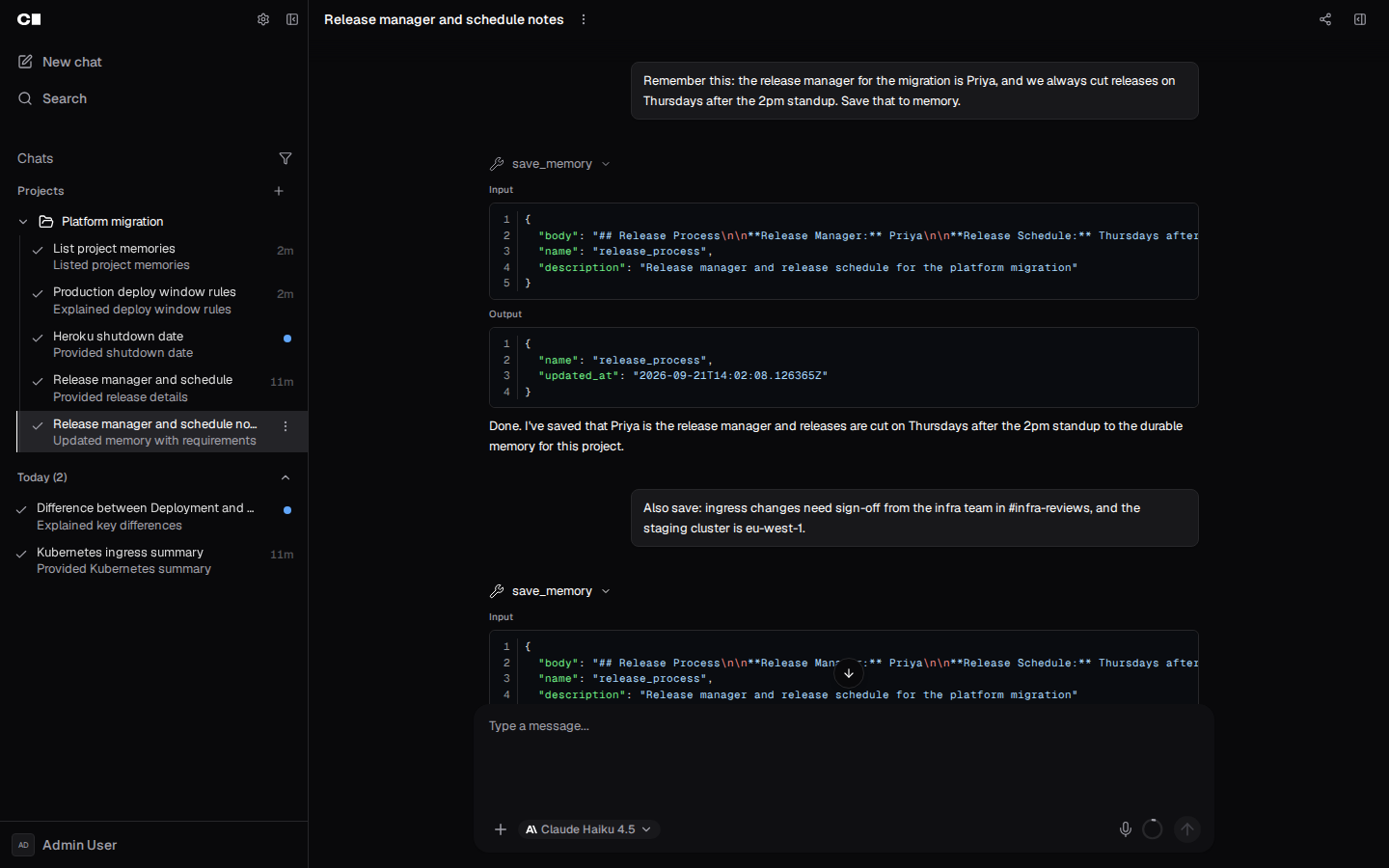 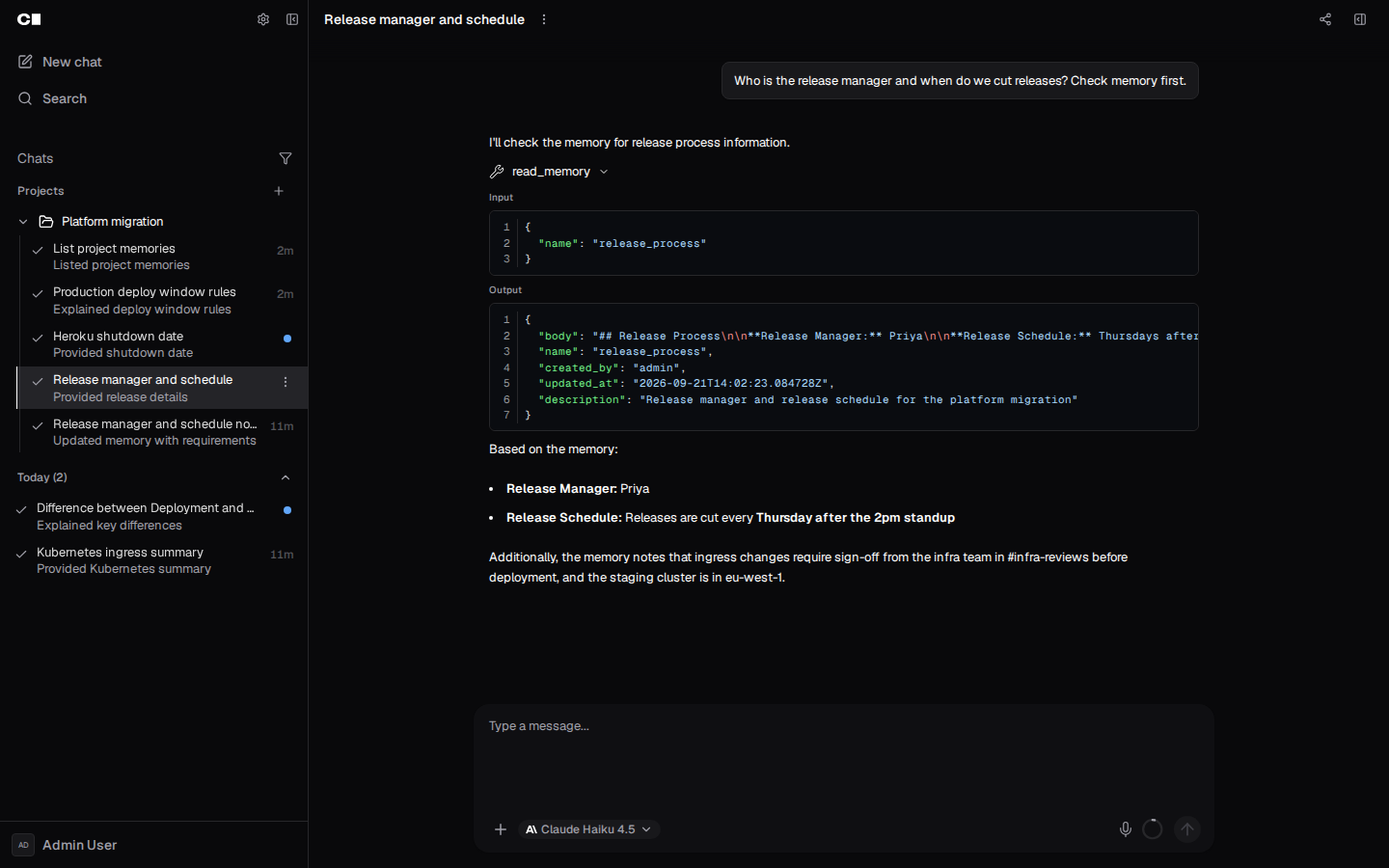 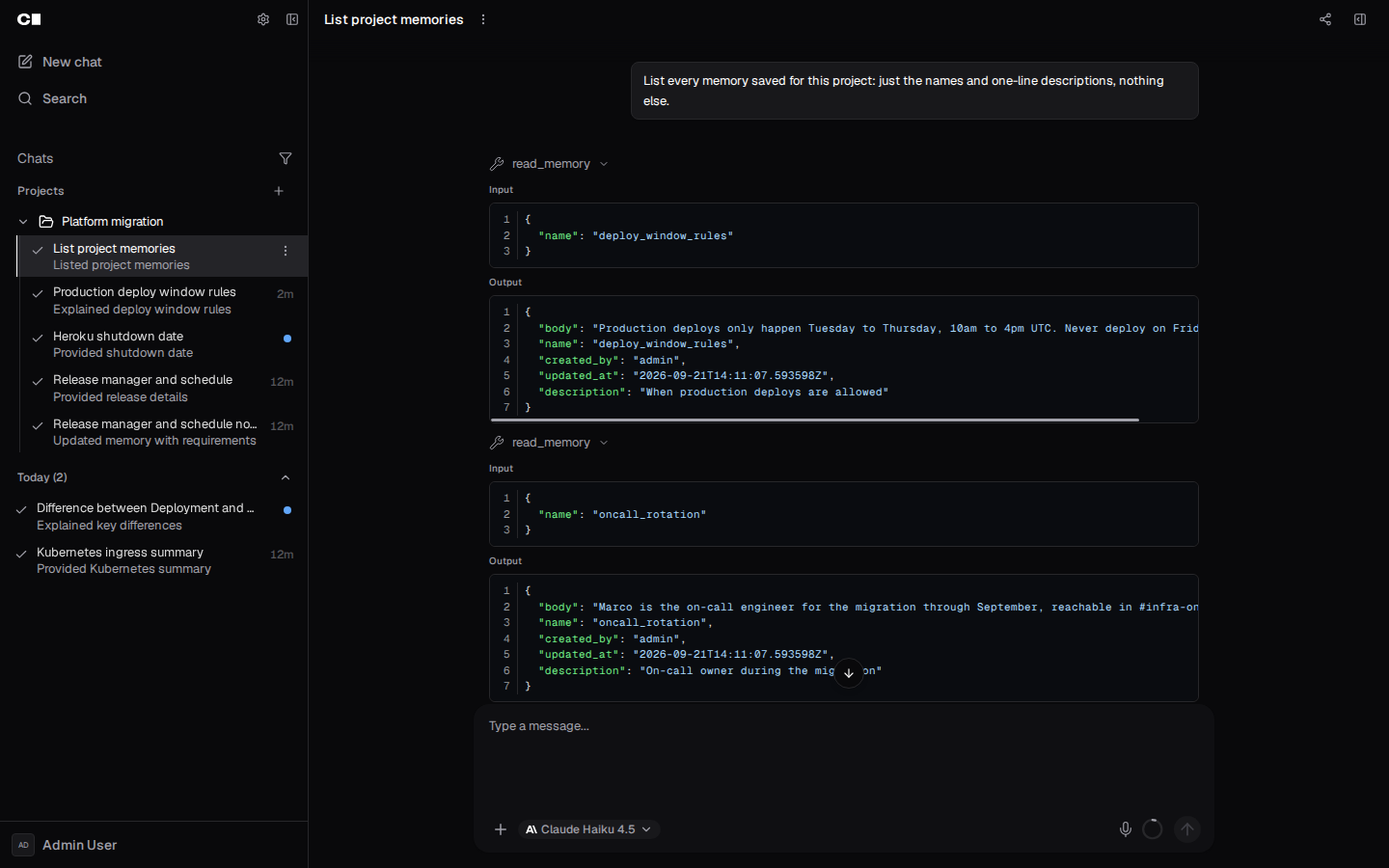 </details> --- Generated with Coder Agents on behalf of @f0ssel. --------- Co-authored-by: Claude Opus 5.5 (1M context) <noreply@anthropic.com> |
||
|
Mathias Fredriksson
|
0f78361750 |
fix(coderd): cancel tool calls in messages deleted on edit (#30194)
Editing a message removes it and every later message from the chat. Before, a tool call in those messages kept going in the workspace: a foreground command ran to completion, and a file edit or write could still apply, while the model no longer knew about it. Now chatd sends the workspace agent a cancel request for each such call before the new turn's first model call. Calls that already returned, such as background processes the model was told about, keep running. Fixes CODAGT-1222 |
||
|
J. Scott Miller
|
fc0af7fbd8 |
feat: open a chat_turn span per prompt (#29771)
**TL;DR:** Wraps each prompt in a `chat_turn` root span with every lifecycle stage parented under it. The span records one outcome per turn (`completed`, `interrupted`, `error`, `abandoned`), and the new `coderd_chatd_turn_outcomes_total` counter counts those outcomes. Turns stay correct when tasks are canceled, replaced, or retried. Each prompt runs inside a `chat_turn` root span owned by the runner (`runnerTurnSpan`). The generation step, prepare, MCP connect, stream, TTFT, provider attempt, commit, thinking, tool call, compaction, and retry backoff stages are parented under it, activating the stages from #29770. `chat_turn` spans are standalone roots: the turn runs on a worker, often on another replica, and no trace context is persisted. **Lifecycle** - **Start.** Each generation loop iteration calls `Ensure`, which opens the turn if none is open and returns a `turnToken`. The span is backdated to the trigger: the latest of the last user prompt, a dynamic tool's result message after it, and a pending compaction request. An `acquisition` stage covers trigger to pickup. - **Stale trigger / takeover.** A trigger at or before the previous anchor opens the turn at now with no `acquisition` and counts `stale_anchor`. A runner that took the chat over from an owner with a stale heartbeat (`TakenOver`, from acquisition) opens its first turn at now with no `acquisition`, so the dead owner's run is not reported as pickup delay. - **Newer prompt.** `Ensure` on the current turn with a newer trigger closes it and opens a new one. The closed turn is `abandoned` unless the task that ran it records an outcome before releasing it. - **Finish.** After `FinishTurn` or `EnterRequiresAction` commits, the step calls `Complete`; `Settle` closes the span after the step's own stage ends, so the finishing step is inside the turn. A chat waiting in `requires_action` is outside any turn; the generation resumed by its tool results opens a new one. - **Emission.** Closing a turn fixes its end time; its span is emitted once every task that joined it (`Ensure` takes the task ID) has called `Release`, which `runTask` does after the task returns. A finishing task whose `FinishTurn` promoted a queued prompt therefore still counts its turn as `completed` even when the promoted task's `Ensure` runs before its `Complete`. `End` at runner exit emits whatever is left. - **Failure.** A step that commits `FinishError`, or fails closed, invalidates the turn as `error` after the commit. Errors the task runner retries, including task timeouts, keep the same turn open; an expected, non-retryable exit records no outcome and leaves the turn open until the interrupt task, a newer prompt, or runner exit closes it. A canceled generation task records no outcome and cannot obtain a turn token, so a replaced task never touches its successor's turn. - **Interrupt.** The interrupt task marks the open turn `interrupted` before `FinishInterruption` commits and closes it after. Only a stop (by the user or a parent agent) is `interrupted`; it ends with unset span status, since error status is reserved for `error` turns. runner shutdown, loss of ownership, and message edits close the turn as `abandoned` with unset status. - **Promotion.** Every promoting transition (`FinishTurn`, `FinishInterruption`, a send to an errored chat, `PromoteQueued`) returns the promoted message's queued time in its result, and one `recordQueueWait` helper records a standalone `queue_wait` to the promotion. The promoted turn opens at the promotion time. `chat_turn` is observed on `coderd_chatd_stage_duration_seconds` only for completed turns, so the histogram is completed-turn latency; every turn still emits its span. `coderd_chatd_turn_outcomes_total{outcome, chat_kind}` counts every closed turn exactly once (`completed`, `interrupted`, `error`, `abandoned`), matching the span's `turn_outcome`, under the `chat-stage-metrics` experiment. Turn time accounting is in draft #29772. **Stages and identity** - `tool_call` is a live stage around each local tool call in `chatloop`; the tool runs on its context, and it ends errored only when the tool fails to execute. Calls that never run (inactive, unknown, or rejected by policy) record no stage. - `mcp_connect` carries connected and failed server counts and ends errored only when servers were configured and none connected. - The compaction stage carries the model that runs the summary. - `withStageIdentity` puts scope and chat kind on the turn context. Detached background work runs in `background` scope as its own trace roots. - The `advisor` tool's nested model call appears only as its enclosing `tool_call`. ARCHITECTURE.md gains a "Lifecycle tracing" section. <details> <summary>Review decisions</summary> - Turn identity stays timestamp-based with targeted fixes (clamped acquisition, rotation on a newer trigger, invalidate after commit, fail-closed invalidation, settle closing invalidated turns) plus a takeover flag; keying turns on message IDs would not detect takeover and cannot express interrupted/abandoned outcomes. - Outcome classification: the interrupt task owns `interrupted`, and cancellation or a fence mismatch alone never records an outcome, so shutdown, ownership loss, and edits are `abandoned`. Only `error` turns set error span status. Remaining ordering races between a step and an interrupt are documented as known limitations in ARCHITECTURE.md. - Turns are emitted after the tasks that ran them return, not when they close, so an outcome a replaced task records while unwinding reaches its own turn; the successor task is not delayed. Chosen over an after-commit, pre-publish hook on `ChatMachine.Update`, which would fix only the `FinishTurn` ordering. - `requires_action` ends the turn rather than pausing it, so `chat_turn` measures chatd time; a prompt with client tools counts as several turns. - Promoted turns anchor at promotion time and `queue_wait` is always standalone, so `chat_turn` never includes time spent queued behind another turn. - The former `capacity_wait` stage (#29805) was dropped: it was a per-worker lower bound, excluded from accounting, and needed its own SQL and bookkeeping. #29805's remaining helpers are folded into this PR. </details> Supersedes #28972, #28973, and #29805. 🤖 This PR was generated by Coder Agents on behalf of @jscottmiller. |
||
|
J. Scott Miller
|
7a9442014e |
feat: add chatd lifecycle stage tracer (#29769)
**TL;DR:** Adds a stage tracer that turns each chat lifecycle stage into
both an OpenTelemetry span and a Prometheus histogram observation, so
traces and metrics always agree. The metrics are only registered with
the `chat-stage-metrics` experiment. Nothing calls the tracer until the
next PRs.

Adds `chatloop.StageTracer`, which emits each chat lifecycle stage as an
OpenTelemetry span and a `coderd_chatd_stage_duration_seconds{stage,
scope, chat_kind}` observation from one `End` call, so trace and metric
durations cannot disagree. The provider-bound stages (`stream`,
`provider_attempt`) are also observed on
`coderd_chatd_model_stage_duration_seconds{stage, provider_type,
chat_kind, model}`, the only family carrying `provider_type` and
`model`, and only for turn-scoped stages. Time to first token per model
stays on the existing `coderd_chatd_ttft_seconds`. Nothing calls the
tracer yet; the next PRs instrument the provider call and the runner.

- The families are registered only when the `chat-stage-metrics`
experiment is enabled (safe and known, so
`--experiments=chat-stage-metrics` or `--experiments=*` turns it on).
Spans are emitted regardless. `NewMetrics` leaves the families off;
`chatd.New` opts in from the experiment, and a test asserts the
experiment decides whether they reach the server's registry.
- `Stage`, `Scope`, `ChatKind`, and `StageAnomaly` are typed string
constants. `scope` separates latency attributable to a prompt (`turn`)
from detached `background` work; `chat_kind` is `root` or `subagent`,
empty without a known chat.
- `StageModel` carries the wire `provider`, `provider_type`, `model`,
and `reasoning_effort`. All are span attributes; only `provider_type`
and `model` are metric labels, on the model family. No family carries an
organization label.
- Observed stages: `chat_turn`, `queue_wait`, `acquisition`,
`mcp_connect`, `stream`, `time_to_first_token`, `provider_attempt`,
`tool_call`, `commit`, `retry_backoff`. `generation_step`, `prepare`,
`thinking`, and `compaction` are span-only. A test keeps the stage sets
and help text consistent.
- API: `Start` / `StartRootAt` for live spans (span timestamps come from
the tracer clock), `Record` for stages reconstructed from timestamps
(the scope comes from the context). `End` is idempotent;
`EndWithoutObservation` ends the span without a sample. A nil tracer,
provider, or metrics discards.
- `coderd_chatd_stage_anomalies_total{reason}` counts observations
dropped, adjusted, or inconsistent (`negative_elapsed`,
`inverted_window`, `missing_timestamp`, `future_start`, `stale_anchor`).
Span-only stages never feed it.
- Buckets are 12 round edges (`0.1 0.25 0.5 1 2.5 5 10 30 60 300 1800
3600`).
- Moves the body of the `for` loop in `StartGeneration` into
`runGenerationStep` so the step has a function boundary for a deferred
stage end. Control flow and error wrapping are unchanged.

<details>
<summary>Series cost (approximate, whole stack)</summary>

A histogram label set is 12 edges + `+Inf` + `_sum` + `_count`: 15
series. Per replica, each `chat_kind` costs about 150 stage series and 4
turn outcome counters; each `(chat_kind, model)` costs 30 (2 stages x
15). Both chat kinds on `M` models: about `308 + 60*M` per replica, plus
background-scope stage series.

Dogfood `main`, 3 replicas: ~3.4k `coderd_*` series per replica (~10.1k
total).

| Models used per replica | Added series (3 replicas) | vs. baseline |
|---:|---:|---:|
| 1 | ~1.1k | +11% |
| 5 | ~1.8k | +18% |
| 10 | ~2.7k | +27% |
| 35 | ~7.2k | +72% |

Most deployments run four or fewer models, so a typical replica adds
roughly 370 to 550 series. The experimental turn accounting in #29772
would add 88 more per replica (11 categories x 4 outcomes x 2 chat
kinds). Series appear lazily and do not grow with organizations.

</details>

<details>
<summary>Review decisions</summary>

- Experiment gate only; no deployment flag or metric levels. If the
experiment graduates, the families become always on like the other chatd
families; a flag is added then only if dogfood shows a cardinality
problem.
- Organization is on neither metrics nor spans, and `effort` is
span-only; `provider_type` (configured type), not the wire `provider`,
is the model-family label.
- `time_to_first_token` is not on the model family; per-model TTFT is
`ttft_seconds`, which observes the same measured window.
- The model family records only turn-scoped stages.
- Nil guards are kept so a nil or zero tracer is always safe to call.
- HTTP attribute keys stay snake_case like the rest of the chatd span
attributes.

</details>

Supersedes #28968 and #28969.

🤖 This PR was generated by Coder Agents on behalf of @jscottmiller.
|
||
|
Mathias Fredriksson
|
fa5bac6e77 |
feat: send tool call IDs and cancel unresolved calls on interrupt (#29954)
Retries and replica takeovers ran tool calls again, and an interrupt recorded the same generic result whether a call had finished, was still running, or never started. chatd now derives a tool call ID from the chat, the committed assistant message, and the provider tool call ID, and sends it with execute starts, edit_files, and write_file. Every replica and retry computes the same ID, so the agent returns the first result instead of running the tool again, and a retried foreground execute waits only for the rest of its timeout. On interrupt, chatd cancels the unresolved calls of those tools on the agent before committing, within 30 seconds, and records what happened: "tool call was canceled before it ran; no changes were made", the output of a command canceled while running, or the real result. The UI shows a canceled command with the existing killed marker. If the cancel fails, including an old agent's 404, the result stays the generic interrupted text. Calls whose provider tool call ID is empty or repeats in the message get no ID and behave as before. Fixes CODAGT-757 |
||
|
Michael Suchacz
|
5a997c471a |
fix(coderd/x/chatd): tell the model when output hit the token limit mid tool call (#30120)
When an Anthropic response hits the output token limit while the model
is writing a tool call's input, chatd gets `FinishReasonLength` with a
cut-off call. It handled both shapes of that call badly:

- If the provider closed the `tool_use` block, the call carried
truncated JSON and got the generic malformed-input result, which invites
the model to resend the same oversized input and hit the limit again.
- If the block never closed, fantasy emitted no tool call, chatloop
discarded the dangling tool input, and the turn ended with only
reasoning and no explanation.

On a length finish, `GenerateAssistant` now gives each cut-off local
call an error result: "This tool call was not executed because the
response reached the output token limit (N tokens) while writing its
input. Split the content into smaller tool calls." The token count is
included when the call has a configured output limit. A tool input that
started streaming but never became a call first gets a stand-in call
with empty input. The call persists with nil args and replays as `{}`,
so the provider receives a valid `tool_use` and `tool_result` pair, and
generation continues with another step.

With lifecycle hooks enabled, `pre_tool_use` admission skips calls the
step already resolved, so the hook is not dispatched for them and no
second result is added. The duplicate tool ID check still runs on the
full batch, because a resolved call still occupies its ID.

Independent of #30119, which stops the AI Gateway from failing these
streams before chatd sees them.

## Testing

-
`TestGenerateAssistant_SilentNoOutputFinish/LengthFinishResolvesTruncatedToolCalls`
(truncated tool call, dangling tool input): no error, reasoning kept,
and each call paired with the output-limit result.
- `TestPreToolUseHookOutputLimitTruncatedToolCallResolvedOnce` with
hooks enabled, for truncated and unfinished input: no hook dispatch, one
stored error result per call, a second model request, and a replayed
request that pairs `tool_use` input `{}` with its `tool_result`.
`DuplicateIDFailsClosed` checks that a reused ID still fails the chat
with `duplicate tool use ID`.
- Red-green: with `chatloop.go` and `generation.go` restored to the base
code, all four truncation cases fail. `DuplicateIDFailsClosed` passes on
the base code by design and fails on `d02bf4aa89b`, which dropped
resolved calls before the duplicate check.
- `go test ./coderd/x/chatd/... -count=1` passes, and lint on the
touched packages reports no issues. Local pre-push checks were skipped
per standing preference; PR CI covers them.
- Remote UAT: not run yet.

## Review record

- Parent review (Xum) of `d02bf4aa89b`: skipping resolved calls inside
`chathooks.PendingToolCalls` hid them from the duplicate tool ID check
in `admitStepToolCalls`. Fixed in `745f722165b`.
- Codex: not requested yet.

> Xum, an AI coding agent, prepared this PR on behalf of @ibetitsmike.
|
||
|
Thomas Kosiewski
|
9aa7130e01 |
feat: evaluate experiment rules per user in discovery and chatd (#29964)
Slice 3 of 4 for runtime experiment rules: evaluate stored rules per user in discovery, the frontend experiments query, and the pilot `mcp-tool-search` gate in chatd. There is still no way to edit rules through the product; that comes in slice 4. With no rules stored and a healthy database, backend decisions match today. This PR deliberately changes three things: 1. **Fail closed on rule reads.** If the rules read fails, `mcp-tool-search` is off, even when it is enabled at startup. 2. **Frontend freshness.** The experiments query now refetches. 3. **Caching.** `/api/v2/experiments` and rendered HTML are sent with `Cache-Control: no-store`. Static assets keep their long-lived caching. ## What's in it - **coderd** builds `api.ExperimentEvaluator` from `experiments.NewDBStore` plus the startup `--experiments` list. - **Discovery:** `GET /api/v2/experiments` and the `<meta property="experiments">` tag both use `EnabledExperiments(ctx, caller)`. - **chatd:** `mcp-tool-search` is now user-scoped. `chatd.Config.ExperimentEvaluator` is required, so `chatd.New` returns an error without it. `prepareGeneration` decides once per turn for the chat owner (`chat.OwnerID`); child chats inherit the owner. - **Ruleguard** (`userScopedExperimentStaticCheck` in `scripts/rules.go`): rejects static `Experiments.Enabled(...)` and `httpmw.RequireExperiment*(...)` checks of user-scoped experiments in server packages. A codersdk test keeps its list equal to `codersdk.ExperimentsUserScoped`. - **Frontend:** the experiments query is keyed by user ID and seeded from the meta tag only when the embedded user matches. It is stale 60 s after page load and refetches on mount, window focus and reconnect. Logout also clears the experiments metadata. The dashboard keeps the last loaded list when a background refetch fails, instead of replacing the page with an error. - **Once per turn:** chatd decides `mcp-tool-search` on a turn's first step and reuses that decision for the turn's later steps, so a rule change applies from the next turn and never withdraws a `find_tools` call the model already made. The decision lives on the chat runner, keyed by the turn's prompt row, like the stop-nudge tracker. A runner handoff in the middle of a turn evaluates again. - **Reference audit:** the only non-test server check of `mcp-tool-search` is in `generation_preparer.go`, and it now goes through the evaluator. ## Testing - **Go:** per-user results and `no-store` on `/api/v2/experiments`; the per-user meta tag and the HTML cache headers in `site`; group and org conditions end to end in enterprise; chatd owner eligibility, on → off → on across turns including a child chat, and a failed rules read. - **Vitest:** user-keyed seeding, staleness from page load after a remount, refetch on focus, logout clearing, and the dashboard surviving a failed refetch. Remote dogfood UAT through Coder Agents passed on a licensed test deployment: - per-user discovery in both the API and the meta tag; - widening a rule, and turning it off, with no restart; - `off` beating a startup default, and `inherit` restoring it; - fail closed on malformed JSON and on an unknown mode, with no condition text in the logs; - the `no-store` headers; - real-model chatd enforcement: `find_tools` offered on turn 1, gone after `off`, back on turn 3. That round tested `b57207d4ee`. The later commits change only tests, and a follow-up round will cover the final head. **For the author:** `coderd/x/chatd/ARCHITECTURE.md`'s list of the runner's local state doesn't mention the per-turn trackers (debug turn, session start, stop nudges, and now this experiment decision). I did not edit that document. **Known behavior:** a broken rule logs one error line per evaluation (per request or turn), with only the experiment, revision, category and position. ## Stack 1. #29869: evaluator library 2. #29898: storage and audit types 3. **This PR:** enforcement and discovery 4. Control plane (experimental API, `coder exp experiment-rules` CLI, docs) > [!NOTE] > This PR was written by an AI agent (Xum). --- _Generated with [`xum`](https://github.com/coder/xum) • Model: `anthropic:claude-opus-5-5` • Thinking: `high`_ --------- Signed-off-by: Thomas Kosiewski <tk@coder.com> |
||
|
Michael Suchacz
|
f5092aaa4a |
feat: make chat limits configurable deployment options (#28927)
Adds deployment options for the chat limits that shape turn behavior and API acceptance, replacing hardcoded constants in `coderd/x/chatd` and the chat API. Defaults are unchanged. | Option | Default | Limit | |---|---|---| | `CODER_CHAT_MAX_STEPS_PER_TURN` | 1200 | steps (model responses) in a chat turn | | `CODER_CHAT_MAX_GENERATION_RETRIES` | 25 | consecutive retries after a model generation fails with a transient error | | `CODER_CHAT_MAX_QUEUED_MESSAGES_PER_CHAT` | 20 | messages that can be queued in a chat | | `CODER_CHAT_MAX_ATTACHMENTS_PER_CHAT` | 50 | files linked to a chat; linking more deletes the earliest uploads | | `CODER_CHAT_MAX_PROMPT_BYTES` | 131072 | system prompt, plan mode instructions, and each user's custom prompt | | `CODER_CHAT_MAX_CONCURRENT_RECORDING_UPLOADS` | 25 | desktop recordings each server stores at the same time | `codersdk.DefaultChat*` constants remain the single source of truth. Values below 1 fail startup validation, and each option's description ends with "Must be at least 1." `chatd.New` fills any zero field in `chatd.Config.Limits` with its default once, `LimitsFromConfig` is a plain conversion, and the code that receives a limit as a parameter (the `chatstate` queue and file link checks, the turn step check, `chatretry.Retry`, and `chatadvisor.NewRuntime`) returns an error for a limit below 1 instead of choosing a default or disabling the limit. The options are documented in the generated configuration reference and in the platform controls docs. `CODER_CHAT_MAX_GENERATION_RETRIES` counts consecutive retries, and the count resets after each successful step. The default allows 25 retries (26 attempts) where the old constants allowed 24. The same limit now applies to each nested advisor model call and to background title, summary, and turn status label generation, which previously used fixed `chatretry` budgets. Chat creation and tool result bodies keep the fixed 256 KiB limit from main. The prompt-saving endpoints accept bodies up to twice the prompt limit, for JSON escaping and characters that sanitization removes, but never less than 256 KiB, so small prompt limits still return the 400 length error. At the default this equals the 256 KiB limit on main. Four settings from earlier revisions were removed, and the fixed limits from main are back: - `CODER_CHAT_MAX_TOOL_OUTPUT_BYTES`: the agent already keeps a 16 KiB head and a 16 KiB tail of command output, so raising it had no effect and lowering it cut the tail. - `CODER_CHAT_MAX_DYNAMIC_TOOLS_PER_CHAT`: tool definitions share the 256 KiB chat creation body limit, so raising the count did little. - `CODER_CHAT_DEBUG_MAX_BODY_BYTES`: one setting covered two unrelated debug caps. - `CODER_CHAT_DEBUG_MAX_TEXT_RUNES`: the name did not say what it applied to. Root and subagent concurrency caps stay fixed because they are licensing behavior, and `MaxChatFileSizeBytes` stays fixed because the web UI hardcodes the generated constant for client-side checks. `codersdk.MaxChatFileIDs` is removed; the web UI's "Attachment expired" tooltip no longer quotes the number because the cap is now per deployment, and it says that attaching a file beyond the limit permanently deletes the chat's earliest-uploaded attachments. ## Review record | Round | Reviewed head | Result | Disposition | |---|---|---|---| | Codex 1 and 2 (Sep 2 to 3) | `7f10a1572f8`, `8ee09f8fa3b`, `197bb78d5b` | 10 findings, then OK on `197bb78d5b` | all threads resolved | | Codex 3 (Sep 17) | `e4efac249a5` (pre-rebase) | 4 findings | advisor retry limit confirmed and fixed in `9e462b7b3d0` (rebased from `67341e458e8`); ARCHITECTURE.md TODOs added; JSON-escaping body sizing and streamed-argument rune cap declined as pre-existing design (evidence in threads) | | Codex 4 (Sep 18) | `9e462b7b3d0` | 6 findings | recording evicted at attachment cap 1 confirmed and fixed in `5b61895decb`; `Limits` field docs and zero-value fallback documented; prompt retro-enforcement, generated multi-sentence lines, and tool-output truncation metadata declined as pre-existing design (evidence in threads) | | Codex 5 (Sep 18) | `5b61895decb` | 1 finding | over-cap batch of already-linked files accepted after lowering the cap: confirmed and fixed in `f44063e74e5` | | mafredri (Sep 23) | `f44063e74e5` | 24 threads, changes requested | all fixed in `05e3e3d622a`, `c1f78e09e8b`, `709ddb67977`, `d0587a49829`, `ca4347b24de`, and `1f6c9e2a46f`, then answered and resolved; the ARCHITECTURE.md text was written at the author's direction and approved by the author | | Sibling sweep (Sep 24) | `1f6c9e2a46f` | author-requested audit of all 24 mafredri threads for sibling issues, plus a test refactor | fixed in `37eaf07d34d` through `1f14ac041b7`: the advisor retry limit, `chatretry.Retry`, and the turn step check reject values below 1 instead of disabling retries or the limit; limit tests run against both the default and configured values set through `chatd.Config` or `DeploymentValues`; the expired-attachment tooltip is concrete. A required coder-frontend-review run (8 roles in one agent, CD re-run once) found a stale story comment, removed. | | Codex 6 (Sep 27) | `a71383e3a31` | OK, no findings | requested after the rebase at the author's direction, past the six-pass review budget | The branch was rebased onto main `4851c7b60c8` on Sep 27; the previous head was `91b84000adb`, and the earlier SHAs in the review record predate the rebase. Conflicts in the `chatstate` transitions and `CreateChat` keep both main's `InitialStatus` and this PR's `MaxFileLinks`, and main's rewrite of `advisor_internal_test.go` in #28754 keeps main's version plus this PR's limit tests. Two tests added on main needed the new retry arguments: `TestGenerateStructuredTitleWithUsage_FallsBackToTextWhenToolChoiceRejected` and `TestAdvisorRunStreamsReasoningDeltasSeparatelyFromAdvice`. Validation on `a71383e3a31`: the pre-commit hook (generation, golangci-lint, build), the full `coderd/x/chatd/...` suite (20 packages), the chat tests in `codersdk`, `coderd`, and `enterprise/coderd`, the CLI help tests, race-detector runs of the `chatd`, `chatstate`, `chatadvisor`, and `chatretry` packages, and `go build` plus `go vet` on each of the 27 commits. No remote UAT was run. > Xum acted on behalf of @ibetitsmike for this pull request. |
||
|
Michael Suchacz
|
fd5b37576a |
feat(coderd): record provider response IDs on chat messages (#29763)
Chat messages could only be linked to AI Gateway records per chat, so nothing recorded which model response produced a given message. fantasy surfaces the response ID the model endpoint returns on the stream's finish part: the Anthropic Messages ID as the part ID, and the OpenAI Responses ID in provider metadata. chatd now stores that ID in the existing `chat_messages.provider_response_id` column for assistant steps and the compaction summary row. No migration and no aibridge changes. What the stored value is depends on the route: | Route | Stored value | Joins to | |---|---|---| | Anthropic Messages API through the AI Gateway (Anthropic and Bedrock Claude) | The gateway's interception ID. The gateway replaces the message ID because injected MCP tool loops can fold several upstream messages into one response. | `aibridge_interceptions.id` | | OpenAI Responses API through the AI Gateway | The upstream `resp_` ID, passed through unchanged | `provider_response_id` on `aibridge_token_usages`, `aibridge_user_prompts`, and `aibridge_tool_usages` | | Direct to the provider | The provider's own ID (`msg_`, `resp_`) | Nothing in the gateway tables | To resolve messages to interceptions, then read usage by `interception_id`: ```sql SELECT cm.id AS chat_message_id, i.id AS interception_id FROM chat_messages cm JOIN aibridge_interceptions i ON i.id::text = cm.provider_response_id UNION SELECT cm.id, tu.interception_id FROM chat_messages cm JOIN aibridge_token_usages tu ON tu.provider_response_id = cm.provider_response_id; ``` Not covered, and left NULL: - Partial rows saved on interrupt, because fantasy only reports the ID in the finish part. - Chat Completions providers (OpenAI-compatible, OpenRouter, Vercel), because fantasy does not surface the chunk ID there. - User, tool, and system rows, and all existing messages. <details> <summary>Delivery record</summary> - `96a896c` replaced the earlier interception-link design (`59fa58f`, `7f93c18`, `9d04ccd`) in place: the aibridge hook, the `aibridge_interception_id` column and migration, the message part buffer tracking, and the `ARCHITECTURE.md` section are all removed. The net diff against the base touches only `coderd/database` and `coderd/x/chatd`. - Local validation on `96a896c`: pre-commit hook green (gen, fmt, lint, build); `go test ./coderd/x/chatd/... ./coderd/database/` green. Red-green: removing the finish-part capture fails both new end-to-end tests (`TestActiveServer_PersistsAnthropicMessageID`, `TestOpenAIResponsesPersistsProviderResponseID`). CI on `96a896c`: green. - Remote UAT round 2 on `96a896c` ([chat](https://dogfood.cdr.dev/agents/75353a23-cd9e-4c81-a99f-472c78f3ba32)): **FAIL** against this description's earlier claim that every stored ID joins the gateway usage rows directly. Anthropic rows routed through the gateway stored the interception ID, so 0 of 18 joined usage rows directly, while every checked Anthropic row equaled `aibridge_interceptions.id`. Both OpenAI Responses rows joined directly. Interrupted partial rows, Chat Completions rows, and user and tool rows were NULL, with no empty strings or duplicate IDs. Multi-step turns, manual compaction, edit and regenerate, a provider switch, and a retried 429 behaved as expected. One unattributed anomaly: a single duplicate user row after interrupt and continue, which did not reproduce and is outside this diff. - `2e889ba` corrects the doc comment on `PersistedStep.ProviderResponseID` and this description to match; behavior is unchanged. Pre-commit hook and CI green. - Remote UAT round 3 on `2e889ba` against the corrected contract ([same chat](https://dogfood.cdr.dev/agents/75353a23-cd9e-4c81-a99f-472c78f3ba32)): **PASS**. The query above resolved all 40 stamped rows to exactly one interception from the same chat, with none unresolved. Reading usage by interception recovered every usage row for 38 of them; the last two resolved but their usage rows were not counted. Fresh Anthropic and Responses calls, a seven-step tool turn, manual compaction, an Anthropic to Responses to Anthropic switch in one chat, and a UI reload behaved as described, and the NULL cases held. Three interrupt and continue attempts did not reproduce the round-2 duplicate, so it stays unattributed. Not tested: gateway-injected MCP tool loops (unreachable from chatd, whose delegated requests skip the gateway's MCP proxy), direct Anthropic `msg_` IDs, Bedrock, and threshold-triggered compaction. Both rounds had a verified isolation proof and a clean dogfood audit. - Codex rounds 1 to 3 reviewed the old design. Codex round 4 on `2e889ba` ([request](https://github.com/coder/coder/pull/29763#issuecomment-5796193371), 13:58Z): no major issues ([result](https://github.com/coder/coder/pull/29763#issuecomment-5796267231), reviewed commit `2e889ba05c`). No unresolved review threads. Review passes so far: 4 of 6. - Final head `2e889ba` is the exact commit remote UAT round 3 and Codex round 4 covered; required checks green. </details> > Xum updated this PR on behalf of @ibetitsmike. |
||
|
Michael Suchacz
|
96b0bdc7bc | refactor(coderd/x/chatd): unify model override resolution (#28754) | ||
|
Michael SuchaczandPaul Frybarger
|
19e2b0415a |
fix(coderd/x/chatd): preserve tool definitions during compaction (#29436)
Supersedes #28883 by @pfrybar. His commit is carried with authorship intact (rebased onto main as |
||
|
Ethan
|
77479408b4 |
feat: make the Coder Agents stream silence timeout configurable (#29394)
The `chatloop` stream silence guard cancels and retries a model attempt after `10m` of silence, and it was hard-coded. It's armed before the request opens, so it also bounds time to first token, and slow local models (e.g. `llama-server` on a large prompt) can spend longer than that on prompt processing alone, meaning every attempt just gets cancelled and retried. This PR adds `--chat-stream-silence-timeout` / `CODER_CHAT_STREAM_SILENCE_TIMEOUT` (default `10m`) and passes it to both the main loop and the advisor. Setting it to `0` disables the guard entirely, and anything above `24h` is rejected, which also keeps the watchdog arithmetic below from overflowing. Whilst doing this I ran into the runner's `15m` task watchdog, which kept counting during an open stream. That silently cancelled any healthy stream longer than `15m`, and would've stopped a silence timeout above `15m` from ever firing. To fix, the silence guard now kicks the watchdog out to `max(15m, silence + 5m)` whenever it arms or sees a part. Silent streams still fail through the guard, healthy streams can run for as long as they like, and hang detection is unchanged everywhere else. With the guard disabled there's nothing to kick against, so arming it just stops the watchdog for the rest of the attempt. That does mean the DB write after the stream isn't bounded either when `0` is set; I think that's fine for an opt-in setting, and a user can still stop the chat from the UI if it wedges there. I did consider removing the guard entirely, but the provider HTTP clients have no timeout, so a provider that holds the connection open would only ever be caught as a generic task hang, which is what #25782 was fixing. |
||
|
Michael Suchacz
|
8397680687 |
fix: keep text and image together in MCP tool results (#29332)
## Problem MCP tool results that mix text and an image (Playwright's default `browser_take_screenshot` returns `[text, image]`) were reduced to text only in both MCP conversion paths, so screenshots never reached the model. The generic tool renderer also showed media results as a JSON dump of base64. ## Fix - `mcpclient` and `chattool`: keep all text plus the first usable binary item. Error flags survive empty and MIME-less results. Only one binary payload is represented; additional images are still dropped. - `chatloop`: at execution time, cap tool media at the 10 MiB attachment limit and correct or reject declared image types by byte signature (sniffing, not decoding). - `chatd` prompt build and `chatprovider`: at generation and compaction, replace media the destination provider cannot accept with the text plus an omission note (Anthropic/Bedrock: JPEG, PNG, GIF, WebP under the inline cap; OpenAI/Azure and Google: their image allowlists, applying the configured vendor's rules behind `openai-compat`). Persisted history is unchanged, so the UI keeps the payload and provider switches keep working. - `site`: results flagged `is_media` render through `ToolResultMedia` (image with the existing lightbox, or a short notice for non-image media, plus the text). Unflagged media-shaped JSON stays in the JSON viewer. - `go.mod`: pin [coder/fantasy `9a3598480a71`](https://github.com/coder/fantasy/commit/9a3598480a71e45901bfcfbf566ffa42c6bbdd63), main's `a511353f83eb` plus the batch-order fix `460d4fdd113b` (Chat Completions and compatible transports emit every tool result before synthetic user images). The fix lives on `mike/mcp-tool-media-batch-order`; no upstream PR yet. ## Validation Round 3 dogfood UAT on this head, `522bd76a58a`: **PASS** ([chat](https://dogfood.cdr.dev/agents/5e617636-c6f2-46fc-96e5-97ae35ed822e), real Playwright MCP, Claude Haiku 4.5 and GPT-4o mini through the AI gateway). Verified in the UI and on the wire: image plus text render together, the lightbox opens and closes, both survive a reload; audio shows a notice instead of base64; media-shaped JSON stays in the JSON viewer; BMP on OpenAI Responses and Chat Completions reaches the model as text plus an omission note; SVG and PNG histories switch from Anthropic to OpenAI; cross-provider compaction through the organization override works; a result over 10 MiB persists only text plus a note, and a 5.5 MiB PNG is substituted for Anthropic yet still renders in the UI. Google is not routable on the dogfood gateway (404), so it was not exercised. The remote agent's own FAIL was a probe artifact (the code viewer renders in a shadow root) and was overturned on its screenshots by the independent runner. Rounds 1 and 2 (`65db84a`, `5001de7`) covered the same API surface earlier. Known limits: signature sniffing does not catch a truncated PNG with a valid header (providers return 400 for it), and only the first binary item of a result is kept. Pre-existing and out of scope: chatd opens a new MCP session per generation action, so Playwright's default per-session browser loses page state between steps (UAT used `--cdp-endpoint`). Reviews: | Review | Head | Outcome | |---|---|---| | Codex 1 to 5 | `472914f` to `bcf4c72` | 16 findings (empty binary promoted over text, no provider caps, SVG on Anthropic, provider-switch gap, Bedrock labels, unbounded media, unvalidated bytes, renderer gating, lightbox test), all fixed | | Codex 6, 7 | `8a9a9e0`, `5001de7` | no major issues; one Responses audio concern [refuted with a live probe](https://github.com/coder/coder/pull/29332#discussion_r4018514197) | | [Codex](https://github.com/coder/coder/pull/29332#pullrequestreview-5226106293) | `83e1a10` | two P2s refuted with serializer captures ([MIME](https://github.com/coder/coder/pull/29332#discussion_r4029188332), [advisor](https://github.com/coder/coder/pull/29332#discussion_r4029160781)); [reassessment](https://github.com/coder/coder/pull/29332#issuecomment-5702295886) clean | | Codex | `522bd76` | [no major issues](https://github.com/coder/coder/pull/29332#issuecomment-5713663081) on the rewritten tests | | @DanielleMaywood | `472914f`, `5001de7` | renderer restructure and explicit audio mapping done; lazy slice cloning removed; two threads left open for her re-check | Local pre-push hooks were skipped per Mike's instruction; CI is the gate. > Xum acted on Mike's (@ibetitsmike) behalf to create this PR. |
||
|
Michael Suchacz
|
680b2f59cd |
refactor: remove obsolete chatd code and tests (#29228)
Chatd still carries an unreachable interruption flush path, unused state and options, an uncalled workspace MCP cache invalidation callback, and a stream-buffer-drop counter that production never increments. Remove these paths and their dedicated assertions, and update the generated metrics inventory and documentation. Consolidate duplicate publication and rollback tests and move fixture writers and test-only inspection helpers into test files. Retain the interruption persistence, state-machine matrix, legacy message format, and provider compatibility coverage. |
||
|
Garrett Delfosse
|
c12355d6e5 |
fix(coderd/x/chatd): carry unanswered user messages through compaction verbatim (#28645)
Fixes [CODAGT-737](https://linear.app/codercom/issue/CODAGT-737/compaction-can-treat-the-last-user-message-as-an-assistant-message) ## Problem Auto-compaction can trigger on a turn whose last history message is a fresh, unanswered **user** message. Two things go wrong: 1. The summary instruction is appended as another user message. Providers that merge consecutive same-role messages (verified against fantasy's Anthropic conversion) fuse it with the user's message, and the summarizer misattributes the user's instruction as assistant intent. 2. After compaction the original user row falls outside the prompt window, so the instruction survives only through summary fidelity. ## Fix Carry unanswered trailing user messages through compaction verbatim instead of summarizing them. All logic lives in `chatd`; `chatloop` is unchanged apart from prompt wording. - **Prepare** (`generation_preparer.go`): `pendingUserSegmentStart` locates the trailing user rows on the persisted rows, before provider-switch sanitization (which can drop the assistant row separating them from an already-answered message). Head and tail are converted separately so the summarizer input excludes the tail exactly. Falls back to summarizing everything when no usable segment exists. - **Commit** (`buildCompactionMessages`): replays the tail after the boundary trio as uncompressed, model-only user rows. The existing prompt window query includes them; no SQL, UI, or turn-guard changes. Replay rows carry no usage, so compaction cannot immediately re-fire. - **Prompt** (`chatloop/compaction.go`): the summary prefix no longer claims the assistant "was actively working", which is false in this case. The summarizer prompt is unchanged. - `ARCHITECTURE.md` compaction section updated. ## Testing `go test ./coderd/x/chatd/...` green. New: `TestBuildCompactionMessages_ReplaysPendingUserMessages`, `TestPendingUserSegmentStart`, `TestPendingUserSegmentConversionEquivalence`, `TestPendingUserSegmentDerivedBeforeProviderSwitchSanitization`, `TestDecisionGeneratesAfterCompactionWithReplayedPendingUser`. <details> <summary>Root-cause repro</summary> Replaying the reported scenario through fantasy's Anthropic provider against a capture server: ``` === fantasy prompt (roles as chatd builds them) === [2] role=user "You'll hit compaction now, we'll need to go through some fin..." [3] role=user "You are performing a context compaction. Summarize the conve..." === wire request to Anthropic === [2] role=user, 2 content block(s) block[0]: "You'll hit compaction now, we'll need to go through some final checks..." block[1]: "You are performing a context compaction. Summarize the conversation so..." ``` </details> --- 🤖 This PR was generated by Coder Agents on behalf of @f0ssel. |
||
|
Michael Suchacz
|
ac824cd235 |
chore(coderd): remove dead code from chatd (#29008)
Removes production code in `coderd/x/chatd` that nothing reaches, the tests that only existed to exercise it, and option/config fields that callers filled in but chatd never read. No runtime behaviour changes; the only edits outside `coderd/x/chatd` drop the now-nonexistent fields at their three call sites (`coderd/coderd.go`, `coderd/exp_chats.go`, `coderd/coderdtest`). Net: 42 files, +147 / -1065. Verification method for every item: `golang.org/x/tools/cmd/deadcode` (with and without `-test`) rooted at `cmd/coder`, `enterprise/cmd/coder` and every package that imports chatd; a `go/packages` pass counting `TypesInfo.Uses` per declared type, const, var, field and method across the same roots, split into test and non-test use sites, plus a read-vs-write split for struct fields; `rg` over the whole repo including `site/src` for json tag names; then `go build ./...`, `go vet ./coderd/x/chatd/...`, `golangci-lint run ./coderd/x/chatd/... ./coderd/ ./coderd/coderdtest/`, and `go test ./coderd/x/chatd/...` (all 20 packages) locally. <details> <summary>Evidence per deletion</summary> | Removed | What it was | Why unused | |---|---|---| | `subagent.go` `resolveConfiguredModelOverride`, `parseModelOverride`, `parsedModelOverride` (~135 lines) + `TestResolveConfiguredModelOverride_*`, `TestParseModelOverride` | raw-string model override resolver | Only callers were its two tests; production resolves overrides through `resolveOrganizationModelOverride` (`title_override.go`, `compaction_override.go`, `subagent.go`). | | `chatd.go` `removeSkillIndexMessages`, `isSkillIndexMessage` + `TestSkillIndexRefreshReplacesStaleAliases` | skill-index refresh helpers | Zero production references; the test simulated a refresh path no production code performs. | | `chatd.go` `chatMessage`, `newChatMessage`, `withCreatedBy`, `appendMessageFields`, `BuildSingleChatMessageInsertParams` (~90 lines) | insert-params builder | Exported, but every caller was a `chatd_test` file (6 sites). Replaced by a 25-line `singleChatMessageInsertParams` helper in `chatd_helpers_test.go`. | | `chatd.go` `Server.closeInflightAdmission` | one-line wrapper around `inflightClosed.Store(true)` | Single call site (`Close`); inlined. | | `chatd.go` `Server.workerID`, `instructionLookupTimeout`, `pendingChatAcquireInterval`, `maxChatsPerAcquire`, `chatHeartbeatInterval` | Server struct fields | Assigned in `New` and never read anywhere (the values reach the worker through `chatWorkerOptions`, not these fields). | | `Config.InstructionLookupTimeout`, `homeInstructionLookupTimeout`, `coderd.Options.ChatdInstructionLookupTimeout`, `coderdtest.Options.ChatdInstructionLookupTimeout` | timeout plumbing | The value only landed in the dead `Server.instructionLookupTimeout`; no CLI flag sets it and nothing reads it. | | `PromoteQueuedOptions.CreatedBy` | option field | Set by `coderd/exp_chats.go` and three tests, never read in chatd (promotion keeps the queued row's `created_by`). | | `SubmitToolResultsOptions.DynamicTools` | option field | Set by `coderd/exp_chats.go` (which re-read `chat.DynamicTools` just to pass it) and three tests, never read in chatd. | | `attachments.go` `buildAssistantPartsForPersist` (whole file) | assistant part builder | Stale copy left by #26270; production uses `buildAssistantParts` in `message_conversion.go`. Its six tests were retargeted to the live function (now `message_conversion_internal_test.go`) and a dead-copy assertion in `subagent_internal_test.go` was dropped. | | `chatloop.RunOptions` (94 lines) | old loop options struct | Only two of 23 fields were ever populated, for one internal call to `prepareMessagesForRequest`, which now takes `model, logger` directly and no longer returns the ignored canonical slice. `GenerateAssistantOptions` / `ExecuteLocalToolsOptions` are the live types. | | `chatloop.ErrDynamicToolCall`, `ErrStopAfterTool`, `PendingToolCall`, `PersistedStep.PendingDynamicToolCalls` | dynamic-tool exit protocol | Zero references outside their declarations (one stale comment in `chatdebug/service.go` updated). | | `chatloop.CompactionOptions.Persist`, `.OnError` | callbacks | `Persist` had zero references; `OnError` was set only by two tests that asserted it was never invoked. | | `chatloop` `stepResult.shouldContinue` + its computation | flag | Written once, never read. | | `chatloop.StateWaiting` | metric label const | Zero references. | | `generation.go` `generationOutcome.InsertedMessages`, `runnerActionMessage` | outcome field | Built on every commit, never read. | | `chatstate` `ExecutionState.IsArchived`, `AllOwnershipStates`, `OwnershipState`/`StateU`/`StateO`, `TransitionAcquire` | state-machine leftovers | Zero references (the ownership consts became dead once `AllOwnershipStates` went). | | `chatstate` `ExecutionState.QueueNonEmpty` | predicate | Only referenced by the test asserting its own table; the sibling `IsRunnable` check in that test is kept. | | `chatdebug.Attempt.RetryClassification`, `.RetryDelayMs` | json fields | Never assigned anywhere, `omitempty`, and `retry_classification`/`retry_delay_ms` do not appear in `site/src` or `typesGenerated.ts`. | | `chatdebug.RunContext.Kind`, `StepContext.HistoryTipMessageID`, `RecorderOptions.Provider`/`.Model`, `stepHandle.opts`/`.usage`/`.err` | context/handle fields | Written (from `chatd.go`, `chatloop/compaction.go`, `modelcall.go`, `recorder.go`) and never read. The DB run row keeps its own `kind` column. | | `chatprovider.MergeProviderAPIKeys` + `TestMergeProviderAPIKeys_PreservesProviderRegions` | key merge | Superseded by `ResolveUserProviderKeys`, whose region test already covers the same behaviour. | | `chatprovider` `providerCreationError` | one-line `xerrors.Errorf` wrapper | Single call site; inlined with identical message. | | `chatretry.IsRetryable` | classifier wrapper | Zero references. | | `computeruse.IsTool` + `TestComputerUseTool` | one-line forwarder to `fantasyopenai.IsComputerUseTool` | No production caller; two test assertions now call the fantasy function directly, and the dropped test only asserted the library's own constructor. | | `chatprompt.ToolResultToPart` | one-line forwarder to `codersdk.ChatMessageToolResult` | Single call site; inlined. | | `subagent_catalog.go` `formatSubagentDefinitions` | forwarder with `nil` overrides | Single call site; inlined. | | `worker.go` `chatWorker.chatWorkerID` | getter | Only tests called it; they read `opts.WorkerID` directly now. | | `chattest.AnthropicErrorResponse`, `OpenAIServerErrorResponse`, `ChatMessageWithParts` (`messages.go` removed) | test fixtures | Zero references. | | `chattest` `AnthropicRequest.Options`, `OpenAIRequest.Options` | `json:",inline"` map fields | `encoding/json` has no inline tag (the TODO on each said so); never populated, never read. | </details> <details> <summary>Considered and kept</summary> - `chatstate.CreateChat` (test-only thin wrapper over `insertChat`, production uses `CreateChatWithID`): documented package API with 25 test call sites; not worth the churn. - `chatprompt.MarshalContent` / `MarshalToolResult`: test-only, but they deliberately produce legacy-format DB rows so the read path's legacy handling stays covered. - `chatstate.AllowedExecutionTransitionsFrom` / `AllowedInputStates` / `AllowedExecutionTransitionOutputs`, `chatdebug.StepFromContext`, `WithClock`, `WithStaleThreshold`, `WaitUntilIdleForTest`, `PublishBuffer.BufferedChannels`, `chattool.NewWorkspaceMCPTool`: test seams that tests actively use to reach otherwise unexported state. - `AgentCapacityLimiter` interface (one production implementation): tests inject fakes. - `applyHookResultMessages` / `appendHookResultMessages`: a named pair over one placement enum, both used. - Nil-receiver guards on `*Metrics`, `*Result`, `*streamSyncPoller`, `*runnerDebugTurn`: nil is a supported "disabled" value on those paths. - Tests flagged by heuristics as assertion-light (`TestNopMetrics_DoesNotPanic`, `TestStepHandleFinish_NilHandle`, `TestRetry_OnRetryNilDoesNotPanic`, the `chatstate` synthetic-cancellation tests that assert through helpers): they cover real nil-safety or delegate assertions to helpers; kept. </details> <details> <summary>Out-of-scope findings (not changed here)</summary> - `chatdebug.Service.FinalizeStale` has had no production caller since #26270 removed the background sweep loop; only its tests call it, and comments in `chatd_debug.go` and `database/querier.go` still describe the loop. Deleting it would erase the implementation a fix needs, so it is left for a decision. - `coderd_chatd_chats` (gauge) and `coderd_chatd_stream_buffer_dropped_total` (counter) are registered and documented in `docs/admin/integrations/prometheus.md` but never set or incremented in production; `Metrics.RecordStreamBufferDropped` is test-only. Removing them changes the exported metric set and the docs, so they are left alone. </details> ## Declined review findings None yet. > Xum (AI agent) opened this PR on behalf of @ibetitsmike. |
||
|
Michael Suchacz
|
9c42b14857 |
feat: add /clear chat context command (#24745)
> [!NOTE]
> Xum acted on Mike's behalf in this pull request.
<!-- xum-attribution: model=claude-fable-5 thinking=high -->

Adds a `/clear` slash command to Agents chats that resets the model
context without deleting anything: the transcript stays visible, and the
next prompt runs as if the chat were brand new. It mirrors `/compact`'s
UX (slash menu entry, exact-text interception, dedicated endpoint,
synthetic tool block in the transcript) but generates no summary and
makes no model call.

## How it works

`POST /api/experimental/chats/{chat}/clear` commits synchronously inside
the API transaction through a new `chatstate` transition,
`ClearContext`, allowed from `waiting` and from `error` without queued
messages (`W -> W`, `E0 -> W`). No worker round-trip, no status flicker
to `running`, no migration. Clearing an errored chat clears
`last_error`, and any pending manual compaction request is dropped
rather than left to run against the cleared context.

The endpoint persists the same compressed boundary shape `/compact`
uses: a hidden model-only sentinel row, a visible synthetic
`chat_cleared` tool call, and its result. Prompt assembly already
selects the latest compressed model-only row as the context cutoff, so
the query is unchanged. Boundary detection is generalized to recognize
both `chat_summarized` and `chat_cleared`, so `/compact` after `/clear`
(and the reverse) never reach across the newer boundary, and
auto-compaction does not fire off stale pre-clear usage.

Busy chats, errored chats with queued messages, and clears with no
conversation after the latest boundary return 409. Archived chats are
rejected. The endpoint is owner-only for symmetry with `/compact`.

## Frontend

`/clear` joins the slash command menu, and the previously compact-only
send interception becomes a small built-in command dispatch shared by
both commands, so a personal or workspace skill named `clear` still
takes precedence. Because the clear commits synchronously, the UI keeps
the chat in `waiting`, refetches on success, and surfaces conflicts with
the standard error toast. The transcript renders a "Context cleared"
card via a new `ChatClearedTool` renderer.

## Docs

The user-facing agents architecture page documents `/clear`.
`coderd/x/chatd/ARCHITECTURE.md` carries TODO notes in the affected
sections for the PR author to write.

## Tests

- `chatstate`: transition matrix entries plus dedicated `ClearContext`
coverage (error-state entry, queued-message rejection, boundary row
requirement).
- `chatd`: end-to-end manual clear (fresh next prompt, error recovery,
boundary interplay with compaction, stale-usage auto-compaction
regression, busy rejection) plus boundary and message-builder units.
- `coderd`: HTTP authorization and error mapping for the endpoint.
- Frontend: slash command availability and skill collision units,
stories for the submit path, the conflict toast, and the cleared-card
renderer.
|
||
|
Michael Suchacz
|
5cc2f2c103 |
feat: add MCP connect and generation-prep observability (#28402)
## Stack context Follow-up to the MCP connect-stall incident (chats on dev.coder.com stalled ~15 min/turn while a configured MCP server black-holed requests). The stack: #28400 makes the 10s MCP connect budget actually hold; this PR makes connect and preparation slowness observable so the next incident shows up in logs and the chat debug UI instead of as a silent timeline gap. ## Why During the incident, each stalled turn looked like a silent gap before the first debug step: no per-server connect durations anywhere, no warning that preparation was slow, and the only signal was a generic "connection failure" log without timing. ## Changes - `mcpclient.ConnectAll` now returns per-server `ConnectSummary` values (config ID, slug, outcome `connected`/`timeout`/`error`/`no_tools`, duration, tool count, redacted error). Failure logs include the duration, and successful connects slower than 5s log a `slow MCP server connect` warning. - Connect summaries are seeded into the chat debug run summary under an `mcp_connect` key (seeded keys survive `FinalizeRun`'s aggregation), and the debug panel's run card renders them as a per-server list with outcome badges, durations, tool counts, and errors. - `prepareGeneration` logs a `slow generation preparation` warning when a turn's preparation exceeds 30s. ## Tests - Go: connect summary assertions added to the budget tests (outcome/duration/tool count for black-holed vs healthy servers); `go test ./coderd/x/chatd/...` green. - Frontend: new `coerceRunSummary` unit tests for `mcp_connect` coercion (malformed entries dropped, non-array ignored) and a `RunWithMCPConnectSummary` story whose play function expands the run and asserts the rendered outcomes, durations, tool counts, and error text. `pnpm check`, `lint:types`, unit and storybook projects green. > 🤖 Mux authored this PR on Mike's behalf. <!-- mux-attribution: model=anthropic:claude-opus-4-6 thinking=high --> |
||
|
Jaayden HalkoandHugo Dutka
|
64d2d8a108 |
feat(coderd/x/chatd): record live tool execution stamps in the message part buffer (#28361)
**Stack**: #28359 → #28360 → **#28361 (this PR)** → #28362 During local tool execution, buffer episodes now record when each tool-call occurrence actually starts and finishes, via `RecordToolStart`/`RecordToolCompletion`/`ToolCompletions` on the message part buffer. Occurrences are keyed by unresolved-call position, so gaps left by rejected calls and duplicate tool-call IDs stay distinct: `partitionAmbiguousToolCalls` additionally returns the allowed calls' input positions, and generation's `chatloop.ToolBillingRecorder` implementation translates dispatch-order stamps back through them. Mechanism only: nothing reads the stamps yet. The final PR in the stack uses them to bill interrupted tool batches on a dedicated usage record committed alongside their synthesized cancellation rows. Third of a four-PR stack splitting #28211. Stacked on #28360. Refs CODAGT-928 (https://linear.app/codercom/issue/CODAGT-928/track-local-tool-execution-for-agent-runtime). --------- Co-authored-by: Hugo Dutka <hugo@coder.com> |
||
|
Jaayden Halko
|
b428c8feb6 |
feat(coderd): bill completed local tool batches in agent runtime (#28360)
**Stack**: #28359 → **#28360 (this PR)** → #28361 → #28362 ## Summary Completed local tool batches now count toward Coder Agent runtime (`chat_messages.runtime_ms`, the source of truth for `hb_agent_runtime_v1`), excluding sub-agent orchestration tools to avoid double counting, and without multiplying runtime for parallel tool calls. Second of a four-PR stack splitting #28211. Stacked on #28359. Refs CODAGT-928 (https://linear.app/codercom/issue/CODAGT-928/track-local-tool-execution-for-agent-runtime). ## Problem Agent runtime previously measured only model invocation wall clock (stream open to fully consumed). Time spent executing local tools between steps, including file operations, terminal commands, workspace provisioning, and MCP tools, was deliberately excluded, which undercounts the product definition of "actively processing a task". Naive inclusion has two hazards: a batch of parallel tool calls would bill N windows for one wall-clock wait, and `wait_agent` would re-bill child agents that already bill their own model and tool time. ## Fix Each completed local tool batch bills one window: the union of the billed tools' execution intervals, persisted as `runtime_ms` on a dedicated usage record appended after the batch's tool-result rows. The record is a tool-role message with `visibility='model'`, so it never reaches the API, SSE, or clients, and prompt replay drops it because its single internal `tool-batch-usage` part converts to no provider content. Its content carries an audit payload (`billed_ms`, `billed_calls`) so the billed window is inspectable after the fact; real tool-result rows never carry batch-level runtime. Concurrent calls all start at batch start, so 5 parallel 10s reads bill 10s, not 50s; serial calls (`SerialToolCalls`) count only from their own launch, so unbilled waits before them do not count. Sub-agent orchestration tools (`spawn_agent`, `wait_agent`, `message_agent`, `interrupt_agent`, `list_agents`, `list_subagent_models`, plus the deprecated `close_agent` alias) never extend the window: every chat, including children, applies the same rules to its own runtime, so a parent's `wait_agent` window would double count. A lone `wait_agent` bills 0 and appends no usage record; `execute` 10s in parallel with `wait_agent` 60s bills 10s. A test pins the unbilled set to the registered sub-agent tool catalog so they cannot drift. `GetTotalChatMessageRuntimeMsInRange` already sums `runtime_ms` role-agnostically, so the usage record is picked up with no schema, query, or cron changes. Client-executed dynamic tools, external agents, parked/idle time, and retry backoff remain unbilled. Interrupted batches still bill only the model window; the rest of the stack adds partial-window billing via the same usage record. `ExecuteLocalToolsOptions` also gains an optional `ToolBillingRecorder` (`RecordStart`/`RecordComplete`) observing per-occurrence dispatch-order execution stamps. This PR wires no recorder; the next PR in the stack connects it to the message part buffer for interrupt billing. **NOTE**: Reported agent runtime (`hb_agent_runtime_v1`) increases from deploy forward. There is no backfill and no feature flag. |
||
|
Jaayden Halko
|
d44aae37de |
refactor(coderd/x/chatd): return PersistedStep directly from ExecuteLocalTools (#28359)
**Stack**: **#28359 (this PR)** → #28360 → #28361 → #28362 `chatloop.ToolExecutionOutcome` only wrapped a `PersistedStep`, so callers had to reach through `outcome.Step` for every field. `ExecuteLocalTools` now returns the `PersistedStep` directly and the wrapper type is deleted. No behavior change. First of a four-PR stack that makes local tool execution count toward Coder Agent runtime (splitting #28211). This refactor keeps the rename noise out of the feature PRs. Refs CODAGT-928 (https://linear.app/codercom/issue/CODAGT-928/track-local-tool-execution-for-agent-runtime). |
||
|
Michael Suchacz
|
9168dbf4d3 |
refactor(coderd/x/chatd): unify LLM model-call construction behind a resolver (#28145)
Centralizes every LLM client build in chatd behind one resolver and makes all model calls behave the same, instead of preserving per-flow quirks. ## Why `chatd` built LLM clients in five places (standard turn, compaction override, quickgen, title override, advisor), each repeating config parsing, route resolution, client construction, and debug wrapping with slightly different behavior. An earlier iteration of this PR centralized construction but preserved every historical quirk behind purpose-specific spec constructors and policy flags. Review concluded the quirks themselves were the problem. ## What changed - `Server.resolveModelCall` (`modelcall.go`) is the single pipeline from a `modelCallSpec` to a ready client plus call metadata. Callers build spec literals inline; the only spec fields are data: model source (chat config, explicit config row, or fixed provider/model pair for computer use), requested reasoning effort, chatd-scoped routing, and build options. - Uniform behavior for every call: - Provider options are always derived. Whole-chat summaries, turn status labels, and chat-model compaction summaries previously sent none; they now follow the config like everything else. - `MaxOutputTokens` always defaults to 32k when the config leaves it unset. The compaction summary call nulls the cap after copying the template because it is non-streaming and the Anthropic SDK rejects non-streaming requests whose cap implies a completion over ten minutes. - Debug recording always wraps the client when chat debug is enabled, labeled with the resolved provider/model. The debug-rebuild paths (`manualTitleDebugSpec`, `quickgenDebugSpec`) are deleted; debug helpers now only create and finalize run records, since run association flows through the generate context, not the model. - Clients are always constructed with the configured model string and unmutated route, so AI Gateway validation sees the name exactly as configured. The resolved identity feeds metadata, logs, and debug labels only. - `resolvedModelCall.newCall` / `newObjectCall` are the only production constructors of `fantasy.Call` / `fantasy.ObjectCall`; object calls now carry the config's sampling parameters. - Net: -240 lines. ## Validation - Full `./coderd/x/chatd/...` suite green (PostgreSQL-backed). - Red-green toggles verified for the three key unifications (option derivation, token default, summary cap removal). - ARCHITECTURE.md: prose the refactor made stale is deleted; no new resolver documentation is added. > Mux acted on Mike's behalf for this PR. |
||
|
Michael Suchacz
|
7724ee281a |
feat: defer MCP tool schemas behind a find_tools search (#28225)
## Summary When the `mcp-tool-search` experiment is enabled, chatd stops inlining connected MCP tool schemas into every generation. It instead exposes a built-in `find_tools` tool whose description carries a compact catalog of the deferred tools, and only ships full JSON schemas for tools the model has activated by searching or by calling them directly. Closes [CODAGT-760](https://linear.app/coder/issue/CODAGT-760). ## Problem Tool-heavy agent configurations (GitHub, Linear, Notion, and dev-tooling MCP servers) inline over 100k tokens of tool schema definitions into every generation. Initial uncached requests reached ~216k tokens with time-to-first-token close to nine minutes, while the model typically invokes only a handful of tools per turn. ## How it works - `decideMCPToolSearch` defers external and workspace `.mcp.json` MCP tools whenever the experiment is enabled. Native, dynamic, provider, skill, and transport tools are never deferred. - `find_tools` embeds a server-grouped catalog in its tool description (degrading to names-only, then counts-only, then a constant-size summary past a context-scaled size cap) and scores keyword matches across tool names, descriptions, parameter schemas, and server metadata. Queries can scope to one server with a `server:` prefix, and exact `names` arguments always activate. - Activation state is ephemeral: it is re-derived each generation from surviving chat history (`find_tools` results and direct calls to deferred tools), so activations naturally lapse when compaction summarizes them away. Aggregate activated schema weight is capped at 10% of the context window, shedding the least recently activated schemas first; `find_tools` shares that budget across parallel calls in one step. No new persistence. - Deferred tools stay registered for execution, so the model can call a cataloged tool directly without searching first; the schema is activated for subsequent steps. - Fail-open: the experiment being disabled, an empty candidate set, or an MCP tool named `find_tools` all disable deferral, leaving today's behavior byte-identical on the wire. - Prometheus counters/histograms track `find_tools` calls, matches, activations, and deferred token weight. - The conversation timeline renders `find_tools` calls with a collapsed search summary and expandable match list, falling back to the generic renderer on malformed payloads. ## Validation - Unit tests for the catalog, matcher, experiment-gated decision, and activation derivation; end-to-end chatd generation tests covering search-then-call, direct-call activation, experiment-off wire parity, compaction lapse, and subagent tool gating. - Storybook interaction tests for the timeline rendering and malformed-payload fallback. - Remote dogfood UAT on dev.coder.com passed: deferral with a real MCP server and Anthropic model, direct calls without prior search, activation persistence across turns, experiment-off parity, and clean UI/console. > Disclosure: Mux (AI agent) authored this PR on Mike's behalf. |
||
|
|
4b7494be72 |
feat: harden chat generation runtime instrumentation for billing (#27451)
Closes CODAGT-835 ## Summary `chat_messages.runtime_ms` becomes the billing source of truth for Coder Agents runtime (summed hourly by #27312), but it was built for debugging: the June refactor (#26270) silently stopped recording tool-step runtime, compaction was never measured, and interrupted turns lost their partial runtime entirely. This PR defines the billable metric, closes the paths that dropped it, and documents the definition where the data lives. ## The billable definition **`runtime_ms` is the wall-clock duration of the model invocation that produced the persisted message content**, measured from just before the provider stream opens until it is fully consumed. What counts: - Assistant generation steps, in top-level and sub-agent chats (sub-agents are ordinary chats on the same generation path). - Compaction summarization calls, persisted on the compaction assistant message (**new**). - Interrupted attempts: the message-part episode's lifetime is persisted on the partial assistant message committed by `FinishInterruption`, so partial generation time survives interruption (**new**; measured via a new `Buffer.EpisodeDuration`, which works even though the generation goroutine and the interrupt task are different tasks). What deliberately does not count (each is documented in code and docs): - **Local tool execution.** Tool wall time includes idle waits, most importantly `wait_agent` polling a sub-agent chat that already bills its own model invocations; billing the batch would double count, and excluding one tool from a concurrent batch's wall time is ill-defined. Pre-refactor instrumentation did include tool time; this makes the exclusion an explicit product definition instead of a silent regression. - **Failed model calls whose output is discarded** (retried attempts, terminal errors, content-filter refusals). They persist no content, so they bill nothing; billing errs toward undercounting. Notably a stream-silence timeout can burn 10 idle minutes before a retry, which should not be billable "active generation". If product later wants failed attempts billed, that needs a place to persist runtime on error turns (`FinishError` inserts no rows today) and is a deliberate follow-up, not instrumentation drift. - **Ancillary calls that produce no chat messages** (title generation, advisor, turn summaries) and all idle/parked time (`requires_action`, queueing). The definition is documented as `COMMENT ON COLUMN chat_messages.runtime_ms` (migration 000551, surfacing as a Go doc comment on `ChatMessage.RuntimeMs`), on `chatloop.PersistedStep.Runtime`, in the chatd architecture doc, and in the Spend Management docs page. ## Index for the hourly scan None needed: `GetTotalChatMessageRuntimeMsInRange` (#27312) filters an hour-wide `created_at` range, which the existing `idx_chat_messages_created_at` b-tree already serves; the residual `runtime_ms IS NOT NULL` filter applies to one hour of rows. A partial index would add permanent write amplification for a query that runs once an hour. > [!NOTE] > Migration 000551 is also claimed by #27312; whichever merges second renumbers via `fix_migration_numbers.sh`. ## Tests - End-to-end: the existing full-server generation test now asserts `RuntimeMs.Valid` on the committed assistant row (it previously read `.Int64` without checking `.Valid`, so it passed on NULL). - Interrupted turn: full task-level test (real DB, mock clock) asserting the partial assistant message persists the attempt's runtime. - Errored stream: asserts a failed invocation yields no step and no runtime. - Tool-using turn: asserts runtime lands on the assistant row only and tool rows stay NULL. - Compaction: asserts the summarization call duration is recorded and lands on the compaction assistant message only. - `messagepartbuffer.EpisodeDuration` unit coverage. Blocks: CODAGT-843 (B3), CODAGT-838 (D8). --------- Co-authored-by: Claude Fable 5 <noreply@anthropic.com> Co-authored-by: Hugo Dutka <hugo@coder.com> |
||
|
Michael Suchacz
|
6b8f820493 |
feat: remove native chat cost tracking in favor of AI Gateway cost data (#27330)
## Stack Context This stack makes AI Gateway data and budgets the source of truth for AI spend controls. 1. Re-back the per-chat cost endpoint with AI Gateway data (#27328, merged). 2. Remove native chat usage limits (#27329, merged). 3. **This PR, now based on `main`:** remove native chat cost tracking and its dedicated admin UI. ## Summary Removes native per-message price calculation, model pricing fields, cost persistence, aggregate cost queries, and admin cost API types. It also deletes the Analytics and Spend pages plus their legacy redirects. The AI Gateway-backed per-chat cost row and compact budget indicators remain. The spend documentation is renamed to `spend-management.md` and updated for the remaining surfaces, group budget APIs, CSV export, upgrade handling for native pricing and cost history, and the absence of a deployment-wide spend dashboard. The per-chat cost API documents that data follows AI Gateway retention and reports zero after all matching requests are purged. No schema is dropped in this release. `chat_messages.total_cost_micros` remains nullable and unwritten so replicas from the previous release can continue inserting messages during rolling upgrades. #27600 tracks removal after the compatibility window. > Mux prepared this PR on Mike's behalf. |
||
|
Michael Suchacz
|
0e16e356b0 |
refactor(coderd/x/chatd): read the OpenAI transport from the model (#27704)
Stacked on #27703. Provider option conversion, reasoning effort injection, and file part acceptance each recomputed the OpenAI wire format from `(provider, modelID, override)`. They now read it from `chatprovider.Model`, so a decision cannot drift from the client it was built for. `ProviderOptionsFromChatConfig` takes a `Transport`, `ApplyReasoningEffort` takes a `Model`, and `AcceptsFilePartMediaType` becomes a `Model` method. `UsesResponsesAPI` and `UsesResponsesOptions` are deleted. The override extraction is unexported and reachable only from `ModelFromConfig`, which now takes the model's `ChatModelOpenAIConfig` directly, removing the six scattered extractions at call sites. That also resolves the computer-use mismatch. The computer-use model is a hardcoded default with no config row of its own: its client was built without an override while request preparation applied the chat model's. Preparation now reads the computer-use model's own transport, so the two agree without one model's client settings following a different model. Passing the chat model's `openai_config` into the computer-use client would have made them agree on the wrong value. `TestModelTransportConsumersAgree` pins the invariant in one test: the HTTP path the client actually hits, the concrete provider option struct type, the type created by reasoning effort, and text/image file acceptance. > Mux prepared this PR on Mike's behalf. |
||
|
Michael Suchacz
|
b5c9e8e471 |
refactor(coderd/x/chatd): carry the resolved OpenAI transport on a model wrapper (#27703)
Stacked on #27683. The OpenAI wire format is decided when the client is built, then thrown away, so downstream sites recompute it from `(provider, modelID, override)`. Any disagreement fails silently: the SDK type-asserts the concrete provider options struct and discards every OpenAI option, and text attachments are dropped because Responses natively accepts only images and PDFs. This adds `chatprovider.Model`, which pairs a fantasy client with the transport resolved from that client's own identity. Its fields are unexported and only the constructor sets the transport, deriving it from the client, so no caller can pick a transport that disagrees with the client it wraps. `chatopenai.Transport`'s zero value is invalid and panics when read rather than defaulting to a wire format, following the existing precedent for construction invariants. `Model` is threaded through construction, the resolve paths, and the four struct fields that store a model for later request preparation. Terminal call sites keep taking `fantasy.LanguageModel` and receive `LanguageModel()`, which avoids a new package edge from `chatloop` and `chatadvisor` into `chatprovider`. No decisions move yet. The consumers still recompute the transport, and `UsesResponsesAPI` now delegates to `TransportFor` so the two agree by construction. #27704 makes the consumers read it from the model. > Mux prepared this PR on Mike's behalf. |
||
|
Michael Suchacz
|
c6cee10e8b |
feat: add per-model OpenAI Responses API toggle (#27683)
chatd hardcoded `WithUseResponsesAPI()`, so the provider SDK's static known-model list decided whether an OpenAI model spoke the Responses API or Chat Completions. A model absent from that list silently fell back to Chat Completions until the fantasy fork was patched. This exposes the SDK's `WithResponsesAPIFunc` hook as a per-model setting, `openai_config.use_responses_api`, stored in the existing `chat_model_configs.options` JSONB. Unset keeps the known-model list, `true` forces Responses, `false` forces Chat Completions. There is no migration. It sits in a new construction-time `openai_config` section rather than in `provider_options.openai` because it selects the API when the client is built, while `provider_options` holds per-request parameters. That placement is also load-bearing: a config setting only this field would otherwise materialize an OpenAI request-options struct and turn on provider-side response storage, since `Store` defaults to true there. Three places independently decided the transport and would silently disagree with the client actually built: | Site | Effect when it disagrees | | --- | --- | | `ModelFromConfig` | the transport being overridden | | `AcceptsFilePartMediaType` | text attachments dropped, since Responses natively accepts only images and PDFs | | `UsesResponsesOptions` | the SDK type-asserts the concrete options struct, so every OpenAI option is discarded | They share one predicate here, `chatopenai.UsesResponsesAPI`, with the override threaded to each. The rest of the stack removes that threading by resolving the transport once and carrying it. Compaction overrides and the quickgen debug model built clients without `ConfigOptions`, so they now pass it and pick up both this setting and the existing Anthropic beta headers. The toggle also makes transport-conditional option handling admin-switchable, so two hardening changes ride along. `ServiceTierFromChat` now maps every tier the codersdk enum advertises (`auto`, `default`, `flex`, `scale`, `priority`); it previously returned nil for `default` and `scale`, so flipping a model to Responses silently dropped a configured `service_tier` that the API accepts (fantasy forwards the value unchanged). And a new `TestProviderOptionsTransportParity` pins, per `provider_options.openai` field, which transport honors it, against a table in ARCHITECTURE.md, so a field honored on one transport and silently ignored on the other fails the test unless recorded as intentional. Review rounds also caught two lifecycle gaps around the new field. `isZeroChatModelCallConfig` now inspects `OpenAIConfig`, so a stored options blob whose only setting is this toggle survives into GET/list responses instead of reading as `model_config: null`; `TestIsZeroChatModelCallConfigCoversEveryField` sets each config field in isolation and fails if any field is invisible to the zero check. And the model editor's update path sends an explicit empty `model_config` when an edit clears the last field, since an omitted property preserves the stored options server-side; covered by the `EditClearingLastOptionSendsEmptyConfig` story. Azure keeps following the known-model list, because the Azure provider exposes no equivalent hook. The model editor renders Azure with the OpenAI option schema, so instead of shipping a visible but inert control, the option schema generator gains a `providers` struct tag that it emits as `visible_for_providers`. Gating uses the raw provider type rather than the alias table, so the control appears only for openai-typed providers. No hand-written frontend field: the editor renders it from the generated schema. Closes https://linear.app/codercom/issue/CODAGT-874/add-completionsresponses-api-toggle-in-model-editor > Mux prepared this PR on Mike's behalf. |
||
|
Michael Suchacz
|
fc24c27dfd |
fix: reserve chat hook dispatch capacity for running turns (#27656)
## Context Follow-up fix from live UAT of the merged chat lifecycle hooks stack (#27430). Its companion UAT fix (#27655) has merged, so this targets `main` directly. ## Why? UAT measured a burst of 1,500 concurrent chat creations against a consumer with 1.2s latency. 255 were admitted and 1,245 got `502 hook_dispatch_failed (over_capacity)`, which is correct fail-closed behavior. The collateral wasn't: the same burst failed 24 `stop` dispatches, parking chats that had already been admitted and had already executed tools. One 256-slot semaphore served every event, so new-work admission could take every slot and kill turns in flight. Callers now classify each dispatch as admission or generation, and admission draws from a 192-slot gate held *before* the shared pool. At least 64 shared slots stay reachable only by dispatches for work a chat already admitted. The dispatcher is per `coderd` replica, so these limits are per replica, not deployment-wide, and the docs say so. **The caller classifies, not the event type.** Event type isn't a reliable proxy in either direction: a subagent spawn dispatches `user_prompt_submit` from inside a running turn, and the edit path dispatches `session_start` at admission time. `CapacityClassUnset` is rejected in `Dispatch`, so a new call site fails closed rather than silently inheriting a share. **Acquisition order is load-bearing.** Admission takes its own gate first. Taking a shared slot first would let admissions queued on the gate occupy the very capacity the reserve protects. `acquireCapacity` is the only path that takes either pool, so the order can't be bypassed. ## What this does not guarantee Nothing bounds how many turns generate concurrently, so the 192/64 split is a judgement call, not a derived ceiling. This stops an *admission* burst from consuming every slot; it does not make the remainder sufficient. A large enough generation load can still exhaust the reserve and error a running chat. The docs say so explicitly rather than promising a guarantee the code doesn't deliver. Generation can now take all 256 slots, so generation traffic starves admission harder than before. That's the intended priority: rejecting a new prompt is recoverable, ending a turn that already ran tools is not. ## Testing Red-green proved both new tests. Removing the release-on-failure path fails `RefusedSharedAcquireReleasesAdmission` deterministically; removing the expired-deadline check fails `ExpiredDeadlineRefusesFreeSlot` in 18/30 runs. That deadline check fixes a real race found in review. `acquire` previously shared one `time.Timer` across both acquires. Because `select` picks a ready case at random, an admission dispatch could take a slot after its capacity deadline had passed. Measured over 300 trials: 135 late acquisitions, worst overshoot 2.1ms. `acquire` now takes an absolute deadline and refuses an expired one before selecting, which measures 0/300. Go: `coderd/x/agenthooks/...` and `coderd/x/chatd/...`, plus `-race -count=3` on the dispatcher. > Mux opened this PR on Mike's behalf. |
||
|
Michael Suchacz
|
df1c0f9710 |
feat: show what a chat lifecycle hook changed (#27655)
## Stack Context Follow-up fixes from live UAT of the merged chat lifecycle hooks stack (#27430). Two PRs: 1. **This PR**: make hook effects visible and correctly attributed in the transcript. 2. [`mike/chat-hooks-uat/dispatch-capacity`]: reserve dispatch capacity so an admission burst can't fail running turns. ## Why? UAT found three ways the transcript misrepresented what a lifecycle hook did. All three are user-visible and share the same surface (`chathooks/effects.go`, `codersdk.ChatMessagePart`, the conversation timeline), so they're reviewed together. **A prompt `input_override` silently discarded attachments.** `ComposeUserPromptContent` replaced the entire submitted part list with one text part, dropping `file` and `file-reference` parts along with their `chat_file_links`. The user saw their attachments vanish with no explanation. The override now replaces submitted *text* parts only and preserves non-text parts in order. A consumer that wants to block attachments uses `deny`, which is the documented mechanism for refusing a submission. **Every user-visible `system` row was labelled "Lifecycle hook".** The timeline keyed the notice off `role === "system"`. That was correct only by accident, because the hook `user_message` was the sole client-visible system row. The backend now emits the notice as a typed `hook-notice` part and the timeline renders on that, so a future system row can't be mislabelled as a policy notice. **Nothing marked a tool call the hook had rewritten.** A consumer could replace tool input via `input_override` and the transcript showed the rewritten input as if the model had produced it. `ChatMessagePart` gains `hook_rewritten`, set from `preflight.Overrides` on the same path that already carries `ToolCallCreatedAt`, and the tool row renders a "Modified by policy" badge. `ToolCall.PolicyProvider` renders the badge itself, at four wrap sites: the `Tool` dispatch wrapper, the `ReadFilesTool` aggregate and its per-file rows, and `ReadFileTimelineBlock` (grouped and single `read_file` rows bypass `Tool`). Renderer props do not include the flag; descendants consume it through the provider context. The badge is emitted by the provider rather than by the shared header because several renderer branches return early without one, including the auth-required `execute` card, a completed `ask_user_question`, and an empty question payload. Those branches would drop the attribution with no type or runtime error, and the gap is not greppable: every renderer file contains a header somewhere, only individual branches do not. Emitting at the provider removes the possibility instead of enumerating the cases. A rewritten call is wrapped in a group labelled by its badge, so one rewritten file inside a merged read is attributed on its own rather than inheriting the group's badge. `HeaderButton` still appends the policy wording to an explicit `ariaLabel`, since an explicit `aria-label` replaces the name computed from descendants. Provider-executed calls are excluded from attribution. Hooks never see them, and duplicate tool-call ID rejection deliberately skips them, so a reused ID would otherwise mark a provider-executed call as policy-rewritten. ## Testing Go: `coderd/x/chatd/...`, `coderd/x/agenthooks/...`, `codersdk/...`, and `coderd -run 'Hook|Chat'`. Frontend: `tsc` plus every `AgentsPage` story; the only failures are `MCP Tool Completed` and `Scroll To Bottom Button Works With Inverse Scroll`, both of which fail on trunk. A registry-wide story asserts every registered renderer shows the badge, verified against three inverted toggles: removing the badge, hiding it with `display:none`, and skipping the provider for one renderer (which names that renderer). Storybook also covers the rewritten subagent spawn, a completed empty question payload, a non-hook system message, and a failed `read_file` guarding the accessible name. > Mux opened this PR on Mike's behalf. |
||
|
Michael Suchacz
|
c17bed25e0 |
feat: wire chat lifecycle hooks into chatd (#27429)
Wires chat lifecycle hooks into chatd, gated by the `agent-lifecycle-hooks` experiment. Part of the lifecycle hooks stack (#27401, #27428, #27430). See `docs/admin/setup/chat-lifecycle-hooks.md` for the consumer-facing contract. ## Summary When a hook URL is configured, chatd dispatches `session_start`, `user_prompt_submit`, `pre_tool_use`, `post_tool_use`, `pre_compact`, `post_compact`, and `stop` events to the consumer and applies its responses. ## Design - **Stateless**: Coder stores no hook dispatch or decision state. Delivery is at least once; consumers deduplicate on stable payload identifiers (chat ID, event type, tool-use ID) and answer duplicates with the same decision. - **Admission-time prompt effects**: `user_prompt_submit` dispatches exactly once per submission (create, send, queue, edit, subagent spawn) and folds its effects into the stored prompt as typed message parts: original-or-overridden user parts, then model-only `hook-context`, then a user-visible `hook-notice`. Hook context is stripped from every client-facing conversion; hook notices are excluded from model prompts. The server rejects hook parts in client-submitted content. - **Tool gating**: `pre_tool_use` allow can override tool input; deny becomes a synthetic denied tool result, with any returned model context persisted as a model-only transcript row so it never reaches clients. The denial text identifies an external policy (the deployment's lifecycle hook) as the source and marks the decision as persistent, so the model explains the denial instead of retrying it or misreporting it as an infrastructure failure. - **Fail closed**: a dispatch failure rejects the triggering request or moves the chat to the error state in the same transaction as the affected step, so a runnable state is never published with unapproved content. - **Admission before persistence**: `pre_tool_use` is dispatched for the calls the model produced, before the assistant message is stored. See "Staged tool admission" below. - **Fresh dispatch per tool call**: every non-provider-executed tool call is decided by its own `pre_tool_use` dispatch; Coder never reuses an earlier decision on the consumer's behalf. Retries re-dispatch the same logical event. ## Structure All hook dispatch flows through one seam: entry points build a `chathooks.Chat` (chat identity) and a `chathooks.Message` (event details) and call `Trigger.Trigger`, the only component that talks to the dispatcher. The integration lives in the `coderd/x/chatd/chathooks` subpackage, split by responsibility: - `trigger.go`: the trigger seam; builds the wire envelope per event, normalizes deny into a typed error, and holds the package's single enabled-check. - `effects.go`: pure conversion of hook results into transcript rows and prompt parts. - `errors.go`: failure classification (dispatch error messages, denial mapping, tool-result dispatch-failure scanning). - `tooluse.go`: the tool-call gate (`pre_tool_use` preflight, `post_tool_use` payloads, applying admitted input to the step). Server-bound glue stays in `coderd/x/chatd/hook_server.go`: the chat-parking dispatch error handlers, the step-commit row insertion wrappers, and the dynamic post-tool-use state loader, which depends on chatd validation types. This PR adopts the `codersdk/x/agenthooks` and `coderd/x/agenthooks/dispatch` import paths introduced at the tip of #27401; intermediate commits still reference the pre-move paths and are not individually buildable. ## Staged tool admission `pre_tool_use` originally ran at tool execution time, which is after the assistant message carrying the tool call was already committed. An `input_override` therefore had to rewrite stored message content in place. @hugodutka pointed out that chatd treats message content as immutable, and that the rewrite was a shortcut rather than a requirement. It was also a correctness problem in its own right: the rewrite only updated the database, so the transcript could show one input while a different one had executed. The hook now runs before the step is persisted: ```text provider stream ends (tool calls complete, in memory) -> pre_tool_use dispatch per call -> ONE transaction: assistant row with admitted inputs, synthetic denials, hook rows -> execute ``` The step is inserted once, carrying the input the tool runs with. `UpdateChatMessageContentByID` and `Tx.UpdateMessageContent` are deleted from #27428, so message content stays immutable. Two consequences, both intentional: - **Clients converge rather than wait.** Tool-call parts still stream live, so a rewritten call briefly shows the model's proposed input before the committed message replaces it. The chat store already clears stream state when an assistant message arrives, so the stored input wins with no frontend change and no added latency before tool cards appear. - **A call already in history was already admitted.** Execution consumes the stored input instead of dispatching a second decision, which keeps one dispatch and one set of hook effects per call. A consumer policy change between admission and execution applies to later calls, not to calls already admitted. The per-chat debug endpoint still records the provider's original tool input. Its purpose is to report provider behavior, and it requires an explicit per-chat debug flag; the invariant here covers the transcript. ## Configuration Adds `chat-hook-url`, `chat-hook-secret`, `chat-hook-timeout`, and `chat-hook-enabled` deployment options with startup validation. The flags are hidden from `coder server --help` while the feature is experimental; the setup guide documents them. ## Tool input validation Built-in tool arguments reach a consumer as raw JSON with key spelling preserved, but the tools decode those bytes with Go, which matches struct fields case-insensitively and keeps the last match. A policy reading `path` could therefore authorize one value while the tool executed another, and a lone case variant such as `{"PATH":"/secret"}` was invisible to a policy checking for `path`. Coder now rejects a built-in tool call whose input repeats a key or spells a schema property with different capitalization, before the `pre_tool_use` dispatch, so a consumer is never asked to authorize bytes whose meaning depends on the reader. Rejected calls produce an error result the model can retry; unambiguous calls in the same batch still run. A consumer-authored `input_override` is rechecked after the dispatch and fails the turn closed, because the model cannot correct it. Dynamic and MCP inputs are excluded because the client and the workspace agent execute those calls rather than coderd. Two paths needed more than a schema check. Execution resolves a deprecated tool name to its canonical tool, so validation resolves aliases first. The `edit_files` decoder also reads `search` and `replace`, which its schema does not advertise, so those aliases are now matched exactly and their case variants ignored. A hook denial now returns a structured 403 carrying `kind: "hook_denied"`, mirroring the dispatch-failure response that already carries its own kind. Without it a client cannot tell a policy decision apart from a generic failure, and the chat UI titled a denial "Request failed". Adding a kind needs no migration: `ChatErrorKind` is persisted only inside the JSONB `chats.last_error` column, whose decoder accepts unknown kinds. The hook docs also correct the tool-input convergence window. A batch dispatches sequentially before the assistant row commits, so the original input stays visible for a span that scales with the number of tool calls in the step rather than a single hook timeout. > This PR was written by Mux, an AI coding agent, on Mike's behalf. |
||
|
Michael Suchacz
|
3227cac217 |
feat: add manual chat compaction via /compact (#27081)
Adds a user-triggered `/compact` action for Coder Agents chats: typing
`/compact` in the composer (or picking it from the `/` trigger menu)
summarizes the conversation so far to free up context window space.

## How it works

- New `POST /api/experimental/chats/{chat}/compact` endpoint
(owner-only, RBAC `ActionUpdate`, excluded from the public API reference
via `x-apidocgen skip`). It marks the chat with a durable one-shot
`chats.compaction_requested_at` signal and moves it `waiting -> running`
via a new `RequestCompaction` state transition; no message row is
inserted. AI Gateway attribution needs no per-request key: generation
preparation resolves the owner's synthetic API key (#27170) like any
other turn.
- `RequestCompaction` hands off chat ownership (clears
`worker_id`/`runner_id`) so a worker acquisition hint is published;
since the transition changes no history, the previous runner could
otherwise miss the request under reordered pubsub delivery.
- The background chat worker picks the chat up like any other turn. A
pending manual request takes precedence over turn completion in the
generation decision, and forces compaction even below the automatic
threshold (and when compaction is disabled via threshold=100). The
commit step consumes the request marker in the same transaction; any
transition that ends the turn clears stale markers.
- The summary triplet reuses the automatic-compaction path, now tagged
with a `source` (`automatic` | `manual`) that is plumbed through
streamed progress parts, persisted tool JSON, and the UI label
("Summarized (manual)").
- Validation order: busy chats reject with 409 (state-machine conflict),
empty/already-compacted chats with 409 "nothing to compact", archived
chats with 400; the owner usage-limit check runs last so no-op requests
surface the specific conflict instead of a limit error.
- Web UI: the `/` trigger menu now has a built-in "Commands" group
listing `/compact`; submit intercepts exactly `/compact` and calls the
endpoint instead of sending a message. A personal or workspace skill
named `compact` takes precedence over the built-in command; while skill
collisions are still resolving, an exact `/compact` submission is
blocked with a retryable hint instead of leaking as message text.
History and queued-message edits are never intercepted. After
compaction, the context usage indicator resets to its unknown state
until the next assistant response reports fresh usage, instead of
showing the stale pre-compaction number.
- codersdk: `ExperimentalClient.CompactChat`.

Worker-path execution (rather than compacting synchronously in the
handler) reuses the existing lock fencing, live "Summarizing..."
streaming, retry accounting, restart resilience, and debug-run
observability. Rationale documented in `coderd/x/chatd/ARCHITECTURE.md`.

## Testing

- State machine: transition-matrix coverage for `RequestCompaction`,
marker lifecycle tests (carried by lease renewals/queue appends, cleared
by terminal transitions, consumed by commit), ownership handoff +
acquisition hint assertions.
- Worker: decision-ordering and forced-compaction unit tests;
active-server end-to-end test (manual compact below threshold produces a
`source=manual` summary, returns to `waiting`, no assistant follow-up;
busy chat rejected).
- API: success, archived, non-owner, RBAC-denied, empty-chat, no-daemon
cases; usage-limit ordering (at-limit owners still get
state/nothing-to-compact conflicts for no-op requests, with marker
rollback).
- Frontend: Storybook play tests for the Commands menu group, submit
intercept, skill-name collision, queued-edit passthrough, and
manual/automatic tool rendering; unit tests for command availability
resolution and the post-compaction context usage reset.

> This PR was created by Mux, an AI coding agent, working on Mike's
behalf.
|
||
|
Michael Suchacz
|
4ed6fcced7 |
refactor(coderd): stop storing chat gateway key IDs and drop the columns (#27171)
> Mux is working on behalf of Mike. ## Summary Stop reading and writing the legacy `api_key_id` columns on chat messages and queued messages, and drop the columns in the same PR. Runtime AI Gateway attribution continues to use the per-user synthetic key introduced by #27170. With the columns gone, `sqlc` generates `database.ChatMessage` and `database.ChatQueuedMessage` without `api_key_id`, so no transitional query scaffolding is needed. Migration `000548` drops the `api_key_id` columns. #27170 already removed their foreign keys, so the down migration re-adds nullable text columns without constraints. Previous column values cannot be restored. Also moves the model config validation in `CreateChat` above the message-building work so a disabled or invalid model fails fast. On main this mattered more: the old ordering minted a synthetic API key before rejecting the request. Deploy note: replicas still running the previous release write `api_key_id` on insert, so chat message inserts on old replicas fail during the rolling window after the column drop. This was previously split across two PRs to avoid that window; per review feedback the split added more churn than it was worth for an experimental surface. Depends on #27170 (merged). |
||
|
Michael Suchacz
|
997b5d0843 |
feat: add synthetic gateway keys (#27170)
> Mux is working on behalf of Mike. ## Summary Add a per-user synthetic API key for chatd AI Gateway attribution. Chatd resolves the key from the chat owner, extends it before expiry, and discards the generated bearer token so the key is never a usable credential. There is no mapping table. The key is resolved from `api_keys` by a deterministic token name (`chatd_<owner_id>_session_token`), mirroring the provisionerd session token model, with three deltas that chatd needs: - **Login type guard**: token names are unvalidated user input, so a user can create a bearer token with the colliding name. The lookup excludes `login_type = 'token'` rows, so chatd never picks up (or extends) a real user token. Synthetic keys are minted with the owner's login type, which is never `token`. - **In-place expiry extension instead of delete-and-reinsert**: chat generations have no stop boundary, and an in-flight generation may have already delegated the current key ID to aibridged. Extending `expires_at` keeps the key ID stable forever. - **Advisory-lock mint**: the unique index on token names is partial (`WHERE login_type = 'token'`), so nothing DB-enforces uniqueness for synthetic keys. A per-user advisory lock serializes concurrent mints. Keys carry a minimal scope (`api_key:read`) as defense in depth; the delegated gateway path never evaluates scopes and the secret is discarded at mint. Migration 000544 removes the foreign keys from the legacy message and queue `api_key_id` columns while chatd continues stamping them for rolling compatibility. Stale IDs are tolerated because routing uses `chats.owner_id`. Individual key deletion, delete-all, and password reset remove the key without changing chat history or queue versions, and the next lookup remints it. Suspension does not delete the key; delegated gateway authorization rejects inactive users at request time. This is the first PR in a three-PR rollout and must be fully deployed before #27171. Refs https://linear.app/codercom/issue/CODAGT-561/maintain-synthetic-api-key-per-user-per-chat |


