mirror of
https://github.com/coder/coder.git
synced 2026-11-25 14:11:29 +08:00
feea5ab959f59cd2135443ed2a0c19bf7643db8f
404
Commits
| Author | SHA1 | Message | Date | |
|---|---|---|---|---|
 Nick VigilanteandBen Potter |
1baff57cb0 |
fix: resolve docs and code conflicts found in the main docs audit (#32158)
## Summary Addresses 106 of the 113 conflicts between the docs and the code that the November audit of `main` found: 102 are fixed and 4 have an interim docs fix. Every finding was re-checked against the code before it was fixed. Most fixes are docs-only. Three are small code fixes where the docs described the intended behavior and the code was wrong, each in its own commits so it can be split out. No change in this PR alters template build or agent behavior. ## Changes Fixes by area (finding counts): templates 28, install 13, integrations and monitoring 13, auth and security 12, networking 11, Coder Agents 9, AI governance 7, reference 7, workspaces 6. Code fixes. Each needs a look from the code owner. If an owner prefers not to take one, drop its commits and I will change the docs to describe the current behavior instead. | Commits | Change | Risk to check | |---------|--------|---------------| | `fix: keep built-in listener defaults in packaged coder.env`, and three follow-up commits | `coder.env` comments out `CODER_HTTP_ADDRESS=` and the three `CODER_TLS_*` lines, so an untouched package install listens on `127.0.0.1:3000` as the docs say. Only the `CODER_HTTP_ADDRESS=` line changed behavior. The TLS options default to empty, so commenting them out is for consistency. The Lima examples rewrite the commented line and fail if the line is not found. A test compares every option that the file sets against the built-in defaults. | The deb and RPM packages were not built or installed. Every released package through v2.39.0 ships the empty line, and upgrades keep an existing file (`config\|noreplace`), so the upgrade pages now say how to fix it. | | `fix(cli/clilog): accept log sinks that are all disabled`, and three follow-up commits | `--log-human=/dev/null` with no other log location no longer fails with "no loggers provided". It is the documented way to disable logging. An empty location still fails with that error when no other sink is set, as before. | Behavior change: with `/dev/null`, the server and the provisioner daemon can start with no log output. | | `fix(cli): detect CODER_PROC_PRIO_MGMT by presence`, and a comment follow-up | Log line only. With the variable set to an empty value, the agent now logs that process priority management is enabled, which is what `agentexec` already does. No detection or behavior change. | Low. | Two option descriptions in `codersdk/deployment.go` are corrected, with the CLI reference, configuration reference, and golden files regenerated: the default quiet hours schedule (the max deadline is the quiet hours window on the next day that the template's autostop requirement applies) and `--experiments` (`*` opts in to the experiments marked safe, also in `enterprise/cli/provisionerdaemonstart.go`). ### Code fixes that were reverted after review Two code fixes from the first version of this PR are reverted in the branch. The net diff has no change under `agent/` or `coderd/`. The docs now describe what the code does, and both issues stay open for the owner. - **`error` merge strategy for `coder_env` (DOCS-1669).** The fix made `merge_strategy = "error"` fail whenever a name was set twice, whatever the resource order. Existing template versions that pair an `error` entry with a later `replace` or `append` entry would start to fail every build after `terraform apply`. That is a breaking change that needs its own PR and release note. The fix and its tests are in `dff8e7c6ce` and can be cherry-picked. `environment-variables.md` now says the check runs only when the `error` resource is processed. - **Nice value before the capability drop (DOCS-1687).** The fix let `coder agent-exec` apply a negative nice value by calling `setpriority` before it drops effective capabilities. The current order is deliberate: with the fix, any local process could run the agent binary with `--coder-nice=-20` when the binary has the `CAP_SYS_NICE` file capability. `process-priority.md` now says a nice value below the agent's own is not applied, and no longer tells admins to grant `CAP_SYS_NICE`. ## Not included Seven findings are left out. - DOCS-1629: covered by #31639. - DOCS-1703 and DOCS-1724: covered by #31980. - DOCS-1584, DOCS-1683, DOCS-1685, DOCS-1686: each needs an owner decision, and no neutral docs wording exists until that decision is made. The validation comment on each issue names the decision. Four fixes are interim, so their issues stay open: - DOCS-1600: the AI Gateway pages now agree that the legacy metric names are deprecated and "will be removed in a future release". The code still emits them, and its TODO names v2.37, which has shipped. The owner still needs to set the removal release. - DOCS-1689: the page now says **New Template** opens the builder only for users with the Owner role, because the page gates on read access to the deployment config. Whether Template Admins should get the builder is still open. - DOCS-1669 and DOCS-1687: docs-only for now. Refer to [Code fixes that were reverted after review](#code-fixes-that-were-reverted-after-review). ## Review notes - Claims that describe product intent and need an owner's yes: the Premium qualifier on per-organization workspace sharing (the API route has no license check, the dashboard needs multiple organizations), `organization` port sharing in OSS, the telemetry field list, and the `1-5` cron range in the prebuilds schedule example. - Not run end to end: the PostgreSQL TLS procedure on a cluster, the OpenShift and air-gapped examples, the BSD `date` and `tar` forms on macOS, the Windows command on the multiple Kubernetes clusters page, and the keep-alive script in `docs/reference/index.md` (only its comparison logic was run, against sample values). Nothing was checked on a live deployment. - Likely merge conflicts with open PRs: #31990 (`mcp-server.md`, `feature-stages.md`, `docker-in-workspaces.md`), #31982 (`workspace-management.md`), #31980 (`health-check.md`), #31977 (`manage-provisioner-jobs.md`), #31869 (`airgap.md`), #30486 (`add-envbuilder.md`), and #31326 and #31531 (`codersdk/deployment.go` and generated files). ## Testing - `make pre-commit` (gen, fmt, lint, slim build), before the PR opened and again after the review changes. - `go test` for `./cli/clilog/...`, `./codersdk/`, `./cli/` (`TestServer`, `TestAgent`, and golden files), and `./enterprise/cli/` (provisioner, server, and help golden files). `./agent/agentexec/...` and `./coderd/provisionerdserver/...` pass after the reverts. Linux only. CI covers macOS and Windows. - The `coder.env` test fails against the file on `main` and passes against the new one. It reads the file with `godotenv`, which accepts CRLF line endings. - An empty `CODER_HTTP_ADDRESS=` was confirmed end to end with a full build of the server (output below). - The new `sed` and `grep` lines in the Lima examples were run with GNU tools against the old and the new form of `coder.env`. The Lima VMs were not started. - `--log-human=/dev/null` and `CODER_LOGGING_HUMAN=` were confirmed with the same build (output below). - `coder agent-exec --coder-nice=-5 -- echo` from a full build, as a non-root user: `coder-agent: failed to adjust niceness to -5 ...: permission denied` on stderr, the command output on stdout, exit code 0. - `postgres-ssl.md` rendered with the GitHub Markdown API: two ordered lists with three and five items, where `main` has six lists. - markdownlint, the table formatter, `make lint/emdash`, `make lint/docs-html`, `make lint/docs-manifest`, `make lint/docs-redirects`, `make lint/style-claims`, and Vale on the changed lines. - A doc-check self-review of the docs diff by four independent reviewers. It found six problems, which are fixed. The accuracy and coverage lenses ran on every area. The language and structure lenses ran in full on only part of the diff. <details> <summary>Test and terminal output for the code fixes (Linux)</summary> ```console $ go test ./codersdk/ -run TestPackagedCoderEnvKeepsDefaults -count=1 -v --- PASS: TestPackagedCoderEnvKeepsDefaults (0.00s) ok github.com/coder/coder/v2/codersdk 0.071s $ go test ./cli/clilog/ -run TestBuilder -count=1 -v --- PASS: TestBuilder (0.00s) --- PASS: TestBuilder/NoSinks (0.00s) --- PASS: TestBuilder/NoSinks/JSONDevNull (0.00s) --- PASS: TestBuilder/NoSinks/StackdriverDevNull (0.00s) --- PASS: TestBuilder/NoSinks/NoConfiguration (0.00s) --- PASS: TestBuilder/NoSinks/HumanDevNull (0.00s) --- PASS: TestBuilder/WithHuman (0.00s) --- PASS: TestBuilder/WithFilter (0.00s) --- PASS: TestBuilder/WithJSON (0.00s) --- PASS: TestBuilder/Verbose (0.00s) --- PASS: TestBuilder/FromDeploymentValues (0.01s) --- PASS: TestBuilder/FromDeploymentValues/Defaults (0.00s) --- PASS: TestBuilder/FromDeploymentValues/EmptyHumanEnv (0.00s) --- PASS: TestBuilder/FromDeploymentValues/Override (0.00s) ok github.com/coder/coder/v2/cli/clilog 0.171s $ TMPDIR=$HOME/.cache/agentexec-tmp go test ./agent/agentexec/... ./coderd/provisionerdserver/... -count=1 ok github.com/coder/coder/v2/agent/agentexec 4.236s ok github.com/coder/coder/v2/coderd/provisionerdserver 2.404s # Full build of the server (go build ./cmd/coder). An empty value stops it before it connects to the database. $ CODER_HTTP_ADDRESS= coder server --postgres-url 'postgres://127.0.0.1:1/x?sslmode=disable' Encountered an error running "coder server", see "coder server --help" for more information error: TLS is disabled. Enable with --tls-enable or specify a HTTP address # With the variable unset, the server passes that check and goes on to the database. $ coder server --postgres-url 'postgres://127.0.0.1:1/x?sslmode=disable' 2026-11-13 02:19:41.901 [warn] ping postgres: retrying error="dial tcp 127.0.0.1:1: connect: connection refused" try=11 Encountered an error running "coder server", see "coder server --help" for more information error: connect to postgres: connect to postgres: unable to connect after 11 tries; last error: dial tcp 127.0.0.1:1: connect: connection refused # An empty log location with no other sink still stops the server. $ CODER_LOGGING_HUMAN= coder server --postgres-url 'postgres://127.0.0.1:1/x?sslmode=disable' Encountered an error running "coder server", see "coder server --help" for more information error: make logger: no loggers provided, use /dev/null to disable logging # /dev/null passes the logger check. The server prints no log lines and goes on to the database. $ coder server --log-human=/dev/null --postgres-url 'postgres://127.0.0.1:1/x?sslmode=disable' Encountered an error running "coder server", see "coder server --help" for more information error: connect to postgres: connect to postgres: unable to connect after 11 tries; last error: dial tcp 127.0.0.1:1: connect: connection refused ``` </details> ## Linear Fixes DOCS-1583, DOCS-1585, DOCS-1586, DOCS-1587, DOCS-1588, DOCS-1589, DOCS-1590, DOCS-1591, DOCS-1592, DOCS-1593, DOCS-1594, DOCS-1595, DOCS-1596, DOCS-1597, DOCS-1598, DOCS-1599, DOCS-1601, DOCS-1602, DOCS-1603, DOCS-1604, DOCS-1605, DOCS-1606, DOCS-1607, DOCS-1608, DOCS-1609, DOCS-1614, DOCS-1618, DOCS-1619, DOCS-1620, DOCS-1624, DOCS-1635, DOCS-1639, DOCS-1644, DOCS-1651, DOCS-1652, DOCS-1653, DOCS-1654, DOCS-1655, DOCS-1656, DOCS-1657, DOCS-1658, DOCS-1659, DOCS-1660, DOCS-1661, DOCS-1662, DOCS-1663, DOCS-1664, DOCS-1665, DOCS-1666, DOCS-1667, DOCS-1668, DOCS-1670, DOCS-1671, DOCS-1672, DOCS-1673, DOCS-1674, DOCS-1675, DOCS-1676, DOCS-1677, DOCS-1678, DOCS-1679, DOCS-1680, DOCS-1681, DOCS-1682, DOCS-1684, DOCS-1688, DOCS-1690, DOCS-1691, DOCS-1692, DOCS-1693, DOCS-1694, DOCS-1695, DOCS-1696, DOCS-1697, DOCS-1698, DOCS-1699, DOCS-1700, DOCS-1701, DOCS-1702, DOCS-1704, DOCS-1705, DOCS-1706, DOCS-1707, DOCS-1708, DOCS-1709, DOCS-1710, DOCS-1711, DOCS-1712, DOCS-1713, DOCS-1714, DOCS-1715, DOCS-1716, DOCS-1717, DOCS-1718, DOCS-1719, DOCS-1720, DOCS-1721, DOCS-1722, DOCS-1723, DOCS-1725, DOCS-1726, DOCS-1727 Part of DOCS-1600, DOCS-1689, DOCS-1669, DOCS-1687 <details> <summary>Decision log</summary> ### Scope - One PR for all findings, as agreed with the reviewer. The code fixes are separate commits so an owner can ask for any of them to move to its own PR. Nothing in the PR is a breaking change, so the title has no `!`. - A finding was skipped only when an open PR already covers it, or when every available wording would assert an undecided product behavior. - Each validation comment on the Linear issues records the evidence, the corrections to the original finding, and what was not verified. ### Docs or code - The default was a docs-only fix that describes what the code does. - A code fix was chosen when the docs describe a behavior the code plainly intended and the code change is small and testable: the packaged env file, the log sink check, and the log line for the environment variable presence check. - The `error` merge strategy and the nice value ordering started as code fixes and went back to docs-only after review. The first breaks existing template versions. The second weakens a deliberate security ordering. - The SCIM `userName` finding (DOCS-1609) took the docs path. The handler is unchanged. ### Wording choices worth a second look - `feature-stages.md` says `--experiments=*` enables only the experiments marked safe, and points to the "Get safe experiments" API. It does not list the other experiments, because the list would drift and those experiments are hidden on purpose. The `--experiments` flag help now says the same. - `agent-metadata.md` replaces the writes-per-second formula with a description of the batcher (each server replica writes one statement every 5 seconds, or sooner at 500 entries). - `extending-templates/index.md` no longer calls `startup_script` deprecated. The provider documents it as an alias for a `coder_script`. - `postgres-ssl.md` separates client verification from server verification, so the server verification steps work alone. - `rpm.md`, `upgrade.md`, and the 2.29 to 2.34 ESR upgrade page explain the empty `CODER_HTTP_ADDRESS=` line that older packages shipped, because upgrades keep the old file. The behavior changed in v2.34.0 with the serpent upgrade in #24926. - The keep-alive script in `docs/reference/index.md` reads the current deadline and skips the request when it is already later. The comparison is on text, so it applies only when the API returns a UTC timestamp, which needs the database to use the UTC time zone. Otherwise the script sets the deadline on every pass, as it did before, and the page says so. - `external-auth.md` anchors the new GitHub Enterprise regex example. The older unanchored examples on that page and on `git-providers.md` are not changed here. ### Self-review findings that were rejected - "The builder opens for Template Admins": the Templates page needs a successful deployment config read, which the Template Admin role does not have. - "Organization Admins can set AI model prices": the price write authorizes against a site-level object, which organization-scoped grants do not match. - "The provisioner chart sets no default resources": `helm/libcoder/templates/_coder.yaml` applies 2000m and 4096Mi when `coder.resources` is empty. ### Automated review, round 1 The `coder-agents-review` app left 45 findings on `8853332`. Fixed: the two reverts above, the anchored regex, the `coder.env` follow-ups (Lima examples, upgrade notes, a comment in the file, and a test that covers every option in the file), the clilog change, the two option descriptions, and the docs findings (CORS behavior, token lifetime example, keep-alive script, agent metadata, refresh token errors, `switch` form type, `dbcrypt` skip list, and a stray line in a YAML example). Declined, with the reason on each thread: - Refactoring the `agentexec` logging and renaming its log field: not related to a docs conflict. - Rewording the "process priority management not enabled (linux-only)" log message: the docs quote the message, and the wording predates this PR. - Problems in code and docs that this PR does not change (the `Capabilities` subtest, the Helm values comment, the AWS provider path in `airgap.md`, and others in the review's out-of-scope list). ### Automated review, round 2 The app left 14 new findings on `04925bd`, and accepted the three declined threads on `cli/agent.go`. All 14 are fixed. The main one: the round 1 change that removed the "no loggers provided" error went too far, because an empty log location would then start a server with no logs. The error is back for every case except `/dev/null`. Reported by the app as out of scope and not changed: the swagger annotation for `GET /api/v2/experiments/available` declares an array, but the handler returns an object with a `safe` array. Three Storybook fixtures keep the old `--experiments` description. ### Automated review, round 3 The app confirmed that all round 2 findings are fixed, and left 10 small findings on `f55cb6d` (8 P4, 2 Nit). All are fixed: the TLS condition and the release range in the `coder.env` notes, one place for the `/dev/null` rule in `clilog`, two test cases, a clearer test failure, and the CPU example in `agent-metadata.md`. ### Automated review, rounds 4 and 5 Round 4 left one P4 on `8fffb38` (name the `--trace` option in the logging note), which is fixed. Round 5 on `2ce754e` reports no new findings and says every earlier finding is fixed or closed. The app did not post an approval: it leaves its out-of-scope items and the code fixes to a human reviewer. Two threads on `cli/agent.go` stay open on purpose for the code owner. ### Doc-check review The doc-check workflow left 12 comments on `2ce754e` (10 blocking, 2 suggestions). All are fixed in `c888885`: "refer to" or "visit" in place of "see" for cross-references on the lines this PR added, the **New template** label as the dashboard shows it, one instruction per step in the server verification procedure of `postgres-ssl.md`, and two wording changes in `process-priority.md`. The `CAP_SYS_NICE` sentence keeps a short reason, which differs from the suggested text. The `coder-agents-review` app then reviewed that commit (rounds 6 and 7). Round 6 left two P4 findings, fixed in `30b2c79`: the `failed to adjust niceness` message is described once, in the troubleshooting entry, with where it appears, and the client verification steps in `postgres-ssl.md` render as one numbered list. Round 7 reports no new findings. `2a6035c` then softens one sentence from that fix, because the agent logs the stderr of devcontainer CLI commands. The app was not run again on that commit. ### Adjacent gaps found and not fixed here - `add-envbuilder.md` has the same `zip` command that `template-from-scratch.md` had. - `template-from-scratch.md` leaves the reader in `build/` after `cd $_`, before a step that runs from `template-tour`. </details> --- _Generated by Coder Agents on behalf of @nickvigilante._ --------- Co-authored-by: Ben Potter <me@bpmct.net> |
||
|
J. Scott MillerandGarrett Delfosse
|
38e74c4506 |
feat: add agent-plugins experiment and Agent API v2.17 plugin messages (#29320)
Linear: [CODAGT-1101](https://linear.app/codercom/issue/CODAGT-1101/agent-plugins-read-only-support-behind-the-agent-plugins-experiment) **tl;dr:** Adds the `agent-plugins` experiment and the Agent API v2.17 messages that carry Agent Plugins data from the agent to coderd. First of eight stacked PRs adding read-only [Agent Plugins](https://agent-plugins.org/) v1.0.0 support. A plugin is a directory with a `plugin.json` manifest, skills under `skills/`, and an optional `mcp.json`. Across the stack, the agent discovers plugins in `plugins/` and `.agents/plugins/` under its scan roots (for example `~/.coder/plugins/<name>`), chatd lists their skills with plugin attribution, the agent runs the MCP servers of plugins in the workspace working directory, and the Agents page shows plugin attribution in the chat context. Hooks, commands, agents, install flows, and org-managed plugins are out of scope. Background: [research/agent-plugins-standard.md](https://github.com/coder/scott-misc/blob/main/research/agent-plugins-standard.md) (internal). This PR adds `codersdk.ExperimentAgentPlugins` and a `PluginBody` oneof variant on `ContextResource` (tag 18) that carries the validated manifest fields and nests the plugin's skills and MCP servers. `Manifest` gains `agent_plugins_enabled` (field 23), which coderd sets when the experiment is enabled; the agent discovers plugins only then. coderd stores each nested resource as its own row with the plugin's name in a new `plugin_name` column (migration 000642), which the hydrate, MCP sync, and re-pin queries copy. With the experiment off, `PushContextState` drops plugin resources and everything nested in them. Otherwise it rejects pushes with plugin names that fail `workspacesdk.ValidatePluginName` (the spec's name grammar, shared by agent and coderd), OK plugins without a name or with a duplicate name, a non-OK plugin that nests resources, nested entries of the wrong kind, plugin skill sources outside `<plugin source>/skills/`, and plugin MCP servers with an empty `server_name` or a source other than `<plugin name>/<server_name>`. Nested resources count toward the 1000-resource cap. Agents now dial v2.17, so a new agent needs a coderd that supports it, as with every Agent API minor. Turning the experiment off does not remove plugin data already pinned to existing chats. <!-- pr-map:start --> <details><summary>PR map</summary> `main..4b0cfc9657` | Category | Files | + | - | |---|---:|---:|---:| | prod (backend) | 15 | 342 | 78 | | test (backend) | 9 | 534 | 3 | | migrations | 2 | 14 | 0 | | generated (backend) | 7 | 1216 | 1027 | | generated (frontend) | 1 | 2 | 0 | | **Total** | 34 | 2108 | 1108 | 1. `coderd/agentapi/context.go` (+211/-51, API): drops plugin resources when the experiment is off; otherwise validates plugin names and nesting, and stores each nested skill and MCP server as its own row with the plugin's name. 2. `agent/proto/agent.proto` (+39/-9, API): `PluginBody` with nested `skills` and `mcp_servers`, and `Manifest.agent_plugins_enabled`. 3. `codersdk/workspacesdk/frontmatter.go` (+31/-0): `ValidatePluginName` and `MaxPluginNameLength` (manifest name grammar). 4. `coderd/database/queries/chats.sql`, `workspaceagentcontext.sql`, migration 000642 (+28/-7, DB): the `plugin_name` column on both context resource tables, copied by the hydrate, MCP sync, and re-pin queries. 5. `codersdk/agentsdk/agentsdk.go`, `agent/agent.go` (+18/-4, API): `Manifest.AgentPluginsEnabled` and `ConnectRPC217WithRole`; the agent dials v2.17. 6. `coderd/agentapi/api.go`, `manifest.go` (+4): the manifest flag follows the experiment. 7. `tailnet/proto/version.go` (+8/-1, API): Agent API v2.17. 8. `codersdk/deployment.go` (+4, API): the `agent-plugins` experiment. </details> <!-- pr-map:end --> --- This PR was generated by Coder Agents on behalf of @jscottmiller. Co-authored-by: Garrett Delfosse <delfossegarrett@gmail.com> |
||
|
Thomas Kosiewski
|
e307f1d5cf |
feat: add the user-scoped chat-automations experiment (#32064)
## Why The Automations RFC controls availability with one user-scoped experiment. Its text: "The user-scoped `chat-automations` experiment controls availability. Operators configure defaults with `--experiments` and can change per-user rules while Coder is running. Each surface checks the relevant caller or automation's owner, and experiment evaluation fails closed." The later backend PRs (management routes, the `manage_automations` tool, `Publish`) need that check first. This PR registers the experiment and proves the per-user, fail-closed check. Nothing consumes it yet. Part of CODAGT-1135 ## What changed - Registers `chat-automations` in `ExperimentsKnown` and `ExperimentsUserScoped`. An earlier experiment with this name was removed in #30412, and this PR restores none of its consumers. - Keeps it out of `ExperimentsSafe`, so `--experiments=*` does not turn it on. Automations act with their owner's authority, and a test pins the choice. - Adds the name to the `userScopedExperimentStaticCheck` ruleguard rule, so server code cannot decide it from the static list. `TestExperimentsUserScopedRuleguard` keeps the rule in step with `ExperimentsUserScoped`. - Regenerates the swagger files, `docs/reference/api/schemas.md` and `typesGenerated.ts`. - Adds tests for the real experiment name. The evaluator tests cover the startup default, stored `on`, `off` and condition rules for two users, and an off decision on a rules read error, a malformed rule, an unknown mode, an attribute read error, a condition error and a nil subject. A coderd test with a real database checks the same per-user behavior through `api.ExperimentEvaluator` and `GET /api/v2/experiments`. ## Scope No routes, tool, UI or chatd change. I added no helper: `Evaluator.Enabled(ctx, userID, ex)` already decides per user and fails closed, and API handlers reach it through `api.ExperimentEvaluator`. chatd has no evaluator handle on main, because #31327 removed the unused field. The first chatd consumer adds it together with its read. ## Blast radius With the experiment off, which is the default, behavior on main does not change. Two things become visible. `GET /api/experimental/experiments/rules` and `coder exp experiment-rules list` show a `chat-automations` row, and an administrator can store a rule for it. A deployment that already passes `--experiments=chat-automations` sees three small differences: the startup log reports an opted-in hidden experiment where it reported an unknown one, the deployment Overview page stops flagging the name as invalid, and the rules row shows the static default as on. Nothing reads the experiment yet, so no feature turns on. ## Live check A local `./scripts/develop.sh` deployment built from this head ran with no flag, with `--experiments=*` and with `--experiments=chat-automations`. `GET /api/v2/experiments` lists `chat-automations` for the owner and for a member only when the startup list or a rule turns it on, and `--experiments=*` does not turn it on. A condition rule `user.username == "member"` turned it on for the member and off for the owner without a restart, and `reset` restored the startup default. --- _Generated with [`xum`](https://github.com/coder/xum) • Model: `anthropic:claude-sonnet-5-5` • Thinking: `xhigh`_ |
||
|
Ehab Younes
|
1126533c31 |
feat: export workspace last used time to Prometheus (#31346)
Add an opt-in coderd_workspace_last_used_timestamp_seconds gauge that reports workspaces.last_used_at, the value the dormancy threshold measures inactivity from. To enable it, set --prometheus-collect-workspace-stats or CODER_PROMETHEUS_COLLECT_WORKSPACE_STATS. A separate WorkspaceStats collector refreshes the gauge once a minute in the background from a new GetWorkspaceLastUsedForMetrics query. Each series has a workspace_id label, so a workspace that reuses a deleted workspace's name starts a new series. Workspaces owned by deleted users are excluded. Closes CLIENT-1065 |
||
|
Molly Fraser
|
0a7ef88af9 |
feat: add option to disable the embedded AI Gateway (#31967)
Adds `--ai-gateway-embedded-enabled` / `CODER_AI_GATEWAY_EMBEDDED_ENABLED` (default `true`) so standalone-only deployments can stop `coderd` from starting the in-memory AI Gateway. `CODER_AI_GATEWAY_ENABLED` stays the global switch: the AI Gateway entitlement, `/api/v2/ai-gateway/serve`, and cost-control metrics still depend only on it. The embedded daemon now starts only when both options are `true`. | `ENABLED` | `EMBEDDED_ENABLED` | Result | |---|---|---| | `true` | `true` | Unchanged | | `true` | `false` | No embedded gateway; standalone gateways keep working | | `false` | any | No AI Gateway | Refs AIGOV-514 ## Open questions for reviewers - **Coder Agents does not work with the embedded gateway disabled.** `chatd` still starts, but model calls fail with "AI Gateway transport factory is not configured" because there is no in-process transport. AIGOV-597 (routing Agents through standalone gateways) was canceled. The docs and option help state that Agents requires the embedded gateway. Is that acceptable, or should `chatd` also be turned off in this mode? - **Option name:** the ticket proposed `CODER_AI_GATEWAY_EMBEDDED_ENABLED` tentatively. OK to keep? ## Verification ``` $ go test ./cli/ -run 'TestServer_AIGateway' -count=1 ok github.com/coder/coder/v2/cli 0.518s $ go test ./enterprise/coderd/ -run 'TestAIGatewayServe' -count=1 ok github.com/coder/coder/v2/enterprise/coderd 0.755s ``` `TestServer_AIGatewayEmbedded` fails when the new check is removed. <details> <summary>Implementation notes</summary> - `codersdk/deployment.go`: new option and `AIBridgeConfig.EmbeddedEnabled` field; updated `--ai-gateway-enabled` description. - `cli/server.go`: outer `if Enabled` sets up cost-control metrics and the blocked-users collector (the standalone `/serve` endpoint uses these too). Inner `if EmbeddedEnabled` creates the daemon, registers the in-memory handler, and adds its cleanup. - `cli/server_test.go`: `TestServer_AIGatewayEmbedded` covers the three modes by checking for the embedded daemon's startup log. - `enterprise/coderd/aibridgeserve_test.go`: `TestAIGatewayServeEmbeddedDisabled` checks the entitlement and `/serve` still work with embedded disabled. - `docs/ai-governance/ai-gateway/standalone.md`: new "Disable the embedded gateway" section. - Remaining files are generated by `make gen`. - Found during review: keeping metrics inside the embedded check would have dropped cost-control metrics for standalone gateways. </details> --- Generated with Coder Agents; reviewed, revised, and verified by @mollymaefraser. |
||
|
Ethan
|
a0be9d0e1d |
feat: make message_agent always steer (#31175)
`message_agent` no longer takes an `interrupt` flag, and always steers. If the child is busy, it gets the message before its next model call and keeps working. To correct or redirect a busy child, the parent just calls `message_agent`, and `interrupt_agent` only stops it, which is the same split the API has after #31174. The tool result also drops `interrupted`, as it was just whether the child was running before the send. That was the last caller of the interrupt busy behaviour, so chatd and chatstate drop it too. `SendMessage` never interrupts now. On a busy chat it only ever adds the message to a lane, so the sends that moved a running chat to interrupting, or a `requires_action` chat back to running, are gone, along with the send's inline interruption finish for chats with no worker. Most of the diff is deleted tests. A steer send to a paused chat, or to an errored chat whose next message is being edited, no longer fails with a 429 at the queue limit when it's delivered straight away, which is whenever the message being edited is a queue message. Part of CODAGT-1140 |
||
|
Kyle CarberryandJon Ayers
|
b798061108 |
perf: reuse import-time lock file and cache terraform version (#29825)
Workspace builds now reuse the lock file that `terraform init` wrote during template import, which takes a minimal Docker build from about 3.1s to 1.65s, measured from build created to agent connected. --------- Co-authored-by: Jon Ayers <jon@coder.com> |
||
|
Tyler
|
f0ddf43c42 |
feat: group Premium deployment options in their own section when unlicensed (#31460)
On deployments without a license, the Network settings page now moves options that need a license into their own "Premium settings" section. The section has a Premium badge in its title and the description "These settings require a Premium license to take effect. Learn more about Premium". The link goes to the in-product Premium page (`/deployment/premium`) and only shows when the user can view licenses, matching the paywall's `canViewPremium` check. With a license, every option stays in one table in its defined order, the same as before. Options annotated `enterprise` in `codersdk/deployment.go` count as needing a license. Proxy Health Check Interval is now annotated `enterprise` too, because only `enterprise/cli/server.go` reads it. As a side effect, `coder server --help` lists it under the Enterprise options group. The golden files are regenerated. `OptionsTable` gains an optional `aria-label`, so the two tables on the Network page have names. [Relates to DES-22148](https://linear.app/codercom/issue/DES-22148/add-premium-upsell-pills-to-deployment-level-settings). <img width="6400" height="3270" alt="PR 31460 Before After Network" src="https://github.com/user-attachments/assets/7ab2a2ec-a54a-42dc-9556-ae8f1964d4a3" /> <details> <summary>Decision log</summary> - **Block Direct Connections, the example in DES-22148, is not Premium.** Free code (`cli/server.go`, `coderd/workspaceagents.go`) reads it with no license check. The "Disabled" in the screenshot is just its default value (`false`). - **The existing `enterprise` annotation is the source of truth**, so the frontend doesn't keep its own list of Premium options. - **Group by license, with one label per section (designer's call).** This replaces earlier per-row badges and helper lines, which repeated the same message on every row and made the default `md` badge look oversized next to 14px titles. It follows Coder Kit's badge guidance (Premium is a category label) and the existing h2 `SettingsHeaderTitle` with a badge on the Security page's Browser-Only Connections section. The accepted tradeoff: unlicensed, DERP Server Relay URL and Cluster Host sit apart from the related networking options. - **With a license, the section disappears** and the options return to their defined order, so licensed admins see no change. - **"To take effect", not "to change".** This page is read-only, and the server accepts these values without a license. The features behind them are gated: Browser Only stays off and shows a license warning (`enterprise/coderd/license/license.go:900`), workspace proxies need `workspace_proxy` (`enterprise/coderd/coderd.go:413`), and multiple replicas need `high_availability` (`license.go:693`). The wording follows the docs' "requires a Premium license" pattern. - **"Learn more about Premium" is an internal link** to `PREMIUM_PAGE_PATH`, without the external-link icon (designer's call). It uses `Link asChild showExternalIcon={false}` around a router link, as elsewhere in the app, and is hidden without `permissions.viewAllLicenses`, like `PaywallSmall`. - **The check is any license, not per feature.** Only the Network page renders `enterprise`-annotated options: DERP Server Relay URL, Browser Only, Cluster Host and Proxy Health Check Interval. - **Not annotated in this PR**, because no deployment settings page shows them: Default Quiet Hours Schedule, Allow Custom Quiet Hours, Provisioner Daemon PSK and the AI Gateway Proxy options. AI Budget Policy/Period render only when the AI Governance page is already entitled. **Follow-ups** - Add per-feature checks by putting the feature name in the annotation and checking `entitlements.features[name].enabled`. - Give the other `OptionsTable` callers an `aria-label`. </details> --- Generated by Coder Agents on behalf of @designertyler. |
||
|
Michael Suchacz
|
31b8fd1b88 | feat: graduate the chat advisor from experiments (#31414) | ||
|
Michael Suchacz
|
1acacc9c30 | feat: graduate MCP tool search from experiments (#31327) | ||
|
Michael Suchacz
|
3697bb38ce |
feat!: choose the computer use model per organization (#31300)
> [!NOTE]
> Xum opened this PR for Mike (Coder agent). Mike reviews it before
merge.
Fixes CODAGT-1472.
Computer use now runs on a chat model that each organization picks.
Before, it ran a fixed model on the first enabled AI provider of a
deployment-wide provider type, sorted by name. On dogfood that
provider's key is rejected, so every computer use subagent failed.
## What changed
- **Setting.** A new `computer_use` organization model override, set in
the **Computer use** row of **Organization settings** on the Coder
Agents admin page. Without an override, computer use runs on the
organization's default model. If the chosen model is disabled, deleted,
or unusable for the chat owner, computer use falls back to the default
model, as other overrides do. It also falls back when the chosen model
moves to an AI provider that is not Anthropic or OpenAI, and the row
then says that the saved model is ignored.
- **API.** `PUT
/api/v2/organizations/{organization}/chats/model-overrides/computer_use`
returns 404 while the `chat-virtual-desktop` experiment is off, and 400
unless the model's AI provider type is Anthropic or OpenAI.
- **chatd.** The `computer_use` subagent runs on that model, and the
computer tool flavor follows the model's provider type. OpenAI computer
use always uses the Responses API, so a model that sets
`use_responses_api: false` gets a configuration error. When no usable
model exists, `computer_use` is unavailable, and the reason says whether
a saved computer use model was skipped and why the default model cannot
be used. The default model is read under the chat owner's model ACLs, as
chat turns do.
- **UI.** The row lists only enabled Anthropic and OpenAI models. A
warning icon with the tooltip "Make sure that the selected model
supports computer use." appears when the model in effect (the selected
one, or the default) is not on a curated list of canonical model IDs
known to accept the computer tool (`knownComputerUseModels` in
`knownModels/catalog.ts`, exact match only). It also appears when the
model's AI provider type is OpenAI and its **Use Responses API**
override is Off, because OpenAI computer use needs the Responses API.
The warning does not block saving. I built the list from a live probe on
2026-10-26 that sent each Anthropic and OpenAI model one request with
the computer tool.
- **Docs.** `virtual-desktop.md`, `models.md`, `organizations.md`, and
`architecture.md` describe the new setting, and chatd's
`ARCHITECTURE.md` describes the computer use model routing.


## Breaking change
This removes the deployment-wide computer use provider setting
(`agents_computer_use_provider`), its experimental `GET`/`PUT
/api/experimental/chats/config/computer-use-provider` endpoints (shipped
since v2.35), the Virtual desktop settings card, and its audit field.
Migration 000635 deletes the stored value. After the upgrade, computer
use runs on each organization's default model until an admin picks a
computer use model. Computer use subagents created before the upgrade
keep the model they inherited from their parent chat, so a follow-up
message to one of them can fail; a new computer use subagent uses the
organization's computer use model. Telemetry now reports the
per-organization overrides instead of the provider, and `null` when it
cannot read them.
## Testing
- `make pre-commit` passes. `go test` passes for `./coderd/x/chatd/...`,
`./coderd/database/migrations/`, and the targeted coderd, telemetry,
dbauthz, enterprise audit, and codersdk tests. Vitest and the touched
Storybook stories pass.
- Each new Go test fails when its target behavior is removed from
production code.
- Remote dogfood UAT ran on an isolated Coder instance built from the PR
head, with real Anthropic and OpenAI models:
- 110234e: the row with the experiment on and off, the picker, the
warning icon cases, save and clear, the 400 for other provider types,
which model and computer tool each computer use subagent used
(Anthropic, OpenAI, default, and disabled override), a real desktop
session on an Anthropic and an OpenAI model, the unavailable reasons,
the upgrade through migration 000634, and the removed endpoints.
- 09ce818: an override whose model moved to an unsupported AI provider.
- 7925be9: the alert for a moved and a disabled override, and a computer
use subagent on an Anthropic model.
- 2a01eaf: the row, and computer use subagents on the override and on
the default model.
- 47f5bd1: the warning icon for an OpenAI model with **Use Responses
API** set to Off, On, and Default. With Off, a computer use subagent on
that model fails with a configuration error before any provider request.
With Default, it runs with the computer tool through the Responses API.
- 81d33b4: the unavailable reasons for a disabled override, a cleared
override, and missing credentials, and a computer use subagent on an
Anthropic override. This round found that the docs named the wrong
section of the model form for **Use Responses API**. aeb3d02 fixes that
step, and a re-read of the docs against the recorded UI passed.
|
||
|
Garrett Delfosse
|
b54f7de4c6 | feat: graduate chat projects out of the chat-projects experiment (#31354) | ||
|
Garrett Delfosse
|
f348cd66d7 |
feat(codersdk): mark the chat-projects experiment as safe (#31313)
Adds `chat-projects` to `ExperimentsSafe`. The experiment stays opt-in. Marking it safe does two things: - `--experiments='*'` turns it on. - Coder no longer logs the hidden-experiment warning when it is turned on by name. It also allows #30684 to document projects under the content guidelines, which require docs for safe experiments. Tests: `go test ./codersdk -run TestExperiments`, `go test ./coderd -run Test_Experiments`, `go test ./coderd/prometheusmetrics -run Experiment`. > Generated by Coder Agents on behalf of @f0ssel. |
||
|
Nick Vigilante
|
58d19d78c5 |
feat: enable Coder.Please Vale rule (#30789)
Depends on #30782. Adds `Coder.Please`, a Vale rule that enforces [Leave out "please"](https://github.com/coder/coder/blob/main/docs/.style/style-guide/voice-and-tone.md#leave-out-please). - Flags `\bplease\b`, ignoring case. - Severity: `warning`. Scope: `docs/**` except `docs/.style/style-guide/**`. - Baseline: 31 findings in 24 pages (23 hand-written plus the generated configuration reference), 0 after cleanup. - Code spans and fenced code blocks are skipped by Vale, so quoted product text such as `Please try again later` stays untouched, as the guide asks. ## Commits 1. `docs: leave "please" out of instructions`: rewrites each use as a direct imperative and keeps the meaning. It also fixes the one generated page that had a finding. `docs/admin/setup/configuration-reference.md` comes from the telemetry group description in `codersdk/deployment.go`, so the cleanup edits that source and the golden files (`cli/testdata/coder_server_--help.golden`, `cli/testdata/server-config.yaml.golden`, `enterprise/cli/testdata/coder_server_--help.golden`) regenerated with `go test -update`. 2. `feat(docs/.style): enable Coder.Please Vale rule`: adds the rule, flips the footer to enforced, adds the checks-table row, and updates the coverage counts. No `.vale.ini` change is needed, and no generated page is excluded. Linear: DOCS-1281 <details> <summary>Decision log</summary> - An `existence` rule with one `\bplease\b` token. Word boundaries keep `pleasant` and `displeasing` out. - `warning` rather than `error`, because a quoted product message can legitimately contain the word outside code font. - Generated pages: fixed in Go source instead of excluded, because only one string was affected and the text reads better without it. - URL query strings such as `body=please+enter+your+request+here` aren't flagged, because Vale skips link destinations. - The README sentence about rows, checks, and sections moves from 7, 10, and 9 to 8, 11, and 10 for the new row. Test cases (fixtures under `/tmp/please-test/`, not committed), run with LF and CRLF line endings, 6 findings each: - Flagged: sentence-initial `Please`, trailing `, please.`, `PLEASE`, a blockquote, a list item, a heading. - Not flagged: a code span containing `Please try again later`, a fenced code block containing `Please install curl`, `pleasant`, `displeasing`. Checks: - `vale --output=line docs/` reports 0 `Coder.Please` findings. - `go run ./scripts/styleclaims` passes. - The pre-commit hooks pass on both commits (gen, `lint/go`, `lint/ts`, markdown, emdash, style-claims, typos). - `go test ./cli -run 'Test(CommandHelp|ServerYAML)'` and `go test ./enterprise/cli -run TestEnterpriseCommandHelp` pass with the updated golden files. </details> *Generated by [Coder Agents](https://coder.com/docs/ai-coder/agents) on behalf of @nickvigilante.* |
||
|
Hugo Dutka
|
c61d842b9c |
feat: show available ACP harnesses in chat context (#31059)
Expose discovered ACP harnesses in the chat context resource inventory when the `chat-acp-subagents` experiment is enabled, including configuration paths and resource status. Persist ACP harness resources from agent context snapshots and update the SDK and generated API types. Generated with Codex, carefully reviewed by Hugo. |
||
|
Garrett Delfosse
|
2b9fad8bba |
feat: add chat project sharing database layer (#30479)
Database and authorization layer for chat project sharing (experiment `chat-projects`), part 1 of 2. #30439 adds the API on top of it. Nothing here changes behavior: projects start with empty ACLs, no endpoint writes them yet, and deleting a project still detaches its chats. Project deletion is in #30683. - **Schema:** migration `000621` adds `user_acl` and `group_acl` jsonb columns to `chat_projects`, typed as `ChatACL` like chats, with GIN indexes. It also adds the `chat_project:share` API key scope. - **Queries:** - `GetChatProjectsOwnedOrSharedWithUserID`: owned projects plus projects with an ACL entry for the user directly, through a group, or through the Everyone group (whose ID is the organization ID). Entries count only for members of the project's organization. Keys match regardless of actions, so dbauthz filters the rows. - `IsChatProjectAccessibleByUserID`: whether a user owns a project or holds a `read` or `*` grant on it, for code running under a system subject. With sharing disabled, dbauthz answers owner-only. - `GetChatProjectByIDForUpdate`: lets the ACL update read, modify, and write in one transaction. - `UpdateChatProjectACLByID`. - **RBAC:** - New `share` action on `chat_project`. dbauthz requires it to update the ACL. - `ChatProject.RBACObject` attaches the project ACL. Memory objects get a derived ACL: project `read` grants memory read, and `read` with `update` grants memory create and delete. Wildcard grants count. Read sharees change memories through their chats' agents, which #30439 gates. Project instructions authorize through the same object, so a `read` grant reads them and an `update` grant edits them. - `--disable-chat-sharing` also covers projects: ACLs are ignored, the ACL update is rejected, and roles deny `chat_project:share`. The help text and chat sharing docs say so. - **Audit:** `user_acl` and `group_acl` changes are tracked. - **Tests:** - Querier tests run the access queries both raw and through dbauthz (owner, direct user, group, Everyone, wildcard grants, a member of another org, grants without read). - RBAC object and memory ACL tests, with an authorizer check, in both sharing modes. - dbauthz cases including the disabled guards, and the `chat_project:share` negation in the roles test. The generated TypeScript changes only add the new scope value. > Generated by Coder Agents. |
||
|
Thomas Kosiewski
|
f923f4a525 |
chore!: remove the chat automations experiment (#30412)
Removes the experimental Chat Automations feature (`chat-automations` experiment) from main. This reverts the 16-PR stack that added it and adds two forward migrations that undo its schema and credential changes.
> [!WARNING]
> **Upgrade consequences**
>
> - **Automation data is deleted.** Migration 000615 drops the `chat_automations` table and deletes every queued message an automation delivered. Chats, their messages and ordinary queued messages stay. Messages lose their automation provenance (`automation_id`, `input_id`).
> - **Automation-only credentials are revoked.** Migration 000616 deletes API keys, OAuth2 codes and OAuth2 tokens whose only scopes (or allow-list entries) were `chat_automation:*`. Mixed credentials keep their other scopes. Custom roles lose their `chat_automation` permissions. OAuth2 apps that allowed only `chat_automation` scopes get the whitespace allowlist that grants nothing, as in 000595.
> - **A coordinated restart is required.** Stop all old replicas before the new version runs the migrations. Old replicas read the dropped table and columns, so a rolling deploy is not supported.
> - **Remove `--chat-max-automations-per-owner` before upgrading.** The flag, the YAML key `chat.maxAutomationsPerOwner` and the env var `CODER_CHAT_MAX_AUTOMATIONS_PER_OWNER` are removed. A deployment that still sets the flag or the YAML key will not start (`unknown flag` / `unknown option`). The env var is ignored. This includes dogfood. No release or tag contains the flag.
> - **Down migrations restore the schema only.** 000616 down and 000615 down recreate the 000611 schema with empty tables. They do not restore deleted automations, webhook secrets, provenance, queued deliveries, revoked credentials, stripped permissions or the deleted experiment rule.
## What is removed
- The `chat-automations` experiment and its stored runtime rule (`experiment_rule:chat-automations`).
- The `--chat-max-automations-per-owner` deployment option.
- The `chat_automation` RBAC resource, its member and chatd grants, and the `chat_automation:*` API key scopes.
- The automation sqlc queries, dbauthz wrappers and audit table entries.
- The management routes under `/api/experimental/organizations/{organization}/chat-automations`, and the webhook route `POST /api/experimental/chat-automations/{automation}/events` with its rate limiter.
- The chatd management service, webhook publish, schedule loop, the `manage_automations` tool, and the chatstate admission seam and queue promotion guard that only automations used.
- The Agents Automations page, editor, nav entry, chat labels, the Manage automations toggle and the API client.
- The `archived:any` chat search value that the automations "View chats" dialog added.
- `docs/ai-coder/agents/automations.md`, its manifest entry, the glossary entry and the related rows.
Reverted PRs: #30085, #30096, #30112, #30117, #30127, #30134, #30160, #30166, #30167, #30171, #30187, #30207, #30214, #30217, #30219, #30220.
## What stays, and why
- Migrations 000609, 000610 and 000611, their fixture, and the #30297 lock fix with `migration000609_test.go` stay unchanged. Deployments such as dogfood already ran them.
- New migration **000615** reverses the schema changes of 000609 and 000611 against the current schema. It uses the same short-wait lock-and-retry block as 000609, and it rebuilds `chats_expanded` from main's current definition minus the two automation columns. New migration **000616** follows the 000595 Tasks removal for credentials and recreates `api_key_scope` without the five `chat_automation:*` values. It keeps the `chat_project_memory:*` values from 000612.
- The `chat_automation` value stays in the `resource_type` enum, and `codersdk.ResourceTypeChatAutomation` stays. Old audit log rows stay readable, as with `task` after the Tasks removal.
- The 000615 delete fires the existing queue-version trigger, so `queue_version` moves to `snapshot_version` for each affected chat. `snapshot_version` is not bumped: the coordinated restart restarts every stream loop from an empty state, and the site does not read the version fields.
- `coderd/x/chatd/ARCHITECTURE.md` drops the sections the stack added and gets back its pre-stack wording, merged with the later main edits to the same file.
## Notes for reviewers
- #30379 (chat project page) merged while this PR was in progress. It passed `manageAutomationsEnabled` in `AgentCreatePage.test.tsx` and listed an `automations` route in `AgentsPageLayout.test.tsx`. Later main commits also added automation props in `ConversationTimeline.test.tsx` and `ConversationTimelineWorkingBlocks.stories.tsx`. This PR removes all of them.
- Remaining `automation` matches under `coderd`, `codersdk`, `enterprise`, `site/src` and `docs` are intended:
- migrations 000609 to 000611, their fixture and `migration000609_test.go`;
- the new 000615 and 000616 migrations and `migration000615_test.go`;
- the `chat_automation` resource type in `dump.sql`, `models.go`, `codersdk/audit.go`, the generated API docs, `swagger.json` and `typesGenerated.ts`;
- unrelated uses of the word "automation" (docs, `chatlabels_test.go`, `ratelimit.go`, `autostop.go`, `subagent_catalog.go`, `WorkspaceSharingSection.tsx`, `AgentChatPage.stories.tsx`).
Remote UAT on an isolated dev deployment passed. It upgraded a populated pre-removal database, then checked chats, queued messages, tokens, the 404 routes, the removed page and nav entry, and the experiments list.
---
_Generated with [`xum`](https://github.com/coder/xum) • Model: `anthropic:claude-opus-5-5` • Thinking: `high`_

|
||
|
McKayla はな
|
86ebc72236 | chore: remove unused autofill-parameters endpoint and experiment (#30525) | ||
|
Jakub Domeracki
|
b4fb7901e6 |
docs: clarify that disable-password-auth also applies to owners (#30362)
The `--disable-password-auth` help text says owners can still sign in with a password "to avoid potential lock out", and a comment in `coderd/userauth.go` says the same. Neither is true. #6193 removed the owner bypass on purpose, so the flag blocks password login for everyone. The recovery advice was also wrong. It named a command that doesn't exist (`create-admin`), and any admin that `create-admin-user` creates while the flag is on still can't sign in. This PR changes docs and comments only: - Rewrites the flag description to say it applies to owners too and how to recover access. Regenerated the CLI and config reference docs and the golden files. - Fixes the misleading comment in `coderd/userauth.go`. - Adds the same warning and recovery steps to `docs/admin/users/password-auth.md`. > [!NOTE] > Generated by Coder Agents on behalf of @jdomeracki-coder. |
||
|
Mathias Fredriksson
|
02a12fefa8 |
chore: remove the Coder Agents chat board prototype (#30394)
Prototypes shouldn't be on main, so this removes the Coder Agents chat board. It removes the board added in #29425 and extended in #29472, #30094, #30103, #30231 and #30332, plus the hidden `chat-board` experiment from #30084. With them go the route, the sidebar entry and grouping, the settings toggle, the sidebar row trailing slot, and the `chatId` prop on `AgentChatPage`. The abort signal on `getChats` stays, because #30079 uses it outside the board. The board continues in the experimental PR #30395, which is not for merging. |
||
|
Thomas Kosiewski
|
9316d67440 |
feat: add chat automations management API behind chat-automations (#30112)
Adds the management API for chat automations under
`/api/experimental/organizations/{organization}/chat-automations`,
behind the new user-scoped `chat-automations` experiment. This is the
first of two PRs for RFC step 3; nothing publishes automation messages
yet.

- **Experiment:** `chat-automations` is in `ExperimentsKnown`,
`ExperimentsUserScoped`, and the ruleguard list in `scripts/rules.go`.
Every route asks `chatd.AutomationsEnabled(ctx, api.ExperimentEvaluator,
callerID)`, which fails closed on a missing subject or evaluator; the
routes stay mounted and return 404 when the experiment is off for the
caller, so a runtime rule for one user applies on the next request
without a restart. There is no `/api/v2` alias.
- **Routes:** list, create (201), get, `PATCH`, delete (204), with
Swagger annotations and audit entries. List returns the automations in
the organization the caller can read (members see their own,
organization admins see all).
- **Service** (`coderd/x/chatd/automations.go`): create validates kind
and target shape, a non-empty prompt, a five-field cron and IANA time
zone, model access, and that an `existing_chat` target is a root chat of
the owner in the same organization. It defaults `when_busy` to `skip`
for schedules and `queue` for webhooks and computes the first schedule
cursor. `PATCH` runs the same per-field validation on each changed
field, rejects `kind` and `target_mode`, bumps `schedule_revision` on
prompt, cron, or time zone changes, and recomputes the cursor on cron or
time zone changes.
- **Owner-only:** only the owner can `PATCH` an automation, even with
organization-admin or site-owner roles (403); admins can list, read, and
delete.
- **Secrets:** a webhook's secret (`coder_automation_` prefix) is
returned once in the create response. Only its SHA-256 is stored, and it
appears in no list, get, audit, or log output.
- **Cap:** new option `--chat-max-automations-per-owner` (default 50)
caps automations per owner across all organizations; creating one more
returns 409. Creates serialize on a per-owner advisory lock.
- **Cron:** `cron.Standard(spec, timeZone)` accepts any standard
five-field expression (the existing `Weekly` rejects day-of-month and
month restrictions). Responses include the next five run times of an
enabled schedule.

PR 3b (stacked on this one) adds disable and re-enable with the queue
cutoff, makes delete run disable first, and adds secret rotation and the
schedule preview route. Until then, the queue promotion guard from
#30096 discards queued rows whose automation was deleted.

Dogfood UAT ran on a real dev instance and passed:
create/list/get/patch/delete via curl, owner-only 403s for an
organization admin and the site owner, the cap (including concurrent
creates and cross-organization counting), a runtime rule turning the
experiment off for one user without a restart, and `/api/v2` 404s.

Part of CODAGT-1209 (PR 3b closes it)
Part of CODAGT-1135
Refs CODAGT-1217

Stack: PR 3 of the Automations for Coder Agents stack, on top of #30096
(which is on top of #30085).

> This PR was written by an AI agent (xum) and reviewed by the agent's
own test audit and UAT. A human has not reviewed it yet.

---
_Generated with [`xum`](https://github.com/coder/xum) • Model:
`anthropic:claude-opus-5-5` • Thinking: `high`_

---------

Signed-off-by: Thomas Kosiewski <tk@coder.com>
|
||
|
Nick Vigilante
|
149366a459 |
feat: validate documented experiment keys (DOCS-139) (#29316)
## Summary
The docs name specific experiment keys wherever an individual
experimental feature is documented, and nothing verifies those keys
still exist in the code.
When an experiment is renamed or graduated, the enablement example keeps
telling operators to set a key the server no longer accepts.
This adds `scripts/checkexperimentkeys`, which fails when a key named in
`docs/**` is absent from `codersdk.ExperimentsKnown`, and wires it into
`make lint` as `lint/check-experiment-keys`.
**The data flows one way.**
The check reads keys the docs already name and validates them against
code.
It does not generate a page, add a manifest route, or write any key into
`docs/`.
That is deliberate: #29113 retired the generated feature-stage lists
because the team decided not to advertise which features are currently
experimental or beta.
A guard against stale keys is compatible with that decision; an index is
not.
The five key references the check currently guards are the per-feature
ones that decision left in place: `chat-advisor`,
`chat-virtual-desktop`, `auto-fill-parameters`, `agent-lifecycle-hooks`,
and `mcp-server-http`.
### Recognition rules
Only explicit enablement forms are matched: `--experiments=<key-list>`
and `CODER_EXPERIMENTS=<key-list>`, including every key in a
comma-separated list.
Values may be single- or double-quoted.
Explicit shell line continuations are joined before matching, preserving
the first physical line for a finding.
Bare identifiers in prose are ignored on purpose.
A check that guesses at prose produces false positives, and a check with
false positives gets deleted by the first person it blocks.
`*`, `feature1`, `feature2`, and angle-bracketed values are recognized
placeholders.
The recognized forms are documented in the script's README.
Known gap: the space-separated `--experiments <key>` form is not
matched.
No prose uses it today, so this is latent rather than broken, and
closing it is a small follow-up if the form reappears.
### Also fixed
`ExperimentMCPToolSearch` had no case in `DisplayName()`, so it rendered
as a title-cased guess in the product UI as well as anywhere else
display names surface.
`TestExperimentDisplayNames` now pins the display name of every known
experiment against an expected map, with a length assertion, so a new
experiment cannot silently fall back to the title-cased key.
## Verification
- `go test ./scripts/checkexperimentkeys ./codersdk` passes.
Coverage includes known and unknown keys, quoted values, shell
continuations, placeholders, multi-key lists, bare-prose exclusion, and
failure-output formatting.
- `golangci-lint run ./scripts/checkexperimentkeys/... ./codersdk/...`
reports 0 issues.
- `make lint/check-experiment-keys` is clean against current `docs/`.
- Negative control: a fixture containing
`CODER_EXPERIMENTS=not-a-real-key` exits 1 with the expected finding.
- The full `pre-commit` hook passes, including
`lint/check-experiment-keys` inside aggregate `make lint`.
<details>
<summary>History: the deferred lint wiring, now resolved</summary>
This PR previously landed the tool and a standalone `make` target while
leaving the one-line addition to aggregate `make lint` for a follow-up,
and stayed draft, because three documented `oauth2` keys were stale and
owned by another PR:
- `docs/admin/integrations/oauth2-provider.md:34`
- `docs/ai-coder/mcp-server.md:108`
- `docs/ai-coder/mcp-server.md:114`
#29268 merged on 2026-09-15 and removed all three in favor of
`CODER_OAUTH2_PROVIDER_ENABLE`.
The branch is rebased onto that, the check is green against `main`, the
wiring is folded into this PR, and the merge-order constraint recorded
as CRF-5 no longer applies.
The rebase also collided with `DisplayName()`, which gained new cases on
`main`.
Resolved in favor of `main`'s switch rather than this branch's earlier
map refactor, keeping the production diff to the one missing case and
moving the exhaustiveness expectations into the test.
</details>
<details>
<summary>Why this replaced a generated reference page</summary>
DOCS-139 originally asked for a generated
`docs/reference/experiments.md` listing every key in `ExperimentsKnown`.
That was built and opened as #29311, then closed without merging.
Commit
|
||
|
Garrett DelfosseandClaude Opus 5.5
|
7cd1b2040b |
feat: add chat projects API (#29242)
- Experiment, behind `chat-projects` (off by default). First of three stacked PRs: #29301 (memory), #29583 (UI). This PR is API only; the screenshots below are from the UI in #29583. - CRUD under `/api/experimental/organizations/{organization}/chats/projects/{project}`. `GET /api/experimental/chats/projects` lists the caller's projects across all organizations. - `project_id` on chat create and as a chat list filter. A chat joins a project only at creation; there is no move. - Projects are identified by ID. Names are display labels (64 characters, description 1024) with no uniqueness constraint. An optional `icon` URL (usually an emoji image under `/emojis`) is capped at 256 characters and audited. - A user can own at most 100 projects across all organizations; creating another answers 409. Creates count and insert under a per-owner advisory lock so concurrent requests cannot overshoot. - Projects are private to their `owner_id`. Members may only create their own, and a chat can only be bound to a project its owner owns. An unreadable or foreign project on chat create answers 404 so IDs cannot be probed; a project from another organization answers 400. - Permissions ride on the `agents-access` role next to chats (after #30004), so whoever can use Coder Agents can use projects. Owners and org admins reach every project. ### Examples Create a project in an organization: ```http POST /api/experimental/organizations/{organization}/chats/projects {"name": "Platform", "description": "Infra and deploy work", "icon": "/emojis/1f680.png"} ``` ```json { "id": "7c0e4a3e-5b1f-4f7d-9a51-2f3c8f6d2b10", "organization_id": "bb640d07-ca8a-4869-b6bc-ae61ebb2fda1", "owner_id": "0ed9befc-4911-4ccf-a8e2-559bf72daa94", "name": "Platform", "description": "Infra and deploy work", "icon": "/emojis/1f680.png", "created_at": "2026-09-30T15:04:05Z", "updated_at": "2026-09-30T15:04:05Z" } ``` List the caller's projects across organizations with `GET /api/experimental/chats/projects` (an array of the object above). Update with `PATCH .../chats/projects/{project}` and any of `name`, `description`, `icon`; delete with `DELETE`, which detaches its chats. Create a chat in the project, and list only its chats: ```http POST /api/v2/chats {"organization_id": "bb640d07-…", "project_id": "7c0e4a3e-…", "content": [{"type": "text", "text": "Plan the deploy"}]} GET /api/v2/chats?project_id=7c0e4a3e-… ``` At the limit: ```json 409 {"message": "You can have at most 100 chat projects. Delete a project to create another."} ``` <details> <summary>Screenshots (UI from #29583)</summary> 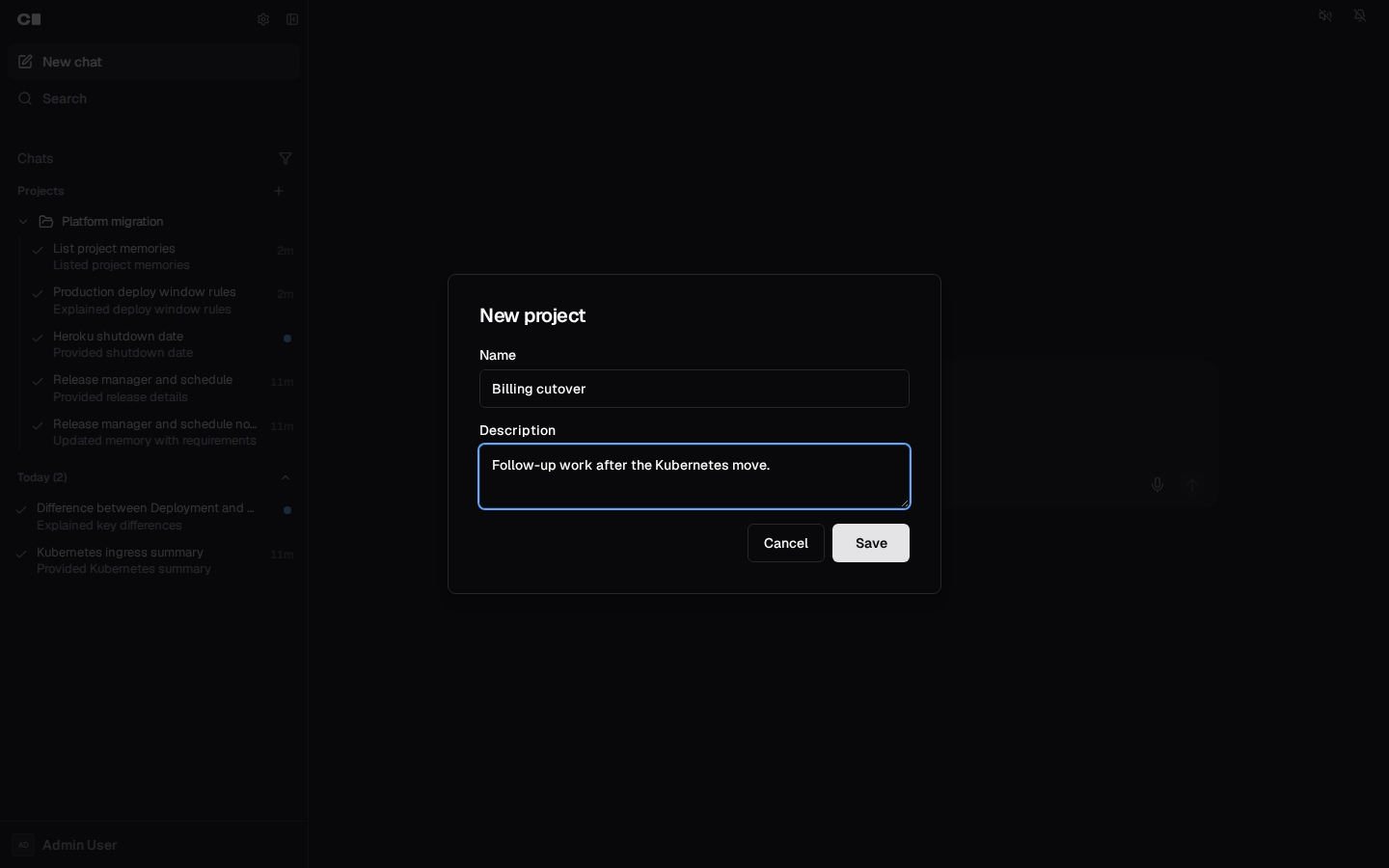 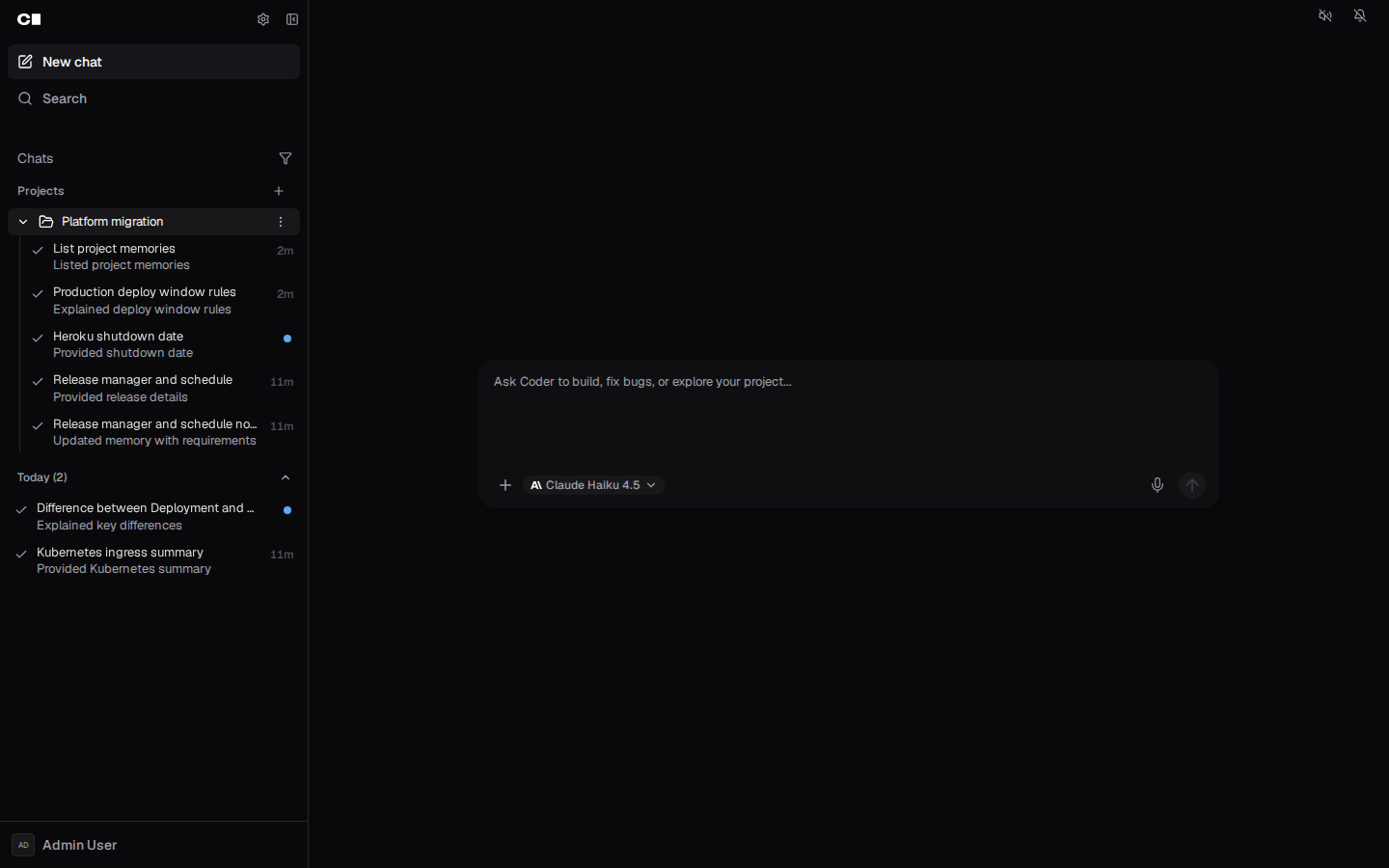 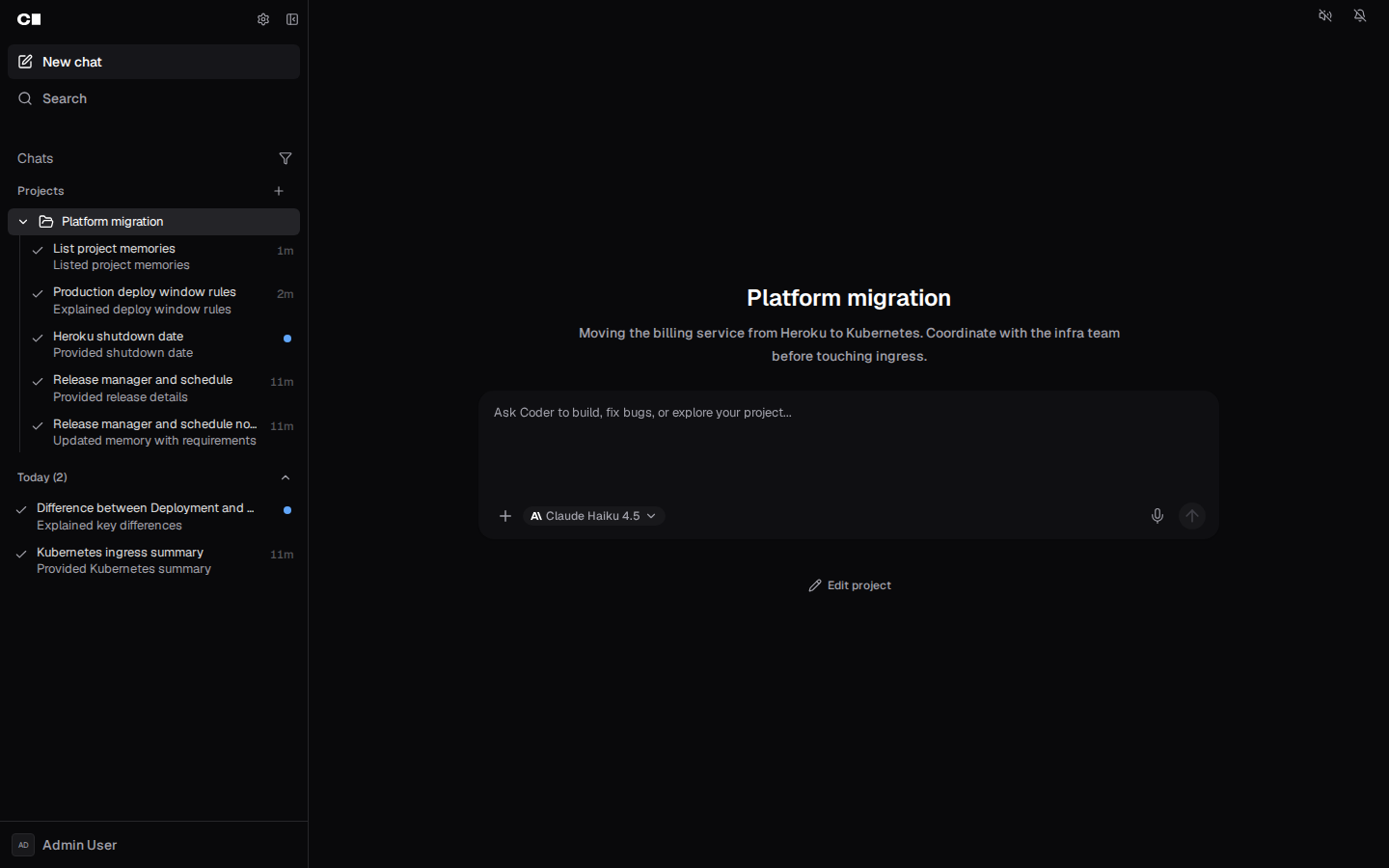 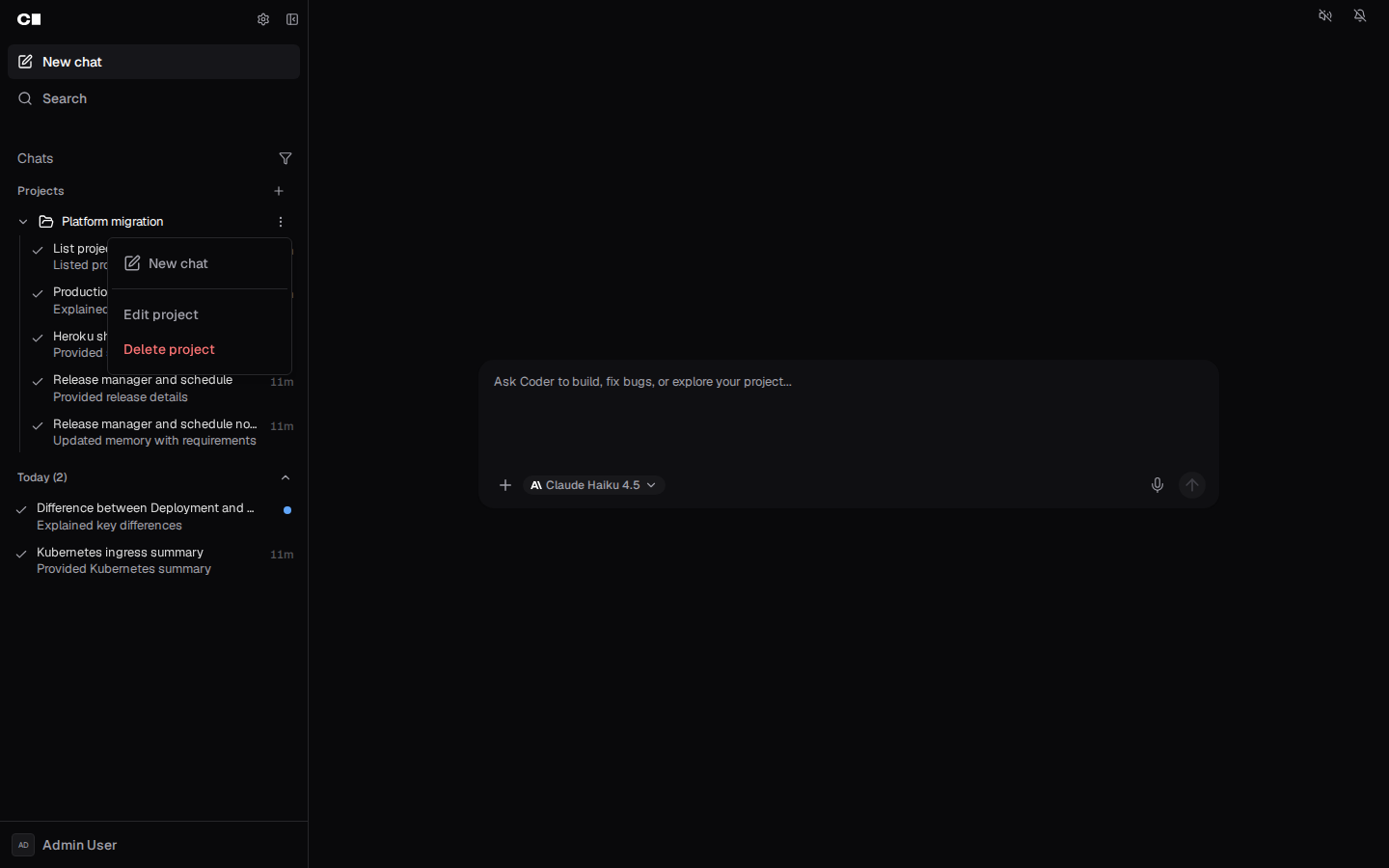  </details> --- Generated with Coder Agents on behalf of @f0ssel. --------- Co-authored-by: Claude Opus 5.5 (1M context) <noreply@anthropic.com> |
||
|
J. Scott Miller
|
7a9442014e |
feat: add chatd lifecycle stage tracer (#29769)
**TL;DR:** Adds a stage tracer that turns each chat lifecycle stage into
both an OpenTelemetry span and a Prometheus histogram observation, so
traces and metrics always agree. The metrics are only registered with
the `chat-stage-metrics` experiment. Nothing calls the tracer until the
next PRs.

Adds `chatloop.StageTracer`, which emits each chat lifecycle stage as an
OpenTelemetry span and a `coderd_chatd_stage_duration_seconds{stage,
scope, chat_kind}` observation from one `End` call, so trace and metric
durations cannot disagree. The provider-bound stages (`stream`,
`provider_attempt`) are also observed on
`coderd_chatd_model_stage_duration_seconds{stage, provider_type,
chat_kind, model}`, the only family carrying `provider_type` and
`model`, and only for turn-scoped stages. Time to first token per model
stays on the existing `coderd_chatd_ttft_seconds`. Nothing calls the
tracer yet; the next PRs instrument the provider call and the runner.

- The families are registered only when the `chat-stage-metrics`
experiment is enabled (safe and known, so
`--experiments=chat-stage-metrics` or `--experiments=*` turns it on).
Spans are emitted regardless. `NewMetrics` leaves the families off;
`chatd.New` opts in from the experiment, and a test asserts the
experiment decides whether they reach the server's registry.
- `Stage`, `Scope`, `ChatKind`, and `StageAnomaly` are typed string
constants. `scope` separates latency attributable to a prompt (`turn`)
from detached `background` work; `chat_kind` is `root` or `subagent`,
empty without a known chat.
- `StageModel` carries the wire `provider`, `provider_type`, `model`,
and `reasoning_effort`. All are span attributes; only `provider_type`
and `model` are metric labels, on the model family. No family carries an
organization label.
- Observed stages: `chat_turn`, `queue_wait`, `acquisition`,
`mcp_connect`, `stream`, `time_to_first_token`, `provider_attempt`,
`tool_call`, `commit`, `retry_backoff`. `generation_step`, `prepare`,
`thinking`, and `compaction` are span-only. A test keeps the stage sets
and help text consistent.
- API: `Start` / `StartRootAt` for live spans (span timestamps come from
the tracer clock), `Record` for stages reconstructed from timestamps
(the scope comes from the context). `End` is idempotent;
`EndWithoutObservation` ends the span without a sample. A nil tracer,
provider, or metrics discards.
- `coderd_chatd_stage_anomalies_total{reason}` counts observations
dropped, adjusted, or inconsistent (`negative_elapsed`,
`inverted_window`, `missing_timestamp`, `future_start`, `stale_anchor`).
Span-only stages never feed it.
- Buckets are 12 round edges (`0.1 0.25 0.5 1 2.5 5 10 30 60 300 1800
3600`).
- Moves the body of the `for` loop in `StartGeneration` into
`runGenerationStep` so the step has a function boundary for a deferred
stage end. Control flow and error wrapping are unchanged.

<details>
<summary>Series cost (approximate, whole stack)</summary>

A histogram label set is 12 edges + `+Inf` + `_sum` + `_count`: 15
series. Per replica, each `chat_kind` costs about 150 stage series and 4
turn outcome counters; each `(chat_kind, model)` costs 30 (2 stages x
15). Both chat kinds on `M` models: about `308 + 60*M` per replica, plus
background-scope stage series.

Dogfood `main`, 3 replicas: ~3.4k `coderd_*` series per replica (~10.1k
total).

| Models used per replica | Added series (3 replicas) | vs. baseline |
|---:|---:|---:|
| 1 | ~1.1k | +11% |
| 5 | ~1.8k | +18% |
| 10 | ~2.7k | +27% |
| 35 | ~7.2k | +72% |

Most deployments run four or fewer models, so a typical replica adds
roughly 370 to 550 series. The experimental turn accounting in #29772
would add 88 more per replica (11 categories x 4 outcomes x 2 chat
kinds). Series appear lazily and do not grow with organizations.

</details>

<details>
<summary>Review decisions</summary>

- Experiment gate only; no deployment flag or metric levels. If the
experiment graduates, the families become always on like the other chatd
families; a flag is added then only if dogfood shows a cardinality
problem.
- Organization is on neither metrics nor spans, and `effort` is
span-only; `provider_type` (configured type), not the wire `provider`,
is the model-family label.
- `time_to_first_token` is not on the model family; per-model TTFT is
`ttft_seconds`, which observes the same measured window.
- The model family records only turn-scoped stages.
- Nil guards are kept so a nil or zero tracer is always safe to call.
- HTTP attribute keys stay snake_case like the rest of the chatd span
attributes.

</details>

Supersedes #28968 and #28969.

🤖 This PR was generated by Coder Agents on behalf of @jscottmiller.
|
||
|
Cian Johnston
|
9fa17a12ef |
fix: strip client actor headers unconditionally (#30037)
Strip all client-supplied headers matching `IsActorHeader()` in `PrepareClientHeaders`, regardless of `send_actor_headers`. This reserves the case-insensitive `X-AI-Bridge-Actor` prefix for identity injected by the gateway. Remove the redundant deletion of the three standard actor headers from `BuildUpstreamHeaders`. Generated with Coder Agents on behalf of @johnstcn. |
||
|
Cian Johnston
|
8742d2484c |
feat: add opt-in AI Gateway actor email headers (#29930)
Add opt-in forwarding of the authenticated Coder account email through `--ai-gateway-actor-header-meta-email`, `CODER_AI_GATEWAY_ACTOR_HEADER_META_EMAIL`, or `ai_gateway.actor_header_meta_email`. The option defaults to empty: enabling `send_actor_headers` alone does not forward email. Set a destination header explicitly to opt in; accounts without an email omit it. Carry authenticated email through the Gateway authorization response and strip client-supplied standard/configured email headers before applying trusted identity. The additive protocol field joins unreleased Gateway API v1.3 alongside workspace attribution. Includes email configuration precedence, authorization compatibility, captured upstream request tests, and matching documentation. Refs https://linear.app/codercom/issue/AIGOV-601 Generated with Coder Agents on behalf of @johnstcn. |
||
|
Cian Johnston
|
05d1fa8a4c |
feat: configure AI Gateway actor identity headers (#29929)
Allows configuring AI Gateway actor ID and username headers independently through `--ai-gateway-actor-header-id` and `--ai-gateway-actor-header-username` or associated environment variables and YAML settings. - Defaults to existing header name, an empty string disables that attribute. - Existing `send_actor_headers` gate remains off by default. - Validates header names, case-insensitive collisions, and protected destinations for embedded and standalone gateways. - Strips standard and configured identity destinations before injecting authenticated values. - Adds coverage for configuration precedence, captured upstream request, and generated help/API documentation. Refs https://linear.app/codercom/issue/AIGOV-601 Generated with Coder Agents on behalf of @johnstcn. |
||
|
Mathias Fredriksson
|
dd1c836ab0 |
feat: gate the chat board behind a hidden experiment (#30084)
Follow-up to #29425 and #29472. Before this PR, any deployment could turn on the chat board, because it only needed a per-browser opt-in. Now it also needs to enable the experiment. |
||
|
Thomas Kosiewski
|
9aa7130e01 |
feat: evaluate experiment rules per user in discovery and chatd (#29964)
Slice 3 of 4 for runtime experiment rules: evaluate stored rules per user in discovery, the frontend experiments query, and the pilot `mcp-tool-search` gate in chatd. There is still no way to edit rules through the product; that comes in slice 4. With no rules stored and a healthy database, backend decisions match today. This PR deliberately changes three things: 1. **Fail closed on rule reads.** If the rules read fails, `mcp-tool-search` is off, even when it is enabled at startup. 2. **Frontend freshness.** The experiments query now refetches. 3. **Caching.** `/api/v2/experiments` and rendered HTML are sent with `Cache-Control: no-store`. Static assets keep their long-lived caching. ## What's in it - **coderd** builds `api.ExperimentEvaluator` from `experiments.NewDBStore` plus the startup `--experiments` list. - **Discovery:** `GET /api/v2/experiments` and the `<meta property="experiments">` tag both use `EnabledExperiments(ctx, caller)`. - **chatd:** `mcp-tool-search` is now user-scoped. `chatd.Config.ExperimentEvaluator` is required, so `chatd.New` returns an error without it. `prepareGeneration` decides once per turn for the chat owner (`chat.OwnerID`); child chats inherit the owner. - **Ruleguard** (`userScopedExperimentStaticCheck` in `scripts/rules.go`): rejects static `Experiments.Enabled(...)` and `httpmw.RequireExperiment*(...)` checks of user-scoped experiments in server packages. A codersdk test keeps its list equal to `codersdk.ExperimentsUserScoped`. - **Frontend:** the experiments query is keyed by user ID and seeded from the meta tag only when the embedded user matches. It is stale 60 s after page load and refetches on mount, window focus and reconnect. Logout also clears the experiments metadata. The dashboard keeps the last loaded list when a background refetch fails, instead of replacing the page with an error. - **Once per turn:** chatd decides `mcp-tool-search` on a turn's first step and reuses that decision for the turn's later steps, so a rule change applies from the next turn and never withdraws a `find_tools` call the model already made. The decision lives on the chat runner, keyed by the turn's prompt row, like the stop-nudge tracker. A runner handoff in the middle of a turn evaluates again. - **Reference audit:** the only non-test server check of `mcp-tool-search` is in `generation_preparer.go`, and it now goes through the evaluator. ## Testing - **Go:** per-user results and `no-store` on `/api/v2/experiments`; the per-user meta tag and the HTML cache headers in `site`; group and org conditions end to end in enterprise; chatd owner eligibility, on → off → on across turns including a child chat, and a failed rules read. - **Vitest:** user-keyed seeding, staleness from page load after a remount, refetch on focus, logout clearing, and the dashboard surviving a failed refetch. Remote dogfood UAT through Coder Agents passed on a licensed test deployment: - per-user discovery in both the API and the meta tag; - widening a rule, and turning it off, with no restart; - `off` beating a startup default, and `inherit` restoring it; - fail closed on malformed JSON and on an unknown mode, with no condition text in the logs; - the `no-store` headers; - real-model chatd enforcement: `find_tools` offered on turn 1, gone after `off`, back on turn 3. That round tested `b57207d4ee`. The later commits change only tests, and a follow-up round will cover the final head. **For the author:** `coderd/x/chatd/ARCHITECTURE.md`'s list of the runner's local state doesn't mention the per-turn trackers (debug turn, session start, stop nudges, and now this experiment decision). I did not edit that document. **Known behavior:** a broken rule logs one error line per evaluation (per request or turn), with only the experiment, revision, category and position. ## Stack 1. #29869: evaluator library 2. #29898: storage and audit types 3. **This PR:** enforcement and discovery 4. Control plane (experimental API, `coder exp experiment-rules` CLI, docs) > [!NOTE] > This PR was written by an AI agent (Xum). --- _Generated with [`xum`](https://github.com/coder/xum) • Model: `anthropic:claude-opus-5-5` • Thinking: `high`_ --------- Signed-off-by: Thomas Kosiewski <tk@coder.com> |
||
|
Thomas Kosiewski
|
84fe2dda92 |
feat: add per-user experiment rule evaluator (#29869)
Slice 1 of 4 for runtime experiment rules: adds an internal evaluator
that decides whether an experiment is enabled for a given user, based on
a stored rule and that user's attributes. The package has no storage,
API, or callers yet, so behavior does not change.

## What's in it

- `coderd/experiments`: `Evaluator` with `New(logger, store, static)`,
`Enabled(ctx, userID, ex)` and `EnabledExperiments(ctx, userID)`. It
also adds the `Store` interface, the `Rule`/`StoredRule`/`User` models
and `ValidateRule`.
- Rule modes: `inherit` (use the startup `--experiments` default), `on`,
`off` (a kill switch that wins over a static on), and `condition` (a CEL
expression over `user.id`, `user.username`, `user.email`, `user.roles`,
`user.organizations`, `user.groups`).
- **Fail closed:** the decision is off for a rules-read error, a
malformed rule (including a stored revision below 1) or unknown mode, a
failed attribute load, a compile or eval error, a cost overrun, a
cancelled context, or a `uuid.Nil` subject. This holds even when the
experiment is enabled statically. `New` rejects a nil store, so there is
no fallback.
- **Diagnostics:** only errors returned to the caller carry full CEL
diagnostics. Logs record the experiment, revision, error category and
line:column, never condition text or CEL message text.
- Limits: 4096 code points, cost limit 10,000, and evaluation stops when
the context is cancelled. Compiled programs go in a bounded,
concurrency-safe cache keyed by exact source text. Decisions are never
cached.
- `codersdk.ExperimentsUserScoped = {example}`. Only experiments listed
there accept rules.
- `coderd/experiments/experimentstest`: a fake `Store` for tests.

## Dependency

Adds `cel.dev/cel-go v0.32.0` (plus indirect `antlr4-go/antlr/v4
v4.13.1`). `cel.dev/cel-go` is the module path that
`github.com/google/cel-go` now declares. GHSA-gcjh-h69q-9w9g
(GO-2026-6094) is fixed in 0.29.0. `govulncheck
./coderd/experiments/...` reports nothing against either new module. Its
remaining findings are go1.26.5 standard-library issues, fixed in
go1.26.6, plus existing dependencies, and they show up on unrelated
packages too.

## Stack

1. **This PR:** evaluator library
2. Storage and audit types (`site_configs` rows, revisions, `WriteRule`)
3. Enforcement and discovery (`/api/v2/experiments`, meta tag, chatd
`mcp-tool-search`, ruleguard)
4. Control plane (experimental API, `coder exp experiment-rules` CLI,
docs)

Remote dogfood UAT through Coder Agents passed. `/api/v2/experiments` is
unchanged for admin and member with and without `--experiments=example`,
and the package tests pass with and without `-race`.

> [!NOTE]
> This PR was written by an AI agent (Xum).

---
_Generated with [`xum`](https://github.com/coder/xum) • Model:
`anthropic:claude-opus-5-5` • Thinking: `high`_

---------

Signed-off-by: Thomas Kosiewski <tk@coder.com>
|
||
|
Sas Swart
|
813b8c151f |
feat: make AI Gateway content recording optional (#30031)
Add `--ai-gateway-disable-content-recording`, which stops user prompts,
tool
calls and model thoughts from being stored. Cost control reads none of
those
tables, so budgets, spend accounting and enforcement are unaffected.

A dropped record is still logged, so pairing the option with
`--ai-gateway-structured-logging-source=gateway` keeps the SIEM export
for
records that are never persisted. The gateway warns at startup when
content is
dropped while coderd is the only emitter, since those records then reach
neither
the database nor a SIEM.

Covered end to end for the embedded and the standalone gateway, and
documented
alongside cost controls.

<details>
<summary>Why the stack is ordered this way</summary>

The final design is a chain of recorder decorators:

    +---------------------+
    |    AsyncRecorder    |  all records except the interception start
    +---------------------+
    |     LogRecorder     |  emit the structured record
    +---------------------+
    | ValidatingRecorder  |  refuse malformed records
    +---------------------+
    |  caller middleware  |  record policy, e.g. drop content
    +---------------------+
    |    TraceRecorder    |
    +---------------------+
    |    DRPCRecorder     |  acquire client, send to coderd
    +---------------------+

Ordering constraints:

- The record type constants (1) are the vocabulary both emitters and the
  validator use, so they come first.
- Validation (5) rejects unset timestamps, so records must already be
stamped
where they are created (3). Stamping at creation leaves
`WrappedRecorder`
  doing nothing but client acquisition, which is why it is folded into
  `DRPCRecorder` (4) and not before.
- coderd's server-time fallback (2) is what keeps a gateway of an older
version
  from persisting zero times once the gateway owns stamping (3).
- PRs 1 to 5 change no user-visible surface. Each deployment option then
lands
with the code that reads it: the log source with gateway-side emission
(6),
content recording with the filter that drops the records (7). Pool
options are
plumbed to the serving pool in 6, where the first option that needs them
  arrives, rather than as an unused hook beforehand.

</details>

---
🤖 Raised by [Coder Agents](https://coder.com) on behalf of @SasSwart.
|
||
|
Sas Swart
|
23fb35d185 |
feat: let the AI Gateway emit the structured interception records (#30030)
coderd emitted the structured interception records as they arrived over
DRPC, so
a record the gateway never sends cannot be exported.

- Add `--ai-gateway-structured-logging-source` (`coderd`, `gateway`,
`both`) and
teach the gateway's `LogRecorder` to emit the same format where the
records
originate. Gateway lines omit `thread_parent_id` and `thread_root_id`,
which
  are resolved by a database lookup only coderd can perform.
- Reaching the serving pool required repairing the pool options: they
were
derived at construction sites and discarded, so the server always built
its
pool with the defaults. They are now derived from the deployment
configuration
in one place and passed to the pool that serves requests. The server
reports
those options, and its ownership of the `key_pool_state` collector, so a
second
  registration cannot silently reappear and panic startup.
- The standalone gateway inherits both structured logging options, since
it is
  now one of the processes that can emit.

This is the keystone of the stack: the flag, the mechanism that carries
it and
the behavior it selects land together, so
`TestAIGatewayStart_InheritedOptions`
and the gateway help output stay truthful at every commit.

<details>
<summary>Why the stack is ordered this way</summary>

The final design is a chain of recorder decorators:

    +---------------------+
    |    AsyncRecorder    |  all records except the interception start
    +---------------------+
    |     LogRecorder     |  emit the structured record
    +---------------------+
    | ValidatingRecorder  |  refuse malformed records
    +---------------------+
    |  caller middleware  |  record policy, e.g. drop content
    +---------------------+
    |    TraceRecorder    |
    +---------------------+
    |    DRPCRecorder     |  acquire client, send to coderd
    +---------------------+

Ordering constraints:

- The record type constants (1) are the vocabulary both emitters and the
  validator use, so they come first.
- Validation (5) rejects unset timestamps, so records must already be
stamped
where they are created (3). Stamping at creation leaves
`WrappedRecorder`
  doing nothing but client acquisition, which is why it is folded into
  `DRPCRecorder` (4) and not before.
- coderd's server-time fallback (2) is what keeps a gateway of an older
version
  from persisting zero times once the gateway owns stamping (3).
- PRs 1 to 5 change no user-visible surface. Each deployment option then
lands
with the code that reads it: the log source with gateway-side emission
(6),
content recording with the filter that drops the records (7). Pool
options are
plumbed to the serving pool in 6, where the first option that needs them
  arrives, rather than as an unused hook beforehand.

</details>

---
🤖 Raised by [Coder Agents](https://coder.com) on behalf of @SasSwart.
|
||
|
Michael Suchacz
|
f5092aaa4a |
feat: make chat limits configurable deployment options (#28927)
Adds deployment options for the chat limits that shape turn behavior and API acceptance, replacing hardcoded constants in `coderd/x/chatd` and the chat API. Defaults are unchanged. | Option | Default | Limit | |---|---|---| | `CODER_CHAT_MAX_STEPS_PER_TURN` | 1200 | steps (model responses) in a chat turn | | `CODER_CHAT_MAX_GENERATION_RETRIES` | 25 | consecutive retries after a model generation fails with a transient error | | `CODER_CHAT_MAX_QUEUED_MESSAGES_PER_CHAT` | 20 | messages that can be queued in a chat | | `CODER_CHAT_MAX_ATTACHMENTS_PER_CHAT` | 50 | files linked to a chat; linking more deletes the earliest uploads | | `CODER_CHAT_MAX_PROMPT_BYTES` | 131072 | system prompt, plan mode instructions, and each user's custom prompt | | `CODER_CHAT_MAX_CONCURRENT_RECORDING_UPLOADS` | 25 | desktop recordings each server stores at the same time | `codersdk.DefaultChat*` constants remain the single source of truth. Values below 1 fail startup validation, and each option's description ends with "Must be at least 1." `chatd.New` fills any zero field in `chatd.Config.Limits` with its default once, `LimitsFromConfig` is a plain conversion, and the code that receives a limit as a parameter (the `chatstate` queue and file link checks, the turn step check, `chatretry.Retry`, and `chatadvisor.NewRuntime`) returns an error for a limit below 1 instead of choosing a default or disabling the limit. The options are documented in the generated configuration reference and in the platform controls docs. `CODER_CHAT_MAX_GENERATION_RETRIES` counts consecutive retries, and the count resets after each successful step. The default allows 25 retries (26 attempts) where the old constants allowed 24. The same limit now applies to each nested advisor model call and to background title, summary, and turn status label generation, which previously used fixed `chatretry` budgets. Chat creation and tool result bodies keep the fixed 256 KiB limit from main. The prompt-saving endpoints accept bodies up to twice the prompt limit, for JSON escaping and characters that sanitization removes, but never less than 256 KiB, so small prompt limits still return the 400 length error. At the default this equals the 256 KiB limit on main. Four settings from earlier revisions were removed, and the fixed limits from main are back: - `CODER_CHAT_MAX_TOOL_OUTPUT_BYTES`: the agent already keeps a 16 KiB head and a 16 KiB tail of command output, so raising it had no effect and lowering it cut the tail. - `CODER_CHAT_MAX_DYNAMIC_TOOLS_PER_CHAT`: tool definitions share the 256 KiB chat creation body limit, so raising the count did little. - `CODER_CHAT_DEBUG_MAX_BODY_BYTES`: one setting covered two unrelated debug caps. - `CODER_CHAT_DEBUG_MAX_TEXT_RUNES`: the name did not say what it applied to. Root and subagent concurrency caps stay fixed because they are licensing behavior, and `MaxChatFileSizeBytes` stays fixed because the web UI hardcodes the generated constant for client-side checks. `codersdk.MaxChatFileIDs` is removed; the web UI's "Attachment expired" tooltip no longer quotes the number because the cap is now per deployment, and it says that attaching a file beyond the limit permanently deletes the chat's earliest-uploaded attachments. ## Review record | Round | Reviewed head | Result | Disposition | |---|---|---|---| | Codex 1 and 2 (Sep 2 to 3) | `7f10a1572f8`, `8ee09f8fa3b`, `197bb78d5b` | 10 findings, then OK on `197bb78d5b` | all threads resolved | | Codex 3 (Sep 17) | `e4efac249a5` (pre-rebase) | 4 findings | advisor retry limit confirmed and fixed in `9e462b7b3d0` (rebased from `67341e458e8`); ARCHITECTURE.md TODOs added; JSON-escaping body sizing and streamed-argument rune cap declined as pre-existing design (evidence in threads) | | Codex 4 (Sep 18) | `9e462b7b3d0` | 6 findings | recording evicted at attachment cap 1 confirmed and fixed in `5b61895decb`; `Limits` field docs and zero-value fallback documented; prompt retro-enforcement, generated multi-sentence lines, and tool-output truncation metadata declined as pre-existing design (evidence in threads) | | Codex 5 (Sep 18) | `5b61895decb` | 1 finding | over-cap batch of already-linked files accepted after lowering the cap: confirmed and fixed in `f44063e74e5` | | mafredri (Sep 23) | `f44063e74e5` | 24 threads, changes requested | all fixed in `05e3e3d622a`, `c1f78e09e8b`, `709ddb67977`, `d0587a49829`, `ca4347b24de`, and `1f6c9e2a46f`, then answered and resolved; the ARCHITECTURE.md text was written at the author's direction and approved by the author | | Sibling sweep (Sep 24) | `1f6c9e2a46f` | author-requested audit of all 24 mafredri threads for sibling issues, plus a test refactor | fixed in `37eaf07d34d` through `1f14ac041b7`: the advisor retry limit, `chatretry.Retry`, and the turn step check reject values below 1 instead of disabling retries or the limit; limit tests run against both the default and configured values set through `chatd.Config` or `DeploymentValues`; the expired-attachment tooltip is concrete. A required coder-frontend-review run (8 roles in one agent, CD re-run once) found a stale story comment, removed. | | Codex 6 (Sep 27) | `a71383e3a31` | OK, no findings | requested after the rebase at the author's direction, past the six-pass review budget | The branch was rebased onto main `4851c7b60c8` on Sep 27; the previous head was `91b84000adb`, and the earlier SHAs in the review record predate the rebase. Conflicts in the `chatstate` transitions and `CreateChat` keep both main's `InitialStatus` and this PR's `MaxFileLinks`, and main's rewrite of `advisor_internal_test.go` in #28754 keeps main's version plus this PR's limit tests. Two tests added on main needed the new retry arguments: `TestGenerateStructuredTitleWithUsage_FallsBackToTextWhenToolChoiceRejected` and `TestAdvisorRunStreamsReasoningDeltasSeparatelyFromAdvice`. Validation on `a71383e3a31`: the pre-commit hook (generation, golangci-lint, build), the full `coderd/x/chatd/...` suite (20 packages), the chat tests in `codersdk`, `coderd`, and `enterprise/coderd`, the CLI help tests, race-detector runs of the `chatd`, `chatstate`, `chatadvisor`, and `chatretry` packages, and `go build` plus `go vet` on each of the 27 commits. No remote UAT was run. > Xum acted on behalf of @ibetitsmike for this pull request. |
||
|
david-fraley
|
702b13112d | feat: add Debug with Coder Agents action for failed workspace builds (#29811) | ||
|
Ethan
|
f64ccfb836 |
feat: add experimental inline MCP servers (#29546)
Closes CODAGT-1131 Fifth PR in the inline MCP servers stack, on top of #29520. A chat owner can now declare MCP servers by URL and headers on their own chat, and chatd connects to them every turn alongside the org-configured ones. They go in a new `inline_mcp_servers` field on `POST /api/v2/chats` and `POST /api/v2/chats/{chat}/messages`, which replaces the whole set (omit to keep, `[]` to remove). Root chats only. `GET /api/v2/chats/{chat}` returns them, with the URL blanked for non-owners and header values never returned. Subagents only get servers marked `allow_in_subagents`, a root chat in explore mode gets none, and a root chat in plan mode gets all of them. URLs must be `https`, or `http` to an IP literal in `CODER_MCP_ALLOWED_PRIVATE_CIDRS`. Header values have no minimum length, so anything under the redactor's 8 byte floor from #29518 is accepted but not redacted, which the docs call out. Every cap is exported from `codersdk`. It's behind the `chat-inline-mcp-servers` experiment, and the `--disable-chat-caller-supplied-tools` kill switch from #29466 covers it too. With either off, declaring servers gets a 403 and existing chats stop connecting to theirs, but `[]` still works so a client can detach. Load failures show up in the chat debug panel as failed connections, as do org servers with an invalid config. Docs are hand-written in `mcp-servers.md`. |
||
|
Ethan
|
c1af0793e5 |
feat: add caller-supplied tools kill switch for chats (#29466)
This is the first PR in a stack that adds experimental support for attaching MCP servers to a chat when it's created, and then deprecates `unsafe_dynamic_tools` in favour of them. Both are "caller-supplied tools", i.e. tools the client hands to coderd at chat creation rather than tools an admin has configured, so we want a single switch admins can use to turn all of them off. This PR adds that switch: `--disable-chat-caller-supplied-tools` (`CODER_DISABLE_CHAT_CALLER_SUPPLIED_TOOLS`). It follows the existing `disable-*` deployment flag pattern (`--disable-chat-sharing` etc.), so there's no new API route and it's independent of any experiment. When set, `POST /api/v2/chats` returns a `403` if the request includes `unsafe_dynamic_tools`, and chats that already have dynamic tools run without them; a call to one gets a tool error result and the model just continues. Later in the stack, chat-attached MCP servers are gated behind the same flag. It's unset by default, so nothing changes unless you opt in. Part of CODAGT-1131 |
||
|
Nick Vigilante
|
99a3425333 |
fix: advertise install.sh with curl -fsSL everywhere (#29801)
## Summary The install one-liner is advertised as `curl -L` in most docs pages, the README, and the CLI's default version-mismatch hint, while `install.sh` itself and the deployment-local hint use `curl -fsSL`. Without `-f`, curl writes an HTTP error body to stdout, and the one-liner pipes that error page into `sh`. This PR standardizes every `install.sh` invocation on `-fsSL` so a failed download fails closed. ## Changes - Docs: `install/cli.md`, `install/operate/upgrade.md` (twice), `get-started/index.md`, `start/local-deploy.md`, `install/operate/provisioners/index.md`, `admin/templates/managing-templates/change-management.md` (twice), `user-guides/workspace-access/zed.md`, and `README.md`. - CLI: `defaultUpgradeMessage` in `cli/root.go` now prints `curl -fsSL`, matching the deployment-local branch in the same function. - `codersdk/deployment.go`: the `--cli-upgrade-message` description now says `curl -fsSL`; the server help goldens, `server-config.yaml.golden`, `docs/reference/cli/server.md`, and `docs/admin/setup/configuration-reference.md` are regenerated to match. - `install.sh`: the "To run" header comment now matches the script's own usage text. - Style guide: a new "Commands that pipe a download into a shell" rule in `docs/.style/style-guide/formatting.md`, and the tabs example uses `-fsSL`. The coder.com download page already builds its command from `-fsSL` in coder/coder.com#1093, and coder.com `main` has no other `install.sh` one-liners outside test fixtures, so no coder.com change is needed. DatoCMS content and a release verification page are not in this PR. `main` since moved the upgrade and provisioner pages under `docs/install/operate/` and removed the install one-liner from `docs/install/index.md` in #29304, so that page no longer appears in this diff. ## Testing - `TZ=UTC go test ./cli -run='Test(CommandHelp|ServerYAML|ErrorExamples|.*Golden)' -update` and `go test ./enterprise/cli -run=TestEnterpriseCommandHelp -update` pass and produce the committed golden diffs. - `go test ./cli -run 'Test.*Version|TestWrapTransport'` passes, including `Test_wrapTransportWithVersionCheck`. - `go run ./scripts/configdocgen` output contains the new `curl -fsSL` description. - `markdownlint-cli2` on the edited style guide page reports 0 errors. - `git grep` finds no remaining `curl -L …install.sh` outside the style guide's **Don't** example. - After merging `main`: `make pre-commit` passes, and `make test`, `make test-js`, and `make site/out/index.html` pass. Linear: https://linear.app/codercom/issue/DOCS-964/standardize-installsh-curl-flags-on-fssl-across-docs-codercom-and-the --- 🤖 Built with AI assistance. |
||
|
Ehab Younes
|
bacb4fc6ed |
feat: expose per-app session counts (#29351)
Track individual applications across deployment statistics, Prometheus, telemetry, and the dashboard instead of exposing only fixed family totals. Preserve existing fields and gauges so current consumers can migrate without breaking. - Add per-app counts with normalized identifiers and registry-backed display names, families, and bundled icons. Unrecognized apps retain their identifiers. - Limit each statistics report to 64 distinct app names, combining excess names into an explicit overflow bucket. - Group dashboard connections by family, including an Other category, with alphabetical per-app tooltips and distinct loading and empty states. - Export app-keyed Prometheus counts separately from current family metadata, allowing queries to enrich historical counts without rewriting stored samples. - Document family queries with unknown fallback, deployment isolation, and replica handling, alongside collection behavior and migration guidance. - Include per-app counts in telemetry, update API schemas and documentation, and add regression coverage across collection, metrics, and dashboard behavior. Closes #27411 |
||
|
Nick Vigilante
|
5e41baf73c |
docs: normalize control plane, coderd, and coder server terminology (#28960)
Normalizes the three overlapping names for the thing that serves the Coder API and dashboard. This is step 1 of the Install/Deploy and Administration refactor ([DOCS-685](https://linear.app/codercom/issue/DOCS-685), [DOCS-738](https://linear.app/codercom/issue/DOCS-738)) and lands first because every later page depends on settled terminology. Resolves [DOCS-871](https://linear.app/codercom/issue/DOCS-871). ## The rule | Term | Means | Use when | |---|---|---| | control plane | The component that serves the Coder API and dashboard, brokers connections, and coordinates provisioners | Default in prose, diagrams, planning, sizing, security | | `coderd` | The process that implements it | Architecture internals, metrics, logs, flags, troubleshooting | | `coder server` | The literal CLI command | Only when the reader will type it | Retired: "the Coder server" as a name for the component, and "a service" as a standalone description of it. ## What changed - **`docs/.style/style-guide/word-choice.md`**: new "Naming Coder's components" rule, with do/don't examples. Also fixes a "Do" example on that page that itself used "the Coder server". - **`docs/reference/glossary.md`**: rewrote `coderd` and Control plane, added a `coder server` entry. The existing Control plane entry defined it as "the collective term for `coderd`, its provisioners, and its database", which made it indistinguishable from the Deployment entry two sections later. Control plane is now the component; Deployment remains the whole installation. - **65 pages** across `docs/admin`, `docs/install`, `docs/get-started`, `docs/tutorials`, `docs/user-guides`, `docs/ai-coder`, and `docs/about`: roughly 154 component-sense "Coder server" usages, 21 bare "the server" usages meaning the control plane, 3 "a service" descriptions, and 43 unbackticked `coderd` mentions in prose. - One real bug caught in passing: `docs/tutorials/best-practices/security-best-practices.md` documented `coderd server --disable-path-apps`, which is not a command. Now `coder server`. Generated files were not touched: `configuration-reference.md`, `prometheus.md`, `audit-logs.md`, `reference/cli/*`, `reference/api/*`, and the generated blocks inside `feature-stages.md`. Those still contain the retired term and need generator-side changes; see the deferred list below. ## Reviewer attention, please **Anchor changes.** 11 headings were renamed, so their fragments change. No in-repo link targets any of them (the one internal link that did was updated), but external deep links from tickets or blog posts would break, and fragments cannot be fixed with a redirect. Happy to revert any of these if you would rather they ride along with the page moves in [DOCS-869](https://linear.app/codercom/issue/DOCS-869), which changes those URLs anyway. <details> <summary>Renamed headings and their old fragments</summary> | File | Old fragment | New heading | |---|---|---| | `admin/networking/index.md` | `#coder-server` | `## Control plane` | | `install/index.md` | `#starting-the-coder-server` | `## Starting the control plane` | | `install/uninstall.md` | `#the-coder-server-binary-and-cli` | `## The Coder binary and CLI` | | `install/registry-mirror-artifactory.md` | `#step-5-configure-coder-server-or-provisioners` | `## Step 5: Configure the control plane or provisioners` | | `install/cloud/compute-engine.md` | `#configuring-coder-server` | `## Configuring the control plane` | | `get-started/index.md` | `#cant-start-coder-server-address-already-in-use` | ``### Can't start `coder server`: Address already in use`` | | `tutorials/external-database.md` | `#coder-server-fails-startup-with-...` | ``### `coder server` fails startup with ...`` | | `tutorials/faqs.md` | `#how-do-i-change-the-access-url-for-my-coder-server` | `## How do I change the access URL for my control plane?` | | `tutorials/best-practices/security-best-practices.md` | `#coder-server` | `## Control plane` | | `tutorials/best-practices/security-best-practices.md` | `#server-logs-and-audit-logs` | `### Control plane logs and audit logs` | | `tutorials/best-practices/scale-coder.md` | `#coder-server`, `#how-to-capture-coder-server-metrics-with-prometheus` | `## Control plane`, `### How to capture control plane metrics with Prometheus` | </details> **One deliberate deviation from the issue.** DOCS-871 proposed reserving "sub-agent" for the Coder Agents sense and using "devcontainer agent" for the workspace sense. I did not make that change. The glossary already disambiguates with "Sub-agent (Coder Agents)" and "Sub-agent (dev containers)", and "devcontainer agent" would violate the existing dev container spelling rule in the same style guide, which requires "dev container" as two lowercase words. The current split reads correctly and costs no churn. Happy to revisit if you disagree. <details> <summary>Deferred, with reasons</summary> - **Generated content still says "Coder server".** `reference/cli/*` comes from Go command help text, `configuration-reference.md` from `configdocgen`, and `reference/api/*` from Swagger annotations. Fixing those means changing Go source, which belongs in its own PR so a docs review does not turn into a backend review. - **`validated-architectures/index.md` "also known as `coderd`"** is fixed here, but the page's larger problem is that it holds four documents in one file. That split is [DOCS-868](https://linear.app/codercom/issue/DOCS-868). - **"server flag" phrasing** in `admin/users/idp-sync.md` and `admin/users/oidc-auth/index.md` means `coder server` flags. Left alone; rewording those sentences is a copy edit, not a substitution. - **Metric and UI labels** such as "Dashboard-to-server latency" in `admin/networking/index.md`. Renaming risks diverging from what the dashboard shows. - **Pre-existing `Coder.GerundHeading` warnings** on headings this PR touches, and a "from from" typo in `scale-coder.md`. Out of scope for a terminology pass. - **Peer-sense "server"** in NAT traversal prose, where "client or server" describes the connection roles rather than the control plane. Needs restructuring, not substitution. </details> ## Verification | Check | Result | |---|---| | `make lint/emdash` | pass | | `make lint/markdown` | pass, 504 files, 0 errors | | `make lint/docs-html` | pass | | `make lint/prose` | pass, findings identical to the `main` baseline (1 intentional demo error, 145 warnings, 1 suggestion; only Vale's file ordering and one line-number shift in `glossary.md` differ) | | `make gen` | clean, no drift | | `make fmt/markdown` | applied | No redirects needed: no page moved or was renamed in this PR. <details> <summary>Merged main, 2026-09-14</summary> One conflict, in `docs/ai-coder/ai-gateway/providers.md`. Both hunks were text this PR had edited and `main` had since deleted in #29053, which removed env-based AI provider configuration: - The deprecated provider seeding note, which held a `coderd` backtick fix, is gone. Took `main`. - The failure-mode table lost its env-drift row. Took `main`'s two rows and reapplied the `coderd` logs wording. `main` also landed new prose carrying the retired terms, so the pass was extended to cover it: - `docs/admin/integrations/oauth2-provider.md`: two "the server log(s)" in the scope-enforcement sections added by #29144 are now "the `coderd` log(s)"; "a `scope` the server will not grant" is now "the control plane". - `docs/reference/cli/index.md` gained "the server" from #29104, and stays deferred as generated content. The new `docs/ai-coder/agent-relay/claude-code.md` needed no change, and no page `main` added links to a heading this PR renamed. </details> <details> <summary>Decision log for the wider refactor</summary> Agreed with @nickvigilante before implementation, recorded on DOCS-685 and in the Notion outline: 1. Feature stages and release channels move to Reference; ESR upgrade guides move under Operate. No new top-level Releases section. 2. `data-retention.md` moves to Administration > Security; `chat-lifecycle-hooks.md` moves into the Coder Agents docs. `admin/setup/` therefore survives as "Deployment configuration" and `configdocgen` is not touched. 3. Prepare is advisory, not a gate, framed as "don't know where to start? Start here", with lead times and owners per item. 4. One actor table, on the Install overview, spanning all five phases, noting that one person can be several actors and several people can be one actor. 5. The quickstart stays independent and is mentioned once, on the Install overview. The proposed `server/single-machine` page is dropped. 6. Coder Validated Architecture keeps its name in nav, defined in-page, with a glossary entry. 7. PR 3 is split: moves only, then prose, so the riskiest change reads as a pure rename diff. 8. For every PR that moves a page, the coder.com `redirects.json` change merges first. 9. There is no Download section and no CLI page in docs. Per-OS CLI steps live on coder.com/download and the Install overview links to it. </details> Generated with Coder Agents on behalf of @nickvigilante. |
||
|
Spike Curtis
|
aae145bdc9 |
feat: make NATS pubsub opt-out via no_nats_pubsub experiment (#29283)
Makes the embedded NATS pubsub an opt-out feature instead of opt-in. The `nats_pubsub` experiment is removed and replaced with a `no_nats_pubsub` experiment, so NATS pubsub is now the default and can be disabled to fall back to PostgreSQL pubsub. NATS clustering requires this replica's routable address, resolved into `clusterHost` from either `--cluster-host` (`CODER_CLUSTER_HOST`) or the DERP relay URL. When neither is set (allowed when DERP is disabled on the primary), NATS cannot form a cluster, so startup logs a big error and falls back to PostgreSQL pubsub. The NATS cluster CA is only minted/rotated when NATS clustering is actually active (experiment not set and a cluster host is present). <details> <summary>Implementation notes</summary> - `codersdk/deployment.go`: removed `ExperimentNATSPubsub` (`nats_pubsub`), added `ExperimentNoNATSPubsub` (`no_nats_pubsub`, display name "No NATS Pubsub"). - `cli/server.go`: NATS is used by default unless `no_nats_pubsub` is enabled; if `clusterHost` is empty, log an error and keep the PostgreSQL pubsub. - `coderd/coderd.go`: gate NATS CA minting/rotation on `!ExperimentNoNATSPubsub && ClusterHost != ""` (i.e. only when NATS clustering is active). - `enterprise/coderd/licenses.go`: updated a stale comment. - `enterprise/coderd/coderd_test.go`: `TestMultiReplica_NATSPubsubPeers` no longer sets the removed experiment. - Regenerated `coderd/apidoc/docs.go`, `coderd/apidoc/swagger.json`, `docs/reference/api/schemas.md`, `site/src/api/typesGenerated.ts`. </details> --- *This PR was generated by Coder Agents on behalf of @spikecurtis.* |
||
|
Ethan
|
77479408b4 |
feat: make the Coder Agents stream silence timeout configurable (#29394)
The `chatloop` stream silence guard cancels and retries a model attempt after `10m` of silence, and it was hard-coded. It's armed before the request opens, so it also bounds time to first token, and slow local models (e.g. `llama-server` on a large prompt) can spend longer than that on prompt processing alone, meaning every attempt just gets cancelled and retried. This PR adds `--chat-stream-silence-timeout` / `CODER_CHAT_STREAM_SILENCE_TIMEOUT` (default `10m`) and passes it to both the main loop and the advisor. Setting it to `0` disables the guard entirely, and anything above `24h` is rejected, which also keeps the watchdog arithmetic below from overflowing. Whilst doing this I ran into the runner's `15m` task watchdog, which kept counting during an open stream. That silently cancelled any healthy stream longer than `15m`, and would've stopped a silence timeout above `15m` from ever firing. To fix, the silence guard now kicks the watchdog out to `max(15m, silence + 5m)` whenever it arms or sees a part. Silent streams still fail through the guard, healthy streams can run for as long as they like, and hang detection is unchanged everywhere else. With the guard disabled there's nothing to kick against, so arming it just stops the watchdog for the rest of the attempt. That does mean the DB write after the stream isn't bounded either when `0` is set; I think that's fine for an opt-in setting, and a user can still stop the chat from the UI if it wedges there. I did consider removing the guard entirely, but the provider HTTP clients have no timeout, so a provider that holds the connection open would only ever be caught as a generic task hang, which is what #25782 was fixing. |
||
|
Steven Masley
|
a90ad83af3 |
feat!: add a hidden flag to disable dynamic parameter closure evaluation (#29356)
**What changed** Dynamic parameter rendering now evaluates only the coder parameter blocks and what they reference. Other root-module resources are skipped. Parameter, preset, and tag values are unchanged; optimizing rendering on large templates. **How to revert** Set `CODER_DYNAMIC_PARAMETERS_FULL_EVALUATION=true` (or `--dynamic-parameters-full-evaluation`) on `coder server` to restore full evaluation. The flag is hidden and needs no restart of workspaces. If you need it, please [open an issue](https://github.com/coder/coder/issues/new) with the template so we can fix the root cause. **Troubleshooting** Symptoms would be a parameter default, option list, preset value, or workspace tag that shows as unknown or empty after upgrading, when it was populated before. Confirm by setting the flag above; if the value comes back, report it. Templates written in `.tf.json` are not affected (they always use full evaluation). **Why** Rendering re-ran the entire template graph on every parameter change in the workspace form, which dominated latency on large templates. Resources a workspace would create cannot feed a parameter, so evaluating them is wasted work. The optimization lives in coder/preview#226 (coder/trivy#74); this PR adds the deployment-level escape hatch. --- - `CODER_DYNAMIC_PARAMETERS_FULL_EVALUATION` / `--dynamic-parameters-full-evaluation` (hidden, default `false`) on `DeploymentValues`. - `dynamicparameters.PreviewOptions(dv)` maps it to `preview.OptionFullEvaluation()`; `dynamicparameters.WithPreviewOptions` threads it through the loader to `preview.Preview`. - Wired at the three render paths that hold deployment values: the template version tags extractor, the dynamic parameters websocket, and `wsbuilder` builds created from `coderd` (which call `.DeploymentValues(...)`). Not covered: the autobuild lifecycle executor and the enterprise prebuilds reconciler construct `wsbuilder` without deployment values, so builds started from those paths use preview's default regardless of the flag. Those only re-render for builds, not the keystroke websocket path the optimization targets. Prepared with Coder Agents assistance. |
||
|
Paweł Banaszewski
|
263f2c207e |
feat: register AI Gateway proxy experiment and share provider helpers (#29347)
- Add `ai-gateway-reverse-proxy` experiment and update generated API types and documentation. The experiment has no runtime effect yet. - Extract shared (will be used by next PRs in stack) provider routing and key-pool enumeration helpers. - Log unsupported routes at Debug level. |
||
|
Bobby Ho
|
f5be7ae660 |
feat: remove the oauth2 experiment in favor of CODER_OAUTH2_PROVIDER_ENABLE (#29257)
Third of five for PLAT-492. Removes the oauth2 experiment entirely; CODER_EXPERIMENTS=oauth2 is now treated as an unknown experiment and nothing depends on it. Stacked on #29251. No migration. Removes ExperimentOAuth2 and its generated/API references. Removed outright per review, consistent with experiments having no compatibility guarantee. Migration guidance is covered by the startup logging in #29267 and docs/release notes in #29268, both pointing to CODER_OAUTH2_PROVIDER_ENABLE. Existing unknown-experiment handling and tests already cover leftover oauth2 values. After this merges, main is safe to cut a release from. |
||
|
Bobby Ho
|
4ee70c66c3 |
feat: gate the OAuth2 provider on CODER_OAUTH2_PROVIDER_ENABLE (#29251)
Second of five for PLAT-492. Gates all OAuth2 provider routes and dashboard navigation on CODER_OAUTH2_PROVIDER_ENABLE instead of the oauth2 experiment. The flag is off by default, so deployments using CODER_EXPERIMENTS=oauth2 must set it before upgrading or OAuth2 clients will receive 404s. Existing apps, tokens, secrets, and DCR settings are unchanged. Stacked on #29248 and labeled release/breaking; the next PR makes the old experiment a no-op with a migration warning. |
||
|
Bobby Ho
|
1cc73bc43f |
feat: add the CODER_OAUTH2_PROVIDER_ENABLE deployment flag (#29248)
First of five PRs for PLAT-492, adding the opt-in CODER_OAUTH2_PROVIDER_ENABLE flag for the OAuth 2.1 provider. It defaults to false and is not enforced yet, so there is no behavior change. Adds the CLI/env/YAML flag and exposes oauth2_provider in build info. Enables it by default in tests to prepare for route gating. Updates tests, golden files, and frontend fixtures. Follow-ups will gate routes/UI, retire the experiment, add startup logging, and update docs. |
||
|
Steven Masley
|
940f988cfb |
feat: add deployment-level option to disable Terraform module caching (#29187)
<!-- Generated by Coder Agents on behalf of @Emyrk. --> <img width="762" height="239" alt="Screenshot From 2026-09-11 17-09-41" src="https://github.com/user-attachments/assets/9f31fd1e-4cb2-47ab-8d37-4073df9f0a7c" /> Closes #22834. Adds `CODER_PROVISIONER_DISABLE_MODULE_CACHE` so an admin can disable Terraform module caching for every template at once instead of toggling ~100 templates by hand. - The deployment setting wins. Templates cannot opt back in, and the per-template toggle becomes read-only while the deployment setting is on. - Modules stay cached at template import, so dynamic parameter rendering still resolves module-defined parameters. Only the workspace build is denied the cached files. - Templates report `module_cache_disabled_by_deployment`, and template settings shows why the checkbox is locked. <details><summary>Agent context</summary> Decisions taken with @Emyrk before implementing: 1. **Precedence.** `deployment || template`, no per-template override, so no migration and no nullable column. The rule lives in one place, `codersdk.ModuleCacheDisabled`. 2. **Import-time caching untouched.** `dynamicparameters/render.go` overlays `cached_module_files` at `.terraform/modules` to render module-defined parameters. Skipping the cache there would reproduce the `Module not loaded. Did you run terraform init?` failure reported by a customer, so the deployment setting only affects what `AcquireJob` hands the provisioner. 3. **Write path.** A PATCH carrying `disable_module_cache` is discarded while the deployment setting is on, rather than persisted. Persisting it would silently keep templates opted out after the deployment setting is removed. 4. **API shape.** `disable_module_cache` keeps its meaning (this template's stored value) and the new read-only `module_cache_disabled_by_deployment` reports the deployment state. Reading the effective value from `/deployment/config` was rejected because template admins may lack deployment-config read permission. 5. **Naming.** `CODER_PROVISIONER_DISABLE_MODULE_CACHE` over the issue's `CODER_DISABLE_TERRAFORM_MODULE_CACHE`, to match the provisioning option group. Note: `InsertTemplateParams` has no `disable_module_cache` binding, so new templates always store `false`. With deployment precedence they still behave as opted out, so the create path needed no change. Out of scope and tracked elsewhere: the `coderd_template` Terraform provider attribute (separate repo) and backporting the per-template toggle to `release/2.30`. </details> --- <sub>Coder Agents on behalf of @Emyrk.</sub> |
||
|
Michael Suchacz
|
9cd38b5373 |
feat!: remove the Tasks API from coderd and codersdk (#28789)
Removes the Tasks API and task orchestration from coderd and codersdk: the `/api/v2/tasks` handlers, task middleware and search filters, task name generation, autobuild pause/resume logic, task notification enqueues, telemetry, and the codersdk task types. Regenerates apidoc, the API reference docs, and `typesGenerated.ts`. **Breaking change:** the Tasks API is removed; requests to `/api/v2/tasks` fail. Tasks was deprecated in v2.34. **Stack context:** Coder Tasks removal stack (CODAGT-642): #28743 frontend → #28788 CLI → #28789 API → #28790 provisioner → #29084 notifications → #29085 build reasons → #29086 tables → #28750 permissions. The last four PRs replace the single data-drop migration that used to live in #28750; each carries one concern and its own migration number. **Why:** with the UI (#28743) and CLI (#28788) gone, this deletes the server surface. Database tables, RBAC, and notification templates stay until the top of the stack so every layer builds and migrates independently. **What to scrutinize:** - The `enable-ai-tasks` option is removed outright (review feedback): configs still carrying `enableAITasks` fail to parse until the key is deleted. - provisionerdserver now writes `HasAITask: false` on template/build flags; the column and these lines are dropped in #29085. - `codersdk.ResourceTypeTask` stays so audit logs recorded before the removal keep rendering. **Validation:** `go build ./...`, `go vet ./...`, `go test ./codersdk/...`, site biome and tsc, CLI goldens regenerated, pre-commit hooks. **Size:** +242/-10,792 over 76 files; additions are regenerated docs/goldens and test fixture updates. > Created by Xum (AI agent) on behalf of @ibetitsmike. |
||
|
Paweł Banaszewski
|
8472a6884f |
chore!: remove env-based AI provider configuration (#29053)
> AI tools were used to create this PR Removes deprecated AI provider configuration through environment variables, CLI flags, and YAML. Deletion includes indexed providers and legacy OpenAI, Anthropic, and Bedrock options under both AI Gateway and AI Bridge branding, eg. `CODER_AI_GATEWAY_PROVIDER_<N>_*` or `CODER_AI_GATEWAY_ANTHROPIC_KEY`. Removes the associated startup-seeding code. Updates tests and documentation. **Breaking change:** Remove [obsolete AI provider CLI flags and YAML keys](https://coder.com/docs/ai-coder/ai-gateway/providers#database-management-of-providers) before upgrading, otherwise Coder will fail to start with an `unknown flag` or `unknown option` error. Provider environment variables are ignored and no longer seed the database. Existing database-stored provider configuration is preserved. |
||
|
dylanhuff-at-coder
|
4875ae218a |
feat: enforce user secret file policy (#28518)
Adds the deployment option `--user-secrets-disable-file-path` / `CODER_USER_SECRETS_DISABLE_FILE_PATH` / `userSecretsDisableFilePath` (default `false`). When it is set, the create and batch-create user-secret endpoints reject requests with a non-empty file path, and PATCH validates the post-update state under a `SELECT ... FOR UPDATE` row lock, rejecting a new or changed file path as well as enabled states that would have no effective delivery target. Legacy stored paths are preserved, so users can still edit, disable, clear the path, or migrate the secret to env delivery. This is PR 1 of a 4-PR stack; follow-ups cover manifest filtering, the dashboard, and CLI/docs. Refs #27488 Reviewed and updated by Coder Agents on behalf of @dylanhuff-at-coder. |




