 christinandAndrew Aquino
d44f87eed0
## Summary
On the template builder (`/templates/new/builder`), the **Continue**
button was disabled until the current step's requirements were met,
leaving users with no explanation for why they could not advance.
This PR keeps the **Continue** button enabled at all times. When the
current step is incomplete, clicking Continue no longer advances;
instead it:
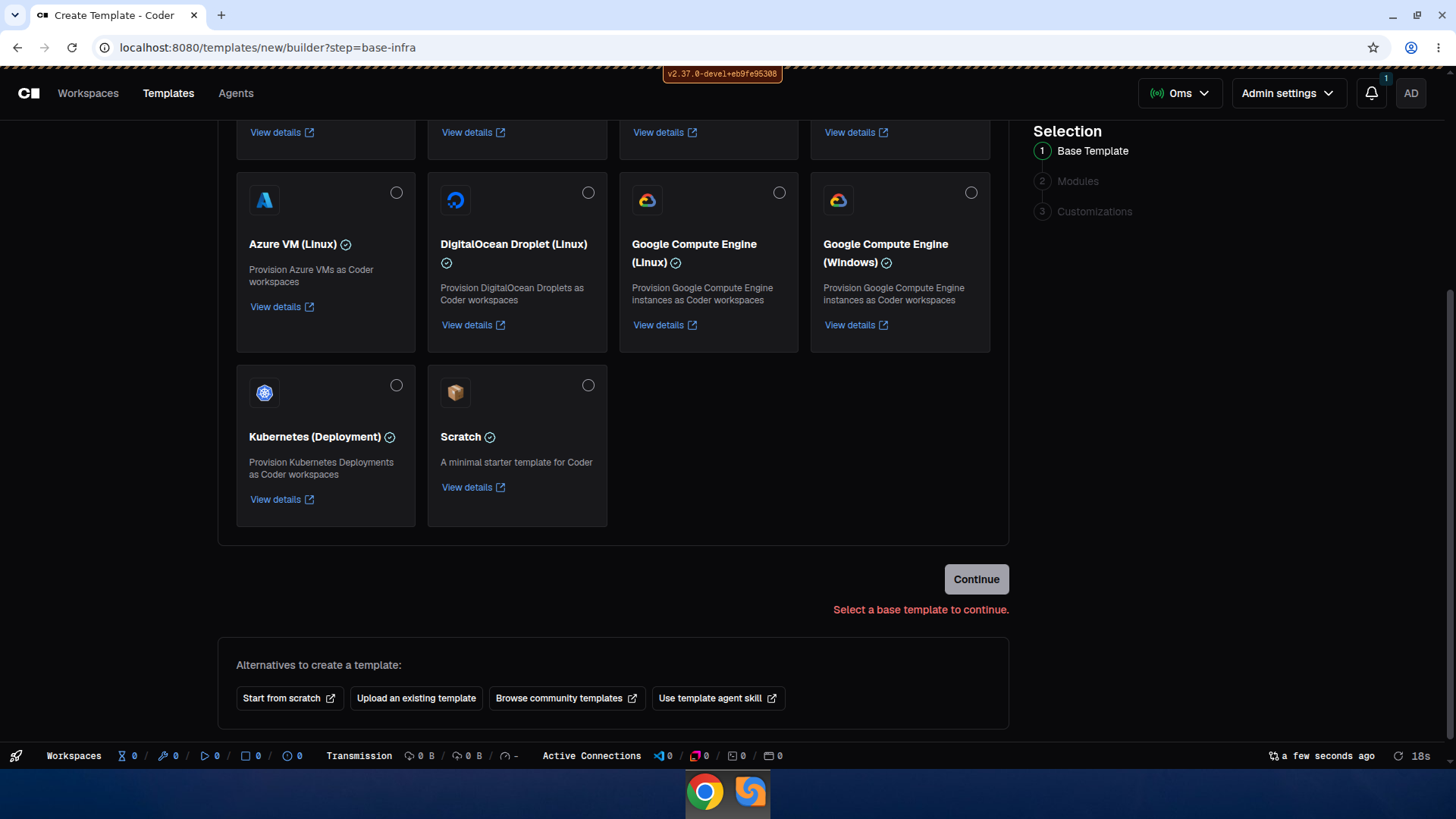
- shows a red validation message (12px) below the button explaining what
is missing, and
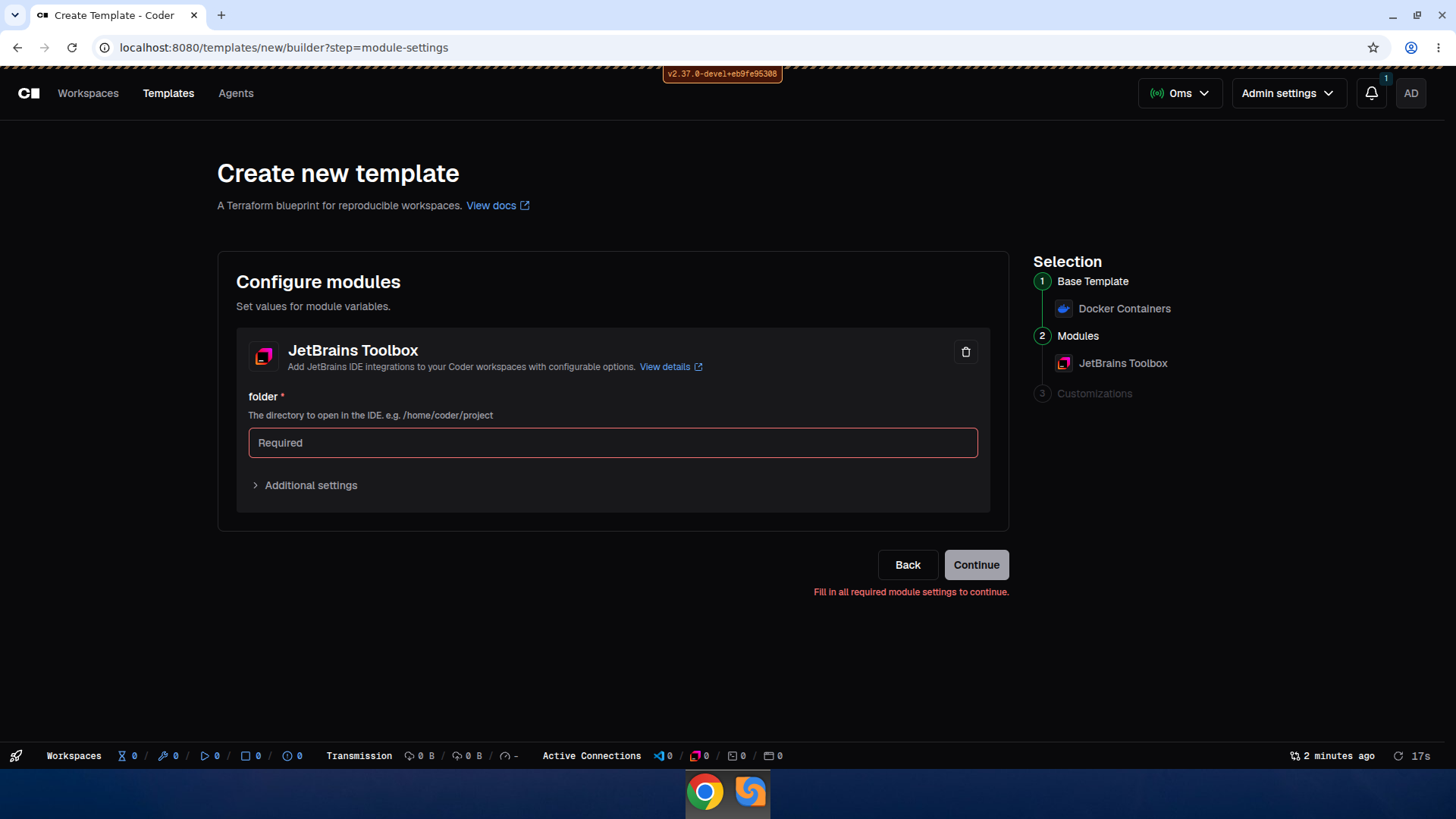
- outlines the required input fields that are blocking continuation in
red.
## Changes
- Removed the `disabled={!canContinue}` guard from the Continue button
so it is always clickable.
- `handleNext` blocks navigation when the step is incomplete and reveals
the red validation message instead.
- Added `continueErrorMessage(stepId)` with a step-specific reason (base
template not selected, required parameters/module settings missing, no
provisioner online).
- Validation message uses a 12px (`text-xs`) font.
- When validation is triggered, empty required fields in the
base-parameters and module-settings steps are outlined in red
(`aria-invalid` + `border-border-destructive`). Optional fields are
unaffected.
- The message and outlines clear automatically once the step's
requirements are satisfied or the user moves to another step.
- Added Storybook interaction tests: `TemplateBuilderPageView` (Continue
stays enabled, message appears then clears),
`BaseTemplateParametersStep` and `ModuleSettingsStep` (required field
flagged invalid when empty).
The final-step "Create Template" button keeps its existing
provisioner-based disable behavior; this change is scoped to the
Continue button as requested.
## Visual proof
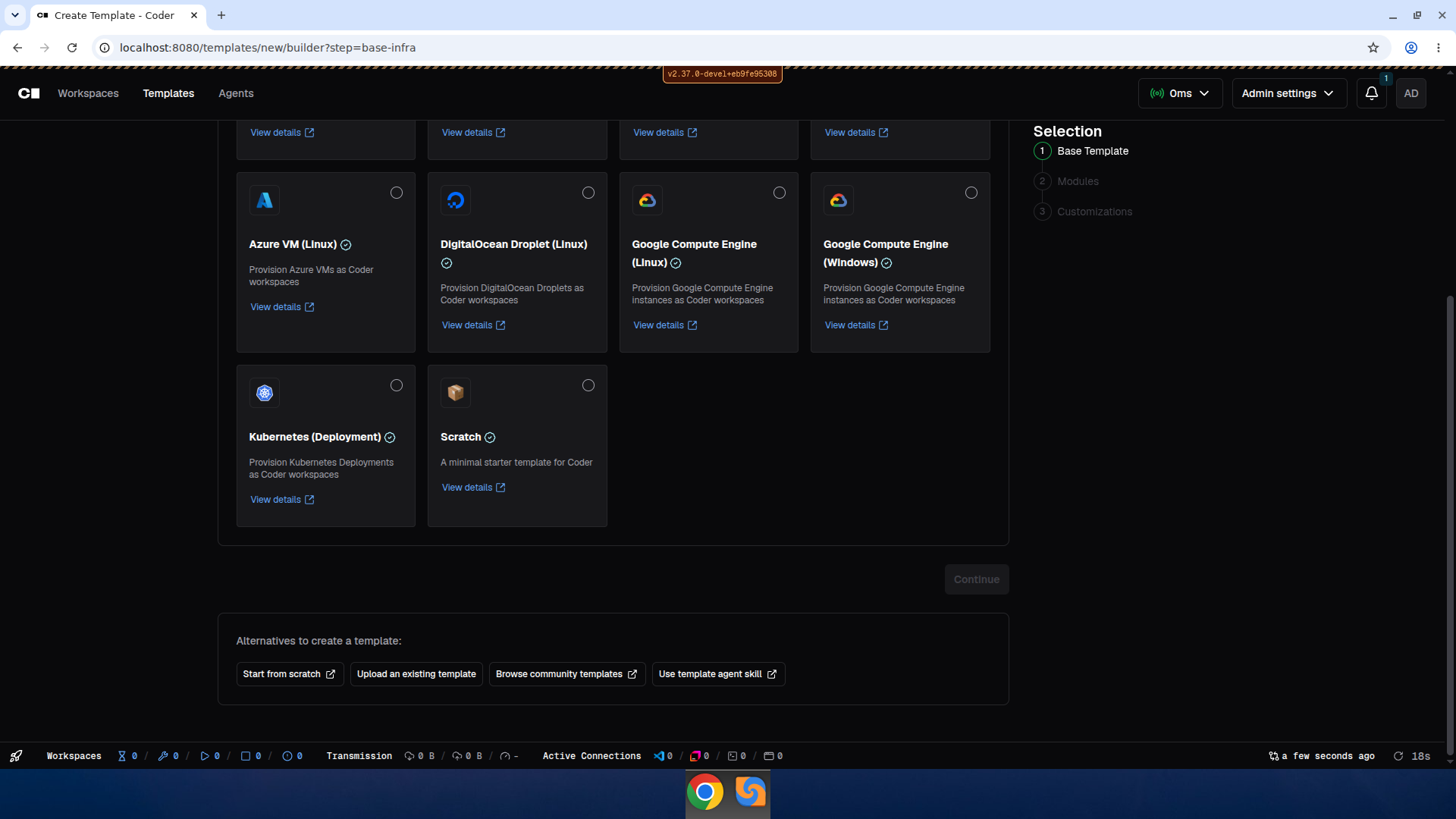
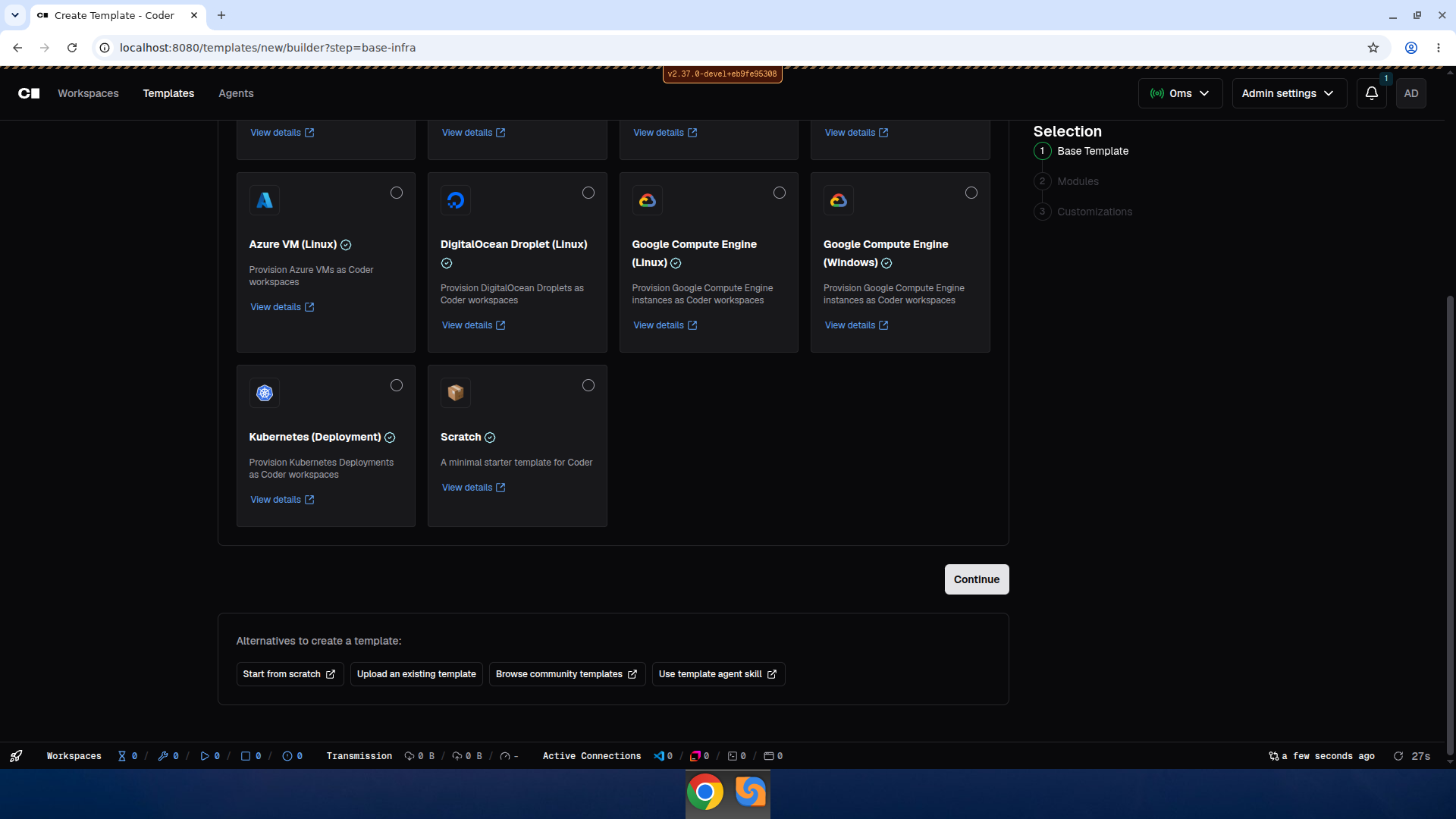
Base template step (`?step=base-infra`), no base selected:
| Before (Continue disabled) | After (Continue enabled) | After
(validation error on click) |
|---|---|---|
|
| 
| 
|
Module settings step (`?step=module-settings`) — required field outlined
in red with the 12px message on Continue:
## Testing
- `pnpm check`, `pnpm lint`, `pnpm lint:types`, `pnpm format` pass.
- Storybook interaction tests pass (`vitest --project=storybook` for the
three step/page stories).
- Verified manually against the running dev app on port 8080.
<details>
<summary>Implementation notes</summary>
Requirement: "for the template builder (`/templates/new/builder`) always
keep the continue button enabled. If the requirements to continue are
not met, show the error in red." Follow-up: "use 12px for the font size
for the error message and highlight the input fields that cause the
error with a red outline if applicable."
Approach:
1. Keep the Continue button always enabled by dropping the `disabled`
prop.
2. Gate navigation in `handleNext`: when `canContinue` is false, set a
local `showContinueError` flag and return instead of navigating.
3. Render a red (`text-content-destructive`), 12px (`text-xs`)
validation message below the nav controls when `showContinueError &&
!canContinue`.
4. Pass `showContinueError` into the step renderers as `showErrors`; the
base-parameters and module-settings steps mark each required-but-empty
field's `field.error`, which `FormField` renders as `aria-invalid` plus
a red border.
5. Clear the flag (and thus the message and outlines) when requirements
become satisfied or on step change, so nothing lingers.
6. Message text is derived per step via `continueErrorMessage(stepId)`.
</details>
---
_This PR was generated by Coder Agents on behalf of @chrifro._
---------
Co-authored-by: Andrew Aquino <dawneraq@gmail.com>









Coder is a self-hosted platform for cloud development environments and AI coding agents. Workspaces are defined with Terraform, connected through a secure Wireguard® tunnel, and automatically shut down when not used. Coder Agents runs a native AI coding agent whose loop executes in the control plane on your infrastructure, with no API keys in workspaces.
- Define cloud development environments in Terraform
- EC2 VMs, Kubernetes Pods, Docker Containers, etc.
- Automatically shutdown idle resources to save on costs
- Onboard developers in seconds instead of days
- Delegate coding work to AI agents on your infrastructure
- Bring any model (Anthropic, OpenAI, Google, Bedrock, self-hosted)
- No LLM credentials in workspaces, user identity on every action
- Centralized model governance, cost tracking, and audit logging

Quickstart
Check out our install guides for other methods and a complete tutorial.
Try Coder with the install script on Linux and macOS, or grab the latest binary or installer from GitHub Releases on Windows:
curl -L https://coder.com/install.sh | sh
Start the server and open http://localhost:3000 to create your initial user, create a Docker template, and provision your first workspace:
coder server
For a production deployment, add a PostgreSQL database (version 13 or later) and an external access URL, and see our validated architectures for sizing and infrastructure guidance:
coder server --postgres-url <url> --access-url <url>
Without these flags, Coder uses a built-in database and sets up a *.try.coder.app access URL for evaluation. Use coder --help for the full list of flags and environment variables.
Documentation
Browse the documentation or visit a specific section below:
- Workspaces: Workspaces contain the IDEs, dependencies, and configuration information needed for software development
- Templates: Templates are written in Terraform and describe the infrastructure for workspaces
- Coder Agents: Delegate coding work to AI agents running on your self-hosted infrastructure
- AI Gateway: Centralize authentication, auditing, and cost controls for AI tooling
- Administration: Learn how to operate Coder
- Premium: Learn about paid features built for large teams
- IDEs: Connect your existing editor to a workspace
Support
Open an issue for bugs and feature requests.
For community support, showcasing what you built, and feedback on in-progress features, join our Discord or GitHub Discussions.
Dedicated support is included in Coder Premium. For more information, visit coder.com/pricing.
Integrations
New integrations are always in progress. Open an issue to request one. Contributions are welcome in any official or community repository.
Official
- Coder Registry: Templates, modules, and integrations for common development environments
- Coding Agents: Run agents like Claude Code, Codex, and OpenCode isolated in Coder workspaces
- coderd Terraform Provider: Declaratively manage your Coder deployment configuration as code
- VS Code Extension: Open any Coder workspace in VS Code with a single click
- JetBrains Toolbox Plugin: Open any Coder workspace from JetBrains Toolbox with a single click
- Dev Containers: Build development environments using
devcontainer.jsonon Docker, Kubernetes, and OpenShift - Kubernetes Log Stream: Stream Kubernetes Pod events to the Coder startup logs
- Self-Hosted VS Code Extension Marketplace: A private extension marketplace that works in restricted or airgapped networks integrating with code-server.
- GitHub Actions: An action to set up the Coder CLI in GitHub workflows
Community
- Coder Discord: Chat with the community, get support, and hear about new product updates first
- Community Templates: Community-contributed workspace templates in the Coder Registry
- Community Modules: Community-contributed modules to extend Coder templates
- Coder Template GitHub Action: A GitHub Action that updates Coder templates
- Coder Agents Chat Action: A GitHub Action that starts a Coder Agents chat against a GitHub issue or pull request
Contributing
New contributors are always welcome. If you are new to the Coder codebase, see the contribution guide to get started.
Hiring
Apply on the careers page if you are interested in joining the team.